




IB Maths IA idea · Calculus and optimisation
Where should a screen be mounted? The best viewing angle
Sit too close to a screen and it fills your view badly, sit too far and it shrinks. Somewhere between, there is a best seat, and you can find it exactly.
These ideas are starting points, not an IA to copy. Never copy an idea blindly: make the question, method and analysis your own, and check your plan with your teacher.
The big idea
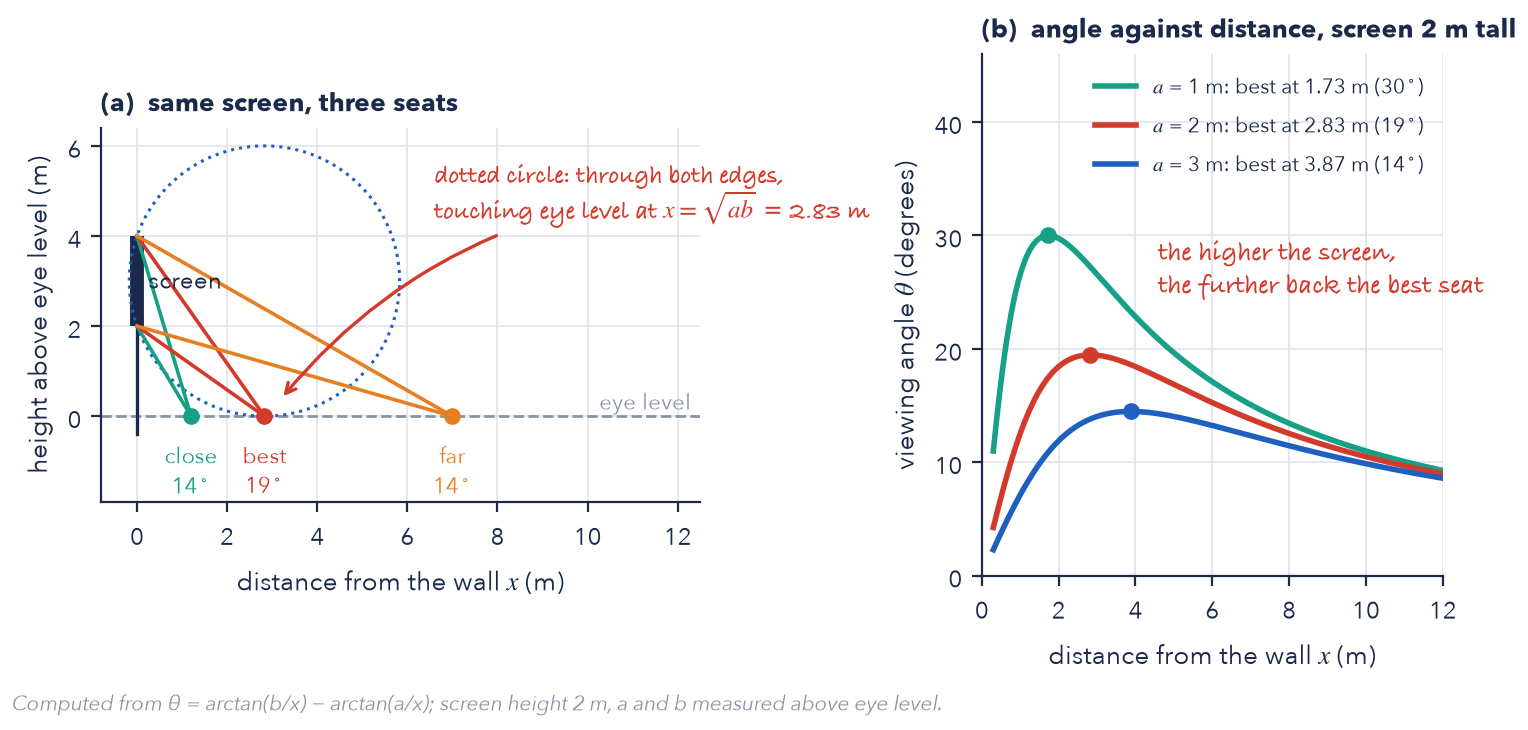
The angle a screen fills in your view depends on how far away you sit. Treat that angle as a function of distance, using the difference of two inverse tangents, and it rises, peaks and falls. Differentiate to find the peak. The method goes back to Regiomontanus in 1471, who asked it about a painting hung above eye level. The best distance turns out to depend on the two edge heights in a surprisingly simple way. A good IA does not stop at one viewer. It asks what a whole room of viewers needs, what neck strain and picture quality add to the choice, and how real measurements compare with the model.
The maths you will use
- Inverse trigonometric functions. Write the angle as , check it with right-angled triangles.
- Differentiation. Differentiate each arctan term with the chain rule and set to get .
- Optimisation. Show the stationary point is a maximum with changing sign or the second derivative, and describe how flat the peak is.
- Sensitivity and graphs. Plot and against the edge heights and describe how they change.
- Weighted cost function. Combine viewing angle with neck tilt in one function of , and find how the weights move the optimum.
- Measurement and error. Measure heights and angles with uncertainty, and compare predicted and measured angles.
Key equations
The maths in action
Example research question
For a screen whose edges are 2 m and 4 m above eye level, at what distance is the viewing angle greatest, and how well does the predicted angle at seats in a real classroom agree with angles measured with a clinometer?
Change the context, the data or the method so the question is yours. Our Maths IA guide shows how to check it.
Check your research question
- Names the screen, its edge heights above eye level and the seating area, with measurements.
- Says exactly what is being optimised: the viewing angle for one viewer, or a combination for many.
- Says how the model will be tested against measurements in a real room.
- States what is left out: screen brightness, glare, resolution, how far the viewer's head moves.
- Is narrow enough for 12 to 20 pages and includes a decision of your own, such as how to weigh comfort against angle.
Which course it fits
- AA SL ideal
- AA HL ideal
- AI SL good
- AI HL ideal
Syllabus links in Maths AA:
- AA 3.2 Right-angled trigonometry, sine and cosine rules
- AA 5.3 Differentiating powers of x
- AA 5.6 Standard derivatives; chain, product and quotient rules
- AA 5.8 Maxima, minima, inflexion and optimisation
- AA 3.9 Reciprocal and inverse trigonometric functions (HL only)
- AA 5.15 Further derivatives and integrals; partial fractions (HL only)
Steps
- Read and predict. Find out what the viewing angle problem is. Before calculating, guess whether the best seat is nearer the wall or further away than where you usually sit.
- Choose the room. Pick a classroom, cinema or living room. Measure the screen edges and the eye height of a seated viewer, and say how you measured.
- Build the angle. Write the angle with inverse tangents, graph it for your screen and read an approximate peak before differentiating.
- Trial run (1 lesson). Measure the angle at two seats with a phone clinometer or a protractor and compare with the formula. Is the method good enough? Fix it now.
- Differentiate. Find the derivative of the arctan terms, set it to zero and solve for the distance. Show it is a maximum.
- Check the formula. Test the best-distance formula against your graph and against a table of values from a spreadsheet.
- Add something of your own. Add several viewers, neck strain or the tilt of the screen. Say what question the extra step answers.
- Go further, with a reason. Move to two variables or to an integral over seats, and compare with the simpler model. HL: this is where the rigour for criterion E comes from.
- Reflect as you go. After every result, write one line on what it means for a real room and what it assumes. These lines become your evaluation.
- Cut, check, then send. Check units everywhere, every graph labelled, every symbol defined once and the conclusion answers your aim. Then send your teacher one draft.
Make it yours
- Many viewers. Model a seating area and find the best mounting height for all the seats together, for example by averaging the angle over the seats.
- Add neck strain. Add a second function for how far a viewer tilts their head, and find the best distance for a weighted sum of the two.
- Tilt and height together. Let the mounting height and the tilt of the screen both vary, and study the viewing quality as a function of two variables.
- Measure a real room. Measure the screen edges and eye heights in a classroom or cinema, then measure the angle at several seats with a phone clinometer.
- Eye level inside the screen. Look at the case where the viewer's eye is level with part of the screen, so one edge is below eye level.
- Whole-seating integral. Replace the sum over seats by an integral over the area, with the viewing angle as the integrand.
HL extension
Treat the mounting height and the tilt as two variables, find the stationary point with partial derivatives, and compare the sum over seats with an integral over the seating area.
The data you need
Measure the edge heights of a screen and the eye height of a seated viewer, then measure the viewing angle at several seats with a phone clinometer or a protractor.
Traps
- Measuring heights from the floor, not from the viewer's eye level, so the formula gives the wrong seat.
- Writing the angle as one arctan of the ratio of heights. It is the difference of two angles, not the angle of a difference.
- Calling the maximum a minimum or never checking which it is.
- Using one viewer's eye height for a room of people of different heights, and not saying so.
- Reporting the best distance to three decimals when the eye height is only known to a few centimetres.
- Forgetting that the formula assumes the viewer's eye is below the bottom edge of the screen.
More Maths IA ideas in Calculus and optimisation
- Cans: the least metal for a given volumeIn the Photon IA Guide
Differentiate once and the textbook 'best can' falls out in a line. Your IA starts where that line stops matching the cans on the shelf.
- Area under a curve: trapezium or Simpson?In the Photon IA Guide
Two methods, one area. Which is closer, by how much, and what does it cost? The evaluation practically writes itself.
- When is the rate of change greatest in real data?In the Photon IA Guide
Real data is jagged, and you cannot differentiate a jagged line. So how do you say when it was changing fastest?
- The lifeguard problem: where should you enter the water?In the Photon IA Guide
You can run faster than you can swim, so the straight line to the swimmer is not the quickest way. Somewhere along the shore there is a best place to enter the water, and the maths for it also describes how light bends.
- Which aperture gives the sharpest photo?Free with an account
Open the aperture wide and the lens blurs the picture. Close it down and diffraction blurs it instead. So there is a best f-number in the middle, and you can find it with calculus and then check it with a camera.
- Vase or bowl: how close can integration get?In the Photon IA Guide
You can pour water into a vase and read its volume. Can you get the same number from a pencil, a ruler and an integral?
- Hanging chains: catenary or parabola?In the Photon IA Guide
A hanging chain looks like a parabola, and Galileo thought it was one. It is not. You will measure how big the difference really is, and when it matters.
- The most efficient wine glass: least glass for the volumeFree with an account
Every glass holds the same drink, but they do not all use the same amount of glass. You are going to look for the bowl shape that needs the least glass for a given volume, and see how far real glasses are from it.
- The fastest slide: straight line, circle or cycloid?In the Photon IA Guide
The straight line is the shortest way down a slide. It is not the fastest. You will build the time of a descent as an integral and find out how much time a curve can save.
Other free Maths IA ideas
- The rule of 72: how good is it, and why 72?
- Setting a price: how to maximise profit from real data
- The birthday problem: how safe are hash codes?
- Walk every bridge once: from Königsberg to your city
- How old is it? Radiocarbon dating and its errors
- Simpson's paradox: when the overall trend lies
- From rally to match: how small edges become big wins
- Day length: how does latitude change the year?
- Bouncing ball: how far does it travel in total?
- Drawing a shape with functions: how close can you get?
- Newton's method: how fast, and when does it fail?