Hand-built revision cheatsheets for IB Physics Higher Level, fully aligned with the new IB Physics syllabus first examined May 2025. Every topic from A1 Kinematics through E5 Fusion & Stars condensed into one printable page each — formulas, derivations, common errors, worked examples, and a per-section exam-attack plan that mirrors the IB mark scheme. The same study sheets Mr Ejaz prints for Photon Academy students before mock exams. Authored by Mr Ejaz Ahmad — IBO-certified, 15+ years of IB Physics tuition in Singapore.
The new IB Physics syllabus (first examined May 2025) is organised into five mandatory themes — Mechanics, Particulate Matter, Wave Behaviour, Fields, and Quantum & Nuclear. Each theme contains 4 or 5 topics — every topic below has its own dedicated cheatsheet covering both SL content and the HL extensions (AHL).
Theme A
Space, Time & Motion (Mechanics)
The opening theme covering all of classical mechanics: kinematics, dynamics (forces & momentum), energy & power, and the HL-only extensions of rigid-body rotation and special relativity. Heavily examined on Papers 1 and 2; A1–A3 form the backbone of Paper 3 problem-solving.
The Particulate Nature of Matter (Thermal & Electricity)
From thermal energy transfers and the greenhouse effect through gas laws, the laws of thermodynamics, and electric circuits. A favourite source of conceptual exam questions on Papers 1 and 2.
From simple harmonic motion through the wave model, wave phenomena (reflection, refraction, diffraction, interference), standing waves on strings and pipes, and the Doppler effect for sound and light. Ideal Paper 1 territory.
Gravitational, electric, and magnetic fields, motion of charged particles in EM fields, and the AHL-only induction topic. The single most heavily examined theme on Paper 3 extended-response questions.
From the structure of the atom and quantum physics through radioactive decay, fission, fusion and stellar evolution. Conceptually rich and historically tested heavily on Paper 1 multiple-choice plus extended Paper 3 problems.
The official IB Physics data booklet is issued at the start of every Paper 1, 2 and 3. It contains every constant, equation and unit conversion allowed in the exam. Each cheatsheet on this hub cross-references it so you can tell at a glance what's given and what must be memorised.
IB Physics HL vs SL vs A-Level Physics vs AP Physics
Singapore IB students often weigh IB Physics HL against A-Level H2 Physics or AP Physics, but the syllabus is set by the IBO. Here is the difference at a glance — pick the row that matches your maths background, university plans, and tolerance for conceptual write-ups.
What makes these IB Physics HL cheatsheets different
There is plenty of free IB Physics content online — much of it written for the OLD syllabus, by non-IB teachers, or formatted poorly. These pages are different in three ways.
Aligned to the new IB syllabus
Every cheatsheet covers the new IB Physics syllabus first examined May 2025 — Themes A through E — with no leftover content from the old options-based curriculum. SL and AHL content is tagged on every section so SL students can read the same page and skip HL-only material.
Mark-scheme aware
Each cheatsheet flags the specific places students lose marks on Papers 1, 2 and 3 — like getting the angle wrong in Φ = BA cos θ, using SUVAT when air resistance breaks constant acceleration, or stating Lenz's law direction without justification. The "TRAPS" boxes mirror IB examiner reports verbatim.
Built for fast revision
Each page is a single scrollable cheatsheet — no clicking through endless sub-pages. Every section has its IB syllabus reference (A.1, B.3, etc.), a "TRICK" tip for shortcut methods, and an exam-attack plan listing exactly which technique to reach for when you see each question type.
Top 5 marks lost in IB Physics HL
The most-dropped marks across the IB Physics HL syllabus
Across thousands of marked Photon Academy mock papers, these five errors account for more lost marks than every other mistake combined. Read them once before you start revising — they alone can lift you a grade.
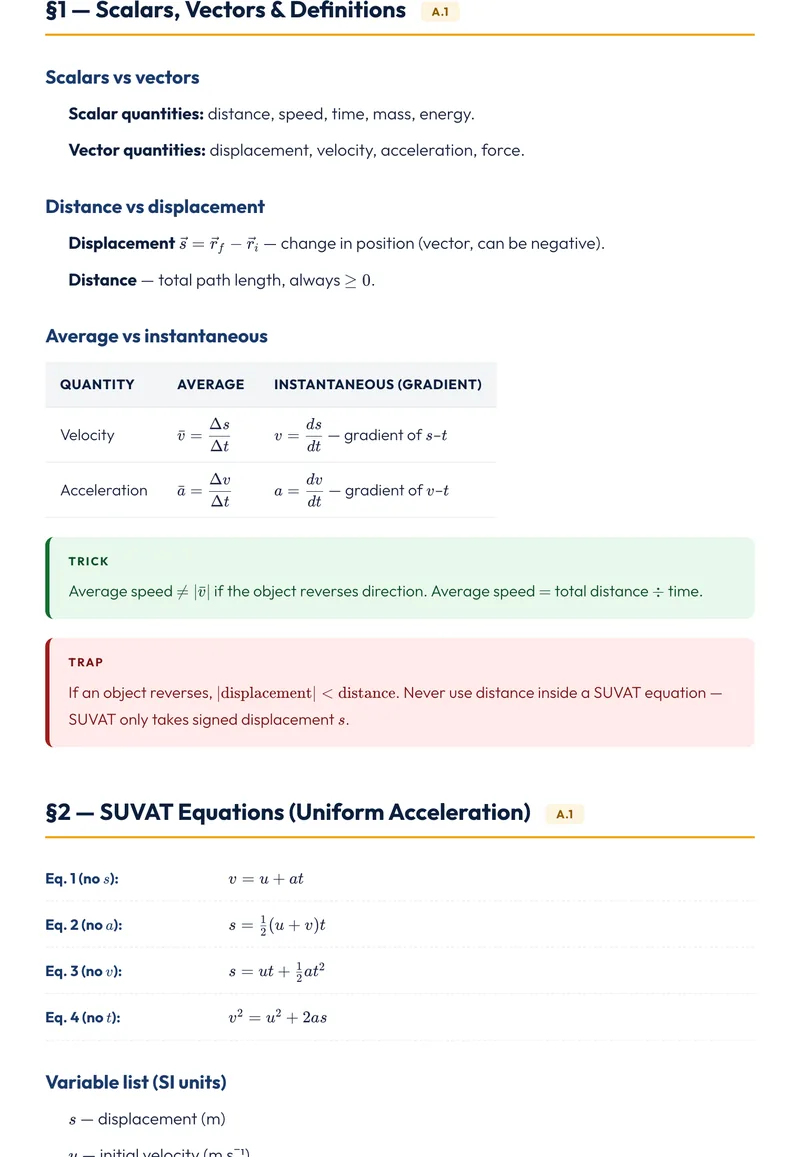
Using SUVAT when acceleration is NOT constant. SUVAT only applies under constant acceleration. The classic trap is free fall WITH air resistance — drag changes the acceleration, so SUVAT no longer applies. Use motion graphs (area under v–t for displacement) or qualitative description instead.
Speed at projectile apex set to zero. Only the vertical component v_y is zero at the apex. The horizontal v_x = u cos θ is unchanged, so the speed at the apex equals u cos θ — never zero. The acceleration at the apex is also still g downward, not zero.
Wrong angle in Φ = BA cos θ. The angle θ is between B and the NORMAL to the surface, not between B and the surface itself. If a question says "the field makes an angle α with the surface", then θ = 90° − α and Φ = BA sin α. This single misread costs the question.
Magnetic force claimed to change kinetic energy. The magnetic force is always perpendicular to v, so it does no work. Speed and KE remain constant; only direction changes. Any answer that shows speed changing in a B-field is automatically wrong.
Lenz's law direction stated without justification. Just writing "the current flows clockwise" earns zero marks. You must explain WHY: identify which way the flux is changing, then state that the induced current opposes that change, then apply the right-hand rule. The IB always wants the chain of reasoning, not just the answer.
Revision Strategy
How top IB Physics HL students revise
From Photon Academy's 7-graders, here is the exact revision sequence we coach. Follow it topic by topic for the 4–8 weeks before mock or final exams.
1. Open the data booklet
Always have the official IB Physics data booklet open while you revise. Cross-reference every formula and constant in each cheatsheet — the booklet contains a lot, but a few results (Wien's constant value, certain projectile derivations, the empirical 68/95/99.7 rule) are NOT included and must be memorised.
2. Read the TRAPS first
Skim the red "TRAP" boxes in every section before reading anything else. These are the marks examiners report being lost on year after year — getting the angle wrong in Φ = BA cos θ, mislabelling proper time, etc. Knowing them up front stops you making the same errors in your next mock.
3. Drill past papers by syllabus reference
Find one past-paper question per topic on the same syllabus reference (e.g. A.1 for kinematics, D.4 for induction). For Paper 3 prep, focus drilling on Theme A (mechanics-energy fusion problems), Theme D (gravitational and induction extended problems), and Theme E (binding energy & stellar physics).
FAQ
IB Physics HL frequently asked questions
A few questions IB students and parents in Singapore often ask about IB Physics HL and the new syllabus.
What is the new IB Physics HL syllabus?
The new IB Physics syllabus was first examined in May 2025. It reorganises the old 12-option topic structure into five mandatory themes — A: Space, Time & Motion; B: Particulate Matter; C: Wave Behaviour; D: Fields; E: Nuclear & Quantum — with no more options. Higher Level students cover all 24 sub-topics including extension content like rigid body mechanics, special relativity, induction, mass spectrometers, and stellar evolution.
How hard is IB Physics HL compared to A-Level Physics or AP Physics?
IB Physics HL is one of the most demanding pre-university physics courses, broader than Singapore A-Level H2 Physics (more relativity, more astrophysics, more rigid-body work) and similar in depth to AP Physics C with stronger conceptual write-up requirements. The grade boundary for a 7 typically sits around 70–75% of the total marks, and Photon Academy IB Physics HL students consistently achieve 6 or 7 with focused mark-scheme practice.
What is the difference between IB Physics HL and SL?
SL covers Themes A–E at a foundational level and skips the AHL extension content within each theme. HL adds AHL sub-topics like rigid body mechanics (A4), relativity (A5), advanced wave phenomena (single slits, gratings), induction (D4), Bohr model derivations, and binding-energy curves. HL also adds Paper 3, a calculator-allowed extended-response paper exclusive to HL students. Each cheatsheet on this hub flags "SL" or "AHL" tags so SL students can read the same page and skip the HL-only sections.
Which topics are most heavily tested on IB Physics HL Paper 3?
Paper 3 (HL only, 75 minutes, 45 marks) tests extended problem-solving and data analysis. The most heavily examined topic areas are Mechanics (A1–A3 mechanics-and-energy fusion problems), Fields (D1–D4 — especially gravitational and induction extended problems), and Quantum/Nuclear (E1–E5 binding energy, fission, and stellar physics). Each topic page on this hub flags which Paper 3 themes a topic feeds into.
Is the IB Physics HL data booklet allowed in all three papers?
Yes — the IB Physics Data Booklet is available in all three papers (P1, P2, P3). It contains every constant, equation, and unit conversion you need. However, several frequently-tested results are NOT in the booklet and must be memorised: Wien's displacement law constant (2.9 × 10⁻³ m K), the binding-energy formula derivation, certain SUVAT-derived expressions for projectile range, and the empirical 68/95/99.7 rule. Each cheatsheet on this hub flags non-booklet results explicitly.
How do top IB Physics HL students revise these topics?
The most effective revision sequence used by Photon Academy 7-graders: (1) read the cheatsheet end-to-end to refresh formulas and definitions; (2) study the TRAPS in red — these are the marks examiners report being lost on year after year; (3) attempt the worked example covered up; (4) attempt 5–10 IB-style past-paper questions on the same syllabus reference; (5) re-read the exam-attack plan. For Paper 3, focus drilling on Mechanics, Fields and Nuclear extended problems.
Want the full IB Physics HL library?
The cheatsheets above are free for everyone. Photon Academy students unlock the full library for each topic — the printable PDF cheatsheet, a 40-page Notes booklet, the IB-style Tutorial booklet, full mark-scheme-style Tutorial Solutions with M1/A1/R1 annotations, and Practice Solutions for past-paper-style problems. Enrolled students get free access; non-students can subscribe.
Want it taught live? Small-group IB Physics tuition with Mr Ejaz includes the full library free — new 2025 syllabus, examiner insight, and real exam technique.