




IB Maths IA idea · Sport and games
From rally to match: how small edges become big wins
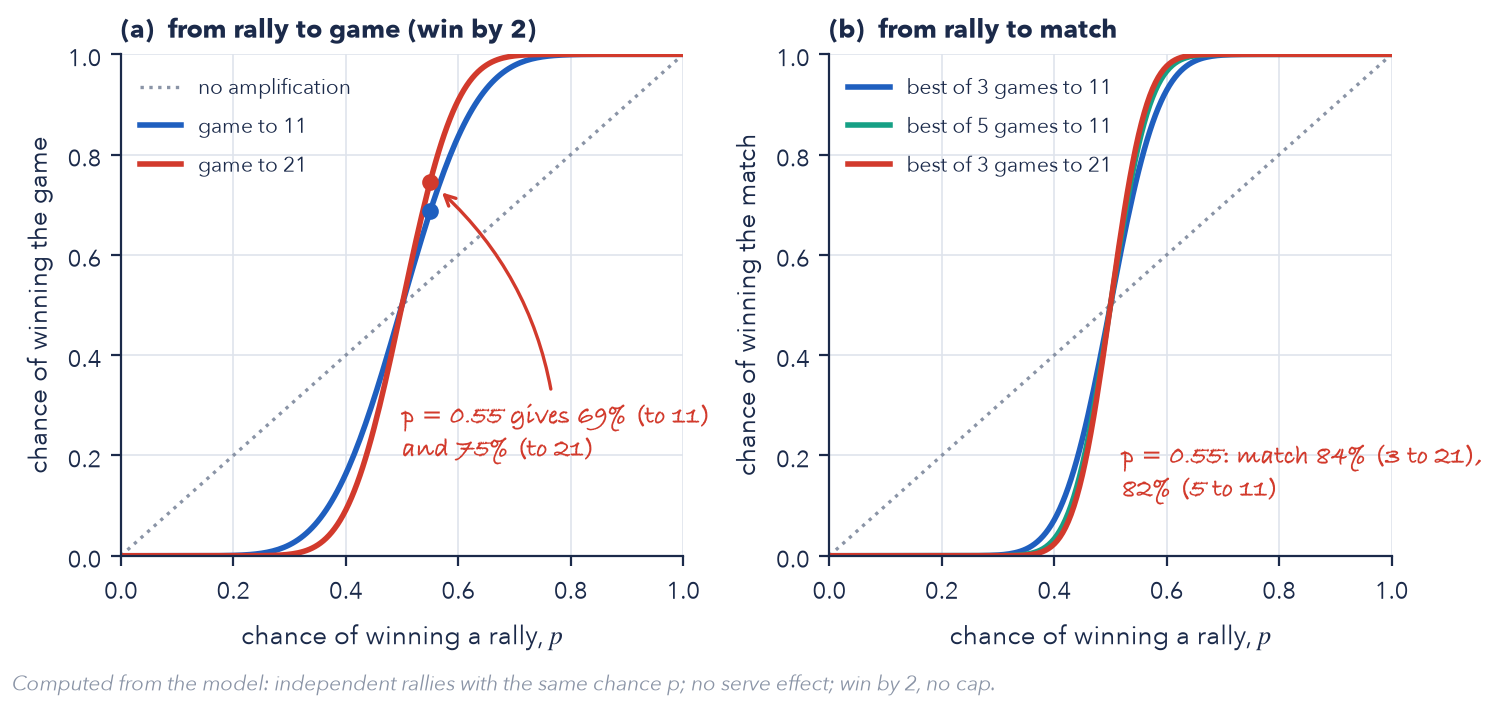
Win 55% of the rallies and you would expect to win about 55% of the games. You will not. You are going to find out how far off that guess is.
These ideas are starting points, not an IA to copy. Never copy an idea blindly: make the question, method and analysis your own, and check your plan with your teacher.
The big idea
A match is built from games, and a game is built from rallies. If you win each rally with the same chance p, the chance of winning a game to 11 is a sum of binomial-type terms, plus a tail for the stage where both players reach 10 points and must win by two. That tail is a geometric series, and it sums to a neat expression. Then a match is built from games the same way. The derivative at p = 0.5 tells you how strongly each stage amplifies a small edge. The formulas are the easy part. Say whether rallies are really independent with the same p, test the model against real scores or a simulation, and compare sports with different scoring rules.
The maths you will use
- Binomial and negative-binomial counting. Count the ways to win 11 points before the opponent reaches 10: for .
- Geometric series. Sum the chances of winning from deuce: , giving .
- Composition of functions. Build the match chance as , with for best of three.
- Differentiation. Find and as amplification factors; use the chain rule for .
- Simulation. Simulate games with a random number generator and compare proportions with the formula, with a stated error.
Key equations
The maths in action
Example research question
For a table-tennis game to 11 (win by two), how does the chance of winning a game and a best-of-five match depend on the chance of winning a rally, and how well does the model, checked by simulation, predict the results of real matches in one league?
Change the context, the data or the method so the question is yours. Our Maths IA guide shows how to check it.
Check your research question
- Names the sport and its scoring rules: points to win, win-by-two, a cap, and the number of games in a match.
- Says what is assumed about rallies (independent, the same chance) and how that will be tested.
- Names what is calculated: game chance, match chance, amplification, or the chance needed for a given result.
- Says how the formula is checked: simulation, real scores, or both.
- Goes beyond a table of results by deriving a formula or comparing two rule sets.
Which course it fits
- AA SL good
- AA HL ideal
- AI SL good
- AI HL ideal
Syllabus links in Maths AA:
- AA 1.3 Geometric sequences and series
- AA 1.8 Infinite geometric series
- AA 1.9 Binomial theorem
- AA 4.5 Basic probability and expected frequency
- AA 4.8 Binomial distribution
- AA 5.6 Standard derivatives; chain, product and quotient rules
Steps
- Read and predict. Find the scoring rules of your sport. Before calculating, guess the chance of winning a game if you win 55% of the rallies.
- Fix the rules. Write down points to win, win-by-two, any cap, and games per match. Say which sport uses which rules.
- Count the ways. Work out the chance of winning to 11 with the opponent on 0, 1, ... 9, and add them up. Check small cases by listing.
- Trial run (1 lesson). Simulate 1,000 games in a spreadsheet or Python. Does the result match your first formula? Fix any mismatch now.
- Solve the deuce stage. Find the chance of winning from 10-10 and add it into the game formula. Check it against the simulation.
- Build the match. Use the game chance to find the match chance for your format, and graph all three levels against p.
- Test on real scores. Estimate a rally chance from real scores and compare the predicted and the actual game and match results.
- Go further, with a reason. Differentiate at p = 0.5, or compare two rule sets. HL: this is where the rigour for criterion E comes from.
- Reflect as you go. After each result, write one line on what it means for a real player and what it assumes. These lines become your evaluation.
- Cut, check, then send. Check every symbol is defined, the simulation agrees with the formula and the conclusion answers your aim. Then send your teacher one draft.
Make it yours
- Game to 11 against game to 21. Compute the chance of winning a game under both scoring lengths for the same rally chance.
- The deuce stage. Find the chance of winning from 10-10 when you must win by two points.
- Amplification factor. Differentiate the game and match win chances with respect to p at p = 0.5.
- Simulate it. Simulate thousands of games and matches and compare the results with the formulas.
- Test on real scores. Use scores from a league or tournament to estimate a rally chance for each player, then predict match results.
- Change the rules. Compare traditional and rally scoring, a point cap, or first to 15 against first to 11.
HL extension
Derive the game formula including the win-by-two stage in closed form, differentiate at by the chain rule, and model the serve advantage with two rally chances, comparing with real scores.
The data you need
Simulation for checking the formulas, plus real scores from your own matches or a published league or tournament to estimate a rally chance and test the predictions.
Traps
- Assuming the chance of winning a rally is the same for the server and the receiver. In many sports it is not.
- Forgetting the win-by-two rule, or applying it from the start instead of from the tied score.
- Using the 21-point formula for badminton without saying that the real game stops at 30.
- Applying the model to pickleball's traditional side-out scoring, where only the server can score.
- Simulating a few hundred games and calling the formula confirmed.
- A simulation that has the same mistake as the formula: check one case by hand.
More Maths IA ideas in Sport and games
- Rating players: how does the Elo system work?In the Photon IA Guide
A rating is a number that says how likely you are to win. Every game nudges it up or down. How does one formula keep track of a whole league's strength?
- Hot streaks: is a player streaky or just luck?In the Photon IA Guide
Commentators say a player is "on fire". You're going to ask whether that is real or just what randomness looks like, and let a p-value settle the argument.
- Best throwing angle when landing height differsIn the Photon IA Guide
Everyone knows the best angle for a long throw. But the pitch is rarely flat: shot put, free throw, throwing off a wall. So does the rule survive?
- Archery: what angle hits the gold?Free with an account
An archer aims at the inner gold ring, 12 centimetres across, 70 metres away, and the arrow leaves the bow pointing only a few degrees above the horizontal. How much can that angle wobble before the arrow misses?
- Netball and basketball: which shot is most forgiving?Free with an account
Every coach says shoot with more arc. A steeper shot has a bigger hole to aim at, but it needs more speed. So where does the best angle really sit?
- Penalty kicks: where should you shoot?In the Photon IA Guide
A penalty is over in less than a second, so the keeper has to move before seeing the ball. If the kicker always shoots to one side, the keeper learns it. So how often should each of them go left?
- Tie-breaks: do league rules change who wins?In the Photon IA Guide
Two teams finish on the same points. Who lifts the trophy? You're going to find out whether the tie-break rule quietly decides the league.
Other free Maths IA ideas
- The rule of 72: how good is it, and why 72?
- Setting a price: how to maximise profit from real data
- The birthday problem: how safe are hash codes?
- Walk every bridge once: from Königsberg to your city
- Where should a screen be mounted? The best viewing angle
- How old is it? Radiocarbon dating and its errors
- Simpson's paradox: when the overall trend lies
- Day length: how does latitude change the year?
- Bouncing ball: how far does it travel in total?
- Drawing a shape with functions: how close can you get?
- Newton's method: how fast, and when does it fail?