




IB Maths IA idea · Numbers, algorithms and computing
Newton's method: how fast does it converge, and when does it fail?
Your calculator finds roots in a blink. Newton's method is the idea inside. You're going to test how fast it works, and then go looking for the starting point where it breaks.
These ideas are starting points, not an IA to copy. Never copy an idea blindly: make the question, method and analysis your own, and check your plan with your teacher.
The big idea
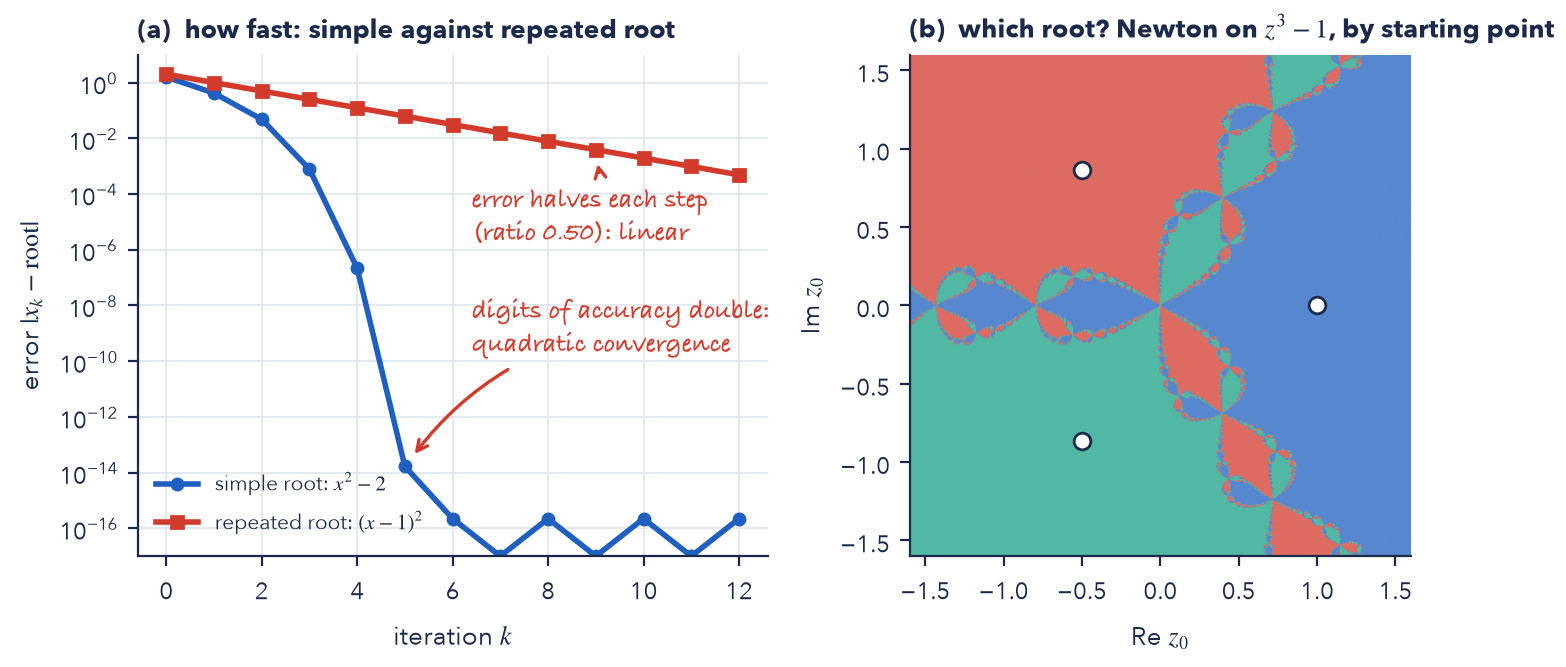
Newton's method replaces a curve by its tangent, again and again. It is in neither course, so you derive it from the tangent line yourself. Does it behave the same near a simple root and a repeated root? Predict first, then measure the convergence rate and explain it with calculus. Then look for the starting points that fail: cycles, divergence, a jump to a far root. A strong IA connects the numbers to a justified argument. At HL, running iterations and describing them is not HL-level use of mathematics: you need a derivation (Taylor's theorem), a proof, or a link to complex numbers.
The maths you will use
- Tangent line as a model. Derive from the tangent line to meeting the axis.
- Order of convergence. Compute errors and estimate from against , or fit .
- Taylor expansion. Expand about the root to prove for a simple root.
- Repeated roots. Show gives , so convergence is only linear.
- Failure analysis. Find starting points that cycle, diverge or jump to a far root by following iterates, and describe them with algebra.
Key equations
The maths in action
Example research question
How does the speed of Newton's method change between a simple and a repeated root, measured by the order of convergence from computed errors and by a derivation from Taylor's theorem, and for which starting points does it fail on ?
Change the context, the data or the method so the question is yours. Our Maths IA guide shows how to check it.
Check your research question
- Names the function(s) and the roots you will study, and says why you chose them.
- Says what you will measure: the number of iterations, the size of the error, or the order of convergence (and how you will define it).
- Says what 'fails' means: no convergence, a cycle, or convergence to the wrong root.
- Includes a way to justify the behaviour with calculus, not only to observe it.
- Is narrow enough for 12 to 20 pages: two or three functions done in depth, not ten done quickly.
Which course it fits
- AA SL good
- AA HL ideal
- AI SL stretch
- AI HL good
Syllabus links in Maths AA:
- AA 5.4 Tangents and normals
- AA 5.6 Standard derivatives; chain, product and quotient rules
- AA 2.10 Solving equations graphically and analytically
- AA 5.12 Continuity, differentiability, first principles (HL only)
- AA 5.13 Limits with l'Hopital's rule or Maclaurin series (HL only)
- AA 1.12 Complex numbers in Cartesian form (HL only)
Steps
- Read and predict. Read how Newton's method is derived. Before running anything, predict how the error should behave near a root, and whether it should matter if the root is repeated.
- Trial run (1 lesson). Run five steps on a simple equation by hand and in a spreadsheet or program. Check that they agree and that you can control the number of digits shown.
- Choose functions and roots. Pick two or three functions with different roots (simple, repeated, close together). Say why each earns its place.
- Collect convergence data. Record the error at each step, with a true root found independently. Decide how many digits you keep and say why.
- Find the rate. Look for a pattern in the errors. Write down the claim you are testing before you fit anything.
- Explain with calculus. Use a Taylor expansion or another justified argument to explain your observed rate. If a step needs an assumption, state it.
- Search for failures. Choose starting values systematically, not randomly. Classify what you find, and explain each type using the derivative.
- Compare or extend. Try a second method or map which start finds which root. Decide what you will use as a fair comparison.
- Reflect. Which assumptions did the computer hide? What changed in your plan after your first surprising result?
- Write, cut, check. Write in the layout order. Show one worked iteration and put the rest in tables. Run the checklist, then get your question checked before your teacher's draft.
Make it yours
- Simple root against repeated root. Run the method on functions with the same root but different multiplicity.
- Derive the rate. Use a Taylor expansion about the root to show how the next error depends on the current one.
- Hunt for failure. Search systematically for starting values that cycle, diverge or land on a different root.
- Map the basins. For a function with several roots, colour each start by the root it finds. On the real line first; at HL, in the complex plane for − 1.
- Compare with other methods. Run bisection, the secant method and Newton on the same equations and count the steps and the function evaluations.
- Change the context. How a calculator finds square roots, or an old method for cube roots.
HL extension
Prove quadratic convergence for a simple root with Taylor's theorem, find the exact constant, show how a repeated root changes the rate, and connect the failure regions of to complex numbers and symmetry.
The data you need
Run the iteration in a spreadsheet or program for chosen functions and starting points and record the errors at each step.
Traps
- Quoting the Newton formula without deriving it from the tangent line.
- Calling the convergence 'fast' without a measure: an error table or a rate, not an impression.
- Trusting the software when the derivative is zero or nearly zero at the start. Say what happens.
- At HL, staying with iteration tables and graphs. Without a derivation or a proof, criterion E stays in the middle band.
- Rounding the iterates early, so the errors that you study are rounding errors.
- Choosing only friendly functions, such as a square root. A method that never fails is not much of an exploration.
- A list of failure cases with no reasons.
More Maths IA ideas in Numbers, algorithms and computing
- Number bases: which base stores information best?Free with an account
Computers use base 2. We use base 10. Babylonians used base 60. Which one is best? You're going to find that the answer depends on what you count as cost.
- Coin change: how fast does the count of ways grow?Free with an account
How many ways can you pay 50 cents? By hand it is easy, then hopeless. You're going to build a machine that counts for you, then ask how fast the count explodes.
- Chords in a circle: which formula counts the regions?In the Photon IA Guide
Join points on a circle and count the regions. 1, 2, 4, 8, 16... you think you know what comes next. Draw one more point and check.
- Check digits: how do barcodes catch mistakes?In the Photon IA Guide
Every barcode ends in a digit that checks the others. Swap two digits and the scanner usually shouts, but sometimes it stays quiet. You're going to prove exactly when it stays quiet.
- Maclaurin series: how many terms are enough?In the Photon IA Guide
Your calculator never 'knows' the value of sin 0.3. It builds it from a handful of terms. How many does it need, and how do you know?
- Repeating decimals: what is the pattern in the digits?In the Photon IA Guide
1/7 gives 0.142857142857... and then it repeats, forever. Why that block, why 6 digits, and what would 1/13 do? You're going to find out why, not only what.
Other free Maths IA ideas
- The rule of 72: how good is it, and why 72?
- Setting a price: how to maximise profit from real data
- The birthday problem: how safe are hash codes?
- Walk every bridge once: from Königsberg to your city
- Where should a screen be mounted? The best viewing angle
- How old is it? Radiocarbon dating and its errors
- Simpson's paradox: when the overall trend lies
- From rally to match: how small edges become big wins
- Day length: how does latitude change the year?
- Bouncing ball: how far does it travel in total?
- Drawing a shape with functions: how close can you get?