




IB Maths IA idea · Differential equations and change
How old is it? Radiocarbon dating and its errors
A bone is a few thousand years old, or a few tens of thousands. The only clock is a tiny amount of carbon that fades by half every 5,730 years. How accurate is that clock, and where does it stop working?
These ideas are starting points, not an IA to copy. Never copy an idea blindly: make the question, method and analysis your own, and check your plan with your teacher.
The big idea
Living things take in carbon-14 and hold it at a steady level. After death it decays by a fixed fraction each year, so the amount left is an exponential function of time. Measure the fraction left and solve for the age with a logarithm. That is the routine part. The mathematics that matters is about error. A small error in the measured fraction becomes an error in the age, and the derivative tells you how much: for an old sample, little is left to measure, so the same instrument error gives a much larger age error. Add the uncertainty in the half-life itself and the choice between two published values. The marks come from tracing each source of error to the age it produces, then saying honestly when the method stops being useful.
The maths you will use
- Exponential decay. Write and link to the half-life by .
- Logarithms to invert it. Solve for the age and check by substitution.
- Derivative as an error tool. Differentiate with respect to to get and compare a fixed and a relative error.
- Solving for a limit. Solve for the age at which the uncertainty reaches a chosen size .
- Linearising data. Plot against for samples of known age and read from the gradient, with its uncertainty.
Key equations
The maths in action
Example research question
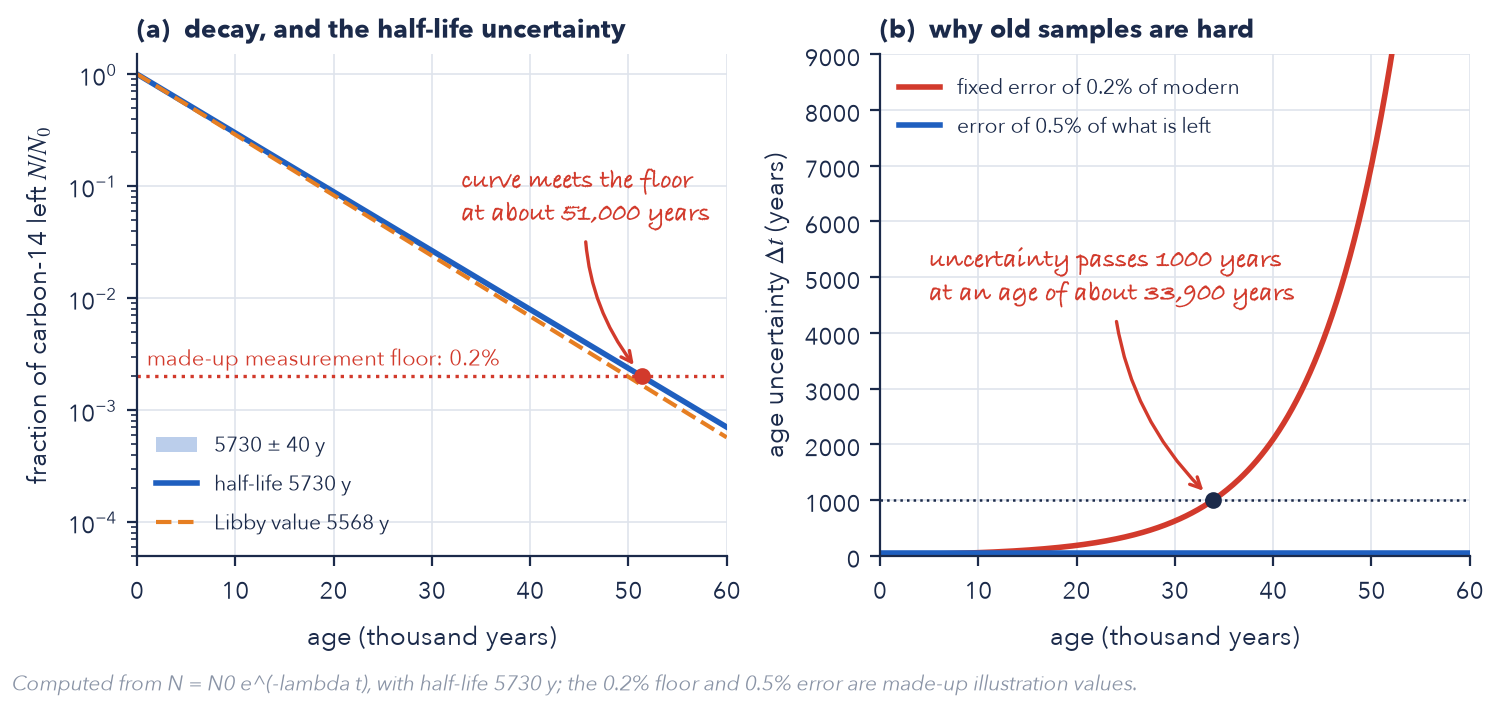
How does the age error of a radiocarbon date grow with the age of the sample when the instrument error is a fixed amount, and at what age does the uncertainty pass 1,000 years for a half-life of 5,730 years?
Change the context, the data or the method so the question is yours. Our Maths IA guide shows how to check it.
Check your research question
- Names the sample or set of samples, real or labelled made-up, and the quantity measured (the fraction of carbon-14 left).
- Names the quantity you will find: an age, an age uncertainty, or the age limit of the method.
- Says how the error is propagated and what kind of measurement error it assumes.
- Goes beyond a calculator: there is a derivation (inverting the decay, a derivative or a limit) and a comparison of two choices.
- States what you leave out: calibration, contamination, and variation in atmospheric carbon-14.
Which course it fits
- AA SL ideal
- AA HL ideal
- AI SL good
- AI HL ideal
Syllabus links in Maths AA:
- AA 1.5 Exponents and an introduction to logarithms
- AA 1.7 Rational exponents and laws of logarithms
- AA 2.9 Exponential and logarithmic functions
- AA 5.1 Limits and the derivative as a rate of change
- AA 5.6 Standard derivatives; chain, product and quotient rules
- AA 5.18 First-order differential equations; Euler's method (HL only)
Steps
- Read and predict. Find out how radiocarbon dating works. Before any calculation, guess how an error of one percent in the measured amount changes the age.
- Choose the samples. Use published measurements, or made-up ones you label as made-up. Note the source and the stated uncertainty of every value.
- Derive the decay and the age. Write N = , link λ to the half-life, and invert it with a logarithm. Define every symbol.
- Trial run (1 lesson). Date three samples with a spreadsheet and check each by substituting the age back. Fix any mismatch now: units, ln against log, half-life against mean life.
- Propagate the error. Differentiate the age with respect to the amount left. Use it for a percentage error and for a fixed error, and compare.
- Find the limit. Solve for the age where the error passes a size you choose. Describe how it moves as the instrument improves.
- Compare half-lives. Redo your ages with a second published half-life. Say which one the published ages use, and why.
- Go further, with a reason. Compare with calibrated ages, or linearise and fit λ from data. HL: this is where the rigour for criterion E comes from.
- Reflect as you go. After every result, write one line on what it means for how far a reader should trust the age and what it assumes. These lines become your evaluation.
- Cut, check, then send. Check every graph has labelled axes with units, every symbol is defined once and the conclusion answers your aim. Then send your teacher one draft.
Make it yours
- Find an age. Take a measured fraction of carbon-14 left, solve N = for t, and check by putting your answer back in.
- Propagate a measurement error. Differentiate the age with respect to the measured amount and use it to turn an error in the amount into an error in the age.
- Find where the method stops. Find the age at which the amount left falls below the smallest amount you could measure, and the age where the age error passes 1,000 years.
- Two half-lives. Date the same sample with 5,730 years and with the older value 5,568 years, and compare.
- Why calibration is needed. Compare ages from the decay formula with calibrated ages for the same samples from a published calibration table.
- Fit decay to data. Use published measurements for samples of known age, linearise with ln, and fit a line to estimate λ.
HL extension
Derive the age and its error from a differential equation , then propagate both the measurement error and the half-life uncertainty together by adding squares, and show which one dominates at each age.
The data you need
Published radiocarbon measurements for a few samples (laboratory reports or a calibration table), or made-up readings clearly labelled.
Traps
- Mixing the half-life and the mean life. λ = ln 2 divided by the half-life, and the units must match your time axis.
- Using log (base 10) where the formula needs ln, or the reverse.
- Treating an age from the decay formula as a calendar date. Radiocarbon ages need calibration to become calendar ages.
- Quoting an age without an uncertainty, or an uncertainty without saying where it comes from.
- Assuming a fixed percentage error at every age. Real instruments have a floor, and that is what limits old samples.
- Claiming the method works for any age. Say where it stops and show the calculation.
More Maths IA ideas in Differential equations and change
- Cooling drinks: does Newton's law of cooling fit?In the Photon IA Guide
Everyone says a hot drink cools exponentially. You're going to test that with real readings, and measure how wrong it is.
- Medicine in the bloodstream: why are doses spaced out?In the Photon IA Guide
Take a tablet every eight hours and the level in your blood does not just repeat. It climbs, then settles. You're going to find the level it settles at, and the longest gap between doses that is still safe and effective.
- Lynx and hares: predator-prey cyclesIn the Photon IA Guide
When hares are plentiful, lynx thrive. When lynx thrive, hares crash. Then the lynx starve and the hares come back. Can two equations produce that endless chase, and what does the maths say about the point where nothing changes?
- Chaos: does a butterfly change the weather?Free with an account
Start two simulated weather systems almost exactly the same. Wait. They stop looking alike. Can you measure how fast they drift apart, and how far ahead any forecast can be trusted?
- Rumour spread: how does the contact rate matter?In the Photon IA Guide
A rumour crosses a school in days; a disease takes weeks. Same maths, different numbers. You're going to build the spread yourself and see what really matters.
- Draining tank: predict the time to emptyIn the Photon IA Guide
Water leaves a tank fast at first and slowly at the end. Can a differential equation tell you exactly when it runs dry?
- Epidemics: does a top-down model match a real outbreak?Free with an account
One model tracks the whole population with three equations. The other follows every person by the rules of chance. Which one better matches a real outbreak, and where do they disagree?
- Pursuit curves: does the chaser ever catch up?In the Photon IA Guide
A chaser always aims at a runner who keeps moving. The path it traces is not a straight line, and not a circle. Does it ever get there?
Other free Maths IA ideas
- The rule of 72: how good is it, and why 72?
- Setting a price: how to maximise profit from real data
- The birthday problem: how safe are hash codes?
- Walk every bridge once: from Königsberg to your city
- Where should a screen be mounted? The best viewing angle
- Simpson's paradox: when the overall trend lies
- From rally to match: how small edges become big wins
- Day length: how does latitude change the year?
- Bouncing ball: how far does it travel in total?
- Drawing a shape with functions: how close can you get?
- Newton's method: how fast, and when does it fail?