




IB Maths IA idea · Money and personal finance
The rule of 72: how good is it, and why 72?
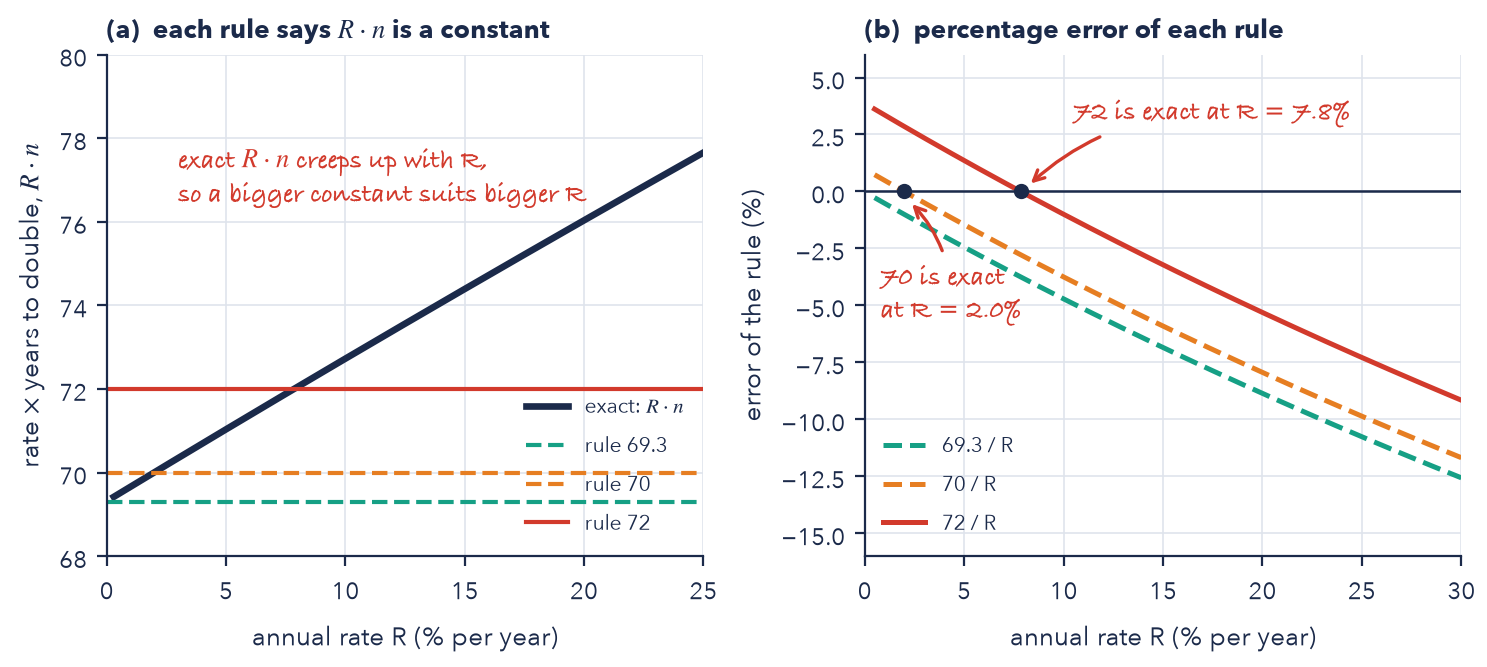
Divide 72 by the interest rate and you get the years to double your money. It's off by under 1% at 8%, and by about 13% at 40%. You're going to find where it works and why 72 was chosen.
These ideas are starting points, not an IA to copy. Never copy an idea blindly: make the question, method and analysis your own, and check your plan with your teacher.
The big idea
Doubling time n solves (1 + r)ⁿ = 2, so n = ln 2 / ln(1 + r), an exact formula that a logarithm gives you straight away. The rule of 72 replaces it with 72 divided by the rate in percent. Why does that work at all? Write ln(1 + r) as a series: for a small rate it is close to r, which gives 69.3 divided by the rate, and the next term explains why a slightly bigger number such as 72 does better in practice. The calculation is short. The marks come from measuring the error, saying where each rule is best and why, and testing the rules on rates you found for yourself.
The maths you will use
- Exponential equation and logarithms. Solve exactly for , and give the doubling time as a function of the rate.
- Percentage error. Define the error of each rule against the exact time and graph it against the rate; find where it is zero.
- Maclaurin series. Expand and keep two or three terms to show , so a bigger constant fits larger rates.
- Continuous compounding. Show that gives exactly, and compare with yearly compounding.
- Solving numerically. Find the rates where each rule is exact with a GDC solver or bisection, and report to a stated accuracy.
Key equations
The maths in action
Example research question
How accurate are the rules 69.3, 70 and 72 divided by the annual rate for the doubling time of an investment growing at 1% to 40% a year, why does 72 do best near 8%, and does the same hold for monthly compounding?
Change the context, the data or the method so the question is yours. Our Maths IA guide shows how to check it.
Check your research question
- Names the rules being tested (69.3, 70, 72 or others) and the range of rates, with a reason for the range.
- States how error is measured: percentage error against the exact doubling time, and its sign.
- Says what is derived and not just calculated: the exact formula or the series.
- Includes a test against real rates, or says clearly why none is used.
- States what you leave out: fees, tax, changing rates, compounding other than yearly.
Which course it fits
- AA SL good
- AA HL ideal
- AI SL ideal
- AI HL good
Syllabus links in Maths AA:
- AA 1.4 Compound interest and depreciation
- AA 1.5 Exponents and an introduction to logarithms
- AA 1.7 Rational exponents and laws of logarithms
- AA 2.9 Exponential and logarithmic functions
- AA 5.13 Limits with l'Hopital's rule or Maclaurin series (HL only)
- AA 5.19 Maclaurin series (HL only)
Steps
- Read and predict. Find where the rule of 72 is used. Before any calculation, guess at which rate it is most accurate.
- Fix the model. State the compounding rule (yearly, monthly or continuous) and define every symbol. Say what you mean by doubling.
- Solve exactly. Solve the doubling equation with logarithms and tabulate exact times over your range of rates.
- Trial run (1 lesson). Test 72 ÷ R at five rates by hand and by spreadsheet. Fix any mismatch now: percent against decimal, rounding.
- Find the constants. Expand the logarithm as a series, or study the product of rate and doubling time numerically. Explain 69.3 and the shift towards 72.
- Measure the error. Define percentage error, graph it for each rule and calculate where each rule is exact.
- Test on real rates. Collect published rates and compare the rule and the exact time. Say which rate range your data covers.
- Go further, with a reason. Build a rule for tripling, or for monthly compounding. HL: this is where the rigour for criterion E comes from.
- Reflect as you go. After every result, write one line on what it means for a saver and what it assumes. These lines become your evaluation.
- Cut, check, then send. Check every graph has labelled axes with units, every symbol is defined once and the conclusion answers your aim. Then send your teacher one draft.
Make it yours
- Find the exact doubling time. Solve (1 + r)ⁿ = 2 with logarithms and tabulate n for rates from 1% to 40%.
- Explain the 69.3. Show that continuous compounding doubles in exactly ln 2 divided by the rate, and compare with annual compounding.
- Expand the logarithm. Write ln(1 + r) as a Maclaurin series and keep one, two and three terms.
- Where is each rule best?. Plot the percentage error of 69.3, 70 and 72 against the rate and find where each crosses zero.
- Why 72 and not 70?. Compare the divisors of 72 with those of 70 and 69.3, then the error over common rates.
- Other multiples and real rates. Build a rule for tripling, or for halving a currency's value by inflation. Test it on real published rates.
HL extension
Derive from the Maclaurin series, bound the error of truncation, show why the constant that is best depends on the range of rates, and extend to continuous and monthly compounding.
The data you need
Compute exact times from the model, then test the rules on real savings, loan or inflation rates from published sources.
Traps
- Putting the rate in as 0.08 in one place and 8 in another. State the units of R everywhere.
- Judging a rule by one rate. A rule that is perfect at 8% can be poor at 2% or 20%.
- Calling an error small without a percentage. Half a year matters more at 3 years than at 30.
- Taking the series for ln(1 + r) outside its range. Say when it converges and how many terms you need.
- Mixing continuous and yearly compounding. The constant 69.3 belongs to the continuous case.
- Explaining 72 only by its many divisors. That is convenience, not accuracy; show both.
More Maths IA ideas in Money and personal finance
- Credit cards: how long does the minimum payment take?In the Photon IA Guide
Owe 3,000 on a card at 26% a year, pay only the minimum, and the debt takes nearly 18 years to clear. You're going to find out why it takes so long, and what a slightly bigger payment does to it.
- Loans and savings: when does a plan break even?In the Photon IA Guide
Two loan offers, same amount, different small print. Which is cheaper, and when does the answer flip? You're going to prove it with algebra, not just a calculator.
- Flat rate or effective rate: what does a car loan really cost?In the Photon IA Guide
A lender says 3% a year, flat, for 5 years. The real rate on what you actually owe is closer to 5.6%. You're going to find why the two rates differ, and how to turn one into the other.
- Home loans: where does each payment go?Free with an account
Pay the bank the same amount every month for 25 years, and in year one most of it never touches the loan. You're going to find the month that flips, and what a rate rise does to it.
- Retirement savings: how long will the money last?Free with an account
A fund of 1,000,000 earning 5% a year. Withdraw 50,000 a year and it never runs out. Withdraw 60,000 and it's gone in under 37 years. You're going to find the line between the two, and what inflation does to it.
- Rent or buy: when does buying a home win?In the Photon IA Guide
Buying costs a deposit and fees up front, and then more each year than renting. Yet in the model below it overtakes renting after about 8 years. You're going to find the break-even year, and what moves it.
Other free Maths IA ideas
- Setting a price: how to maximise profit from real data
- The birthday problem: how safe are hash codes?
- Walk every bridge once: from Königsberg to your city
- Where should a screen be mounted? The best viewing angle
- How old is it? Radiocarbon dating and its errors
- Simpson's paradox: when the overall trend lies
- From rally to match: how small edges become big wins
- Day length: how does latitude change the year?
- Bouncing ball: how far does it travel in total?
- Drawing a shape with functions: how close can you get?
- Newton's method: how fast, and when does it fail?