Free worked solutions · 2026 Edition

IB Physics D.2: Electric and magnetic fields worked solutions

Worked solutions to every practice question in D.2: Electric and magnetic fields of Photon Physics: Study Guide for the IB Diploma (SL & HL). Try each question, then compare your working with the full solution.

  • SL & HL
  • 31 questions
  • Full worked solutions
  • Free, no sign-up

Basic practice

Question B1

Type Q1 · Charge transfer / P1A[1 mark]
A positively charged rod is held close to an uncharged metal sphere on an insulating stand. With the rod still in place, the sphere is connected to earth for a moment; the earth connection is then broken and finally the rod is taken away. What is the final charge on the sphere, and how did it arise?
A. negative; electrons flowed from earth onto the sphere
B. positive; electrons flowed from the sphere to earth
C. negative; positive charge flowed from the sphere to earth
D. zero; the rod never touched the sphere
Show solutionHide solution
The positive rod pulls conduction electrons towards the near side of the sphere. While the sphere is earthed, the rod draws extra electrons up from earth (M). Breaking the earth link with the rod still there traps them; when the rod goes, they spread over the sphere, which is left negative. B has the electron flow backwards; in C positive charge cannot move through a metal; D ignores induction: no contact is needed.

Final answer

A
Question B2

Type Q2 · Contact then force / P1A[1 mark]
Two identical small conducting spheres carry charges +5q and -q. At separation r the force between them has size F. The spheres are made to touch and are then put back at separation r. What is the force now?
A. \tfrac45F, attractive   B. \tfrac45F, repulsive
C. \tfrac95F, repulsive   D. \tfrac54F, repulsive
Show solutionHide solution
The total charge +5q-q=+4q is conserved and shared equally: +2q each. Both are now positive, so they repel. The product of the charges goes from 5q^2 to 4q^2: F_{\text{new}}=\tfrac45F. A keeps the old direction; C adds the sizes 5q+q before sharing; D inverts the ratio.

Final answer

B

Question B3

Type Q3 · Force and field / P1A[1 mark]
Two small charged spheres, +40\,\mathrm{nC} and -25\,\mathrm{nC}, have their centres 0.30\,\mathrm{m} apart in air. What is the electric force between them?
A. 3.0\times10^{-5}\,\mathrm{N}, attractive   B. 1.0\times10^{-4}\,\mathrm{N}, attractive
C. 1.0\times10^{-4}\,\mathrm{N}, repulsive   D. 1.0\times10^{14}\,\mathrm{N}, attractive
Show solutionHide solution
Convert to coulombs first: q_1q_2=(40\times10^{-9})(25\times10^{-9})=1.0\times10^{-15}\,\mathrm{C^2}, so the force is 8.99\times10^{9}(1.0\times10^{-15})/0.30^2=1.0\times10^{-4}\,\mathrm{N}; unlike charges attract. A divides by r instead of r^2; C misses the signs; D leaves the charges in nanocoulombs.

Final answer

B

Question B4

Type Q4 · Force scaling / P1A[1 mark]
Two point charges in a vacuum attract each other with a force F. One charge is tripled, their separation is doubled and the space between them is filled with an oil of permittivity 2.0\varepsilon_0. What is the new force?
A. \tfrac32F   B. \tfrac38F   C. \tfrac34F   D. 6F
Show solutionHide solution
F=q_1q_2/(4\pi\varepsilon r^2): the charge factor is 3, the distance factor 1/2^2=1/4 and the medium factor 1/2.0. New force =3\times\tfrac14\times\tfrac12F=\tfrac38F. A uses 1/r; C forgets the oil; D multiplies by the permittivity instead of dividing.

Final answer

B

Question B5

Type F1 · Field definition / P1A[1 mark]
A point charge of -2.0\,\mathrm{\mu C} placed at P experiences an electric force of 8.0\,\mathrm{mN} towards the east. What is the electric field strength at P?
A. 4.0\times10^{3}\,\mathrm{N\,C^{-1}} west   B. 4.0\times10^{3}\,\mathrm{N\,C^{-1}} east
C. 1.6\times10^{-8}\,\mathrm{N\,C^{-1}} west   D. 2.5\times10^{-4}\,\mathrm{N\,C^{-1}} east
Show solutionHide solution
E=F/q=8.0\times10^{-3}/2.0\times10^{-6}=4.0\times10^{3}\,\mathrm{N\,C^{-1}}. The field is defined by the force on a POSITIVE charge; this charge is negative, so the field points opposite to its force: west. C multiplies F by q; D divides q by F.

Final answer

A

Question B6

Type F2 · Point-field ratio / P1A[1 mark]
Point P is 0.10\,\mathrm{m} from an isolated point charge +Q. Point R is 0.30\,\mathrm{m} from a different isolated point charge +3Q. What is \dfrac{\text{field strength at R}}{\text{field strength at P}}?
A. \tfrac19   B. \tfrac13   C. 1   D. 3
Show solutionHide solution
E=kQ/r^2: the source charge is 3 times larger and the distance 3 times larger, so E_R/E_P=3/3^2=\tfrac13. A ignores the larger charge; C uses 1/r; D inverts the ratio.

Final answer

B

Question B7

Type F3 · Field-line pattern / P1A[1 mark]
Point charges +3q and -q are fixed a short distance apart. Which statement about the electric field lines drawn for this pair is correct?
A. The lines start on -q and end on +3q.
B. Three times as many lines leave +3q as end on -q, so some lines go off to a great distance.
C. Lines from the two charges cross at the point midway between them.
D. Between the charges the lines are straight, parallel and equally spaced.
Show solutionHide solution
Lines leave positive charges and end on negative ones (A is reversed), and the number of lines is in proportion to the charge: only a third of the lines from +3q can end on -q; the rest head away. Lines never cross, because the field has one direction at each point (C). Parallel, equally spaced lines belong to the uniform field between plates (D).

Final answer

B

Question B8

Type U1 · Parallel plates / P1A[1 mark]
Two parallel plates 2.5\,\mathrm{cm} apart have a potential difference of 5.0\,\mathrm{kV} between them. An electron is midway between the plates. What is the electric force on it?
A. 3.2\times10^{-14}\,\mathrm{N} towards the positive plate
B. 3.2\times10^{-14}\,\mathrm{N} towards the negative plate
C. 6.4\times10^{-14}\,\mathrm{N} towards the positive plate
D. 3.2\times10^{-17}\,\mathrm{N} towards the positive plate
Show solutionHide solution
E=V/d=5.0\times10^{3}/0.025=2.0\times10^{5}\,\mathrm{V\,m^{-1}} everywhere between the plates, so F=eE=1.6\times10^{-19}(2.0\times10^{5})=3.2\times10^{-14}\,\mathrm{N}; the electron is negative, so it is pulled towards the positive plate. C uses half the gap because the electron is midway; D leaves the p.d. in kilovolts.

Final answer

A

Question B9

Type M1 · Wire pattern / P1A[1 mark]
A long vertical wire carries a steady current upwards. What is the pattern of the magnetic field lines in a horizontal plane, seen from above?
A. clockwise circles centred on the wire
B. anticlockwise circles centred on the wire
C. straight lines pointing radially away from the wire
D. straight lines parallel to the wire
Show solutionHide solution
Seen from above, the current comes up towards you. Right-hand grip: thumb along the current, fingers curl anticlockwise. The lines are circles centred on the wire, never radial (C is the pattern of a point charge).

Final answer

B

Question B10

Type M2 · Magnets and coils / P1A[1 mark]
A flat circular coil faces you. The current in it flows anticlockwise as you see it. In which direction does the magnetic field point at the centre of the coil?
A. towards you   B. away from you
C. anticlockwise around the coil   D. there is no field: the opposite sides cancel
Show solutionHide solution
Curl the fingers of the right hand with the current (anticlockwise); the thumb points out of the coil, towards you. Every part of the loop gives a field in the same direction at the centre, so nothing cancels (D). C describes the current, not the field.

Final answer

A

Question B11

Type U4 · Charge multiples / P1A[1 mark]
In an oil-drop experiment, which value could NOT be the charge measured on a drop?
A. 3.2\times10^{-19}\,\mathrm{C}   B. 4.0\times10^{-19}\,\mathrm{C}
C. 8.0\times10^{-19}\,\mathrm{C}   D. 1.6\times10^{-18}\,\mathrm{C}
Show solutionHide solution
Every free charge is a whole number of elementary charges e=1.60\times10^{-19}\,\mathrm{C}. A is 2e, C is 5e and D is 10e; B would be 2.5e, which no drop can carry.

Final answer

B

Question B12

Type P3 · Potential and work / P1A[1 mark]
An electron moves from a point where the electric potential is +20\,\mathrm{V} to a point where it is +170\,\mathrm{V}. What is the change in its electric potential energy?
A. +150\,\mathrm{eV}   B. -150\,\mathrm{eV}   C. -190\,\mathrm{eV}   D. -2.4\times10^{-17}\,\mathrm{eV}
Show solutionHide solution
\Delta E_p=q\Delta V_e=(-e)(170-20)=-150\,\mathrm{eV}: a negative charge LOSES potential energy as it moves to a higher potential. A drops the electron's sign; C adds the two potentials; D gives the joule value with an eV unit (150\,\mathrm{eV}=2.4\times10^{-17}\,\mathrm{J}).

Final answer

B

Tutorial practice

Question T10

Type P5 · Potential gradient / P1A[1 mark]
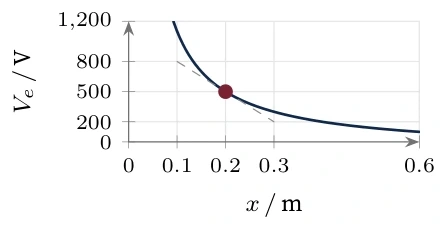
The graph shows how the electric potential V varies with distance x along a line. At x=0.20\,\mathrm{m}, V=500\,\mathrm{V} and the tangent to the curve passes through (0.10\,\mathrm{m},\ 800\,\mathrm{V}) and (0.30\,\mathrm{m},\ 200\,\mathrm{V}). What is the electric field at x=0.20\,\mathrm{m}?
A. 3.0\times10^{3}\,\mathrm{V\,m^{-1}} in the +x direction
B. 3.0\times10^{3}\,\mathrm{V\,m^{-1}} in the -x direction
C. 2.5\times10^{3}\,\mathrm{V\,m^{-1}} in the +x direction
D. 6.0\times10^{2}\,\mathrm{V\,m^{-1}} in the +x direction
Diagram for D.2 question T10
Show solutionHide solution
E=-\Delta V/\Delta x from the tangent: -(200-800)/(0.30-0.10)=+3.0\times10^{3}\,\mathrm{V\,m^{-1}}. The field points the way the potential falls, +x. B drops the minus sign; C divides V by x (a chord from the origin, not the tangent); D uses the change in V alone.

Final answer

A

Question T1

Type Q3 · Force and field; Type F6 · Vector fields / P2[7 marks]
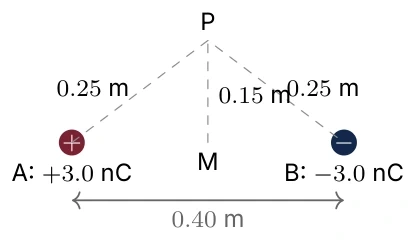
Point charges +3.0\,\mathrm{nC} at A and -3.0\,\mathrm{nC} at B are fixed 0.40\,\mathrm{m} apart. Point P lies on the perpendicular bisector of AB, 0.15\,\mathrm{m} from the midpoint M of AB, so that \text{AP}=\text{BP}=0.25\,\mathrm{m}.
(a) Calculate the size of the force that A exerts on B, and state its direction. [2]
(b) Show that the field at P due to A alone is about 430\,\mathrm{N\,C^{-1}}. [1]
(c) Determine the resultant field at P: its size and the way it points. [3]
(d) A point charge of +1.5\,\mathrm{nC} is placed at P. Calculate the force on it. [1]
Diagram for D.2 question T1
Show solutionHide solution
(a) F=k(3.0\times10^{-9})^2/0.40^2=5.06\times10^{-7}\,\mathrm{N} (A1); unlike charges attract, so the force on B is towards A (A1). (b) E_A=8.99\times10^{9}(3.0\times10^{-9})/0.25^2=431\,\mathrm{N\,C^{-1}} (A1). (c) E_B has the same size; E_A points away from A, E_B towards B (M1). Their components along MP cancel; the components parallel to AB add: 2(431)(0.20/0.25) (M1) =690\,\mathrm{N\,C^{-1}}, parallel to AB from A towards B (A1). (d) F=qE=1.5\times10^{-9}(690)=1.0\times10^{-6}\,\mathrm{N}, along the field (A1).

Final answer

(a) 5.1\times10^{-7}\,\mathrm{N}, towards A (b) 431\,\mathrm{N\,C^{-1}} (c) 6.9\times10^{2}\,\mathrm{N\,C^{-1}}, parallel to AB from A towards B (d) 1.0\times10^{-6}\,\mathrm{N}, parallel to AB towards B

Question T2

Type F7 · Zero-field point; Type F5 · Fields on a line; Type P1 · Potential sum / P2[7 marks]
Point charges of +18\,\mathrm{nC} and +2.0\,\mathrm{nC} are fixed at x=0 and x=0.60\,\mathrm{m} on a straight line.
(a) Explain why the point on the line where the resultant field is zero lies between the charges. [1]
(b) Determine the position of this point. [2]
(c) Calculate the magnitude of the resultant field at x=0.30\,\mathrm{m} and state its direction. [2]
(d) HL: Calculate the electric potential at the point found in (b). [2]
Show solutionHide solution
(a) Between two positive charges each field points away from its own source, so the two fields are opposite and can cancel; outside the pair they point the same way (A1). (b) k(18)/x^2=k(2.0)/(0.60-x)^2 (M1), so x/(0.60-x)=\sqrt{18/2.0}=3 and x=0.45\,\mathrm{m}, nearer the smaller charge (A1). (c) E_{18}=8.99\times10^{9}(18\times10^{-9})/0.30^2=1.80\times10^{3}\,\mathrm{N\,C^{-1}} in +x; E_{2}=8.99\times10^{9}(2.0\times10^{-9})/0.30^2=200\,\mathrm{N\,C^{-1}} in -x (M1); resultant 1.6\times10^{3}\,\mathrm{N\,C^{-1}} in +x (A1). (d) Potentials add as scalars: V=8.99\times10^{9}(18\times10^{-9}/0.45+2.0\times10^{-9}/0.15) (M1) =479\,\mathrm{V} (A1). The field there is zero but the potential is not.

Final answer

(a) only between like charges do the two fields point opposite ways (b) x=0.45\,\mathrm{m} (c) 1.6\times10^{3}\,\mathrm{N\,C^{-1}} in the +x direction (towards the 2.0\,\mathrm{nC} charge) (d) 4.8\times10^{2}\,\mathrm{V}

Question T3

Type F4 · Conductor field / P1A[1 mark]
A hollow metal sphere of radius R holds a charge +Q. Which pair gives the field strengths at a point halfway between the centre and the surface, and just outside the surface?
A. zero; kQ/R^2   B. 4kQ/R^2; kQ/R^2
C. kQ/2R^2; kQ/R^2   D. zero; zero
Show solutionHide solution
The charge sits on the outer surface and the field inside a conductor in equilibrium is zero, cavity included. Just outside, the sphere acts like a point charge Q at its centre: kQ/R^2. B applies the point-charge law inside; C makes the field grow with r as for a charged insulator; D forgets the outside field.

Final answer

A

Question T4

Type U2 · Electric balance; Type Q2 · Contact then force / P2[6 marks]
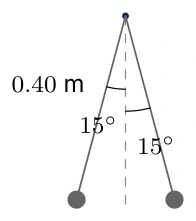
Two identical small conducting spheres, each of mass 0.30\,\mathrm{g}, hang from the same point on insulating threads 0.40\,\mathrm{m} long. One sphere is given a charge; the spheres touch and then come to rest apart, each thread at 15^\circ to the vertical.
(a) Explain why the spheres carry equal charges. [1]
(b) Show that the distance between the centres of the spheres is about 0.21\,\mathrm{m}. [1]
(c) Determine the electric force on each sphere. [2]
(d) Calculate the charge on each sphere and the charge first given to the sphere. [2]
Diagram for D.2 question T4
Show solutionHide solution
(a) Charge flows until both conductors are at the same potential; identical spheres then hold equal shares of the conserved total (A1). (b) r=2(0.40\sin15^\circ)=0.207\,\mathrm{m} (A1). (c) Each sphere is in equilibrium under weight, tension and the horizontal electric force: F=mg\tan15^\circ (M1) =3.0\times10^{-4}(9.8)(0.268)=7.9\times10^{-4}\,\mathrm{N} (A1). (d) q=r\sqrt{F/k}=0.207\sqrt{7.88\times10^{-4}/8.99\times10^{9}}=6.1\times10^{-8}\,\mathrm{C} (A1); the original charge was twice this, 1.2\times10^{-7}\,\mathrm{C} (A1).

Final answer

(a) identical conductors share the total charge equally (b) 0.207\,\mathrm{m} (c) 7.9\times10^{-4}\,\mathrm{N} (d) 61\,\mathrm{nC} each; 0.12\,\mathrm{\mu C}

Question T5

Type U3 · Millikan drops / P2[6 marks]
An oil drop of radius 1.2\,\mathrm{\mu m} and density 880\,\mathrm{kg\,m^{-3}} is held at rest between two horizontal plates 6.0\,\mathrm{mm} apart when the potential difference between them is 468\,\mathrm{V} and the upper plate is positive. Upthrust from the air is negligible.
(a) Calculate the weight of the drop. [2]
(b) Determine the charge on the drop as a multiple of e, and state its sign. [2]
(c) The drop picks up one more electron. Determine its acceleration at that moment. [2]
Show solutionHide solution
(a) m=\tfrac43\pi(1.2\times10^{-6})^3(880)=6.37\times10^{-15}\,\mathrm{kg} (M1); W=mg=6.24\times10^{-14}\,\mathrm{N} (A1). (b) qV/d=mg, so q=mgd/V=6.24\times10^{-14}(6.0\times10^{-3})/468=8.0\times10^{-19}\,\mathrm{C}=5.0e (A1). The field points down (upper plate positive) but the force is up: the drop is negative (A1). (c) The electric force is now \tfrac65 of the weight (M1), so the resultant is \tfrac15mg upwards and a=\tfrac15(9.8)=2.0\,\mathrm{m\,s^{-2}} upwards; the drag is zero at that instant because the drop is at rest (A1).

Final answer

(a) 6.2\times10^{-14}\,\mathrm{N} (b) -5e (8.0\times10^{-19}\,\mathrm{C}) (c) 2.0\,\mathrm{m\,s^{-2}} upwards

Question T6

Type M3 · Magnetic sum / P1A[1 mark]
Two long straight wires X and Y are perpendicular to the page. X carries a current out of the page and Y an equal current into the page; X is on the left. Point P is midway between them. Each wire alone would produce a magnetic field of size B at P. What is the resultant field at P?
A. zero   B. 2B, pointing up the page
C. 2B, pointing down the page   D. 2B, pointing from X to Y
Show solutionHide solution
Grip rule for X (current out): anticlockwise circles; at P, to the right of X, the field points up the page. For Y (current in): clockwise circles; at P, to the left of Y, the field also points up. The two add: 2B up. Opposite currents do not mean opposite fields everywhere (A); fields of wires are tangent to circles, never along the line joining the wires (D).

Final answer

B

Question T7

Type Q5 · Field analogy / P2[5 marks]
Two identical small spheres, each of mass 0.50\,\mathrm{kg} and charge +q, are held in empty space far from other bodies.
(a) Show that the ratio of the electric force to the gravitational force between them does not depend on their separation. [2]
(b) Calculate the value of q for which the two forces have equal size. [2]
(c) State one way in which the electric interaction differs from the gravitational interaction. [1]
Show solutionHide solution
(a) F_E/F_G=(kq^2/r^2)/(Gm^2/r^2) (M1) =kq^2/Gm^2: both are inverse-square laws, so r cancels (A1). (b) kq^2=Gm^2 (M1): q=m\sqrt{G/k}=0.50\sqrt{6.67\times10^{-11}/8.99\times10^{9}}=4.3\times10^{-11}\,\mathrm{C} (A1), only about 2.7\times10^{8} electrons' worth. (c) Charges come in two signs, so the electric force can attract or repel; masses only attract (A1).

Final answer

(a) both forces vary as 1/r^2, so r^2 cancels (b) 4.3\times10^{-11}\,\mathrm{C} (c) electric forces can repel; gravity only attracts

Question T8

Type P4 · Equipotentials / P1A[1 mark]
Equipotential surfaces are drawn around an isolated negative point charge, with the same potential difference between neighbouring surfaces. Which description is correct?
A. concentric spheres, equally spaced
B. concentric spheres, further apart further from the charge
C. concentric spheres, closer together further from the charge
D. planes through the charge
Show solutionHide solution
V_e=kQ/r depends only on r, so every equipotential is a sphere centred on the charge, whatever its sign. Equal steps in V_e need ever larger steps in r as the field weakens: the spheres spread out. Equal spacing (A) belongs to a uniform field.

Final answer

B

Question T9

Type P2 · Conductor V; Type P6 · Field-graph area / P2[5 marks]
An isolated metal sphere of radius 0.15\,\mathrm{m} has a potential of +3.0\,\mathrm{kV}.
(a) Calculate the charge on the sphere. [2]
(b) Write down the values of V_e and E at the sphere's centre. [1]
(c) A graph of field strength E against distance r from the centre is drawn for r\ge0.15\,\mathrm{m}. Determine the area under the graph between r=0.15\,\mathrm{m} and r=0.45\,\mathrm{m}, and state what it represents. [2]
Show solutionHide solution
(a) Outside, the sphere acts as a point charge: V=kQ/R (M1), Q=VR/k=3.0\times10^{3}(0.15)/8.99\times10^{9}=5.0\times10^{-8}\,\mathrm{C} (A1). (b) E=0 inside the conductor, so the potential does not change from its surface value: 3.0\,\mathrm{kV}; field zero (A1). (c) The area under E against r is V(0.15)-V(0.45) (M1); V falls as 1/r, so V(0.45)=3.0/3=1.0\,\mathrm{kV} and the area is 2.0\times10^{3}\,\mathrm{V}, a potential difference (A1).

Final answer

(a) 5.0\times10^{-8}\,\mathrm{C} (b) 3.0\,\mathrm{kV}; zero (c) 2.0\times10^{3}\,\mathrm{V}, the potential difference between the two distances

Advanced practice

Question V1

Type F8 · Read field sources; Type F7 · Zero-field point; Type F3 · Field-line pattern / P2[10 marks]
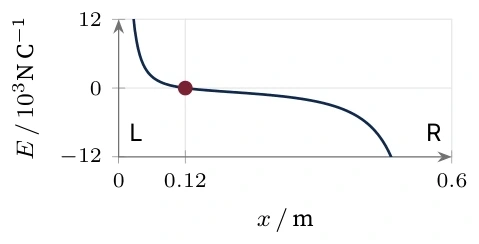
Two point charges L and R are fixed at x=0 and x=0.60\,\mathrm{m}. The graph shows the resultant electric field E between them, taken as positive in the +x direction. Close to L the field is large and positive; it falls, passes through zero at x=0.12\,\mathrm{m}, and becomes large and negative close to R.
(a) Deduce the sign of each charge. [2]
(b) Determine \dfrac{\text{charge of R}}{\text{charge of L}}. [2]
(c) L carries 1.0\,\mathrm{nC}. Calculate E at x=0.060\,\mathrm{m}. [2]
(d) Sketch the electric field lines around the two charges. Mark the point where the field is zero. [2]
(e) A small positive charge is placed at x=0.12\,\mathrm{m} and then pushed a little towards R along the line. Predict its motion, with a reason. [2]
Diagram for D.2 question V1
Show solutionHide solution
(a) Just to the right of L the field points away from L (+x), so L is positive (A1); just to the left of R it points away from R (-x), so R is positive (A1). (b) At the zero the two magnitudes are equal: kQ_L/0.12^2=kQ_R/0.48^2 (M1), Q_R/Q_L=(0.48/0.12)^2=16 (A1); not 4, the distance ratio. (c) E=8.99\times10^{9}(1.0\times10^{-9}/0.060^2-16\times10^{-9}/0.54^2) (M1) =2497-493=2.0\times10^{3}\,\mathrm{N\,C^{-1}} in +x (A1). (d) Lines leave both charges and point outwards, sixteen times as many from R; they bend away from the gap and none joins L to R (A1); the zero point lies between them, much nearer L (A1). (e) Beyond x=0.12\,\mathrm{m} the graph is negative, so the force on a positive charge points back towards 0.12\,\mathrm{m} (M1); it returns, overshoots and oscillates about the zero point along the line (A1).

Final answer

(a) both positive (b) 16 (c) 2.0\times10^{3}\,\mathrm{N\,C^{-1}} in +x (d) lines out of both charges, bending away from each other; zero point 0.12\,\mathrm{m} from L (e) pushed back towards x=0.12\,\mathrm{m}: it oscillates about that point

Question V2

Type U3 · Millikan drops; Type U4 · Charge multiples; Type U2 · Electric balance / P2[9 marks]
In a version of Millikan's experiment, oil of density 920\,\mathrm{kg\,m^{-3}} is sprayed between two horizontal plates 8.0\,\mathrm{mm} apart. The viscosity of the air is 1.8\times10^{-5}\,\mathrm{Pa\,s} and the drag on a drop of radius r falling at speed v is 6\pi\eta rv.
(a) With no potential difference across the plates, one drop falls at a terminal speed of 1.2\times10^{-4}\,\mathrm{m\,s^{-1}}. Show that its radius is about 1.0\,\mathrm{\mu m}. [2]
(b) The same drop is held at rest when the potential difference is 705\,\mathrm{V}. Determine its charge. [3]
(c) Other drops, measured in the same way, carry charges of 6.41, 9.62, 11.2 and 16.0\times10^{-19}\,\mathrm{C}. Explain how these results, with your answer to (b), show that charge is quantised, and deduce the elementary charge. [3]
(d) Taking air's density as 1.2\,\mathrm{kg\,m^{-3}}, show that the upthrust on a drop is too small to neglected. [1]
Show solutionHide solution
(a) At terminal speed the drag balances the weight: 6\pi\eta rv=\tfrac43\pi r^3\rho g (M1), so r=\sqrt{9\eta v/2\rho g}=\sqrt{9(1.8\times10^{-5})(1.2\times10^{-4})/(2(920)(9.8))}=1.04\times10^{-6}\,\mathrm{m} (A1). (b) m=\tfrac43\pi r^3\rho=4.31\times10^{-15}\,\mathrm{kg} (M1); at rest qV/d=mg (M1), q=4.31\times10^{-15}(9.8)(8.0\times10^{-3})/705=4.8\times10^{-19}\,\mathrm{C} (A1). (c) Every charge is close to a whole multiple of one value: 4.80=3(1.60), 6.41=4(1.60), 9.62=6(1.60), 11.2=7(1.60), 16.0=10(1.60)\times10^{-19}\,\mathrm{C} (M1). No charge lies between these steps, and the differences between charges are also multiples of the same value (A1). The largest common factor is e\approx1.60\times10^{-19}\,\mathrm{C} (A1); the smallest measured charge, 4.8\times10^{-19}\,\mathrm{C}, is 3e, not e. (d) Upthrust =\rho_{\text{air}}Vg and weight =\rho_{\text{oil}}Vg; their ratio is 1.2/920\approx0.13\%, far below the precision of the measurements (A1).

Final answer

(a) 1.04\,\mathrm{\mu m} (b) 4.8\times10^{-19}\,\mathrm{C} (c) all are whole multiples (3, 4, 6, 7, 10) of 1.6\times10^{-19}\,\mathrm{C}; e\approx1.60\times10^{-19}\,\mathrm{C} (d) upthrust is about 0.13\% of the weight

Question V3

Type P7 · Energy barrier; Type P3 · Potential and work / P2[7 marks]
A small metal sphere of radius 2.0\,\mathrm{cm} carries a charge of +0.40\,\mathrm{nC} and is fixed in a vacuum. A proton is 0.50\,\mathrm{m} from the centre of the sphere and moving directly towards it at 3.0\times10^{5}\,\mathrm{m\,s^{-1}}.
(a) Calculate the potential at the sphere's surface and at the starting point of the proton. [2]
(b) Determine whether the proton reaches the surface of the sphere. [3]
(c) Calculate the speed of the proton when it reaches the surface. [2]
Show solutionHide solution
(a) V_s=kQ/R=8.99\times10^{9}(0.40\times10^{-9})/0.020=180\,\mathrm{V} (A1); at 0.50\,\mathrm{m}, V=7.2\,\mathrm{V} (A1). (b) Kinetic energy =\tfrac12(1.67\times10^{-27})(3.0\times10^{5})^2=7.52\times10^{-17}\,\mathrm{J}=470\,\mathrm{eV} (M1). The rise in potential energy to the surface is e(180-7.2)=173\,\mathrm{eV}=2.76\times10^{-17}\,\mathrm{J} (M1). The kinetic energy is larger, so the proton reaches the surface (A1). Comparing the voltage 180\,\mathrm{V} with an energy in joules scores nothing. (c) E_k=7.52\times10^{-17}-2.76\times10^{-17}=4.75\times10^{-17}\,\mathrm{J} (M1); v=\sqrt{2E_k/m}=2.4\times10^{5}\,\mathrm{m\,s^{-1}} (A1).

Final answer

(a) 180\,\mathrm{V}; 7.2\,\mathrm{V} (b) yes: it needs 173\,\mathrm{eV} and has 470\,\mathrm{eV} (c) 2.4\times10^{5}\,\mathrm{m\,s^{-1}}

Question V4

Type P8 · Unequal spheres; Type P2 · Conductor V / P2[7 marks]
Metal sphere A, of radius 12\,\mathrm{cm}, is at a potential of +2.4\,\mathrm{kV}. Metal sphere B, of radius 4.0\,\mathrm{cm}, is uncharged and a long way from A. The spheres are then joined by a long thin wire.
(a) Calculate the charge on A before the spheres are joined. [2]
(b) Explain why charge flows along the wire, and state the direction in which electrons flow. [2]
(c) Determine the final charge on each sphere. [2]
(d) Calculate the final potential of the spheres. [1]
Show solutionHide solution
(a) Q=VR/k=2.4\times10^{3}(0.12)/8.99\times10^{9} (M1) =3.2\times10^{-8}\,\mathrm{C} (A1). (b) A is at +2.4\,\mathrm{kV} and B at zero; charge moves until the two potentials are equal (A1). Electrons flow from B to the positive sphere A, leaving B positive (A1). (c) Charge is conserved and the potentials become equal: Q_A/0.12=Q_B/0.040, so Q_A=3Q_B (M1); Q_A=2.4\times10^{-8}\,\mathrm{C} and Q_B=8.0\times10^{-9}\,\mathrm{C} (A1). The larger sphere keeps the larger share; equal shares would leave unequal potentials. (d) V=kQ_B/0.040=1.8\times10^{3}\,\mathrm{V} (A1).

Final answer

(a) 3.2\times10^{-8}\,\mathrm{C} (b) the spheres are at different potentials; electrons flow from B to A (c) A 2.4\times10^{-8}\,\mathrm{C}, B 8.0\times10^{-9}\,\mathrm{C} (d) 1.8\times10^{3}\,\mathrm{V}

Question V5

Type P9 · Energy gradient; Type P3 · Potential and work / P2[7 marks]
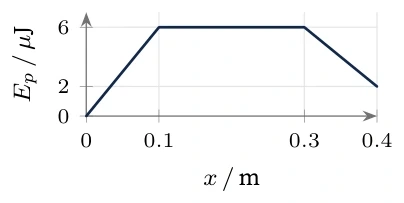
A small bead with a charge of +2.0\,\mathrm{nC} slides without friction along a straight horizontal track. The graph shows its electric potential energy E_p against position x: E_p rises uniformly from 0 at x=0 to 6.0\,\mathrm{\mu J} at x=0.10\,\mathrm{m}, stays at 6.0\,\mathrm{\mu J} up to x=0.30\,\mathrm{m}, then falls uniformly to 2.0\,\mathrm{\mu J} at x=0.40\,\mathrm{m}.
(a) Determine the size and direction of the electric force on the bead in each of the three regions. [3]
(b) Calculate the electric field strength for 0<x<0.10\,\mathrm{m} and the potential difference between x=0 and x=0.10\,\mathrm{m}. [2]
(c) The bead passes x=0 moving in the +x direction with a kinetic energy of 5.0\,\mathrm{\mu J}. Describe its later motion. [2]
Diagram for D.2 question V5
Show solutionHide solution
(a) F=-\Delta E_p/\Delta x (M1): -6.0\times10^{-6}/0.10=-6.0\times10^{-5}\,\mathrm{N}, i.e. 6.0\times10^{-5}\,\mathrm{N} in -x (A1); zero where E_p is constant; +(4.0\times10^{-6})/0.10=4.0\times10^{-5}\,\mathrm{N} in +x (A1). (b) E=F/q=6.0\times10^{-5}/2.0\times10^{-9}=3.0\times10^{4}\,\mathrm{N\,C^{-1}} in -x (A1); \Delta V=\Delta E_p/q=6.0\times10^{-6}/2.0\times10^{-9}=3.0\times10^{3}\,\mathrm{V} (A1). (c) It slows down; it cannot reach x=0.10\,\mathrm{m} because it would need 6.0\,\mathrm{\mu J}. It stops where E_p=5.0\,\mathrm{\mu J}, at x=0.083\,\mathrm{m} (M1), then the force pushes it back and it passes x=0 moving in -x with 5.0\,\mathrm{\mu J} again (A1).

Final answer

(a) 6.0\times10^{-5}\,\mathrm{N} in -x; zero; 4.0\times10^{-5}\,\mathrm{N} in +x (b) 3.0\times10^{4}\,\mathrm{N\,C^{-1}} in -x; 3.0\times10^{3}\,\mathrm{V} (c) slows, stops at x=0.083\,\mathrm{m}, returns through x=0 at its starting speed

Connected questions

Question X1

Connected · D.2 + D.3 + A.1 / P2[8 marks]
An electron, starting at rest, is accelerated by a p.d. of 400\,\mathrm{V}. It then enters the space between two horizontal plates, midway between them and moving parallel to them. The plates are 2.0\,\mathrm{cm} apart and 5.0\,\mathrm{cm} long, with a potential difference of 150\,\mathrm{V} between them.
(a) Show that the electron enters the plates at about 1.2\times10^{7}\,\mathrm{m\,s^{-1}}. [2]
(b) Calculate the field strength in the gap and the force it exerts on the electron. [2]
(c) Determine whether the electron leaves the region between the plates or strikes a plate. [3]
(d) State the shape of the path between the plates and explain why it has this shape. [1]
Show solutionHide solution
(a) D.2: eV=\tfrac12mv^2 (M1), v=\sqrt{2(1.6\times10^{-19})(400)/9.11\times10^{-31}}=1.19\times10^{7}\,\mathrm{m\,s^{-1}} (A1). (b) E=V/d=150/0.020=7.5\times10^{3}\,\mathrm{V\,m^{-1}} (A1); F=eE=1.2\times10^{-15}\,\mathrm{N}, towards the positive plate (A1). (c) D.3 and A.1: a=F/m=1.32\times10^{15}\,\mathrm{m\,s^{-2}} across the plates; time to cross the plates t=0.050/1.19\times10^{7}=4.2\times10^{-9}\,\mathrm{s} (M1). Sideways shift in that time \tfrac12at^2=1.2\times10^{-2}\,\mathrm{m} (M1), more than the 1.0\,\mathrm{cm} to the plate, so the electron strikes the positive plate, after t=\sqrt{2(0.010)/a}=3.9\times10^{-9}\,\mathrm{s}, about 4.6\,\mathrm{cm} along (A1). (d) Constant velocity along the plates and constant acceleration across them, like a projectile: a parabola (A1).

Final answer

(a) 1.19\times10^{7}\,\mathrm{m\,s^{-1}} (b) 7.5\times10^{3}\,\mathrm{V\,m^{-1}}; 1.2\times10^{-15}\,\mathrm{N} towards the positive plate (c) it would fall 1.2\,\mathrm{cm} sideways, more than the 1.0\,\mathrm{cm} available: it strikes the positive plate about 4.6\,\mathrm{cm} along (d) a parabola: constant force at right angles to the initial velocity

Question X2

Connected · D.2 + D.1 / P2[7 marks]
Fine dust on the Moon can become charged and float above the surface. The Moon has mass 7.35\times10^{22}\,\mathrm{kg} and radius 1.74\times10^{6}\,\mathrm{m}. Just above one region of the surface there is a vertical electric field of 50\,\mathrm{V\,m^{-1}}, pointing upwards.
(a) Show that the gravitational field strength at the Moon's surface is about 1.6\,\mathrm{N\,kg^{-1}}. [1]
(b) A dust grain of mass 2.0\times10^{-15}\,\mathrm{kg} floats at rest in this field. Determine the charge on the grain and the number of electrons it has lost. [3]
(c) Outline two similarities and one difference between the electric field of a point charge and the gravitational field of a point mass. [3]
Show solutionHide solution
(a) D.1: g=GM/R^2=6.67\times10^{-11}(7.35\times10^{22})/(1.74\times10^{6})^2=1.62\,\mathrm{N\,kg^{-1}} (A1). (b) D.2: the electric force balances the weight, qE=mg (M1), q=2.0\times10^{-15}(1.62)/50=6.5\times10^{-17}\,\mathrm{C} (A1). The force is up, along the field, so the grain is positive: it has lost 6.5\times10^{-17}/1.6\times10^{-19}\approx4.0\times10^{2} electrons (A1). (c) Any two similarities: both field strengths fall as 1/r^2; both are radial for a point source; both are force per unit property of the test body; both add as vectors (A1 each, max 2). Difference: two signs of charge, so the electric force can repel, whereas gravity always attracts (A1).

Final answer

(a) 1.62\,\mathrm{N\,kg^{-1}} (b) +6.5\times10^{-17}\,\mathrm{C}; about 400 electrons lost (c) similarities: inverse-square field strength, radial lines, field = force per unit charge/mass; difference: electric force can repel, gravity only attracts

Question X3

Connected · D.2 + E.1 / P2[8 marks]
An alpha particle (charge +2e) with a kinetic energy of 5.0\,\mathrm{MeV} travels directly towards a gold nucleus (Z=79, A=197), which stays at rest.
(a) Explain why the alpha particle slows down as it approaches the nucleus. [1]
(b) Show that the alpha particle gets no closer to the nucleus's centre than about 4.5\times10^{-14}\,\mathrm{m}. [3]
(c) Calculate the electric force on the alpha particle at the point of closest approach. [2]
(d) Calculate the radius of the gold nucleus and comment on your answer to (b). [2]
Show solutionHide solution
(a) Both are positive; the repulsion acts against the motion and does negative work on the alpha particle (A1). (b) D.2: at the turning point the particle has stopped, its kinetic energy fully converted to electric potential energy (M1): 5.0\times10^{6}(1.6\times10^{-19})=k(2e)(79e)/d (M1), d=8.99\times10^{9}(158)(1.6\times10^{-19})/5.0\times10^{6}=4.5\times10^{-14}\,\mathrm{m} (A1). (c) F=k(2e)(79e)/d^2 (M1) =18\,\mathrm{N} (A1). (d) E.1: R=R_0A^{1/3}=1.20\times10^{-15}(197)^{1/3}=7.0\times10^{-15}\,\mathrm{m} (A1). The closest approach is about 6.5R: the alpha particle never reaches the nucleus, so it feels only the Coulomb force and the scattering follows the inverse-square law (A1).

Final answer

(a) the repulsive electric force opposes its motion (b) 4.5\times10^{-14}\,\mathrm{m} (c) 18\,\mathrm{N} (d) 7.0\times10^{-15}\,\mathrm{m}; the alpha particle stops about six radii from the nucleus, so only the electric force acts

Question X4

Connected · D.2 + B.5 / P2[8 marks]
In an electrostatic paint sprayer, droplets of paint leave the nozzle with a negative charge. The nozzle is at -40\,\mathrm{kV} and the metal panel being painted is earthed.
(a) Explain, in terms of electrons, why the earthed panel attracts the negative droplets. [2]
(b) The paint carries a charge of 1.0\,\mathrm{mC} for every kilogram and is sprayed at 0.60\,\mathrm{g\,s^{-1}}. Calculate the current in the earth connection of the panel. [2]
(c) One droplet has a mass of 2.0\times10^{-9}\,\mathrm{kg}. Calculate its charge and the number of excess electrons on it. [2]
(d) Calculate the energy transferred to this droplet by the electric field as it travels from the nozzle to the panel. [1]
(e) Explain why the panel does not become charged as the paint lands on it. [1]
Show solutionHide solution
(a) The negative droplets repel conduction electrons in the panel, which flow away to earth (A1); the panel is left positive and unlike charges attract (A1). (b) B.5: charge per second =1.0\times10^{-3}(0.60\times10^{-3}) (M1) =6.0\times10^{-7}\,\mathrm{C\,s^{-1}}=6.0\times10^{-7}\,\mathrm{A} (A1). (c) q=-(1.0\times10^{-3})(2.0\times10^{-9})=-2.0\times10^{-12}\,\mathrm{C} (A1); n=2.0\times10^{-12}/1.6\times10^{-19}=1.25\times10^{7} electrons (A1). (d) W_{\mathrm{field}}=|q|V=2.0\times10^{-12}(4.0\times10^{4})=8.0\times10^{-8}\,\mathrm{J} (A1). (e) The panel is earthed: electrons from each droplet flow to earth as the current in (b), so deposited charge does not accumulate on the panel (A1).

Final answer

(a) induction: the droplets repel electrons from the near side of the panel to earth, so the panel is positive and attracts them (b) 6.0\times10^{-7}\,\mathrm{A} (c) -2.0\times10^{-12}\,\mathrm{C}; 1.25\times10^{7} (d) 8.0\times10^{-8}\,\mathrm{J} (e) the charge of the landing paint flows away to earth

From the book

Photon Physics: Study Guide for the IB Diploma (SL & HL)

Electric and magnetic fields from the core ideas to full exam questions, with question types, worked examples and graded practice.

About the book