Free worked solutions · 2026 Edition

IB Physics D.3: Motion in electromagnetic fields worked solutions

Worked solutions to every practice question in D.3: Motion in electromagnetic fields of Photon Physics: Study Guide for the IB Diploma (SL & HL). Try each question, then compare your working with the full solution.

  • SL & HL
  • 34 questions
  • Full worked solutions
  • Free, no sign-up

Basic practice

Question B1

Type B1 · E2 · Electric paths · P1A[1 mark]
An electron enters the space between two parallel charged plates, moving parallel to the plates. The field between the plates is uniform. Which describes the motion of the electron between the plates?
A. a circular arc at constant speed
B. a parabola bending towards the positive plate; its velocity component parallel to the plates is constant
C. a parabola bending towards the negative plate; its velocity component parallel to the plates is constant
D. a straight line along which it slows down
Show solutionHide solution
The field exerts a constant force eE at right angles to the plates, directed against the field lines for a negative charge, so towards the positive plate. A constant force at right angles to the initial velocity gives a parabola, like a ball thrown horizontally; nothing acts along the plates, so that velocity component stays constant. A is the magnetic-field path; C has the sign wrong.

Final answer

B
Question B2

Type B2 · E1 · Electric acceleration · P1A[1 mark]
A proton is in a uniform electric field of strength 3.0\times10^{4}\,\mathrm{N\,C^{-1}}. What is the magnitude of its acceleration?
A. 4.8\times10^{-15}\,\mathrm{m\,s^{-2}}   B. 3.0\times10^{4}\,\mathrm{m\,s^{-2}}
C. 2.9\times10^{12}\,\mathrm{m\,s^{-2}}   D. 5.3\times10^{15}\,\mathrm{m\,s^{-2}}
Show solutionHide solution
a=\dfrac{eE}{m_p}=\dfrac{1.60\times10^{-19}\times3.0\times10^{4}}{1.673\times10^{-27}}=2.9\times10^{12}\,\mathrm{m\,s^{-2}}. A is the force in newtons, B mistakes the field strength for the acceleration, D uses the electron mass.

Final answer

C

Question B3

Type B3 · M1 · Force and angle · P1A[1 mark]
Four particles are in the same uniform magnetic field of 0.50\,\mathrm{T}. Which experiences the largest magnetic force?
A. a proton at rest
B. a proton moving at 2.0\times10^{6}\,\mathrm{m\,s^{-1}} parallel to the field
C. an electron moving at 1.0\times10^{5}\,\mathrm{m\,s^{-1}} at right angles to the field
D. an alpha particle moving at 1.5\times10^{5}\,\mathrm{m\,s^{-1}} at 30^\circ to the field
Show solutionHide solution
Check speed and angle first: A has v=0 and B has \sin0^\circ=0, so both feel no magnetic force however large the numbers. C: F=evB=1.60\times10^{-19}(1.0\times10^{5})(0.50)=8.0\times10^{-15}\,\mathrm{N}. D: F=2evB\sin30^\circ=3.2\times10^{-19}(1.5\times10^{5})(0.50)(0.50)=1.2\times10^{-14}\,\mathrm{N}, the largest.

Final answer

D

Question B4

Type B4 · M2 · Force direction · P1A[1 mark]
An electron travels to the right across the page through a uniform magnetic field that points into the page. Which way does the magnetic force on the electron point?
A. to the left   B. down the page   C. up the page   D. perpendicular to the page, outwards
Show solutionHide solution
For a positive charge the left-hand rule (field into the page, current to the right) gives a force up the page. The electron's charge is negative, so its conventional current points to the left and the force is reversed: down the page (B). C is the answer for a proton. The force is perpendicular to the field, which rules out D, and to the velocity, which rules out A.

Final answer

B

Question B5

Type B5 · W1 · Force on a wire · P2[2 marks]
A straight wire of length 0.15\,\mathrm{m} lies across a uniform magnetic field, perpendicular to it, and carries 2.4\,\mathrm{A}. The field pushes on the wire with 9.0\,\mathrm{mN}.
(a) Calculate the magnetic field strength. [1]
(b) The wire is turned so that it makes an angle of 30^\circ with the field; the current is unchanged. Calculate the new force on the wire. [1]
Show solutionHide solution
(a) B=\dfrac{F}{IL}=\dfrac{9.0\times10^{-3}}{2.4\times0.15}=0.025\,\mathrm{T} (A1); convert mN to N first. (b) F=BIL\sin30^\circ=9.0\,\mathrm{mN}\times0.50=4.5\,\mathrm{mN} (A1). The angle is the one between the wire and the field, not between the wire and the page.

Final answer

(a) 0.025\,\mathrm{T} (b) 4.5\,\mathrm{mN}

Question B6

Type B6 · W2 · Which way the rod moves · P1A[1 mark]
A metal rod lies across two horizontal rails that run east–west, so the rod points north–south. A cell drives a current through the rod from south to north. A uniform magnetic field acts vertically upwards. Which way does the magnetic force push the rod?
A. north   B. east   C. west   D. vertically upwards
Show solutionHide solution
Left hand: first finger up (field), second finger north (current); the thumb points east. The force is at right angles to both the current and the field, so A and D are impossible; C comes from using the right hand.

Final answer

B

Question B7

Type B7 · W4 · Parallel wires · P1A[1 mark]
Two long parallel wires carry currents I and 3I in opposite directions. The magnetic force on the wire carrying I has magnitude F. What is the magnetic force on the wire carrying 3I?
A. F, towards the other wire   B. F, away from the other wire
C. 3F, away from the other wire   D. F/3, away from the other wire
Show solutionHide solution
The two forces are a Newton's third law pair: equal in size and opposite in direction, whatever the two currents are. \dfrac{F}{L}=\dfrac{\mu_0}{2\pi}\cdot\dfrac{I_1I_2}{r} contains the product I_1I_2, the same for both wires. Currents in opposite directions repel, so the force is away from the other wire.

Final answer

B

Question B8

Type B8 · M4 · Why a circle · P1A[1 mark]
A proton circles in a uniform magnetic field, its velocity perpendicular to the field. Which of these stay constant?
A. kinetic energy alone
B. kinetic energy and the size of the acceleration
C. momentum and the size of the acceleration
D. kinetic energy, momentum and the size of the acceleration
Show solutionHide solution
The magnetic force never has a component along the velocity, so it does no work: the speed and the kinetic energy stay constant. The force, and so the acceleration v^2/r, keeps the same size. Momentum is a vector whose direction changes all the time, so it is not constant (C and D fail).

Final answer

B

Question B9

Type B9 · R2 · Radius scaling · P1A[1 mark]
An ion moves in a circle of radius r in a uniform magnetic field. Its speed is doubled and the magnetic field strength is halved. What is the new radius?
A. 4r   B. 2r   C. r   D. r/4
Show solutionHide solution
r=\dfrac{mv}{qB}: doubling v doubles r and halving B doubles it again, so the radius becomes 4r (A). B changes only one factor; D inverts both.

Final answer

A

Question B10

Type B10 · R3 · Identify the particle · P1A[1 mark]
A proton and an alpha particle enter the same uniform magnetic field at right angles to it, with the same speed. How does the path of the alpha particle compare with the path of the proton?
A. it curves the same way, with about twice the radius
B. it curves the opposite way, with about twice the radius
C. it curves the same way, with about half the radius
D. it curves the same way, with about four times the radius
Show solutionHide solution
Sign first: both particles are positive, so they curve the same way (B fails). Then the radius: r=\dfrac{mv}{qB} with the same v and B gives r\propto\dfrac{m}{q}. The alpha particle has four times the mass and twice the charge, so its radius is about twice the proton's. D forgets the charge.

Final answer

A

Question B11

Type B11 · M3 · Identify the field · P1A[1 mark]
A charged particle is released from rest in a region that contains one uniform field, and it stays at rest. When it is projected across the region it moves in a circle at constant speed. Which field is present?
A. electric   B. magnetic   C. gravitational   D. it cannot be decided
Show solutionHide solution
A charge at rest feels a force in an electric field and any mass feels one in a gravitational field, so A and C would make it move from rest. Only a magnetic field ignores a stationary charge, and its force at right angles to the velocity gives a circle at constant speed.

Final answer

B

Question B12

Type B12 · R5 · Orbit time · P2[2 marks]
An electron moves at 2.0\times10^{6}\,\mathrm{m\,s^{-1}} in a circle of radius 2.8\,\mathrm{cm} in a uniform magnetic field.
(a) Calculate the time for one revolution. [1]
(b) The field fills only a region in which the electron completes a quarter of a circle. Calculate the time it spends in the field. [1]
Show solutionHide solution
(a) The speed is constant, so T=\dfrac{2\pi r}{v}=\dfrac{2\pi(0.028)}{2.0\times10^{6}}=8.8\times10^{-8}\,\mathrm{s} (A1); use the circumference, not the diameter. (b) A quarter circle takes T/4=2.2\times10^{-8}\,\mathrm{s} (A1).

Final answer

(a) 8.8\times10^{-8}\,\mathrm{s} (b) 2.2\times10^{-8}\,\mathrm{s}

Tutorial practice

Question T1

Type T1 · E1 · Electric acceleration; E5 · Gravity check · P2[6 marks]
Two horizontal parallel plates are 1.5\,\mathrm{cm} apart with a potential difference of 90\,\mathrm{V} between them; the upper plate is positive. An electron is between the plates.
(a) Calculate the electric field strength between the plates. [1]
(b) Calculate the electric force on the electron and state its direction. [2]
(c) Show that the weight of the electron can be neglected. [2]
(d) Calculate the acceleration of the electron. [1]
Show solutionHide solution
(a) E=\dfrac{V}{d}=\dfrac{90}{0.015}=6.0\times10^{3}\,\mathrm{V\,m^{-1}} (A1). (b) F=eE=1.60\times10^{-19}(6.0\times10^{3})=9.6\times10^{-16}\,\mathrm{N} (A1), upwards towards the positive plate, opposite to the field (A1). (c) mg=9.110\times10^{-31}(9.8)=8.9\times10^{-30}\,\mathrm{N} (M1); \dfrac{eE}{mg}=1.1\times10^{14}, so the weight changes the motion by about one part in 10^{14} (A1). Saying only that the electron is light does not earn the mark: compare the two forces. (d) a=\dfrac{eE}{m_e}=\dfrac{9.6\times10^{-16}}{9.110\times10^{-31}}=1.05\times10^{15}\,\mathrm{m\,s^{-2}} (A1).

Final answer

(a) 6.0\times10^{3}\,\mathrm{V\,m^{-1}} (b) 9.6\times10^{-16}\,\mathrm{N}, upwards (c) weight 8.9\times10^{-30}\,\mathrm{N}, about 10^{14} times smaller (d) 1.05\times10^{15}\,\mathrm{m\,s^{-2}}

Question T2

Type T2 · E3 · Hit a plate? · P2[7 marks]
A proton moving horizontally at 1.0\times10^{5}\,\mathrm{m\,s^{-1}} enters the space midway between two horizontal plates 6.0\,\mathrm{cm} long and 2.0\,\mathrm{cm} apart, with 50\,\mathrm{V} across them.
(a) Show that the acceleration of the proton between the plates is about 2.4\times10^{11}\,\mathrm{m\,s^{-2}}. [2]
(b) Determine whether the proton leaves the space between the plates or hits a plate. [3]
(c) Calculate the least entry speed at which the proton would just leave the plates. [2]
Show solutionHide solution
(a) E=V/d=50/0.020=2.5\times10^{3}\,\mathrm{V\,m^{-1}} (M1); a=eE/m_p=1.60\times10^{-19}(2.5\times10^{3})/1.673\times10^{-27}=2.39\times10^{11}\,\mathrm{m\,s^{-2}} (A1). (b) The proton starts midway, so it hits a plate if it moves 1.0\,\mathrm{cm} sideways, not 2.0\,\mathrm{cm} (M1). Time to move 1.0\,\mathrm{cm}: t=\sqrt{2(0.010)/2.39\times10^{11}}=2.89\times10^{-7}\,\mathrm{s} (M1). Time to cross the plates: 0.060/1.0\times10^{5}=6.0\times10^{-7}\,\mathrm{s}, longer, so it hits a plate, 1.0\times10^{5}(2.89\times10^{-7})=2.9\,\mathrm{cm} from the entry (A1). Use the unchanged horizontal speed for the crossing time, never the total speed. (c) It must cover 6.0\,\mathrm{cm} in 2.89\times10^{-7}\,\mathrm{s} (M1): v=0.060/2.89\times10^{-7}=2.1\times10^{5}\,\mathrm{m\,s^{-1}} (A1).

Final answer

(a) 2.39\times10^{11}\,\mathrm{m\,s^{-2}} (b) it hits a plate, about 2.9\,\mathrm{cm} from the entry (c) 2.1\times10^{5}\,\mathrm{m\,s^{-1}}

Question T3

Type T3 · E2 · Electric paths · P1A[1 mark]
An electron moves in the same direction as the field lines of a uniform electric field. Which describes its motion?
A. it speeds up along a straight line
B. it slows down along a straight line, stops and then moves back
C. along a parabola   D. round a circle, its speed unchanged
Show solutionHide solution
An electron is pushed against the field direction, so here the force is directly against the velocity: the electron decelerates in a straight line, stops and is accelerated back. A is true for a proton. A parabola needs a force at an angle to the velocity, and a circle needs a magnetic field.

Final answer

B

Question T4

Type T4 · M2 · Force direction · P1A[1 mark]
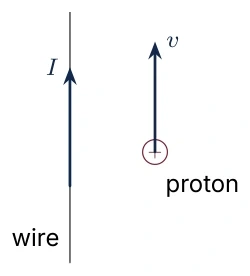
A long straight wire in the plane of the page carries a current towards the top of the page. A proton a short distance to the right of the wire moves parallel to the wire, also towards the top of the page. Which way is the proton pushed by the magnetic field?
A. towards the wire   B. away from the wire
C. perpendicular to the page, inwards   D. perpendicular to the page, outwards
Diagram for D.3 question T4
Show solutionHide solution
Two steps. Right-hand grip: with the current up the page, the wire's field to its right points into the page. Left-hand rule for the proton: field into the page, its motion up the page, so the force points to the left, towards the wire. Same result as for parallel currents in the same direction, which attract. C and D use the field direction as the force direction.

Final answer

A

Question T5

Type T5 · W1 · Force on a wire · P2[4 marks]
A straight wire of length 0.40\,\mathrm{m} carrying a current of 5.0\,\mathrm{A} lies in a uniform magnetic field of 0.12\,\mathrm{T}.
(a) Calculate the largest force the field could exert on this wire. [1]
(b) The measured force on the wire is 0.12\,\mathrm{N}. Determine the angle between the wire and the field. [2]
(c) Describe how the force is oriented with respect to the wire and to the field. [1]
Show solutionHide solution
(a) The force is greatest when the wire is at right angles to the field: F=BIL=0.12(5.0)(0.40)=0.24\,\mathrm{N} (A1). (b) \sin\theta=\dfrac{F}{BIL}=\dfrac{0.12}{0.24}=0.50 (M1), \theta=30^\circ (A1). (c) Perpendicular to the wire and to the field, so perpendicular to the plane holding both (A1).

Final answer

(a) 0.24\,\mathrm{N} (b) 30^\circ (c) at right angles to both the wire and the field

Question T6

Type T6 · W3 · Loop in a field · P1A[1 mark]
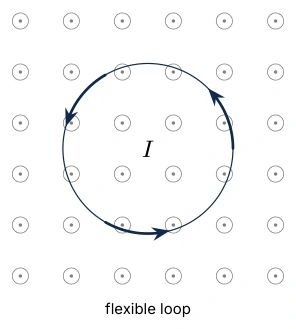
A flexible circular loop of wire lies flat in the plane of the page in a uniform magnetic field pointing out of the page. A current flows anticlockwise round the loop. What is the effect of the magnetic forces on the loop?
A. every part is pushed outwards, so the loop expands
B. every part is pushed inwards, so the loop contracts
C. the loop rotates about a diameter   D. the loop moves out of the page
Diagram for D.3 question T6
Show solutionHide solution
Take the top of the loop: the anticlockwise current there flows to the left. Left hand: field out of the page, current to the left, force towards the top of the page, away from the centre. The same holds at every point, so the forces pull outwards and cancel: no resultant force and no turning, but the loop stretches. Every force lies in the plane of the loop, so D is impossible.

Final answer

A

Question T7

Type T7 · W4 · Parallel wires · P2[6 marks]
Two long straight parallel overhead cables are 0.30\,\mathrm{m} apart. Each carries a current of 600\,\mathrm{A} in the same direction.
(a) State and explain whether the cables attract or repel each other. [2]
(b) Calculate the force per unit length on each cable. [1]
(c) The current in one cable doubles and the separation becomes 0.45\,\mathrm{m}. Calculate the new force per unit length. [2]
(d) Compare the forces on the two cables in (c). [1]
Show solutionHide solution
(a) Each cable sits in the magnetic field of the other and carries a current across it, so it feels a force BIL (M1); for currents in the same direction the forces pull the cables together: they attract (A1). (b) \dfrac{F}{L}=\dfrac{\mu_0}{2\pi}\cdot\dfrac{I_1I_2}{r}=\dfrac{4\pi\times10^{-7}(600)(600)}{2\pi(0.30)}=0.24\,\mathrm{N\,m^{-1}} (A1). (c) \dfrac{F}{L}=\dfrac{2\times10^{-7}(1200)(600)}{0.45}=0.32\,\mathrm{N\,m^{-1}} (M1 for both changes, A1). (d) The forces form a Newton's third law pair: the same size on both cables, in opposite directions, even though one current is larger (A1).

Final answer

(a) attract (b) 0.24\,\mathrm{N\,m^{-1}} (c) 0.32\,\mathrm{N\,m^{-1}} (d) equal in size, opposite in direction

Question T8

Type T8 · R1 · Radius or speed; M4 · Why a circle · P2[6 marks]
A proton moves in a circle of radius 0.25\,\mathrm{m} in a uniform magnetic field of 0.060\,\mathrm{T}, its velocity always perpendicular to the field.
(a) Explain why the speed of the proton does not change and why its path is circular. [2]
(b) Calculate the speed of the proton. [2]
(c) Calculate the kinetic energy of the proton in eV. [2]
Show solutionHide solution
(a) The magnetic force is perpendicular to the velocity at every instant, so it does no work and the speed stays constant (A1). At constant speed the force has constant size and always points towards the same point, so it acts as the centripetal force of a circle (A1). (b) evB=\dfrac{m_pv^2}{r} gives v=\dfrac{eBr}{m_p}=\dfrac{1.60\times10^{-19}(0.060)(0.25)}{1.673\times10^{-27}} (M1) =1.43\times10^{6}\,\mathrm{m\,s^{-1}} (A1). (c) E_k=\tfrac12m_pv^2=1.72\times10^{-15}\,\mathrm{J} (A1); 1.72\times10^{-15}/1.60\times10^{-19}=1.08\times10^{4}\,\mathrm{eV} (A1).

Final answer

(a) force at right angles to the velocity: no work, constant speed; constant-size force towards a centre (b) 1.43\times10^{6}\,\mathrm{m\,s^{-1}} (c) 1.08\times10^{4}\,\mathrm{eV}

Question T9

Type T9 · R4 · Energy to radius · P2[6 marks]
Alpha particles start from rest and are accelerated through a potential difference of 2.0\,\mathrm{kV}. After acceleration, the alpha particles travel perpendicular to a uniform 0.25\,\mathrm{T} magnetic field. The mass of an alpha particle is 6.64\times10^{-27}\,\mathrm{kg}.
(a) Show that the speed of the alpha particles is about 4.4\times10^{5}\,\mathrm{m\,s^{-1}}. [2]
(b) Calculate the radius of their path in the field. [2]
(c) Protons accelerated through the same potential difference enter the same field. Determine the radius of their path. [2]
Show solutionHide solution
(a) The field does work qV with q=2e (M1): \tfrac12mv^2=2(1.60\times10^{-19})(2000)=6.4\times10^{-16}\,\mathrm{J}, v=\sqrt{2(6.4\times10^{-16})/6.64\times10^{-27}}=4.39\times10^{5}\,\mathrm{m\,s^{-1}} (A1). (b) r=\dfrac{mv}{qB}=\dfrac{6.64\times10^{-27}(4.39\times10^{5})}{3.20\times10^{-19}(0.25)} (M1) =3.6\times10^{-2}\,\mathrm{m} (A1). (c) For a proton v=\sqrt{2eV/m_p}=6.19\times10^{5}\,\mathrm{m\,s^{-1}} (M1) and r=\dfrac{m_pv}{eB}=2.6\times10^{-2}\,\mathrm{m} (A1). The particles share the p.d., not the speed, so r\propto\sqrt{m/q}, not m/q.

Final answer

(a) 4.39\times10^{5}\,\mathrm{m\,s^{-1}} (b) 3.6\,\mathrm{cm} (c) 2.6\,\mathrm{cm}

Question T10

Type T10 · M3 · Identify the field · P2[3 marks]
Each of three regions X, Y and Z contains one uniform field: electric, magnetic or gravitational. Ignore any other field.
Region X: an electron released from rest accelerates; a neutron fired across the region keeps a constant velocity.
Region Y: an electron released from rest stays at rest; an electron fired across the region moves in a circle.
Region Z: a neutron and an electron released from rest accelerate equally.
(a) Identify the field in each region, giving a reason for each. [3]
Show solutionHide solution
(a) X: the force acts on a charge at rest but not on a neutral particle, so it is electric (A1). Y: no force on a stationary charge, but a moving charge is pushed at right angles to its velocity, so it is magnetic (A1). Z: neutral and charged particles accelerate equally, independent of charge and mass, as in free fall: gravitational (A1).

Final answer

(a) X electric; Y magnetic; Z gravitational

Question T11

Type T11 · R1 · Radius or speed; R5 · Orbit time · P2[6 marks]
Electrons moving at 3.5\times10^{6}\,\mathrm{m\,s^{-1}} enter a region of uniform magnetic field of 1.2\,\mathrm{mT} at right angles to the field.
(a) Calculate the radius of their path. [2]
(b) Show that the time for one revolution does not depend on the speed of the electrons. [2]
(c) The electrons leave the field after turning through 90^\circ. Calculate the time they spend in the field. [2]
Show solutionHide solution
(a) r=\dfrac{m_ev}{eB}=\dfrac{9.110\times10^{-31}(3.5\times10^{6})}{1.60\times10^{-19}(1.2\times10^{-3})} (M1) =1.66\times10^{-2}\,\mathrm{m} (A1); 1.2 mT is 1.2\times10^{-3}\,\mathrm{T}. (b) T=\dfrac{2\pi r}{v} (M1) and r=\dfrac{m_ev}{eB}, so T=\dfrac{2\pi m_e}{eB}: v cancels (A1). A faster electron goes round a larger circle in the same time. (c) T=\dfrac{2\pi(9.110\times10^{-31})}{1.60\times10^{-19}(1.2\times10^{-3})}=2.98\times10^{-8}\,\mathrm{s} (M1); a quarter turn takes T/4=7.5\times10^{-9}\,\mathrm{s} (A1).

Final answer

(a) 1.66\,\mathrm{cm} (b) T=2\pi m_e/(eB) (c) 7.5\times10^{-9}\,\mathrm{s}

Question T12

Type T12 · M2 · Force direction · P2[5 marks]
A vertical metal rod of length 0.50\,\mathrm{m} moves horizontally to the right at 4.0\,\mathrm{m\,s^{-1}} through a uniform magnetic field of 0.20\,\mathrm{T} directed into the page.
(a) State which way the magnetic field pushes the free electrons in the rod. [1]
(b) Explain why the separation of charge in the rod stops after a very short time. [2]
(c) Calculate the potential difference between the ends of the rod. [2]
Show solutionHide solution
(a) The electrons move to the right with the rod. For a positive charge the force would be up the page; electrons are negative, so the force on them is down the rod (A1). (b) Electrons collect at the lower end, leaving the upper end positive; this charge sets up an electric field along the rod whose force on each electron is upwards (M1). Electrons stop collecting when eE=evB (A1). (c) E=vB=4.0(0.20)=0.80\,\mathrm{V\,m^{-1}} (M1); V=EL=0.80(0.50)=0.40\,\mathrm{V}, that is V=BvL (A1).

Final answer

(a) down the rod (b) the separated charge sets up an electric field whose force balances the magnetic force (c) 0.40\,\mathrm{V}

Question T13

Type T13 · M5 · Velocity selector · Seen in 2025 papers · P2[3 marks]
Positive ions travel to the right through crossed uniform fields: the electric field is 1.8\times10^{4}\,\mathrm{V\,m^{-1}} down the page and the magnetic field is 0.060\,\mathrm{T} into the page. (a) Calculate the speed at which an ion passes without deflection. [2]
(b) State the initial deflection of a faster positive ion. [1]
Show solutionHide solution
(a) The electric force is downwards; qvB acts upwards. With zero resultant force, qE=qvB (M1), so v=E/B=1.8\times10^{4}/0.060=3.0\times10^{5}\,\mathrm{m\,s^{-1}} (A1). (b) At greater speed the magnetic force increases while the electric force is unchanged; the ion initially bends upwards (A1). The selected speed is independent of mass and charge magnitude.

Final answer

(a) 3.0\times10^{5}\,\mathrm{m\,s^{-1}} (b) upwards

Advanced practice

Question V5

Type V5 · W4 · Parallel wires · Advanced · P2[7 marks]
Three long parallel wires P, Q and R lie in one plane, with Q between them, 5.0\,\mathrm{cm} from each. P carries 4.0\,\mathrm{A} and Q carries 2.0\,\mathrm{A}, both in the same direction; R carries 6.0\,\mathrm{A} in the opposite direction.
(a) Find the size and direction of the total force on each metre of Q. [3]
(b) Determine the resultant force per unit length on P. [2]
(c) The resultant force per unit length on R is 9.6\times10^{-5}\,\mathrm{N\,m^{-1}} away from Q. Show that the three resultant forces add to zero and explain why this is expected. [2]
Show solutionHide solution
Use \dfrac{F}{L}=\dfrac{\mu_0}{2\pi}\cdot\dfrac{I_1I_2}{r}=\dfrac{2\times10^{-7}I_1I_2}{r} for each pair. (a) P on Q: same direction, attraction towards P, 2\times10^{-7}(4.0)(2.0)/0.050=3.2\times10^{-5}\,\mathrm{N\,m^{-1}} (M1). R on Q: opposite, repulsion away from R, which is also towards P, 2\times10^{-7}(6.0)(2.0)/0.050=4.8\times10^{-5}\,\mathrm{N\,m^{-1}} (M1). Total 8.0\times10^{-5}\,\mathrm{N\,m^{-1}} towards P (A1). (b) Q on P: 3.2\times10^{-5} towards Q; R on P (distance 0.10\,\mathrm{m}): 2\times10^{-7}(4.0)(6.0)/0.10=4.8\times10^{-5} away from R (M1). Resultant 1.6\times10^{-5}\,\mathrm{N\,m^{-1}} away from Q (A1). (c) Taking the direction from P to R as positive: -8.0-1.6+9.6=0 (A1). Each pair of wires exerts equal and opposite forces on each other, so the internal forces of the set of three must add to zero (A1).

Final answer

(a) 8.0\times10^{-5}\,\mathrm{N\,m^{-1}} towards P (b) 1.6\times10^{-5}\,\mathrm{N\,m^{-1}} away from Q (c) -8.0-1.6+9.6=0 (in 10^{-5}\,\mathrm{N\,m^{-1}}); the forces are Newton's third law pairs

Question V1

Type V1 · E4 · Exit angle and screen; E3 · Hit a plate? · Predicted type · P2[7 marks]
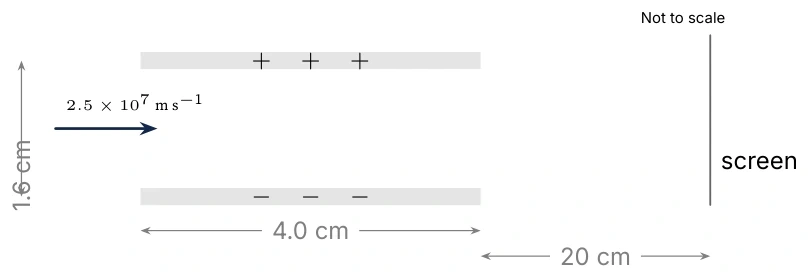
Electrons moving at 2.5\times10^{7}\,\mathrm{m\,s^{-1}} enter the space midway between two parallel plates, moving parallel to them. The plates are 4.0\,\mathrm{cm} long and 1.6\,\mathrm{cm} apart, with a potential difference of 120\,\mathrm{V} between them. A screen stands 20\,\mathrm{cm} beyond the end of the plates, at right angles to the original beam.
(a) Show that the electrons do not hit a plate. [2]
(b) Determine the angle between the velocity of the electrons and their original direction as they leave the plates. [2]
(c) Calculate the total deflection of the beam on the screen. [2]
(d) The entry speed is doubled. State the factor by which the deflection on the screen changes. [1]
Diagram for D.3 question V1
Show solutionHide solution
(a) a=\dfrac{eV}{m_ed}=\dfrac{1.60\times10^{-19}(120)}{9.110\times10^{-31}(0.016)}=1.32\times10^{15}\,\mathrm{m\,s^{-2}}; t=0.040/2.5\times10^{7}=1.6\times10^{-9}\,\mathrm{s} (M1); y=\tfrac12at^2=1.7\times10^{-3}\,\mathrm{m}, less than half the gap, 8.0\,\mathrm{mm} (A1). (b) v_y=at=2.11\times10^{6}\,\mathrm{m\,s^{-1}} (M1); \tan\theta=v_y/v_x=0.0843, \theta=4.8^\circ (A1). Use the velocity components, not the displacements. (c) Beyond the plates there is no field and the path is straight: extra deflection 0.20\tan\theta=1.69\times10^{-2}\,\mathrm{m} (M1); total 1.7\,\mathrm{mm}+16.9\,\mathrm{mm}=18.5\,\mathrm{mm}\approx1.9\,\mathrm{cm} (A1). (d) Both parts are proportional to 1/v^2, so the deflection falls to one quarter (A1).

Final answer

(a) deflection 1.7\,\mathrm{mm}, less than 8.0\,\mathrm{mm} (b) 4.8^\circ (c) 1.9\,\mathrm{cm} (d) one quarter

Question V2

Type V2 · R6 · Charge/mass from data; R4 · Energy to radius · Predicted type · P2[7 marks]
In a fine-beam tube, electrons start from rest, are accelerated through a potential difference V and then move in a circle of radius r in a uniform magnetic field of 0.80\,\mathrm{mT}, perpendicular to their velocity. A student records:
V / V: 51, 90, 141, 203, 276
r / cm: 3.0, 4.0, 5.0, 6.0, 7.0
(a) Show that V=\dfrac{eB^2}{2m_e}r^2. [2]
(b) Using a graph of V against r^2, find its gradient. [2]
(c) Determine the charge-to-mass ratio e/m_e of the electron. [2]
(d) Explain why this experiment cannot give e and m_e separately. [1]
Show solutionHide solution
(a) Energy: eV=\tfrac12m_ev^2 (M1). Circle: evB=\dfrac{m_ev^2}{r}, so v=\dfrac{eBr}{m_e}; substituting, eV=\tfrac12m_e\dfrac{e^2B^2r^2}{m_e^2}, which gives V=\dfrac{eB^2}{2m_e}r^2 (A1). (b) r^2 / m^2: 9.0,16,25,36,49\times10^{-4}; the points lie on a line through the origin (M1); gradient =\dfrac{276-51}{(49-9.0)\times10^{-4}}=5.63\times10^{4}\,\mathrm{V\,m^{-2}} (A1). Plotting V against r gives a curve. (c) \dfrac{e}{m_e}=\dfrac{2\times\text{gradient}}{B^2} (M1) =\dfrac{2(5.63\times10^{4})}{(0.80\times10^{-3})^2}=1.76\times10^{11}\,\mathrm{C\,kg^{-1}} (A1); divide by B^2, not B. (d) e and m_e enter only as e/m_e: a particle with twice the charge and twice the mass would follow the same path (A1).

Final answer

(a) combine eV=\tfrac12m_ev^2 with evB=m_ev^2/r (b) 5.63\times10^{4}\,\mathrm{V\,m^{-2}} (c) 1.76\times10^{11}\,\mathrm{C\,kg^{-1}} (d) only the ratio appears in the equation

Question V3

Type V3 · R7 · Changing radius; R3 · Identify the particle; R1 · Radius or speed · Going further · P2[7 marks]
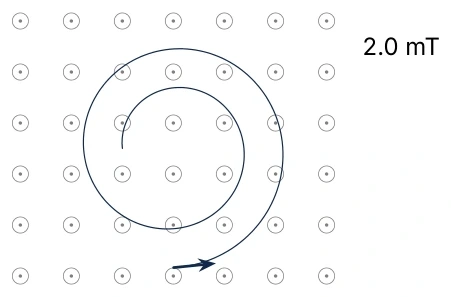
A particle detector contains a uniform magnetic field of 2.0\,\mathrm{mT} directed out of the page. An electron leaves a track in the plane of the page. The track curves anticlockwise and winds inwards, so its radius gets smaller.
(a) Explain how the anticlockwise sense of the track shows that the particle is negative. [2]
(b) Where the radius of the track is 4.0\,\mathrm{cm}, calculate the speed of the electron. [2]
(c) Explain why the radius of the track decreases. [2]
(d) Later the radius is 2.0\,\mathrm{cm}. Calculate the ratio of the kinetic energy there to the kinetic energy where the radius was 4.0\,\mathrm{cm}. [1]
Diagram for D.3 question V3
Show solutionHide solution
(a) Take a point where the track moves to the right. For a positive charge, field out of the page and motion to the right give a force towards the bottom of the page, a clockwise turn (M1). The track turns the other way, so the charge is negative (A1). (b) v=\dfrac{eBr}{m_e}=\dfrac{1.60\times10^{-19}(2.0\times10^{-3})(0.040)}{9.110\times10^{-31}} (M1) =1.4\times10^{7}\,\mathrm{m\,s^{-1}} (A1), about 5\% of c, so r=mv/(eB) applies. (c) The magnetic force is at right angles to the velocity and does no work, so it cannot slow the electron (M1). The electron loses kinetic energy in collisions with the atoms of the detector; its speed falls, and r\propto v in a fixed field (A1). (d) v\propto r, so E_k\propto r^2: (2.0/4.0)^2=0.25 (A1). The track is planar, not a helix.

Final answer

(a) a positive charge would curve clockwise (b) 1.4\times10^{7}\,\mathrm{m\,s^{-1}} (c) the electron loses energy to the material of the detector; the magnetic force does no work (d) 0.25

Question V4

Type V4 · W3 · Loop in a field; W2 · Which way the rod moves; W1 · Force on a wire · P2[7 marks]
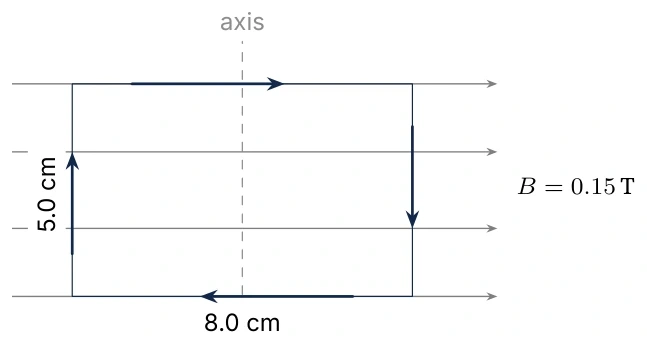
A single rectangular loop of wire, 8.0\,\mathrm{cm} by 5.0\,\mathrm{cm}, lies in the plane of the page in a uniform magnetic field of 0.15\,\mathrm{T} that points to the right, parallel to the 8.0\,\mathrm{cm} sides. A current of 3.0\,\mathrm{A} flows clockwise round the loop.
(a) Calculate the force on each side of the loop and state the directions of the forces that are not zero. [3]
(b) Show that the resultant force on the loop is zero, and describe the motion of the loop if it is free to turn about an axis through its centre parallel to the 5.0\,\mathrm{cm} sides. [2]
(c) The loop turns until its plane is at right angles to the field and comes to rest there. State the direction of the forces on its sides now and their effect. [2]
Diagram for D.3 question V4
Show solutionHide solution
(a) The 8.0\,\mathrm{cm} sides carry current parallel or antiparallel to the field: \sin\theta=0, no force (A1). Each 5.0\,\mathrm{cm} side: F=BIL=0.15(3.0)(0.050)=2.25\times10^{-2}\,\mathrm{N} (A1). Clockwise current flows down the right side and up the left side; the left-hand rule gives out of the page on the right side and into the page on the left side (A1). (b) The two forces are equal in size and opposite in direction, so the resultant is zero (A1); they act along different lines, so the loop turns about the axis, its right side coming out of the page (A1). (c) The side that came towards you still carries current down the page; with the field to the right, its force points further towards you, away from the centre. Every side is pushed outwards in the plane of the loop (A1); the forces cancel and have no turning effect, so they only stretch the loop (A1).

Final answer

(a) 8.0\,\mathrm{cm} sides: zero; 5.0\,\mathrm{cm} sides: 2.3\times10^{-2}\,\mathrm{N}, right side out of the page, left side into the page (b) the two forces are equal and opposite; the loop turns about the axis (c) all outwards in the plane of the loop: they stretch it but do not turn it

Connected questions

Question X1

Type X1 · D.3 + A.3 + B.5 · Connected · Paper 2[8 marks]
In an electron gun, electrons start from rest and are accelerated through a potential difference of 1.8\,\mathrm{kV}. The beam current is 0.40\,\mathrm{mA}.
(a) Calculate the kinetic energy of each electron, in J. [1]
(b) Show that the speed of the electrons is about 2.5\times10^{7}\,\mathrm{m\,s^{-1}}. [2]
(c) Calculate the number of electrons leaving the gun each second. [1]
(d) The beam enters a uniform magnetic field of 1.5\,\mathrm{mT} at right angles to it. Calculate the radius of the path of the electrons. [2]
(e) Calculate the power delivered to the beam by the gun and explain why the magnetic field does not change the kinetic energy carried by the beam. [2]
Show solutionHide solution
(a) B.5: the work done on each electron is eV=1.60\times10^{-19}(1800)=2.88\times10^{-16}\,\mathrm{J} (A1). (b) A.3: \tfrac12m_ev^2=2.88\times10^{-16} (M1), v=\sqrt{2(2.88\times10^{-16})/9.110\times10^{-31}}=2.51\times10^{7}\,\mathrm{m\,s^{-1}} (A1), under a tenth of c. (c) B.5: n=I/e=0.40\times10^{-3}/1.60\times10^{-19}=2.5\times10^{15} each second (A1). (d) r=\dfrac{m_ev}{eB}=\dfrac{9.110\times10^{-31}(2.51\times10^{7})}{1.60\times10^{-19}(1.5\times10^{-3})} (M1) =9.5\times10^{-2}\,\mathrm{m} (A1). (e) P=IV=0.40\times10^{-3}(1800)=0.72\,\mathrm{W} (A1); the magnetic force never has a component along the velocity, so it does no work and the speed of every electron is unchanged (A1).

Final answer

(a) 2.88\times10^{-16}\,\mathrm{J} (b) 2.51\times10^{7}\,\mathrm{m\,s^{-1}} (c) 2.5\times10^{15} (d) 9.5\times10^{-2}\,\mathrm{m} (e) 0.72\,\mathrm{W}; the magnetic force is at right angles to the velocity and does no work

Question X2

Type X2 · D.3 + A.2 · Connected · Paper 2[7 marks]
A horizontal copper rod of mass 25\,\mathrm{g} and length 0.20\,\mathrm{m} hangs from two identical light vertical springs that conduct electricity. The whole rod is in a uniform horizontal magnetic field of 0.30\,\mathrm{T} at right angles to the rod. With no current, each spring is extended by 2.0\,\mathrm{cm}.
(a) Calculate the spring constant of each spring. [2]
(b) A current in the rod makes both springs return to their natural length. Calculate the current. [2]
(c) The current is reversed, with the same size. Determine the new extension of each spring. [2]
(d) The field points due north and the rod lies east–west. State the direction of the current in (b). [1]
Show solutionHide solution
(a) A.2: the two springs share the weight, 2kx=mg (M1): k=\dfrac{0.025(9.8)}{2(0.020)}=6.1\,\mathrm{N\,m^{-1}} (A1). (b) The magnetic force must equal the weight: BIL=mg (M1), I=\dfrac{0.245}{0.30(0.20)}=4.1\,\mathrm{A} (A1). (c) Reversed, the magnetic force acts downwards and adds to the weight: the springs now hold 2mg (M1), so each extends 2(2.0)=4.0\,\mathrm{cm} (A1). (d) The force must be upwards. Left hand: field north, thumb up, second finger points east: the current flows from west to east (A1).

Final answer

(a) 6.1\,\mathrm{N\,m^{-1}} (b) 4.1\,\mathrm{A} (c) 4.0\,\mathrm{cm} (d) from west to east

Question X3

Type X3 · D.3 + E.1 · Connected · Paper 2[7 marks]
Ions of neon-20 and neon-22, each with charge +e, start from rest and are accelerated through a potential difference of 500\,\mathrm{V}. They then enter a uniform magnetic field of 0.20\,\mathrm{T} at right angles to it. Take the mass of a neon-20 ion as 20\,\mathrm{u} and of a neon-22 ion as 22\,\mathrm{u}.
(a) Neon has 10 protons in its nucleus. State the number of neutrons in a neon-22 nucleus. [1]
(b) Show that the speed of the neon-20 ions is about 6.9\times10^{4}\,\mathrm{m\,s^{-1}}. [2]
(c) Calculate the radius of the path of the neon-20 ions. [2]
(d) Determine the radius of the path of the neon-22 ions and explain why the two isotopes follow different paths. [2]
Show solutionHide solution
(a) E.1: nucleon number 22 minus 10 protons: 12 neutrons (A1). (b) m=20(1.661\times10^{-27})=3.32\times10^{-26}\,\mathrm{kg}; \tfrac12mv^2=eV=8.0\times10^{-17}\,\mathrm{J} (M1); v=\sqrt{2(8.0\times10^{-17})/3.32\times10^{-26}}=6.94\times10^{4}\,\mathrm{m\,s^{-1}} (A1). (c) r=\dfrac{mv}{eB}=\dfrac{3.32\times10^{-26}(6.94\times10^{4})}{1.60\times10^{-19}(0.20)} (M1) =7.2\times10^{-2}\,\mathrm{m} (A1). (d) Same charge and same p.d., so the same kinetic energy: r=\dfrac{\sqrt{2meV}}{eB}\propto\sqrt m, r_{22}=7.2\times10^{-2}\sqrt{22/20}=7.6\times10^{-2}\,\mathrm{m} (A1). Isotopes have the same charge but different numbers of neutrons, so different masses, and the heavier ions curve less (A1).

Final answer

(a) 12 (b) 6.94\times10^{4}\,\mathrm{m\,s^{-1}} (c) 7.2\times10^{-2}\,\mathrm{m} (d) 7.6\times10^{-2}\,\mathrm{m}; same charge and energy, larger mass, larger radius

Question X4

Type X4 · D.3 + A.1 + A.2 · Connected · Paper 2[7 marks]
A dust grain of mass 2.0\times10^{-12}\,\mathrm{kg} and charge +4.0\times10^{-15}\,\mathrm{C} moves horizontally at 0.50\,\mathrm{m\,s^{-1}} into the space midway between two horizontal plates. The plates are 0.20\,\mathrm{m} long and 0.15\,\mathrm{m} apart; the lower plate is positive and the p.d. between them is 675\,\mathrm{V}.
(a) Calculate the field strength between the plates and the size of the electric force on the grain. [2]
(b) Determine the resultant force on the grain and its acceleration. [2]
(c) Calculate the vertical displacement of the grain as it leaves the plates, and state whether it hits a plate. [2]
(d) Calculate the p.d. at which the grain would pass straight through. [1]
Show solutionHide solution
(a) E=V/d=675/0.15=4.5\times10^{3}\,\mathrm{V\,m^{-1}} (A1); F=qE=1.8\times10^{-11}\,\mathrm{N}, upwards since the lower plate is positive (A1). (b) A.2: the weight mg=1.96\times10^{-11}\,\mathrm{N} acts down, against the electric force, so they subtract: resultant 1.6\times10^{-12}\,\mathrm{N} downwards (M1); a=F/m=0.80\,\mathrm{m\,s^{-2}} (A1). Here the weight is NOT negligible. (c) A.1: time between the plates 0.20/0.50=0.40\,\mathrm{s}; y=\tfrac12at^2=\tfrac12(0.80)(0.40)^2=0.064\,\mathrm{m} (A1), less than half the gap, 0.075\,\mathrm{m}, so it leaves the plates (A1). (d) Straight through when qE=mg: E=mg/q=4.9\times10^{3}\,\mathrm{V\,m^{-1}}, V=Ed=735\,\mathrm{V} (A1).

Final answer

(a) 4.5\times10^{3}\,\mathrm{V\,m^{-1}}; 1.8\times10^{-11}\,\mathrm{N} upwards (b) 1.6\times10^{-12}\,\mathrm{N} downwards; 0.80\,\mathrm{m\,s^{-2}} (c) 6.4\,\mathrm{cm} downwards; it does not hit a plate (d) 735\,\mathrm{V}

From the book

Photon Physics: Study Guide for the IB Diploma (SL & HL)

Motion in electromagnetic fields from the core ideas to full exam questions, with question types, worked examples and graded practice.

About the book