Free worked solutions · 2026 Edition

IB Physics D.1: Gravitational fields worked solutions

Worked solutions to every practice question in D.1: Gravitational fields of Photon Physics: Study Guide for the IB Diploma (SL & HL). Try each question, then compare your working with the full solution.

  • SL & HL
  • 32 questions
  • Full worked solutions
  • Free, no sign-up

Basic practice

Question A1

Type A1 · Define g[1 mark]
A student is asked what "gravitational field strength at P" means, for a point P near a planet. Which answer is right?
A. The pull of the planet on whatever object is put at P.
B. The weight of a 1\,\mathrm{kg} mass at P divided by the distance from P to the planet's centre.
C. GM/r^2, with r measured from P down to the planet's surface.
D. The pull of the planet on each kilogram of a tiny mass put at P.
Show solutionHide solution
Field strength is force divided by mass, found with a test mass too small to disturb the field. A has no "per kilogram", so its value would change with the object. B divides by a distance that has no place in the definition. C is a result for a spherical planet, not a definition, and it measures r from the wrong place.

Final answer

D
Question A2

Type A2 · Force ratio[1 mark]
Moons X and Y orbit the same planet. X has twice the mass of Y and its orbital radius is three times that of Y. What is \dfrac{\text{gravitational force of the planet on X}}{\text{gravitational force of the planet on Y}}?
A. \tfrac{2}{9}   B. \tfrac{2}{3}   C. \tfrac{1}{9}   D. \tfrac{9}{2}
Show solutionHide solution
F\propto m/r^2 for the same planet: \dfrac{F_X}{F_Y}=\dfrac{2}{3^2}=\dfrac{2}{9}. B forgets to square the radius ratio. C drops the moon's mass, which cancels in an acceleration but not in a force. D is the ratio upside down.

Final answer

A

Question A3

Type A3 · Surface g[1 mark]
Planet P has \tfrac18 of the mass of Earth and half of Earth's diameter. On Earth's surface a dropped stone accelerates at 9.8\,\mathrm{m\,s^{-2}}. What field strength, in \mathrm{N\,kg^{-1}}, would an astronaut measure on the ground on P?
A. 1.2   B. 2.5   C. 4.9   D. 0.31
Show solutionHide solution
g\propto M/R^2, and half the diameter is half the radius: g_P=9.8\times\dfrac{1/8}{(1/2)^2}=9.8\times\tfrac12=4.9\,\mathrm{N\,kg^{-1}}. A uses the mass ratio alone; B divides by the radius ratio without squaring it; D multiplies by R^2 instead of dividing.

Final answer

C

Question A4

Type A4 · Field at height[1 mark]
A planet has radius R. At what height above its surface is the gravitational field strength one quarter of its value at the surface?
A. R   B. 2R   C. 3R   D. 4R
Show solutionHide solution
g\propto1/r^2 with r from the centre. A quarter of the field needs r=2R, which is a height of 2R-R=R. B gives the distance from the centre, not the height. C and D come from treating g as \propto 1/r (r=4R), with and without the subtraction.

Final answer

A

Question B1

Type B1 · Two fields[1 mark]
Two point masses M and 9M are a distance d apart. At a point on the line joining them the resultant gravitational field is zero. How far is this point from the mass M?
A. \tfrac{d}{10}   B. \tfrac{d}{3}   C. \tfrac{3d}{4}   D. \tfrac{d}{4}
Show solutionHide solution
Equal and opposite fields: \dfrac{GM}{x^2}=\dfrac{G(9M)}{(d-x)^2}, so \dfrac{d-x}{x}=3 and x=\dfrac{d}{4}, nearer the smaller mass. A uses the mass ratio without the square root. B measures both distances from M (x=d/3). C is the distance from 9M.

Final answer

D

Question C1

Type C1 · Period ratio[1 mark]
Two moons R and S orbit the same planet in circular orbits. The orbital radius of R is four times that of S. What is \dfrac{\text{orbital period of R}}{\text{orbital period of S}}?
A. 2   B. 4   C. 8   D. 64
Show solutionHide solution
Same central mass, so T^2\propto r^3: \dfrac{T_R}{T_S}=4^{3/2}=8. A takes the square root only, B assumes T\propto r, and D is 4^3, the ratio of the T^2 values rather than of the periods.

Final answer

C

Question C2

Type C2 · Circular force, Weightless[1 mark]
An astronaut floats inside a space station that moves in a circular orbit 400\,\mathrm{km} above Earth's surface.
X: Earth still pulls on the astronaut with almost 90\% of the force it exerts on the ground.
Y: Nothing accelerates the astronaut, because the forces on her balance.
Z: The floor of the station pushes on the astronaut with zero force.
Which of X, Y and Z are true?
A. X and Y   B. X and Z
C. Y and Z   D. all three
Show solutionHide solution
At r=6.77\times10^{6}\,\mathrm{m} (Earth radius 6.37\times10^{6}\,\mathrm{m}) the field is (6.37/6.77)^2=0.89 of the surface value, so X is true. Gravity is the resultant force: it supplies the centripetal acceleration, so Y is false. Station and astronaut fall with the same acceleration, so no contact force is needed: Z is true. "Weightless" means zero contact force, not zero gravity.

Final answer

B

Question D1

Type D1 · Define V[1 mark]
Which of these describes the gravitational potential at a point P?
A. The energy per kilogram needed to carry a tiny mass slowly in from very far away to P.
B. The energy per kilogram needed to carry a tiny mass slowly from P out to a very great distance.
C. The potential energy that a tiny mass would have if it were put at P.
D. The pull of gravity on each kilogram of a tiny mass at P.
Show solutionHide solution
Potential is measured from infinity, where it is zero, to the point, and is per kilogram. B carries the mass the other way, which reverses the sign. C is potential energy, which still contains the mass. D is the field strength.

Final answer

A

Question D2

Type D2 · V at r[1 mark]
A planet has radius R. On its surface the gravitational potential is -6.0\,\mathrm{MJ\,kg^{-1}}. A probe hovers 2R above the ground. What is the potential where the probe is?
A. -0.67\,\mathrm{MJ\,kg^{-1}}   B. -2.0\,\mathrm{MJ\,kg^{-1}}
C. -3.0\,\mathrm{MJ\,kg^{-1}}   D. -18\,\mathrm{MJ\,kg^{-1}}
Show solutionHide solution
V\propto-1/r with r from the centre: r=R+2R=3R, so V=-6.0/3=-2.0\,\mathrm{MJ\,kg^{-1}}. A uses an inverse square (a field habit). C divides by the height, 2R, instead of the distance from the centre. D multiplies.

Final answer

B

Question E1

Type E1 · Escape speed[1 mark]
A projectile launched from Earth at 11.2\,\mathrm{km\,s^{-1}} or more never comes back. Planet W has the same mass as Earth and one quarter of Earth's volume. What is the least launch speed that lets a projectile leave W for good?
A. 5.6\,\mathrm{km\,s^{-1}}   B. 11.2\,\mathrm{km\,s^{-1}}
C. 14.1\,\mathrm{km\,s^{-1}}   D. 22.4\,\mathrm{km\,s^{-1}}
Show solutionHide solution
v_{\text{esc}}=\sqrt{2GM/R}\propto R^{-1/2} at fixed M. A quarter of the volume means R_W=(1/4)^{1/3}R_E=0.63R_E, so v=11.2/\sqrt{0.63}=14.1\,\mathrm{km\,s^{-1}}. D treats the volume ratio as a radius ratio; A turns the ratio upside down; B ignores the change of size.

Final answer

C

Question E2

Type E2 · Energy graphs[1 mark]
Graphs of kinetic energy E_k, gravitational potential energy E_p and total energy E of a satellite in a circular orbit are drawn against orbital radius r on the same axes. At radius r_1 the E_k graph reads +2.0\,\mathrm{GJ}. What do the other two graphs read at r_1?
A: E_p=-2.0 GJ, E=0. B: E_p=-4.0 GJ, E=+2.0 GJ. C: E_p=-1.0 GJ, E=+1.0 GJ. D: E_p=-4.0 GJ, E=-2.0 GJ.
Show solutionHide solution
For every circular orbit the potential energy is minus twice the kinetic energy: -4.0\,\mathrm{GJ}. Adding the two gives -2.0\,\mathrm{GJ}, which is minus the kinetic energy. A bound orbit has negative total energy, which rules out A, B and C.

Final answer

D

Tutorial practice

Question A5

Type A5 · Newton law[1 mark]
A student varies the separation r of two fixed masses and records the gravitational force F between them. Which graph of F against x is a straight line through the origin?
A. x=r   B. x=1/r   C. x=1/r^2   D. x=r^2
Show solutionHide solution
Newton's law says F equals a constant, Gm_1m_2, times 1/r^2. Plotting F against 1/r^2 therefore gives a line that passes through (0,0) with slope Gm_1m_2. Against 1/r the graph curves upwards; against r and r^2 it falls.

Final answer

C

Question A6

Type A6 · Density to g[1 mark]
Planet Y is made of rock of the same density as Earth and has 0.40 times Earth's radius. A stone dropped on Earth falls with acceleration 9.8\,\mathrm{m\,s^{-2}}. With what acceleration, in \mathrm{m\,s^{-2}}, does a stone fall when dropped on Y?
A. 1.6   B. 3.9   C. 9.8   D. 61
Show solutionHide solution
Replace the mass first: M=\rho\tfrac43\pi R^3, so g=\dfrac{GM}{R^2}=\tfrac43\pi G\rho R\propto\rho R. Same density: g_Y=0.40\times9.8=3.9\,\mathrm{m\,s^{-2}}. A keeps M\propto R^3 but forgets that dividing by R^2 removes two powers; D holds the mass fixed and uses 1/R^2; C ignores the size.

Final answer

B

Question A7

Type A7 · Average g[1 mark]
A space probe with its engines off moves straight away from a moon that has no atmosphere. In 5.0 minutes its speed falls from 2.40\,\mathrm{km\,s^{-1}} to 2.10\,\mathrm{km\,s^{-1}}. Only the moon's gravity acts. What is the average gravitational field strength of the moon over this time?
A. 60\,\mathrm{N\,kg^{-1}}, towards the moon
B. 1.0\,\mathrm{N\,kg^{-1}}, away from the moon
C. 1.0\,\mathrm{N\,kg^{-1}}, towards the moon
D. 1.0\times10^{-3}\,\mathrm{N\,kg^{-1}}, towards the moon
Show solutionHide solution
With gravity the only force, the field equals the acceleration: \bar g=\Delta v/\Delta t=(2100-2400)/300=-1.0\,\mathrm{m\,s^{-2}}. The probe slows while moving away, so the acceleration, and the field, point towards the moon. A leaves the time in minutes; D leaves the speeds in \mathrm{km\,s^{-1}}; B follows the velocity instead of the change in velocity.

Final answer

C

Question B2

Type B2 · Field-line direction[1 mark]
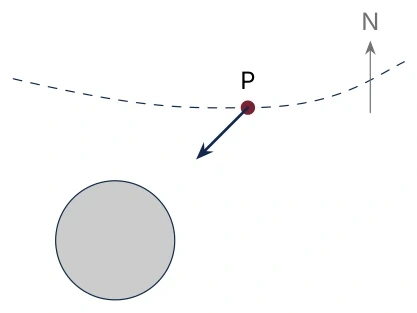
A probe with its engines off moves on a curved path past a planet, in the plane of the page. At point P the probe is moving due east. The gravitational field line through P points south-west. In which direction is the probe accelerating at P?
A. East   B. North-east   C. South   D. South-west
Diagram for D.1 question B2
Show solutionHide solution
Gravity is the only force, so \vec a=\vec g: the acceleration lies along the tangent to the field line, in the direction of its arrow, south-west. The path tangent (east) gives the velocity, not the acceleration. Nothing requires the acceleration to be at right angles to the path; that holds only for uniform circular motion.

Final answer

D

Question C4

Type C4 · T–r proof, Orbit speed[6 marks]
A survey satellite moves in a circular orbit around Mars with a period of 2.00 hours. Mass of Mars =6.42\times10^{23}\,\mathrm{kg}; radius of Mars =3.39\times10^{6}\,\mathrm{m}. G=6.67\times10^{-11}\,\mathrm{N\,m^2\,kg^{-2}}.
(a) Show that T^2=\dfrac{4\pi^2}{GM}r^3 for a circular orbit of radius r about a body of mass M. [2]
(b) Determine how far above the Martian ground the satellite travels. [2]
(c) Calculate the orbital speed of the satellite. [1]
(d) A second satellite orbits Mars at twice this orbital radius. Determine its period. [1]
Show solutionHide solution
(a) Gravity is the only force, so it must give the satellite its centripetal acceleration \omega^2r: \dfrac{GM}{r^2}=\omega^2r (M1). Put \omega=2\pi/T and rearrange: T^2=\dfrac{4\pi^2}{GM}r^3 (A1). (b) GM=4.28\times10^{13}\,\mathrm{m^3\,s^{-2}} and T=7200\,\mathrm{s}, so r^3=GMT^2/4\pi^2=5.62\times10^{19}\,\mathrm{m^3} and r=3.83\times10^{6}\,\mathrm{m} (M1); h=r-R=4.4\times10^{5}\,\mathrm{m} (A1). (c) v=2\pi r/T=2\pi\times3.83\times10^{6}/7200=3.34\times10^{3}\,\mathrm{m\,s^{-1}} (A1). (d) T\propto r^{3/2}: 2.00\times2^{3/2}=5.66 hours (A1).

Final answer

(a) shown (b) 4.4\times10^{5}\,\mathrm{m} (c) 3.34\times10^{3}\,\mathrm{m\,s^{-1}} (d) 5.66 hours

Question D3

Type D3 · Add V[1 mark]
Point masses M and 4M are a distance d apart. At point N on the line joining them the resultant gravitational field is zero. What is the gravitational potential at N?
A. 0   B. -\dfrac{9GM}{d}   C. -\dfrac{3GM}{d}   D. -\dfrac{5GM}{d}
Show solutionHide solution
First find N: \dfrac{GM}{x^2}=\dfrac{4GM}{(d-x)^2} gives x=\tfrac d3 from M, \tfrac{2d}{3} from 4M. Potentials are scalars and both are negative, so they add: V=-\dfrac{GM}{d/3}-\dfrac{4GM}{2d/3}=-\dfrac{3GM}{d}-\dfrac{6GM}{d}=-\dfrac{9GM}{d}. A confuses zero field with zero potential; C subtracts the two terms; D uses d for both distances.

Final answer

B

Question D4

Type D4 · Equipotentials[1 mark]
Near a moon, two neighbouring equipotential surfaces have potentials -62.0\,\mathrm{MJ\,kg^{-1}} and -62.6\,\mathrm{MJ\,kg^{-1}}. They are 300\,\mathrm{km} apart. Treat the field between them as uniform. A 5.0\,\mathrm{kg} mass is released from rest between them. What is its initial acceleration?
A. 2.0\,\mathrm{m\,s^{-2}}, towards the -62.6\,\mathrm{MJ\,kg^{-1}} surface
B. 2.0\,\mathrm{m\,s^{-2}}, towards the -62.0\,\mathrm{MJ\,kg^{-1}} surface
C. 0.40\,\mathrm{m\,s^{-2}}, towards the -62.6\,\mathrm{MJ\,kg^{-1}} surface
D. 2.0\times10^{-3}\,\mathrm{m\,s^{-2}}, towards the -62.6\,\mathrm{MJ\,kg^{-1}} surface
Show solutionHide solution
g=\dfrac{\Delta V}{\Delta r}=\dfrac{0.6\times10^{6}}{3.00\times10^{5}}=2.0\,\mathrm{N\,kg^{-1}}, and a=g whatever the mass. The field points towards lower, more negative potential. C divides by the 5.0\,\mathrm{kg}; D leaves the spacing in kilometres; B has the direction reversed.

Final answer

A

Question E4

Type E4 · Escape energy[1 mark]
The gravitational potential at the surface of a moon is -2.8\,\mathrm{MJ\,kg^{-1}}. What is the minimum kinetic energy a 1200\,\mathrm{kg} probe needs at the surface to escape from the moon? Ignore other bodies.
A. 3.4\times10^{9}\,\mathrm{J}   B. 1.7\times10^{9}\,\mathrm{J}
C. 2.8\times10^{6}\,\mathrm{J}   D. 6.7\times10^{9}\,\mathrm{J}
Show solutionHide solution
At the threshold the total energy is zero: E_k+mV=0, so E_k=-mV=1200\times2.8\times10^{6}=3.4\times10^{9}\,\mathrm{J}. C is the energy per kilogram. B and D halve or double the right answer, the usual result of carrying the \tfrac12 of \tfrac12mv^2 to the wrong side.

Final answer

A

Question D5

Type D5 · V–r gradient, Work and potential[6 marks]
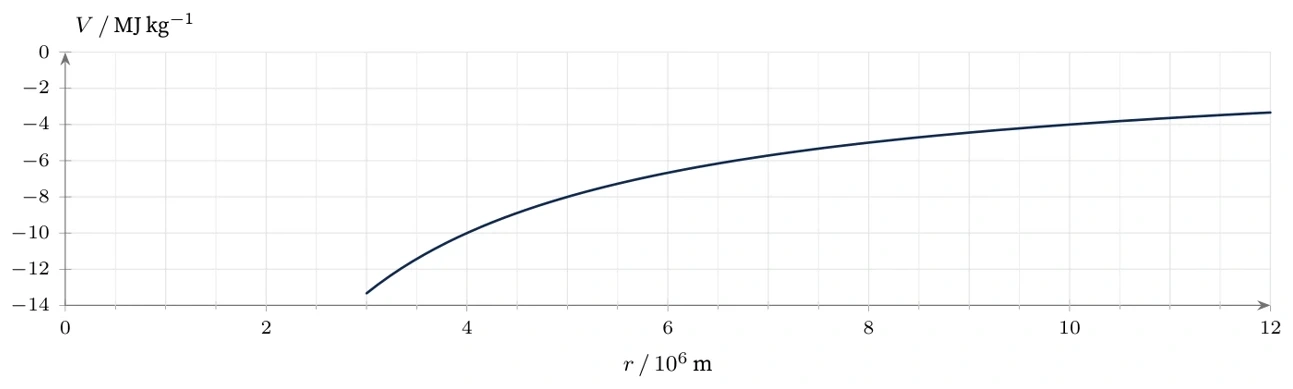
The graph (F-D5) shows how the gravitational potential V varies with distance r from the centre of planet Q, from its surface at r=3.0\times10^{6}\,\mathrm{m} to r=12.0\times10^{6}\,\mathrm{m}. G=6.67\times10^{-11}\,\mathrm{N\,m^2\,kg^{-2}}.
(a) Use the graph to show that the gravitational field strength at r=6.0\times10^{6}\,\mathrm{m} is about 1.1\,\mathrm{N\,kg^{-1}}. [2]
(b) Use a value read from the graph to determine the mass of Q. [2]
(c) Calculate the minimum work needed to move a 250\,\mathrm{kg} probe from r=4.0\times10^{6}\,\mathrm{m} to r=10.0\times10^{6}\,\mathrm{m}. [2] Graph values (r in million metres, V in MJ/kg): (3.0, -13.3), (4.0, -10.0), (6.0, -6.67), (10.0, -4.0), (12.0, -3.33). The plotted curve is V=-40/r.
Diagram for D.1 question D5
Show solutionHide solution
(a) Draw the tangent at r=6.0\times10^{6}\,\mathrm{m}; it runs from about (2.0\times10^{6},\,-11.1\times10^{6}) to (10.0\times10^{6},\,-2.2\times10^{6}) (M1). Gradient =8.9\times10^{6}/8.0\times10^{6}=1.1\,\mathrm{J\,kg^{-1}\,m^{-1}} and g=-\Delta V/\Delta r gives a field of magnitude 1.1\,\mathrm{N\,kg^{-1}} towards Q (A1). (b) At r=4.0\times10^{6}\,\mathrm{m}, V=-10.0\times10^{6}\,\mathrm{J\,kg^{-1}} (M1); M=-Vr/G=10.0\times10^{6}\times4.0\times10^{6}/6.67\times10^{-11}=6.0\times10^{23}\,\mathrm{kg} (A1). (c) \Delta V=-4.0\times10^{6}-(-10.0\times10^{6})=+6.0\times10^{6}\,\mathrm{J\,kg^{-1}} (M1); W=m\Delta V=250\times6.0\times10^{6}=1.5\times10^{9}\,\mathrm{J} (A1).

Final answer

(a) tangent gradient \approx1.1\,\mathrm{J\,kg^{-1}\,m^{-1}}, so g\approx1.1\,\mathrm{N\,kg^{-1}} towards Q (b) 6.0\times10^{23}\,\mathrm{kg} (c) 1.5\times10^{9}\,\mathrm{J}

Question E3

Type E3 · Orbit energy[5 marks]
An 800\,\mathrm{kg} satellite moves in a circular orbit of radius 7.00\times10^{6}\,\mathrm{m} around Earth. Its engines then move it into a circular orbit of radius 8.00\times10^{6}\,\mathrm{m}. Mass of Earth =5.97\times10^{24}\,\mathrm{kg}; G=6.67\times10^{-11}\,\mathrm{N\,m^2\,kg^{-2}}.
(a) Show that the total energy of the satellite in the first orbit is about -2.3\times10^{10}\,\mathrm{J}. [1]
(b) Determine by how much each of E_k, E_p and the total energy changes in the move. [3]
(c) Later, thin air drags on the satellite in its new orbit. State and explain what happens to its speed. [1]
Show solutionHide solution
(a) E=-\dfrac{GMm}{2r}=-\dfrac{6.67\times10^{-11}\times5.97\times10^{24}\times800}{2\times7.00\times10^{6}}=-2.28\times10^{10}\,\mathrm{J} (A1). (b) E_k=\dfrac{GMm}{2r} falls from 2.28\times10^{10} to 1.99\times10^{10}\,\mathrm{J}: \Delta E_k=-2.84\times10^{9}\,\mathrm{J} (A1). E_p=-\dfrac{GMm}{r} rises from -4.55\times10^{10} to -3.98\times10^{10}\,\mathrm{J}: \Delta E_p=+5.69\times10^{9}\,\mathrm{J} (A1). \Delta E=\Delta E_k+\Delta E_p=+2.84\times10^{9}\,\mathrm{J}, supplied by the engines (A1). (c) Drag removes total energy, so the orbit shrinks; in a smaller orbit E_k=GMm/2r is larger, so the speed increases (A1).

Final answer

(a) -2.28\times10^{10}\,\mathrm{J} (b) \Delta E_k=-2.84\times10^{9}\,\mathrm{J}, \Delta E_p=+5.69\times10^{9}\,\mathrm{J}, \Delta E=+2.84\times10^{9}\,\mathrm{J} (c) it increases

Question C3

Type C3 · Kepler laws[5 marks]
A comet moves round the Sun on a long elliptical orbit. Its closest distance from the Sun is 0.60\,\mathrm{AU} and its greatest distance is 35\,\mathrm{AU}.
(a) State Kepler's first law as it applies to the comet. [1]
(b) Use Kepler's second law to explain why the comet moves fastest when it is closest to the Sun. [2]
(c) Over a short time \Delta t near each end of the orbit, the region swept out by the Sun–comet line is a thin triangle of area \tfrac12rv\Delta t. Estimate \dfrac{\text{speed at the closest point}}{\text{speed at the greatest distance}}. [2]
Show solutionHide solution
(a) The comet moves on an ellipse with the Sun at one focus, not at the centre (A1). (b) The line from the Sun to the comet sweeps out equal areas in equal times (M1). Near the Sun this line is short, so to sweep the same area in the same time the comet must travel a longer arc: its speed is greatest there (A1). (c) Equal areas: \tfrac12r_1v_1\Delta t=\tfrac12r_2v_2\Delta t (M1), so v_1/v_2=r_2/r_1=35/0.60=58 (A1).

Final answer

(a) the orbit is an ellipse with the Sun at one focus (b) equal areas in equal times: near the Sun the line is short, so the comet must cover a longer arc in the same time (c) 58

Advanced practice

Question A8

Type A8 · Density to g, Define g[5 marks]
An astronaut lands on a spherical asteroid of radius 12\,\mathrm{km} made of rock of uniform density 2500\,\mathrm{kg\,m^{-3}}. G=6.67\times10^{-11}\,\mathrm{N\,m^2\,kg^{-2}}.
(a) Show that the mass of the asteroid is about 1.8\times10^{16}\,\mathrm{kg}. [1]
(b) Calculate the gravitational field strength at its surface. [1]
(c) The astronaut releases a sample bag from rest 1.5\,\mathrm{m} above the ground. Calculate the time it takes to land. [1]
(d) A second asteroid is made of the same rock and has a radius of 36\,\mathrm{km}. Without calculating its mass, determine the field strength at its surface. Explain your reasoning. [2]
Show solutionHide solution
(a) M=\rho\tfrac43\pi R^3=2500\times\tfrac43\pi(1.2\times10^{4})^3=1.81\times10^{16}\,\mathrm{kg} (A1). (b) g=GM/R^2= 6.67\times10^{-11}\times1.81\times10^{16}/(1.2\times10^{4})^2=8.4\times10^{-3}\,\mathrm{N\,kg^{-1}} (A1). (c) The bag falls with a=g, constant over 1.5\,\mathrm{m}: t=\sqrt{2s/g}=\sqrt{3.0/8.38\times10^{-3}}=19\,\mathrm{s} (A1). (d) g=\tfrac43\pi G\rho R, so at equal density g\propto R (M1): three times the radius gives 3\times8.38\times10^{-3}=2.5\times10^{-2}\,\mathrm{N\,kg^{-1}} (A1).

Final answer

(a) 1.81\times10^{16}\,\mathrm{kg} (b) 8.4\times10^{-3}\,\mathrm{N\,kg^{-1}} (c) 19\,\mathrm{s} (d) 2.5\times10^{-2}\,\mathrm{N\,kg^{-1}}: g\propto\rho R

Question B3

Type B3 · Null stability, Two fields[6 marks]
In a model, two spheres P and Q are held fixed in empty space with their centres 4.0\times10^{8}\,\mathrm{m} apart. The mass of P is 2.0\times10^{22}\,\mathrm{kg} and the mass of Q is 1.8\times10^{23}\,\mathrm{kg}. G=6.67\times10^{-11}\,\mathrm{N\,m^2\,kg^{-2}}.
(a) Show that the resultant gravitational field is zero at a point N, 1.0\times10^{8}\,\mathrm{m} from the centre of P on the line joining the centres. [2]
(b) A small probe is placed on the line joining the centres, 1.0\times10^{6}\,\mathrm{m} from N towards Q. Calculate the resultant gravitational field strength at this point and state its direction. [3]
(c) The probe is released from rest there. Explain whether it moves back to N. [1]
Show solutionHide solution
(a) Field of P at N: \dfrac{GM_P}{(1.0\times10^{8})^2}=1.33\times10^{-4}\,\mathrm{N\,kg^{-1}} towards P (M1); field of Q at N: \dfrac{GM_Q}{(3.0\times10^{8})^2}=1.33\times10^{-4}\,\mathrm{N\,kg^{-1}} towards Q, so they cancel (A1). (b) New distances: 1.01\times10^{8}\,\mathrm{m} from P, 2.99\times10^{8}\,\mathrm{m} from Q (M1). Fields: 1.308\times10^{-4} towards P and 1.343\times10^{-4} towards Q (M1); resultant 3.5\times10^{-6}\,\mathrm{N\,kg^{-1}} towards Q (A1). (c) The resultant points away from N, so the probe accelerates further towards Q: N is a point of equilibrium but the probe is not pulled back to it (A1).

Final answer

(a) both fields 1.33\times10^{-4}\,\mathrm{N\,kg^{-1}}, opposite (b) 3.5\times10^{-6}\,\mathrm{N\,kg^{-1}}, towards Q (c) no: it accelerates away from N, towards Q

Question C6

Type C6 · Period ratio, Orbit speed[6 marks]
Communication satellites are placed in geostationary orbits around Earth. Mass of Earth =5.97\times10^{24}\,\mathrm{kg}; G=6.67\times10^{-11}\,\mathrm{N\,m^2\,kg^{-2}}.
(a) A geostationary orbit has a period of 24 hours. State two other features of the orbit. [1]
(b) Show that the radius of a geostationary orbit is about 4.2\times10^{7}\,\mathrm{m}. [2]
(c) Calculate the orbital speed of a geostationary satellite. [1]
(d) The Moon orbits Earth with a period of 27.3 days. Use your answer to (b) and Kepler's third law to estimate the orbital radius of the Moon. [2]
Show solutionHide solution
(a) It lies in the plane of the equator and the satellite moves in the same sense as Earth's rotation, so it stays above one point (A1). (b) T=86\,400\,\mathrm{s} and GM=3.98\times10^{14}\,\mathrm{m^3\,s^{-2}}, so r^3=GMT^2/4\pi^2=7.53\times10^{22}\,\mathrm{m^3} (M1), r=4.22\times10^{7}\,\mathrm{m} (A1). (c) v=2\pi r/T=2\pi\times4.22\times10^{7}/86\,400=3.07\times10^{3}\,\mathrm{m\,s^{-1}} (A1). (d) Same central mass, so r\propto T^{2/3} (M1): r_{\text{Moon}}=4.22\times10^{7}\times27.3^{2/3}=3.8\times10^{8}\,\mathrm{m} (A1).

Final answer

(a) above the equator; moving in the same direction as Earth turns (b) 4.22\times10^{7}\,\mathrm{m} (c) 3.07\times10^{3}\,\mathrm{m\,s^{-1}} (d) 3.8\times10^{8}\,\mathrm{m}

Question E5

Type E5 · Launch energy, Escape energy[6 marks]
A 500\,\mathrm{kg} probe is to be placed in a circular orbit of radius 4.0\times10^{6}\,\mathrm{m} around a planet that does not rotate. It starts from rest on the surface. Mass of the planet =6.4\times10^{23}\,\mathrm{kg}; radius =3.4\times10^{6}\,\mathrm{m}; G=6.67\times10^{-11}\,\mathrm{N\,m^2\,kg^{-2}}. Ignore the atmosphere.
(a) Show that the total energy of the probe at rest on the surface is about -6.3\times10^{9}\,\mathrm{J}. [1]
(b) Determine the total energy of the probe in its orbit. [2]
(c) Determine the minimum energy that must be supplied. [1]
(d) Compare your answer to (c) with the minimum energy needed for the probe to escape from the surface, and comment. [2]
Show solutionHide solution
(a) At rest E_k=0, so E=-\dfrac{GMm}{R}=-\dfrac{6.67\times10^{-11}\times6.4\times10^{23}\times500}{3.4\times10^{6}}=-6.28\times10^{9}\,\mathrm{J} (A1). (b) In a circular orbit the kinetic energy is half the size of the potential energy, so the total is half the potential energy (M1): -\tfrac12\times6.67\times10^{-11}\times6.4\times10^{23}\times500/4.0\times10^{6}=-2.67\times10^{9}\,\mathrm{J} (A1). (c) \Delta E=-2.67\times10^{9}-(-6.28\times10^{9})=3.6\times10^{9}\,\mathrm{J} (A1). (d) Escape needs total energy 0, so 6.28\times10^{9}\,\mathrm{J} (M1); reaching this low orbit takes about 57\% of the escape energy, because the probe keeps negative total energy and remains bound (A1).

Final answer

(a) -6.28\times10^{9}\,\mathrm{J} (b) -2.67\times10^{9}\,\mathrm{J} (c) 3.6\times10^{9}\,\mathrm{J} (d) escape needs 6.28\times10^{9}\,\mathrm{J}; the orbit needs about 57\% of it

Question D6

Type D6 · Field to potential, Work and potential[6 marks]
A lander will be lifted from the surface of a moon of radius 2.0\times10^{6}\,\mathrm{m}, where the gravitational potential is -2.50\,\mathrm{MJ\,kg^{-1}}. The table gives the average gravitational field strength over three intervals of distance r from the moon's centre.
Average field strengths (N/kg): from 2.0 to 3.0 million metres, 0.833; from 3.0 to 5.0 million metres, 0.333; from 5.0 to 10.0 million metres, 0.100.
(a) Explain why the potential increases by \bar g\,\Delta r across each interval as r increases. [1]
(b) Determine the gravitational potential at r=3.0, 5.0 and 10.0\times10^{6}\,\mathrm{m}. [3]
(c) Calculate the minimum energy needed to lift a 400\,\mathrm{kg} lander from the surface to r=10.0\times10^{6}\,\mathrm{m}. [1]
(d) The mass of the moon is 7.5\times10^{22}\,\mathrm{kg} and G=6.67\times10^{-11}\,\mathrm{N\,m^2\,kg^{-2}}. Show that your value at r=10.0\times10^{6}\,\mathrm{m} is consistent with this mass. [1]
Show solutionHide solution
(a) g_r=-\Delta V/\Delta r; the field points towards the moon, so its outward component is -\bar g and \Delta V=+\bar g\,\Delta r outwards: work must be done against gravity (A1). (b) V_3=-2.50+0.833\times1.0=-1.67\,\mathrm{MJ\,kg^{-1}} (M1); V_5=-1.67+0.333\times2.0=-1.00\,\mathrm{MJ\,kg^{-1}} (A1); V_{10}=-1.00+0.100\times5.0=-0.50\,\mathrm{MJ\,kg^{-1}} (A1). (c) W=m\Delta V=400\times(2.50-0.50)\times10^{6}=8.0\times10^{8}\,\mathrm{J} (A1). (d) -GM/r=-6.67\times10^{-11}\times7.5\times10^{22}/ 1.0\times10^{7}=-5.0\times10^{5}\,\mathrm{J\,kg^{-1}}, the same as (b) (A1).

Final answer

(a) g=-\Delta V/\Delta r and the field points inwards (b) -1.67, -1.00, -0.50\,\mathrm{MJ\,kg^{-1}} (c) 8.0\times10^{8}\,\mathrm{J} (d) -GM/r=-5.0\times10^{5}\,\mathrm{J\,kg^{-1}}

Question E6

Type E6 · Radial energy, Escape speed[6 marks]
A probe is fired vertically upwards from the surface of a moon that has no atmosphere. Mass of the moon =7.35\times10^{22}\,\mathrm{kg}; radius =1.74\times10^{6}\,\mathrm{m}; G=6.67\times10^{-11}\,\mathrm{N\,m^2\,kg^{-2}}. Ignore all other bodies.
(a) Show that a launch speed of about 2.4\,\mathrm{km\,s^{-1}} is enough to leave the moon for good. [1]
(b) The probe is launched at 2.00\,\mathrm{km\,s^{-1}}. Determine the greatest distance from the centre of the moon that it reaches. [3]
(c) A second probe is launched at 2.80\,\mathrm{km\,s^{-1}}. Determine its speed when it is very far from the moon. [2]
Show solutionHide solution
(a) v_{\text{esc}}=\sqrt{2GM/R}=\sqrt{2\times6.67\times10^{-11}\times7.35\times10^{22}/1.74\times10^{6}}=2.37\times10^{3}\,\mathrm{m\,s^{-1}} (A1). (b) Energy per kilogram is conserved: \tfrac12v^2-\dfrac{GM}{R}=-\dfrac{GM}{r_{\max}} (M1). \dfrac{GM}{R}=2.82\times10^{6} and \tfrac12v^2=2.00\times10^{6}\,\mathrm{J\,kg^{-1}}, so \dfrac{GM}{r_{\max}}=8.17\times10^{5}\,\mathrm{J\,kg^{-1}} (M1) and r_{\max}=6.0\times10^{6}\,\mathrm{m}, about 3.4 moon radii (A1). Using a constant surface field would give a far smaller height. (c) Far away V=0: \tfrac12v_\infty^2=\tfrac12v^2-\tfrac12v_{\text{esc}}^2 (M1), v_\infty=\sqrt{2800^2-2374^2}=1.48\times10^{3}\,\mathrm{m\,s^{-1}} (A1).

Final answer

(a) 2.37\times10^{3}\,\mathrm{m\,s^{-1}} (b) 6.0\times10^{6}\,\mathrm{m} (c) 1.48\times10^{3}\,\mathrm{m\,s^{-1}}

Connected questions

Question X1

Type X1 · D.1 + A.2 + A.3[8 marks]
A 650\,\mathrm{kg} lander descends vertically towards the surface of Mars. Mass of Mars =6.42\times10^{23}\,\mathrm{kg}; radius of Mars =3.39\times10^{6}\,\mathrm{m}; G=6.67\times10^{-11}\,\mathrm{N\,m^2\,kg^{-2}}. Ignore the thin atmosphere.
(a) Show that a body falling freely near the Martian ground accelerates at about 3.7\,\mathrm{m\,s^{-2}}. [1]
(b) Explain why the field may be treated as uniform during the last 2.0\,\mathrm{km} of the descent. [1]
(c) The lander descends at a constant 4.0\,\mathrm{m\,s^{-1}} using its rocket. Determine the thrust. [2]
(d) At a height of 20\,\mathrm{m} the rocket stops and the lander falls freely. Calculate its speed on reaching the ground. [2]
(e) Crushable legs bring the lander to rest over a distance of 0.80\,\mathrm{m}. Determine the average force of the ground on the lander. [2]
Show solutionHide solution
(a) g=GM/R^2=6.67\times10^{-11}\times6.42\times10^{23}/(3.39\times10^{6})^2=3.73\,\mathrm{N\,kg^{-1}} (A1). (b) 2.0\,\mathrm{km} is less than 0.1\% of the radius, so (R/(R+h))^2 differs from 1 by about 0.1\% (A1). (c) Constant velocity, so the resultant force is zero (M1): thrust =mg=650\times3.73=2.42\times10^{3}\,\mathrm{N} (A1). (d) v^2=u^2+2gs=4.0^2+2\times3.73\times20=165 (M1), v=12.8\,\mathrm{m\,s^{-1}} (A1). (e) Work done by the ground removes the kinetic energy and the energy the field supplies over the 0.80\,\mathrm{m}: F\times0.80=\tfrac12\times650\times165+650\times3.73\times0.80 (M1), F=6.9\times10^{4}\,\mathrm{N} (A1).

Final answer

(a) 3.73\,\mathrm{N\,kg^{-1}} (b) 2.0\,\mathrm{km}\ll R: g changes by about 0.1\% (c) 2.42\times10^{3}\,\mathrm{N} (d) 12.8\,\mathrm{m\,s^{-1}} (e) 6.9\times10^{4}\,\mathrm{N}

Question X2

Type X2 · D.1 + D.2 + E.1[7 marks]
Picture a hydrogen atom as a proton with one electron circling it at a radius of 5.3\times10^{-11}\,\mathrm{m}. Use data-booklet values: m_e=9.11\times10^{-31}\,\mathrm{kg}, m_p=1.67\times10^{-27}\,\mathrm{kg}, e=1.60\times10^{-19}\,\mathrm{C}, k=8.99\times10^{9}\,\mathrm{N\,m^2\,C^{-2}}, G=6.67\times10^{-11}\,\mathrm{N\,m^2\,kg^{-2}}.
(a) Calculate the gravitational attraction of the proton on the electron. [1]
(b) Calculate the electric attraction of the proton on the electron. [1]
(c) Determine the ratio of the electric force to the gravitational force, and comment. [1]
(d) State two ways in which the gravitational field of the proton resembles its electric field, and one way in which it differs. [2]
(e) The electric force provides the centripetal force. Determine the speed of the electron. [2]
Show solutionHide solution
(a) m_em_p=1.52\times10^{-57}\,\mathrm{kg^2} and r^2=2.81\times10^{-21}\,\mathrm{m^2}, so F_g=G\times1.52\times10^{-57}/2.81\times10^{-21}=3.6\times10^{-47}\,\mathrm{N} (A1). (b) F_e=\dfrac{ke^2}{r^2}=8.2\times10^{-8}\,\mathrm{N} (A1). (c) F_e/F_g=2.3\times10^{39}; gravity plays no part in holding the atom together (A1). (d) Both fields are radial around a point source and fall as 1/r^2; each is proportional to the source quantity, mass or charge (A1). The gravitational field always attracts, while an electric field can attract or repel (A1). (e) \dfrac{ke^2}{r^2}=\dfrac{m_ev^2}{r} (M1), v=\sqrt{\dfrac{ke^2}{m_er}}=2.2\times10^{6}\,\mathrm{m\,s^{-1}} (A1).

Final answer

(a) 3.6\times10^{-47}\,\mathrm{N} (b) 8.2\times10^{-8}\,\mathrm{N} (c) 2.3\times10^{39}: gravity is negligible in atoms (d) both radial and inverse-square, both \propto the source quantity; gravity only attracts (e) 2.2\times10^{6}\,\mathrm{m\,s^{-1}}

Question X3

Type X3 · D.1 + E.5 + B.1[9 marks]
A white dwarf has mass 1.2\times10^{30}\,\mathrm{kg}, radius 7.0\times10^{6}\,\mathrm{m} and surface temperature 12\,000\,\mathrm{K}. G=6.67\times10^{-11}\,\mathrm{N\,m^2\,kg^{-2}}; \sigma=5.67\times10^{-8}\,\mathrm{W\,m^{-2}\,K^{-4}}; c=3.00\times10^{8}\,\mathrm{m\,s^{-1}}; L_{\odot}=3.83\times10^{26}\,\mathrm{W}.
(a) Calculate the gravitational field strength at its surface. [1]
(b) Calculate the luminosity of the white dwarf, in watts and in solar luminosities. [2]
(c) Determine the wavelength at which its spectrum peaks, and name the region of the spectrum. [1]
(d) (HL) Calculate the escape speed from its surface, as a fraction of the speed of light. [2]
(e) (HL) The star is imagined to shrink with no change of mass. Determine the radius at which the escape speed would equal the speed of light, and comment on what this tells you about such an object. [3]
Show solutionHide solution
(a) g=GM/R^2=6.67\times10^{-11}\times1.2\times10^{30}/(7.0\times10^{6})^2=1.6\times10^{6}\,\mathrm{N\,kg^{-1}} (A1). (b) Surface area A=4\pi R^2=6.16\times10^{14}\,\mathrm{m^2}; L=\sigma AT^4 with T^4=2.07\times10^{16}\,\mathrm{K^4} (M1), giving 7.2\times10^{23}\,\mathrm{W}=1.9\times10^{-3}L_{\odot} (A1). (c) \lambda_{\max}=2.9\times10^{-3}/12\,000=2.4\times10^{-7}\,\mathrm{m}, in the ultraviolet (A1). (d) v_{\text{esc}}=\sqrt{2GM/R} (M1) =4.8\times10^{6}\,\mathrm{m\,s^{-1}}=0.016c (A1). (e) c=\sqrt{2GM/R} gives R=2GM/c^2 (M1) =2\times6.67\times10^{-11}\times1.2\times10^{30}/(3.00\times10^{8})^2=1.8\times10^{3}\,\mathrm{m} (A1). Inside that radius nothing, not even light, could leave: the object would be a black hole (A1).

Final answer

(a) 1.6\times10^{6}\,\mathrm{N\,kg^{-1}} (b) 7.2\times10^{23}\,\mathrm{W}, 1.9\times10^{-3}L_{\odot} (c) 2.4\times10^{-7}\,\mathrm{m}, ultraviolet (d) 4.8\times10^{6}\,\mathrm{m\,s^{-1}}, 0.016c (e) 1.8\times10^{3}\,\mathrm{m}; not even light could escape: a black hole

Question X4

Type X4 · D.1 + C.5 + A.2[9 marks]
A planet moves in a circular orbit around a star of mass 1.8\times10^{30}\,\mathrm{kg} with a period of 4.2 days. The star and planet both orbit their common centre of mass, so the star moves too. A line in the star's spectrum, of wavelength 656.28\,\mathrm{nm} in the laboratory, shifts up and down by at most 1.2\times10^{-4}\,\mathrm{nm}. G=6.67\times10^{-11}\,\mathrm{N\,m^2\,kg^{-2}}; c=3.00\times10^{8}\,\mathrm{m\,s^{-1}}. Assume the planet's orbit is seen edge-on and the planet's mass is much smaller than the star's.
(a) Show that the orbital radius of the planet is about 7.4\times10^{9}\,\mathrm{m}. [2]
(b) Calculate the orbital speed of the planet. [1]
(c) Determine the greatest speed of the star along the line of sight. [2]
(d) The total momentum of the star and planet is zero. Determine the mass of the planet. [2]
(e) Explain why the spectral line is shifted alternately to longer and to shorter wavelengths. [2]
Show solutionHide solution
(a) r^3=\dfrac{GMT^2}{4\pi^2} with T=4.2\times86\,400=3.63\times10^{5}\,\mathrm{s} (M1); r=7.37\times10^{9}\,\mathrm{m} (A1). (b) v_p=2\pi r/T=1.28\times10^{5}\,\mathrm{m\,s^{-1}} (A1). (c) \dfrac{\Delta\lambda}{\lambda}=\dfrac{v}{c} (M1), v_s=3.00\times10^{8}\times1.2\times10^{-4}/656.28=55\,\mathrm{m\,s^{-1}} (A1). (d) Mv_s=m_pv_p (M1), m_p=1.8\times10^{30}\times54.9/1.28\times10^{5}=7.7\times10^{26}\,\mathrm{kg}, about 0.4 of Jupiter's mass (A1). (e) The star circles the centre of mass once every 4.2 days (M1); while it moves away from Earth the line is redshifted, while it moves towards Earth it is blueshifted (A1).

Final answer

(a) 7.37\times10^{9}\,\mathrm{m} (b) 1.28\times10^{5}\,\mathrm{m\,s^{-1}} (c) 55\,\mathrm{m\,s^{-1}} (d) 7.7\times10^{26}\,\mathrm{kg} (e) the star moves alternately away from and towards us

From the book

Photon Physics: Study Guide for the IB Diploma (SL & HL)

Gravitational fields from the core ideas to full exam questions, with question types, worked examples and graded practice.

About the book