Free worked solutions · 2026 Edition

IB Physics C.5: Doppler effect worked solutions

Worked solutions to every practice question in C.5: Doppler effect of Photon Physics: Study Guide for the IB Diploma (SL & HL). Try each question, then compare your working with the full solution.

  • SL & HL
  • 27 questions
  • Full worked solutions
  • Free, no sign-up

Basic practice

Question A1

Type A1 · Definition[1 mark]
A fire alarm on a wall sounds a steady note. A cyclist riding straight towards the alarm hears a higher pitch than a person standing still beside the road. Which statement explains the difference?
A. The alarm emits a higher frequency while the cyclist approaches.
B. Sound travels through the air faster in the direction of the cyclist.
C. The cyclist meets more wavefronts each second than the person standing still.
D. The wavelength of the sound in the air is shorter in front of the cyclist.
Show solutionHide solution
The cyclist moves into the oncoming wavefronts, so more of them reach her each second. A is wrong: the alarm's own frequency never changes. B is wrong: the speed of sound in still air is fixed by the air. D is wrong: the alarm is at rest, so the spacing of the fronts in the air is unchanged; only a moving source changes it.

Final answer

C
Question A2

Type A2 · Wavefronts[1 mark]
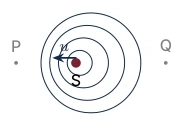
Figure F11 shows wavefronts from a source S that moves at constant speed towards listener P and away from listener Q. Both listeners are at rest. Compared with the sound S emits, what does Q detect?
| Option | wavelength | frequency | | — | — | — | | A. | longer | lower | | B. | longer | higher | | C. | shorter | lower | | D. | the same | lower |
Diagram for C.5 question A2
Show solutionHide solution
Behind a moving source each front is emitted further from the previous one, so the fronts reaching Q are spread out: longer wavelength. The sound still travels at the same speed through the air, so f=v/\lambda is lower. B and C break v=f\lambda at fixed speed; D would be true only for a moving listener.

Final answer

A

Question B1

Type B1 · Passing graph[1 mark]
A listener stands right beside a straight railway line. A train sounding a horn of constant frequency f approaches at constant speed, passes her, and moves away at the same speed. Which row describes the frequency she hears?
| Option | while it approaches | while it moves away | | — | — | — | | A. | above f, rising | below f, falling | | B. | above f, constant | below f, constant | | C. | equal to f | below f, constant | | D. | below f, constant | above f, constant |
Show solutionHide solution
On a straight line the whole velocity of the train points at her and then away from her, and it does not change, so each part of the graph is flat: higher than f on approach, lower after the pass. A describes a speed that changes, C ignores the approach, D reverses the direction test.

Final answer

B

Question B2

Type B2 · Changing speed[1 mark]
An ambulance with a siren of frequency f drives straight towards a pedestrian who is standing still. The ambulance brakes and stops before it reaches her. While it brakes, the frequency she hears is
A. above f and falling towards f.
B. above f and rising.
C. below f and falling.
D. above f at first and then below f.
Show solutionHide solution
It is still approaching, so the heard frequency is above f; as it slows the shift shrinks, and when it stops she hears exactly f. A falling frequency does not mean it is moving away (C, D): it only means it approaches more slowly.

Final answer

A

Question C1

Type C1 · Red or blue[1 mark]
Light from a star that is moving towards the Earth is compared with light from the same element in a laboratory. Which row describes the star's spectral lines?
| Option | wavelength | frequency | | — | — | — | | A. | longer | lower | | B. | longer | higher | | C. | shorter | higher | | D. | shorter | lower |
Show solutionHide solution
Approach crowds the waves: shorter wavelength, and since c=f\lambda with c fixed, higher frequency. This is a blueshift. A is the receding case; B and D break c=f\lambda.

Final answer

C

Question C2

Type C2 · Light wavelength[1 mark]
A hydrogen line of wavelength 486.1\,\mathrm{nm} in the laboratory is observed at 487.6\,\mathrm{nm} in the spectrum of a galaxy. What is the speed of the galaxy relative to the Earth?
A. 3.1\times10^{-3}\,\mathrm{m\,s^{-1}}, away from the Earth
B. 9.3\times10^{14}\,\mathrm{m\,s^{-1}}, away from the Earth
C. 9.3\times10^{5}\,\mathrm{m\,s^{-1}}, towards the Earth
D. 9.3\times10^{5}\,\mathrm{m\,s^{-1}}, away from the Earth
Show solutionHide solution
\Delta\lambda=487.6-486.1=1.5\,\mathrm{nm}; v=c\,\Delta\lambda/\lambda=3.00\times10^{8}\times1.5/486.1=9.3\times10^{5}\,\mathrm{m\,s^{-1}}. The wavelength is longer, so the galaxy recedes. A leaves out c, B mixes nanometres with metres, C has the direction backwards.

Final answer

D

Question C3

Type C3 · Light-shift graph[1 mark]
A light source moves directly away from an observer at speed v, where v\ll c. The source emits wavelength \lambda and the observer measures \lambda_{\text{obs}}. Which describes the graph of \lambda_{\text{obs}} against v?
A. a straight line through the origin with gradient \lambda/c
B. a straight line with intercept \lambda and gradient \lambda/c
C. a straight line with intercept \lambda and gradient c/\lambda
D. a curve that starts at \lambda and levels off as v increases
Show solutionHide solution
\lambda_{\text{obs}}=\lambda+\Delta\lambda=\lambda+(\lambda/c)v: a straight line, value \lambda at v=0, gradient \lambda/c. A is the graph of \Delta\lambda, not of \lambda_{\text{obs}}. C inverts the gradient. The low-speed equation is linear, so D is not what it predicts.

Final answer

B

Question D1

Type D1 · Source wavelength[1 mark]
A car horn emits sound of wavelength \lambda when the car is at rest. The car now moves directly away from a stationary listener at one quarter of the speed of sound. What wavelength reaches the listener?
A. \tfrac45\lambda   B. \tfrac54\lambda   C. \tfrac34\lambda   D. \tfrac43\lambda
Show solutionHide solution
In one period T the sound travels vT=\lambda and the car moves \tfrac14vT the other way, so successive fronts behind it are \lambda+\tfrac14\lambda=\tfrac54\lambda apart. A is the frequency factor, C is the approaching case, D inverts it.

Final answer

B

Question D2

Type D2 · Moving source[1 mark]
A drone emitting a 900\,\mathrm{Hz} tone flies directly away from a stationary microphone at 20\,\mathrm{m\,s^{-1}}. Use 340\,\mathrm{m\,s^{-1}} for the speed of sound in air. What frequency does the microphone detect?
A. 850\,\mathrm{Hz}   B. 847\,\mathrm{Hz}   C. 956\,\mathrm{Hz}   D. 953\,\mathrm{Hz}
Show solutionHide solution
Moving source, receding: f'=fv/(v+u_s)=900\times340/360=850\,\mathrm{Hz}. B uses the moving-observer form f(v-u)/v; C and D are the approaching answers from the two forms.

Final answer

A

Question D3

Type D3 · Moving observer[1 mark]
A cyclist rides at 17\,\mathrm{m\,s^{-1}} directly towards a stationary alarm that emits 600\,\mathrm{Hz}. Use 340\,\mathrm{m\,s^{-1}} for the speed of sound in air. What frequency does the cyclist hear?
A. 570\,\mathrm{Hz}   B. 571\,\mathrm{Hz}   C. 632\,\mathrm{Hz}   D. 630\,\mathrm{Hz}
Show solutionHide solution
Moving observer, approaching: f'=f(v+u_o)/v=600\times357/340=630\,\mathrm{Hz}. C uses the moving-source denominator v-u; A and B are the receding answers.

Final answer

D

Tutorial practice

Question B3

Type B3 · Radial motion[1 mark]
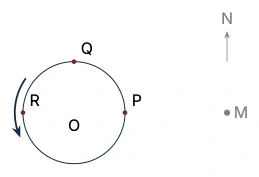
Figure F12 is a view from above. A model aircraft flies anticlockwise at constant speed around a horizontal circle with centre O. A microphone M at the same height is due east of O, at three times the radius from O. P is the point of the circle nearest to M, Q is due north of O and R is due west of O. Where is the aircraft when M detects the lowest frequency?
A. at P   B. at Q   C. at R
D. at a point between P and Q
Diagram for C.5 question B3
Show solutionHide solution
Only the part of the velocity along the line to M changes the frequency. At P and R the velocity is at right angles to that line, so M hears the emitted frequency. The lowest frequency occurs where the aircraft heads straight away from M: the tangent point from M on the arc between P and Q. At Q it is still moving partly away from M, but not directly.

Final answer

D

Question C6

Type C6 · Light wavelength[1 mark]
Two lines in the spectrum of a receding galaxy have laboratory wavelengths 400\,\mathrm{nm} and 600\,\mathrm{nm}. The 400\,\mathrm{nm} line is shifted by 2.0\,\mathrm{nm}. What is the shift of the 600\,\mathrm{nm} line?
A. 1.3\,\mathrm{nm}   B. 3.0\,\mathrm{nm}   C. 2.0\,\mathrm{nm}   D. 4.5\,\mathrm{nm}
Show solutionHide solution
Every line shifts by the same fraction, \Delta\lambda/\lambda=v/c=2.0/400=5.0\times10^{-3}, so \Delta\lambda=5.0\times10^{-3}\times600=3.0\,\mathrm{nm} (and v=1.5\times10^{6}\,\mathrm{m\,s^{-1}}). C treats the shift as the same number of nanometres, A inverts the ratio, D squares it.

Final answer

B

Question A3

Type A3 · Definition, Wavefronts[4 marks]
A toy boat moves to the right at a steady speed across a still pond. A paddle on the boat dips into the water at a constant rate and sends out circular ripples. The boat moves at half the speed of the ripples.
(a) Sketch four successive wavefronts made by the boat, and mark the boat's present position. [2]
(b) Leaf L floats ahead of the boat and leaf R behind it, both on its line of motion. Explain why L bobs up and down more often than R. [2]
Show solutionHide solution
(a) Each circle is centred on the point where the boat was when that ripple left it, so the centres step to the right while the circles grow (M1). With the boat at half the ripple speed, the spacing ahead is \tfrac12\lambda and behind \tfrac32\lambda, one third as much in front: the boat sits inside the smallest circle, ahead of its centre (A1). (b) All the ripples move at the same speed through the water (M1). Ahead of the boat they are closer together, so at that speed more crests pass L each second, f=v/\lambda, than pass R (A1).

Final answer

(a) Four circles of decreasing size whose centres move to the right; the fronts are crowded on the right (spacing one third of that on the left). (b) Ripple speed is unchanged; the wavelength ahead is shorter, so more crests reach L each second.

Question C4

Type C4 · Light frequency[4 marks]
A space probe transmits radio waves of frequency 8.40\,\mathrm{GHz} and moves directly away from the Earth at 15.0\,\mathrm{km\,s^{-1}}.
(a) Calculate the frequency received on the Earth. Give your answer to six significant figures. [2]
(b) Later in the mission the received frequency is 8.400\,28\,\mathrm{GHz}. Determine the speed of the probe and state its direction of motion relative to the Earth. [2]
Show solutionHide solution
(a) \Delta f=fv/c=8.40\times10^{9}\times1.50\times10^{4}/3.00\times10^{8}=4.20\times10^{5}\,\mathrm{Hz} (M1). The probe recedes, so the received frequency is lower: 8.399\,58\times10^{9}\,\mathrm{Hz} (A1). Rounded to three figures it would read 8.40\,\mathrm{GHz} and the shift would vanish, which is why six figures are asked for. (b) \Delta f=+2.80\times10^{5}\,\mathrm{Hz}, so v=c\,\Delta f/f=3.00\times10^{8}\times2.80\times10^{5}/8.40\times10^{9} (M1) =1.00\times10^{4}\,\mathrm{m\,s^{-1}}; the frequency is raised, so the probe now approaches the Earth (A1).

Final answer

(a) 8.399\,58\times10^{9}\,\mathrm{Hz} (b) 1.00\times10^{4}\,\mathrm{m\,s^{-1}}, towards the Earth

Question C5

Type C5 · Light wavelength[5 marks]
A star of radius 1.1\times10^{9}\,\mathrm{m} rotates about an axis at right angles to the line of sight. A sodium line with laboratory wavelength 589.000\,\mathrm{nm} is observed at 589.042\,\mathrm{nm} in light from one edge of the star's disc and at 589.018\,\mathrm{nm} from the opposite edge.
(a) Determine the speed of the star as a whole along the line of sight, and its direction. [2]
(b) Determine the speed of the star's surface at its equator. [2]
(c) Calculate the rotation period of the star, in days. [1]
Show solutionHide solution
(a) The mean of the two edges, 589.030\,\mathrm{nm}, gives the motion of the whole star: \Delta\lambda=0.030\,\mathrm{nm} (M1), v=3.00\times10^{8}\times0.030/589.0=1.5\times10^{4}\,\mathrm{m\,s^{-1}}, longer wavelength so receding (A1). (b) Each edge differs from the mean by 0.012\,\mathrm{nm}: one edge turns towards us, the other away (M1); v=3.00\times10^{8}\times0.012/589.0=6.1\times10^{3}\,\mathrm{m\,s^{-1}} (A1). (c) T=2\pi R/v=2\pi\times1.1\times10^{9}/6.11\times10^{3}=1.13\times10^{6}\,\mathrm{s}=13 days (A1).

Final answer

(a) 1.5\times10^{4}\,\mathrm{m\,s^{-1}}, away from the Earth (b) 6.1\times10^{3}\,\mathrm{m\,s^{-1}} (c) 13 days

Question D4

Type D4 · Compare readings[1 mark]
A loudspeaker emitting frequency f moves directly towards a stationary microphone at one fifth of v, the speed of sound in air. In a second run the loudspeaker is at rest and the microphone moves towards it at the same speed. What is \dfrac{\text{frequency detected in the first experiment}}{\text{frequency detected in the second}}?
A. 1   B. \tfrac{24}{25}   C. \tfrac{25}{24}   D. \tfrac54
Show solutionHide solution
Moving source: f\,v/(v-\tfrac15v)=\tfrac54f. Moving observer: f(v+\tfrac15v)/v=\tfrac65f. Ratio \tfrac54\div\tfrac65=\tfrac{25}{24}. The same relative speed does not give the same frequency for sound (A), because only source motion changes the wavelength in the air. D compares with the emitted frequency.

Final answer

C

Question D5

Type D5 · Moving observer[4 marks]
A loudspeaker fixed at the top of a lift shaft emits a steady 1200\,\mathrm{Hz}. A microphone is fixed to the roof of the lift car, directly below it. While the lift moves at constant speed the microphone records 1185\,\mathrm{Hz}. The speed of sound in the shaft is 340\,\mathrm{m\,s^{-1}}.
(a) Determine the speed of the lift, and whether it is moving up or down. [3]
(b) Calculate the frequency recorded when the lift travels the other way at the same speed. [1]
Show solutionHide solution
(a) The source is at rest and the microphone moves, so this is a moving observer (M1). The frequency is below 1200\,\mathrm{Hz}, so the microphone moves away from the loudspeaker: the lift goes down (A1). 1185=1200(340-u_o)/340 gives u_o=340(1-1185/1200)=4.25\,\mathrm{m\,s^{-1}} (A1). (b) f'=1200(340+4.25)/340=1215\,\mathrm{Hz} (A1); for a moving observer the rise and the fall are equal.

Final answer

(a) 4.25\,\mathrm{m\,s^{-1}}, moving down (away from the loudspeaker) (b) 1215\,\mathrm{Hz}

Question E1

Type E1 · Source speed · Predicted type[3 marks]
In the pit lane a racing car's engine, at a fixed rate, gives a note of 300\,\mathrm{Hz}. On the straight, with the engine at the same rate, the car drives directly towards a stationary marshal, who measures 328\,\mathrm{Hz}. Use 340\,\mathrm{m\,s^{-1}} for the speed of sound in air.
(a) Determine the speed of the car. [2]
(b) Predict the frequency the marshal measures once the car has passed and moves directly away at the same speed. [1]
Show solutionHide solution
(a) Moving source, approaching: 328=300\times340/(340-u_s) (M1), so u_s=340(1-300/328)=29.0\,\mathrm{m\,s^{-1}} (A1). (b) f'=300\times340/(340+29.0)=276\,\mathrm{Hz} (A1). The fall below 300\,\mathrm{Hz} (24\,\mathrm{Hz}) is smaller than the rise (28\,\mathrm{Hz}): the source formula is not symmetric.

Final answer

(a) 29.0\,\mathrm{m\,s^{-1}} (b) 276\,\mathrm{Hz}

Advanced practice

Question C7

Type C7 · Light frequency, Passing graph[6 marks]
A satellite in a low orbit transmits a radio signal of frequency 437.00\,\mathrm{MHz}. During one pass over a ground station the received frequency starts 10.2\,\mathrm{kHz} above 437.00\,\mathrm{MHz}, falls smoothly through 437.00\,\mathrm{MHz} when the satellite is closest, and ends about 10.2\,\mathrm{kHz} below it.
(a) Explain why the received frequency is above 437.00\,\mathrm{MHz} at the start of the pass. [1]
(b) Calculate the component of the satellite's velocity along the line of sight at the start of the pass. [2]
(c) Explain why the received frequency is 437.00\,\mathrm{MHz} when the satellite is closest. [1]
(d) Explain why the frequency changes smoothly rather than in a sudden step. [1]
(e) The orbital speed of the satellite is 7.6\,\mathrm{km\,s^{-1}}. Suggest why your answer to (b) is smaller. [1]
Show solutionHide solution
(a) The distance to the station is decreasing, so the waves arrive compressed: higher frequency (A1). (b) v=c\,\Delta f/f (M1) =3.00\times10^{8}\times10.2\times10^{3}/437.00\times10^{6}=7.0\times10^{3}\,\mathrm{m\,s^{-1}} (A1). (c) At closest approach the velocity is perpendicular to the line to the station, so there is no component towards or away from it and no shift (A1). (d) The satellite does not pass through the station: the angle between its velocity and the line of sight turns gradually, so the component, and with it the shift, changes gradually (A1). (e) The station is off to the side of the track, so even at the start of the pass the velocity makes an angle with the line of sight; only v\cos\theta counts (A1).

Final answer

(a) it approaches the station (b) 7.0\times10^{3}\,\mathrm{m\,s^{-1}} (c) its velocity is at right angles to the line of sight (d) the line-of-sight component changes gradually (e) the line of sight is never quite along the velocity

Question E2

Type E2 · Equal frequencies[5 marks]
Two stationary warning horns stand at the ends of a straight track. Horn A, at the west end, emits 480\,\mathrm{Hz}; horn B, at the east end, emits 520\,\mathrm{Hz}. A worker rides a trolley along the track between them at constant speed and hears both horns at the same frequency. Use 340\,\mathrm{m\,s^{-1}} for the speed of sound in air.
(a) Explain why the trolley must be moving towards A. [2]
(b) Determine the speed of the trolley. [2]
(c) Calculate the frequency that the worker hears. [1]
Show solutionHide solution
(a) A moving observer hears a higher frequency from a source it approaches and a lower one from a source it leaves (M1). The lower note must be raised and the higher one lowered, so the trolley approaches A and leaves B (A1). (b) Both horns are at rest, so use the observer form twice with opposite signs: 480(340+u)/340=520(340-u)/340 (M1), giving u=340\times40/1000=13.6\,\mathrm{m\,s^{-1}} (A1). (c) 480\times353.6/340=499\,\mathrm{Hz}; check: 520\times326.4/340=499\,\mathrm{Hz}, between the two emitted values (A1).

Final answer

(a) approaching A raises its 480\,\mathrm{Hz}, leaving B lowers its 520\,\mathrm{Hz} (b) 13.6\,\mathrm{m\,s^{-1}} (c) 499\,\mathrm{Hz}

Question E3

Type E3 · Two unknowns, Passing graph · Predicted type[6 marks]
A train sounds its horn continuously as it runs along a straight track at constant speed. A sensor on a post right beside the track records 612\,\mathrm{Hz} while the train approaches and 548\,\mathrm{Hz} after it has passed. Use 340\,\mathrm{m\,s^{-1}} for the speed of sound in air.
(a) Explain why the frequency recorded during the approach is higher than the frequency the horn emits. [1]
(b) Determine the speed of the train. [3]
(c) Determine the frequency emitted by the horn. [1]
(d) The sensor is moved 40\,\mathrm{m} to the side of the track. State how the graph of recorded frequency against time changes. [1]
Show solutionHide solution
(a) Each front is emitted closer to the sensor than the one before, so the fronts ahead are crowded; at the same speed of sound, more arrive each second (A1). (b) 612=f\times340/(340-u) and 548=f\times340/(340+u) (M1). Dividing removes f: 612/548=(340+u)/(340-u) (M1), so u=340\times64/1160=18.8\,\mathrm{m\,s^{-1}} (A1). (c) f=612(340-18.76)/340=578\,\mathrm{Hz} (A1); equivalently f=2\times612\times548/(612+548). (d) Far from the post the line of sight is almost along the track, so the two end values stay; near the post the component of velocity towards the sensor falls gradually through zero, so the frequency falls smoothly through 578\,\mathrm{Hz} (A1).

Final answer

(a) fronts crowded ahead of the train (b) 18.8\,\mathrm{m\,s^{-1}} (c) 578\,\mathrm{Hz} (d) the same two values far from the post, joined by a smooth fall instead of a step

Question B5

Type B5 · Radial motion, Source speed[6 marks]
A small buzzer that emits 1200\,\mathrm{Hz} is whirled on a cord in a horizontal circle of radius 0.90\,\mathrm{m} at constant speed. A microphone far away, in the plane of the circle, records a frequency that varies between a maximum of 1240\,\mathrm{Hz} and a minimum. Use 340\,\mathrm{m\,s^{-1}} for the speed of sound in air.
(a) State where the buzzer is on the circle when the microphone records 1240\,\mathrm{Hz}. [1]
(b) Determine the speed of the buzzer. [2]
(c) Calculate the time for one revolution. [2]
(d) Calculate the minimum frequency recorded. [1]
Show solutionHide solution
(a) At the point where the velocity points directly at the microphone (the tangent point on the approaching side), because then the whole speed is along the line of sight (A1). The nearest point does not give the maximum. (b) 1240=1200\times340/(340-u) (M1), so u=340(1-1200/1240)=11.0\,\mathrm{m\,s^{-1}} (A1). (c) T=2\pi r/u (M1) =2\pi\times0.90/10.97=0.52\,\mathrm{s} (A1). (d) f=1200\times340/(340+10.97)=1.16\times10^{3}\,\mathrm{Hz} (1162.5\,\mathrm{Hz}) (A1).

Final answer

(a) where its velocity points straight at the microphone (b) 11.0\,\mathrm{m\,s^{-1}} (c) 0.52\,\mathrm{s} (d) 1.16\times10^{3}\,\mathrm{Hz}

Question D6

Type D6 · Source wavelength, Moving source, Compare readings[7 marks]
In a ripple tank, water waves travel at 0.24\,\mathrm{m\,s^{-1}}. A dipper vibrating at 8.0\,\mathrm{Hz} moves in a straight line across the tank at 0.060\,\mathrm{m\,s^{-1}}.
(a) Calculate the wavelength the dipper would produce if it were stationary. [1]
(b) Determine the wavelengths of the waves ahead of the dipper and behind it. [2]
(c) A cork floats ahead of the dipper, on its line of motion. Calculate the frequency at which the cork bobs. [2]
(d) The dipper is now held still and the cork is moved towards it at 0.060\,\mathrm{m\,s^{-1}}. Calculate the new bobbing frequency, and explain why it differs from your answer to (c). [2]
Show solutionHide solution
(a) \lambda=v/f=0.24/8.0=0.030\,\mathrm{m} (A1). (b) In one period (0.125\,\mathrm{s}) a crest moves 0.030\,\mathrm{m} while the dipper moves 0.0075\,\mathrm{m} (M1): ahead 0.030-0.0075=0.0225\,\mathrm{m}, behind 0.0375\,\mathrm{m} (A1). (c) The waves still travel at 0.24\,\mathrm{m\,s^{-1}} (M1): f=0.24/0.0225=10.7\,\mathrm{Hz}, the same as 8.0\times0.24/(0.24-0.060) (A1). (d) f=8.0(0.24+0.060)/0.24=10.0\,\mathrm{Hz} (A1). The waves in the water are now 0.030\,\mathrm{m} long; the cork meets them at 0.30\,\mathrm{m\,s^{-1}} relative to the waves, which raises the rate less than shortening the waves did (A1).

Final answer

(a) 0.030\,\mathrm{m} (b) 0.0225\,\mathrm{m} ahead, 0.0375\,\mathrm{m} behind (c) 10.7\,\mathrm{Hz} (d) 10.0\,\mathrm{Hz}; a moving dipper shortens the waves in the water, a moving cork only meets unchanged waves faster

Connected questions

Question X1

Type X1 · C.5 · B.1[7 marks]
The spectrum of star R has its peak intensity at 414\,\mathrm{nm}. A hydrogen absorption line with laboratory wavelength 656.28\,\mathrm{nm} appears at 656.39\,\mathrm{nm} in the spectrum of R. The radius of R is 1.25\times10^{9}\,\mathrm{m}.
(a) Calculate the surface temperature of R. [1]
(b) Determine the speed of R along the line of sight and state whether it is approaching or receding. [2]
(c) The motion of R also shifts the peak of its spectrum. Estimate this shift and comment on whether it affects your answer to (a). [2]
(d) Determine the luminosity of R. [2]
Show solutionHide solution
(a) T=\frac{2.9\times10^{-3}}{414\times10^{-9}}=7.0\times10^{3}\,\mathrm{K} (A1). (b) \Delta\lambda=0.11\,\mathrm{nm}; v=c\,\Delta\lambda/\lambda=3.00\times10^{8}\times0.11/656.28 (M1) =5.0\times10^{4}\,\mathrm{m\,s^{-1}}; longer wavelength, so receding (A1). (c) Every wavelength stretches by the same fraction, 0.11/656.28=1.7\times10^{-4}, so the peak moves by 414\times1.7\times10^{-4}=0.07\,\mathrm{nm} (M1). T\propto1/\lambda_{\max} changes by the same 0.017\%: far below the precision of the data (A1). (d) Stefan–Boltzmann with the surface area 4\pi R^2, R=1.25\times10^{9}\,\mathrm{m} and T=7.0\times10^{3}\,\mathrm{K} (M1): L=2.7\times10^{27}\,\mathrm{W} (A1).

Final answer

(a) 7.0\times10^{3}\,\mathrm{K} (b) 5.0\times10^{4}\,\mathrm{m\,s^{-1}}, receding (c) about 0.07\,\mathrm{nm}; it changes T by under 0.02\%, negligible (d) 2.7\times10^{27}\,\mathrm{W}

Question X2

Type X2 · C.5 · D.1 · A.2[7 marks]
A star moves in a circular orbit around an unseen companion of much larger mass. The orbit is seen edge-on from the Earth, and the pair as a whole is not moving relative to the Earth. A hydrogen line of laboratory wavelength 656.28\,\mathrm{nm} in the star's spectrum varies between 655.84\,\mathrm{nm} and 656.72\,\mathrm{nm} with a period of 5.6 days.
(a) Show that the orbital speed of the star is about 2.0\times10^{5}\,\mathrm{m\,s^{-1}}. [2]
(b) Calculate the radius of the orbit. [2]
(c) Determine the mass of the companion in solar masses. M_{\odot}=1.99\times10^{30}\,\mathrm{kg}. [2]
(d) Explain why the line is observed at 656.28\,\mathrm{nm} twice in each orbit. [1]
Show solutionHide solution
(a) The largest shift is 656.72-656.28=0.44\,\mathrm{nm} (M1), when the star moves straight away; v=3.00\times10^{8}\times0.44/656.28=2.01\times10^{5}\,\mathrm{m\,s^{-1}} (A1). (b) T=5.6\times86\,400=4.84\times10^{5}\,\mathrm{s}; r=vT/2\pi (M1) =2.01\times10^{5}\times4.84\times10^{5}/2\pi=1.55\times10^{10}\,\mathrm{m} (A1). (c) The companion's pull is what keeps the star on its circle; per kilogram of star, GM/r^2=v^2/r, giving M=rv^2/G (M1) =1.55\times10^{10}\times(2.01\times10^{5})^2/6.67\times10^{-11}=9.4\times10^{30}\,\mathrm{kg}=4.7\,M_{\odot} (A1). (d) Twice in each orbit the star moves at right angles to the line of sight, so it has no velocity component towards or away from the Earth (A1).

Final answer

(a) 2.01\times10^{5}\,\mathrm{m\,s^{-1}} (b) 1.55\times10^{10}\,\mathrm{m} (c) 9.4\times10^{30}\,\mathrm{kg}=4.7\,M_{\odot} (d) twice per orbit the velocity is across the line of sight

Question X3

Type X3 · C.5 · C.4[7 marks]
A toy train carries a whistle made from a pipe 0.150\,\mathrm{m} long, closed at one end. Ignore end effects. Use 340\,\mathrm{m\,s^{-1}} for the speed of sound in air.
(a) Show that the fundamental frequency of the pipe is about 570\,\mathrm{Hz}. [1]
(b) State the frequency of the next harmonic the pipe can produce. [1]
(c) The train moves at 12\,\mathrm{m\,s^{-1}} directly towards a stationary listener while the whistle sounds its fundamental. Calculate the frequency the listener hears. [2]
(d) Calculate the wavelength of this sound in the air between the train and the listener. [2]
(e) Explain why the motion of the train does not change the frequency at which the air in the pipe resonates. [1]
Show solutionHide solution
(a) Closed at one end: L=\lambda/4, so f=v/4L=340/0.600=567\,\mathrm{Hz} (A1). (b) Only odd harmonics: 3\times567=1.70\times10^{3}\,\mathrm{Hz} (A1). (c) Moving source, approaching: f'=567\times340/(340-12) (M1) =587\,\mathrm{Hz} (A1). (d) \lambda'=(v-u_s)/f=328/566.7 (M1) =0.579\,\mathrm{m}; check: 340/587.4=0.579\,\mathrm{m} (A1). (e) The air column travels with the pipe, so its length and the speed of sound relative to it are unchanged: the standing wave and its frequency are the same. Only the waves outside, in air that is not moving with the train, are compressed (A1).

Final answer

(a) 567\,\mathrm{Hz} (b) 1.70\times10^{3}\,\mathrm{Hz} (c) 587\,\mathrm{Hz} (d) 0.579\,\mathrm{m} (e) the air in the pipe moves with the pipe, so the standing wave inside is unchanged

Question X4

Type X4 · C.5 · A.1[7 marks]
An ambulance with a siren of frequency 800\,\mathrm{Hz} drives straight towards a pedestrian who is standing still. At t=0 it starts to brake with constant deceleration, and it stops 8.0\,\mathrm{s} later, before reaching her. At t=0 she hears 850\,\mathrm{Hz}. Use 340\,\mathrm{m\,s^{-1}} for the speed of sound in air. Take t as the time the sound is emitted and ignore the travel time of the sound.
(a) Show that the speed of the ambulance at t=0 is 20\,\mathrm{m\,s^{-1}}. [2]
(b) Calculate the deceleration. [1]
(c) Calculate the distance the ambulance travels while braking. [1]
(d) Calculate the frequency she hears for sound emitted at t=4.0\,\mathrm{s}. [2]
(e) Explain why the answer to (d) is not exactly halfway between 850\,\mathrm{Hz} and 800\,\mathrm{Hz}. [1]
Show solutionHide solution
(a) 850=800\times340/(340-u) (M1), so u=340(1-800/850)=20.0\,\mathrm{m\,s^{-1}} (A1). (b) a=\Delta v/\Delta t=20/8.0=2.5\,\mathrm{m\,s^{-2}} (A1). (c) s=\tfrac12(20+0)\times8.0=80\,\mathrm{m} (A1). (d) At t=4.0\,\mathrm{s}, u=20-2.5\times4.0=10\,\mathrm{m\,s^{-1}} (M1); f'=800\times340/330=824\,\mathrm{Hz} (A1). (e) The speed halves, but f'=fv/(v-u) is not a straight-line function of u, so equal falls in speed give slightly unequal falls in frequency (26\,\mathrm{Hz} then 24\,\mathrm{Hz}) (A1).

Final answer

(a) 20.0\,\mathrm{m\,s^{-1}} (b) 2.5\,\mathrm{m\,s^{-2}} (c) 80\,\mathrm{m} (d) 824\,\mathrm{Hz} (e) f' is not proportional to the speed

From the book

Photon Physics: Study Guide for the IB Diploma (SL & HL)

Doppler effect from the core ideas to full exam questions, with question types, worked examples and graded practice.

About the book