Free worked solutions · 2026 Edition

IB Physics C.2: Wave model worked solutions

Worked solutions to every practice question in C.2: Wave model of Photon Physics: Study Guide for the IB Diploma (SL & HL). Try each question, then compare your working with the full solution.

  • SL & HL
  • 31 questions
  • Full worked solutions
  • Free, no sign-up

Basic practice

Question B1

Type B1 · Type N1 · Transverse or longitudinal[1 mark]
A wave travels through rock. The rock particles vibrate parallel to the direction in which the wave carries energy. Which row describes this wave?
A. transverse; it needs a medium
B. longitudinal; it needs a medium
C. longitudinal; it can also cross a vacuum
D. transverse; it can also cross a vacuum
Show solutionHide solution
Vibration parallel to the energy transfer makes the wave longitudinal (A and D fail). The rock particles are the medium: a mechanical wave needs matter to pass the disturbance on, so it cannot cross a vacuum (C fails). Check both halves of every row.

Final answer

B
Question B2

Type B2 · Type N3 · EM region[1 mark]
An electromagnetic wave has a wavelength of 5\times10^{-6}\,\mathrm{m} in a vacuum. In which region of the spectrum is it?
A. ultraviolet   B. visible   C. infrared   D. microwave
Show solutionHide solution
5\times10^{-6}\,\mathrm{m}=5\,\mathrm{\mu m}. Visible light runs from about 4\times10^{-7} to 7\times10^{-7}\,\mathrm{m}, so this wave is about ten times longer than red light: infrared (order 10^{-5}\,\mathrm{m} in the booklet). B treats micrometres as tenths of a micrometre; A goes the wrong way along the spectrum; microwaves are of order 10^{-2}\,\mathrm{m}.

Final answer

C

Question B3

Type B3 · Type G2 · Distances along a wave[1 mark]
A water wave has a wavelength of 1.2\,\mathrm{m} and an amplitude of 0.15\,\mathrm{m}. What is the distance, measured along the direction of travel, from a crest to the nearest trough?
A. 0.15\,\mathrm{m}   B. 0.30\,\mathrm{m}   C. 0.60\,\mathrm{m}   D. 1.2\,\mathrm{m}
Show solutionHide solution
A crest and the next trough are half a cycle apart along the wave: \lambda/2=0.60\,\mathrm{m}. B is 2A, the vertical drop from crest to trough, a distance across the wave, not along it. D is a full wavelength (crest to crest).

Final answer

C

Question B4

Type B4 · Type G1 · Period from a time graph[1 mark]
A point on a vibrating string reaches its greatest displacement, 4.0\,\mathrm{mm}, at t=5.0\,\mathrm{ms} and next reaches it at t=25.0\,\mathrm{ms}. What are the period and the frequency of the wave?
A. 20\,\mathrm{ms}; 50\,\mathrm{Hz}   B. 10\,\mathrm{ms}; 100\,\mathrm{Hz}
C. 20\,\mathrm{ms}; 0.050\,\mathrm{Hz}   D. 25\,\mathrm{ms}; 40\,\mathrm{Hz}
Show solutionHide solution
One period separates two successive maxima of the same point: T=25.0-5.0=20\,\mathrm{ms}, and f=1/T=1/0.020=50\,\mathrm{Hz}. B takes a maximum-to-minimum gap; C forgets to convert ms to s; D reads the time of the second maximum as the period.

Final answer

A

Question B5

Type B5 · Type S1 · Distance travelled[2 marks]
A tuning fork vibrates at 425\,\mathrm{Hz} in air, where sound travels at 340\,\mathrm{m\,s^{-1}}.
(a) Calculate the wavelength of the sound. [1]
(b) Determine how far the sound has travelled from the fork while the fork makes 50 oscillations. [1]
Show solutionHide solution
(a) \lambda=v/f=340/425=0.800\,\mathrm{m} (A1). (b) Each oscillation sends out one more wavelength, so the front of the sound is 50\lambda=50(0.800)=40.0\,\mathrm{m} away (A1). Check with time: t=50/425=0.118\,\mathrm{s} and vt=40.0\,\mathrm{m}.

Final answer

(a) 0.800\,\mathrm{m} (b) 40.0\,\mathrm{m}

Question B6

Type B6 · Type S3 · Change the frequency · Predicted type[1 mark]
A student shakes the end of a long rope at 2.0\,\mathrm{Hz} and makes waves of wavelength 1.5\,\mathrm{m}. She then shakes it at 3.0\,\mathrm{Hz} without changing the tension. What are the new wavelength and wave speed?
A. \lambda=1.0\,\mathrm{m}, v=3.0\,\mathrm{m\,s^{-1}}   B. \lambda=1.5\,\mathrm{m}, v=4.5\,\mathrm{m\,s^{-1}}
C. \lambda=2.25\,\mathrm{m}, v=6.75\,\mathrm{m\,s^{-1}}   D. \lambda=1.0\,\mathrm{m}, v=2.0\,\mathrm{m\,s^{-1}}
Show solutionHide solution
The rope, not the hand, sets the speed: v=f\lambda=2.0(1.5)=3.0\,\mathrm{m\,s^{-1}} before and after. New wavelength \lambda=v/f=3.0/3.0=1.0\,\mathrm{m}. B assumes the speed rises with the frequency, C makes the wavelength grow with the frequency, D multiplies the new wavelength by the old frequency.

Final answer

A

Question B7

Type B7 · Type M2 · Particle direction[1 mark]
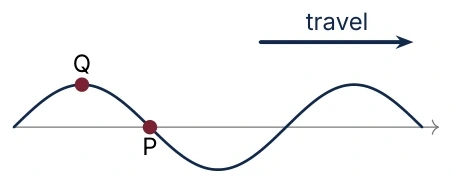
A transverse wave travels to the right along a rope. At one instant, point P is at zero displacement with a crest just to its left and a trough just to its right; point Q is at a crest. In which directions are P and Q moving at this instant?
A. P upwards; Q momentarily at rest   B. P downwards; Q momentarily at rest
C. P upwards; Q downwards   D. P to the right; Q to the right
Diagram for C.2 question B7
Show solutionHide solution
Shift the whole pattern a little to the right and read the new displacement at the same place. The crest on P's left moves onto P, so P rises. Q sits at the top of its oscillation, where it stops for an instant before coming down. D moves the rope along with the wave: rope points only move up and down.

Final answer

A

Question B8

Type B8 · Type M1 · Phase difference[1 mark]
A wave of frequency 50\,\mathrm{Hz} travels at 20\,\mathrm{m\,s^{-1}}. What is the phase difference between two points on the wave that are 0.10\,\mathrm{m} apart along the direction of travel?
A. \pi/4   B. \pi/2   C. \pi   D. 2\pi
Show solutionHide solution
\lambda=v/f=20/50=0.40\,\mathrm{m}. The points are 0.10/0.40=\tfrac14 of a wavelength apart, so the phase difference is \tfrac14(2\pi)=\pi/2. C is the half-wavelength answer; D would need the points to be a whole wavelength apart.

Final answer

B

Question B9

Type B9 · Type I1 · Intensity and amplitude[1 mark]
In the same medium and at the same frequency, the amplitude of a wave falls to one third of its value. The intensity was I. What is it now?
A. I/9   B. I/3   C. I/\sqrt3   D. 3I
Show solutionHide solution
I\propto A^2, so I_{\text{new}}=I(1/3)^2=I/9. B treats intensity as proportional to amplitude; C takes a square root instead of squaring.

Final answer

A

Question B10

Type B10 · Type I2 · Inverse-square spreading[2 marks]
A small loudspeaker radiates 0.50\,\mathrm{W} of sound equally in all directions.
(a) Calculate the intensity of the sound 4.0\,\mathrm{m} from the loudspeaker. [1]
(b) State the intensity 8.0\,\mathrm{m} from the loudspeaker. [1]
Show solutionHide solution
(a) The power spreads over a sphere: I=P/4\pi r^2=0.50/(4\pi\times4.0^2)=2.49\times10^{-3}\,\mathrm{W\,m^{-2}} (A1). (b) Twice the distance spreads the same power over four times the area: I/4=6.2\times10^{-4}\,\mathrm{W\,m^{-2}} (A1).

Final answer

(a) 2.5\times10^{-3}\,\mathrm{W\,m^{-2}} (b) 6.2\times10^{-4}\,\mathrm{W\,m^{-2}}

Question B11

Type B11 · Type N4 · EM field directions[1 mark]
An electromagnetic wave travels vertically upwards. At one point the electric field of the wave points north. In which direction could the magnetic field of the wave point at that point?
A. up   B. north   C. west   D. down
Show solutionHide solution
The electric field, the magnetic field and the direction of travel are mutually perpendicular. The magnetic field must be horizontal (not up or down, A and D) and at right angles to north (not B): west.

Final answer

C

Question B12

Type B12 · Type N2 · Energy, not matter · Predicted type[2 marks]
A ribbon is tied to the middle of a long horizontal rope. A pulse is sent along the rope and, when it reaches the far end, it shakes a small bell fixed there.
(a) Describe the motion of the ribbon as the pulse passes it. [1]
(b) Explain how the bell gains energy even though the ribbon does not move towards it. [1]
Show solutionHide solution
(a) The ribbon is displaced at right angles to the rope and then returns to its original position; it has no net displacement along the rope (A1). (b) As each short section is displaced it pulls on the section ahead and does work on it; energy is handed on section by section to the far end, while every section only oscillates about its own position (A1).

Final answer

(a) up (at right angles to the rope) and back to where it started (b) each part of the rope pulls on the next and does work on it, so energy passes along the rope while the rope stays in place

Tutorial practice

Question T1

Type T1 · Type G4 · Two graphs; Type G1 · Period from a time graph[5 marks]
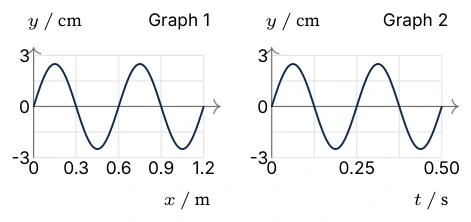
A transverse wave travels along a long stretched spring. Graph 1 shows the displacement y of the spring against distance x at one instant: two complete cycles fill 1.20\,\mathrm{m} and the crests are 2.5\,\mathrm{cm} above the undisturbed line. Graph 2 shows the displacement of one point of the spring against time: one complete oscillation takes 0.25\,\mathrm{s}.
(a) State the amplitude of the wave. [1]
(b) Determine the speed of the wave. [2]
(c) Calculate the total distance moved by one point of the spring in 1.0\,\mathrm{s}, and compare it with the distance the wave travels in that time. [2]
Diagram for C.2 question T1
Show solutionHide solution
(a) Equilibrium to crest: 2.5\,\mathrm{cm} (A1). (b) Graph 1 gives \lambda=1.20/2=0.60\,\mathrm{m} and graph 2 gives T=0.25\,\mathrm{s} (M1); v=\lambda/T=0.60/0.25=2.4\,\mathrm{m\,s^{-1}} (A1). (c) In 1.0\,\mathrm{s} the point makes 1.0/0.25=4 oscillations and covers 4A=10\,\mathrm{cm} in each (M1): 40\,\mathrm{cm}=0.40\,\mathrm{m}, up and down on the spot, while the wave moves 2.4\,\mathrm{m} along the spring (A1).

Final answer

(a) 2.5\,\mathrm{cm} (b) 2.4\,\mathrm{m\,s^{-1}} (c) 0.40\,\mathrm{m}, against 2.4\,\mathrm{m} for the wave

Question T2

Type T2 · Type G3 · Speed from a snapshot; Type S3 · Change the frequency · Predicted type[4 marks]
Straight ripples are made in a ripple tank by a bar vibrating at 12\,\mathrm{Hz}. A photograph, drawn to full size, shows that the distance from the first bright crest to the fifth bright crest is 6.0\,\mathrm{cm}.
(a) Determine the wavelength of the ripples. [1]
(b) Calculate the speed of the ripples. [1]
(c) The bar's frequency is raised to 16\,\mathrm{Hz} and the water depth is unchanged. Calculate the new wavelength and explain your reasoning. [2]
Show solutionHide solution
(a) First to fifth crest is four gaps: \lambda=6.0/4=1.5\,\mathrm{cm} (A1); 6.0/5 counts crests, not gaps. (b) v=f\lambda=12(0.015)=0.18\,\mathrm{m\,s^{-1}} (A1). (c) The speed depends on the water (its depth), not on the source, so v stays 0.18\,\mathrm{m\,s^{-1}} (M1); \lambda=0.18/16=1.1\times10^{-2}\,\mathrm{m}=1.1\,\mathrm{cm} (A1).

Final answer

(a) 1.5\,\mathrm{cm} (b) 0.18\,\mathrm{m\,s^{-1}} (c) 1.1\,\mathrm{cm}; the speed is set by the water, so it is unchanged

Question T3

Type T3 · Type M5 · Find the compression[1 mark]
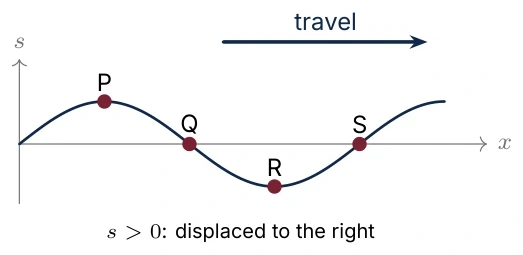
A sound wave travels to the right through air. The graph shows the displacement s of the air layers against position x at one instant; a positive s means a displacement to the right. P is at a maximum of s, Q is where s is zero and falling, R is at a minimum of s and S is where s is zero and rising. At which point are the air layers most crowded together?
A. P   B. Q   C. R   D. S
Diagram for C.2 question T3
Show solutionHide solution
At Q the layers just to the left have positive displacement (pushed right, towards Q) and the layers just to the right have negative displacement (pushed left, towards Q): they crowd together, a compression. At S they move apart (rarefaction). At P and R neighbouring layers are displaced by almost the same amount, so the air there has its normal spacing: the largest displacement is not the largest pressure.

Final answer

B

Question T4

Type T4 · Type M6 · Particle positions[5 marks]
Nine markers, numbered 0 to 8, are fixed 5.0\,\mathrm{cm} apart along a long horizontal spring. A longitudinal wave of frequency 4.0\,\mathrm{Hz} travels along the spring. At one instant the markers are at these distances from the undisplaced position of marker 0, in cm: 0.0,\ 6.1,\ 11.5,\ 16.1,\ 20.0,\ 23.9,\ 28.5,\ 33.9,\ 40.0.
(a) Determine the amplitude of the wave. [1]
(b) Identify the marker at the centre of a compression. Explain your answer. [2]
(c) Determine the wavelength. [1]
(d) Calculate the speed of the wave. [1]
Show solutionHide solution
(a) Displacement = actual position minus equilibrium position 5.0n: 0,\ +1.1,\ +1.5,\ +1.1,\ 0,\ -1.1,\ -1.5,\ -1.1,\ 0\,\mathrm{cm}. The largest is 1.5\,\mathrm{cm} (A1). (b) Marker 4: marker 3 is displaced towards it and marker 5 is displaced towards it (M1), so markers 3 and 5 are 7.9\,\mathrm{cm} apart instead of 10\,\mathrm{cm} (A1). (c) Markers 0 and 8 are rarefaction centres (their neighbours move away from them); the next rarefaction is one wavelength on: \lambda=40\,\mathrm{cm} (A1). Not 5.0\,\mathrm{cm}: that is the marker spacing. (d) v=f\lambda=4.0(0.40)=1.6\,\mathrm{m\,s^{-1}} (A1).

Final answer

(a) 1.5\,\mathrm{cm} (b) marker 4 (c) 40\,\mathrm{cm} (d) 1.6\,\mathrm{m\,s^{-1}}

Question T5

Type T5 · Type I3 · Source and distance; Type I1 · Intensity and amplitude[1 mark]
A small source radiates sound equally in all directions. Its power is doubled and a listener moves from 2.0\,\mathrm{m} to 4.0\,\mathrm{m} from it. What is \dfrac{\text{new amplitude}}{\text{old amplitude}} at the listener?
A. 0.25   B. 0.50   C. 0.71   D. 1.0
Show solutionHide solution
Intensity ratio =2\times(2.0/4.0)^2=0.50; amplitude ratio =\sqrt{0.50}=0.71. B stops at the intensity ratio; A ignores the doubled power; D applies the inverse square law to the amplitude and the power ratio to it as well.

Final answer

C

Question T6

Type T6 · Type S2 · Arrival interval; Type S1 · Distance travelled[5 marks]
A worker strikes a steel rail with a hammer. A student 680\,\mathrm{m} away along the track hears two bangs, one through the rail and one through the air. Sound travels at 5.1\times10^{3}\,\mathrm{m\,s^{-1}} in steel and 340\,\mathrm{m\,s^{-1}} in air.
(a) Explain why there are two bangs. [1]
(b) Calculate the time between the two bangs. [2]
(c) The sound has a frequency of 850\,\mathrm{Hz}. Calculate its wavelength in the steel and in the air. [2]
Show solutionHide solution
(a) The same disturbance travels by two media at different speeds, so it arrives at two different times (A1). (b) t_{\text{air}}=680/340=2.00\,\mathrm{s} and t_{\text{steel}}=680/5100=0.133\,\mathrm{s} (M1); interval =1.87\,\mathrm{s} (A1). Subtracting the speeds first gives nothing useful. (c) The hammer sets the frequency in both: \lambda_{\text{steel}}=5100/850=6.0\,\mathrm{m} (A1), \lambda_{\text{air}}=340/850=0.40\,\mathrm{m} (A1).

Final answer

(a) the two paths have different wave speeds (b) 1.87\,\mathrm{s} (c) 6.0\,\mathrm{m} in steel; 0.40\,\mathrm{m} in air

Question T7

Type T7 · Type N1 · Transverse or longitudinal; Type N3 · EM region; Type N4 · EM field directions[4 marks]
A microwave oven and a loudspeaker both send waves into a kitchen.
(a) Outline two differences between sound waves and microwaves. [2]
(b) The oven works at 2.45\,\mathrm{GHz}. Calculate the wavelength of its microwaves in air. [1]
(c) A microwave travels horizontally due east. At one point its electric field is vertical. State the direction of its magnetic field at that point. [1]
Show solutionHide solution
(a) Any two of: sound is longitudinal while microwaves are transverse; sound needs a material medium while microwaves also travel through a vacuum; in sound, particles of the air oscillate, in a microwave the electric and magnetic fields oscillate; sound travels at about 340\,\mathrm{m\,s^{-1}} in air, microwaves at about 3.0\times10^{8}\,\mathrm{m\,s^{-1}} (A1 each). (b) \lambda=c/f=3.00\times10^{8}/2.45\times10^{9}=0.122\,\mathrm{m} (A1). (c) The magnetic field is perpendicular to both the vertical electric field and the eastward travel: horizontal, along the north–south line (A1).

Final answer

(a) any two: sound is longitudinal, microwaves transverse; sound needs a medium, microwaves cross a vacuum; sound is an oscillation of matter, microwaves of electric and magnetic fields; speeds \sim10^{2} against 3.0\times10^{8}\,\mathrm{m\,s^{-1}} (b) 0.122\,\mathrm{m} (c) horizontal, north–south

Question T8

Type T8 · Type M3 · Marker later[1 mark]
A transverse wave of period 0.80\,\mathrm{s} travels to the right along a rope. At t=0 a paint mark M on the rope is at zero displacement and moving downwards. Where is M at t=0.60\,\mathrm{s}?
A. at a crest, at the same horizontal position
B. at a trough, at the same horizontal position
C. at zero displacement, three quarters of a wavelength further right
D. at zero displacement, moving upwards
Show solutionHide solution
0.60/0.80=\tfrac34 of a cycle. Starting at zero and moving down, M reaches the trough after \tfrac14 cycle, zero (moving up) after \tfrac12 and the crest after \tfrac34. It never moves along the rope, so C is wrong; B stops after a quarter cycle; D after half a cycle.

Final answer

A

Question T9

Type T9 · Type I2 · Inverse-square spreading; Type I1 · Intensity and amplitude[4 marks]
A radio transmitter radiates 5.0\,\mathrm{kW} equally in all directions.
(a) Calculate the intensity of the radio waves 10\,\mathrm{km} from the transmitter. [1]
(b) Determine the distance at which the intensity is one quarter of your answer to (a). [1]
(c) Determine the ratio \dfrac{\text{amplitude at that distance}}{\text{amplitude at }10\,\mathrm{km}}. Explain your answer. [2]
Show solutionHide solution
(a) I=P/4\pi r^2=5.0\times10^{3}/(4\pi(1.0\times10^{4})^2)=3.98\times10^{-6}\,\mathrm{W\,m^{-2}} (A1). (b) I\propto1/r^2: one quarter at twice the distance, 20\,\mathrm{km} (A1). (c) I\propto A^2 (M1), so the amplitude falls by \sqrt{1/4}=0.50 (A1); a quarter of the amplitude would need I/16.

Final answer

(a) 4.0\times10^{-6}\,\mathrm{W\,m^{-2}} (b) 20\,\mathrm{km} (c) 0.50

Question T10

Type T10 · Type G1 · Period from a time graph; Type S1 · Distance travelled[4 marks]
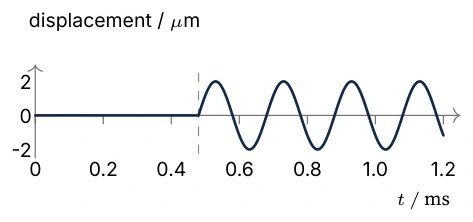
One end of a long steel rod is struck at t=0. A sensor 2.4\,\mathrm{m} along the rod records the longitudinal displacement of the rod at that point. The trace stays at zero until t=0.48\,\mathrm{ms}, then oscillates with an amplitude of 2.0\,\mathrm{\mu m}, completing one oscillation every 0.20\,\mathrm{ms}.
(a) State the amplitude of the wave. [1]
(b) Calculate the frequency of the wave. [1]
(c) Calculate the speed of the wave in the rod. [1]
(d) Calculate the wavelength. [1]
Diagram for C.2 question T10
Show solutionHide solution
(a) 2.0\,\mathrm{\mu m}=2.0\times10^{-6}\,\mathrm{m} (A1). (b) f=1/T=1/(0.20\times10^{-3})=5.0\times10^{3}\,\mathrm{Hz} (A1). (c) The disturbance needs 0.48\,\mathrm{ms} to cover 2.4\,\mathrm{m}: v=2.4/0.48\times10^{-3}=5.0\times10^{3}\,\mathrm{m\,s^{-1}} (A1). (d) \lambda=v/f=1.0\,\mathrm{m} (A1).

Final answer

(a) 2.0\,\mathrm{\mu m} (b) 5.0\times10^{3}\,\mathrm{Hz} (c) 5.0\times10^{3}\,\mathrm{m\,s^{-1}} (d) 1.0\,\mathrm{m}

Advanced practice

Question V1

Type V1 · Type G5 · Profile shift; Type M2 · Particle direction[7 marks]
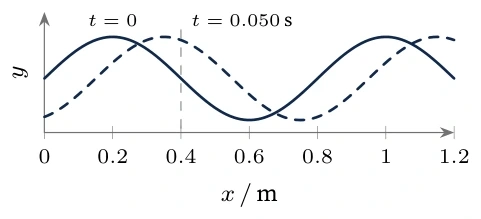
A wave travels to the right along a string. The graph shows the string at t=0 (solid line) and at t=0.050\,\mathrm{s} (dashed line); less than one period separates them. The wavelength is 0.80\,\mathrm{m}. A crest at x=0.20\,\mathrm{m} on the solid line has reached x=0.35\,\mathrm{m} on the dashed line.
(a) Determine the speed of the wave. [2]
(b) Calculate the frequency of the wave. [1]
(c) Without the information that less than one period separates the two lines, another speed would fit the graph. Calculate the next larger possible speed. [1]
(d) State the direction of motion at t=0 of the point of the string at x=0.40\,\mathrm{m}. [1]
(e) Calculate the time after t=0 at which this point first reaches a crest. [2]
Diagram for C.2 question V1
Show solutionHide solution
(a) The same crest moved 0.35-0.20=0.15\,\mathrm{m} (M1) in 0.050\,\mathrm{s}: v=3.0\,\mathrm{m\,s^{-1}} (A1). Assuming a quarter-wavelength shift (0.20\,\mathrm{m}) gives 4.0\,\mathrm{m\,s^{-1}} and loses both marks. (b) f=v/\lambda=3.0/0.80=3.75\,\mathrm{Hz} (A1). (c) One more wavelength would look identical: shift 0.95\,\mathrm{m}, v=0.95/0.050=19\,\mathrm{m\,s^{-1}} (A1). (d) At t=0 the point is at zero displacement with the crest at 0.20\,\mathrm{m} to its left; the crest is coming towards it, so it is moving upwards (A1). (e) The crest must travel 0.20\,\mathrm{m} (M1): t=0.20/3.0=0.067\,\mathrm{s} (A1), a quarter of the period 0.267\,\mathrm{s}, as it should be.

Final answer

(a) 3.0\,\mathrm{m\,s^{-1}} (b) 3.75\,\mathrm{Hz} (c) 19\,\mathrm{m\,s^{-1}} (d) upwards (e) 0.067\,\mathrm{s}

Question V2

Type V2 · Type M4 · Draw the snapshot; Type M2 · Particle direction[7 marks]
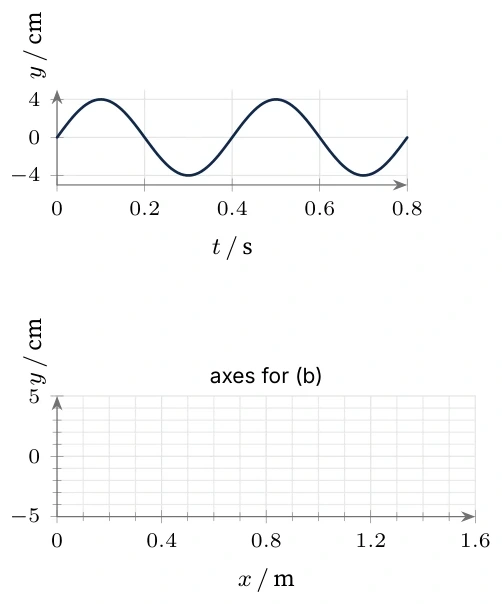
The end of a long horizontal rope, at x=0, is moved up and down from t=0. The graph shows its displacement y against time: it starts at zero moving upwards, the amplitude is 4.0\,\mathrm{cm} and the period is 0.40\,\mathrm{s}. Waves travel along the rope at 2.0\,\mathrm{m\,s^{-1}} in the +x direction; the rope was at rest before t=0.
(a) Calculate the wavelength. [1]
(b) On the axes provided, sketch the shape of the rope from x=0 to x=1.6\,\mathrm{m} at t=0.60\,\mathrm{s}. [3]
(c) State the direction of motion of the rope at x=0.40\,\mathrm{m} at t=0.60\,\mathrm{s}. [1]
(d) Calculate the average speed of a point of the rope over one period and compare it with the wave speed. [2]
Diagram for C.2 question V2
Show solutionHide solution
(a) \lambda=vT=2.0(0.40)=0.80\,\mathrm{m} (A1). (b) The front has travelled vt=1.2\,\mathrm{m}, so the rope beyond 1.2\,\mathrm{m} is still flat (A1). Behind the front, a point at distance x repeats what the end did x/v earlier; the end has done 1.5 cycles, so the rope shows 1.5\lambda: y=+4.0\,\mathrm{cm} at x=0.20 and 1.0\,\mathrm{m}, -4.0\,\mathrm{cm} at 0.60\,\mathrm{m}, zero at 0, 0.40, 0.80 and 1.2\,\mathrm{m} (A1 shape and wavelength, A1 correct phase). The part just behind the front is displaced upwards, because the end's first movement was upwards. (c) The crest at 0.20\,\mathrm{m} is travelling towards x=0.40\,\mathrm{m}, which is at zero, so this point is moving upwards (A1). (d) In one period a point moves 4A=16\,\mathrm{cm} (M1): average speed 0.16/0.40=0.40\,\mathrm{m\,s^{-1}}, a fifth of the wave speed; the two speeds measure different motions (A1).

Final answer

(a) 0.80\,\mathrm{m} (b) one and a half wavelengths from x=0 to the front at x=1.2\,\mathrm{m}, crests (+4.0\,\mathrm{cm}) at 0.20 and 1.0\,\mathrm{m}, a trough at 0.60\,\mathrm{m}, flat beyond 1.2\,\mathrm{m} (c) upwards (d) 0.40\,\mathrm{m\,s^{-1}}, one fifth of the wave speed

Question V3

Type V3 · Type I3 · Source and distance; Type I2 · Inverse-square spreading; Type I1 · Intensity and amplitude[6 marks]
On a building site, siren A radiates sound power P equally in all directions. A worker 12\,\mathrm{m} from A hears a sound of amplitude a. A second siren, B, radiates 4P.
(a) Determine how far from the worker B must be placed, with A switched off, so that the amplitude at the worker is again a. [2]
(b) Determine the distance at which B gives an amplitude of 1.5a at the worker. [2]
(c) B radiates 0.80\,\mathrm{W}. Calculate the intensity at the worker in (b). [1]
(d) Suggest one reason why the measured intensity is smaller than the value in (c). [1]
Show solutionHide solution
(a) Same amplitude means the same intensity (M1): 4P/4\pi r^2=P/4\pi(12)^2, so r^2=4(144) and r=24\,\mathrm{m} (A1). (b) Amplitude 1.5a needs intensity 1.5^2=2.25 times A's (M1): 4(12/r)^2=2.25, r=12\times2/1.5=16\,\mathrm{m} (A1). (c) I=0.80/(4\pi\times16^2)=2.49\times10^{-4}\,\mathrm{W\,m^{-2}} (A1). (d) Some energy is absorbed by the air, the ground and the site, or reflected away, so less than the full power crosses the sphere; the siren may also radiate more strongly in some directions (A1).

Final answer

(a) 24\,\mathrm{m} (b) 16\,\mathrm{m} (c) 2.5\times10^{-4}\,\mathrm{W\,m^{-2}} (d) absorption by the air and the ground, or the siren does not radiate equally in every direction

Question V4

Type V4 · Type N2 · Energy, not matter; Type N1 · Transverse or longitudinal · Predicted type[6 marks]
In a stadium, spectators make a “Mexican wave'': each person stands up and then sits down again as the pattern reaches them. The pattern goes once round a 600\,\mathrm{m} circuit of seats in 40\,\mathrm{s}. Each person stays standing for 0.80\,\mathrm{s} and seats are 0.50\,\mathrm{m} apart along the circuit.
(a) Calculate the speed of the pattern. [1]
(b) Estimate the number of people standing at any instant. [2]
(c) State whether this pattern is a transverse or a longitudinal model. [1]
(d) In a wave on a rope, energy reaches the far end even though the rope itself does not move along. Explain why the Mexican wave is a poor model of this energy transfer. [2]
Show solutionHide solution
(a) 600/40=15\,\mathrm{m\,s^{-1}} (A1). (b) A person stands while the pattern moves 15(0.80)=12\,\mathrm{m} (M1), so about 12/0.50=24 people stand at once (A1). (c) People move vertically, the pattern horizontally: transverse (A1). (d) In a rope each section pulls on the next and does work on it, so energy travels from the source along the rope (M1). In the stadium each person stands up using their own energy because they see the pattern coming; no person pushes the next, so the pattern moves but no energy is carried along the stands (A1).

Final answer

(a) 15\,\mathrm{m\,s^{-1}} (b) 24 (c) transverse (d) no person does work on the next; each uses their own energy, so no energy is passed along

Question V5

Type V5 · Type M1 · Phase difference; Type S3 · Change the frequency; Type S1 · Distance travelled · Predicted type[7 marks]
Two pressure sensors are 0.34\,\mathrm{m} apart along a long air-filled pipe. A loudspeaker at one end sends a 400\,\mathrm{Hz} sound wave along the pipe; sound travels at 340\,\mathrm{m\,s^{-1}}. Both sensors show the same trace, with the far sensor's trace delayed.
(a) Calculate the wavelength of the sound. [1]
(b) Calculate the delay between the two traces. [1]
(c) Determine the phase difference between the two traces, in radians. [2]
(d) The frequency is now raised slowly from 400\,\mathrm{Hz}. Determine the lowest frequency at which the two traces are exactly in phase. [2]
(e) At that frequency the near sensor is at the centre of a compression. State what is at the far sensor at the same instant. [1]
Show solutionHide solution
(a) \lambda=340/400=0.85\,\mathrm{m} (A1). (b) Delay =0.34/340=1.0\times10^{-3}\,\mathrm{s} (A1). (c) The sensors are 0.34/0.85=0.40 of a wavelength apart (M1): \phi=0.40(2\pi)=0.8\pi=2.51\,\mathrm{rad} (A1). Equivalently delay/period =1.0/2.5=0.40. (d) The speed is fixed by the air, so raising f shortens \lambda (M1). The traces first agree when the separation is one whole wavelength: \lambda=0.34\,\mathrm{m}, f=340/0.34=1.0\times10^{3}\,\mathrm{Hz} (A1). (e) Points one wavelength apart are in phase: another compression centre (A1).

Final answer

(a) 0.85\,\mathrm{m} (b) 1.0\,\mathrm{ms} (c) 0.8\pi=2.5\,\mathrm{rad} (d) 1.0\times10^{3}\,\mathrm{Hz} (e) the centre of a compression

Connected questions

Question X1

Type X1 · C.2 + A.1 + C.3; P2[7 marks]
A survey ship's sonar sends short pulses of 30\,\mathrm{kHz} ultrasound straight down. Sound travels at 1500\,\mathrm{m\,s^{-1}} in sea water, and the echo from the sea bed returns 0.12\,\mathrm{s} after a pulse is sent.
(a) Calculate the depth of the sea bed below the sonar. [2]
(b) Calculate the wavelength of the ultrasound in the water. [1]
(c) Each pulse lasts 2.0\,\mathrm{ms}. Determine the number of wavelengths in one pulse and the length of the pulse in the water. [2]
(d) Some of the sound leaks into the air, where it travels at 340\,\mathrm{m\,s^{-1}}. State what happens to the frequency and calculate the wavelength in air. [2]
Show solutionHide solution
(a) A.1: the echo covers the depth twice, 2d=vt (M1), d=1500(0.12)/2=90\,\mathrm{m} (A1). (b) \lambda=1500/3.0\times10^{4}=0.050\,\mathrm{m} (A1). (c) N=ft=3.0\times10^{4}(2.0\times10^{-3})=60 wavelengths (A1); length =60(0.050)=3.0\,\mathrm{m}, the same as vt (A1). (d) C.3: the source fixes the frequency, so it stays 30\,\mathrm{kHz} when the wave changes medium (A1); \lambda=340/3.0\times10^{4}=1.1\times10^{-2}\,\mathrm{m} (A1).

Final answer

(a) 90\,\mathrm{m} (b) 0.050\,\mathrm{m} (c) 60; 3.0\,\mathrm{m} (d) unchanged; 1.1\times10^{-2}\,\mathrm{m}

Question X2

Type X2 · C.2 + C.1; P2[7 marks]
Water waves of wavelength 2.4\,\mathrm{m} travel at 1.2\,\mathrm{m\,s^{-1}} across a lake and pass two small floats, F and G, which lie on the same line of travel with G 0.60\,\mathrm{m} beyond F. Each float moves vertically with simple harmonic motion of amplitude 6.0\,\mathrm{cm}.
(a) Calculate the frequency and the period of the motion of F. [2]
(b) Determine the greatest acceleration of F. [2]
(c) At one instant F is at its highest point. Describe the displacement and the motion of G at that instant. [2]
(d) Further across the lake the amplitude of the floats has fallen to 4.0\,\mathrm{cm}. Calculate the ratio of the wave intensity there to the intensity at F. [1]
Show solutionHide solution
(a) f=v/\lambda=1.2/2.4=0.50\,\mathrm{Hz} (A1), T=1/f=2.0\,\mathrm{s} (A1). (b) C.1: \omega=2\pi f=\pi\,\mathrm{rad\,s^{-1}} (M1); a_{\max}=\omega^2x_0=\pi^2(0.060)=0.59\,\mathrm{m\,s^{-2}} (A1). (c) G is 0.60/2.4=\tfrac14 wavelength further on, so it is a quarter cycle behind F (M1). A quarter cycle before its own highest point, G is at zero displacement and moving upwards (A1). (d) I\propto A^2: (4.0/6.0)^2=0.44 (A1).

Final answer

(a) 0.50\,\mathrm{Hz}; 2.0\,\mathrm{s} (b) 0.59\,\mathrm{m\,s^{-2}} (c) zero displacement, moving upwards (d) 0.44

Question X3

Type X3 · C.2 + B.1; P2[7 marks]
The Sun behaves approximately as a black body with a surface temperature of 5800\,\mathrm{K} and a luminosity of 3.8\times10^{26}\,\mathrm{W}. Earth is 1.5\times10^{11}\,\mathrm{m} from the Sun.
(a) Determine the peak wavelength of the Sun's emission. Name the part of the spectrum it lies in. [2]
(b) Calculate the frequency of this radiation. [1]
(c) Show that the intensity of sunlight arriving at Earth is about 1.3\times10^{3}\,\mathrm{W\,m^{-2}}. [2]
(d) Mars is 1.52 times as far from the Sun as Earth. Calculate the intensity of sunlight at Mars. [1]
(e) Explain how this energy reaches Earth although the space between is almost empty. [1]
Show solutionHide solution
(a) B.1: \lambda_{\max}=2.9\times10^{-3}/5800=5.0\times10^{-7}\,\mathrm{m} (A1), visible (A1). (b) f=c/\lambda=3.00\times10^{8}/5.0\times10^{-7}=6.0\times10^{14}\,\mathrm{Hz} (A1). (c) The power spreads over a sphere of radius 1.5\times10^{11}\,\mathrm{m} (M1): I=L/4\pi d^2=3.8\times10^{26}/(4\pi(1.5\times10^{11})^2)=1.34\times10^{3}\,\mathrm{W\,m^{-2}} (A1). (d) I\propto1/d^2: 1.34\times10^{3}/1.52^2=5.8\times10^{2}\,\mathrm{W\,m^{-2}} (A1). (e) Light is an electromagnetic wave: oscillating electric and magnetic fields sustain each other, so no material medium is needed (A1).

Final answer

(a) 5.0\times10^{-7}\,\mathrm{m}; visible (b) 6.0\times10^{14}\,\mathrm{Hz} (c) 1.34\times10^{3}\,\mathrm{W\,m^{-2}} (d) 5.8\times10^{2}\,\mathrm{W\,m^{-2}} (e) electromagnetic waves need no medium

Question X4

Type X4 · C.2 + C.4; P2[7 marks]
A guitar string of length 0.65\,\mathrm{m} is fixed at both ends. Waves travel along it at 286\,\mathrm{m\,s^{-1}}.
(a) A single pulse is sent from one end. Calculate the time it takes to return after reflecting at the other end. [2]
(b) The string vibrates in its first harmonic. Determine the wavelength on the string and the frequency. [2]
(c) Sound travels at 340\,\mathrm{m\,s^{-1}} in air. Determine the wavelength in air of the note that this vibration produces. [1]
(d) Explain why the wave on the string is transverse but the sound wave in air is longitudinal. [2]
Show solutionHide solution
(a) There and back is 2L=1.30\,\mathrm{m} (M1): t=1.30/286=4.5\times10^{-3}\,\mathrm{s} (A1). (b) C.4: nodes at both ends with one loop between them, so \lambda=2L=1.30\,\mathrm{m} (A1); f=v/\lambda=286/1.30=220\,\mathrm{Hz} (A1). (c) The frequency is the same in the air: \lambda=340/220=1.55\,\mathrm{m} (A1). (d) The string's points are displaced at right angles to the string, along which energy travels (A1). The vibrating string pushes and pulls the air beside it, so air layers move back and forth along the direction in which the sound travels away from the string (A1).

Final answer

(a) 4.5\times10^{-3}\,\mathrm{s} (b) 1.30\,\mathrm{m}; 220\,\mathrm{Hz} (c) 1.55\,\mathrm{m} (d) string points move across the string; air layers move back and forth along the direction of travel

From the book

Photon Physics: Study Guide for the IB Diploma (SL & HL)

Wave model from the core ideas to full exam questions, with question types, worked examples and graded practice.

About the book