Free worked solutions · 2026 Edition

IB Physics C.3: Wave phenomena worked solutions

Worked solutions to every practice question in C.3: Wave phenomena of Photon Physics: Study Guide for the IB Diploma (SL & HL). Try each question, then compare your working with the full solution.

  • SL & HL
  • 30 questions
  • Full worked solutions
  • Free, no sign-up

Basic practice

Question B1

Type 1 · what changes at a boundary[1 mark]
Monochromatic light passes from air into glass of refractive index 1.50. How do its speed, frequency and wavelength inside the glass compare with their values in air?
A. Speed unchanged; frequency \times1.50; wavelength \div1.50.
B. Speed \div1.50; frequency \div1.50; wavelength unchanged.
C. Speed \div1.50; frequency unchanged; wavelength \div1.50.
D. Speed \div1.50; frequency unchanged; wavelength \times1.50.
Show solutionHide solution
The source sets the frequency, and a stationary boundary cannot change it. The speed falls to c/n, so \lambda=v/f falls by the same factor 1.50. B changes the frequency at the boundary; D makes the wavelength grow while the wave slows.

Final answer

C
Question B2

Type 2 · pulses at a boundary[1 mark]
A pulse travels along a light string towards the point where it is joined to a much heavier string under the same tension. Which describes the reflected pulse and the transmitted pulse?
A. Reflected pulse upright; transmitted pulse inverted.
B. Reflected pulse inverted; transmitted pulse upright.
C. Both pulses inverted.
D. Reflected pulse upright; no transmitted pulse.
Show solutionHide solution
The heavy string barely moves, so the junction behaves almost like a fixed end: the reflection is inverted. The transmitted pulse is always on the same side as the incident pulse, smaller and slower. A and C invert the wrong pulse; D describes a free end with no second string.

Final answer

B

Question B3

Type 3 · Snell: angle or index[1 mark]
A ray of light in air strikes a flat glass surface. The ray makes an angle of 50^\circ with the surface. The refractive index of the glass is 1.50. What is the angle between the refracted ray and the normal?
A. 25^\circ   B. 31^\circ   C. 40^\circ   D. 65^\circ
Show solutionHide solution
The angle of incidence is measured from the normal: 90^\circ-50^\circ=40^\circ. Then \sin r=\sin40^\circ/1.50=0.429, r=25.4^\circ. B puts 50^\circ into Snell's law; C forgets to refract; D gives the refracted ray's angle to the surface.

Final answer

A

Question B4

Type 5 · critical angle links[2 marks]
Light travelling from a clear liquid into air has a critical angle of 48.0^\circ.
(a) Calculate the refractive index of the liquid. [1]
(b) Calculate the speed of light in the liquid. [1]
Show solutionHide solution
(a) At the critical angle the refracted ray runs along the surface: n\sin48.0^\circ=1\times\sin90^\circ, so n=1/\sin48.0^\circ=1.35 (A1). (b) v=c/n=3.00\times10^{8}\times\sin48.0^\circ=2.23\times10^{8}\,\mathrm{m\,s^{-1}} (A1).

Final answer

(a) 1.35 (b) 2.23\times10^{8}\,\mathrm{m\,s^{-1}}

Question B5

Type 8 · recognise diffraction[1 mark]
Sea waves reach a harbour entrance 20\,\mathrm{m} wide. Which wavelength of wave spreads out most inside the harbour?
A. 0.5\,\mathrm{m}   B. 2\,\mathrm{m}   C. 5\,\mathrm{m}   D. 20\,\mathrm{m}
Show solutionHide solution
Spreading through a gap is diffraction; it is strongest when gap and wavelength are of similar size. A is the trap: short waves pass almost straight through.

Final answer

D

Question B6

Type 9 · add displacements[1 mark]
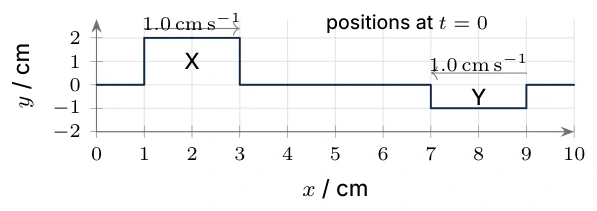
Two rectangular pulses on a string are shown at time t=0. Pulse X moves right and pulse Y moves left, both at 1.0\,\mathrm{cm\,s^{-1}}. What is the displacement of the string at x=4.0\,\mathrm{cm} and at x=5.0\,\mathrm{cm} when t=2.5\,\mathrm{s}?
A. +2.0\,\mathrm{cm} and +1.0\,\mathrm{cm}
B. +2.0\,\mathrm{cm} and +3.0\,\mathrm{cm}
C. 0 and +1.0\,\mathrm{cm}
D. +2.0\,\mathrm{cm} and -1.0\,\mathrm{cm}
Diagram for C.3 question B6
Show solutionHide solution
At t=2.5\,\mathrm{s} pulse X covers 3.5 to 5.5\,\mathrm{cm} and pulse Y covers 4.5 to 6.5\,\mathrm{cm}. At x=4.0 only X is present: +2.0\,\mathrm{cm}. At x=5.0 both overlap: +2.0+(-1.0)=+1.0\,\mathrm{cm}. B adds sizes and ignores the sign.

Final answer

A

Question B7

Type 10 · coherence conditions[1 mark]
Two loudspeakers are connected to the same signal generator. At point P the path difference is exactly half a wavelength, yet a quiet but clearly audible sound is heard there. What is the most likely reason?
A. Silence needs a path difference of one whole wavelength.
B. The two loudspeakers are not coherent.
C. The two waves arriving at P have different amplitudes.
D. Longitudinal waves cannot cancel completely.
Show solutionHide solution
One generator drives both speakers, so they are coherent (B is wrong) and P is a minimum. A minimum is silent only if the two amplitudes there are equal; P is nearer one speaker, so the cancellation is incomplete. A reverses the rule; D is false: sound cancels as well as any wave.

Final answer

C

Question B8

Type 11 · path difference: max or min[1 mark]
Two dippers vibrate in phase in a ripple tank and make waves of wavelength 3.0\,\mathrm{cm}. Point P is 31.0\,\mathrm{cm} from one dipper and 35.5\,\mathrm{cm} from the other. What is observed at P?
A. A maximum: the two paths differ by a whole number of wavelengths.
B. A minimum: the path difference is 0.5\lambda.
C. A minimum: the path difference is 1.5\lambda.
D. Neither: the total path, 66.5\,\mathrm{cm}, is not a whole or half number of wavelengths.
Show solutionHide solution
Path difference =35.5-31.0=4.5\,\mathrm{cm}=1.5\lambda, a half-odd number of wavelengths: the waves arrive in antiphase, so P is a minimum. D adds the two paths instead of subtracting them.

Final answer

C

Question B9

Type 18 · Young: scale s = lambda D/d[1 mark]
In a double-slit experiment the fringe spacing is s. The wavelength is halved, the slit-to-screen distance is doubled and the slit separation is doubled. What is the new fringe spacing?
A. s/4   B. s/2   C. s   D. 2s
Show solutionHide solution
s=\lambda D/d, so the new spacing is (\tfrac12)(2)/(2)=\tfrac12 of s. D puts d on the top line; C assumes that doubling lengths always cancels.

Final answer

B

Question B10

Type 17 · Young: measure lambda or s[2 marks]
Light from a blue laser passes through two slits 0.50\,\mathrm{mm} apart. On a screen 2.40\,\mathrm{m} away, the distance from the centre of the first bright fringe to the centre of the seventh bright fringe is 12.6\,\mathrm{mm}. Calculate the wavelength of the light. [2]
Show solutionHide solution
Seven bright fringes enclose six spacings: s=12.6/6=2.10\,\mathrm{mm} (M1). \lambda=sd/D=(2.10\times10^{-3})(0.50\times10^{-3})/2.40=4.38\times10^{-7}\,\mathrm{m} (A1). Dividing by 7 gives 375\,\mathrm{nm} and loses the A1.

Final answer

4.38\times10^{-7}\,\mathrm{m} (438\,\mathrm{nm})

Question B11

Type 21 · single slit: change b or lambda[1 mark]
Monochromatic light passes through a single narrow slit and the pattern is seen on a distant screen. The slit is made narrower; the light falling on each millimetre of the slit is unchanged. What happens to the central maximum?
A. It becomes wider and its peak intensity is unchanged.
B. It becomes wider and its peak intensity falls.
C. It becomes narrower and its peak intensity rises.
D. It becomes narrower and its peak intensity falls.
Show solutionHide solution
The first minimum is at \theta=\lambda/b, so a smaller b widens the central maximum. Less light now gets through and it is spread over a wider angle, so the peak falls (the centre amplitude is proportional to b, so halving b quarters the peak). A keeps the peak height fixed: the commonest wrong sketch.

Final answer

B

Question B12

Type 28 · more slits: sharper maxima[1 mark]
Light falls normally on a grating. The illuminated part is reduced from 400 slits to 40 slits; the slit spacing is unchanged. Compared with before, the principal maxima are
A. at smaller angles, and broader.
B. at larger angles, and sharper.
C. at the same angles, and sharper and brighter.
D. at the same angles, but broader and dimmer.
Show solutionHide solution
The angles obey n\lambda=d\sin\theta, which does not contain the number of slits. Fewer slits means less light and less complete cancellation just off each maximum, so each maximum is broader and dimmer. A and B move the maxima; C describes adding slits.

Final answer

D

Tutorial practice

Question T1

Type 4 · refracted wavefronts (also 3, 1)[5 marks]
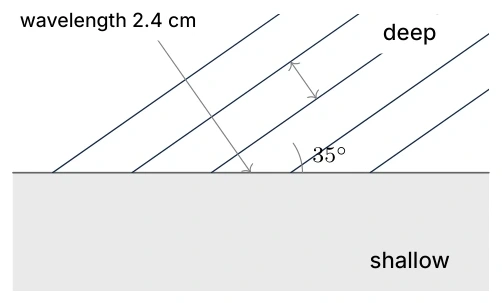
Plane water waves of frequency 12\,\mathrm{Hz} travel in deep water towards a straight boundary with shallow water. In the deep water the wavefronts make an angle of 35^\circ with the boundary and the wavelength is 2.4\,\mathrm{cm}. In the shallow water the wavelength is 1.6\,\mathrm{cm}.
(a) State the angle of incidence of the waves at the boundary. Explain your answer. [1]
(b) Calculate the speed of the waves in each region. [2]
(c) Determine the angle that the wavefronts make with the boundary in the shallow water. [2]
Diagram for C.3 question T1
Show solutionHide solution
(a) The ray is perpendicular to the wavefronts and the normal is perpendicular to the boundary; turning both lines by 90^\circ keeps the angle between them, so the ray meets the normal at 35^\circ (R1). (b) v=f\lambda: 12\times0.024=0.288\,\mathrm{m\,s^{-1}} and 12\times0.016=0.192\,\mathrm{m\,s^{-1}} (A1 each); the frequency is the same on both sides. (c) \sin\theta_2=\sin35^\circ\times(0.192/0.288)=0.382 (M1), \theta_2=22.5^\circ (A1). The wavefront angle to the boundary equals the ray angle to the normal.

Final answer

(a) 35^\circ (b) 0.288\,\mathrm{m\,s^{-1}} (deep), 0.192\,\mathrm{m\,s^{-1}} (shallow) (c) 22.5^\circ

Question T2

Type 6 · can the ray leave? (also 5)[6 marks]
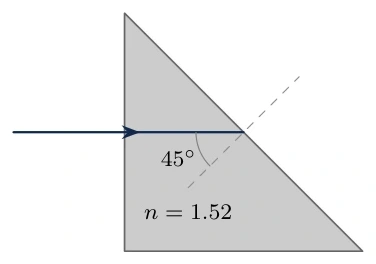
Light enters a right-angled isosceles glass prism, refractive index 1.52, along the normal to one short face, as shown.
(a) Calculate the critical angle for the glass–air boundary. [1]
(b) Explain why the light is totally internally reflected at the long face, and state the angle through which the light is turned. [2]
(c) The long face is now placed in contact with water of refractive index 1.33. Determine whether the light is still totally internally reflected. If it is not, calculate the angle of refraction in the water. [3]
Diagram for C.3 question T2
Show solutionHide solution
(a) \sin\theta_c=1/1.52, \theta_c=41.1^\circ (A1). (b) The light travels from higher to lower refractive index and meets the long face at 45^\circ, which exceeds 41.1^\circ (R1). The reflected ray leaves at 45^\circ on the other side of the normal, so it is turned through 90^\circ (A1). (c) For glass to water \sin\theta_c=1.33/1.52, \theta_c=61.0^\circ (M1). Now 45^\circ<61.0^\circ, so some light refracts into the water (A1): 1.52\sin45^\circ=1.33\sin\theta, \theta=53.9^\circ (A1). Using 1/1.52 again is the glass–air trap.

Final answer

(a) 41.1^\circ (b) incidence 45^\circ>41.1^\circ, glass to air; turned through 90^\circ (c) no: critical angle now 61.0^\circ>45^\circ; refracted at 53.9^\circ

Question T3

Type 11 · path difference (also 12)[6 marks]
Two loudspeakers S_1 and S_2 are driven in phase by one signal generator at 850\,\mathrm{Hz}. Sound travels at 340\,\mathrm{m\,s^{-1}} in the room. A microphone at P is 3.00\,\mathrm{m} from S_1 and 3.60\,\mathrm{m} from S_2.
(a) Show that the wavelength of the sound is 0.40\,\mathrm{m}. [1]
(b) Explain why the microphone detects a minimum at P. [2]
(c) At P, the wave from S_2 alone has 0.80 of the amplitude of the wave from S_1 alone. Determine the intensity at P as a fraction of the intensity with S_1 alone switched on. [2]
(d) The connections to S_2 are reversed. State what the microphone now detects at P. [1]
Show solutionHide solution
(a) \lambda=v/f=340/850=0.40\,\mathrm{m}. (b) Path difference 3.60-3.00=0.60\,\mathrm{m} (M1) =1.5\lambda; in-phase sources, so the waves arrive in antiphase and interfere destructively (R1). (c) Resultant amplitude A-0.80A=0.20A (M1); intensity \propto amplitude^2: (0.20)^2=0.040 (A1). Subtracting intensities (1-0.64=0.36) is the trap. (d) Reversing one speaker adds half a cycle, so the waves now arrive in phase: a maximum, amplitude 1.80A, intensity 3.24 times that of S_1 alone (A1).

Final answer

(a) 340/850=0.40\,\mathrm{m} (b) path difference 0.60\,\mathrm{m}=1.5\lambda: antiphase (c) 0.040 (d) a maximum (3.24 times the S_1-only intensity)

Question T4

Type 13 · direct + reflected wave (also 14)[7 marks]
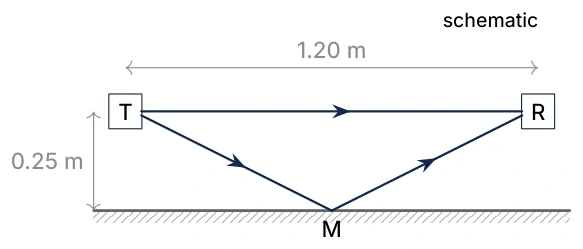
A microwave transmitter T and a receiver R are each 0.25\,\mathrm{m} above a flat metal sheet and 1.20\,\mathrm{m} apart. R receives a direct wave and a wave reflected from the sheet midway between them. The wavelength is 4.0\,\mathrm{cm}. Assume that reflection at the sheet does not change the phase of the wave.
(a) Show that the path difference between the two waves is 0.10\,\mathrm{m}. [2]
(b) Deduce whether R detects a maximum or a minimum. [1]
(c) The sheet is slowly lowered. Calculate the distance it moves before R next detects a minimum. [2]
(d) The sheet is returned to its first position and the frequency is raised from 7.5\,\mathrm{GHz}. Calculate the frequency at which R next detects a minimum. [2]
Diagram for C.3 question T4
Show solutionHide solution
(a) Each reflected leg is \sqrt{0.60^2+0.25^2}=0.65\,\mathrm{m} (M1); reflected path 1.30\,\mathrm{m}, so the path difference is 0.10\,\mathrm{m} (A1). Using one leg only is the trap. (b) 0.10/0.040=2.5: antiphase, a minimum (A1). (c) The next minimum needs a path difference of 3.5\lambda=0.14\,\mathrm{m}, a reflected path of 1.34\,\mathrm{m} (M1): each leg 0.67\,\mathrm{m}, height \sqrt{0.67^2-0.60^2}=0.298\,\mathrm{m}; the sheet drops 0.048\,\mathrm{m} (A1). (d) Keep the 0.10\,\mathrm{m} path difference and make it 3.5\lambda: \lambda=0.0286\,\mathrm{m} (M1), f=c/\lambda=1.05\times10^{10}\,\mathrm{Hz} (A1).

Final answer

(a) 1.30-1.20=0.10\,\mathrm{m} (b) minimum (2.5\lambda) (c) 0.048\,\mathrm{m} (4.8\,\mathrm{cm}) (d) 10.5\,\mathrm{GHz}

Question T5

Type 17 · Young: measure (also 10, 18)[6 marks]
A student shines a red laser directly onto two slits 0.40\,\mathrm{mm} apart. Fringes appear on a screen 3.00\,\mathrm{m} away.
(a) Explain why the laser can illuminate the slits directly, while light from a filament lamp must first pass through a single narrow slit. [2]
(b) The distance between the two dark fringes on either side of the central bright fringe is 4.8\,\mathrm{mm}. Determine the wavelength of the laser light. [2]
(c) The student changes to a green laser of wavelength 520\,\mathrm{nm} and moves the screen to 2.00\,\mathrm{m} from the slits. Calculate the new fringe spacing. [2]
Show solutionHide solution
(a) The two slits must be coherent sources: same frequency and a constant phase difference (R1). Across a laser beam the phase relation is fixed, so the slits sit on the same wavefront. A filament emits from many atoms at random; one narrow slit makes a single small source whose wavefronts reach both slits together (R1). (b) The two dark fringes are at \pm s/2 from the centre, so they are one spacing apart: s=4.8\,\mathrm{mm} (M1). Calling it 2s is the trap. \lambda=sd/D=(4.8\times10^{-3})(0.40\times10^{-3})/3.00=6.4\times10^{-7}\,\mathrm{m} (A1). (c) s=\lambda D/d=(520\times10^{-9})(2.00)/(0.40\times10^{-3}) (M1) =2.60\,\mathrm{mm} (A1).

Final answer

(a) laser light across the beam keeps a constant phase relation, so the slits are coherent sources; a lamp needs one narrow source (b) 640\,\mathrm{nm} (c) 2.60\,\mathrm{mm}

Question T6

Type 19 · fringes and a moving sensor[5 marks]
Green light of wavelength 532\,\mathrm{nm} passes through two slits 0.25\,\mathrm{mm} apart. A small light sensor moves at constant speed along a line on a screen 1.50\,\mathrm{m} from the slits, across the fringes. The sensor records a bright maximum every 0.040\,\mathrm{s}.
(a) Calculate the fringe spacing. [1]
(b) Determine the speed of the sensor. [2]
(c) The slit separation is halved; the sensor speed is unchanged. State the new time between maxima. [1]
(d) One slit is partly covered. Suggest why the sensor reading between maxima no longer falls to zero. [1]
Show solutionHide solution
(a) s=\lambda D/d=(532\times10^{-9})(1.50)/(0.25\times10^{-3})=3.19\times10^{-3}\,\mathrm{m} (A1). (b) Between one maximum and the next the sensor moves one spacing (M1): v=3.19\times10^{-3}/0.040=0.080\,\mathrm{m\,s^{-1}} (A1). Using half a spacing is the trap. (c) s doubles, so 0.080\,\mathrm{s} (A1). (d) Less light comes through the covered slit, so the two waves have unequal amplitudes and cannot cancel completely (R1).

Final answer

(a) 3.19\,\mathrm{mm} (b) 0.080\,\mathrm{m\,s^{-1}} (c) 0.080\,\mathrm{s} (d) unequal amplitudes: the cancellation is incomplete

Question T7

Type 20 · single slit: first minimum[5 marks]
Laser light passes through a single slit of width 0.15\,\mathrm{mm}. On a screen 2.50\,\mathrm{m} beyond the slit, the central bright maximum is 22.0\,\mathrm{mm} wide, measured from dark edge to dark edge.
(a) Determine the wavelength of the light. [3]
(b) Sketch the variation of relative intensity with angle, and mark the angles of the first two minima on each side. [2]
Show solutionHide solution
(a) The first minimum is half the central width from the centre: 11.0\,\mathrm{mm} (M1). \theta=0.0110/2.50=4.40\times10^{-3}\,\mathrm{rad} (M1), \lambda=b\theta=(0.15\times10^{-3})(4.40\times10^{-3})=6.6\times10^{-7}\,\mathrm{m} (A1). Using the full 22.0\,\mathrm{mm} doubles the answer. (b) Symmetric curve with the tallest peak at \theta=0, zeros at \pm4.4 and \pm8.8\,\mathrm{mrad} (A1); side maxima about 5% of the central peak and half its width (A1).

Final answer

(a) 6.6\times10^{-7}\,\mathrm{m} (660\,\mathrm{nm}) (b) central peak; minima at \pm4.4 and \pm8.8\,\mathrm{mrad}; side maxima much lower and half as wide

Question T9

Type 25 · grating angle (also 26)[6 marks]
Light of wavelength 546\,\mathrm{nm} is incident normally on a grating with 300 lines per millimetre.
(a) Calculate the grating spacing. [1]
(b) Calculate the angle between the two second-order maxima. [2]
(c) Determine the total number of maxima produced. [2]
(d) State the smallest grating spacing that still produces a second-order maximum for this light. [1]
Show solutionHide solution
(a) d=1/(3.00\times10^{5})=3.33\times10^{-6}\,\mathrm{m} (A1); per millimetre is not per metre. (b) \sin\theta_2=2(546\times10^{-9})/3.33\times10^{-6}=0.328, \theta_2=19.1^\circ (M1); the two second orders are on opposite sides: 38.2^\circ (A1). (c) n\le d/\lambda=6.1, so n_{\max}=6 (M1); orders 0,\pm1,\dots,\pm6 give 13 maxima (A1). Rounding up to 7, or answering 6, are the traps. (d) Second order needs 2\lambda\le d: d=1.09\times10^{-6}\,\mathrm{m} (A1).

Final answer

(a) 3.33\times10^{-6}\,\mathrm{m} (b) 38.2^\circ (c) 13 (d) 1.09\times10^{-6}\,\mathrm{m}

Question T8

Type 22 · double slit in envelope[5 marks]
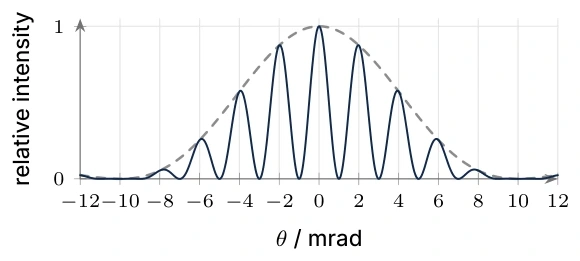
The graph shows the intensity pattern produced when light of wavelength 500\,\mathrm{nm} passes through two identical narrow slits.
(a) Determine the separation of the slits. [1]
(b) Determine the width of each slit. [1]
(c) State the number of bright fringes inside the central diffraction envelope, and explain why there are no fringes at \pm10\,\mathrm{mrad}. [2]
(d) The width of each slit is halved; the separation is unchanged. Describe the change in the pattern. [1]
Diagram for C.3 question T8
Show solutionHide solution
(a) Fringe spacing 2.0\,\mathrm{mrad}: d=\lambda/\theta=500\times10^{-9}/2.0\times10^{-3}=2.5\times10^{-4}\,\mathrm{m} (A1). (b) Envelope first minimum at 10\,\mathrm{mrad}: b=\lambda/\theta=5.0\times10^{-5}\,\mathrm{m} (A1). Swapping b and d is the trap. (c) d/b=5: fringes of order 0,\pm1,\dots,\pm4, so 9 (A1); the fifth order falls on the single-slit minimum, where each slit sends no light (R1). (d) Envelope doubles in width; fringes stay 2.0\,\mathrm{mrad} apart, now 19 inside it, each less bright (A1).

Final answer

(a) 0.25\,\mathrm{mm} (b) 0.050\,\mathrm{mm} (c) 9; the envelope is zero where the fifth-order fringes would be (d) envelope twice as wide (zeros at \pm20\,\mathrm{mrad}), fringe spacing unchanged, so 19 fringes, dimmer

Question T10

Type 27 · grating: white light[5 marks]
White light containing all wavelengths from 400\,\mathrm{nm} to 700\,\mathrm{nm} is incident normally on a grating with 600 lines per millimetre.
(a) Calculate the angular width of the first-order spectrum. [2]
(b) Determine the highest order in which the complete visible spectrum appears. [2]
(c) Explain why the zero-order maximum is white. [1]
Show solutionHide solution
d=1.67\times10^{-6}\,\mathrm{m}. (a) Violet: \sin\theta=0.400/1.667, \theta=13.9^\circ; red: \sin\theta=0.700/1.667, \theta=24.8^\circ (M1); width 10.9^\circ (A1). Taking \sin^{-1} of the difference of the sines is the trap. (b) Use the longest wavelength: third order needs \sin\theta=3(0.700)/1.667=1.26>1, impossible (M1); second order red at 57.1^\circ exists, so the second order is the highest complete one (A1). The third order begins (violet at 46.1^\circ) but is cut off, and it overlaps the end of the second. (c) At n=0 every wavelength has \theta=0, so all colours recombine (R1).

Final answer

(a) 10.9^\circ (13.9^\circ to 24.8^\circ) (b) second order (c) \theta=0 for every wavelength at n=0

Advanced practice

Question A1

Type 7 · sound through layers (new 2026 style)[7 marks]
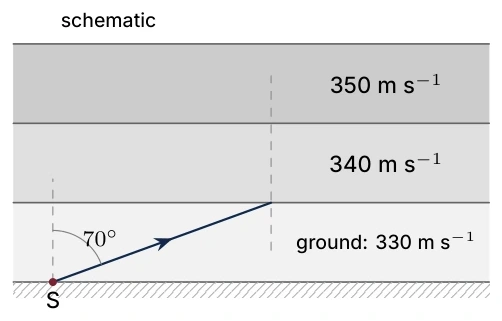
On a still night the air near the ground is cooler than the air above it. Model the air as three horizontal layers in which sound travels at 330, 340 and 350\,\mathrm{m\,s^{-1}}, from the ground upwards. A ray of sound leaves a source S on the ground at 70^\circ to the vertical.
(a) State and explain whether the ray bends towards or away from the vertical when it enters the middle layer. [1]
(b) Calculate the critical angle at the boundary between the lowest and middle layers. [2]
(c) Determine the angle between the ray and the vertical in the top layer. [2]
(d) Determine the smallest speed a higher layer would need to turn this ray back towards the ground. Comment on whether the top layer does this. [2]
Diagram for C.3 question A1
Show solutionHide solution
(a) Into a faster layer the ray bends away from the normal (the vertical) (R1). (b) \sin\theta_c=v_1/v_2=330/340 (M1), \theta_c=76.1^\circ (A1). 70^\circ is smaller, so the ray does enter the middle layer, at 75.5^\circ. (c) Across parallel layers \sin\theta/v stays constant (M1): \sin\theta_3=\sin70^\circ\times350/330=0.997, \theta_3=85.3^\circ (A1). (d) Turning needs \sin\theta=1: v=330/\sin70^\circ=351\,\mathrm{m\,s^{-1}} (M1). The top layer travels at 350\,\mathrm{m\,s^{-1}}, so it does not turn this ray; a layer faster than 351\,\mathrm{m\,s^{-1}} above would reflect it totally (R1). Claiming the first faster layer must trap the ray is the trap.

Final answer

(a) away: the sound speeds up (b) 76.1^\circ (c) 85.3^\circ (d) 351\,\mathrm{m\,s^{-1}}; the top layer (350) is just too slow, so the ray passes into it

Question A3

Type 15 · minima between sources (new 2026 style)[5 marks]
Two dippers S_1 and S_2 are 25.0\,\mathrm{cm} apart in a ripple tank. They vibrate in phase and produce waves of wavelength 6.0\,\mathrm{cm}.
(a) Explain why the midpoint of S_1S_2 is a point of maximum disturbance. [1]
(b) Determine the number of points of minimum disturbance on the straight line between S_1 and S_2, and their distances from S_1. [3]
(c) State the distance between neighbouring minima on this line. [1]
Show solutionHide solution
(a) The paths are equal, so the waves arrive in phase (R1). (b) At distance x from S_1 the path difference is |(25.0-x)-x|=|25.0-2x|, which cannot exceed 25.0\,\mathrm{cm} (M1). Minima need |25.0-2x|=3.0,\ 9.0,\ 15.0,\ 21.0\,\mathrm{cm}; 27.0 is too large (M1). Each value gives two points, one on each side of the midpoint: 8 minima at the distances listed (A1). (c) Moving \Delta x changes the path difference by 2\Delta x, so successive minima are \lambda/2=3.0\,\mathrm{cm} apart (A1).

Final answer

(a) equal paths, zero path difference (b) 8: at 2.0, 5.0, 8.0, 11.0, 14.0, 17.0, 20.0, 23.0\,\mathrm{cm} (c) 3.0\,\mathrm{cm} (\lambda/2)

Question A2

Type 16 · infer source phase (predicted)[6 marks]
Two loudspeakers are driven by one signal generator through a switch that makes them either in phase or in antiphase. The frequency is 680\,\mathrm{Hz}; take 340\,\mathrm{m\,s^{-1}} for sound in air. Detector D_1 is 4.00\,\mathrm{m} from one speaker and 4.75\,\mathrm{m} from the other. Detector D_2 is 3.00\,\mathrm{m} from one speaker and 4.00\,\mathrm{m} from the other.
(a) Calculate the wavelength. [1]
(b) D_1 records a loud maximum. Deduce the setting of the switch. [2]
(c) Predict what D_2 records with the same setting. [1]
(d) The frequency is changed to 1360\,\mathrm{Hz} with the same setting. Deduce what D_1 now records. [2]
Show solutionHide solution
(a) \lambda=340/680=0.50\,\mathrm{m} (A1). (b) Path difference at D_1 is 0.75\,\mathrm{m}=1.5\lambda (M1), which alone would put the waves in antiphase. A maximum means the sources add another half cycle: they are in antiphase (R1). Assuming a maximum proves in-phase sources is the trap. (c) At D_2 the path difference is 1.00\,\mathrm{m}=2\lambda, so the paths keep the phase and the antiphase sources give a minimum (A1). It is silent only if the two amplitudes there are equal. (d) \lambda=340/1360=0.25\,\mathrm{m} (M1), not 1.00\,\mathrm{m}; 0.75\,\mathrm{m}=3\lambda, so with antiphase sources D_1 records a minimum (A1).

Final answer

(a) 0.50\,\mathrm{m} (b) antiphase (c) a minimum (d) a minimum

Question A4

Type 24 · derive first minimum (predicted; also 23)[7 marks]
Light of wavelength 590\,\mathrm{nm} passes through a single slit of width 0.15\,\mathrm{mm}. A screen is 1.80\,\mathrm{m} away. Point O on the screen lies on the perpendicular from the centre of the slit.
(a) Treat each point of the slit as a source of secondary wavelets. Explain, using pairs of rays, why O is bright. [2]
(b) Divide the slit into an upper and a lower half. Pair each point in the upper half with the point b/2 below it. Show that the first minimum is where b\sin\theta=\lambda. [3]
(c) Calculate how wide the central maximum is on the screen. [1]
(d) A detector sits at the first minimum on one side. The slit is widened to 0.20\,\mathrm{mm}. Deduce whether the detector still receives no light. [1]
Show solutionHide solution
(a) Points equally far above and below the centre are equidistant from O (M1), so each pair arrives in phase; every pair adds constructively and O is the brightest point (R1). (b) Two paired points are b/2 apart, so their rays to a distant point at angle \theta differ in path by (b/2)\sin\theta (M1). Cancellation needs half a wavelength: (b/2)\sin\theta=\lambda/2 (M1). Every point in the upper half has a partner, so all pairs cancel at once: b\sin\theta=\lambda (A1). Pairing only the two edges proves nothing about the rest of the slit. (c) \theta=\lambda/b=3.93\times10^{-3}\,\mathrm{rad}; width 2D\theta=14.2\,\mathrm{mm} (A1). (d) Detector at 7.08\,\mathrm{mm}; new minima at 5.31\,\mathrm{mm} and 10.6\,\mathrm{mm}, so it lies in the first side maximum and receives light (R1).

Final answer

(a) symmetric pairs travel equal distances, so all arrive in phase (b) pair path difference (b/2)\sin\theta=\lambda/2 (c) 14.2\,\mathrm{mm} (d) it now receives light: the first minimum moves in to 5.3\,\mathrm{mm}; the detector at 7.1\,\mathrm{mm} is between the first and second minima

Connected questions

Question X1

C.2 + C.3[8 marks]
Red laser light has a wavelength of 633\,\mathrm{nm} in air.
(a) Calculate the frequency of the light. [1]
(b) The beam enters a block of flint glass of refractive index 1.60. Calculate the speed and the wavelength of the light in the glass. [2]
(c) Inside the block the beam meets a face that is in contact with water (refractive index 1.33), at an angle of incidence of 60^\circ. Determine whether the beam enters the water. [2]
(d) The same laser illuminates two slits 0.25\,\mathrm{mm} apart, with a screen 2.00\,\mathrm{m} away. Calculate the fringe spacing, and the fringe spacing when slits and screen are under water. [3]
Show solutionHide solution
(a) f=c/\lambda=3.00\times10^{8}/633\times10^{-9}=4.74\times10^{14}\,\mathrm{Hz} (A1). (b) v=c/n=1.88\times10^{8}\,\mathrm{m\,s^{-1}} (A1); \lambda=633/1.60=396\,\mathrm{nm}, with f unchanged (A1). (c) \sin\theta_c=1.33/1.60, \theta_c=56.2^\circ (M1); 60^\circ>56.2^\circ, so the beam is totally internally reflected (A1). (d) s=\lambda D/d=(633\times10^{-9})(2.00)/(0.25\times10^{-3})=5.06\,\mathrm{mm} (A1). In water \lambda=633/1.33=476\,\mathrm{nm} (M1), so s=3.81\,\mathrm{mm} (A1).

Final answer

(a) 4.74\times10^{14}\,\mathrm{Hz} (b) 1.88\times10^{8}\,\mathrm{m\,s^{-1}}, 396\,\mathrm{nm} (c) no: \theta_c=56.2^\circ<60^\circ, total internal reflection (d) 5.06\,\mathrm{mm}; 3.81\,\mathrm{mm}

Question X2

C.3 + C.4[8 marks]
A microwave transmitter faces a flat metal plate. A small probe moved along the line between them detects minima 1.50\,\mathrm{cm} apart.
(a) Explain how the minima are formed, and determine the wavelength of the microwaves. [3]
(b) Calculate the frequency of the microwaves. [1]
(c) The microwaves now fall normally on two narrow gaps 6.0\,\mathrm{cm} apart in a metal sheet. A receiver moves on an arc of radius 0.80\,\mathrm{m} centred on the gaps. Calculate the angle of the first maximum away from the centre line. [2]
(d) Explain why s=\lambda D/d cannot be used here, and state how many maxima the receiver can detect. [2]
Show solutionHide solution
(a) The reflected wave travels back through the incident wave and they superpose to form a standing wave (R1); minima are nodes, half a wavelength apart (M1): \lambda=3.00\,\mathrm{cm} (A1). (b) f=c/\lambda=1.00\times10^{10}\,\mathrm{Hz} (A1). (c) Path difference d\sin\theta=\lambda (M1): \sin\theta=3.00/6.0=0.50, \theta=30.0^\circ (A1). (d) s=\lambda D/d assumes \sin\theta\approx\tan\theta\approx\theta, which fails at 30^\circ (R1). n\le d/\lambda=2, but n=2 needs \theta=90^\circ, along the sheet, so only n=0,\pm1: three maxima (A1).

Final answer

(a) incident and reflected waves superpose into a standing wave; minima are nodes, \lambda/2 apart: 3.00\,\mathrm{cm} (b) 1.00\times10^{10}\,\mathrm{Hz} (c) 30.0^\circ (d) the angle is not small; 3 (at 0^\circ and \pm30^\circ)

Question X4

C.3 + E.1[8 marks]
In a hydrogen lamp, electrons fall from the energy level at -1.51\,\mathrm{eV} to the level at -3.40\,\mathrm{eV}.
(a) Calculate the wavelength of the photons emitted. [2]
(b) Light from the lamp passes through a red filter and a single narrow slit, then through two slits 0.50\,\mathrm{mm} apart. Explain the purpose of the single slit. [2]
(c) Calculate the fringe spacing on a screen 1.80\,\mathrm{m} from the two slits. [2]
(d) The filter is changed to pass the line from the -0.85\,\mathrm{eV} level to the -3.40\,\mathrm{eV} level. Calculate the new fringe spacing. [2]
Show solutionHide solution
(a) \Delta E=1.89\,\mathrm{eV}=3.02\times10^{-19}\,\mathrm{J} (M1); \lambda=hc/\Delta E=6.58\times10^{-7}\,\mathrm{m} (A1). (b) Different parts of a lamp emit at random, so light from them has no fixed phase relation (R1). One narrow slit acts as a single source; its wavefronts reach both slits, so they act as coherent sources with a constant phase difference (R1). (c) s=\lambda D/d=(6.58\times10^{-7})(1.80)/(0.50\times10^{-3}) (M1) =2.37\,\mathrm{mm} (A1). (d) \Delta E=2.55\,\mathrm{eV}, \lambda=4.88\times10^{-7}\,\mathrm{m} (M1), s=1.76\,\mathrm{mm} (A1). Shorter wavelength, closer fringes.

Final answer

(a) 658\,\mathrm{nm} (b) makes one narrow source, so the two slits are lit by the same wavefronts: coherent (c) 2.37\,\mathrm{mm} (d) 1.76\,\mathrm{mm} (488\,\mathrm{nm})

Question X3

C.3 + E.2 + D.2 (HL)[8 marks]
A beam of electrons, initially at rest, is accelerated by a p.d. of 150\,\mathrm{V}.
(a) Show that the momentum of each electron is about 6.6\times10^{-24}\,\mathrm{kg\,m\,s^{-1}}. [2]
(b) Calculate the de Broglie wavelength of the electrons. [1]
(c) The beam passes through a single slit 50\,\mathrm{nm} wide and reaches a detector screen 0.80\,\mathrm{m} away. Calculate the width of the central maximum. [2]
(d) The potential difference is increased to 600\,\mathrm{V}. Determine the new width of the central maximum. [2]
(e) State one feature of the pattern that shows the electrons behaving as waves. [1]
Show solutionHide solution
(a) E_k=qV=(1.60\times10^{-19})(150)=2.40\times10^{-17}\,\mathrm{J} (M1); p=\sqrt{2mE_k}=\sqrt{2(9.11\times10^{-31})(2.40\times10^{-17})}=6.61\times10^{-24}\,\mathrm{kg\,m\,s^{-1}} (A1). (b) \lambda=h/p=6.63\times10^{-34}/6.61\times10^{-24}=1.00\times10^{-10}\,\mathrm{m} (A1). (c) \theta=\lambda/b=2.0\times10^{-3}\,\mathrm{rad} (M1); width 2D\theta=3.2\,\mathrm{mm} (A1). (d) p\propto\sqrt V, so four times the p.d. doubles p and halves \lambda (M1): width 1.6\,\mathrm{mm} (A1). (e) Minima: angles at which no electrons arrive, which particles moving in straight lines could not produce (A1).

Final answer

(a) E_k=2.40\times10^{-17}\,\mathrm{J}, p=6.61\times10^{-24}\,\mathrm{kg\,m\,s^{-1}} (b) 1.00\times10^{-10}\,\mathrm{m} (c) 3.2\,\mathrm{mm} (d) 1.6\,\mathrm{mm} (e) dark minima where no electrons arrive

From the book

Photon Physics: Study Guide for the IB Diploma (SL & HL)

Wave phenomena from the core ideas to full exam questions, with question types, worked examples and graded practice.

About the book