Free worked solutions · 2026 Edition

IB Physics C.1: Simple harmonic motion worked solutions

Worked solutions to every practice question in C.1: Simple harmonic motion of Photon Physics: Study Guide for the IB Diploma (SL & HL). Try each question, then compare your working with the full solution.

  • SL & HL
  • 30 questions
  • Full worked solutions
  • Free, no sign-up

Basic practice

Question B1

Type 1 Read amplitude and period[1 mark]
A float bobs up and down in a test tank. Its height above the tank floor varies between 22\,\mathrm{mm} and 46\,\mathrm{mm}, and it takes 0.40\,\mathrm{s} to go from its highest point to its next lowest point. What are the amplitude and the angular frequency of the motion?
A. 24\,\mathrm{mm}, 7.9\,\mathrm{rad\,s^{-1}}   B. 12\,\mathrm{mm}, 7.9\,\mathrm{rad\,s^{-1}}
C. 12\,\mathrm{mm}, 16\,\mathrm{rad\,s^{-1}}   D. 34\,\mathrm{mm}, 7.9\,\mathrm{rad\,s^{-1}}
Show solutionHide solution
Amplitude is measured from the equilibrium level: half the range, (46-22)/2=12\,\mathrm{mm}. Highest to lowest is half a cycle, so T=0.80\,\mathrm{s} and \omega=2\pi/0.80=7.85\,\mathrm{rad\,s^{-1}}. A takes the whole range, C takes 0.40\,\mathrm{s} as the period, D gives the mid-height above the floor.

Final answer

B
Question B2

Type 2 SHM condition[1 mark]
The resultant force F on a body depends on its displacement x from a fixed point. Which force law gives simple harmonic motion about that point?
A. F=-4.0x^{3}
B. F=+4.0x
C. F=-4.0x
D. F has constant size 4.0\,\mathrm{N} and always points towards the fixed point
Show solutionHide solution
SHM needs both conditions: F proportional to x and directed towards the fixed point, so F=-kx. A points the right way but is not proportional. B is proportional but pushes the body away. D points the right way but its size does not depend on x (a marble rolling to and fro in a V-shaped groove behaves like this).

Final answer

C

Question B3

Type 3 Turning points[1 mark]
A pendulum of period 1.6\,\mathrm{s} is released from rest at one end of its swing at t=0. Which is correct at t=0.40\,\mathrm{s}?
A. Speed maximum, acceleration zero.   B. Speed zero, acceleration maximum.
C. Speed maximum, acceleration maximum.   D. Speed zero, acceleration zero.
Show solutionHide solution
0.40\,\mathrm{s} is T/4. A quarter of a cycle after leaving an extreme, the bob passes through equilibrium: x=0, so a=-\omega^2x=0, and the speed is greatest. B describes t=0 and t=0.80\,\mathrm{s}.

Final answer

A

Question B4

Type 7 Pendulum period[1 mark]
On the Moon, where g=1.6\,\mathrm{m\,s^{-2}}, a pendulum of length 0.40\,\mathrm{m} has period T. What length of pendulum has the same period T on Earth?
A. 0.065\,\mathrm{m}   B. 0.99\,\mathrm{m}   C. 2.45\,\mathrm{m}   D. 15\,\mathrm{m}
Show solutionHide solution
Equal periods need equal l/g: l_E=0.40\times9.8/1.6=2.45\,\mathrm{m}. B uses the square root of the g ratio, D its square, A inverts it.

Final answer

C

Question B5

Type 5 Spring period[1 mark]
A mass on a spring oscillates with period 0.60\,\mathrm{s}. Extra mass is added so that the total mass becomes 2.25 times the original. What is the new period?
A. 0.40\,\mathrm{s}   B. 0.90\,\mathrm{s}   C. 1.35\,\mathrm{s}   D. 0.60\,\mathrm{s}
Show solutionHide solution
T=2\pi\sqrt{m/k}, so T\propto\sqrt m for the same spring: 0.60\times\sqrt{2.25}=0.60\times1.5=0.90\,\mathrm{s}. C makes T proportional to m; A divides instead of multiplying.

Final answer

B

Question B6

Type 13 Energy exchange[1 mark]
A diving board vibrates after a diver leaves it. Treat the motion of its tip as undamped SHM. Which statement is correct?
A. The kinetic energy is greatest at the extremes of the motion.
B. The total energy is greatest when the tip passes through equilibrium.
C. The potential energy is least, and the kinetic energy greatest, at equilibrium.
D. Energy is lost each time the tip changes direction.
Show solutionHide solution
At equilibrium the speed is greatest, so E_k is greatest and the stored (elastic) energy least. At the extremes the tip is momentarily at rest (not A). Without damping the total is constant (not B, not D).

Final answer

C

Question B10

Type 10 Maximum speed and acceleration[2 marks]
The head of an electric toothbrush vibrates in SHM at 260\,\mathrm{Hz} with amplitude 0.80\,\mathrm{mm}. Calculate the maximum speed and the maximum acceleration of the head. [2]
Show solutionHide solution
\omega=2\pi(260)=1634\,\mathrm{rad\,s^{-1}}; with x_0=8.0\times10^{-4}\,\mathrm{m}: v_{\max}=\omega x_0=1.31\,\mathrm{m\,s^{-1}} (A1), a_{\max}=\omega^2x_0=2.13\times10^{3}\,\mathrm{m\,s^{-2}} (A1), more than 200 times g. Leaving the amplitude in mm gives answers 1000 times too big.

Final answer

1.3\,\mathrm{m\,s^{-1}}; 2.1\times10^{3}\,\mathrm{m\,s^{-2}}

Question B7

Type 14 Energy–time graph[1 mark]
An oscillator of period 0.50\,\mathrm{s} is released from rest at an extreme at t=0. Which describes its graph of kinetic energy against time?
A. Starts at its maximum and repeats every 0.50\,\mathrm{s}.
B. Starts at zero, repeats every 0.25\,\mathrm{s}, never negative.
C. Starts at zero and repeats every 0.50\,\mathrm{s}.
D. Starts at zero and is negative for half of each 0.50\,\mathrm{s}.
Show solutionHide solution
At release v=0, so E_k=0. The speed peaks twice in each cycle (passing equilibrium in each direction), so E_k repeats every T/2=0.25\,\mathrm{s}. E_k=\tfrac12mv^2 cannot be negative (D); C has one peak per cycle; A starts at the wrong place.

Final answer

B

Question B8

Type 12 Average speed over a cycle[1 mark]
A particle oscillates with amplitude 3.0\,\mathrm{cm} and frequency 5.0\,\mathrm{Hz}. What is its average speed over one complete oscillation?
A. 0   B. 0.30\,\mathrm{m\,s^{-1}}   C. 0.60\,\mathrm{m\,s^{-1}}   D. 0.94\,\mathrm{m\,s^{-1}}
Show solutionHide solution
In one cycle the particle travels 4x_0=0.12\,\mathrm{m} in T=0.20\,\mathrm{s}: average speed 0.60\,\mathrm{m\,s^{-1}}. A is the mean velocity (back where it started), B counts only 2x_0, D is the maximum speed 2\pi fx_0.

Final answer

C

Question B9

Type 4 a–x gradient[2 marks]
The graph of acceleration a against displacement x for an oscillating trolley is a straight line through the origin, from (-0.040\,\mathrm{m},\ +3.2\,\mathrm{m\,s^{-2}}) to (+0.040\,\mathrm{m},\ -3.2\,\mathrm{m\,s^{-2}}). Determine the frequency of oscillation. [2]
Show solutionHide solution
Gradient =-3.2/0.040=-80\,\mathrm{s^{-2}}, and a=-\omega^2x, so \omega^2=80 and \omega=8.94\,\mathrm{rad\,s^{-1}} (M1). f=\omega/2\pi=1.42\,\mathrm{Hz} (A1). Change the sign before taking the root, and do not stop at \omega.

Final answer

1.4\,\mathrm{Hz} (1.42\,\mathrm{Hz})

Question B11

Type 16 Energy fractions[1 mark]
A body in SHM starts at an extreme and moves a distance of one quarter of the amplitude towards equilibrium. What fraction of the total energy is now kinetic?
A. \tfrac{1}{16}   B. \tfrac{7}{16}   C. \tfrac{9}{16}   D. \tfrac{15}{16}
Show solutionHide solution
Its displacement is now x=\tfrac34x_0, not \tfrac14x_0. E_p/E_T=(x/x_0)^2=\tfrac{9}{16}, so E_k/E_T=\tfrac{7}{16}. D uses x=\tfrac14x_0; C is the potential fraction; A squares the distance moved.

Final answer

B

Tutorial practice

Question T1

Type 5 Spring period · Type 2 SHM condition[5 marks]
A spring hangs from a clamp. With a 0.200\,\mathrm{kg} hanger on it, 20 oscillations take 12.4\,\mathrm{s}. A stone is added to the hanger and 20 oscillations now take 17.0\,\mathrm{s}.
(a) Show that the spring constant is about 20\,\mathrm{N\,m^{-1}}. [2]
(b) Determine the mass of the stone. [2]
(c) The experiment is repeated on the Moon. State why the timings would be unchanged. [1]
Show solutionHide solution
(a) T_1=12.4/20=0.620\,\mathrm{s} (M1). k=4\pi^2m/T^2=4\pi^2(0.200)/0.620^2=20.5\,\mathrm{N\,m^{-1}} (A1). (b) Same spring, so m\propto T^2: m_2=0.200(0.850/0.620)^2=0.376\,\mathrm{kg} (M1); stone =0.376-0.200=0.176\,\mathrm{kg} (A1). (c) Gravity only sets where the equilibrium position is; the period depends on m and k alone (A1). Timing 20 oscillations, not one, cuts the reaction-time uncertainty in T by a factor of 20.

Final answer

(a) k=20.5\,\mathrm{N\,m^{-1}} (b) 0.176\,\mathrm{kg} (c) T=2\pi\sqrt{m/k} does not contain g.

Question T3

Type 19 Force law to period[6 marks]
Water fills part of a U-tube of uniform bore. The total length of the water column, measured along the tube, is L=0.62\,\mathrm{m}. The water level in one arm is pushed down a distance x and released; the level in the other arm rises by x.
(a) Explain why the resultant force on the water is proportional to x and directed back towards equilibrium. [2]
(b) Show that the acceleration of the water is a=-\dfrac{2g}{L}x. [2]
(c) Calculate the period of the oscillation. [1]
(d) The water is replaced by oil, with the same column length. State the effect on the period. [1]
Show solutionHide solution
(a) One surface is 2x higher than the other. The extra water in that column is not balanced by water opposite, so its weight drives the whole column back (M1). That weight is \rho A(2x)g, proportional to x, and it acts towards the level position (A1). (b) Mass moved =\rho AL. \rho AL\,a=-2\rho Agx (M1), so a=-(2g/L)x (A1). (c) \omega^2=2g/L: T=2\pi\sqrt{L/2g}=2\pi\sqrt{0.62/19.6}=1.12\,\mathrm{s} (A1). (d) \rho cancels, so the period is unchanged (A1). No pressure argument is needed: the unbalanced weight is enough.

Final answer

(a) an unbalanced column of height 2x, whose weight is proportional to x, acts on the whole column towards equilibrium (b) proof (c) 1.12\,\mathrm{s} (d) no change.

Question T4

Type 6 Two springs[5 marks]
A 0.80\,\mathrm{kg} glider on a level air track is held between two springs attached to fixed posts at each end. The springs have constants 30\,\mathrm{N\,m^{-1}} and 50\,\mathrm{N\,m^{-1}} and stay stretched throughout.
(a) Explain why, for a displacement x, the resultant force is -(80\,\mathrm{N\,m^{-1}})\,x. [2]
(b) Calculate the period. [1]
(c) The same two springs are now joined end to end and attached to one side of the glider only. Determine the new period. [2]
Show solutionHide solution
(a) Moving the glider by x stretches one spring by an extra x and lets the other shorten by x. Each change of tension points back towards equilibrium (M1), so F=-30x-50x=-80x (A1). (b) T=2\pi\sqrt{0.80/80}=0.628\,\mathrm{s} (A1). (c) End to end, both springs carry the same force and their extensions add: 1/k=1/30+1/50, k=18.75\,\mathrm{N\,m^{-1}} (M1); T=2\pi\sqrt{0.80/18.75}=1.30\,\mathrm{s} (A1). Adding the periods, or using k=80 again, are the usual errors.

Final answer

(a) both springs push the glider back: -30x-50x (b) 0.63\,\mathrm{s} (c) 1.30\,\mathrm{s}

Question T5

Type 9 Equation of motion · Type 10 Maximum speed and acceleration[5 marks]
A vibration table moves vertically in SHM at 4.0\,\mathrm{Hz}. A sensor shows that its maximum speed is 0.45\,\mathrm{m\,s^{-1}}.
(a) Determine the amplitude of the table. [2]
(b) At t=0 the table is at its highest point. Write an equation for its displacement x (upwards positive) as a function of t. [1]
(c) A coin rests on the table. Show that the coin leaves the table near the top of the motion. [2]
Show solutionHide solution
(a) \omega=2\pi(4.0)=25.1\,\mathrm{rad\,s^{-1}} (M1); x_0=v_{\max}/\omega=0.45/25.1=0.0179\,\mathrm{m} (A1). (b) Starting at the top: x=x_0\cos\omega t=0.018\cos(25t) (A1). (c) At the top the table accelerates downwards at \omega^2x_0=\omega v_{\max}=25.1(0.45)=11.3\,\mathrm{m\,s^{-2}} (M1). Gravity alone can give the coin only 9.8\,\mathrm{m\,s^{-2}} downwards, and the table cannot pull it down, so the coin loses contact (A1).

Final answer

(a) 1.8\times10^{-2}\,\mathrm{m} (b) x=0.018\cos(25t) (x in m, t in s) (c) a_{\max}=11.3\,\mathrm{m\,s^{-2}}>g.

Question T6

Type 11 Speed at a displacement · Type 1 Read amplitude and period · Type 16 Energy fractions[5 marks]
A 0.15\,\mathrm{kg} block on a horizontal spring oscillates between two marks 16\,\mathrm{cm} apart, making 2.5 oscillations every second.
(a) State the amplitude. [1]
(b) Calculate the speed of the block when it is 3.0\,\mathrm{cm} from one of the marks. [2]
(c) Calculate the size of its acceleration there. [1]
(d) What fraction of the total energy is kinetic at that point? [1]
Show solutionHide solution
(a) Half the separation of the extremes: x_0=8.0\,\mathrm{cm} (A1). (b) 3.0\,\mathrm{cm} from a mark is x=5.0\,\mathrm{cm} from equilibrium (M1). \omega=2\pi(2.5)=15.7\,\mathrm{rad\,s^{-1}}; v=\omega\sqrt{x_0^2-x^2}=15.7\sqrt{0.080^2-0.050^2}=0.98\,\mathrm{m\,s^{-1}} (A1). (c) \omega^2x=15.7^2(0.050)=12.3\,\mathrm{m\,s^{-2}}, towards equilibrium (A1). (d) 1-(5.0/8.0)^2=39/64=0.61 (A1).

Final answer

(a) 8.0\,\mathrm{cm} (b) 0.98\,\mathrm{m\,s^{-1}} (c) 12\,\mathrm{m\,s^{-2}} (d) 0.61 (39/64)

Question T7

Type 8 Graph phase · Type 3 Turning points[5 marks]
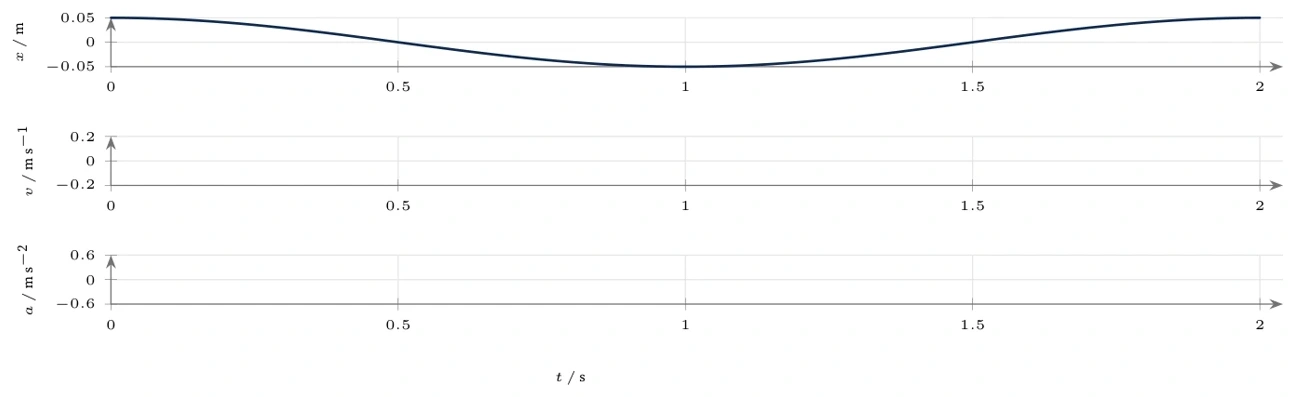
The displacement of a glider is x=0.050\cos(\pi t), with x in m and t in s. The graph of x against t for 0\le t\le2.0\,\mathrm{s} is printed, with empty axes for v and a below it.
(a) Sketch, on the axes provided, the graphs of velocity v and acceleration a against t for the same interval. Mark the peak values. [3]
(b) State the phase difference, in radians, between a and x. [1]
(c) State the first time after t=0 at which the speed is greatest. [1]
Diagram for C.1 question T7
Show solutionHide solution
(a) v is the gradient of the x–t graph: zero at t=0, then negative as x falls, with peak size \omega x_0=\pi(0.050)=0.157\,\mathrm{m\,s^{-1}} at t=0.50\,\mathrm{s} (M1 shape and phase, A1 peak). a=-\omega^2x: the x graph inverted, peak size \pi^2(0.050)=0.49\,\mathrm{m\,s^{-2}} (A1). (b) a is always opposite to x: \pi rad (A1). (c) Speed is greatest at x=0, first at t=T/4=0.50\,\mathrm{s} (A1).

Final answer

(a) v=-0.157\sin(\pi t): starts at 0, goes negative first, peak 0.16\,\mathrm{m\,s^{-1}}; a=-0.493\cos(\pi t): starts at -0.49\,\mathrm{m\,s^{-2}} (b) \pi rad (c) 0.50\,\mathrm{s}

Question T9

Type 18 Energy from m, T , x0 · Type 14 Energy–time graph[5 marks]
A 0.30\,\mathrm{kg} mass oscillates on a horizontal spring. Its potential energy rises and falls between 0 and 0.060\,\mathrm{J}, reaching its maximum every 0.25\,\mathrm{s}.
(a) State the period of the oscillation. [1]
(b) Show that the amplitude is about 5\,\mathrm{cm}. [2]
(c) Calculate the maximum speed of the mass. [1]
(d) Describe the graph of kinetic energy against time for the same interval. [1]
Show solutionHide solution
(a) E_p peaks at both extremes, twice per cycle, so T=2(0.25)=0.50\,\mathrm{s} (A1). (b) \omega=2\pi/0.50=12.6\,\mathrm{rad\,s^{-1}} (M1); x_0=\sqrt{\frac{2E_T}{m\omega^2}}=\sqrt{2(0.060)/(0.30\times12.6^2)}=0.0503\,\mathrm{m} (A1). (c) v_{\max}=\omega x_0=0.632\,\mathrm{m\,s^{-1}} (A1); check \tfrac12(0.30)(0.632)^2=0.060\,\mathrm{J}. (d) E_k=0.060-E_p: also between 0 and 0.060\,\mathrm{J}, period 0.25\,\mathrm{s}, maximum where E_p is zero (A1).

Final answer

(a) 0.50\,\mathrm{s} (b) x_0=0.0503\,\mathrm{m} (c) 0.63\,\mathrm{m\,s^{-1}} (d) same shape, peak 0.060\,\mathrm{J}, shifted by 0.125\,\mathrm{s}: zero whenever E_p is maximum

Question T8

Type 15 Energy–displacement graph · Type 16 Energy fractions[5 marks]
For a 0.50\,\mathrm{kg} oscillator, the graph of potential energy E_p against displacement x is a parabola through the origin, reaching 0.090\,\mathrm{J} at the amplitude, x=\pm0.060\,\mathrm{m}.
(a) Sketch the kinetic-energy graph on the same axes. [1]
(b) Determine the spring constant. [1]
(c) Calculate the period. [2]
(d) State the displacements at which E_k=E_p, and how many times per cycle this happens. [1]
Diagram for C.1 question T8
Show solutionHide solution
(a) E_k=E_T-E_p: the same parabola turned upside down, 0.090\,\mathrm{J} at the centre, zero at the extremes (A1). (b) E_T=\tfrac12kx_0^2: k=2(0.090)/0.060^2=50\,\mathrm{N\,m^{-1}} (A1). (c) T=2\pi\sqrt{m/k}=2\pi\sqrt{0.50/50} (M1) =0.628\,\mathrm{s} (A1). (d) E_p=\tfrac12E_T where (x/x_0)^2=\tfrac12: x=\pm0.060/\sqrt2=\pm0.042\,\mathrm{m}; each point is passed twice per cycle, four events in all (A1).

Final answer

(a) inverted parabola, 0.090\,\mathrm{J} at x=0, zero at \pm0.060\,\mathrm{m} (b) 50\,\mathrm{N\,m^{-1}} (c) 0.63\,\mathrm{s} (d) \pm0.042\,\mathrm{m}; four times

Question T10

Type 20 Energy proof · Type 17 Energy scaling[5 marks]
A 0.50\,\mathrm{kg} block on a smooth horizontal surface is fixed to a spring of constant 200\,\mathrm{N\,m^{-1}}. It is pulled 4.0\,\mathrm{cm} from equilibrium and released.
(a) Starting from E_T=\tfrac12m\omega^2x_0^2, show that E_T=\tfrac12kx_0^2. [2]
(b) Hence calculate the maximum speed of the block. [1]
(c) A student says: “A 2.0\,\mathrm{kg} block pulled out 4.0\,\mathrm{cm} on the same spring would oscillate with more energy, because it is heavier.'' Evaluate this claim. [2]
Show solutionHide solution
(a) For the spring, F=-kx; for SHM, F=ma=-m\omega^2x (M1). Equating for any x: m\omega^2=k, so E_T=\tfrac12kx_0^2 (A1). (b) E_T=\tfrac12(200)(0.040)^2=0.16\,\mathrm{J}=\tfrac12(0.50)v_{\max}^2, v_{\max}=0.80\,\mathrm{m\,s^{-1}} (A1). (c) E_T=\tfrac12kx_0^2 depends only on k and x_0: it is the work done stretching the spring, 0.16\,\mathrm{J} in both cases (M1). The heavier block shares that energy with a smaller speed, v_{\max}=\sqrt{2(0.16)/2.0}=0.40\,\mathrm{m\,s^{-1}}, so the claim is wrong (A1).

Final answer

(a) proof (b) 0.80\,\mathrm{m\,s^{-1}} (c) wrong: E_T=0.16\,\mathrm{J} for both; the heavier block moves more slowly (0.40\,\mathrm{m\,s^{-1}}) and has the longer period.

Advanced practice

Question A1

Type 22 Float: prove SHM / Predicted type[7 marks]
A test tube loaded with sand floats upright in water (\rho=1000\,\mathrm{kg\,m^{-3}}). Its total mass is 0.040\,\mathrm{kg}, its external cross-sectional area is 3.0\times10^{-4}\,\mathrm{m^2} and its length is 0.18\,\mathrm{m}. It is pushed down a little and released.
(a) Calculate the depth of tube below the surface at equilibrium. [1]
(b) The tube is pushed a further distance y below its equilibrium position. Show that the resultant force on it is -\rho Agy. [2]
(c) Hence show that the tube performs SHM and calculate its period. [2]
(d) The tube is moved to sea water, \rho=1030\,\mathrm{kg\,m^{-3}}. Calculate the new period. [1]
(e) In fresh water, determine the largest amplitude for which the motion can stay simple harmonic. [1]
Show solutionHide solution
(a) Floating: \rho Ad\,g=mg, d=m/(\rho A)=0.040/(1000\times3.0\times10^{-4})=0.133\,\mathrm{m} (A1). (b) At equilibrium F_b=F_g. Pushing down by y displaces an extra volume Ay, so the buoyancy grows by \rho Ayg (M1); the resultant is this extra upward force, opposite to y: F=-\rho Agy (A1). (c) a=-(\rho Ag/m)y, the form a=-\omega^2y with \omega^2=\rho Ag/m=73.5\,\mathrm{s^{-2}} (M1); T=2\pi\sqrt{m/(\rho Ag)}=0.733\,\mathrm{s} (A1). The same as 2\pi\sqrt{d/g}. (d) T\propto1/\sqrt\rho: 0.733\sqrt{1000/1030}=0.722\,\mathrm{s} (A1). (e) The force law holds only while part of the tube stays in the water and its top stays above it. The top is 0.18-0.133=0.047\,\mathrm{m} above the surface, the nearer limit, so x_0\le0.047\,\mathrm{m} (A1). Water drag also damps the real motion (C.4).

Final answer

(a) 0.133\,\mathrm{m} (b) proof (c) a=-(\rho Ag/m)y; 0.73\,\mathrm{s} (d) 0.72\,\mathrm{s} (e) 0.047\,\mathrm{m}

Question A2

Type 23 Recover the initial phase · Type 11 Speed at a displacement / Predicted type[6 marks]
A sensor on a vibrating machine moves in SHM with amplitude 0.060\,\mathrm{m} and period 0.90\,\mathrm{s}. At t=0 its displacement is -0.030\,\mathrm{m} and it is moving in the positive direction. Its motion is x=x_0\sin(\omega t+\phi).
(a) Determine \phi, in the range 0\le\phi<2\pi. [2]
(b) Calculate the first time after t=0 at which the sensor passes through equilibrium. [2]
(c) Calculate the speed of the sensor at t=0. [1]
(d) Calculate the first time after t=0 at which the sensor is at x=+0.060\,\mathrm{m}. [1]
Show solutionHide solution
(a) \sin\phi=-0.030/0.060=-0.5, so \phi=7\pi/6 or 11\pi/6 (M1). The velocity \omega x_0\cos\phi must be positive, so \cos\phi>0: \phi=11\pi/6 (A1). (b) \omega=2\pi/0.90=6.98\,\mathrm{rad\,s^{-1}}. Equilibrium next when \omega t+\phi=2\pi (M1): t=(\pi/6)/6.98=0.075\,\mathrm{s} (A1). (c) v=\omega\sqrt{x_0^2-x^2}=6.98\sqrt{0.060^2-0.030^2}=0.363\,\mathrm{m\,s^{-1}} (A1). (d) \omega t+\phi=2\pi+\pi/2: t=(2\pi/3)/6.98=0.300\,\mathrm{s} (A1). A quick check: 0.075\,\mathrm{s}+T/4=0.075+0.225=0.300\,\mathrm{s}.

Final answer

(a) \phi=11\pi/6 (5.76 rad) (b) 0.075\,\mathrm{s} (c) 0.36\,\mathrm{m\,s^{-1}} (d) 0.30\,\mathrm{s}

Question A3

Type 21 Vertical spring energy · Type 18 Energy from m, T , x0[7 marks]
A 0.20\,\mathrm{kg} mass hangs at rest on a light vertical spring, k=25\,\mathrm{N\,m^{-1}}. It is pulled down and released, and oscillates vertically. A data logger shows that the elastic energy stored in the spring varies, reaching a maximum of 0.206\,\mathrm{J}.
(a) Calculate the extension of the spring at equilibrium and the elastic energy stored there. [2]
(b) Show that the mass oscillates with an amplitude close to 5.0\,\mathrm{cm}. [2]
(c) Calculate the period. [1]
(d) Calculate the maximum speed of the mass. [1]
(e) Explain why the elastic energy is not zero at the highest point, although the kinetic energy is. [1]
Show solutionHide solution
(a) e_0=mg/k=0.20(9.8)/25=0.0784\,\mathrm{m} (A1); \tfrac12ke_0^2=0.0768\,\mathrm{J} (A1). (b) Greatest stretch at the lowest point: \tfrac12ke^2=0.206, e=\sqrt{2(0.206)/25}=0.128\,\mathrm{m} (M1). Amplitude =0.128-0.0784=0.050\,\mathrm{m} (A1): displacement is measured from equilibrium, not from the natural length. (c) T=2\pi\sqrt{0.20/25}=0.562\,\mathrm{s} (A1). (d) E_T=\tfrac12kx_0^2=\tfrac12(25)(0.050)^2=0.03125\,\mathrm{J}, so v_{\max}=\sqrt{2(0.03125)/0.20}=0.559\,\mathrm{m\,s^{-1}} (A1). (e) At the top the extension is 0.0784-0.050=0.028\,\mathrm{m}, still positive, so some elastic energy remains; the energy that oscillates is shared between elastic, kinetic and gravitational stores (A1).

Final answer

(a) 0.0784\,\mathrm{m}; 0.0768\,\mathrm{J} (b) 0.0500\,\mathrm{m} (c) 0.56\,\mathrm{s} (d) 0.56\,\mathrm{m\,s^{-1}} (e) the spring is still stretched by 0.028\,\mathrm{m} at the top

Question A4

Type 6 Two springs · Type 5 Spring period[7 marks]
Model a car body of mass 1200\,\mathrm{kg} as resting on four identical vertical springs, one at each wheel, each with k=2.0\times10^{4}\,\mathrm{N\,m^{-1}}. Ignore damping.
(a) Calculate the period of vertical oscillation of the empty car. [2]
(b) Four passengers of total mass 300\,\mathrm{kg} get in. Calculate how far the car sinks and the new period. [3]
(c) The loaded car drives over a road with bumps every 6.0\,\mathrm{m}. Determine the speed at which the bumps arrive at the natural frequency, and suggest why drivers feel this speed. [2]
Show solutionHide solution
(a) The four springs share the displacement, so their forces add: k_{\text{eff}}=4(2.0\times10^4)=8.0\times10^4\,\mathrm{N\,m^{-1}} (M1); T=2\pi\sqrt{1200/(8.0\times10^4)}=0.770\,\mathrm{s} (A1). (b) Extra compression =300(9.8)/(8.0\times10^4)=0.0368\,\mathrm{m} (A1). T=2\pi\sqrt{1500/(8.0\times10^4)} (M1) =0.860\,\mathrm{s} (A1). (c) One bump per period: v=6.0/0.860=6.97\,\mathrm{m\,s^{-1}} (A1). Driving the car at its natural frequency builds up large oscillations, resonance (C.4); real shock absorbers damp it (A1).

Final answer

(a) 0.77\,\mathrm{s} (b) 3.7\,\mathrm{cm}; 0.86\,\mathrm{s} (c) 7.0\,\mathrm{m\,s^{-1}} (25\,\mathrm{km\,h^{-1}}); resonance: large oscillations

Question A5

Type 9 Equation of motion · Type 11 Speed at a displacement · Type 18 Energy from m, T , x0[7 marks]
A 0.80\,\mathrm{kg} block on a spring moves on a smooth horizontal surface with displacement x=0.050\sin(4.0t+0.60), x in m, t in s.
(a) Calculate the displacement and the velocity of the block at t=0. [2]
(b) Show that your answers to (a) agree with v=\pm\omega\sqrt{x_0^2-x^2}. [1]
(c) Calculate the first time after t=0 at which the block passes through equilibrium. [2]
(d) Find the block's total energy of oscillation, and how much of it is kinetic at t=0. [2]
Show solutionHide solution
(a) Radian mode: x=0.050\sin0.60=0.0282\,\mathrm{m} (A1); v=\omega x_0\cos(\omega t+\phi)=0.20\cos0.60=+0.165\,\mathrm{m\,s^{-1}} (A1). (b) 4.0\sqrt{0.050^2-0.0282^2}=0.165\,\mathrm{m\,s^{-1}}: the same speed (A1). (c) x=0 again when 4.0t+0.60=\pi (M1), t=(\pi-0.60)/4.0=0.635\,\mathrm{s} (A1). (d) E_T=\tfrac12m\omega^2x_0^2=\tfrac12(0.80)(16)(0.050)^2=0.016\,\mathrm{J} (A1); E_k=\tfrac12(0.80)(0.165)^2=0.0109\,\mathrm{J} (A1), the rest, 0.0051\,\mathrm{J}, is potential.

Final answer

(a) 0.028\,\mathrm{m}; +0.17\,\mathrm{m\,s^{-1}} (b) 4.0\sqrt{0.050^2-0.0282^2}=0.165\,\mathrm{m\,s^{-1}} (c) 0.64\,\mathrm{s} (d) 0.016\,\mathrm{J}; 0.011\,\mathrm{J}

Question T2

Type 7 Pendulum period / Going further[5 marks]
A simple pendulum of length 0.75\,\mathrm{m} hangs from the ceiling of a lift.
(a) Calculate its period when the lift is at rest. [1]
(b) The lift accelerates upwards at 1.5\,\mathrm{m\,s^{-2}}. Explain why the period changes, and calculate the new period. [3]
(c) The lift cable breaks and the lift falls freely. Describe what the bob does if it was swinging just before. [1]
Show solutionHide solution
(a) T=2\pi\sqrt{0.75/9.8}=1.74\,\mathrm{s} (A1). (b) In the lift's frame the bob behaves as if gravity were g+a: the string must both support the bob and accelerate it, so the tension and the restoring component are larger (M1). g_{\text{eff}}=9.8+1.5=11.3\,\mathrm{m\,s^{-2}} (M1); T=2\pi\sqrt{0.75/11.3}=1.62\,\mathrm{s} (A1). (c) In free fall the bob and lift accelerate together at g; nothing pulls the bob back towards the lowest point relative to the lift. A moving bob is kept on the string's circle by the tension and goes round the pivot at constant speed; a bob at rest at an extreme stays there (A1).

Final answer

(a) 1.74\,\mathrm{s} (b) the restoring force grows as if g were 11.3\,\mathrm{m\,s^{-2}}; 1.62\,\mathrm{s} (c) it no longer oscillates: it circles the pivot at constant speed, or stays put if it was at rest.

Connected questions

Question X1

Type 7 Pendulum period · Type 5 Spring period / C.1 + D.1 + A.2[7 marks]
A geologist takes a pendulum and a spring oscillator to Mars. Mars has mass 6.42\times10^{23}\,\mathrm{kg} and radius 3.39\times10^{6}\,\mathrm{m}.
(a) Determine the free-fall acceleration at the Martian surface. [2]
(b) Calculate the period of a 0.500\,\mathrm{m} pendulum on Mars. [1]
(c) The spring oscillator has period 0.800\,\mathrm{s} on Earth. State and explain its period on Mars. [2]
(d) During take-off the lander accelerates upwards at 2.0\,\mathrm{m\,s^{-2}}. Calculate the pendulum's period inside it. [2]
Show solutionHide solution
(a) D.1: g=GM/R^2=6.67\times10^{-11}(6.42\times10^{23})/(3.39\times10^6)^2 (M1) =3.73\,\mathrm{N\,kg^{-1}} (A1). (b) T=2\pi\sqrt{0.500/3.73}=2.30\,\mathrm{s} (A1), against 1.42\,\mathrm{s} on Earth. (c) 0.800\,\mathrm{s} (A1): the spring's period depends on m and k only; weaker gravity just shortens the equilibrium stretch (A1). (d) g_{\text{eff}}=3.73+2.0=5.73\,\mathrm{m\,s^{-2}} (M1); T=2\pi\sqrt{0.500/5.73}=1.86\,\mathrm{s} (A1).

Final answer

(a) 3.73\,\mathrm{N\,kg^{-1}} (b) 2.30\,\mathrm{s} (c) 0.800\,\mathrm{s}: T=2\pi\sqrt{m/k} has no g (d) 1.86\,\mathrm{s}

Question X2

Type 10 Maximum speed and acceleration · Type 1 Read amplitude and period / C.1 + C.2[8 marks]
Water waves of wavelength 0.48\,\mathrm{m} travel at 0.60\,\mathrm{m\,s^{-1}} past a small moored buoy, which rises and falls in SHM with amplitude 0.025\,\mathrm{m}.
(a) Calculate the frequency and the period of the buoy's motion. [2]
(b) Explain why the buoy oscillates at the frequency of the wave but does not move at the wave speed. [2]
(c) HL: Calculate the maximum vertical speed of the buoy. [1]
(d) HL: A shell rests on the flat top of the buoy. Determine whether it stays in contact throughout the motion. [2]
(e) HL: A second buoy is 0.36\,\mathrm{m} further along the direction of the wave. State the phase difference between the two buoys, in radians. [1]
Show solutionHide solution
(a) C.2: f=v/\lambda=0.60/0.48=1.25\,\mathrm{Hz} (A1); T=0.80\,\mathrm{s} (A1). (b) One crest passes the buoy per period, so it is pushed up and down at the wave frequency (A1). The wave speed is the speed of the pattern; the water and the buoy only oscillate about a fixed level (A1). (c) v_{\max}=\omega x_0=2\pi(1.25)(0.025)=0.196\,\mathrm{m\,s^{-1}} (A1). (d) a_{\max}=\omega^2x_0=1.54\,\mathrm{m\,s^{-2}} (M1). This is less than g, so gravity can supply the downward acceleration at the top: the shell stays on (A1). (e) 0.36/0.48=0.75 of a wavelength, so \Delta\phi=0.75(2\pi)=3\pi/2 rad: the far buoy lags by 3\pi/2, which is the same as leading by \pi/2 (A1).

Final answer

(a) 1.25\,\mathrm{Hz}; 0.80\,\mathrm{s} (b) each patch of water is driven once per wave; the wave carries energy, not water (c) 0.20\,\mathrm{m\,s^{-1}} (d) a_{\max}=1.5\,\mathrm{m\,s^{-2}}<g: stays in contact (e) 3\pi/2 rad (equivalently \pi/2)

Question X3

Type 5 Spring period · Type 13 Energy exchange / C.1 + A.2 + A.3[9 marks]
A 0.60\,\mathrm{kg} trolley moving at 0.80\,\mathrm{m\,s^{-1}} runs into a light buffer spring (k=150\,\mathrm{N\,m^{-1}}) fixed to a wall. It compresses the spring and rebounds at the same speed. Friction is negligible.
(a) Explain why the trolley performs half an oscillation of SHM while it touches the spring. [2]
(b) Show that the contact time is about 0.2\,\mathrm{s}. [2]
(c) Use energy to calculate the maximum compression of the spring. [2]
(d) Calculate the impulse on the trolley and the average force on it during contact. Compare this with the maximum force. [3]
Show solutionHide solution
(a) In contact, the resultant force is the spring force -kx, proportional to the compression and directed back (M1). The trolley enters at equilibrium (spring unstressed) and leaves there after reversing: half a cycle (A1). (b) t=T/2=\pi\sqrt{m/k} (M1) =\pi\sqrt{0.60/150}=0.199\,\mathrm{s} (A1). (c) A.3: \tfrac12mv^2=\tfrac12kx^2 (M1), x=0.80\sqrt{0.60/150}=0.0506\,\mathrm{m} (A1). (d) A.2: velocity reverses, impulse magnitude =|\Delta p|=2mv=0.96\,\mathrm{N\,s} (A1); F_{\text{avg}}=0.96/0.199=4.83\,\mathrm{N} (A1). F_{\max}=kx=7.59\,\mathrm{N}; the average is 2/\pi of the peak, because the force rises and falls as a half sine (A1).

Final answer

(a) while touching, the only horizontal force is -kx (b) 0.199\,\mathrm{s} (c) 0.051\,\mathrm{m} (d) 0.96\,\mathrm{N\,s} opposite the initial motion; 4.8\,\mathrm{N}, against F_{\max}=7.6\,\mathrm{N} (ratio 2/\pi)

Question X4

Type 2 SHM condition · Type 10 Maximum speed and acceleration / C.1 + A.2[8 marks]
A small peg is fixed 0.12\,\mathrm{m} from the centre of a turntable that rotates at 45 revolutions per minute. A distant lamp casts the peg's shadow on a wall, where the shadow moves to and fro along a horizontal line.
(a) Calculate the angular velocity of the turntable. [1]
(b) Using the centripetal acceleration of the peg, explain why the shadow moves with SHM. [3]
(c) State the amplitude and the period of the shadow's motion, and calculate its maximum speed (HL). [3]
(d) Calculate the length of a simple pendulum whose shadow would keep in step with the peg's. [1]
Show solutionHide solution
(a) A.2: \omega=45(2\pi)/60=4.71\,\mathrm{rad\,s^{-1}} (A1). (b) The peg accelerates towards the centre at \omega^2r (M1). The shadow shows only the component along the wall line; when the peg is at angle \theta from that line its shadow is at x=r\cos\theta and its acceleration component is -\omega^2r\cos\theta (M1). So a=-\omega^2x: proportional to x and towards the centre of the line, SHM with the turntable's \omega (A1). (c) x_0=0.12\,\mathrm{m} (A1); T=2\pi/\omega=1.33\,\mathrm{s} (A1); v_{\max}=\omega r=0.565\,\mathrm{m\,s^{-1}}, the peg's own speed, reached as the shadow crosses the centre (A1). (d) l=gT^2/4\pi^2=9.8(1.333)^2/4\pi^2=0.441\,\mathrm{m} (A1).

Final answer

(a) 4.71\,\mathrm{rad\,s^{-1}} (b) the shadow's acceleration is the component of \omega^2r along the line: -\omega^2x (c) 0.12\,\mathrm{m}; 1.33\,\mathrm{s}; 0.57\,\mathrm{m\,s^{-1}} (d) 0.44\,\mathrm{m}

From the book

Photon Physics: Study Guide for the IB Diploma (SL & HL)

Simple harmonic motion from the core ideas to full exam questions, with question types, worked examples and graded practice.

About the book
