Free worked solutions · 2026 Edition

IB Physics B.5: Current and circuits worked solutions

Worked solutions to every practice question in B.5: Current and circuits of Photon Physics: Study Guide for the IB Diploma (SL & HL). Try each question, then compare your working with the full solution.

  • SL & HL
  • 31 questions
  • Full worked solutions
  • Free, no sign-up

Basic practice

Question B1

Type 1 · Charge per second[1 mark]
A current of 0.80\,\mathrm{mA} flows in a wire for 5.0 minutes. How many electrons pass any point in the wire?
A. 2.5\times10^{16}   B. 1.5\times10^{18}   C. 1.5\times10^{21}   D. 3.8\times10^{-20}
Show solutionHide solution
\Delta q=I\Delta t=(0.80\times10^{-3})(300)=0.24\,\mathrm{C}, and each electron carries 1.60\times10^{-19}\,\mathrm{C}, so N=0.24/1.60\times10^{-19}=1.5\times10^{18}. A leaves the time in minutes, C reads mA as A, D multiplies by e instead of dividing.

Final answer

B
Question B2

Type 2 · Energy per charge[1 mark]
While 5.0\,\mathrm{C} of charge flows round a circuit, a cell transfers 6.0\,\mathrm{J} to the external resistor and 1.5\,\mathrm{J} inside itself. What is the emf of the cell?
A. 0.30\,\mathrm{V}   B. 1.2\,\mathrm{V}   C. 1.5\,\mathrm{V}   D. 7.5\,\mathrm{V}
Show solutionHide solution
Emf counts all the energy the cell gives each coulomb, inside and outside: \varepsilon=(6.0+1.5)/5.0=1.5\,\mathrm{V}. B is the terminal p.d. (outside energy only), A is the lost volts (inside only), D forgets to divide by the charge.

Final answer

C

Question B3

Type 3 · Mobile charge[1 mark]
Why does a copper wire conduct while a polythene rod does not?
A. Polythene contains no electrons.
B. Some electrons in copper are free to move through the metal; in polythene the electrons stay bound to their molecules.
C. Electrons in copper move randomly at high speed, and random motion is a current.
D. In copper the positive ions move through the wire and carry the charge.
Show solutionHide solution
Conduction needs mobile charge carriers. Copper has electrons that are free to move between the fixed ions; polythene has plenty of electrons, but they are held in their molecules (A is the trap). Random motion carries no net charge past a point, so it is not a current (C). The ions in a metal stay in the lattice (D).

Final answer

B

Question B4

Type 5 · Ohmic / lamp[1 mark]
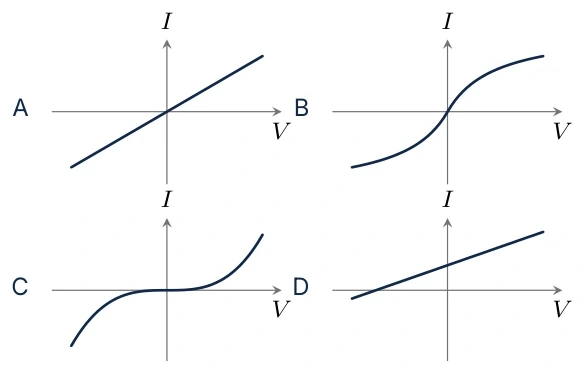
Each graph shows current I (vertical axis) against potential difference V (horizontal axis), for positive and negative V. Which graph is for a filament lamp?
A. A straight line through the origin.
B. A curve through the origin that becomes less steep as the size of V increases.
C. A curve through the origin that becomes steeper as the size of V increases.
D. A straight line that crosses the I axis above the origin.
Diagram for B.5 question B4
Show solutionHide solution
The filament heats up as the current grows, so R=V/I rises: each extra volt adds less current and the graph flattens, the same way for either direction of V. A is a metal at constant temperature, C is a component whose resistance falls as it warms (a thermistor), D would give a current with no p.d.

Final answer

B

Question B5

Type 8 · Wire ratios[1 mark]
Wire Y is made of the same metal as wire X. Y is three times as long as X and has twice the diameter of X. What is \dfrac{\text{resistance of Y}}{\text{resistance of X}}?
A. 0.75   B. 1.33   C. 1.5   D. 12
Show solutionHide solution
For one metal, resistance grows with length and falls with the square of the diameter (the cross-section is \pi d^2/4): 3/2^2=0.75. C forgets to square the diameter, B is the inverse ratio, D multiplies by d^2 instead of dividing.

Final answer

A

Question B6

Type 11 · Equivalent R[1 mark]
A 3.0\,\mathrm{\Omega} resistor is connected in series with a parallel pair made of a 4.0\,\mathrm{\Omega} resistor and a 12\,\mathrm{\Omega} resistor. What is the total resistance?
A. 1.5\,\mathrm{\Omega}   B. 3.0\,\mathrm{\Omega}   C. 6.0\,\mathrm{\Omega}   D. 19\,\mathrm{\Omega}
Show solutionHide solution
Pair first: 1/R_p=1/4.0+1/12=1/3.0, so R_p=3.0\,\mathrm{\Omega}; then add the series resistor: 3.0+3.0=6.0\,\mathrm{\Omega}. B stops at the pair, D adds all three, A puts all three in parallel.

Final answer

C

Question B7

Type 13 · Ideal meters[1 mark]
A student wants the current in, and the p.d. across, a 10\,\mathrm{\Omega} resistor connected to a 6.0\,\mathrm{V} cell of negligible internal resistance. By mistake the ammeter is connected across the resistor and the voltmeter in series with the cell. Both meters are ideal. What are the readings?
A. ammeter 0; voltmeter 6.0\,\mathrm{V}   B. ammeter 0.60\,\mathrm{A}; voltmeter 6.0\,\mathrm{V}
C. ammeter 0.60\,\mathrm{A}; voltmeter 0   D. ammeter 0; voltmeter 0
Show solutionHide solution
An ideal voltmeter has infinite resistance, so with it in series no current flows anywhere: the ammeter reads 0. Zero current means zero p.d. across the resistor and the ammeter, and all 6.0\,\mathrm{V} of the cell appears across the voltmeter. B and C imagine the normal circuit; D forgets that a voltmeter in series still measures the cell's p.d.

Final answer

A

Question B8

Type 17 · Power comparisons[1 mark]
A heating element works from a supply of constant p.d. It is shortened to three-quarters of its length and reconnected to the same supply. What is \dfrac{\text{new power}}{\text{old power}}?
A. 0.56   B. 0.75   C. 1.33   D. 1.78
Show solutionHide solution
The p.d. is fixed, so use P=V^2/R. The resistance falls to 0.75R, so the power rises by 1/0.75=1.33. B uses P\propto R (true only at fixed current); A and D square the length factor.

Final answer

C

Question B9

Type 18 · Lamp ratings[1 mark]
Lamps rated 230\,\mathrm{V}, 100\,\mathrm{W} are connected in parallel to a 230\,\mathrm{V} supply protected by a 13\,\mathrm{A} fuse. What is the largest number of lamps that can be lit together?
A. 5   B. 13   C. 29   D. 30
Show solutionHide solution
In parallel each lamp has the full 230\,\mathrm{V}, so each takes I=P/V=100/230=0.435\,\mathrm{A} and the currents add. 13/0.435=29.9, and the number must be rounded DOWN: 29 lamps, because 30 would draw 13.04\,\mathrm{A}. D rounds up, A uses I=V/P, B allows one lamp per ampere.

Final answer

C

Question B10

Type 20 · Fixed divider[1 mark]
A 12\,\mathrm{V} supply of negligible internal resistance is connected across a fixed 3.0\,\mathrm{k\Omega} resistor in series with a variable resistor that can be set anywhere from 0 to 5.0\,\mathrm{k\Omega}. What is the range of the p.d. across the fixed resistor?
A. 0 to 12\,\mathrm{V}   B. 4.5\,\mathrm{V} to 12\,\mathrm{V}
C. 7.5\,\mathrm{V} to 12\,\mathrm{V}   D. 4.5\,\mathrm{V} to 7.5\,\mathrm{V}
Show solutionHide solution
With the variable resistor at 0 the fixed resistor has the whole 12\,\mathrm{V}. At 5.0\,\mathrm{k\Omega} it takes its share 12\times3.0/8.0=4.5\,\mathrm{V}. A series variable resistor can never take the output to zero (A). 7.5\,\mathrm{V} is the variable resistor's share (C, D).

Final answer

B

Question B11

Type 23 · Lost volts[1 mark]
A battery of emf 9.0\,\mathrm{V} and internal resistance 0.60\,\mathrm{\Omega} is connected to a 3.9\,\mathrm{\Omega} resistor. What is the p.d. across the battery's terminals?
A. 1.2\,\mathrm{V}   B. 7.8\,\mathrm{V}   C. 9.0\,\mathrm{V}   D. 10.2\,\mathrm{V}
Show solutionHide solution
I=\varepsilon/(R+r)=9.0/4.5=2.0\,\mathrm{A}, so the lost volts are Ir=1.2\,\mathrm{V} and the terminal p.d. is 9.0-1.2=7.8\,\mathrm{V} (or IR=2.0\times3.9). A is the lost volts, C assumes no current, D adds instead of subtracting.

Final answer

B

Question B12

Type 15 · Short / open path[1 mark]
Three 4.0\,\mathrm{\Omega} resistors are connected in series to a 12\,\mathrm{V} cell of negligible internal resistance. A connecting wire is then joined across the ends of one of the resistors. What is the current in the cell before and after the wire is added?
A. 1.0\,\mathrm{A}, 1.0\,\mathrm{A}   B. 1.0\,\mathrm{A}, 1.5\,\mathrm{A}
C. 1.0\,\mathrm{A}, 0   D. 1.0\,\mathrm{A}, 3.0\,\mathrm{A}
Show solutionHide solution
Before: 12/12=1.0\,\mathrm{A}. The wire joins both ends of one resistor, so they are at the same potential: that resistor has no p.d., carries no current and drops out. The circuit is now 8.0\,\mathrm{\Omega} and the current is 12/8.0=1.5\,\mathrm{A}. C thinks the short stops the current; D shorts all three resistors.

Final answer

B

Tutorial practice

Question T1

Type 4 · Chemical / solar[6 marks]
A garden path light has a small solar panel on its top and a rechargeable cell inside. In daylight the panel charges the cell. At night the cell supplies 0.15\,\mathrm{A} at 1.2\,\mathrm{V} to a small lamp for 8.0 hours.
(a) Explain why the light needs the rechargeable cell as well as the solar panel. [1]
(b) Calculate how much charge passes through the lamp during one night. [2]
(c) Calculate the energy transferred to the lamp in one night. [1]
(d) The cell's capacity is 1800\,\mathrm{mA\,h}. Determine how many hours a fully charged cell can run the lamp. [1]
(e) State one advantage of the solar panel over a primary cell that is thrown away when it runs down. [1]
Show solutionHide solution
(a) A solar cell transfers energy only while light falls on it; the lamp works in the dark, so a chemical store is needed (A1). (b) \Delta t=8.0\times3600=2.88\times10^{4}\,\mathrm{s} (M1); \Delta q=I\Delta t=0.15\times2.88\times10^{4}=4.32\times10^{3}\,\mathrm{C} (A1). Hours times amperes would give 1.2\,\mathrm{A\,h}, which is not in coulombs. (c) W=Vq=1.2\times4.32\times10^{3}=5.18\times10^{3}\,\mathrm{J}\approx5.2\,\mathrm{kJ} (A1). (d) 1800\,\mathrm{mA\,h}=1.8\,\mathrm{A\,h}; 1.8/0.15=12 hours (A1). (e) Any one: no fuel or replacement cells; no chemical waste to dispose of; free energy source once installed (A1).

Final answer

(a) The panel gives no emf without light, so energy must be stored by day for use at night. (b) 4.32\times10^{3}\,\mathrm{C}. (c) 5.2\times10^{3}\,\mathrm{J}. (d) 12 hours. (e) No replacement cells to buy or dispose of (it is recharged from sunlight).

Question T2

Type 6 · V/I on a curve[6 marks]
The table gives the current I in a component X for several values of the p.d. V across it.
\begin{array}{lccccc}V/\mathrm{V} & 1.0 & 2.0 & 3.0 & 4.0 & 5.0\\ I/\mathrm{mA} & 10 & 25 & 50 & 80 & 125\end{array}
(a) Calculate the resistance of X when V=2.0\,\mathrm{V} and when V=5.0\,\mathrm{V}. [2]
(b) State, with a reason, whether X is ohmic. [1]
(c) X is connected in parallel with a 50\,\mathrm{\Omega} resistor across a 5.0\,\mathrm{V} supply of negligible internal resistance. Calculate the current from the supply. [2]
(d) The supply p.d. is lowered to 2.0\,\mathrm{V}. Calculate the new supply current. [1]
Show solutionHide solution
(a) R=V/I at each point, with I in amperes: 2.0/0.025=80\,\mathrm{\Omega} (A1); 5.0/0.125=40\,\mathrm{\Omega} (A1). A tangent gradient is not the resistance. (b) The ratio V/I changes (equivalently, I is not proportional to V), so X is non-ohmic (A1). (c) In parallel both have 5.0\,\mathrm{V}: X takes 125\,\mathrm{mA} from the table, the resistor 5.0/50=100\,\mathrm{mA} (M1). Supply current =225\,\mathrm{mA}=0.225\,\mathrm{A} (A1). (d) X now takes 25\,\mathrm{mA} and the resistor 40\,\mathrm{mA}: 65\,\mathrm{mA}=0.065\,\mathrm{A} (A1). The supply p.d. fell to 0.40 of its value but the current to only 0.29: X's resistance changed.

Final answer

(a) 80\,\mathrm{\Omega}; 40\,\mathrm{\Omega}. (b) Not ohmic: V/I is not constant (current not proportional to p.d.). (c) 0.225\,\mathrm{A}. (d) 0.065\,\mathrm{A}.

Question T3

Type 10 · Size from ρ[5 marks]
The element of a 230\,\mathrm{V}, 1.5\,\mathrm{kW} hot-water urn is a flat nichrome ribbon 2.0\,\mathrm{mm} wide and 0.10\,\mathrm{mm} thick. The resistivity of nichrome is 1.1\times10^{-6}\,\mathrm{\Omega\,m}.
(a) Show that the resistance of the element is about 35\,\mathrm{\Omega}. [1]
(b) Calculate the length of ribbon needed. [2]
(c) A repairer cuts the ribbon to half this length and connects it to the 230\,\mathrm{V} supply. Calculate the new power and suggest one reason the urn should not be used like this. [2]
Show solutionHide solution
(a) R=V^2/P=230^2/1500=35.3\,\mathrm{\Omega} (A1). (b) The current flows along the ribbon, so the area is the cross-section: A=(2.0\times10^{-3})(0.10\times10^{-3})=2.0\times10^{-7}\,\mathrm{m^2} (M1). L=RA/\rho=35.3\times2.0\times10^{-7}/1.1\times10^{-6}=6.4\,\mathrm{m} (A1). Using the face area of the ribbon is the usual slip. (c) Half the length halves R; at fixed p.d. P=V^2/R doubles to 3.0\,\mathrm{kW} (A1). The current becomes 3000/230=13\,\mathrm{A}: the ribbon runs much hotter and the circuit or fuse may be overloaded (A1).

Final answer

(a) R=V^2/P=35.3\,\mathrm{\Omega}. (b) 6.4\,\mathrm{m}. (c) 3.0\,\mathrm{kW}; the current doubles to about 13\,\mathrm{A}, so the ribbon (and wiring) overheats.

Question T4

Type 12 · Branch I and V[6 marks]
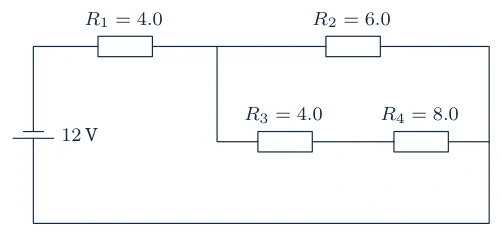
A 12\,\mathrm{V} battery of negligible internal resistance is connected to resistor R_1=4.0\,\mathrm{\Omega} in series with a parallel arrangement. One branch is R_2=6.0\,\mathrm{\Omega}; the other branch is R_3=4.0\,\mathrm{\Omega} in series with R_4=8.0\,\mathrm{\Omega}.
(a) Show that the total resistance of the circuit is 8.0\,\mathrm{\Omega}. [2]
(b) Calculate the current in R_3. [2]
(c) Calculate the p.d. across R_4. [1]
(d) Calculate the power dissipated in R_2. [1]
Diagram for B.5 question T4
Show solutionHide solution
(a) Lower branch R_3+R_4=12\,\mathrm{\Omega} (M1); with R_2: (6.0\times12)/(6.0+12)=4.0\,\mathrm{\Omega}; total 4.0+4.0=8.0\,\mathrm{\Omega} (A1). (b) Battery current 12/8.0=1.5\,\mathrm{A}; p.d. across the parallel part =1.5\times4.0=6.0\,\mathrm{V} (M1); current in the 12\,\mathrm{\Omega} branch =6.0/12=0.50\,\mathrm{A} (A1). Check: R_2 takes 1.0\,\mathrm{A}, and 1.0+0.50=1.5\,\mathrm{A}. (c) V_4=0.50\times8.0=4.0\,\mathrm{V} (A1). (d) P_2=V^2/R=6.0^2/6.0=6.0\,\mathrm{W} (A1).

Final answer

(a) Branches 6.0\,\mathrm{\Omega} and 12\,\mathrm{\Omega} give 4.0\,\mathrm{\Omega}; 4.0+4.0=8.0\,\mathrm{\Omega}. (b) 0.50\,\mathrm{A}. (c) 4.0\,\mathrm{V}. (d) 6.0\,\mathrm{W}.

Question T5

Type 21 · Sensor divider[6 marks]
A frost warning circuit has an NTC thermistor in series with a fixed 3.3\,\mathrm{k\Omega} resistor across a 6.0\,\mathrm{V} battery whose internal resistance can be ignored. An ideal voltmeter measures the p.d. across the thermistor. At 0\,{}^\circ\mathrm{C} the thermistor's resistance is 9.9\,\mathrm{k\Omega}.
(a) Calculate the current in the circuit at 0\,{}^\circ\mathrm{C}. [2]
(b) Calculate the voltmeter reading at 0\,{}^\circ\mathrm{C}. [1]
(c) The air warms up. Explain how the voltmeter reading changes. [2]
(d) Determine the thermistor's resistance when the voltmeter reads 3.0\,\mathrm{V}. [1]
Show solutionHide solution
(a) Series: R=9.9+3.3=13.2\,\mathrm{k\Omega} (M1); I=6.0/13200=4.5\times10^{-4}\,\mathrm{A}=0.45\,\mathrm{mA} (A1). (b) V_T=IR_T=4.5\times10^{-4}\times9900=4.5\,\mathrm{V} (A1). (c) As the thermistor warms its resistance falls, so the total resistance falls and the current rises (M1). The p.d. across the fixed resistor, I\times3.3\,\mathrm{k\Omega}, rises, and the two p.d.s must still add to 6.0\,\mathrm{V}, so the voltmeter reading falls (A1). (d) Equal shares of 6.0\,\mathrm{V} mean equal resistances: 3.3\,\mathrm{k\Omega} (A1).

Final answer

(a) 0.45\,\mathrm{mA}. (b) 4.5\,\mathrm{V}. (c) It falls: the thermistor's resistance falls, the current rises, the fixed resistor takes a larger p.d., so the thermistor's share falls. (d) 3.3\,\mathrm{k\Omega}.

Question T6

Type 24 · Cell V-I graph[6 marks]
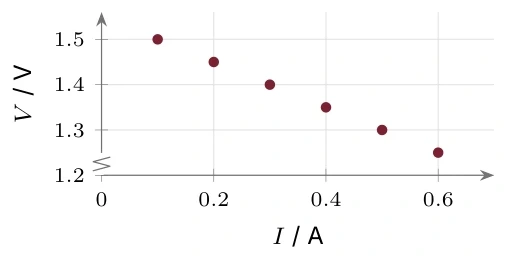
A student varies the current I drawn from a cell and records the terminal p.d. V.
\begin{array}{lcccccc}I/\mathrm{A} & 0.10 & 0.20 & 0.30 & 0.40 & 0.50 & 0.60\\ V/\mathrm{V} & 1.50 & 1.45 & 1.40 & 1.35 & 1.30 & 1.25\end{array}
(a) Use the data to determine the emf \varepsilon and the internal resistance r of the cell. [3]
(b) Calculate the power dissipated inside the cell when I=0.40\,\mathrm{A}. [1]
(c) Calculate the current when the terminals are joined by a wire of negligible resistance. [1]
(d) Suggest why the student switches the circuit off between readings. [1]
Diagram for B.5 question T6
Show solutionHide solution
(a) V=\varepsilon-Ir is a straight line with gradient -r and intercept \varepsilon (M1). Gradient =(1.25-1.50)/(0.60-0.10)=-0.50\,\mathrm{V\,A^{-1}}, so r=0.50\,\mathrm{\Omega} (A1). At I=0: \varepsilon=1.50+0.10\times0.50=1.55\,\mathrm{V} (A1). The first reading, 1.50\,\mathrm{V}, is not the emf: some current was already flowing. (b) I^2r=0.40^2\times0.50=0.080\,\mathrm{W} (A1). (c) I=\varepsilon/r=1.55/0.50=3.1\,\mathrm{A} (A1). (d) Keeping the current on heats the cell and runs it down, so r and \varepsilon change from one reading to the next (A1).

Final answer

(a) \varepsilon=1.55\,\mathrm{V}; r=0.50\,\mathrm{\Omega}. (b) 0.080\,\mathrm{W}. (c) 3.1\,\mathrm{A}. (d) A large current warms the cell (and discharges it), changing r and \varepsilon during the experiment.

Question T7

Type 14 · Meter loading[5 marks]
Resistors of 47\,\mathrm{k\Omega} and 33\,\mathrm{k\Omega} are connected in series to a 9.0\,\mathrm{V} supply of negligible internal resistance.
(a) Calculate the p.d. across the 33\,\mathrm{k\Omega} resistor. [1]
(b) A voltmeter of resistance 100\,\mathrm{k\Omega} is connected across the 33\,\mathrm{k\Omega} resistor. Calculate its reading. [3]
(c) Explain why a voltmeter of resistance 10\,\mathrm{M\Omega} would give a reading closer to your answer to (a). [1]
Show solutionHide solution
(a) 9.0\times33/80=3.71\,\mathrm{V} (A1). (b) The voltmeter is in parallel with the 33\,\mathrm{k\Omega} resistor: R_p=(33\times100)/(133)=24.8\,\mathrm{k\Omega} (M1). New share: 9.0\times24.8/(47+24.8) (M1) =3.11\,\mathrm{V} (A1). Adding the meter in series with the resistor is the common wrong model. (c) With 10\,\mathrm{M\Omega} the parallel pair is 32.9\,\mathrm{k\Omega}, almost 33\,\mathrm{k\Omega}, so the meter draws a negligible current and barely changes the shares (A1).

Final answer

(a) 3.71\,\mathrm{V}. (b) 3.11\,\mathrm{V}. (c) Its resistance is far larger than 33\,\mathrm{k\Omega}, so the parallel combination stays very close to 33\,\mathrm{k\Omega} and the circuit is hardly changed.

Question T8

Type 16 · Switch changes[5 marks]
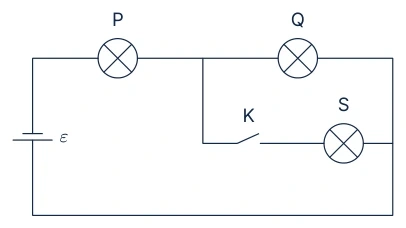
A cell of emf \varepsilon, with no internal resistance, lights three identical lamps P, Q and S. P is in series with Q. Lamp S, in series with a switch K, is connected in parallel with Q. Treat each lamp as having a constant resistance.
(a) K is open. State the p.d. across P in terms of \varepsilon. [1]
(b) K is closed. Determine the p.d. across P and across Q. [2]
(c) Calculate \dfrac{\text{power in P with K closed}}{\text{power in P with K open}}. [1]
(d) State what happens to the brightness of Q when K is closed. [1]
Diagram for B.5 question T8
Show solutionHide solution
(a) Two equal resistances in series share \varepsilon equally: \varepsilon/2 (A1). (b) Q and S in parallel make R/2; with P the total is 1.5R (M1). P takes R/1.5R=2/3 of \varepsilon; the parallel pair takes \varepsilon/3, so Q has \varepsilon/3 (A1). (c) Same lamp, so P\propto V^2: (2/3)^2/(1/2)^2=16/9=1.78 (A1). (d) Q's p.d. falls from \varepsilon/2 to \varepsilon/3, so it is dimmer (A1). The cell current rose, but that does not brighten every lamp.

Final answer

(a) \varepsilon/2. (b) P: 2\varepsilon/3; Q: \varepsilon/3. (c) 16/9=1.78. (d) Q becomes dimmer (its power falls to 4/9 of its value).

Question T9

Type 25 · Internal power[6 marks]
A battery of emf 12\,\mathrm{V} and internal resistance 0.80\,\mathrm{\Omega} powers a heater of resistance 4.0\,\mathrm{\Omega}.
(a) Calculate the current. [1]
(b) Calculate the power delivered to the heater and the power dissipated inside the battery. [2]
(c) Calculate the fraction of the battery's output that reaches the heater. [1]
(d) A second identical heater is connected in parallel with the first. Determine the new terminal p.d. and the power in each heater. [2]
Show solutionHide solution
(a) I=\varepsilon/(R+r)=12/4.8=2.5\,\mathrm{A} (A1). (b) Heater: I^2R=2.5^2\times4.0=25\,\mathrm{W} (A1); inside: I^2r=2.5^2\times0.80=5.0\,\mathrm{W} (A1). Check: \varepsilon I=30\,\mathrm{W}=25+5.0. (c) 25/30=0.83, the same as R/(R+r) (A1). (d) External resistance 2.0\,\mathrm{\Omega}; I=12/2.8=4.29\,\mathrm{A}; terminal p.d. =12-4.29\times0.80=8.57\,\mathrm{V} (M1). Each heater: 8.57^2/4.0=18.4\,\mathrm{W} (A1). The extra heater draws more current, so more volts are lost inside and each heater gets less.

Final answer

(a) 2.5\,\mathrm{A}. (b) 25\,\mathrm{W}; 5.0\,\mathrm{W}. (c) 0.83. (d) 8.6\,\mathrm{V}; 18\,\mathrm{W} each.

Question T10

Type 19 · Cable heating[5 marks]
A 230\,\mathrm{V}, 2.3\,\mathrm{kW} pressure washer is used at the end of an extension cable. The two copper cores of the cable have a total length of 60\,\mathrm{m} and each core has a cross-sectional area of 1.0\,\mathrm{mm^2}. Copper has a resistivity of 1.7\times10^{-8}\,\mathrm{\Omega\,m}.
(a) Show that the total resistance of the cores is about 1\,\mathrm{\Omega}. [1]
(b) Assume the washer draws its rated current. Calculate this current. [1]
(c) Calculate the power dissipated in the cable. [2]
(d) Explain how a cable with thicker cores would change this power. [1]
Show solutionHide solution
(a) R=\rho L/A=1.7\times10^{-8}\times60/(1.0\times10^{-6})=1.02\,\mathrm{\Omega} (A1). The 60\,\mathrm{m} already counts both cores; do not double it. (b) I=P/V=2300/230=10\,\mathrm{A} (A1). (c) P_\text{cable}=I^2R (M1) =10^2\times1.02=102\approx1.0\times10^{2}\,\mathrm{W} (A1). Using V^2/R with 230\,\mathrm{V} is wrong: the 230\,\mathrm{V} is not across the cable. (d) R\propto1/A, so thicker cores have less resistance and waste less power, I^2R, for the same current (A1).

Final answer

(a) 1.02\,\mathrm{\Omega}. (b) 10\,\mathrm{A}. (c) 1.0\times10^{2}\,\mathrm{W}. (d) Larger area, smaller resistance, so less I^2R heating at the same current.

Advanced practice

Question A1

Type 7 · Graph circuit[7 marks]
The table gives the I–V characteristic of a small filament lamp.
\begin{array}{lccccccc}V/\mathrm{V} & 0.5 & 1.0 & 2.0 & 3.0 & 4.0 & 5.0 & 6.0\\ I/\mathrm{A} & 0.10 & 0.16 & 0.24 & 0.30 & 0.35 & 0.39 & 0.42\end{array}
(a) Calculate the resistance of the lamp at 1.0\,\mathrm{V} and at 6.0\,\mathrm{V}, and explain the difference. [3]
(b) The lamp is connected in series with a 10\,\mathrm{\Omega} resistor to a 6.0\,\mathrm{V} supply of negligible internal resistance. Determine the current. [3]
(c) Calculate the power dissipated in the lamp in (b). [1]
Show solutionHide solution
(a) 1.0/0.16=6.25\,\mathrm{\Omega} and 6.0/0.42=14.3\,\mathrm{\Omega} (A1 for both). At higher current the filament is hotter (M1); its ions vibrate more, so the moving charges lose energy to them more often and V/I rises (A1). (b) Same current in both; the p.d.s must add to 6.0\,\mathrm{V}: V_\text{lamp}+10I=6.0 (M1). The lamp's own I–V data must also hold. Try the table: at 3.0\,\mathrm{V}, I=0.30\,\mathrm{A} and 3.0+10\times0.30=6.0\,\mathrm{V} (M1), so I=0.30\,\mathrm{A} (A1). At 2.0\,\mathrm{V} the sum is only 4.4\,\mathrm{V} and at 4.0\,\mathrm{V} it is 7.5\,\mathrm{V}, so the answer is unique. (c) P=VI=3.0\times0.30=0.90\,\mathrm{W} (A1).

Final answer

(a) 6.3\,\mathrm{\Omega} and 14\,\mathrm{\Omega}; the hotter filament has a larger resistance. (b) 0.30\,\mathrm{A}. (c) 0.90\,\mathrm{W}.

Question A2

Type 9 · Reshape volume[6 marks]
A cylinder of conducting modelling dough is 4.0\,\mathrm{cm} long with a diameter of 2.0\,\mathrm{cm}. Its resistance between the flat ends is 120\,\mathrm{\Omega}.
(a) Calculate the resistivity of the dough. [2]
(b) The dough is rolled into a longer, thinner cylinder 12\,\mathrm{cm} long. Its volume does not change. Determine the new resistance between the ends. [2]
(c) Each shape in turn is connected to the same 9.0\,\mathrm{V} battery of negligible internal resistance. Calculate the current through the long cylinder and the ratio \dfrac{\text{power in long cylinder}}{\text{power in short cylinder}}. [2]
Show solutionHide solution
(a) A=\pi(0.010)^2=3.14\times10^{-4}\,\mathrm{m^2} (M1); \rho=RA/L=120\times3.14\times10^{-4}/0.040=0.94\,\mathrm{\Omega\,m} (A1). (b) Volume fixed, so A falls by the same factor that L rises: L\times3, A\div3, R\times9 (M1). R=9\times120=1080\approx1.1\times10^{3}\,\mathrm{\Omega} (A1). Changing only the length (giving 360\,\mathrm{\Omega}) is the trap. (c) I=9.0/1080=8.3\times10^{-3}\,\mathrm{A} (A1). Same p.d., so P=V^2/R and the ratio is 120/1080=1/9 (A1).

Final answer

(a) 0.94\,\mathrm{\Omega\,m}. (b) 1.1\times10^{3}\,\mathrm{\Omega}. (c) 8.3\,\mathrm{mA}; 1/9=0.11.

Question A3

Type 26 · Multiple cells[7 marks]
Two identical cells, each of emf 1.5\,\mathrm{V} and internal resistance 0.60\,\mathrm{\Omega}, are used to light a lamp of resistance 1.2\,\mathrm{\Omega}. Treat the lamp's resistance as constant.
(a) The cells are connected in series. Calculate the current and the power in the lamp. [2]
(b) The cells are connected in parallel instead. Calculate the current in the lamp and the power in the lamp. [3]
(c) For each arrangement calculate the fraction of the cells' total output that is dissipated inside the cells, and state which arrangement lights the lamp more brightly. [2]
Show solutionHide solution
(a) Series: emfs and internal resistances add, 3.0\,\mathrm{V} and 1.2\,\mathrm{\Omega} (M1). I=3.0/(1.2+1.2)=1.25\,\mathrm{A}; lamp power 1.25^2\times1.2=1.88\,\mathrm{W} (A1). (b) Parallel: the emf stays 1.5\,\mathrm{V} (M1) and the internal resistance halves to 0.30\,\mathrm{\Omega} (M1). I=1.5/1.5=1.0\,\mathrm{A}; lamp power 1.0^2\times1.2=1.2\,\mathrm{W} (A1). Doubling the emf as well is the classic slip. (c) Fraction lost =r/(R+r): series 1.2/2.4=0.50, parallel 0.30/1.5=0.20 (A1). The series pair wastes a larger fraction but still delivers more power to the lamp, so it is brighter (A1).

Final answer

(a) 1.25\,\mathrm{A}; 1.9\,\mathrm{W}. (b) 1.0\,\mathrm{A}; 1.2\,\mathrm{W}. (c) Series 0.50, parallel 0.20; the series arrangement is brighter.

Question A4

Type 22 · Loaded sensor[8 marks]
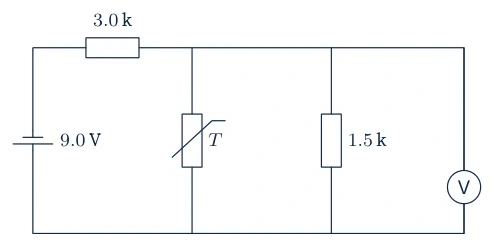
An NTC thermistor T is connected in parallel with a fixed 1.5\,\mathrm{k\Omega} resistor. The pair is connected in series with a 3.0\,\mathrm{k\Omega} resistor across a 9.0\,\mathrm{V} battery of negligible internal resistance. At 25\,{}^\circ\mathrm{C} an ideal voltmeter across the pair reads 2.7\,\mathrm{V}.
(a) Calculate the current in the 3.0\,\mathrm{k\Omega} resistor. [2]
(b) Determine the resistance of T at 25\,{}^\circ\mathrm{C}. [3]
(c) When T is warmed its resistance falls to 1.5\,\mathrm{k\Omega}. Calculate the new voltmeter reading. [2]
(d) State what happens to the current in the battery when T is warmed. [1]
Diagram for B.5 question A4
Show solutionHide solution
(a) The series resistor has 9.0-2.7=6.3\,\mathrm{V} (M1); I=6.3/3000=2.1\times10^{-3}\,\mathrm{A} (A1). Using 9.0\,\mathrm{V} or 2.7\,\mathrm{V} across it is the trap. (b) The fixed 1.5\,\mathrm{k\Omega} resistor takes 2.7/1500=1.8\,\mathrm{mA} (M1); T takes 2.1-1.8=0.3\,\mathrm{mA} (M1); R_T=2.7/(0.30\times10^{-3})=9.0\,\mathrm{k\Omega} (A1). The battery current is not the thermistor current. (c) Pair: 1.5\,\mathrm{k\Omega} parallel with 1.5\,\mathrm{k\Omega} =0.75\,\mathrm{k\Omega} (M1); share =9.0\times0.75/3.75=1.8\,\mathrm{V} (A1). (d) Total resistance falls from 4.29\,\mathrm{k\Omega} to 3.75\,\mathrm{k\Omega}, so the battery current rises (from 2.1 to 2.4\,\mathrm{mA}) (A1).

Final answer

(a) 2.1\,\mathrm{mA}. (b) 9.0\,\mathrm{k\Omega}. (c) 1.8\,\mathrm{V}. (d) It increases (the total resistance falls).

Question A5

Type 23 · Lost volts[8 marks]
A car battery has an emf of 12.6\,\mathrm{V}. With only the headlamps switched on, the battery supplies 8.0\,\mathrm{A} and its terminal p.d. is 12.2\,\mathrm{V}.
(a) Show that the battery's internal resistance is 0.050\,\mathrm{\Omega}. [2]
(b) The starter motor is switched on, in parallel with the headlamps, and the terminal p.d. falls to 9.6\,\mathrm{V}. Calculate the current from the battery. [2]
(c) Treat the headlamps' resistance as constant. Calculate the current in the headlamps and in the starter motor. [2]
(d) Explain why the headlamps dim and calculate their power as a fraction of their normal power. [2]
Show solutionHide solution
(a) Lost volts =12.6-12.2=0.40\,\mathrm{V} (M1); r=0.40/8.0=0.050\,\mathrm{\Omega} (A1). (b) Lost volts now 12.6-9.6=3.0\,\mathrm{V} (M1); I=3.0/0.050=60\,\mathrm{A} (A1). (c) Headlamps: R=12.2/8.0=1.525\,\mathrm{\Omega}, so I=9.6/1.525=6.3\,\mathrm{A} (A1); motor 60-6.3=53.7\approx54\,\mathrm{A} (A1). (d) The motor's large current raises Ir and lowers the terminal p.d. shared by the lamps (A1). Same resistance, so P\propto V^2: (9.6/12.2)^2=0.62 (A1).

Final answer

(a) r=0.40/8.0=0.050\,\mathrm{\Omega}. (b) 60\,\mathrm{A}. (c) Headlamps 6.3\,\mathrm{A}; motor 54\,\mathrm{A}. (d) The large current makes the lost volts Ir large, so the lamps' p.d. falls; power fraction 0.62.

Connected questions

Question X1

B.5 + B.1 + A.3[8 marks]
An electric kettle has a 230\,\mathrm{V}, 2.2\,\mathrm{kW} element made of nichrome wire 1.8\,\mathrm{m} long (resistivity 1.1\times10^{-6}\,\mathrm{\Omega\,m}). It heats 1.2\,\mathrm{kg} of water from 18\,{}^\circ\mathrm{C} to 100\,{}^\circ\mathrm{C}. The specific heat capacity of water is 4180\,\mathrm{J\,kg^{-1}\,K^{-1}}.
(a) Calculate the current in the element and its resistance. [2]
(b) Determine the diameter of the nichrome wire. [2]
(c) Calculate the energy needed to heat the water. [1]
(d) 90\% of the electrical energy reaches the water. Calculate the heating time. [2]
(e) On a day when the supply p.d. is 207\,\mathrm{V}, the element's resistance is unchanged. Calculate the new heating time. [1]
Show solutionHide solution
(a) B.5: I=P/V=2200/230=9.57\,\mathrm{A} (A1); R=V/I=24.0\,\mathrm{\Omega} (A1). (b) A=\rho L/R=1.1\times10^{-6}\times1.8/24.0=8.23\times10^{-8}\,\mathrm{m^2} (M1); d=\sqrt{4A/\pi}=3.2\times10^{-4}\,\mathrm{m}=0.32\,\mathrm{mm} (A1). (c) B.1: Q=mc\Delta T=1.2\times4180\times82=4.11\times10^{5}\,\mathrm{J} (A1). (d) A.3: useful power =0.90\times2200=1980\,\mathrm{W} (M1); t=4.11\times10^{5}/1980=208\,\mathrm{s} (A1). (e) P\propto V^2 at fixed R: P=2200\times(207/230)^2=1782\,\mathrm{W}, so t=4.11\times10^{5}/(0.90\times1782)=256\,\mathrm{s} (A1).

Final answer

(a) 9.6\,\mathrm{A}; 24\,\mathrm{\Omega}. (b) 0.32\,\mathrm{mm}. (c) 4.11\times10^{5}\,\mathrm{J}. (d) 208\,\mathrm{s} (about 3.5 minutes). (e) 256\,\mathrm{s}.

Question X2

B.5 + A.3[8 marks]
A 12.0\,\mathrm{V} battery of internal resistance 0.10\,\mathrm{\Omega} drives the motor of a winch. While the winch lifts a 300\,\mathrm{kg} load vertically at a constant 0.040\,\mathrm{m\,s^{-1}}, the motor current is 15\,\mathrm{A}.
(a) Calculate the p.d. across the motor. [1]
(b) Calculate the electrical power input to the motor and the rate at which the load gains gravitational potential energy. [2]
(c) Calculate the efficiency of the motor. [1]
(d) Calculate the power dissipated inside the battery. [1]
(e) The load is raised 2.0\,\mathrm{m}. Calculate the charge that passes through the motor. [2]
(f) Calculate the fraction of the battery's total energy output that ends as gravitational potential energy. [1]
Show solutionHide solution
(a) V=\varepsilon-Ir=12.0-15\times0.10=10.5\,\mathrm{V} (A1). (b) P_\text{in}=VI=10.5\times15=157.5\,\mathrm{W} (A1); A.3: P_\text{out}=mgv=300\times9.8\times0.040=117.6\,\mathrm{W} (A1). (c) 117.6/157.5=0.747\approx0.75 (A1). (d) I^2r=15^2\times0.10=22.5\,\mathrm{W} (A1). (e) t=2.0/0.040=50\,\mathrm{s} (M1); q=It=15\times50=750\,\mathrm{C} (A1). (f) Battery output \varepsilon I=12.0\times15=180\,\mathrm{W}; 117.6/180=0.65 (A1). Check: 180=22.5+157.5.

Final answer

(a) 10.5\,\mathrm{V}. (b) 158\,\mathrm{W}; 118\,\mathrm{W}. (c) 0.75. (d) 22.5\,\mathrm{W}. (e) 750\,\mathrm{C}. (f) 0.65.

Question X3

B.5 + D.3 + A.2[8 marks]
A copper rod rests across two horizontal copper rails 6.0\,\mathrm{cm} apart, in a uniform vertical magnetic field of 0.25\,\mathrm{T}. A cell of emf 3.0\,\mathrm{V} and internal resistance 0.40\,\mathrm{\Omega} drives a current through the rails and rod via a 1.1\,\mathrm{\Omega} resistor. The rails and rod have negligible resistance. The rod has mass 5.0\,\mathrm{g}; ignore friction.
(a) Calculate the current at the instant the circuit is completed. [2]
(b) Calculate the magnetic force on the rod and state its direction relative to the rod and the field. [2]
(c) Calculate the initial acceleration of the rod. [1]
(d) The 1.1\,\mathrm{\Omega} resistor is to be made from aluminium wire of diameter 0.20\,\mathrm{mm} (resistivity 2.7\times10^{-8}\,\mathrm{\Omega\,m}). Calculate the length of wire needed. [2]
(e) Calculate the power dissipated inside the cell. [1]
Show solutionHide solution
(a) B.5: I=\varepsilon/(R+r)=3.0/(1.1+0.40)=2.0\,\mathrm{A} (M1, A1). (b) D.3: F=BIL=0.25\times2.0\times0.060=0.030\,\mathrm{N} (A1); it is perpendicular to the rod and to the field, so horizontal and along the rails (A1). (c) A.2: a=F/m=0.030/0.0050=6.0\,\mathrm{m\,s^{-2}} (A1). (d) A=\pi(1.0\times10^{-4})^2=3.14\times10^{-8}\,\mathrm{m^2} (M1); L=RA/\rho=1.1\times3.14\times10^{-8}/2.7\times10^{-8}=1.28\approx1.3\,\mathrm{m} (A1). (e) I^2r=2.0^2\times0.40=1.6\,\mathrm{W} (A1).

Final answer

(a) 2.0\,\mathrm{A}. (b) 0.030\,\mathrm{N}, perpendicular to both the rod and the field (horizontal, along the rails). (c) 6.0\,\mathrm{m\,s^{-2}}. (d) 1.3\,\mathrm{m}. (e) 1.6\,\mathrm{W}.

Question X4

B.5 + D.4 + D.3[8 marks]
A metal rod of mass 0.040\,\mathrm{kg} can slide along two horizontal rails 0.10\,\mathrm{m} apart in a uniform vertical magnetic field of 0.50\,\mathrm{T}. A cell of emf 1.5\,\mathrm{V} drives a current through the rails and rod; the total resistance of the circuit, including the cell's internal resistance, is 0.50\,\mathrm{\Omega}. A constant friction force of 0.10\,\mathrm{N} opposes the motion of the rod.
(a) Calculate the current and the magnetic force on the rod when it is at rest, and show that the rod starts to move. [2]
(b) Calculate the initial acceleration of the rod. [1]
(c) Explain why the current falls as the rod speeds up. [2]
(d) Determine the steady speed that the rod reaches. [2]
(e) At the steady speed, calculate the power supplied by the cell and the power dissipated in the circuit resistance. [1]
Show solutionHide solution
(a) B.5: I=1.5/0.50=3.0\,\mathrm{A}; D.3: F=BIL=0.50\times3.0\times0.10=0.15\,\mathrm{N}, more than the 0.10\,\mathrm{N} friction (A1, A1). (b) a=(0.15-0.10)/0.040=1.25\,\mathrm{m\,s^{-2}} (A1). (c) D.4: the moving rod cuts the field and an emf BLv is induced in it (M1). By Lenz's law it opposes the cell's emf, so the net emf \varepsilon-BLv and the current fall as v grows (A1). (d) Steady speed: magnetic force = friction, BIL=0.10, so I=2.0\,\mathrm{A} (M1). Then 1.5-0.50\times0.10\,v=2.0\times0.50, v=10\,\mathrm{m\,s^{-1}} (A1). (e) Cell: \varepsilon I=1.5\times2.0=3.0\,\mathrm{W}; resistance: I^2R=2.0^2\times0.50=2.0\,\mathrm{W} (A1). The remaining 1.0\,\mathrm{W}=Fv=0.10\times10 is done against friction.

Final answer

(a) 3.0\,\mathrm{A}; 0.15\,\mathrm{N}>0.10\,\mathrm{N}. (b) 1.25\,\mathrm{m\,s^{-2}}. (c) The moving rod has an induced emf BLv that opposes the cell, so the net emf and the current fall. (d) 10\,\mathrm{m\,s^{-1}}. (e) 3.0\,\mathrm{W}; 2.0\,\mathrm{W} (the other 1.0\,\mathrm{W} works against friction).

From the book

Photon Physics: Study Guide for the IB Diploma (SL & HL)

Current and circuits from the core ideas to full exam questions, with question types, worked examples and graded practice.

About the book