Free worked solutions · 2026 Edition

IB Physics B.1: Thermal energy transfers worked solutions

Worked solutions to every practice question in B.1: Thermal energy transfers of Photon Physics: Study Guide for the IB Diploma (SL & HL). Try each question, then compare your working with the full solution.

  • SL & HL
  • 31 questions
  • Full worked solutions
  • Free, no sign-up

Basic practice

Question A1

Type A1 · P1A / Kelvin intervals[1 mark]
A bowl of soup cools from 78\,\mathrm{^{\circ}C} to 41\,\mathrm{^{\circ}C}. By how much does its temperature fall?
A. 37\,\mathrm{K}   B. 236\,\mathrm{K}
C. 310\,\mathrm{K}   D. It cannot be found without the mass of the soup.
Show solutionHide solution
A kelvin and a degree Celsius are the same size, so an interval is the same number on both scales: 78-41=37\,\mathrm{K}. C adds 273 to a difference; B subtracts the difference from 273. The mass sets how much energy leaves, not the temperature change.

Final answer

A
Question A2

Type A2 · P1A / Definitions[1 mark]
A student writes four sentences about a liquid. Which one is the meaning of its specific latent heat of vaporization?
A. Energy that warms one kilogram of it through one kelvin.
B. The energy needed to change 1\,\mathrm{kg} of the liquid into vapour with no change of temperature.
C. The energy needed to change the liquid into vapour at its boiling point.
D. The energy needed per kelvin to change 1\,\mathrm{kg} of the liquid into vapour.
Show solutionHide solution
A latent heat is energy per kilogram for a change of phase at constant temperature: unit \mathrm{J\,kg^{-1}}. A defines specific heat capacity. C has no unit mass, so it depends on how much liquid there is. D adds a kelvin that does not belong.

Final answer

B

Question A4

Type A4 · P1A / Phase energy[1 mark]
Water at 0\,\mathrm{^{\circ}C} freezes into ice at 0\,\mathrm{^{\circ}C}. What happens to the mean random kinetic energy and to the intermolecular potential energy of the molecules?
A. Mean random KE unchanged; intermolecular PE decreases.
B. KE unchanged; PE increases.
C. KE decreases; PE unchanged.
D. KE decreases; PE decreases.
Show solutionHide solution
Constant temperature fixes the mean kinetic energy. As bonds form, the molecules settle into lower potential energy, and the energy released leaves the water, so the internal energy falls. B describes melting; C and D wrongly tie a phase change to a temperature change.

Final answer

A

Question B1

Type B1 · P1A / Heater warming[1 mark]
A 60\,\mathrm{W} heater warms 0.40\,\mathrm{kg} of cooking oil for 2.0 minutes. The temperature of the oil rises by 9.0\,\mathrm{K}. No energy is lost. What is the specific heat capacity of the oil, in \mathrm{J\,kg^{-1}\,K^{-1}}?
A. 2.0   B. 33   C. 800   D. 2000
Show solutionHide solution
Q=Pt=60\times120=7200\,\mathrm{J}, so c=Q/(m\Delta T)=7200/(0.40\times9.0)=2000\,\mathrm{J\,kg^{-1}\,K^{-1}}. B leaves the time in minutes, C leaves out the mass, A puts the mass in grams.

Final answer

D

Question B2

Type B2 · P1A / Heat ratios[1 mark]
Solid spheres P and Q are made of the same material. The radius of P is twice the radius of Q. The same energy is supplied to each. What is \dfrac{\text{temperature rise of P}}{\text{temperature rise of Q}}?
A. \tfrac18   B. \tfrac14   C. \tfrac12   D. 8
Show solutionHide solution
Mass scales with volume, so P has 2^3=8 times the mass. With the same Q and c, \Delta T\propto1/m, giving \tfrac18. B uses the area ratio, C the radius ratio, D inverts the answer.

Final answer

A

Question C1

Type C1 · P1A / Latent power[1 mark]
A 1.5\,\mathrm{kW} heater keeps a pan of water boiling. Specific latent heat of fusion of water =3.34\times10^{5}\,\mathrm{J\,kg^{-1}}; of vaporization =2.26\times10^{6}\,\mathrm{J\,kg^{-1}}. What mass of water boils away in 5.0 minutes?
A. 3.3\times10^{-3}\,\mathrm{kg}   B. 0.20\,\mathrm{kg}
C. 1.1\,\mathrm{kg}   D. 1.3\,\mathrm{kg}
Show solutionHide solution
m=Pt/L_v=1500\times300/2.26\times10^{6}=0.20\,\mathrm{kg}. A keeps the time in minutes, C uses mc\Delta T with a 100\,\mathrm{K} rise for water that is already boiling, D uses the latent heat of fusion.

Final answer

B

Question D2

Type D2 · P1A / Conduction rate[1 mark]
Two copper rods X and Y have the same length and are lagged. Their ends are kept at the same two temperatures. The diameter of Y is 2.0 times that of X. What is \dfrac{\text{rate of thermal energy transfer in Y}}{\text{rate in X}}?
A. \tfrac12   B. 2   C. 4   D. 16
Show solutionHide solution
\Delta Q/\Delta t=kA\Delta T/\Delta x with A=\pi d^2/4: doubling the diameter quadruples the area and the rate. B treats the diameter as the area, A confuses the diameter with the thickness, D squares twice.

Final answer

C

Question E4

Type E4 · P1A / Brightness[1 mark]
A lamp radiates 60\,\mathrm{W} of light equally in all directions. What is the intensity 2.0\,\mathrm{m} from the lamp?
A. 1.2\,\mathrm{W\,m^{-2}}   B. 2.4\,\mathrm{W\,m^{-2}}   C. 4.8\,\mathrm{W\,m^{-2}}   D. 15\,\mathrm{W\,m^{-2}}
Show solutionHide solution
The power spreads over a sphere: 60/(4\pi\times2.0^2)=1.2\,\mathrm{W\,m^{-2}}. B uses d instead of d^2, C uses \pi d^2, D leaves out 4\pi.

Final answer

A

Question D1

Type D1 · P1A / Transfer routes[1 mark]
A double-glazed window has a thin layer of air trapped between two panes of glass. Why does the air layer reduce the rate of thermal energy transfer?
A. Air is a poor conductor, and the layer is too thin for much convection.
B. Air reflects the infrared radiation back into the room.
C. Air conducts well, so it carries the energy sideways out of the frame.
D. Convection currents in the air carry the energy back into the room.
Show solutionHide solution
Air's thermal conductivity is about 0.025\,\mathrm{W\,m^{-1}\,K^{-1}}, roughly forty times smaller than glass, and a thin trapped layer cannot set up a strong convection current. Clear air does not reflect infrared, and convection would increase the transfer.

Final answer

A

Question E1

Type E1 · P1A / Wien spectra[1 mark]
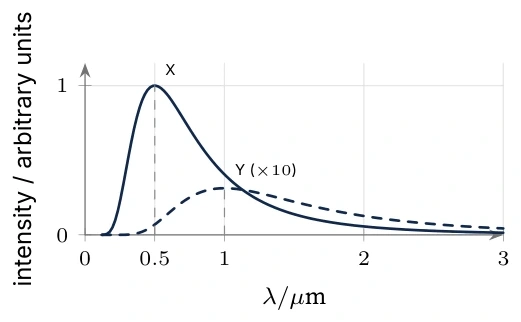
Figure F24 shows the black-body spectra of two stars. The spectrum of star X peaks at 0.50\,\mathrm{\mu m} and that of star Y at 1.0\,\mathrm{\mu m}. What is \dfrac{\text{surface temperature of X}}{\text{surface temperature of Y}}?
A. \tfrac12   B. 2   C. 16   D. 32
Diagram for B.1 question E1
Show solutionHide solution
\lambda_{\max}T is constant, so the temperature ratio is the inverse of the peak-wavelength ratio: 1.0/0.50=2. A keeps the ratio the same way round, C is the ratio of total powers per unit area, D is the ratio of peak heights.

Final answer

B

Question E2

Type E2 · P1A / Radiation ratios[1 mark]
Spheres P and Q radiate as black bodies. P has twice the radius of Q and half its kelvin temperature. What is \dfrac{\text{luminosity of P}}{\text{luminosity of Q}}?
A. \tfrac14   B. \tfrac18   C. 1   D. 64
Show solutionHide solution
L=\sigma(4\pi R^2)T^4: 2^2\times(\tfrac12)^4=4/16=\tfrac14. B forgets to square the radius, C uses T^2, D inverts the temperature ratio.

Final answer

A

Tutorial practice

Question C2

Type C2 · P1A / Mixing balance[1 mark]
0.30\,\mathrm{kg} of water at 80\,\mathrm{^{\circ}C} is poured into a 0.50\,\mathrm{kg} aluminium pan at 20\,\mathrm{^{\circ}C}. Specific heat capacities: water 4200, aluminium 900\,\mathrm{J\,kg^{-1}\,K^{-1}}. No energy is lost. What is the final temperature?
A. 27\,\mathrm{^{\circ}C}   B. 43\,\mathrm{^{\circ}C}   C. 50\,\mathrm{^{\circ}C}   D. 64\,\mathrm{^{\circ}C}
Show solutionHide solution
0.30(4200)(80-T)=0.50(900)(T-20) gives 1260(80-T)=450(T-20), so T=64\,\mathrm{^{\circ}C}. C is the plain average, B weights by mass only, A swaps the two specific heat capacities.

Final answer

D

Question D4

Type D4 · P1A / Junction balance[1 mark]
Two lagged bars of equal length and cross-section are joined end to end. Bar P has thermal conductivity 3k; bar Q has k. The free end of P is kept at 80\,\mathrm{^{\circ}C} and the free end of Q at 0\,\mathrm{^{\circ}C}. What is the temperature of the joint in the steady state?
A. 20\,\mathrm{^{\circ}C}   B. 40\,\mathrm{^{\circ}C}   C. 60\,\mathrm{^{\circ}C}   D. 120\,\mathrm{^{\circ}C}
Show solutionHide solution
The same rate passes through both bars: 3k(80-T)=k(T-0), so T=60\,\mathrm{^{\circ}C}. The better conductor has the smaller temperature drop. B ignores the conductivities, A swaps them, D divides by 3k-k.

Final answer

C

Question E3

Type E3 · P1A / Net radiation · Past-paper extension[1 mark]
A small black object at 400\,\mathrm{K} sits in an enclosure whose walls are at 200\,\mathrm{K}, and loses energy by radiation at a net rate P. The walls are warmed to 300\,\mathrm{K} while the object is kept at 400\,\mathrm{K}. What is the new net rate of loss?
A. 0.063P   B. 0.50P   C. 0.73P   D. 1.24P
Show solutionHide solution
Net rate \propto T^4-T_s^4: \dfrac{400^4-300^4}{400^4-200^4}=\dfrac{175}{240}=0.73. B uses plain temperature differences, A takes the fourth power of the difference, D adds the fourth powers.

Final answer

C

Question A3

Type A3 · P1A / Internal energy[1 mark]
Block X (2.0\,\mathrm{kg}) and block Y (1.0\,\mathrm{kg}) are made of the same metal and are both at 50\,\mathrm{^{\circ}C}.
I. The atoms of X and of Y have equal mean random kinetic energy.
II. The two blocks hold equal internal energy.
III. Placed in contact, neither block warms the other.
Which are true?
A. I, II   B. I, III   C. II, III   D. all three
Show solutionHide solution
Equal temperatures mean equal mean random kinetic energy per atom (I) and no net transfer (III). Internal energy is a total over all the atoms, so the 2.0\,\mathrm{kg} block has twice as much (II is false).

Final answer

B

Question A5

Type A5 · P2 / Evaporation, Internal energy[5 marks]
A clay jug of drinking water stands in a dry breeze on a hot day. Water seeps through the clay and evaporates from the outside surface, and the water in the jug stays cooler than the air.
(a) Explain, in terms of molecules, why evaporation lowers the temperature of the water that remains. [3]
(b) Calculate the mean translational kinetic energy of a water-vapour molecule in air at 32\,\mathrm{^{\circ}C}. [1]
(c) Suggest why the jug cools better in a breeze than in still air. [1]
Show solutionHide solution
(a) Molecules in the liquid have a range of speeds (M1). Only those near the surface with enough kinetic energy to overcome the attraction of their neighbours escape (M1). The molecules left behind have a lower mean random kinetic energy, and temperature measures that mean, so the water cools (A1). (b) \overline{E}_k=\tfrac32k_BT=1.5(1.38\times10^{-23})(305)=6.31\times10^{-21}\,\mathrm{J}; the temperature must be in kelvin (A1). (c) Moving air removes the vapour near the surface, so fewer escaped molecules return to the liquid and the net evaporation rate rises (A1).

Final answer

(a) The fastest surface molecules escape; the mean KE of those left falls, so the temperature falls. (b) 6.31\times10^{-21}\,\mathrm{J}. (c) The breeze carries vapour away, so more molecules can leave.

Question B3

Type B3 · P2 / Mechanical heat[5 marks]
A 0.020\,\mathrm{kg} lead pellet travelling at 250\,\mathrm{m\,s^{-1}} hits a steel plate and stops. 70\% of its kinetic energy heats the pellet. The specific heat capacity of lead is 130\,\mathrm{J\,kg^{-1}\,K^{-1}}; lead melts at 327\,\mathrm{^{\circ}C}.
(a) Calculate the kinetic energy of the pellet before impact. [1]
(b) Determine the temperature rise of the pellet. [2]
(c) The pellet was at 20\,\mathrm{^{\circ}C} before impact. State whether it starts to melt. [1]
(d) Determine the smallest impact speed for which the pellet just reaches its melting point. [1]
Show solutionHide solution
(a) E_k=\tfrac12(0.020)(250)^2=625\,\mathrm{J} (A1). (b) Energy into the pellet =0.70\times625=437.5\,\mathrm{J} (M1); \Delta T=437.5/(0.020\times130)=168\,\mathrm{K} (A1). (c) 20+168=188\,\mathrm{^{\circ}C}, below 327\,\mathrm{^{\circ}C}: no melting (A1). (d) The rise needed is 307\,\mathrm{K}; 0.70\times\tfrac12v^2=130\times307, so v=338\,\mathrm{m\,s^{-1}} (A1). The mass cancels.

Final answer

(a) 625\,\mathrm{J} (b) 168\,\mathrm{K} (c) no: it reaches 188\,\mathrm{^{\circ}C} (d) 338\,\mathrm{m\,s^{-1}}

Question B4

Type B4 · P2 / Continuous flow[5 marks]
Cooling water flows through a heat exchanger in a server room. It enters at 18\,\mathrm{^{\circ}C}, leaves at 30\,\mathrm{^{\circ}C} and carries away thermal energy at 42\,\mathrm{kW}. Water: c=4200\,\mathrm{J\,kg^{-1}\,K^{-1}}, \rho=1000\,\mathrm{kg\,m^{-3}}.
(a) Show that the mass flow rate is about 0.83\,\mathrm{kg\,s^{-1}}. [2]
(b) Calculate the volume of water that passes through in one minute, in litres. [1]
(c) A fault halves the flow rate while the servers still deliver 42\,\mathrm{kW} to the water. Determine the new outlet temperature. [2]
Show solutionHide solution
(a) Each kilogram gains c\Delta T=4200\times12=5.04\times10^{4}\,\mathrm{J} (M1); flow rate =42\,000/5.04\times10^{4}=0.833\,\mathrm{kg\,s^{-1}} (A1). (b) 0.833\times60=50\,\mathrm{kg}, which is 50\,\mathrm{L} (A1). (c) P=(\Delta m/\Delta t)c\Delta T with P fixed, so halving the flow doubles \Delta T to 24\,\mathrm{K} (M1); outlet 18+24=42\,\mathrm{^{\circ}C} (A1).

Final answer

(a) 0.833\,\mathrm{kg\,s^{-1}} (b) 50\,\mathrm{L} (c) 42\,\mathrm{^{\circ}C}

Question C3

Type C3 · P2 / Heating curves[6 marks]
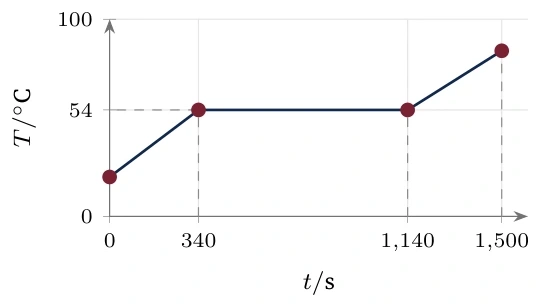
A 0.25\,\mathrm{kg} sample of solid wax in a lagged container is heated at a constant 50\,\mathrm{W}. The graph (figure F23) shows its temperature: 20\,\mathrm{^{\circ}C} at t=0, rising linearly to 54\,\mathrm{^{\circ}C} at 340\,\mathrm{s}, constant until 1140\,\mathrm{s}, then rising linearly to 84\,\mathrm{^{\circ}C} at 1500\,\mathrm{s}.
(a) State the melting point of the wax. [1]
(b) Use the first sloping section to find c for solid wax. [2]
(c) Use the flat section to find the latent heat per kilogram for melting wax. [2]
(d) Without calculation, state and explain which phase has the larger specific heat capacity. [1]
Diagram for B.1 question C3
Show solutionHide solution
(a) The plateau: 54\,\mathrm{^{\circ}C} (A1). (b) Pt=mc\Delta T: 50\times340=0.25\,c\times34 (M1), c=2.0\times10^{3}\,\mathrm{J\,kg^{-1}\,K^{-1}} (A1). (c) The plateau lasts 1140-340=800\,\mathrm{s}; use its duration, not the time from the start (M1): L=50\times800/0.25=1.6\times10^{5}\,\mathrm{J\,kg^{-1}} (A1). (d) Gradient =P/(mc); the liquid rises 30\,\mathrm{K} in 360\,\mathrm{s}, 0.083\,\mathrm{K\,s^{-1}}, against 0.10\,\mathrm{K\,s^{-1}} for the solid, so the liquid's c is larger (2.4\times10^{3}) (A1).

Final answer

(a) 54\,\mathrm{^{\circ}C} (b) 2.0\times10^{3}\,\mathrm{J\,kg^{-1}\,K^{-1}} (c) 1.6\times10^{5}\,\mathrm{J\,kg^{-1}} (d) liquid: its line is less steep for the same power and mass.

Question C4

Type C4 · P2 / Stage budgets[5 marks]
A 0.80\,\mathrm{kg} block of ice at -18\,\mathrm{^{\circ}C} is thawed in a microwave oven that delivers 600\,\mathrm{W} to it. c_{\text{ice}}=2100, c_{\text{water}}=4200\,\mathrm{J\,kg^{-1}\,K^{-1}}; L_f=3.34\times10^{5}\,\mathrm{J\,kg^{-1}}.
(a) Calculate the energy needed to bring the ice to 0\,\mathrm{^{\circ}C}. [1]
(b) Determine the time from switching on until all the ice has melted. [2]
(c) The oven runs for 10.0 minutes in total. Determine the final temperature of the water. [2]
Show solutionHide solution
(a) 0.80\times2100\times18=3.02\times10^{4}\,\mathrm{J}, using the ice value of c (A1). (b) Melting needs 0.80\times3.34\times10^{5}=2.672\times10^{5}\,\mathrm{J} (M1); total 2.97\times10^{5}\,\mathrm{J}, t=2.97\times10^{5}/600=496\,\mathrm{s} (A1). (c) Energy supplied 600\times600=3.60\times10^{5}\,\mathrm{J}; left after melting 6.26\times10^{4}\,\mathrm{J} (M1); \Delta T=6.26\times10^{4}/(0.80\times4200)=18.6\,\mathrm{K}, so 18.6\,\mathrm{^{\circ}C} (A1).

Final answer

(a) 3.02\times10^{4}\,\mathrm{J} (b) 496\,\mathrm{s} (c) 18.6\,\mathrm{^{\circ}C}

Question D3

Type D3 · P2 / Conduction rate, Transfer routes[6 marks]
A shed window is a glass pane 0.60\,\mathrm{m}\times0.50\,\mathrm{m} and 3.0\,\mathrm{mm} thick. On a cold day the inner surface of the glass is at 12.0\,\mathrm{^{\circ}C} and the outer surface at 10.5\,\mathrm{^{\circ}C}. Thermal energy passes through the pane at 135\,\mathrm{W}.
(a) Determine the thermal conductivity of the glass. [2]
(b) The air inside the shed is at 18\,\mathrm{^{\circ}C} and the outside air at 4\,\mathrm{^{\circ}C}. A student uses 14\,\mathrm{K} as the temperature difference across the glass. Calculate the student's rate and explain why it is an overestimate. [2]
(c) The pane is replaced by one of the same glass but twice as thick, with the same surface temperatures. State the new rate. [1]
(d) The heater is switched off. Explain why the shed's air cools more and more slowly. [1]
Show solutionHide solution
(a) k=\dfrac{(\Delta Q/\Delta t)\Delta x}{A\Delta T}=\dfrac{135\times3.0\times10^{-3}}{0.30\times1.5} (M1) =0.90\,\mathrm{W\,m^{-1}\,K^{-1}} (A1). The 1.5\,\mathrm{K} difference is the same in kelvin. (b) 0.90\times0.30\times14/3.0\times10^{-3}=1.26\times10^{3}\,\mathrm{W} (A1). The glass surfaces are not at the air temperatures: thin layers of still air, a poor conductor, carry most of the 14\,\mathrm{K} drop, so the difference across the glass is far smaller (A1). (c) Rate \propto1/\Delta x: 67.5\,\mathrm{W} (A1). (d) As the inside temperature falls, \Delta T across the window falls, so the rate of loss, and with it the cooling rate, falls (A1).

Final answer

(a) 0.90\,\mathrm{W\,m^{-1}\,K^{-1}} (b) 1.26\times10^{3}\,\mathrm{W}; most of the temperature drop is across the still air at each surface (c) 67.5\,\mathrm{W} (d) the rate is proportional to the temperature difference, which keeps falling.

Question E5

Type E5 · P2 / Wien spectra, Brightness, Radiation ratios[7 marks]
The spectrum of the Sun peaks at 500\,\mathrm{nm}. The Sun's radius is 6.96\times10^{8}\,\mathrm{m} and its mean distance from Earth is 1.50\times10^{11}\,\mathrm{m}. Treat the Sun as a black body.
(a) Use Wien's law to find how hot the Sun's surface is. [1]
(b) Show that the Sun radiates about 3.9\times10^{26}\,\mathrm{W} in total. [2]
(c) Find the power per square metre arriving from the Sun at Earth's distance. [2]
(d) Mars orbits 1.52 times as far from the Sun as Earth. Calculate the apparent brightness of the Sun at Mars. [1]
(e) Name the part of the electromagnetic spectrum where the peak falls. [1]
Show solutionHide solution
(a) T=2.9\times10^{-3}/5.00\times10^{-7}=5.8\times10^{3}\,\mathrm{K}, wavelength in metres (A1). (b) L=\sigma4\pi R^2T^4 with the whole surface (M1): 5.67\times10^{-8}\times4\pi(6.96\times10^{8})^2\times5800^4=3.91\times10^{26}\,\mathrm{W} (A1). (c) b=L/4\pi d^2 with d the Sun–Earth distance (M1): 3.91\times10^{26}/(4\pi(1.50\times10^{11})^2)=1.38\times10^{3}\,\mathrm{W\,m^{-2}} (A1), close to the solar constant in the data booklet. (d) 1.38\times10^{3}/1.52^2=598\,\mathrm{W\,m^{-2}} (A1). (e) 500\,\mathrm{nm} is in the visible (green) (A1).

Final answer

(a) 5.8\times10^{3}\,\mathrm{K} (b) 3.91\times10^{26}\,\mathrm{W} (c) 1.38\times10^{3}\,\mathrm{W\,m^{-2}} (d) 598\,\mathrm{W\,m^{-2}} (e) visible

Advanced practice

Question A6

Type A6 · P2 / Internal energy, Kelvin intervals · Predicted type[5 marks]
A sealed lamp bulb is filled with argon, an ideal monatomic gas, of density 1.6\,\mathrm{kg\,m^{-3}}. One mole of argon has a mass of 40\,\mathrm{g}. When the lamp is lit, the gas settles at 127\,\mathrm{^{\circ}C}.
(a) Show that there are about 2.4\times10^{25} argon atoms in each cubic metre of the gas. [2]
(b) Calculate the mean kinetic energy of an argon atom in the lit lamp. [1]
(c) Estimate the internal energy of 1.0\,\mathrm{m^3} of the gas, and state why no potential energy is included. [1]
(d) Estimate the mean distance between neighbouring atoms. [1]
Show solutionHide solution
(a) Moles in 1.0\,\mathrm{m^3}: 1.6/0.040=40\,\mathrm{mol} (M1); atoms =40\times6.02\times10^{23}=2.41\times10^{25} (A1). (b) T=127+273=400\,\mathrm{K}; \overline{E}_k=\tfrac32k_BT=1.5(1.38\times10^{-23})(400)=8.28\times10^{-21}\,\mathrm{J} (A1). (c) 2.41\times10^{25}\times8.28\times10^{-21}=2.0\times10^{5}\,\mathrm{J}; the atoms exert no forces on each other except in collisions, so the internal energy is all random kinetic energy (A1). (d) Each atom has 1/2.41\times10^{25}=4.15\times10^{-26}\,\mathrm{m^3} to itself; the cube root gives a spacing of 3.5\times10^{-9}\,\mathrm{m}, roughly ten atomic diameters (A1). Check (B.3): p=nk_BT=1.3\times10^{5}\,\mathrm{Pa}.

Final answer

(a) 2.41\times10^{25}\,\mathrm{m^{-3}} (b) 8.28\times10^{-21}\,\mathrm{J} (c) 2.0\times10^{5}\,\mathrm{J}; no intermolecular forces in an ideal gas (d) 3.5\times10^{-9}\,\mathrm{m}

Question B5

Type B5 · P2 / Subtract trials, Heater warming[5 marks]
To find the specific heat capacity c of a liquid, a student heats it in a metal can of unknown heat capacity C with a 50.0\,\mathrm{W} immersion heater. With 0.150\,\mathrm{kg} of liquid, the temperature rises by 20.0\,\mathrm{K} in 180\,\mathrm{s}. With 0.300\,\mathrm{kg} of the same liquid in the same can, the same rise takes 324\,\mathrm{s}. Losses are negligible.
(a) Show that (0.150c+C)\times20.0=9.00\times10^{3}\,\mathrm{J}. [1]
(b) Determine c and C. [3]
(c) Explain why it helps to give both trials the same temperature rise. [1]
Show solutionHide solution
(a) Energy supplied =50.0\times180=9.00\times10^{3}\,\mathrm{J}; it warms the liquid (0.150c\times20.0) and the can (C\times20.0) (A1). (b) Second trial: (0.300c+C)\times20.0=50.0\times324=1.62\times10^{4}\,\mathrm{J} (M1). Subtract: 0.150c\times20.0=7.20\times10^{3} (M1), so c=2400\,\mathrm{J\,kg^{-1}\,K^{-1}} and C=450-360=90\,\mathrm{J\,K^{-1}} (A1). Check: (720+90)\times20.0=1.62\times10^{4}\,\mathrm{J}. (c) The can's share C\Delta T is then identical, so subtracting the trials removes it (A1).

Final answer

(a) shown (b) c=2400\,\mathrm{J\,kg^{-1}\,K^{-1}}, C=90\,\mathrm{J\,K^{-1}} (c) the can then takes the same energy in both trials, so it cancels.

Question C5

Type C5 · P2 / Phase mixtures, Mixing balance[6 marks]
A 40\,\mathrm{g} ice cube at -25\,\mathrm{^{\circ}C} is taken from a freezer. c_{\text{ice}}=2100, c_{\text{water}}=4200\,\mathrm{J\,kg^{-1}\,K^{-1}}; L_f=3.34\times10^{5}\,\mathrm{J\,kg^{-1}}. Ignore exchange with the surroundings.
(a) The cube is dropped into a large insulated flask of water at exactly 0\,\mathrm{^{\circ}C}. Explain why some of the water freezes. [2]
(b) Calculate the mass of water that freezes in (a). [2]
(c) An identical cube is dropped instead into 0.150\,\mathrm{kg} of water at 30\,\mathrm{^{\circ}C}. Determine the final temperature. [2]
Show solutionHide solution
(a) The ice is colder than the water, so energy passes into it until it reaches 0\,\mathrm{^{\circ}C} (M1). Water already at 0\,\mathrm{^{\circ}C} cannot cool, so it gives up energy by freezing at constant temperature (A1). (b) Energy to warm the ice 0.040\times2100\times25=2100\,\mathrm{J} (M1); frozen mass =2100/3.34\times10^{5}=6.3\times10^{-3}\,\mathrm{kg} (A1). (c) Test first: cooling the water to 0\,\mathrm{^{\circ}C} releases 18\,900\,\mathrm{J}; warming and melting the ice needs 2100+13\,360=15\,460\,\mathrm{J}, so all the ice melts (M1). Then 18\,900-630T=15\,460+168T, T=4.3\,\mathrm{^{\circ}C} (A1).

Final answer

(a) The ice must warm to 0\,\mathrm{^{\circ}C}; the energy comes from water at 0\,\mathrm{^{\circ}C}, which can only give it by freezing. (b) 6.3\,\mathrm{g} (c) 4.3\,\mathrm{^{\circ}C}

Question D5

Type D5 · P2 / Parallel paths, Conduction rate, Latent power · Predicted type[6 marks]
One wall of a cool box is a 2.0\,\mathrm{cm} layer of foam of area 0.48\,\mathrm{m^2} (k=0.030\,\mathrm{W\,m^{-1}\,K^{-1}}). A steel catch of cross-sectional area 2.0\times10^{-4}\,\mathrm{m^2} (k=50\,\mathrm{W\,m^{-1}\,K^{-1}}) passes straight through the wall. The outer surface is at 30\,\mathrm{^{\circ}C} and the inner surface at 5\,\mathrm{^{\circ}C}.
(a) Find the power conducted through the foam alone. [1]
(b) Calculate the rate through the steel catch. [1]
(c) Determine the total rate and the fraction that passes through the catch. [2]
(d) The box holds 0.40\,\mathrm{kg} of ice at 0\,\mathrm{^{\circ}C} (L_f=3.34\times10^{5}\,\mathrm{J\,kg^{-1}}). Estimate the time for all the ice to melt if this wall is the only route for energy. [2]
Show solutionHide solution
(a) 0.030\times0.48\times25/0.020=18.0\,\mathrm{W} (A1). (b) 50\times2.0\times10^{-4}\times25/0.020=12.5\,\mathrm{W} (A1). (c) Side-by-side paths share the same \Delta T, so the rates add: 30.5\,\mathrm{W} (M1); 12.5/30.5=41\% through 0.04\% of the area (A1). (d) Q=mL_f=1.336\times10^{5}\,\mathrm{J} (M1); t=1.336\times10^{5}/30.5=4.4\times10^{3}\,\mathrm{s} (A1).

Final answer

(a) 18.0\,\mathrm{W} (b) 12.5\,\mathrm{W} (c) 30.5\,\mathrm{W}; 41\% (d) 4.4\times10^{3}\,\mathrm{s} (about 73 minutes)

Question D6

Type D6 · P2 / Junction balance, Conduction rate[6 marks]
An outside wall of area 15\,\mathrm{m^2} is a layer of insulating board, 0.050\,\mathrm{m} thick (k=0.040\,\mathrm{W\,m^{-1}\,K^{-1}}), on the inside of a brick layer 0.10\,\mathrm{m} thick (k=0.70\,\mathrm{W\,m^{-1}\,K^{-1}}). The inner surface is at 20\,\mathrm{^{\circ}C} and the outer surface at 2\,\mathrm{^{\circ}C}. Conditions are steady.
(a) Explain why the rate of thermal energy transfer is the same through both layers. [1]
(b) Determine the temperature where the board meets the brick. [3]
(c) Find the power lost through the whole wall. [1]
(d) Without the board, the bare brick has the same surface temperatures. Calculate the factor by which the rate increases. [1]
Show solutionHide solution
(a) In the steady state the temperatures do not change, so neither layer gains internal energy: the power entering a layer equals the power leaving it (A1). (b) k_1A(20-T)/x_1=k_2A(T-2)/x_2 (M1): 0.040(20-T)/0.050=0.70(T-2)/0.10, so 0.80(20-T)=7.0(T-2) (M1), T=30/7.8=3.8\,\mathrm{^{\circ}C} (A1). The board, the poorer conductor, takes 16\,\mathrm{K} of the 18\,\mathrm{K} drop. (c) 0.80\times15\times(20-3.85)=194\,\mathrm{W}; the brick gives the same (A1). (d) Bare brick: 0.70\times15\times18/0.10=1.89\times10^{3}\,\mathrm{W}, which is 9.8 times larger (A1).

Final answer

(a) steady state: no layer stores energy, so what enters each layer leaves it (b) 3.8\,\mathrm{^{\circ}C} (c) 194\,\mathrm{W} (d) 9.8

Connected questions

Question X1

Type X1 · P2 / B.1 + B.5 + A.3[8 marks]
An electric kettle has a heating element of resistance 24\,\mathrm{\Omega} and runs from a 230\,\mathrm{V} supply. It holds 1.2\,\mathrm{kg} of water at 15\,\mathrm{^{\circ}C}. 85\% of the electrical energy reaches the water. c_{\text{water}}=4200\,\mathrm{J\,kg^{-1}\,K^{-1}}; L_v=2.26\times10^{6}\,\mathrm{J\,kg^{-1}}.
(a) Calculate the power of the element. [1]
(b) Determine the time taken to bring the water to 100\,\mathrm{^{\circ}C}. [3]
(c) The switch fails and the water keeps boiling for a further 60\,\mathrm{s}. Calculate the mass of water boiled away. [2]
(d) Suggest two reasons why less than 100\% of the energy reaches the water, and why the fraction is smaller while it boils. [2]
Show solutionHide solution
(a) P=V^2/R=230^2/24=2.20\times10^{3}\,\mathrm{W} (A1). (b) Q=mc\Delta T=1.2\times4200\times85=4.28\times10^{5}\,\mathrm{J} (M1); useful power 0.85\times2204=1.87\times10^{3}\,\mathrm{W} (M1); t=4.28\times10^{5}/1.87\times10^{3}=229\,\mathrm{s} (A1). (c) m=Pt/L_v=1874\times60/2.26\times10^{6} (M1) =0.050\,\mathrm{kg} (A1). (d) Part of the energy warms the element and the kettle itself; energy leaves the hot kettle by conduction, convection and radiation (A1). Those losses grow with the temperature difference from the room, which is largest at 100\,\mathrm{^{\circ}C}, and escaping steam carries energy away (A1).

Final answer

(a) 2.20\times10^{3}\,\mathrm{W} (b) 229\,\mathrm{s} (c) 0.050\,\mathrm{kg} (d) energy warms the kettle body and is lost by conduction, convection and radiation; losses grow with the temperature difference.

Question X2

Type X2 · P2 / B.1 + B.3[8 marks]
A sealed steel cylinder of volume 0.020\,\mathrm{m^3} contains helium at a pressure of 2.0\times10^{6}\,\mathrm{Pa} and a temperature of 17\,\mathrm{^{\circ}C}. One mole of helium has a mass of 4.0\,\mathrm{g}. Treat helium as an ideal monatomic gas.
(a) Show that the cylinder holds about 1.0\times10^{25} atoms. [2]
(b) Calculate the mean kinetic energy of a helium atom. [1]
(c) Determine the total random kinetic energy of the atoms, and explain why this equals the internal energy of the helium. [2]
(d) Determine the density of the helium. [2]
(e) Sunlight warms the cylinder to 47\,\mathrm{^{\circ}C}. Calculate the increase in the total random kinetic energy of the atoms. [1]
Show solutionHide solution
(a) T=290\,\mathrm{K} (M1); N=pV/k_BT=2.0\times10^{6}\times0.020/(1.38\times10^{-23}\times290)=9.99\times10^{24} (A1). (b) \overline{E}_k=\tfrac32k_BT=6.00\times10^{-21}\,\mathrm{J} (A1). (c) N\overline{E}_k=9.99\times10^{24}\times6.00\times10^{-21}=6.0\times10^{4}\,\mathrm{J} (A1). An ideal gas has no forces between atoms except in collisions, so no intermolecular potential energy; for single atoms all the internal energy is random kinetic energy (A1). (d) Moles =N/N_A=16.6\,\mathrm{mol}, mass =0.0664\,\mathrm{kg} (M1); \rho=0.0664/0.020=3.3\,\mathrm{kg\,m^{-3}} (A1). (e) \Delta E=N\times\tfrac32k_B\times30=6.2\times10^{3}\,\mathrm{J}; the kelvin rise equals the Celsius rise (A1).

Final answer

(a) 9.99\times10^{24} (b) 6.00\times10^{-21}\,\mathrm{J} (c) 6.0\times10^{4}\,\mathrm{J}; no intermolecular potential energy in an ideal gas (d) 3.3\,\mathrm{kg\,m^{-3}} (e) 6.2\times10^{3}\,\mathrm{J}

Question X3

Type X3 · P2 / B.1 + E.5[9 marks]
The spectrum of star S peaks at 290\,\mathrm{nm}. Its distance from Earth is 120\,\mathrm{pc} and its apparent brightness is 3.5\times10^{-10}\,\mathrm{W\,m^{-2}}. 1\,\mathrm{pc}=3.26\,\mathrm{ly}, 1\,\mathrm{ly}=9.46\times10^{15}\,\mathrm{m}, L_{\text{Sun}}=3.83\times10^{26}\,\mathrm{W}.
(a) Calculate the surface temperature of S. [1]
(b) Show that the distance to S is about 3.7\times10^{18}\,\mathrm{m}. [1]
(c) Determine the luminosity of S, in watts and in solar luminosities. [2]
(d) Determine the radius of S. [2]
(e) S is far more luminous than the Sun yet looks much fainter from Earth. Explain why. [1]
(f) A white dwarf has the same surface temperature as S and a radius of 7.0\times10^{6}\,\mathrm{m}. Determine \dfrac{\text{luminosity of S}}{\text{luminosity of the white dwarf}}. [2]
Show solutionHide solution
(a) T=2.9\times10^{-3}/2.90\times10^{-7}=1.0\times10^{4}\,\mathrm{K} (A1). (b) 120\times3.26\times9.46\times10^{15}=3.70\times10^{18}\,\mathrm{m} (A1). (c) L=4\pi d^2b=4\pi(3.70\times10^{18})^2\times3.5\times10^{-10} (M1) =6.0\times10^{28}\,\mathrm{W}=157\,L_{\text{Sun}} (A1). (d) R=\sqrt{L/4\pi\sigma T^4} (M1) =\sqrt{6.0\times10^{28}/(4\pi\times5.67\times10^{-8}\times(1.0\times10^{4})^4)}=2.9\times10^{9}\,\mathrm{m} (A1). (e) Brightness falls as 1/d^2; S is 3.70\times10^{18}/1.50\times10^{11}\approx2.5\times10^{7} times further than the Sun, so d^2 is about 6\times10^{14} times larger, which outweighs its 157 times greater luminosity (A1). (f) Same T, so L\propto R^2 (M1): (2.91\times10^{9}/7.0\times10^{6})^2=1.7\times10^{5} (A1).

Final answer

(a) 1.0\times10^{4}\,\mathrm{K} (b) 3.70\times10^{18}\,\mathrm{m} (c) 6.0\times10^{28}\,\mathrm{W}, 157\,L_{\text{Sun}} (d) 2.9\times10^{9}\,\mathrm{m} (e) it is about 2.5\times10^{7} times further away than the Sun (f) 1.7\times10^{5}

Question X4

Type X4 · P2 / B.1 + A.2 + A.3[9 marks]
A car of mass 1500\,\mathrm{kg} goes down a straight road 2.4\,\mathrm{km} long, inclined at 6.0^{\circ} to the horizontal, at a constant 20\,\mathrm{m\,s^{-1}}. Air resistance and rolling resistance together are 300\,\mathrm{N}; the brakes supply the rest of the backward force.
(a) State why the forces on the car must balance. [1]
(b) Determine the braking force. [2]
(c) Determine the energy transferred in the brakes during the descent. [2]
(d) The four brake discs have a total mass of 32\,\mathrm{kg} and c=450\,\mathrm{J\,kg^{-1}\,K^{-1}}. Calculate their temperature rise if they kept all this energy. [2]
(e) The discs reach about 600\,\mathrm{K} and have a total surface area of 0.80\,\mathrm{m^2}. Treating them as black bodies, compare the power they radiate with the braking power, and comment. [2]
Show solutionHide solution
(a) The car's velocity does not change; the first law then requires zero resultant force (A1). (b) Along the slope: mg\sin6.0^{\circ}=300+F_{\text{brake}} (M1); 1500\times9.8\times0.1045=1537\,\mathrm{N}, so F_{\text{brake}}=1.24\times10^{3}\,\mathrm{N} (A1). (c) W=Fs=1237\times2400 (M1) =2.97\times10^{6}\,\mathrm{J} (A1). Check: loss of gravitational energy mg(2400\sin6.0^{\circ})=3.69\times10^{6}\,\mathrm{J}, minus 300\times2400=7.2\times10^{5}\,\mathrm{J} against resistance. (d) \Delta T=Q/mc (M1) =2.97\times10^{6}/(32\times450)=206\,\mathrm{K} (A1). (e) L=\sigma AT^4=5.67\times10^{-8}\times0.80\times600^4=5.9\times10^{3}\,\mathrm{W}; braking power =Fv=1237\times20=2.5\times10^{4}\,\mathrm{W} (M1). Radiation removes under a quarter, so most of the energy must leave by convection to the air rushing past and by conduction into the wheels (A1).

Final answer

(a) constant velocity (b) 1.24\times10^{3}\,\mathrm{N} (c) 2.97\times10^{6}\,\mathrm{J} (d) 206\,\mathrm{K} (e) 5.9\times10^{3}\,\mathrm{W} radiated against 2.5\times10^{4}\,\mathrm{W} of braking: convection must carry most of it.

From the book

Photon Physics: Study Guide for the IB Diploma (SL & HL)

Thermal energy transfers from the core ideas to full exam questions, with question types, worked examples and graded practice.

About the book