Free worked solutions · 2026 Edition

IB Physics B.2: Greenhouse effect worked solutions

Worked solutions to every practice question in B.2: Greenhouse effect of Photon Physics: Study Guide for the IB Diploma (SL & HL). Try each question, then compare your working with the full solution.

  • SL & HL
  • 28 questions
  • Full worked solutions
  • Free, no sign-up

Basic practice

Question A1

Type A · Solar constant[1 mark]
The solar constant at Earth's orbit is 1.36\times10^{3}\,\mathrm{W\,m^{-2}}. A space probe moves to a circular orbit around the Sun at 1.6 times Earth's distance from the Sun. What is the intensity of sunlight on a panel of the probe that faces the Sun?
A. 133\,\mathrm{W\,m^{-2}}   B. 531\,\mathrm{W\,m^{-2}}
C. 850\,\mathrm{W\,m^{-2}}   D. 3.48\times10^{3}\,\mathrm{W\,m^{-2}}
Show solutionHide solution
The Sun's power spreads over a sphere of area 4\pi d^2, so intensity falls as 1/d^2: 1360/1.6^2=531\,\mathrm{W\,m^{-2}}. C divides by 1.6 once. D multiplies by 1.6^2. A also divides by four, which belongs only to an average over a whole planet.

Final answer

B
Question A3

Type A · Global S/4[1 mark]
A planet with no atmosphere has an albedo of 0.40. The solar constant at its orbit is 900\,\mathrm{W\,m^{-2}}. What is the mean intensity of solar radiation absorbed, averaged over the planet's whole surface?
A. 90\,\mathrm{W\,m^{-2}}   B. 135\,\mathrm{W\,m^{-2}}
C. 225\,\mathrm{W\,m^{-2}}   D. 540\,\mathrm{W\,m^{-2}}
Show solutionHide solution
The planet intercepts sunlight over a disc of area \pi R^2 and spreads it over a sphere of area 4\pi R^2, so the mean incoming intensity is S/4=225\,\mathrm{W\,m^{-2}}. The absorbed fraction is 1-0.40: 0.60\times225=135\,\mathrm{W\,m^{-2}}. A is the mean reflected intensity, C leaves out the albedo, D leaves out the factor of four.

Final answer

B

Question B2

Type B · Albedo and flux[1 mark]
A ploughed field absorbs 4.0 times as much solar power as it reflects. No radiation passes through the soil. What is the albedo of the field?
A. 0.20   B. 0.25   C. 0.75   D. 0.80
Show solutionHide solution
Per unit incident power the field reflects \alpha and absorbs 1-\alpha. So (1-\alpha)/\alpha=4.0, giving 1=5.0\alpha and \alpha=0.20. B is reflected over absorbed, not reflected over incident. D is the absorbed fraction.

Final answer

A

Question B4

Type B · Emission ratio[1 mark]
Two plates radiate the same power per unit area. Plate X has emissivity 0.81 and temperature 300\,\mathrm{K}. Plate Y has emissivity 0.16. What is the temperature of plate Y?
A. 200\,\mathrm{K}   B. 300\,\mathrm{K}
C. 450\,\mathrm{K}   D. 1.52\times10^{3}\,\mathrm{K}
Show solutionHide solution
Equal intensities: 0.81\sigma(300)^4=0.16\sigma T_Y^4, so T_Y=300\,(0.81/0.16)^{1/4}=300\times1.5=450\,\mathrm{K}. A inverts the emissivity ratio. D forgets the fourth root. B assumes equal intensities need equal temperatures; the poorer emitter must be hotter.

Final answer

C

Question C1

Type C · Fourth-root graph[1 mark]
A planet has a fixed albedo and emissivity. Its equilibrium temperature T is plotted against the intensity I of the radiation it absorbs. Which describes the graph?
A. T is proportional to I: a straight line from the origin.
B. A curve starting at the origin that becomes less steep as I grows.
C. A curve starting at the origin that becomes steeper as I grows.
D. T decreases as I grows.
Show solutionHide solution
At equilibrium I=\varepsilon\sigma T^4, so T=(I/\varepsilon\sigma)^{1/4}. Doubling I raises T by only 2^{1/4}=1.19: the curve flattens. A treats T as proportional to I. C is the shape of I plotted against T.

Final answer

B

Question D1

Type D · Which gas?[1 mark]
Which list contains only greenhouse gases?
A. carbon dioxide, nitrous oxide, oxygen
B. methane, water vapour, nitrous oxide
C. nitrogen, carbon dioxide, methane
D. argon, water vapour, carbon dioxide
Show solutionHide solution
The four main greenhouse gases are methane, water vapour, carbon dioxide and nitrous oxide. Nitrogen, oxygen and argon make up about 99% of dry air but absorb almost no infrared: a two-atom molecule of one element, or a single atom, has no vibration that infrared radiation can drive.

Final answer

B

Question D2

Type D · IR resonance[1 mark]
A molecule in the atmosphere has a natural frequency of vibration of 4.0\times10^{13}\,\mathrm{Hz}. At which wavelength does it absorb radiation most strongly?
A. 7.5\times10^{-8}\,\mathrm{m}   B. 5.0\times10^{-7}\,\mathrm{m}
C. 7.5\times10^{-6}\,\mathrm{m}   D. 1.3\times10^{5}\,\mathrm{m}
Show solutionHide solution
Absorption is strongest at resonance, when the radiation's frequency equals the natural frequency: \lambda=c/f=3.00\times10^{8}/4.0\times10^{13}=7.5\times10^{-6}\,\mathrm{m}, in the infrared. A is a power-of-ten slip into the ultraviolet, B is visible light near the peak of sunlight, D is f/c.

Final answer

C

Question E1

Type E · Enhanced causes[1 mark]
Three changes are listed.
I. More coal and natural gas are burned.
II. Tropical forest is cleared for farmland.
III. Arctic sea ice melts earlier each year.
Which are human activities that directly raise the concentration of greenhouse gases?
A. Burning fuels alone.
B. Clearing forest alone.
C. Both burning fuels and clearing forest.
D. Both activities and the loss of sea ice.
Show solutionHide solution
Burning fossil fuels releases carbon dioxide: the primary cause of the enhanced greenhouse effect. Clearing forest releases stored carbon and removes plants that take carbon dioxide out of the air by photosynthesis. III is a result of warming that feeds back through albedo; it adds no greenhouse gas. A and B each miss one human cause; D counts the feedback.

Final answer

C

Question E2

Type E · Climate feedback[1 mark]
As Earth's surface warms, which change acts as a negative feedback on the warming?
A. Thawing permafrost releases methane.
B. Warmer oceans dissolve less carbon dioxide.
C. Snow cover shrinks earlier in spring.
D. The warmer surface radiates more power per square metre.
Show solutionHide solution
Radiated intensity \varepsilon\sigma T^4 rises steeply with temperature, so a warmer surface loses energy faster; that opposes the warming. A and B add greenhouse gas to the air and C lowers the albedo: all three reinforce the warming.

Final answer

D

Question B1

Type B · Albedo variation[1 mark]
Which change lowers the albedo of a region of Earth's surface?
A. Fresh snow falls on bare soil.
B. A layer of thick, low cloud forms over the region.
C. Sea ice melts, leaving open ocean.
D. The Sun sinks lower in the sky over a calm sea.
Show solutionHide solution
Sea ice reflects about 0.6 of the sunlight on it; open ocean with the Sun high reflects less than 0.1. A and B raise the albedo: snow and thick cloud are strong reflectors. D also raises it, because water reflects much more light that arrives at a grazing angle. That is one reason Earth's albedo changes with latitude and time of day.

Final answer

C

Question C3

Type C · Surface balance[1 mark]
In a climate model, a planet's surface absorbs solar radiation of intensity 0.50I and radiation from the atmosphere of intensity 0.95I. The surface also loses 0.30I by convection and evaporation. Its temperature is constant. What is the intensity radiated by the surface?
A. 0.20I   B. 0.65I   C. 1.15I   D. 1.75I
Show solutionHide solution
Take the surface as the system. In: 0.50I+0.95I=1.45I. Out: radiated +\,0.30I. So radiated =1.15I. A leaves out the downward radiation from the atmosphere, B leaves out the sunlight, D adds the convective loss instead of subtracting it.

Final answer

C

Tutorial practice

Question A4

Type A · Local intensity, Solar constant[3 marks]
A Sun-facing detector above the atmosphere has area 0.040\,\mathrm{m^2} at Earth's mean orbital distance. (a) Calculate the incident solar power. [1]
(b) The detector is moved to twice that distance. Determine the new power and explain the change. [2]
Show solutionHide solution
(a) P=SA=1360(0.040)=54.4\,\mathrm{W} (A1). (b) The same luminosity spreads over four times the area when the distance doubles (M1); P=54.4/4=13.6\,\mathrm{W} (A1).

Final answer

(a) 54.4\,\mathrm{W}. (b) 13.6\,\mathrm{W}; inverse-square spreading.

Question C4

Type C · Surface balance[5 marks]
The surface of a planet absorbs a mean solar intensity of 150\,\mathrm{W\,m^{-2}} and a mean intensity of 230\,\mathrm{W\,m^{-2}} radiated down by the atmosphere. Ignore convection and evaporation. The emissivity of the surface is 0.94.
(a) Determine the mean surface temperature. [3]
(b) More carbon dioxide raises the downward intensity from the atmosphere by 4.0\,\mathrm{W\,m^{-2}}. Nothing else changes. Calculate the new mean surface temperature. [2]
Show solutionHide solution
(a) Surface in =150+230=380\,\mathrm{W\,m^{-2}} (M1). At constant temperature this equals 0.94\sigma T^4 (M1), so T=\left(\dfrac{380}{0.94\times5.67\times10^{-8}}\right)^{1/4}=290.6\,\mathrm{K} (A1). (b) 0.94\sigma T^4=384 (M1), T=291.3\,\mathrm{K} (A1). The input rose by about 1%, so T rose by about a quarter of that.

Final answer

(a) 291\,\mathrm{K} (290.6\,\mathrm{K}). (b) 291.3\,\mathrm{K}, a rise of about 0.8\,\mathrm{K}.

Question D5

Type D · Absorption bands[5 marks]
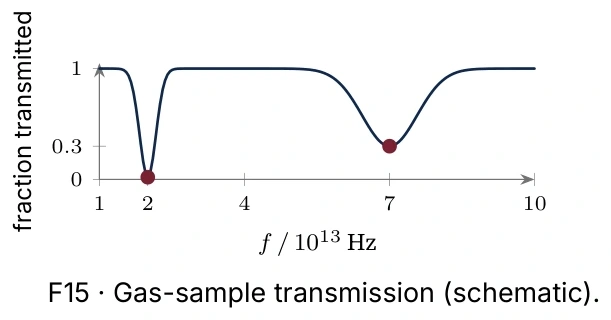
Transmission through a gas sample dips to about 0.02 at 2.0\times10^{13}\,\mathrm{Hz} and to about 0.30 at 7.0\times10^{13}\,\mathrm{Hz} (F15).(a) Calculate the two wavelengths at which the gas absorbs. [2]
(b) Explain, using the resonance model, why the gas absorbs at these frequencies but not at others. [2]
(c) Earth's surface emits most strongly near 10\,\mathrm{\mu m}. Suggest why this gas affects Earth's energy balance more than a gas that absorbs only near 0.5\,\mathrm{\mu m} would. [1]
Diagram for B.2 question D5
Show solutionHide solution
(a) \lambda=c/f (M1): 3.00\times10^{8}/2.0\times10^{13}=1.5\times10^{-5}\,\mathrm{m} and 3.00\times10^{8}/7.0\times10^{13}=4.3\times10^{-6}\,\mathrm{m} (A1). Read the \times10^{13} on the axis. (b) The molecule's vibrations have natural frequencies; radiation at one of them drives the vibration at resonance, with a large amplitude, so energy is absorbed (A1). At other frequencies the driven amplitude stays small and the radiation passes through (A1). (c) Its bands lie near the peak of Earth's outgoing infrared, so it absorbs radiation leaving the surface and re-emits part of it downwards; a gas absorbing at 0.5\,\mathrm{\mu m} would only absorb incoming sunlight high in the air (A1).

Final answer

(a) 1.5\times10^{-5}\,\mathrm{m} and 4.3\times10^{-6}\,\mathrm{m}. (b) These are natural frequencies of the molecule's vibrations. (c) It absorbs the outgoing infrared from the surface, which is then re-emitted partly downwards.

Question E3

Type E · Ice and sea level, Climate feedback[6 marks]
A land ice sheet covers 2.4\times10^{5}\,\mathrm{km^2} with a mean thickness of 1.2\,\mathrm{km}. The density of ice is 920\,\mathrm{kg\,m^{-3}} and of sea water 1.0\times10^{3}\,\mathrm{kg\,m^{-3}}. The area of the oceans is 3.6\times10^{8}\,\mathrm{km^2}.
(a) Calculate the mass of the ice sheet. [2]
(b) Estimate the rise in mean sea level if the whole sheet melts and the water flows into the oceans. [2]
(c) Explain why the melting of the same mass of floating sea ice would not change sea level. [1]
(d) Suggest why losing this ice sheet would increase the rate of warming of the region. [1]
Show solutionHide solution
(a) Area =2.4\times10^{5}\times10^{6}=2.4\times10^{11}\,\mathrm{m^2} (M1: 1\,\mathrm{km^2}=10^{6}\,\mathrm{m^2}). Volume =2.4\times10^{11}\times1200=2.88\times10^{14}\,\mathrm{m^3}; mass =920\times2.88\times10^{14}=2.65\times10^{17}\,\mathrm{kg} (A1). (b) Volume of water =2.65\times10^{17}/1000=2.65\times10^{14}\,\mathrm{m^3} (M1); rise =2.65\times10^{14}/3.6\times10^{14}=0.74\,\mathrm{m} (A1). (c) A floating body displaces its own weight of water (F_b=\rho Vg=mg), so the meltwater exactly fills the volume the ice already displaced (A1). (d) Rock or sea has a much lower albedo than ice, so more sunlight is absorbed and the region warms faster: a positive feedback (A1).

Final answer

(a) 2.6\times10^{17}\,\mathrm{kg}. (b) 0.74\,\mathrm{m}. (c) Floating ice already displaces its own mass of water. (d) The exposed ground or water has a lower albedo, so it absorbs more sunlight.

Question A2

Type A · Solar constant, Local intensity[5 marks]
A solar panel of area 1.5\,\mathrm{m^2} hangs below a high-altitude balloon, above almost all of the atmosphere, and faces the Sun.
(a) Calculate the solar power incident on the panel. [1]
(b) The panel is later used at ground level at noon at a place where the Sun is directly overhead, still facing the Sun. The atmosphere above reflects 25% and absorbs 20% of the sunlight arriving at its top. Calculate the solar power now incident on the panel. [2]
(c) On the same day, at another site, the Sun is 50^\circ from the vertical at noon. Explain why a horizontal panel there receives less power per square metre than the panel in (b). [2]
Show solutionHide solution
(a) Above the atmosphere and facing the Sun, the intensity is the solar constant: P=SA=1360\times1.5=2.04\times10^{3}\,\mathrm{W} (A1). No factor of four: this is one surface facing the Sun. (b) Fraction reaching the ground =1-0.25-0.20=0.55 (M1); P=0.55\times2040=1.12\times10^{3}\,\mathrm{W} (A1). (c) A beam that crosses 1\,\mathrm{m^2} at right angles covers 1/\cos50^\circ=1.56\,\mathrm{m^2} of level ground, so each square metre gets less (A1). The slanting rays also pass through more air, so more is scattered and absorbed on the way down (A1).

Final answer

(a) 2.04\times10^{3}\,\mathrm{W}. (b) 1.12\times10^{3}\,\mathrm{W}. (c) The beam is spread over 1/\cos50^\circ=1.56 times the area, and it crosses a longer path through the atmosphere.

Question B3

Type B · Two surface tests, Albedo and flux[4 marks]
Regions P and Q both receive sunlight of intensity 600\,\mathrm{W\,m^{-2}}. Measurements made at the same moment are given.
\begin{array}{lrr}&\mathrm P&\mathrm Q\\I_{\rm reflected}/\mathrm{W\,m^{-2}}&120&210\\I_{\rm radiated}/\mathrm{W\,m^{-2}}&410&380\\T/\mathrm K&300&290\end{array}
(a) Calculate the albedo of each region. [1]
(b) Determine the emissivity of each region. [2]
(c) Show that both regions absorb more power than they radiate, and state which has the larger net gain per square metre. [1]
Show solutionHide solution
(a) Albedo uses the reflected sunlight only: 120/600=0.20 and 210/600=0.35 (A1). (b) \varepsilon=\dfrac{\text{radiated intensity}}{\sigma T^4} (M1). \sigma(300)^4=459\,\mathrm{W\,m^{-2}}, so \varepsilon_P=410/459=0.893; \sigma(290)^4=401\,\mathrm{W\,m^{-2}}, so \varepsilon_Q=380/401=0.948 (A1). Q radiates less only because it is cooler; it is the better emitter. (c) Absorbed = incident - reflected: P 480 against 410, Q 390 against 380. Net gains 70 and 10\,\mathrm{W\,m^{-2}}, so P (A1).

Final answer

(a) P 0.20, Q 0.35. (b) P 0.893, Q 0.948. (c) P gains 70\,\mathrm{W\,m^{-2}}, Q gains 10\,\mathrm{W\,m^{-2}}: P.

Question C2

Type C · Planet temperature[6 marks]
A rocky exoplanet with no atmosphere moves in a circular orbit of radius 9.0\times10^{10}\,\mathrm{m} around a star of luminosity 1.5\times10^{26}\,\mathrm{W}. The planet's albedo is 0.35 and its emissivity is 0.95.
(a) Show that the intensity of the star's radiation at the planet's orbit is about 1.5\times10^{3}\,\mathrm{W\,m^{-2}}. [2]
(b) Determine the equilibrium surface temperature of the planet. [3]
(c) State one assumption made about the planet in (b). [1]
Show solutionHide solution
(a) I=\dfrac{L}{4\pi d^2} (M1) =\dfrac{1.5\times10^{26}}{4\pi(9.0\times10^{10})^2}=1.47\times10^{3}\,\mathrm{W\,m^{-2}} (A1). (b) Mean absorbed intensity =(1-0.35)\times1474/4=239.5\,\mathrm{W\,m^{-2}} (M1). Balance: 0.95\sigma T^4=239.5 (M1), so T=\left(\dfrac{239.5}{0.95\times5.67\times10^{-8}}\right)^{1/4}=258\,\mathrm{K} (A1). (c) The planet has one temperature over its whole surface, for example because it spins quickly (A1).

Final answer

(a) 1.47\times10^{3}\,\mathrm{W\,m^{-2}}. (b) 258\,\mathrm{K}. (c) The whole surface is at one temperature (it radiates from all of 4\pi R^2 at that temperature).

Question D3

Type D · Absorb and re-emit, IR resonance[5 marks]
On a clear night a lawn cools much faster than on a night with low, damp cloud. The surface temperature of the lawn is 275\,\mathrm{K}.
(a) Calculate the wavelength at which the lawn's emission is most intense, and state the region of the electromagnetic spectrum. [2]
(b) Explain, with reference to molecular energy levels, how water vapour in the damp air slows the cooling of the lawn. [3]
Show solutionHide solution
(a) \lambda_{\max}=\dfrac{2.9\times10^{-3}}{275}=1.05\times10^{-5}\,\mathrm{m} (M1), infrared (A1). (b) Water molecules have vibrational energy levels whose spacing equals the energy hf of infrared photons from the lawn, so they absorb those photons (A1). The excited molecules then emit infrared photons in random directions (A1). Part of this radiation travels back down and is absorbed by the lawn, so its net rate of energy loss is smaller (A1). On a clear night most of the lawn's infrared escapes to space.

Final answer

(a) 1.05\times10^{-5}\,\mathrm{m}; infrared. (b) Water molecules absorb infrared photons whose energy matches a vibrational energy gap, then re-emit in all directions, so part returns to the lawn.

Advanced practice

Question C6

Type C · One-layer model, Surface balance[6 marks]
A black surface absorbs mean sunlight 200\,\mathrm{W\,m^{-2}}. A single atmospheric layer transmits all sunlight and absorbs a fraction \varepsilon_a of surface infrared; its infrared emissivity is also \varepsilon_a. Ignore convection. (a) Write a balance for the layer and show that T_s^4=2T_a^4 for \varepsilon_a>0. [2]
(b) Write a whole-planet balance and obtain \sigma T_s^4=400/(2-\varepsilon_a). [2]
(c) A surface temperature of 280\,\mathrm{K} is measured. Infer \varepsilon_a and state one limitation of this estimate. [2]
Show solutionHide solution
(a) Layer input is \varepsilon_a\sigma T_s^4 and output is 2\varepsilon_a\sigma T_a^4 (M1). Cancel the nonzero common factor to get T_s^4=2T_a^4 (A1). (b) At the top, 200=(1-\varepsilon_a)\sigma T_s^4+\varepsilon_a\sigma T_a^4 (M1). Substitute the layer relation: 200=(1-\varepsilon_a/2)\sigma T_s^4, so \sigma T_s^4=400/(2-\varepsilon_a) (A1). (c) \varepsilon_a=2-400/[\sigma(280)^4]=0.852 (A1). The model ignores convection and treats absorption over different wavelengths as one number (A1).

Final answer

(a) \varepsilon_a\sigma T_s^4=2\varepsilon_a\sigma T_a^4. (b) See solution. (c) \varepsilon_a=0.852; convection or wavelength-dependent absorption is omitted.

Question E4

Type E · Climate feedback, Albedo and flux, Planet temperature[6 marks]
Warming reduces a planet's albedo from 0.30 to 0.27 as snow melts. A resulting increase in low cloud adds 0.02 to the albedo. The solar constant is 1360\,\mathrm{W\,m^{-2}}. Use the simple whole-planet radiation-balance model with emissivity 1; ignore changes in infrared absorption. (a) Calculate the net change in mean solar absorption. [2]
(b) Estimate the equilibrium temperatures before and after both albedo changes. [2]
(c) For each response, trace the feedback and state its sign. [2]
Show solutionHide solution
(a) Final albedo is 0.27+0.02=0.29 (M1); the mean absorption rises by (0.30-0.29)1360/4=3.4\,\mathrm{W\,m^{-2}} (A1). (b) Initially, T=(238/\sigma)^{1/4}=254.5\,\mathrm{K} (A1). Finally, T=(241.4/\sigma)^{1/4}=255.4\,\mathrm{K} (A1). (c) Warming melts snow, reducing albedo and increasing absorption, which reinforces warming: positive (A1). If warming increases low cloud, its extra reflection reduces absorption and opposes warming: negative in this restricted model (A1).

Final answer

(a) An increase of 3.4\,\mathrm{W\,m^{-2}}. (b) 254.5\,\mathrm{K} then 255.4\,\mathrm{K}. (c) Snow loss: positive; cloud reflection: negative.

Question B5

Type B · Area mean albedo, Climate feedback[5 marks]
In early spring a coastal Arctic region is 70% sea ice (albedo 0.60) and 30% open ocean (albedo 0.06). Every part receives the same mean solar intensity, 200\,\mathrm{W\,m^{-2}}.
(a) Show that the mean albedo of the region is about 0.44. [2]
(b) By late summer the ice covers only 40% of the region. Determine the increase in the mean solar intensity absorbed by the region. [2]
(c) Explain why this change is an example of positive feedback. [1]
Show solutionHide solution
(a) With equal illumination, weight each albedo by its share of the area (M1): 0.70(0.60)+0.30(0.06)=0.420+0.018=0.438 (A1). (b) New mean 0.40(0.60)+0.60(0.06)=0.276 (M1). Absorbed =(1-\alpha)\times200: 112.4 before, 144.8 after, an increase of 32.4\,\mathrm{W\,m^{-2}} (A1). (c) Warming melted the ice; the darker ocean absorbs more sunlight, which warms the region further and melts more ice. The response reinforces the change that caused it (A1).

Final answer

(a) 0.438. (b) 32.4\,\mathrm{W\,m^{-2}} (from 112.4 to 144.8\,\mathrm{W\,m^{-2}}). (c) More absorption warms the region, which melts more ice.

Question B6

Type B · Area mean albedo, Emission ratio[5 marks]
A flat test surface consists of equal areas of two coatings. They receive the same sunlight. Coating P has albedo 0.20 and emissivity 0.90; coating Q has albedo 0.60 and emissivity 0.50. Lateral heat transfer keeps both at 300\,\mathrm{K}. (a) Determine the combined albedo. [1]
(b) Calculate the mean emitted intensity. [2]
(c) Sunlight is the only input. Find the incident intensity needed to maintain this temperature, and explain why an area mean of temperatures would fail without lateral heat transfer. [2]
Show solutionHide solution
(a) Equal incident power on each half gives \alpha=(0.20+0.60)/2=0.40 (A1). (b) Average the two intensities: I=[(0.90+0.50)/2]\sigma(300)^4 (M1), giving 321\,\mathrm{W\,m^{-2}} (A1). (c) Balance 0.60S=321.489, hence S=536\,\mathrm{W\,m^{-2}} (A1). If temperatures differed, each area would emit according to its own T^4; raising the mean temperature to the fourth power would not give the mean emission (A1).

Final answer

(a) 0.40. (b) 321\,\mathrm{W\,m^{-2}}. (c) 536\,\mathrm{W\,m^{-2}}; emission depends on T^4.

Question D4

Type D · Absorption bands, IR resonance, Absorb and re-emit[6 marks]
A gas absorbs infrared only between 12 and 18\,\mathrm{\mu m}. A surface at 290\,\mathrm{K} illuminates a thin layer of the gas. The layer absorbs 20\,\mathrm{W\,m^{-2}} and emits the same total intensity, half downwards. For a photon-count estimate, treat all its emission as 15\,\mathrm{\mu m}. (a) Find the peak wavelength of the surface radiation. [1]
(b) Find the energy of a 15\,\mathrm{\mu m} photon in J and eV. [2]
(c) Estimate how many photons cross each square metre downwards each second. [2]
(d) Explain why the gas can warm the surface even though the surface's peak lies outside its absorption band. [1]
Show solutionHide solution
(a) \lambda_{\max}=2.9\times10^{-3}/290=1.0\times10^{-5}\,\mathrm{m}=10\,\mathrm{\mu m} (A1). (b) E=hc/\lambda=1.326\times10^{-20}\,\mathrm{J} (M1), or E/e=0.082875\,\mathrm{eV}\approx0.083\,\mathrm{eV} (A1). (c) Downward intensity is 20/2=10\,\mathrm{W\,m^{-2}} (M1). The photon rate per unit area is 10/(1.326\times10^{-20})=7.54\times10^{20}\,\mathrm{m^{-2}\,s^{-1}} (A1). (d) The surface emits across many wavelengths, including the gas band; some of that energy is absorbed and re-emitted downwards, adding a surface input (A1).

Final answer

(a) 10\,\mathrm{\mu m}. (b) 1.33\times10^{-20}\,\mathrm{J}=0.083\,\mathrm{eV}. (c) 7.54\times10^{20}\,\mathrm{m^{-2}\,s^{-1}}. (d) Surface emission spans a band; absorbed infrared is partly returned downwards.

Question C5

Type C · One-layer model[6 marks]
A simple model treats a planet's atmosphere as one layer at temperature T_a. The layer lets all sunlight through but absorbs all the infrared emitted by the surface; it radiates as a black body, equally upwards and downwards. The surface, at temperature T_s, is a black body and absorbs a mean solar intensity of 180\,\mathrm{W\,m^{-2}}.
(a) By considering the energy balance of the whole planet, show that \sigma T_a^4=180\,\mathrm{W\,m^{-2}}. [1]
(b) By considering the energy balance of the layer, show that \sigma T_s^4=2\sigma T_a^4. [2]
(c) Calculate T_a and T_s. [2]
(d) Suggest why this model overestimates the surface temperature of a real planet. [1]
Show solutionHide solution
(a) Seen from space only the layer radiates, because it absorbs all the surface's infrared. Out =\sigma T_a^4 must equal in =180\,\mathrm{W\,m^{-2}} (A1). (b) The layer absorbs \sigma T_s^4 from the surface (M1) and emits \sigma T_a^4 upwards and \sigma T_a^4 downwards, so \sigma T_s^4=2\sigma T_a^4 (A1). Check at the surface: 180+\sigma T_a^4=360=\sigma T_s^4. (c) T_a=(180/5.67\times10^{-8})^{1/4}=237\,\mathrm{K} (A1); T_s=2^{1/4}T_a=282\,\mathrm{K} (A1). (d) Real air absorbs only part of the surface's infrared (the 8–12 \mum window), and convection and evaporation move energy up without radiation (A1).

Final answer

(a) Only the layer radiates to space. (b) Proof. (c) T_a=237\,\mathrm{K}, T_s=282\,\mathrm{K}. (d) A real atmosphere lets part of the surface infrared escape directly, and convection carries energy upwards.

Connected questions

Question X1

B.2 + B.1 + E.5[9 marks]
The spectrum of a star peaks at a wavelength of 580\,\mathrm{nm}. The star's radius is 6.0\times10^{8}\,\mathrm{m}. A planet with no atmosphere orbits the star at a distance of 1.1\times10^{11}\,\mathrm{m}. The planet's albedo is 0.30, and it emits as a black body.
(a) Use the peak wavelength to show that the star's surface is at about 5000\,\mathrm{K}. [1]
(b) Calculate the luminosity of the star. [2]
(c) Determine the intensity of the star's radiation at the planet's orbit. [2]
(d) Determine the equilibrium temperature of the planet. [2]
(e) Calculate the wavelength at which the planet's emission peaks, and explain why a greenhouse gas could absorb the planet's radiation but not most of the star's. [2]
Show solutionHide solution
(a) B.1 Wien: T=2.9\times10^{-3}/5.80\times10^{-7}=5.0\times10^{3}\,\mathrm{K} (A1). (b) L=\sigma(4\pi R^2)T^4 (M1) =5.67\times10^{-8}\times4\pi(6.0\times10^{8})^2\times5000^4=1.60\times10^{26}\,\mathrm{W} (A1). (c) I=L/4\pi d^2 (M1) =1.60\times10^{26}/(4\pi(1.1\times10^{11})^2)=1.05\times10^{3}\,\mathrm{W\,m^{-2}} (A1). (d) B.2: \sigma T^4=(1-0.30)\times1054/4=184.5\,\mathrm{W\,m^{-2}} (M1), T=239\,\mathrm{K} (A1). (e) \lambda_{\max}=2.9\times10^{-3}/238.8=1.21\times10^{-5}\,\mathrm{m}, infrared (A1). Infrared photon energies match the spacing of molecular vibrational levels; photons near 0.58\,\mathrm{\mu m} carry far more energy than any such gap (A1).

Final answer

(a) 5.0\times10^{3}\,\mathrm{K}. (b) 1.60\times10^{26}\,\mathrm{W}. (c) 1.05\times10^{3}\,\mathrm{W\,m^{-2}}. (d) 239\,\mathrm{K}. (e) 1.21\times10^{-5}\,\mathrm{m}; infrared matches molecular vibration energies, the star's visible peak does not.

Question X2

B.2 + B.1[8 marks]
Earth is estimated to absorb about 0.80\,\mathrm{W\,m^{-2}} more solar power, averaged over its surface, than it radiates to space. Take one year as 3.15\times10^{7}\,\mathrm{s}.
(a) Explain, in terms of the energy balance at the top of the atmosphere, how an increase in carbon dioxide concentration could cause this imbalance. [2]
(b) Assume that all of the extra energy warms the top 50\,\mathrm{m} of the ocean (density 1030\,\mathrm{kg\,m^{-3}}, specific heat capacity 3900\,\mathrm{J\,kg^{-1}\,K^{-1}}). Estimate the temperature rise of this water in one year. [3]
(c) In a polar region the same imbalance instead melts sea ice that is already at 0\,{}^{\circ}\mathrm{C}. Ice has density 920\,\mathrm{kg\,m^{-3}}, and melting it takes 3.34\times10^{5}\,\mathrm{J} per kilogram. Estimate the time needed to melt a layer of ice 1.0\,\mathrm{m} thick. [2]
(d) State why the melting in (c) tends to increase the imbalance. [1]
Show solutionHide solution
(a) Extra carbon dioxide absorbs more of the infrared leaving the surface and re-emits part of it downwards (A1). Less power leaves the top of the atmosphere while the absorbed solar power is unchanged, so in exceeds out until the surface warms enough to restore the balance (A1). (b) Energy per square metre in a year =0.80\times3.15\times10^{7}=2.52\times10^{7}\,\mathrm{J} (M1). Mass of water under 1\,\mathrm{m^2} =50\times1030=5.15\times10^{4}\,\mathrm{kg} (M1). \Delta T=Q/mc=2.52\times10^{7}/(5.15\times10^{4}\times3900)=0.125\,\mathrm{K} (A1). (c) Under 1\,\mathrm{m^2}: m=920\,\mathrm{kg}, Q=mL=920\times3.34\times10^{5}=3.07\times10^{8}\,\mathrm{J} (M1); t=3.07\times10^{8}/0.80=3.8\times10^{8}\,\mathrm{s}, about 12 years (A1). (d) The open water that replaces the ice reflects less sunlight, so more is absorbed (A1).

Final answer

(a) More surface infrared is absorbed and partly re-emitted downwards, so less escapes to space while the absorbed sunlight is unchanged. (b) 0.13\,\mathrm{K} (0.125\,\mathrm{K}). (c) 3.8\times10^{8}\,\mathrm{s}, about 12 years. (d) Open water has a lower albedo than ice.

Question X3

B.2 + C.1 + E.1[8 marks]
Carbon dioxide strongly absorbs infrared radiation of wavelength 15\,\mathrm{\mu m}. In a simple model of the bending vibration responsible, one oxygen atom of mass 2.66\times10^{-26}\,\mathrm{kg} moves with simple harmonic motion on a spring-like bond.
(a) Show that the frequency of the radiation is 2.0\times10^{13}\,\mathrm{Hz}. [1]
(b) In the resonance model this frequency equals the natural frequency of the vibration. Calculate the effective spring constant of the bond. [2]
(c) Calculate, in eV, the energy of one photon of this radiation. [2]
(d) A photon of visible light of wavelength 500\,\mathrm{nm} has an energy of 2.5\,\mathrm{eV}. Explain, using molecular energy levels, why this vibration cannot absorb it. [1]
(e) Suggest one limitation of the mass-on-a-spring model of absorption. [1]
(f) Explain how energy absorbed by carbon dioxide molecules can raise the temperature of the surrounding air. [1]
Show solutionHide solution
(a) f=c/\lambda=3.00\times10^{8}/1.5\times10^{-5}=2.0\times10^{13}\,\mathrm{Hz} (A1). (b) C.1: \omega=2\pi f=1.26\times10^{14}\,\mathrm{rad\,s^{-1}} and \omega^2=k/m (M1), so k=m\omega^2=2.66\times10^{-26}\times(1.26\times10^{14})^2=420\,\mathrm{N\,m^{-1}} (A1). (c) E.1: E=hf=6.63\times10^{-34}\times2.0\times10^{13}=1.33\times10^{-20}\,\mathrm{J} (M1) =1.33\times10^{-20}/1.60\times10^{-19}=0.083\,\mathrm{eV} (A1). (d) Absorption needs a photon whose energy matches the spacing of two vibrational levels exactly; 2.5\,\mathrm{eV} is about 30 times the 0.083\,\mathrm{eV} gap (A1). (e) A classical spring can absorb any amount of energy, so the model does not explain discrete absorption energies, nor why symmetric molecules such as nitrogen do not absorb (A1). (f) The excited molecule collides with nitrogen and oxygen molecules and shares the energy as random kinetic energy, so the mean kinetic energy, and the temperature, of the air rises (A1).

Final answer

(a) 2.0\times10^{13}\,\mathrm{Hz}. (b) 420\,\mathrm{N\,m^{-1}}. (c) 0.083\,\mathrm{eV}. (d) 2.5\,\mathrm{eV} matches no gap of this vibration. (e) It cannot explain why only definite energies are absorbed, or why nitrogen and oxygen do not absorb. (f) Collisions pass the energy to other molecules as random kinetic energy.

From the book

Photon Physics: Study Guide for the IB Diploma (SL & HL)

Greenhouse effect from the core ideas to full exam questions, with question types, worked examples and graded practice.

About the book