Free worked solutions · 2026 Edition

IB Physics A.5: Galilean and special relativity worked solutions

Worked solutions to every practice question in A.5: Galilean and special relativity of Photon Physics: Study Guide for the IB Diploma (SL & HL). Try each question, then compare your working with the full solution.

  • SL & HL
  • 29 questions
  • Full worked solutions
  • Free, no sign-up

Basic practice

Question A1

Type A1 · P1A · Type A1[1 mark]
S' moves at +12\,\mathrm{m\,s^{-1}} relative to S in standard configuration. An event in S has x=200\,\mathrm{m}, t=5.0\,\mathrm{s}. Choose its Galilean coordinates in S'.
A. x'=140\,\mathrm{m}, t'=5.0\,\mathrm{s}   B. x'=260\,\mathrm{m}, t'=5.0\,\mathrm{s}
C. x'=140\,\mathrm{m}, t'=4.3\,\mathrm{s}   D. x'=-140\,\mathrm{m}, t'=5.0\,\mathrm{s}
Show solutionHide solution
x'=x-vt=200-12(5.0)=140\,\mathrm{m} and t'=t: Galilean time is the same in both frames. B adds vt, C changes the time, D reverses the sign of a positive coordinate.

Final answer

A
Question A2

Type A2 · P1A · Type A2[1 mark]
An outward-moving probe at 0.40c fires a laser back towards Earth. Choose the Galilean prediction and the actual Earth-measured speed of the light.
A. Galilean 0.60c; measured c
B. Galilean 1.40c; measured c
C. Galilean c; measured 0.60c
D. Galilean 0.60c; measured 0.60c
Show solutionHide solution
The pulse moves towards Earth at c in the probe frame while the probe moves away at 0.40c, so Galilean addition gives c-0.40c=0.60c. The second postulate says every inertial observer measures c. B adds instead of subtracting; C and D put the Galilean value where the measurement belongs.

Final answer

A

Question B1

Type B1 · P1A · Type B1[1 mark]
A probe passes two buoys fixed in a station frame. Which statement gives the proper time between the two passing events?
A. The buoy clocks measure it because they are at rest.
B. It is the longest interval assigned by any inertial frame.
C. A clock on the probe measures it.
D. All inertial frames assign this interval.
Show solutionHide solution
Proper time is recorded by a single clock present at both events, so the events happen at one place in its frame: only the probe's clock passes both buoys. Each buoy clock is present at one event only (A). The proper interval is the shortest, not the longest (B). Other observers measure \gamma times it (D).

Final answer

C

Question B2

Type B2 · P1A · Type B2[1 mark]
A moon's beacon has rest period 0.60\,\mathrm{s}. A spacecraft passes at 0.80c. What emission period does the spacecraft frame assign?
A. 0.36\,\mathrm{s}   B. 0.60\,\mathrm{s}
C. 1.0\,\mathrm{s}   D. 1.7\,\mathrm{s}
Show solutionHide solution
The flashes occur at one place in the moon frame, so 0.60\,\mathrm{s} is proper. \gamma=1/\sqrt{1-0.80^2}=5/3, and \Delta t=\gamma\Delta t_0=1.0\,\mathrm{s}. A divides by \gamma, D multiplies by \gamma^2, B ignores the motion.

Final answer

C

Question B3

Type B3 · P1A · Type B3, B5[1 mark]
A cylindrical probe has rest length 30\,\mathrm{m} and diameter 4.0\,\mathrm{m}. It passes a station along its axis at 0.60c. Choose the station-measured length and diameter.
A. 24\,\mathrm{m}; 4.0\,\mathrm{m}   B. 24\,\mathrm{m}; 3.2\,\mathrm{m}
C. 37.5\,\mathrm{m}; 4.0\,\mathrm{m}   D. 30\,\mathrm{m}; 3.2\,\mathrm{m}
Show solutionHide solution
\gamma=1.25. Only the dimension along the motion contracts: L=L_0/\gamma=30/1.25=24\,\mathrm{m}. The diameter is perpendicular to the motion and stays 4.0\,\mathrm{m}. B contracts both, C multiplies by \gamma, D contracts the wrong dimension.

Final answer

A

Question C1

Type C1 · P1A · Type C1[1 mark]
A craft travels at 0.60c to a star 9.0\,\mathrm{ly} away in Earth's frame. Earth and craft clocks start at zero at departure. Choose the Earth time and craft reading at arrival.
A. Earth 15\,\mathrm{years}; spacecraft 12\,\mathrm{years}
B. Earth 12\,\mathrm{years}; spacecraft 15\,\mathrm{years}
C. Earth 15\,\mathrm{years}; spacecraft 18.75\,\mathrm{years}
D. Earth 15\,\mathrm{years}; spacecraft 9.6\,\mathrm{years}
Show solutionHide solution
Earth time =D/v=9.0/0.60=15\,\mathrm{years}. The spacecraft clock is present at departure and arrival, so it reads the proper time 15/\gamma=15/1.25=12\,\mathrm{years}. C multiplies by \gamma, D divides by \gamma^2, B swaps the frames.

Final answer

A

Question C3

Type C3 · P1A · Type C2[1 mark]
Pions of rest half-life 18\,\mathrm{ns} cross a laboratory at 0.80c. How far do they travel during one laboratory-measured half-life?
A. 2.6\,\mathrm{m}   B. 4.3\,\mathrm{m}
C. 7.2\,\mathrm{m}   D. 12\,\mathrm{m}
Show solutionHide solution
\gamma=5/3, so the laboratory half-life is \gamma\times18=30\,\mathrm{ns}. Distance =0.80(3.00\times10^{8})(30\times10^{-9})=7.2\,\mathrm{m}. B ignores dilation, A divides by \gamma, D multiplies by \gamma^2.

Final answer

C

Question D1

Type D1 · P1A · Type D1[1 mark]
A station measures P at +0.40c and Q at -0.70c, approaching along one line. What is Q's speed relative to P?
A. 0.30c   B. 0.42c
C. 0.86c   D. 1.10c
Show solutionHide solution
Take P's frame: v=+0.40c, u=-0.70c. u'=(u-v)/(1-uv/c^2)=(-1.10c)/(1+0.28)=-0.86c, a speed of 0.86c. D is the Galilean answer, A subtracts the speeds, B uses +0.70c for Q.

Final answer

C

Question D2

Type D2 · P1A · Type D2[1 mark]
X measures a probe at +0.80c; Y measures the same probe at +0.50c. All motion is along one line. Find Y's velocity relative to X.
A. +0.30c   B. +0.50c
C. +0.93c   D. +1.30c
Show solutionHide solution
With u=0.80c and u'=0.50c, solve u'=(u-v)/(1-uv/c^2) for v: v=(u-u')/(1-uu'/c^2)=0.30c/0.60=+0.50c. Check: (0.80-0.50)/(1-0.40)=0.50. A is Galilean, C adds the velocities relativistically, D adds them classically.

Final answer

B

Question F1

Type F1 · P1A · Type F1[1 mark]
With equal distance scales on ct and x, a spacecraft's world line makes 20^\circ with ct. Find its speed.
A. 0.34c   B. 0.36c
C. 0.94c   D. 2.7c
Show solutionHide solution
\tan\theta=v/c with \theta measured from the ct axis: v=\tan20^\circ\,c=0.36c. A uses sine, C cosine, D the reciprocal (the angle measured from the x axis).

Final answer

B

Question F3

Type F3 · P1A · Type F3[1 mark]
S' moves at 0.60c relative to S. Which point on ct', given as (x,ct) in metres, has x'=0, ct'=1.0\,\mathrm{m}?
A. (0.60,\ 1.00)   B. (0.75,\ 1.25)
C. (0.48,\ 0.80)   D. (1.00,\ 1.67)
Show solutionHide solution
The event must lie on the invariant hyperbola (ct)^2-x^2=(ct')^2-x'^2=1.0\,\mathrm{m^2}. Only B gives 1.25^2-0.75^2=1.00; its coordinates are (\gamma v/c,\ \gamma). A reuses the unprimed scale (ct=1), C divides by \gamma, D goes too far up the axis.

Final answer

B

Tutorial practice

Question A3

Type A3 · P2 · Type A3, E1[4 marks]
Two clocks, P and Q, are fixed 1.20\,\mathrm{km} apart beside a straight test track. Both are at rest in the frame of the track.
(a) Describe how Q can be synchronised with P using a single light pulse. [2]
(b) A technician instead starts Q from zero at the moment the pulse from P arrives. State by how much Q then lags P. [1]
(c) Once correctly synchronised, P and Q show the same reading at the same time in the track frame. Explain why an observer on a fast train moving along the track would not agree. [1]
Show solutionHide solution
(a) Light takes d/c=1.20\times10^{3}/3.00\times10^{8}=4.00\times10^{-6}\,\mathrm{s} to reach Q (M1). P sends the pulse when it reads zero, and Q is started at 4.00\,\mathrm{\mu s} when the pulse arrives (A1). (b) Starting Q at zero ignores the travel time, so Q lags by 4.00\,\mathrm{\mu s} (A1). (c) “Both clocks read zero'' is a pair of events at different places. Events that are simultaneous in the track frame are not simultaneous for an observer moving along the line joining them, so the train finds the clocks out of step (A1).

Final answer

(a) P emits the pulse as it reads zero; Q is set to read 4.00\,\mathrm{\mu s} when the pulse arrives. (b) 4.00\,\mathrm{\mu s}. (c) Simultaneity of separated events depends on the frame.

Question D4

Type D4 · P2 · Type D4[4 marks]
In Earth's frame, event A and event B are separated by \Delta x=7.0\,\mathrm{ly} and c\Delta t=25\,\mathrm{ly}.
(a) Calculate the space-time interval between A and B. [1]
(b) A traveller moving at constant velocity is present at both events. Determine the time between A and B on the traveller's clock. [2]
(c) Calculate the traveller's speed relative to Earth. [1]
Show solutionHide solution
(a) (\Delta s)^2=25^2-7.0^2=576\,\mathrm{ly^2} (A1). (b) In the traveller's frame both events happen at one place, so \Delta x'=0 and (c\Delta t_0)^2=576 (M1): c\Delta t_0=24\,\mathrm{ly}, \Delta t_0=24\,\mathrm{years} (A1). (c) v=\Delta x/\Delta t=7.0/25=0.28c (A1). Check: \gamma=25/24, and 25/\gamma=24.

Final answer

(a) 576\,\mathrm{ly^2}. (b) 24\,\mathrm{years}. (c) 0.28c.

Question B4

Type B4 · P2 · Type B4, B3[6 marks]
A beacon at rest on an asteroid emits a pulse every 5.0\,\mathrm{\mu s} in the asteroid frame. The crew of a passing spacecraft, using their own synchronised clocks, find the pulses 13.0\,\mathrm{\mu s} apart.
(a) Calculate \gamma for the relative motion. [1]
(b) Show that the spacecraft moves at about 0.92c relative to the asteroid. [2]
(c) Along the line of motion the asteroid measures 1.30\,\mathrm{km} in its rest frame. Find its length as measured by the crew. [1]
(d) Calculate the time the asteroid takes to pass a point on the spacecraft, in the spacecraft frame. [2]
Show solutionHide solution
(a) The pulses leave one place in the asteroid frame, so 5.0\,\mathrm{\mu s} is proper: \gamma=13.0/5.0=2.6 (A1). (b) v/c=\sqrt{1-1/\gamma^2} (M1) =\sqrt{1-1/6.76}=0.923, so v=0.923c=2.77\times10^{8}\,\mathrm{m\,s^{-1}} (A1). (c) L=L_0/\gamma=1.30/2.6=0.500\,\mathrm{km} (A1). (d) In the spacecraft frame the 500\,\mathrm{m} asteroid moves past at 2.77\times10^{8}\,\mathrm{m\,s^{-1}} (M1): t=500/2.77\times10^{8}=1.81\times10^{-6}\,\mathrm{s} (A1). This is the proper time between the two passing events, because the same point on the spacecraft is present at both.

Final answer

(a) 2.6. (b) 0.923c (2.77\times10^{8}\,\mathrm{m\,s^{-1}}). (c) 0.500\,\mathrm{km}. (d) 1.81\,\mathrm{\mu s}.

Question C2

Type C2 · P2 · Type C1[6 marks]
A probe leaves Earth at 0.96c for a relay station that is 4.8\,\mathrm{ly} from Earth in Earth's frame. Earth clocks and the probe clock read zero at departure.
(a) Calculate the Earth-frame time of the arrival. [1]
(b) Show that the probe clock reads 1.4\,\mathrm{years} at arrival. [2]
(c) Calculate the Earth–station distance in the probe frame, and use it to confirm (b). [1]
(d) On arrival the probe radios Earth. Calculate the Earth time at which the message is received. [2]
Show solutionHide solution
(a) t=4.8/0.96=5.0\,\mathrm{years} (A1). (b) \gamma=1/\sqrt{1-0.96^2}=1/0.28=3.57 (M1). The probe clock is at both events, so it reads the proper time 5.0/3.57=1.4\,\mathrm{years} (A1). (c) L=4.8/3.57=1.34\,\mathrm{ly}; in the probe frame the station approaches at 0.96c, taking 1.344/0.96=1.4\,\mathrm{years} (A1). (d) The signal leaves at Earth time 5.0\,\mathrm{years} and travels 4.8\,\mathrm{ly} at c (M1), arriving at 5.0+4.8=9.8\,\mathrm{years} (A1). Adding 1.4 instead of 5.0 mixes the two frames.

Final answer

(a) 5.0\,\mathrm{years}. (b) \gamma=3.57; 1.4\,\mathrm{years}. (c) 1.34\,\mathrm{ly}; 1.34/0.96=1.4\,\mathrm{years}. (d) 9.8\,\mathrm{years}.

Question D3

Type D3 · P2 · Type D3, D4[6 marks]
In the frame S of a space station, explosion E_1 occurs at x=0, t=0 and explosion E_2 at x=1500\,\mathrm{m}, t=3.0\,\mathrm{\mu s}. A patrol craft moves at +0.80c relative to the station.
(a) Find (\Delta s)^2 for this pair of explosions. [1]
(b) Determine the distance and the time between E_1 and E_2 in the frame of the craft. [3]
(c) State which explosion happens first for the craft, and explain whether E_1 could have caused E_2. [2]
Show solutionHide solution
(a) c\Delta t=900\,\mathrm{m}; (\Delta s)^2=900^2-1500^2=-1.44\times10^{6}\,\mathrm{m^2} (A1). (b) \gamma=5/3 (M1). \Delta x'=\gamma(\Delta x-v\Delta t)=\tfrac53(1500-0.80\times900)=1300\,\mathrm{m} (A1). c\Delta t'=\gamma(c\Delta t-0.80\Delta x)=\tfrac53(900-1200)=-500\,\mathrm{m}, so \Delta t'=-1.67\,\mathrm{\mu s} (A1). Check: 500^2-1300^2=-1.44\times10^{6}\,\mathrm{m^2}. (c) \Delta t'<0: E_2 happens first for the craft (A1). The interval is negative, so no signal at or below c links the events, and E_1 cannot have caused E_2 (A1).

Final answer

(a) -1.44\times10^{6}\,\mathrm{m^2}. (b) 1300\,\mathrm{m}; -1.67\,\mathrm{\mu s}. (c) E_2 first; no, the interval is spacelike.

Question E2

.[6 marks]
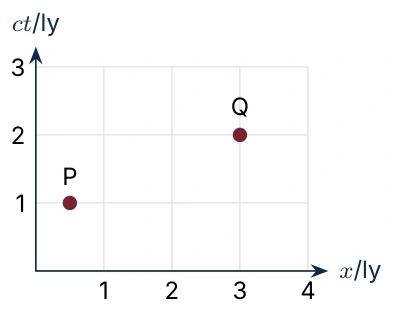
On a space-time diagram for frame S, event P is at x=0.5\,\mathrm{ly}, ct=1.0\,\mathrm{ly} and event Q is at x=3.0\,\mathrm{ly}, ct=2.0\,\mathrm{ly}.
(a) Calculate the space-time interval between P and Q. [1]
(b) Explain why there is no inertial frame in which P and Q happen at the same place. [1]
(c) Frame S' moves along x relative to S, and in S' the events are simultaneous. Determine the speed of S' relative to S. [2]
(d) Calculate the distance between P and Q in S'. [1]
(e) Describe how the x' axis of S' is related to the line PQ on the diagram. [1]
Diagram for A.5 question E2
Show solutionHide solution
(a) \Delta x=2.5\,\mathrm{ly}, c\Delta t=1.0\,\mathrm{ly}: (\Delta s)^2=1.0^2-2.5^2=-5.25\,\mathrm{ly^2} (A1). (b) Being at one place needs a frame moving at \Delta x/\Delta t=2.5c, faster than light; equivalently (\Delta s)^2<0 (A1). (c) Set \Delta t'=\gamma(\Delta t-v\Delta x/c^2)=0 (M1): v/c=c\Delta t/\Delta x=1.0/2.5, v=0.40c (A1). (d) In S', (\Delta s)^2=-(\Delta x')^2, so \Delta x'=\sqrt{5.25}=2.29\,\mathrm{ly} (A1). (e) Events simultaneous in S' lie on a line parallel to the x' axis, so x' is parallel to PQ (gradient ct/x=0.40) (A1).

Final answer

(a) -5.25\,\mathrm{ly^2}. (b) The interval is spacelike: a frame with both at one place would need v>c. (c) 0.40c. (d) 2.29\,\mathrm{ly}. (e) Parallel to PQ.

Question E1

Type E1 · P2 · Type E1[6 marks]
A guard stands at the midpoint M of a platform between two signal lamps, W (west end) and E (east end), 600\,\mathrm{m} apart. Each lamp flashes once. The two pulses reach the central guard together. A train moves east past the platform at 0.60c; its driver is level with M at the instant the flashes reach M.
(a) Explain why the guard concludes that the lamps flashed at the same time. [1]
(b) Does the driver receive both flashes together? Give a reason. [1]
(c) In the train frame one lamp flashed before the other. Identify it and give your reasoning. [2]
(d) Calculate the time between the two flashes in the train frame. [2]
Show solutionHide solution
(a) The guard is 300\,\mathrm{m} from each lamp, both flashes travel at c and arrive together, so they left together (A1). (b) Yes. Both flashes reaching M while the driver is there is a single event, and every frame agrees on it (A1). (c) In the train frame both flashes travel at c and arrive together at the driver, but the platform moves west. When the flashes were emitted, lamp E was further from the driver's reception point than lamp W (M1), so E's light needed longer and E flashed first (A1). (d) \Delta t'=\gamma(\Delta t-v\Delta x/c^2) with \Delta t=0 and \Delta x=600\,\mathrm{m} (M1): |\Delta t'|=1.25\times0.60\times600/3.00\times10^{8}=1.5\times10^{-6}\,\mathrm{s} (A1).

Final answer

(a) Equal distances, both at c, arriving together. (b) Yes: one event. (c) Lamp E, the one ahead of the train. (d) 1.5\,\mathrm{\mu s}.

Question F2

Type F2 · P2 · Type F2[6 marks]
A probe leaves Earth at t=0 and moves away at 0.50c. Earth's world line is the ct axis. At t=2.0\,\mathrm{years} in Earth's frame, Earth sends a radio signal after the probe.
(a) Sketch, on ct–x axes in light-years, the world lines of the probe and of the signal. [1]
(b) Determine the Earth-frame coordinates x and ct of the event at which the probe receives the signal. [2]
(c) Calculate the reading of the probe clock at reception. Its clock read zero as it left Earth. [1]
(d) Determine the time of emission of the signal in the probe frame, and hence the signal's travel time in that frame. [2]
Show solutionHide solution
(a) Probe: x=0.50\,ct (A1 with the signal line drawn at 45^\circ from ct=2.0\,\mathrm{ly}). (b) Signal: x=ct-2.0; meeting 0.50\,ct=ct-2.0 (M1) gives ct=4.0\,\mathrm{ly}, x=2.0\,\mathrm{ly} (A1). (c) The probe is present at departure and reception: \Delta t_0=4.0/\gamma=4.0/1.155=3.46\,\mathrm{years} (A1). (d) Emission at x=0, ct=2.0\,\mathrm{ly}: ct'=\gamma(2.0-0.50\times0)=2.31\,\mathrm{ly} (M1). Travel time in the probe frame =3.46-2.31=1.15\,\mathrm{years} (A1). Check: in the probe frame Earth recedes at 0.50c and is 0.50\times2.31=1.15\,\mathrm{ly} away at emission.

Final answer

(a) Probe line through the origin at 26.6^\circ to ct; signal at 45^\circ from (0, 2.0). (b) x=2.0\,\mathrm{ly}, ct=4.0\,\mathrm{ly}. (c) 3.46\,\mathrm{years}. (d) 2.31\,\mathrm{years}; 1.15\,\mathrm{years}.

Advanced practice

Question A4

Type A4 · P2 · Type A4[3 marks]
A passenger jet flies at a constant 300\,\mathrm{m\,s^{-1}} relative to the ground.
(a) Explain, with reference to the Lorentz time transformation, why Galilean relativity describes the jet well. [1]
(b) For speeds much smaller than c, \gamma-1\approx v^2/2c^2. Calculate \gamma-1 for the jet. [1]
(c) The flight lasts 10.0\,\mathrm{h} in the ground frame. Estimate how far a clock on board falls behind ground clocks. [1]
Show solutionHide solution
(a) With v/c=1.0\times10^{-6}, \gamma differs from 1 by less than one part in 10^{12} and vx/c^2 is tiny for any distance on Earth, so t'=\gamma(t-vx/c^2)\approx t and x'\approx x-vt (A1). (b) \gamma-1\approx(300)^2/(2\times(3.00\times10^{8})^2)=5.0\times10^{-13} (A1). (c) The on-board clock records \Delta t/\gamma, behind by about (\gamma-1)\Delta t=5.0\times10^{-13}\times3.60\times10^{4}=1.8\times10^{-8}\,\mathrm{s} (A1). Real aircraft clocks also feel gravitational effects, which are outside this course.

Final answer

(a) \gamma\approx1 and vx/c^2 is negligible, so t'\approx t and x'\approx x-vt. (b) 5.0\times10^{-13}. (c) 1.8\times10^{-8}\,\mathrm{s} (18 ns).

Question D5

Type D5 · P2 · Type D5[5 marks]
A cargo train of proper length 480\,\mathrm{m} moves at 0.80c past a long platform. A light pulse is sent from the back of the train to the front.
(a) Calculate the travel time of the pulse in the train frame. [1]
(b) Calculate the length of the train in the platform frame. [1]
(c) Show that, in the platform frame, the pulse takes 4.8\,\mathrm{\mu s} to reach the front. [2]
(d) Explain why the answer to (c) is not \gamma times the answer to (a). [1]
Show solutionHide solution
(a) t'=480/3.00\times10^{8}=1.6\times10^{-6}\,\mathrm{s} (A1). (b) L=480/\gamma=480/(5/3)=288\,\mathrm{m} (A1). (c) The front runs ahead while the pulse travels: ct=288+0.80ct (M1), so 0.20ct=288 and t=288/(6.0\times10^{7})=4.8\,\mathrm{\mu s} (A1). Lorentz check: \Delta t=\gamma(\Delta t'+v\Delta x'/c^2)=\tfrac53(1.6+1.28)\,\mathrm{\mu s}=4.8\,\mathrm{\mu s}. (d) \Delta t=\gamma\Delta t_0 needs both events at one place in one frame; here they are 480\,\mathrm{m} apart on the train, so the v\Delta x'/c^2 term matters (A1).

Final answer

(a) 1.6\,\mathrm{\mu s}. (b) 288\,\mathrm{m}. (c) ct=288+0.80ct gives 4.8\,\mathrm{\mu s}. (d) Emission and reception happen at different places in both frames, so neither time is proper.

Question F4

Type F4 · P2 · Type F3, F1[5 marks]
A frame S' travels at +0.60c along the x direction of frame S, with x=x'=0 when t=t'=0. Event Z is at x=3.0\,\mathrm{ly}, ct=4.0\,\mathrm{ly} in S.
(a) On a diagram drawn for S, find how far the ct' axis is tilted from the vertical ct axis. [1]
(b) Determine the coordinates x' and ct' of Z. [2]
(c) Show that your answer to (b) gives the same space-time interval from the origin as the S coordinates. [1]
(d) Event Y lies on the ct axis and is simultaneous with Z in S'. Determine ct for Y. [1]
Show solutionHide solution
(a) \tan\theta=0.60, \theta=31.0^\circ (A1). (b) \gamma=1.25: x'=1.25(3.0-0.60\times4.0)=0.75\,\mathrm{ly} (A1); ct'=1.25(4.0-0.60\times3.0)=2.75\,\mathrm{ly} (A1). (c) 4.0^2-3.0^2=7.0 and 2.75^2-0.75^2=7.0\,\mathrm{ly^2} (A1). (d) Y has x=0, so ct'_Y=\gamma\,ct_Y=2.75 and ct_Y=2.2\,\mathrm{ly} (A1). On the diagram Y is where the line through Z parallel to x' meets the ct axis.

Final answer

(a) 31.0^\circ. (b) x'=0.75\,\mathrm{ly}, ct'=2.75\,\mathrm{ly}. (c) 7.0\,\mathrm{ly^2} both. (d) 2.2\,\mathrm{ly}.

Question B5

Type B5 · P2 · Type B6 · Going further[5 marks]
A long straight copper wire carries a steady current. The conduction electrons drift along the wire at speed v_d; the positive ions are fixed in the wire. A proton moves parallel to the wire, a short distance from it, at speed v_d in the same direction as the electrons. In the laboratory frame the wire is electrically neutral.
(a) For the laboratory frame, state the electric force on the proton and explain the direction of the magnetic force on it. [2]
(b) In the proton's rest frame there is no magnetic force on it. Explain, using length contraction, why there is still a force on the proton, and state its direction. [3]
Show solutionHide solution
(a) The wire is neutral, so the electric force is zero (A1). The conventional current is opposite to the electron drift, so the proton moves antiparallel to the current; F=qvB with the right-hand rule pushes it away from the wire (antiparallel currents repel) (A1). (b) The proton is at rest, so qvB=0, although a magnetic field is still present (M1). The electrons are now at rest: their spacing is no longer contracted, so it is larger than in the laboratory and the negative charge density falls. The ions now move at v_d: their spacing is contracted and the positive charge density rises (M1). The wire carries a net positive charge, so the proton is repelled electrically, away from the wire, the same direction as in (a) (A1).

Final answer

(a) No electric force; magnetic force directed away from the wire. (b) The wire is positively charged in the proton frame; electric repulsion, away from the wire.

Question C4

Type C4 · P2 · Type C2, B3[7 marks]
Muons are produced 6.0\,\mathrm{km} above a detector, measured in Earth's frame, and travel straight down at 0.98c. The muon half-life in its rest frame is 1.5\,\mathrm{\mu s}.
(a) Calculate the flight time in Earth's frame. [1]
(b) Determine, in Earth's frame, the fraction of the muons that reach the detector. [3]
(c) Calculate the thickness of the 6.0\,\mathrm{km} layer in the muon frame, and use it to find the same fraction. [2]
(d) Without relativity, about 8\times10^{-5} of the muons would arrive. State what the measured arrival rate tells you. [1]
Show solutionHide solution
(a) t=6000/(0.98\times3.00\times10^{8})=2.04\times10^{-5}\,\mathrm{s} (A1). (b) \gamma=1/\sqrt{1-0.98^2}=5.03 (M1); dilated half-life 5.03\times1.5=7.54\,\mathrm{\mu s}, so the flight lasts 20.4/7.54=2.71 half-lives (M1); fraction =(1/2)^{2.71}=0.15 (A1). (c) In the muon frame the layer is 6.0/5.03=1.19\,\mathrm{km} (M1); it passes in 1194/(2.94\times10^{8})=4.06\,\mathrm{\mu s}=2.71 proper half-lives, giving the same 0.15 (A1). (d) The detector counts about 15 % of the muons, roughly 2000 times the non-relativistic prediction, as both relativistic descriptions require (A1).

Final answer

(a) 20.4\,\mathrm{\mu s}. (b) \gamma=5.03; half-life 7.54\,\mathrm{\mu s}; 2.71 half-lives; fraction 0.15. (c) 1.19\,\mathrm{km}; 4.06\,\mathrm{\mu s}=2.71 half-lives; 0.15. (d) Far more muons arrive than the non-relativistic prediction: evidence for time dilation and length contraction.

Question E3

Type E3 · P2 · Type E3[6 marks]
Observer O is at rest at x=0 in frame S. Beacon A, at rest at x=-2.0\,\mathrm{ly}, flashes at ct=1.0\,\mathrm{ly}. Beacon B, at rest at x=+4.0\,\mathrm{ly}, flashes at ct=0. A rocket R passes O at t=0, moving at +0.50c.
(a) State which flash is emitted first in S. [1]
(b) Determine which flash O sees first, and when. [1]
(c) Use the Lorentz transformation to find which flash is emitted first in R's frame, and by how much. [2]
(d) Determine the S coordinates of the events at which R receives each flash. [2]
Show solutionHide solution
(a) B, at ct=0, before A at ct=1.0\,\mathrm{ly} (A1). (b) A's light needs 2.0\,\mathrm{years}, arriving at 3.0\,\mathrm{years}; B's needs 4.0, arriving at 4.0\,\mathrm{years}. O sees A first (A1). (c) \gamma=1.155. ct'_A=\gamma(1.0-0.50\times(-2.0))=2.31\,\mathrm{ly}, ct'_B=\gamma(0-0.50\times4.0)=-2.31\,\mathrm{ly} (M1). B is first in R's frame, by 4.62\,\mathrm{years} (A1). (d) R's world line is x=0.50\,ct. B's light: x=4.0-ct, meeting at ct=2.67\,\mathrm{ly}, x=1.33\,\mathrm{ly} (A1). A's light: x=-2.0+(ct-1.0), meeting at ct=6.0\,\mathrm{ly}, x=3.0\,\mathrm{ly} (A1). Seeing order depends on light travel time as well as on emission order: O sees A first although B was emitted first in S.

Final answer

(a) B. (b) A, at t=3.0\,\mathrm{years} (B at 4.0\,\mathrm{years}). (c) B, earlier by 4.62\,\mathrm{years}. (d) B: x=1.33\,\mathrm{ly}, ct=2.67\,\mathrm{ly}; A: x=3.0\,\mathrm{ly}, ct=6.0\,\mathrm{ly}.

Connected questions

Question X1

Type X1 · Connected · P2 · A.5 + E.3[7 marks]
A beam of pions leaves a target at 0.96c and travels down a straight evacuated tube to a detector 40\,\mathrm{m} away in the laboratory frame. Pions have a half-life of 18\,\mathrm{ns} in their rest frame.
(a) Calculate the flight time in the laboratory frame. [1]
(b) Determine the fraction of the pions that reach the detector. [3]
(c) Calculate the length of the tube in the pion frame, and show that it gives the same number of half-lives. [2]
(d) Calculate the decay constant of pions in their rest frame. [1]
Show solutionHide solution
(a) t=40/(0.96\times3.00\times10^{8})=1.39\times10^{-7}\,\mathrm{s} (A1). (b) \gamma=1/\sqrt{1-0.96^2}=3.57 (M1); laboratory half-life 3.57\times18=64.3\,\mathrm{ns}, so 139/64.3=2.16 half-lives (M1); fraction =(1/2)^{2.16}=0.22 (A1). E.3 decay law, A.5 half-life. (c) L=40/3.57=11.2\,\mathrm{m} (M1), crossed in 11.2/(2.88\times10^{8})=38.9\,\mathrm{ns}=2.16 proper half-lives (A1). (d) \lambda=\ln2/T_{1/2}=0.693/18\times10^{-9}=3.85\times10^{7}\,\mathrm{s^{-1}} (A1). The decay constant is a rest-frame property; the laboratory sees the beam decay more slowly.

Final answer

(a) 139\,\mathrm{ns}. (b) \gamma=3.57; half-life 64.3\,\mathrm{ns}; 2.16 half-lives; fraction 0.22. (c) 11.2\,\mathrm{m}; 38.9\,\mathrm{ns}=2.16 half-lives. (d) 3.85\times10^{7}\,\mathrm{s^{-1}}.

Question X2

Type X2 · Connected · P2 · A.5 + D.3 + A.3[8 marks]
In a beam tube, electrons that start at rest gain energy across a 5.0\,\mathrm{kV} potential difference, then pass at right angles into a uniform 2.0\,\mathrm{mT} magnetic field.
(a) Use qV=\tfrac12mv^2 to show that the speed is about 4.2\times10^{7}\,\mathrm{m\,s^{-1}}. [2]
(b) Calculate \gamma for this speed, and comment on whether the Newtonian treatment in (a) is adequate. [2]
(c) The electrons travel 0.30\,\mathrm{m} in the laboratory before entering the field. Calculate the time this takes in the laboratory frame and in the electrons' frame. [2]
(d) Calculate the radius of the electrons' path in the field. [2]
Show solutionHide solution
(a) v=\sqrt{2qV/m}=\sqrt{2(1.60\times10^{-19})(5000)/9.11\times10^{-31}} (M1) =4.19\times10^{7}\,\mathrm{m\,s^{-1}} (A1). (b) v/c=0.140, \gamma=1/\sqrt{1-0.140^2}=1.010 (A1). Relativistic corrections are about 1 %, so the Newtonian result is good to about two significant figures; at higher voltages it would not be (A1). (c) Laboratory: 0.30/4.19\times10^{7}=7.16\times10^{-9}\,\mathrm{s} (A1). Electron frame: the proper time 7.16/1.010=7.09\,\mathrm{ns} (A1). (d) qvB=mv^2/r, so r=mv/qB (M1) =9.11\times10^{-31}(4.19\times10^{7})/(1.60\times10^{-19}\times2.0\times10^{-3})=0.119\,\mathrm{m} (A1).

Final answer

(a) 4.19\times10^{7}\,\mathrm{m\,s^{-1}}. (b) \gamma=1.010: about a 1 % effect, adequate for most purposes. (c) 7.16\,\mathrm{ns}; 7.09\,\mathrm{ns}. (d) 0.119\,\mathrm{m}.

Question X3

Type X3 · Connected · P2 · A.5 + C.5[8 marks]
A spacecraft moves directly away from Earth at 0.050c. Its transmitter sends a radio pulse every 1.000\,\mathrm{s} in the spacecraft frame, on a carrier frequency of 8.40\,\mathrm{GHz}.
(a) Calculate the time between the emission of successive pulses in Earth's frame. [2]
(b) Explain why the antenna on Earth receives the pulses at a longer interval than your answer to (a). [1]
(c) Show that the interval between received pulses is about 1.051\,\mathrm{s}. [2]
(d) Use the Doppler approximation \Delta f/f\approx v/c to estimate the received carrier frequency. [1]
(e) The Doppler shift of sound depends on the speeds of source and observer relative to the air; the Doppler shift of light depends only on their relative velocity. Explain this difference using a postulate of special relativity. [2]
Show solutionHide solution
(a) \gamma=1/\sqrt{1-0.050^2}=1.00125 (M1); the emissions happen at one place on the craft, so Earth measures 1.00125\,\mathrm{s} (A1). (b) Between pulses the craft moves further away, so each pulse has further to travel (A1). (c) In Earth's frame the craft moves 0.050c\times1.00125\,\mathrm{s} between emissions, adding 0.050\times1.00125\,\mathrm{s} of light travel time (M1): received interval =1.00125(1+0.050)=1.0513\,\mathrm{s} (A1). (d) \Delta f\approx0.050\times8.40=0.42\,\mathrm{GHz}, so f\approx7.98\,\mathrm{GHz} (A1); the exact result 8.40/1.0513=7.99\,\mathrm{GHz} agrees closely. (e) Sound is a disturbance of a medium, so “moving'' means moving relative to the air (M1). Light needs no medium and has speed c in every inertial frame, so there is no preferred frame: only the relative velocity of source and observer can matter (A1).

Final answer

(a) 1.00125\,\mathrm{s}. (b) Each pulse starts further away. (c) 1.00125\times1.050=1.0513\,\mathrm{s}. (d) 7.98\,\mathrm{GHz}. (e) No medium: light travels at c for every inertial observer.

Question X4

Type X4 · Connected · P2 · A.5 + A.1 + A.2[7 marks]
A train runs along a straight level track at a constant 25\,\mathrm{m\,s^{-1}}. A passenger holds a ball 1.2\,\mathrm{m} above the floor and releases it from rest relative to the train. Ignore air resistance.
(a) Calculate the time the ball takes to reach the floor. [1]
(b) Describe the path of the ball in the train frame and in the track frame, and use x'=x-vt to explain why the descriptions agree. [3]
(c) The experiment is repeated while the train accelerates uniformly at 1.5\,\mathrm{m\,s^{-2}}. Calculate where the ball lands relative to the point directly below the release point, and explain why the train is no longer an inertial frame. [2]
(d) Calculate \gamma-1 for the train at 25\,\mathrm{m\,s^{-1}} using \gamma-1\approx v^2/2c^2. [1]
Show solutionHide solution
(a) t=\sqrt{2h/g}=\sqrt{2(1.2)/9.8}=0.49\,\mathrm{s} (A1). (b) In the train frame the ball falls vertically (A1). In the track frame it keeps the train's 25\,\mathrm{m\,s^{-1}} horizontally and follows a parabola (A1). Its track coordinate is x=x_0+25t, so x'=x-25t=x_0: the same point on the train, both frames applying F=ma with the same forces (A1). (c) The ball keeps the release speed while the floor gains an extra \tfrac12at^2=\tfrac12(1.5)(0.49)^2=0.18\,\mathrm{m}, so it lands 0.18\,\mathrm{m} behind the point below release (A1). In the train frame the ball accelerates backwards horizontally with no horizontal force on it, so Newton's first law fails: the frame is accelerating, not inertial (A1). (d) \gamma-1\approx25^2/(2\times(3.00\times10^{8})^2)=3.5\times10^{-15} (A1).

Final answer

(a) 0.49\,\mathrm{s}. (b) Straight down (train); parabola (track); x' stays constant. (c) 0.18\,\mathrm{m} behind; the ball accelerates relative to the train with no horizontal force on it. (d) 3.5\times10^{-15}.

From the book

Photon Physics: Study Guide for the IB Diploma (SL & HL)

Galilean and special relativity from the core ideas to full exam questions, with question types, worked examples and graded practice.

About the book