Free worked solutions · 2026 Edition

IB Physics A.2: Forces and momentum worked solutions

Worked solutions to every practice question in A.2: Forces and momentum of Photon Physics: Study Guide for the IB Diploma (SL & HL). Try each question, then compare your working with the full solution.

  • SL & HL
  • 29 questions
  • Full worked solutions
  • Free, no sign-up

Basic practice

Question A1

Type A1 · third-law pairs[1 mark]
A dog sits on a skateboard on level ground. Which force pairs, by Newton's third law, with the gravitational force of Earth on the dog?
A. Skateboard's normal force on dog.
B. Dog's gravitational force on Earth.
C. Dog's normal force on skateboard.
D. Ground's normal force on skateboard.
Show solutionHide solution
Swap the bodies in “Earth on dog'': the dog pulls Earth gravitationally. Both forces have the same type. The normal force on the dog balances its weight here because it is in equilibrium; those forces act on the same body.

Final answer

B
Question A3

Type A3 · equilibrium condition[1 mark]
Which body is in translational equilibrium?
A. A lift cabin rising at a steady 2.0\,\mathrm{m\,s^{-1}}.
B. A tennis ball at the top of a vertical throw.
C. A car circling a roundabout at a steady 10\,\mathrm{m\,s^{-1}}.
D. A parachutist slowing down just after the canopy opens.
Show solutionHide solution
Equilibrium means zero resultant force, so zero acceleration: constant velocity, of which rest is one case. The lift has constant velocity. The ball is momentarily at rest but accelerates at g (B). The car's velocity changes direction, so a resultant acts towards the centre (C). The parachutist decelerates, so the upward drag exceeds the weight (D).

Final answer

A

Question B1

Type B1 · lift; apparent weight[1 mark]
A 70\,\mathrm{kg} passenger stands on scales in a lift moving downwards and slowing at 2.0\,\mathrm{m\,s^{-2}}. What do the scales read?
A. 546\,\mathrm{N}   B. 686\,\mathrm{N}
C. 826\,\mathrm{N}   D. 0\,\mathrm{N}
Show solutionHide solution
Slowing during downward motion means upward acceleration. F_N-mg=ma, so F_N=70(9.8+2.0)=826\,\mathrm{N}. A uses the direction of motion as the direction of acceleration.

Final answer

C

Question B3

Type B3 · resultant and acceleration[1 mark]
A 5.0\,\mathrm{kg} sledge on level snow is pulled by a rope at 30^\circ above the horizontal. The rope tension is 40\,\mathrm{N} and the friction force is 14.6\,\mathrm{N}. What is the acceleration of the sledge?
A. 1.1\,\mathrm{m\,s^{-2}}   B. 4.0\,\mathrm{m\,s^{-2}}
C. 6.9\,\mathrm{m\,s^{-2}}   D. 8.0\,\mathrm{m\,s^{-2}}
Show solutionHide solution
Horizontal component of the pull: 40\cos30^\circ=34.6\,\mathrm{N}. Resultant =34.6-14.6=20.0\,\mathrm{N}, so a=20.0/5.0=4.0\,\mathrm{m\,s^{-2}}. A uses \sin30^\circ for the horizontal part, C leaves out friction, D uses the whole tension and no friction.

Final answer

B

Question F3

Type F3 · circular-force direction[1 mark]
A puck on frictionless ice is tied by a string to a fixed peg and moves in a horizontal circle at constant speed. Which statement is correct?
A. The resultant force is zero because the speed is constant.
B. The resultant force points along the string to the peg, and the velocity changes.
C. The resultant force points along the velocity of the puck.
D. The string's pull is balanced by an outward force on the puck.
Show solutionHide solution
The velocity is tangential and its direction keeps changing, so the puck accelerates towards the peg. The only horizontal force is the string's pull, which is that inward resultant. There is no outward force: nothing pushes the puck outwards. If the string breaks, the puck leaves along the tangent.

Final answer

B

Question D1

Type D1 · stokes drag; terminal speed[1 mark]
Two solid spheres of the same material fall at terminal speed through the same oil. Sphere Y has one third of sphere X's radius. What is v_{t,Y}/v_{t,X}?
A. 1/27   B. 1/9   C. 1/3   D. 3
Show solutionHide solution
At terminal speed, weight minus buoyancy balances drag. The first scales as r^3, Stokes drag as rv_t, so v_t\propto r^2. The ratio is (1/3)^2=1/9.

Final answer

B

Question E1

Type E1 · force–time area[1 mark]
A 0.25\,\mathrm{kg} ball starts at rest. The force rises steadily from zero to 400\,\mathrm{N}, then falls steadily to zero. Contact lasts 5.0\,\mathrm{ms}. What speed follows?
A. 2.0   B. 4.0   C. 8.0   D. 16   (in \mathrm{m\,s^{-1}})
Show solutionHide solution
Impulse is triangular area: J=\tfrac12(400)(0.0050)=1.0\,\mathrm{N\,s}. Since J=mv, v=1.0/0.25=4.0\,\mathrm{m\,s^{-1}}. C omits the factor one half.

Final answer

B

Question E5

Type E5 · momentum–time gradient[1 mark]
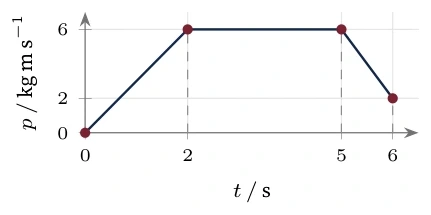
The momentum p of a trolley against time t is made of straight sections joining (0,\,0), (2.0\,\mathrm{s},\,6.0\,\mathrm{kg\,m\,s^{-1}}), (5.0\,\mathrm{s},\,6.0\,\mathrm{kg\,m\,s^{-1}}) and (6.0\,\mathrm{s},\,2.0\,\mathrm{kg\,m\,s^{-1}}). What is the resultant force on the trolley in the three intervals, in order?
A. 3.0\,\mathrm{N}, 0, -4.0\,\mathrm{N}
B. 3.0\,\mathrm{N}, 6.0\,\mathrm{N}, -4.0\,\mathrm{N}
C. 6.0\,\mathrm{N}, 6.0\,\mathrm{N}, 2.0\,\mathrm{N}
D. 6.0\,\mathrm{N}, 18\,\mathrm{N}, 4.0\,\mathrm{N}
Diagram for A.2 question E5
Show solutionHide solution
Force is the gradient \Delta p/\Delta t: 6.0/2.0=3.0\,\mathrm{N}, then 0 on the flat section (the trolley still moves), then (2.0-6.0)/1.0=-4.0\,\mathrm{N}. C reads heights as forces, D takes areas, B forgets that a flat section means zero force.

Final answer

A

Question F1

Type F1 · horizontal circle; slip limit[1 mark]
A cyclist and bicycle, total mass 80\,\mathrm{kg}, circle a flat track of radius 20\,\mathrm{m} at 8.0\,\mathrm{m\,s^{-1}}. What friction force acts towards the centre?
A. 32\,\mathrm{N}   B. 256\,\mathrm{N}
C. 784\,\mathrm{N}   D. 5120\,\mathrm{N}
Show solutionHide solution
Friction supplies mv^2/r=80(8.0)^2/20=256\,\mathrm{N}. A omits the square, C is weight and D omits division by radius.

Final answer

B

Question C1

Type C1 · static-friction limit[1 mark]
A crate of weight 300\,\mathrm{N} rests on a level floor, with \mu_s=0.40, \mu_d=0.30. A horizontal push of 100\,\mathrm{N} is applied. What is the friction force?
A. 0\,\mathrm{N}   B. 90\,\mathrm{N}
C. 100\,\mathrm{N}   D. 120\,\mathrm{N}
Show solutionHide solution
Maximum static friction is 0.40(300)=120\,\mathrm{N}. The push is smaller, so the crate stays at rest and friction matches it: 100\,\mathrm{N}. D is the ceiling; B is the sliding value.

Final answer

C

Tutorial practice

Question A2

Type A2 · free-body diagrams; resolve for equilibrium[4 marks]
A 6.0\,\mathrm{kg} hanging basket is held at rest by two chains on opposite sides: P at 50^\circ to horizontal, Q at 30^\circ to horizontal.
(a) Draw a labelled free-body diagram. [1]
(b) Determine the tension in each chain. [3]
Show solutionHide solution
(a) Draw weight vertically down and one tension along each chain (A1). (b) F_g=6.0(9.8)=58.8\,\mathrm{N}. Horizontal balance: T_P\cos50^\circ=T_Q\cos30^\circ (M1). Vertical balance: T_P\sin50^\circ+T_Q\sin30^\circ=58.8 (M1). Substitute T_Q=T_P\cos50^\circ/\cos30^\circ to find T_P=51.7\,\mathrm{N}, T_Q=38.4\,\mathrm{N} (A1). The steeper chain takes more tension.

Final answer

(a) F_g down, T_P and T_Q along the chains. (b) T_P=51.7\,\mathrm{N}, T_Q=38.4\,\mathrm{N}.

Question B2

Type B2 · connected bodies; tension; free-body diagrams; sliding friction[5 marks]
A 3.0\,\mathrm{kg} block on a horizontal table is joined by a light string over a smooth pulley at the edge to a 1.0\,\mathrm{kg} hanging mass. The block slides; its coefficient of dynamic friction is 0.20.
(a) Draw a free-body diagram for each mass. [2]
(b) Show that acceleration is about 1\,\mathrm{m\,s^{-2}}. [2]
(c) Calculate the string tension. [1]
Show solutionHide solution
(a) Block: F_g down, F_N up, T towards pulley, F_f opposing motion (A1). Hanging mass: F_g down and T up (A1). (b) F_f=0.20(3.0)(9.8)=5.88\,\mathrm{N}. Choose each mass's direction of acceleration as positive: 9.8-T=1.0a, T-5.88=3.0a (M1). Add: 3.92=4.0a, giving a=0.98\,\mathrm{m\,s^{-2}} (A1). (c) T=9.8-0.98=8.82\,\mathrm{N} (A1). Check: 5.88+3.0(0.98)=8.82\,\mathrm{N}.

Final answer

(b) 0.98\,\mathrm{m\,s^{-2}}; (c) 8.82\,\mathrm{N}\approx8.8\,\mathrm{N}.

Question B4

Type B4 · tilted string; acceleration; free-body diagrams[5 marks]
A 0.25\,\mathrm{kg} lamp hangs from the roof of a tram on a light cord. While the tram brakes uniformly on a level track, the cord stays at 12^\circ to the vertical with the lamp displaced towards the front of the tram.
(a) Draw a free-body diagram of the lamp, as seen from the track side. [1]
(b) Determine the deceleration of the tram and the tension in the cord. [3]
(c) Later the tram climbs a straight uphill section at constant speed. State the angle between the cord and the vertical. [1]
Show solutionHide solution
(a) Two forces only: F_g down and T along the cord (A1). No forwards force is drawn. (b) Vertically, T\cos12^\circ=mg (M1); horizontally, T\sin12^\circ=ma (M1). Dividing, a=g\tan12^\circ=9.8(0.2126)=2.08\,\mathrm{m\,s^{-2}} towards the back of the tram, and T=0.25(9.8)/\cos12^\circ=2.50\,\mathrm{N} (A1). (c) Constant velocity means zero resultant, so T balances F_g alone and the cord is vertical, whatever the slope (A1).

Final answer

(a) Weight F_g vertically down; tension T along the cord, tilted backwards from the vertical. (b) 2.08\,\mathrm{m\,s^{-2}}; 2.50\,\mathrm{N}. (c) 0^\circ: the cord hangs vertically.

Question C2

Type C2 · friction on a ramp; static-friction limit; sliding friction[6 marks]
A 4.0\,\mathrm{kg} box rests on a ramp at 25^\circ to horizontal; \mu_s=0.55, \mu_d=0.45.
(a) Show that it stays at rest. [2]
(b) Calculate the smallest force parallel to the ramp that will start it moving up the ramp. [2]
(c) Keep that force on once it moves. Determine the acceleration. [2]
Show solutionHide solution
(a) Required friction is mg\sin25^\circ=16.57\,\mathrm{N}; the limit is 0.55mg\cos25^\circ=19.54\,\mathrm{N} (M1). The limit exceeds the required value, so it holds (A1). (b) For impending upward motion friction is down the slope: F=mg\sin25^\circ+\mu_smg\cos25^\circ (M1), hence F=36.1\,\mathrm{N} (A1). (c) F_N=35.53\,\mathrm{N}, sliding friction =0.45(35.53)=16.0\,\mathrm{N}. Use unrounded F: ma=F-16.57-16.0 (M1), a=0.89\,\mathrm{m\,s^{-2}} upwards (A1).

Final answer

(a) 16.57\,\mathrm{N}<19.54\,\mathrm{N}. (b) 36.1\,\mathrm{N}. (c) 0.89\,\mathrm{m\,s^{-2}} up the ramp.

Question C4

Type C4 · spring force and extension; resultant and acceleration[4 marks]
A slider of mass 0.80\,\mathrm{kg} is attached to a horizontal spring on a frictionless bench. A force sensor pulls the slider away from the fixed end. With a steady reading of 18\,\mathrm{N}, the slider rests at an extension of 0.030\,\mathrm{m}. The spring obeys Hooke's law.
(a) Determine the spring constant. [2]
(b) The pull is suddenly increased to 30\,\mathrm{N}. Calculate the acceleration before the extension has changed. [2]
Show solutionHide solution
(a) At rest the spring balances the 18\,\mathrm{N} pull, so kx=18 (M1). Thus k=18/0.030=6.0\times10^2\,\mathrm{N\,m^{-1}} (A1). (b) Initially x has not changed, so the spring still pulls with 18\,\mathrm{N}. The resultant is 30-18=12\,\mathrm{N} away from the fixed end (M1), giving a=12/0.80=15\,\mathrm{m\,s^{-2}} (A1). Using 30/0.80 would omit the spring force.

Final answer

(a) 6.0\times10^2\,\mathrm{N\,m^{-1}}. (b) 15\,\mathrm{m\,s^{-2}} away from the fixed end.

Question D2

Type D2 · buoyancy and displacement; terminal-speed balance; stokes drag; terminal speed[6 marks]
A plastic bead of radius 0.50\,\mathrm{mm} and density 1050\,\mathrm{kg\,m^{-3}} is released in a deep tank of oil: density 900\,\mathrm{kg\,m^{-3}}, viscosity 0.080\,\mathrm{Pa\,s}.
(a) Calculate the buoyant force. [2]
(b) Determine the terminal speed. [3]
(c) The oil is warmed. State and explain the effect on terminal speed. [1]
Show solutionHide solution
(a) V=\tfrac43\pi(5.0\times10^{-4})^3=5.24\times10^{-10}\,\mathrm{m^3} (M1). F_b=900V(9.8)=4.62\times10^{-6}\,\mathrm{N} (A1). (b) Weight =1050V(9.8)=5.39\times10^{-6}\,\mathrm{N}. At terminal speed F_g=F_b+6\piη rv_t (M1). Rearranging gives v_t=2r^2(\rho_s-\rho_f)g/(9η) (M1), hence 1.02\times10^{-3}\,\mathrm{m\,s^{-1}} (A1). (c) Warming reduces viscosity, hence drag at any given speed; a larger speed is needed for balance (A1).

Final answer

(a) 4.62\times10^{-6}\,\mathrm{N}. (b) 1.02\times10^{-3}\,\mathrm{m\,s^{-1}}. (c) Increases as viscosity falls.

Question E2

Type E2 · one-dimensional collisions; impulse and average force[6 marks]
On a straight track, cart A (0.40\,\mathrm{kg}) at 1.5\,\mathrm{m\,s^{-1}} meets cart B (0.60\,\mathrm{kg}) coming towards it at 0.50\,\mathrm{m\,s^{-1}}. A then moves back at 0.30\,\mathrm{m\,s^{-1}}.
(a) Calculate B's final velocity. [2]
(b) Determine whether the collision is elastic. [2]
(c) Contact lasts 0.050\,\mathrm{s}. Calculate the average force on B. [2]
Show solutionHide solution
Take A's incoming direction as positive. (a) Initial p=0.40(1.5)+0.60(-0.50)=0.30\,\mathrm{kg\,m\,s^{-1}} (M1). Final -0.12+0.60v=0.30, hence v=+0.70\,\mathrm{m\,s^{-1}} (A1). (b) Initial KE =0.45+0.075=0.525\,\mathrm{J}; final KE =0.018+0.147=0.165\,\mathrm{J} (M1). It falls, so inelastic (A1). (c) \Delta p_B=0.60[0.70-(-0.50)]=0.72\,\mathrm{N\,s} (M1), F=0.72/0.050=14.4\,\mathrm{N} (A1). A's momentum change is -0.72\,\mathrm{N\,s}, consistent with the third law.

Final answer

(a) 0.70\,\mathrm{m\,s^{-1}} in A's original direction. (b) Inelastic: 0.525\,\mathrm{J} before, 0.165\,\mathrm{J} after. (c) 14.4\,\mathrm{N} in A's original direction.

Question E7

Type E7 · test momentum conservation[1 mark]
A 2.0\,\mathrm{kg} puck moving at +3.0\,\mathrm{m\,s^{-1}} hits a 1.0\,\mathrm{kg} puck at rest on a straight frictionless track. Which pair of velocities after the collision is possible?
A. 2.0\,\mathrm{kg}: +1.0;   1.0\,\mathrm{kg}: +4.0
B. 2.0\,\mathrm{kg}: +2.5;   1.0\,\mathrm{kg}: +1.0
C. 2.0\,\mathrm{kg}: -1.0;   1.0\,\mathrm{kg}: +8.0
D. 2.0\,\mathrm{kg}: 0;   1.0\,\mathrm{kg}: +3.0   (in \mathrm{m\,s^{-1}})
Show solutionHide solution
Test three things: total momentum 6.0\,\mathrm{kg\,m\,s^{-1}}, total KE no more than 9.0\,\mathrm{J}, and the back puck not moving faster than the front one. A: p=2.0+4.0=6.0, KE =1.0+8.0=9.0\,\mathrm{J}, allowed (elastic). B conserves momentum and loses KE, but the 2.0\,\mathrm{kg} puck would pass through the other. C creates KE (33\,\mathrm{J}). D has p=3.0 only.

Final answer

A

Question E4

Type E4 · recoil and explosions[1 mark]
Two gliders, 0.30\,\mathrm{kg} and 0.60\,\mathrm{kg}, rest on a level air track with a compressed spring between them. The spring is released and the 0.60\,\mathrm{kg} glider moves off at 0.50\,\mathrm{m\,s^{-1}}. How much kinetic energy did the spring give the gliders?
A. 0.075\,\mathrm{J}   B. 0.150\,\mathrm{J}
C. 0.225\,\mathrm{J}   D. 0.450\,\mathrm{J}
Show solutionHide solution
Total momentum stays zero: 0.30v=0.60(0.50), so the light glider moves at 1.0\,\mathrm{m\,s^{-1}} the other way. KE =\tfrac12(0.30)(1.0)^2+\tfrac12(0.60)(0.50)^2=0.150+0.075=0.225\,\mathrm{J}. A and B count one glider only; D gives the whole 0.90\,\mathrm{kg} the speed 1.0\,\mathrm{m\,s^{-1}}. Equal momenta mean the lighter glider carries twice the KE.

Final answer

C

Question F4

Type F4 · circular-motion ratios[1 mark]
A seat on a fairground ride moves in a horizontal circle of radius 4.0\,\mathrm{m}, once every 6.0\,\mathrm{s}. The ride speeds up until the seat circles once every 3.0\,\mathrm{s}, and the seat's circle grows to radius 6.0\,\mathrm{m}. What is (new centripetal acceleration)/(old centripetal acceleration)?
A. 1.5   B. 3.0   C. 4.0   D. 6.0
Show solutionHide solution
With the period known, use a=4\pi^2r/T^2, so a\propto r/T^2. Ratio =(6.0/4.0)\times(6.0/3.0)^2=1.5\times4=6.0. B forgets to square the period factor, C ignores the new radius, A ignores the period.

Final answer

D

Advanced practice

Question C3

Type C3 · spring force and extension; static-friction limit; predicted combination[5 marks]
A 2.0\,\mathrm{kg} block on a rough horizontal floor is tied to a wall by a horizontal spring, k=80\,\mathrm{N\,m^{-1}}; \mu_s=0.30.
(a) Pull it away from the wall and release it at rest. Determine the largest extension at which it stays at rest. [2]
(b) A worker now holds it with a constant 10\,\mathrm{N} pull away from the wall. Determine the range of extensions for rest. [3]
Show solutionHide solution
Maximum friction is 0.30(2.0)(9.8)=5.88\,\mathrm{N}. (a) 80x\le5.88 (M1), so the largest extension is 0.0735\,\mathrm{m} (A1). (b) Friction may act either way: |10-80x|\le5.88 (M1). Thus 80x\ge4.12, x\ge0.0515\,\mathrm{m} (A1), and 80x\le15.88, x\le0.1985\,\mathrm{m} (A1). At small extension friction acts towards the wall; at large extension it acts away.

Final answer

(a) 0.0735\,\mathrm{m}\approx7.4\,\mathrm{cm}. (b) 0.0515\,\mathrm{m}\le x\le0.1985\,\mathrm{m} (5.2 to 19.9\,\mathrm{cm}).

Question D3

Type D3 · buoyancy and displacement[6 marks]
A wooden block, mass 0.60\,\mathrm{kg} and volume 1.0\times10^{-3}\,\mathrm{m^3}, is held completely underwater (\rho=1000\,\mathrm{kg\,m^{-3}}) by a string tied to the tank bottom.
(a) Calculate the string tension. [3]
(b) Cut the string. Calculate the initial acceleration, ignoring drag. [2]
(c) Determine the submerged fraction once it floats at rest. [1]
Show solutionHide solution
(a) F_b=1000(10^{-3})(9.8)=9.8\,\mathrm{N} (M1). Balance: F_b=F_g+T (M1). T=9.8-0.60(9.8)=3.92\,\mathrm{N} (A1). (b) After release the resultant is 3.92\,\mathrm{N} upward: ma=3.92 (M1), a=6.53\,\mathrm{m\,s^{-2}} (A1). (c) Floating requires \rho V_{\rm sub}g=mg, giving V_{\rm sub}=6.0\times10^{-4}\,\mathrm{m^3}, fraction 0.60 (A1).

Final answer

(a) 3.92\,\mathrm{N}. (b) 6.53\,\mathrm{m\,s^{-2}} upwards. (c) 0.60.

Question E6

Type E6 · steady mass transfer; resultant and acceleration[5 marks]
A model rocket stands on a vertical launch rail. At lift-off its mass is 1.6\,\mathrm{kg}, of which 0.40\,\mathrm{kg} is propellant. The motor ejects gas downwards at 0.050\,\mathrm{kg\,s^{-1}} with a speed of 640\,\mathrm{m\,s^{-1}} relative to the rocket. Ignore air resistance.
(a) Show that the thrust is about 32\,\mathrm{N}. [1]
(b) Calculate the acceleration just after lift-off. [2]
(c) Determine the burn time and the acceleration just before the propellant runs out. [2]
Show solutionHide solution
(a) Each second 0.050\,\mathrm{kg} of gas gains 640\,\mathrm{m\,s^{-1}} downwards, so F=(\Delta m/\Delta t)\Delta v=0.050(640)=32\,\mathrm{N} (A1). (b) Resultant =32-1.6(9.8)=16.3\,\mathrm{N} (M1); a=16.3/1.6=10.2\,\mathrm{m\,s^{-2}} (A1). (c) t=0.40/0.050=8.0\,\mathrm{s} (A1). The mass is then 1.2\,\mathrm{kg}: a=(32-11.76)/1.2=16.9\,\mathrm{m\,s^{-2}} (A1). The thrust is constant but the mass falls, so a rises: one fixed m in F=ma cannot describe the burn.

Final answer

(a) 32\,\mathrm{N}. (b) 10.2\,\mathrm{m\,s^{-2}} upwards. (c) 8.0\,\mathrm{s}; 16.9\,\mathrm{m\,s^{-2}}.

Question E3

Type E3 · two-dimensional sticking[5 marks]
A 1.2\,\mathrm{kg} ball moving east at 5.0\,\mathrm{m\,s^{-1}} collides with a 0.80\,\mathrm{kg} ball moving north at 6.0\,\mathrm{m\,s^{-1}}. They stick.
(a) Determine the combined body's velocity. [3]
(b) Calculate the kinetic energy lost. [2]
Show solutionHide solution
(a) Momentum components p_x=6.0, p_y=4.8 (in \mathrm{kg\,m\,s^{-1}}) (M1). The mass is 2.0\,\mathrm{kg}, so V=\sqrt{6.0^2+4.8^2}/2.0=3.84\,\mathrm{m\,s^{-1}} (A1). \theta=\tan^{-1}(4.8/6.0)=38.7^\circ north of east (A1). (b) KE before =15.0+14.4=29.4\,\mathrm{J}; KE after =\tfrac12(2.0)V^2=14.76\,\mathrm{J} (M1). Loss =14.64\,\mathrm{J}\approx14.6\,\mathrm{J} (A1).

Final answer

(a) 3.84\,\mathrm{m\,s^{-1}} at 38.7^\circ north of east. (b) 14.6\,\mathrm{J}\approx15\,\mathrm{J}.

Question F2

Type F2 · vertical circle; top/bottom[6 marks]
A 0.30\,\mathrm{kg} stone on a 0.90\,\mathrm{m} cord moves in a vertical circle.
(a) Show that the smallest top speed for the cord to stay taut is about 3\,\mathrm{m\,s^{-1}}. [2]
(b) Its actual top speed is 4.0\,\mathrm{m\,s^{-1}}. Calculate its bottom speed. [2]
(c) Calculate the tension at the bottom. [2]
Show solutionHide solution
(a) At the limit, T=0, so mg=mv^2/r (M1). v=\sqrt{9.8(0.90)}=2.97\,\mathrm{m\,s^{-1}} (A1). (b) Energy over a height 2r: v_b^2=4.0^2+4(9.8)(0.90)=51.28 (M1). v_b=7.16\,\mathrm{m\,s^{-1}} (A1). (c) T-mg=mv_b^2/r (M1), so T=0.30(51.28)/0.90+2.94=20.0\,\mathrm{N} (A1). For comparison top tension is 0.30(16)/0.90-2.94=2.39\,\mathrm{N}.

Final answer

(a) 2.97\,\mathrm{m\,s^{-1}}. (b) 7.16\,\mathrm{m\,s^{-1}}. (c) 20.0\,\mathrm{N}.

Connected questions

Question X1

Type X1 · forces, motion and energy / A.2 + A.1 + A.3[9 marks]
A sledge and rider, total mass 45\,\mathrm{kg}, start from rest at the top of a straight snow slope 40\,\mathrm{m} long at 12^\circ to the horizontal. The coefficient of dynamic friction is 0.080 on the slope and on the level snow beyond it. Ignore air resistance.
(a) Draw a free-body diagram of the sledge on the slope. [1]
(b) Show that the acceleration down the slope is about 1.3\,\mathrm{m\,s^{-2}}. [2]
(c) Calculate the speed at the foot of the slope. [2]
(d) Determine the distance the sledge travels on the level snow before it stops. [2]
(e) Calculate the energy dissipated by friction on the slope. [2]
Show solutionHide solution
(a) Three forces: weight, normal force, friction up the slope (A1). (b) F_N=mg\cos12^\circ; resultant =mg\sin12^\circ-0.080mg\cos12^\circ (M1), so a=9.8(0.2079-0.0783)=1.27\,\mathrm{m\,s^{-2}} (A1); the mass cancels. (c) A.1: v^2=2as=2(1.27)(40)=101.7 (M1), v=10.1\,\mathrm{m\,s^{-1}} (A1). (d) On the level F_N=mg, so a=-0.080(9.8)=-0.784\,\mathrm{m\,s^{-2}} (M1); s=v^2/2|a|=101.7/1.568=64.8\,\mathrm{m} (A1). (e) A.3: work against friction =F_fs=0.080(45)(9.8)\cos12^\circ(40) (M1) =1.38\times10^{3}\,\mathrm{J} (A1). Check: mgh-\tfrac12mv^2=45(9.8)(8.32)-\tfrac12(45)(101.7)=1.38\times10^{3}\,\mathrm{J}.

Final answer

(a) F_g down, F_N perpendicular to the slope, F_f up the slope. (b) 1.27\,\mathrm{m\,s^{-2}}. (c) 10.1\,\mathrm{m\,s^{-1}}. (d) 64.8\,\mathrm{m}. (e) 1.38\times10^{3}\,\mathrm{J}.

Question X2

Type X2 · forces and orbits / A.2 + D.1[8 marks]
A weather satellite moves in a circular orbit 850\,\mathrm{km} above Earth's surface. Earth's mass is 5.97\times10^{24}\,\mathrm{kg} and its radius is 6.37\times10^{6}\,\mathrm{m}.
(a) State which force provides the centripetal force on the satellite and its direction. [1]
(b) Show that the orbital speed is v=\sqrt{GM/r}, where r is the orbit radius. [2]
(c) Calculate the orbital speed and the time for one orbit. [3]
(d) A 0.50\,\mathrm{kg} water bottle floats in the cabin. Calculate the gravitational force on it and explain why it floats. [2]
Show solutionHide solution
(a) Gravity of Earth, directed to Earth's centre (A1). (b) A.2: gravity is the only force, so it alone gives the inward acceleration: GMm/r^2=mv^2/r (M1), so v^2=GM/r and v=\sqrt{GM/r} (A1). (c) r=6.37\times10^{6}+8.50\times10^{5}=7.22\times10^{6}\,\mathrm{m} (M1). v=\sqrt{6.67\times10^{-11}(5.97\times10^{24})/7.22\times10^{6}}=7.43\times10^{3}\,\mathrm{m\,s^{-1}} (A1). T_{\text{rev}}=2\pi r/v=6.11\times10^{3}\,\mathrm{s} (A1). (d) g=GM/r^2=7.64\,\mathrm{N\,kg^{-1}}, F_g=0.50(7.64)=3.82\,\mathrm{N} (A1). Gravity alone gives the bottle the same centripetal acceleration as the cabin, so the cabin need push on it with no force: it falls round Earth with the cabin (A1).

Final answer

(a) Earth's gravitational pull, towards Earth's centre. (b) Proof. (c) 7.43\times10^{3}\,\mathrm{m\,s^{-1}}; 6.11\times10^{3}\,\mathrm{s} (about 102 minutes). (d) 3.82\,\mathrm{N}; bottle and cabin share the same acceleration, so no normal force is needed.

Question X3

Type X3 · forces on a moving charge / A.2 + D.3[9 marks]
A proton starts from rest and is accelerated through a potential difference of 2.0\,\mathrm{kV}. It then enters a region of uniform magnetic field, 0.15\,\mathrm{T}, directed into the page, moving perpendicular to the field.
(a) Show that the proton's speed is about 6.2\times10^{5}\,\mathrm{m\,s^{-1}}. [2]
(b) Inside the field the proton's speed never changes, yet its path curves. Explain both. [2]
(c) Use Newton's second law to show that the radius is r=mv/qB, and calculate r. [2]
(d) Calculate the time the proton takes to travel half a circle. [1]
(e) Determine the magnitude of the proton's change in momentum over that half circle, and hence the average resultant force. Suggest why this is smaller than qvB. [2]
Show solutionHide solution
(a) qV=\tfrac12mv^2 (M1): v=\sqrt{2(1.60\times10^{-19})(2000)/1.673\times10^{-27}}=6.19\times10^{5}\,\mathrm{m\,s^{-1}} (A1). (b) The magnetic force qvB is always perpendicular to the velocity (M1), so it changes the direction but does no work: the speed stays constant and the constant-size inward force gives a circle (A1). (c) qvB=mv^2/r (M1), so r=mv/qB=1.673\times10^{-27}(6.19\times10^{5})/(1.60\times10^{-19}\times0.15)=4.31\times10^{-2}\,\mathrm{m} (A1). (d) t=\pi r/v=\pi m/qB=2.19\times10^{-7}\,\mathrm{s} (A1). (e) The velocity reverses, so |\Delta p|=2mv=2.07\times10^{-21}\,\mathrm{kg\,m\,s^{-1}}; average force =\Delta p/\Delta t=9.45\times10^{-15}\,\mathrm{N} (A1). The force has constant size qvB=1.48\times10^{-14}\,\mathrm{N} but turns with the proton, so the components partly cancel in the vector average (ratio 2/\pi) (A1).

Final answer

(a) 6.19\times10^{5}\,\mathrm{m\,s^{-1}}. (b) Force perpendicular to velocity. (c) 4.31\times10^{-2}\,\mathrm{m}. (d) 2.19\times10^{-7}\,\mathrm{s}. (e) 2.07\times10^{-21}\,\mathrm{kg\,m\,s^{-1}}; 9.45\times10^{-15}\,\mathrm{N}, against qvB=1.48\times10^{-14}\,\mathrm{N}.

Question X4

Type X4 · momentum and gas pressure / A.2 + B.3[7 marks]
A simple model of a gas: a nitrogen molecule of mass 4.65\times10^{-26}\,\mathrm{kg} moves at 500\,\mathrm{m\,s^{-1}} back and forth between two opposite walls of a cubical box of side 0.10\,\mathrm{m}, bouncing elastically and perpendicular to each wall.
(a) Calculate the change in momentum of the molecule at one wall. [1]
(b) Determine the average force this molecule exerts on one wall. [2]
(c) The gas in the box exerts a pressure of 1.0\times10^{5}\,\mathrm{Pa}. Assume one third of the molecules move along each axis, all at 500\,\mathrm{m\,s^{-1}}. Estimate the number of molecules in the box. [2]
(d) Use the ideal gas law to estimate the temperature of the gas. [2]
Show solutionHide solution
(a) The velocity reverses: \Delta p=2mv=2(4.65\times10^{-26})(500)=4.65\times10^{-23}\,\mathrm{kg\,m\,s^{-1}} (A1). (b) Time between hits on the same wall =2L/v=0.20/500=4.0\times10^{-4}\,\mathrm{s} (M1). F=\Delta p/\Delta t=1.16\times10^{-19}\,\mathrm{N} (A1). (c) Force on one wall =pA=1.0\times10^{5}(0.010)=1.0\times10^{3}\,\mathrm{N} (M1). Molecules hitting that wall: 1.0\times10^{3}/1.16\times10^{-19}=8.60\times10^{21}, so N=3\times8.60\times10^{21}=2.58\times10^{22} (A1). (d) pV=Nk_BT (M1): T=1.0\times10^{5}(1.0\times10^{-3})/(2.58\times10^{22}\times1.38\times10^{-23})=281\,\mathrm{K} (A1). Check: p=\tfrac13\rho\overline{v^2} with \rho=Nm/V=1.20\,\mathrm{kg\,m^{-3}} gives 1.0\times10^{5}\,\mathrm{Pa}.

Final answer

(a) 4.65\times10^{-23}\,\mathrm{kg\,m\,s^{-1}}. (b) 1.16\times10^{-19}\,\mathrm{N}. (c) 2.58\times10^{22}. (d) 281\,\mathrm{K}.

From the book

Photon Physics: Study Guide for the IB Diploma (SL & HL)

Forces and momentum from the core ideas to full exam questions, with question types, worked examples and graded practice.

About the book