Free worked solutions · 2026 Edition

IB Physics A.1: Kinematics worked solutions

Worked solutions to every practice question in A.1: Kinematics of Photon Physics: Study Guide for the IB Diploma (SL & HL). Try each question, then compare your working with the full solution.

  • SL & HL
  • 30 questions
  • Full worked solutions
  • Free, no sign-up

Basic practice

Question A1

Type A1 · Instant velocity / P1A[1 mark]
A dog runs back and forth along a straight beach. Which quantity is its instantaneous velocity at t=4.0\,\mathrm{s}?
A. The gradient of the tangent to its displacement–time graph at t=4.0\,\mathrm{s}.
B. The gradient of the straight line from the origin to the point at t=4.0\,\mathrm{s} on its displacement–time graph.
C. The area under its displacement–time graph from 0 to 4.0\,\mathrm{s}.
D. The gradient of the tangent to its distance–time graph at t=4.0\,\mathrm{s}.
Show solutionHide solution
Velocity is the rate of change of displacement at that instant, so it is the tangent gradient of the displacement–time graph. B is the average velocity over the first 4.0\,\mathrm{s}. C has the unit m s and means nothing here. D gives the speed: it carries no sign, so it cannot tell you which way the dog is running.

Final answer

A
Question A2

Type A2 · Two averages / P1A[1 mark]
An athlete runs half a lap of a circular track of radius 50\,\mathrm{m} in 20\,\mathrm{s}. Her average speed and the magnitude of her average velocity, both in \,\mathrm{m\,s^{-1}}, are
A. 7.9 and 5.0   B. 5.0 and 7.9   C. 7.9 and 7.9   D. 7.9 and 0
Show solutionHide solution
Distance =\pi r=157\,\mathrm{m}, so average speed =157/20=7.9\,\mathrm{m\,s^{-1}}. Displacement is the diameter, 100\,\mathrm{m}, so the average velocity has magnitude 100/20=5.0\,\mathrm{m\,s^{-1}}. B swaps them; C treats the arc as the displacement; D is the answer for a whole lap.

Final answer

A

Question A3

Type A3 · Steady speed / P1A[1 mark]
A walker hears thunder 4.5\,\mathrm{s} after she sees the lightning. That day sound covers 340\,\mathrm{m} in each second. Roughly how far off, in metres, did the lightning strike?
A. 76   B. 1.5\times10^{3}   C. 3.1\times10^{3}   D. 1.4\times10^{9}
Show solutionHide solution
Distance = speed \times time =340\times4.5=1.53\times10^{3}\,\mathrm{m}. The light takes only 1530/(3.0\times10^{8})\approx5\times10^{-6}\,\mathrm{s}, so the whole 4.5\,\mathrm{s} is the sound's travel time. A divides instead of multiplying, C doubles the path as if for an echo, D uses the speed of light.

Final answer

B

Question B1

Type B1 · Position gradient / P1A[1 mark]
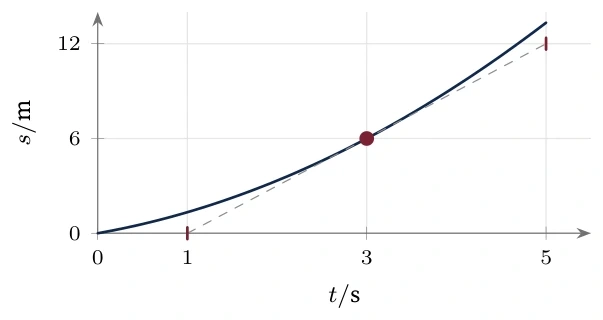
The displacement–time graph of a cyclist is a curve that passes through the point (3.0\,\mathrm{s},\,6.0\,\mathrm{m}). The tangent drawn at that point crosses the time axis at 1.0\,\mathrm{s} and reaches 12\,\mathrm{m} at 5.0\,\mathrm{s}. What is the speed of the cyclist at t=3.0\,\mathrm{s}, in \,\mathrm{m\,s^{-1}}?
A. 0.33   B. 2.0   C. 3.0   D. 18
Diagram for A.1 question B1
Show solutionHide solution
Instantaneous speed is the tangent gradient: (12-0)/(5.0-1.0)=3.0\,\mathrm{m\,s^{-1}}. B is the chord from the origin (6.0/3.0), an average. A is the reciprocal of the gradient, D multiplies the coordinates.

Final answer

C

Question B2

Type B2 · Velocity gradient / P1A[1 mark]
A cart is pushed up a smooth ramp and released. Its velocity, up the ramp positive, falls along a straight line from +6.0\,\mathrm{m\,s^{-1}} at t=0 to -6.0\,\mathrm{m\,s^{-1}} at t=4.0\,\mathrm{s}. Which describes its acceleration?
A. Constant at -3.0\,\mathrm{m\,s^{-2}} throughout.
B. -3.0\,\mathrm{m\,s^{-2}} until 2.0\,\mathrm{s}, then +3.0\,\mathrm{m\,s^{-2}}.
C. -3.0\,\mathrm{m\,s^{-2}} except at 2.0\,\mathrm{s}, where it is zero.
D. Constant at +3.0\,\mathrm{m\,s^{-2}} throughout.
Show solutionHide solution
Acceleration is the gradient of the velocity–time line: (-6.0-6.0)/4.0=-3.0\,\mathrm{m\,s^{-2}}, the same at every instant. At 2.0\,\mathrm{s} the cart is momentarily at rest but the line keeps its slope (C is the trap). Passing through v=0 does not reverse the gradient (B).

Final answer

A

Question C1

Type C1 · Choose SUVAT / P1A[1 mark]
A train's speed rises uniformly from 36\,\mathrm{km\,h^{-1}} to 72\,\mathrm{km\,h^{-1}} in 50\,\mathrm{s}. How far, in metres, does it travel in that time?
A. 500   B. 750   C. 1000   D. 2700
Show solutionHide solution
Convert first: u=10\,\mathrm{m\,s^{-1}}, v=20\,\mathrm{m\,s^{-1}}. With u, v and t known and a not needed, use s=\tfrac12(u+v)t=15\times50=750\,\mathrm{m}. A uses ut, C uses vt, D leaves the speeds in km h^{-1}.

Final answer

B

Question C2

Type C2 · From-rest ratios / P1A[1 mark]
A ball rolls from rest down a uniform slope. It passes a mark 0.50\,\mathrm{m} from its start at 1.2\,\mathrm{m\,s^{-1}}. What is its speed, in \,\mathrm{m\,s^{-1}}, as it passes a mark 2.0\,\mathrm{m} from its start?
A. 1.7   B. 2.4   C. 4.8   D. 19
Show solutionHide solution
From rest v^2=2as, so v\propto\sqrt{s}. Four times the distance gives twice the speed: 2.4\,\mathrm{m\,s^{-1}}. A would be right for twice the distance, C assumes v\propto s, D assumes v\propto s^2.

Final answer

B

Question C3

Type C3 · The next second / P1A[1 mark]
A stone is dropped from rest from a high bridge. Air resistance is negligible. It falls 4.9\,\mathrm{m} in the first second. How far, in metres, does it fall during the third second?
A. 14.7   B. 24.5   C. 29.4   D. 44.1
Show solutionHide solution
Totals from release: s=4.9t^2 gives 19.6\,\mathrm{m} at 2\,\mathrm{s} and 44.1\,\mathrm{m} at 3\,\mathrm{s}. The third second is the difference, 24.5\,\mathrm{m} (the 1 : 3 : 5 pattern: 5\times4.9). D is the three-second total, A the second second, C the speed at 3\,\mathrm{s} read as a distance.

Final answer

B

Question D1

Type D1 · Downward fall / P1A[1 mark]
A probe is dropped from rest close to the surface of a planet with no atmosphere. It falls 6.0\,\mathrm{m} in the first 2.0\,\mathrm{s}. What is its speed after 2.0\,\mathrm{s}, in \,\mathrm{m\,s^{-1}}?
A. 3.0   B. 6.0   C. 12   D. 19.6
Show solutionHide solution
Find this planet's g from the data: 6.0=\tfrac12g(2.0)^2, g=3.0\,\mathrm{m\,s^{-2}}; then v=gt=6.0\,\mathrm{m\,s^{-1}}. Quicker: s=\tfrac12(u+v)t with u=0 gives v=2s/t. A is the average speed, D imports Earth's g.

Final answer

B

Question E1

Type E1 · Apex components / P1A[1 mark]
A football is kicked at 20\,\mathrm{m\,s^{-1}} at 35^\circ above the horizontal. Air resistance is negligible. What is its speed, in \,\mathrm{m\,s^{-1}}, at the highest point of its path?
A. 0   B. 11.5   C. 16.4   D. 20
Show solutionHide solution
Only the vertical component is zero at the top. The horizontal component never changes: 20\cos35^\circ=16.4\,\mathrm{m\,s^{-1}}. B uses the sine, A forgets the horizontal motion, D ignores the loss of vertical velocity.

Final answer

C

Question E3

Type E3 · Angled flight time / P1A[1 mark]
A golf ball is struck at 25\,\mathrm{m\,s^{-1}} at 40^\circ above level ground. Air resistance is negligible. What is its time of flight, in seconds?
A. 1.6   B. 3.3   C. 3.9   D. 5.1
Show solutionHide solution
Vertical component 25\sin40^\circ=16.1\,\mathrm{m\,s^{-1}}. It returns to launch height when 0=16.1t-4.9t^2, so t=2(16.1)/9.8=3.3\,\mathrm{s}. A is the time to the top only, C uses the cosine, D uses the whole 25\,\mathrm{m\,s^{-1}}.

Final answer

B

Question F1

Type F1 · Terminal speed / P1A[1 mark]
A steel ball and a table-tennis ball of the same diameter are released together from a high window. Air resistance acts on both. Which statement is correct?
A. Both start with acceleration g, and the steel ball reaches its terminal speed first.
B. Both start with acceleration g, and the table-tennis ball reaches a lower terminal speed.
C. The table-tennis ball starts with a smaller acceleration because its weight is smaller.
D. Both reach the same terminal speed because drag depends only on size and speed.
Show solutionHide solution
At the instant of release neither ball is moving, so neither feels any air resistance: both accelerate at g (C is wrong). The faster a ball falls, the larger the drag on it, and each stops gaining speed once drag matches its weight. The light ball reaches that balance with less drag, so at a lower speed and sooner (A and D are wrong).

Final answer

B

Tutorial practice

Question A4

Type A4 · Equal-time images / P2[5 marks]
A stroboscope flashing every 0.10\,\mathrm{s} photographs a trolley rolling down a ramp. Six images are recorded. The distances between successive images are 2.0, 3.0, 4.0, 5.0 and 6.0\,\mathrm{cm}.
(a) State the evidence that the acceleration is uniform. [1]
(b) Calculate the average speed of the trolley between the third and fourth images. [1]
(c) Determine the acceleration of the trolley. [2]
(d) Calculate the average speed over the whole photograph. [1]
Show solutionHide solution
(a) Equal time intervals and gaps that grow by the same 1.0\,\mathrm{cm} each time (A1). (b) Third gap: 0.040\,\mathrm{m}/0.10\,\mathrm{s}=0.40\,\mathrm{m\,s^{-1}} (A1). (c) Interval speeds 0.20, 0.30, 0.40, 0.50, 0.60\,\mathrm{m\,s^{-1}} rise by 0.10\,\mathrm{m\,s^{-1}} every 0.10\,\mathrm{s} (M1), so a=1.0\,\mathrm{m\,s^{-2}} (A1). Equivalently, \Delta s=aT^2 gives a=0.010/0.10^2. (d) Six images make five intervals: 0.20\,\mathrm{m} in 0.50\,\mathrm{s}, so 0.40\,\mathrm{m\,s^{-1}} (A1). Dividing by 0.60\,\mathrm{s} is the usual slip.

Final answer

(a) Each gap is 1.0\,\mathrm{cm} longer than the one before. (b) 0.40\,\mathrm{m\,s^{-1}}. (c) 1.0\,\mathrm{m\,s^{-2}}. (d) 0.40\,\mathrm{m\,s^{-1}}.

Question B3

Type B3 · Acceleration area / P1A[1 mark]
A go-kart moving at 3.0\,\mathrm{m\,s^{-1}} starts to accelerate in a straight line. Its acceleration falls uniformly from 4.0\,\mathrm{m\,s^{-2}} to zero in 6.0\,\mathrm{s}. What is its speed at t=6.0\,\mathrm{s}, in \,\mathrm{m\,s^{-1}}?
A. 12   B. 15   C. 24   D. 27
Show solutionHide solution
The area under the acceleration–time graph is the change of velocity: \tfrac12(4.0)(6.0)=12\,\mathrm{m\,s^{-1}}. Add the starting 3.0\,\mathrm{m\,s^{-1}}: 15\,\mathrm{m\,s^{-1}}. A forgets the initial speed; C and D treat the acceleration as constant at 4.0\,\mathrm{m\,s^{-2}}.

Final answer

B

Question B4

Type B4 · Velocity area / P2[5 marks]
A tram starts from rest at one stop and halts at the next, 2.4\,\mathrm{km} away. It accelerates uniformly for 40\,\mathrm{s} to its top speed V, runs at V for 60\,\mathrm{s} and then decelerates uniformly to rest in 20\,\mathrm{s}.
(a) Sketch the velocity–time graph of the run between the stops. [1]
(b) Determine V. [2]
(c) Calculate the deceleration. [1]
(d) Calculate the average speed between the stops. [1]
Show solutionHide solution
(a) Three straight segments, the last one steeper than the first (A1). (b) Area = displacement: \tfrac12(40)V+60V+\tfrac12(20)V=90V=2400 (M1), V=26.7\,\mathrm{m\,s^{-1}} (A1). (c) 26.7/20=1.33\,\mathrm{m\,s^{-2}} (A1). (d) 2400/120=20.0\,\mathrm{m\,s^{-1}} (A1). Taking the average speed as V/2 is the trap: the graph is not a triangle.

Final answer

(a) Trapezium: straight rise 0–40\,\mathrm{s}, flat to 100\,\mathrm{s}, straight fall to zero at 120\,\mathrm{s}. (b) 26.7\,\mathrm{m\,s^{-1}}. (c) 1.33\,\mathrm{m\,s^{-2}}. (d) 20.0\,\mathrm{m\,s^{-1}}.

Question C4

Type C4 · Braking distance / P2[5 marks]
A driver travelling at 24\,\mathrm{m\,s^{-1}} sees a hazard. Her reaction time is 0.70\,\mathrm{s}, after which the brakes give a uniform deceleration of 6.0\,\mathrm{m\,s^{-2}}.
(a) Calculate the distance travelled during the reaction time. [1]
(b) Calculate the braking distance. [2]
(c) The same driver now travels at 12\,\mathrm{m\,s^{-1}}. Determine the total stopping distance and explain why it is less than half of the total at 24\,\mathrm{m\,s^{-1}}. [2]
Show solutionHide solution
(a) Constant speed: 24\times0.70=16.8\,\mathrm{m} (A1). (b) 0=24^2+2(-6.0)s (M1), s=48.0\,\mathrm{m} (A1). (c) 12\times0.70+12^2/12=8.4+12.0=20.4\,\mathrm{m} (A1). The thinking distance halves, but the braking distance goes as u^2 and falls to a quarter (A1).

Final answer

(a) 16.8\,\mathrm{m}. (b) 48.0\,\mathrm{m}. (c) 20.4\,\mathrm{m} (total at 24\,\mathrm{m\,s^{-1}} was 64.8\,\mathrm{m}); braking distance \propto u^2.

Question D2

Type D2 · Up then down / P2[5 marks]
A hot-air balloon is rising at a steady 4.0\,\mathrm{m\,s^{-1}}. When it is 30\,\mathrm{m} above the ground a sandbag is released from it. Air resistance on the sandbag is negligible.
(a) State the velocity of the sandbag at the moment of release. [1]
(b) Calculate the greatest height above the ground that the sandbag reaches. [1]
(c) Determine the time the sandbag takes to reach the ground. [2]
(d) Calculate the speed with which it hits the ground. [1]
Show solutionHide solution
Take up as positive, origin at the release point, a=-9.8\,\mathrm{m\,s^{-2}}. (a) The sandbag shares the balloon's velocity: 4.0\,\mathrm{m\,s^{-1}} up (A1). (b) Rise =4.0^2/(2\times9.8)=0.82\,\mathrm{m}, so 30.8\,\mathrm{m} (A1). (c) The ground is at s=-30\,\mathrm{m}: -30=4.0t-4.9t^2 (M1); the positive root is t=2.92\,\mathrm{s} (A1). (d) v^2=4.0^2+2(9.8)(30)=604, v=24.6\,\mathrm{m\,s^{-1}} (A1). Writing s=+30\,\mathrm{m} is the slip that costs the M1.

Final answer

(a) 4.0\,\mathrm{m\,s^{-1}} upwards. (b) 30.8\,\mathrm{m}. (c) 2.92\,\mathrm{s}. (d) 24.6\,\mathrm{m\,s^{-1}}.

Question E4

Type E4 · Horizontal launch / P2[5 marks]
Water leaves a garden hose horizontally at 6.0\,\mathrm{m\,s^{-1}} from a nozzle 1.20\,\mathrm{m} above level ground. Air resistance is negligible.
(a) Show that the water takes about 0.49\,\mathrm{s} to reach the ground. [1]
(b) Calculate how far from the nozzle, horizontally, the water lands. [1]
(c) Determine the velocity of the water as it reaches the ground. [3]
Show solutionHide solution
(a) No initial vertical velocity: 1.20=4.9t^2, t=0.495\,\mathrm{s} (A1). (b) 6.0\times0.495=2.97\,\mathrm{m} (A1). (c) v_y=9.8\times0.495=4.85\,\mathrm{m\,s^{-1}} down (M1); v=\sqrt{6.0^2+4.85^2}=7.7\,\mathrm{m\,s^{-1}} (A1); \tan\theta=4.85/6.0, \theta=39^\circ below the horizontal (A1). A speed alone is not a velocity.

Final answer

(a) 0.495\,\mathrm{s}. (b) 2.97\,\mathrm{m}. (c) 7.7\,\mathrm{m\,s^{-1}} at 39^\circ below the horizontal.

Question D3

Type D3 · Throw & bounce / P2[4 marks]
A ball is dropped from rest 1.80\,\mathrm{m} above a hard floor. It rebounds and rises to 1.25\,\mathrm{m}. The contact time is very short and air resistance is negligible.
(a) Determine how fast the ball is moving as it reaches the floor and as it leaves it. [2]
(b) Taking upwards as positive, sketch the velocity–time graph from release to the top of the first rebound. Label the two speeds and the times at which they occur. [2]
Show solutionHide solution
(a) v=\sqrt{2gh}: \sqrt{2(9.8)(1.80)}=5.94\,\mathrm{m\,s^{-1}} down; \sqrt{2(9.8)(1.25)}=4.95\,\mathrm{m\,s^{-1}} up (A1 each). (b) Two parallel straight lines of the same negative gradient joined by a near-vertical jump at the bounce (M1); values and times 0.606\,\mathrm{s} and 0.606+0.505=1.11\,\mathrm{s} marked (A1). A speed–time sketch would fold the first line above the axis and score nothing here.

Final answer

(a) 5.94\,\mathrm{m\,s^{-1}} and 4.95\,\mathrm{m\,s^{-1}}. (b) Straight line from 0 down to -5.94\,\mathrm{m\,s^{-1}} at 0.606\,\mathrm{s}, almost vertical jump to +4.95\,\mathrm{m\,s^{-1}}, straight line back to 0 at 1.11\,\mathrm{s}; both lines have gradient -9.8\,\mathrm{m\,s^{-2}}.

Question E2

Type E2 · Compare launches / P1A[1 mark]
From the top of a cliff two identical stones are thrown with the same speed: P horizontally, Q at 30^\circ below the horizontal. Ignore air resistance. Which statement about the two stones is true?
A. They land at the same time with the same speed.
B. Q lands first; both land with the same speed.
C. Q lands first and with the greater speed.
D. They land at the same time; Q has the greater speed.
Show solutionHide solution
Q starts with a downward velocity component, P with none, so Q covers the same drop sooner. The landing speed depends only on the launch speed and the height fallen (v^2=u^2+2gh, or energy in A.3), so it is the same. The landing directions differ, which is why "same velocity" would be wrong.

Final answer

B

Question F2

Type F2 · Drag trajectory / P1A[1 mark]
A ball is launched at an angle above level ground. Which statement describes its real flight, with air resistance, compared with the flight it would have without air resistance?
A. The highest point is reached halfway along the range.
B. The range is shorter and the path is steeper on the way down than on the way up.
C. The horizontal component of velocity stays constant.
D. At the highest point the total acceleration is g, vertically downwards.
Show solutionHide solution
Drag opposes the velocity, so it removes horizontal speed all the way and adds to gravity on the way up: lower peak, shorter range, and a descent steeper than the ascent, with the peak beyond the halfway point (A, C wrong). At the top the velocity is horizontal, so drag points backwards: the vertical acceleration is g but the total acceleration is larger and tilted (D wrong).

Final answer

B

Question F3

Type F3 · Terminal speed / P2[5 marks]
A skydiver steps out of a hovering helicopter. She reaches a terminal speed of 55\,\mathrm{m\,s^{-1}}, then opens her parachute and later lands at a steady 6\,\mathrm{m\,s^{-1}}. Take downwards as positive.
(a) State her acceleration at the moment she steps out, and explain your answer. [1]
(b) Explain why her acceleration decreases before the parachute opens. [2]
(c) Sketch her velocity–time graph from the jump to the landing. [1]
(d) State the direction of her acceleration just after the parachute opens. [1]
Show solutionHide solution
(a) At v=0 there is no air resistance; weight is the only force, so a=g=9.8\,\mathrm{m\,s^{-2}} downwards (A1). (b) As she speeds up the drag increases (M1); the resultant force, weight minus drag, decreases, so the acceleration decreases until it is zero at terminal speed (A1). (c) Correct shape with both plateaux, the drop curving into the lower plateau (A1). (d) Drag now exceeds weight: the resultant, and the acceleration, point upwards while she is still moving down (A1).

Final answer

(a) 9.8\,\mathrm{m\,s^{-2}} down: no drag at zero speed. (b) Drag rises with speed, so the resultant force falls. (c) Curve rising with falling gradient to a plateau at 55, a steep curved drop, then a plateau at 6. (d) Upwards.

Advanced practice

Question B5

Type B5 · Recover two a / P2 / Predicted type[6 marks]
A cyclist starts from rest. For the first 8.0\,\mathrm{s} her acceleration is uniform; for the next 4.0\,\mathrm{s} it is uniform again but smaller. At t=12.0\,\mathrm{s} her speed is 10.0\,\mathrm{m\,s^{-1}}, and she has covered 68\,\mathrm{m} in total.
(a) Sketch the velocity–time graph for the 12.0\,\mathrm{s}, marking the unknown speed v_1 at t=8.0\,\mathrm{s}. [1]
(b) Use the graph to show that v_1=8.0\,\mathrm{m\,s^{-1}}. [3]
(c) Determine the two accelerations. [2]
Show solutionHide solution
(a) Two straight segments, the second shallower (A1). (b) Area = displacement (M1): triangle \tfrac12(8.0)v_1 plus trapezium \tfrac12(v_1+10.0)(4.0) (M1); 4v_1+2v_1+20=68, so 6v_1=48 and v_1=8.0\,\mathrm{m\,s^{-1}} (A1). (c) a_1=8.0/8.0=1.0\,\mathrm{m\,s^{-2}} (A1); a_2=(10.0-8.0)/4.0=0.50\,\mathrm{m\,s^{-2}} (A1). One equation of motion over the whole 12\,\mathrm{s} fails: the acceleration is not uniform across it.

Final answer

(a) Straight line from the origin to (8.0,\,v_1), then a less steep straight line to (12.0,\,10.0). (b) v_1=8.0\,\mathrm{m\,s^{-1}}. (c) 1.0\,\mathrm{m\,s^{-2}} and 0.50\,\mathrm{m\,s^{-2}}.

Question C5

Type C5 · Catch by position / P2[6 marks]
A bus pulls away from a stop with a uniform acceleration of 1.5\,\mathrm{m\,s^{-2}}. At the moment it starts, a cyclist riding at a steady 6.0\,\mathrm{m\,s^{-1}} passes it in the same direction.
(a) Determine the time at which the bus draws level with the cyclist. [2]
(b) Calculate the distance from the stop at which this happens. [1]
(c) Determine the largest distance by which the cyclist leads the bus. [2]
(d) On one set of axes sketch the velocity–time graphs of both. Mark the time at which the bus draws level. [1]
Show solutionHide solution
(a) Same start point and clock: bus s=0.75t^2, cyclist s=6.0t (M1). Equal positions: 0.75t^2=6.0t, t=8.0\,\mathrm{s} (the root t=0 is the start) (A1). (b) 6.0\times8.0=48\,\mathrm{m} (A1). (c) The gap grows while the cyclist is faster, so it is largest when the speeds are equal: 1.5t=6.0, t=4.0\,\mathrm{s} (M1); gap =24-12=12\,\mathrm{m} (A1). (d) The lines cross at 4.0\,\mathrm{s}, which is not the meeting time; the bus is level at 8.0\,\mathrm{s}, when the areas under the two lines are equal (A1).

Final answer

(a) 8.0\,\mathrm{s}. (b) 48\,\mathrm{m}. (c) 12\,\mathrm{m}, at t=4.0\,\mathrm{s}. (d) Horizontal line at 6.0; line from the origin of gradient 1.5; they cross at 4.0\,\mathrm{s}, level at 8.0\,\mathrm{s} where the areas are equal.

Question E5

Type E5 · Height at a wall / P2[6 marks]
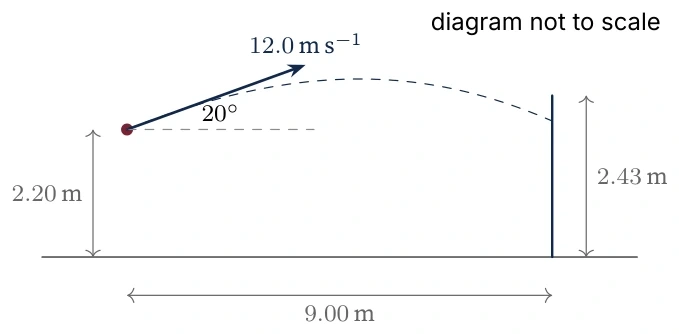
A volleyball is served from 2.20\,\mathrm{m} above the floor at 12.0\,\mathrm{m\,s^{-1}}, 20^\circ above the horizontal. The net is 9.00\,\mathrm{m} away horizontally and its top is 2.43\,\mathrm{m} above the floor. Air resistance is negligible.
(a) Resolve the launch velocity of the serve into horizontal and vertical parts. [1]
(b) Calculate the time the ball takes to reach the plane of the net. [1]
(c) Determine whether the ball passes over the net. [3]
(d) Suggest one change to the serve, other than its height, that would help the ball clear the net. [1]
Diagram for A.1 question E5
Show solutionHide solution
(a) 12.0\cos20^\circ=11.3\,\mathrm{m\,s^{-1}}, 12.0\sin20^\circ=4.10\,\mathrm{m\,s^{-1}} (A1). (b) 9.00/11.28=0.798\,\mathrm{s} (A1). (c) s_y=4.10(0.798)-4.9(0.798)^2=+0.154\,\mathrm{m} (M1); height =2.20+0.154=2.35\,\mathrm{m} (M1); less than 2.43\,\mathrm{m}, so the ball strikes the net (A1). Comparing 0.154\,\mathrm{m} with 2.43\,\mathrm{m} forgets the launch height. (d) Either change raises the ball at 9.00\,\mathrm{m} (A1).

Final answer

(a) 11.3\,\mathrm{m\,s^{-1}}, 4.10\,\mathrm{m\,s^{-1}}. (b) 0.798\,\mathrm{s}. (c) Height at the net 2.35\,\mathrm{m}<2.43\,\mathrm{m}: it hits the net by about 8\,\mathrm{cm}. (d) A larger launch angle or a greater launch speed.

Question E6

Type E6 · Downward aim / P2 / Predicted type[6 marks]
From a bridge 20.0\,\mathrm{m} above a river, a parcel is thrown so that it lands on a raft 12.0\,\mathrm{m} away horizontally, 1.50\,\mathrm{s} after release. Air resistance is negligible.
(a) Calculate the horizontal component of the launch velocity. [1]
(b) Determine the vertical component of the launch velocity and state its direction. [2]
(c) Hence state the launch speed and its angle to the horizontal. [1]
(d) Determine the velocity of the parcel as it lands. [2]
Show solutionHide solution
(a) 12.0/1.50=8.0\,\mathrm{m\,s^{-1}} (A1). (b) Up positive, landing at s=-20.0\,\mathrm{m}: -20.0=1.50u_y-4.9(1.50)^2 (M1), u_y=-5.98\,\mathrm{m\,s^{-1}}, so 5.98\,\mathrm{m\,s^{-1}} downwards (A1). (c) \sqrt{8.0^2+5.98^2}=10.0\,\mathrm{m\,s^{-1}}, \tan^{-1}(5.98/8.0)=36.8^\circ below the horizontal (A1). (d) v_y=-5.98-9.8(1.50)=-20.7\,\mathrm{m\,s^{-1}} (M1); v=\sqrt{8.0^2+20.7^2}=22.2\,\mathrm{m\,s^{-1}} at \tan^{-1}(20.7/8.0)=68.9^\circ below the horizontal (A1). Check: v^2=u^2+2gh=99.8+392 gives the same speed.

Final answer

(a) 8.0\,\mathrm{m\,s^{-1}}. (b) 5.98\,\mathrm{m\,s^{-1}} downwards. (c) 10.0\,\mathrm{m\,s^{-1}} at 36.8^\circ below the horizontal. (d) 22.2\,\mathrm{m\,s^{-1}} at 68.9^\circ below the horizontal.

Connected questions

Question X1

Type X1 · A.1 + A.2 / P2[9 marks]
A model rocket of mass 0.50\,\mathrm{kg} is launched vertically. Its motor gives a constant upward thrust of 12\,\mathrm{N} for 2.0\,\mathrm{s} and then stops. Ignore air resistance and the change in the rocket's mass.
(a) Draw a free-body diagram of the rocket while the motor is firing, and show that its acceleration is about 14\,\mathrm{m\,s^{-2}}. [2]
(b) Calculate the speed and the height of the rocket when the motor stops. [2]
(c) Determine the greatest height the rocket reaches. [2]
(d) Calculate the time from launch to the greatest height. [1]
(e) Sketch the acceleration–time and velocity–time graphs from launch to the greatest height. [2]
Show solutionHide solution
(a) Two arrows: thrust 12\,\mathrm{N} up, weight 4.9\,\mathrm{N} down (A1). A.2: a=(12-4.9)/0.50=14.2\,\mathrm{m\,s^{-2}} (A1). (b) A.1 from rest: v=14.2\times2.0=28.4\,\mathrm{m\,s^{-1}} (A1); s=\tfrac12(14.2)(2.0)^2=28.4\,\mathrm{m} (A1). (c) After burnout only gravity acts: extra rise 28.4^2/(2\times9.8)=41.2\,\mathrm{m} (M1); total 69.6\,\mathrm{m} (A1). (d) 2.0+28.4/9.8=4.90\,\mathrm{s} (A1). (e) a–t: two horizontal lines with a jump at 2.0\,\mathrm{s} (A1); v–t: two straight lines meeting at the peak (2.0,\,28.4) (A1). The rocket is still rising after the motor stops; its greatest speed, not its greatest height, comes at burnout.

Final answer

(a) Thrust up, weight down; 14.2\,\mathrm{m\,s^{-2}}. (b) 28.4\,\mathrm{m\,s^{-1}}; 28.4\,\mathrm{m}. (c) 69.6\,\mathrm{m}. (d) 4.90\,\mathrm{s}. (e) a: +14.2 for 0–2.0\,\mathrm{s}, then -9.8 to 4.90\,\mathrm{s}; v: straight rise to 28.4 at 2.0\,\mathrm{s}, straight fall to 0 at 4.90\,\mathrm{s}.

Question X2

Type X2 · A.1 + A.3 / P2[8 marks]
A diver leaves a platform 10.0\,\mathrm{m} above the water at 4.0\,\mathrm{m\,s^{-1}}, 30^\circ above the horizontal. Treat the diver as a point and ignore air resistance.
(a) Find the two components of the take-off velocity. [1]
(b) Calculate the greatest height of the diver above the water. [2]
(c) Use the components to determine the speed and direction of the diver on entering the water. [2]
(d) Use energy conservation to confirm the speed in (c), and state why the mass of the diver is not needed. [2]
(e) Calculate the time from take-off to entering the water. [1]
Show solutionHide solution
(a) 4.0\cos30^\circ=3.46\,\mathrm{m\,s^{-1}}, 4.0\sin30^\circ=2.00\,\mathrm{m\,s^{-1}} (A1). (b) Rise =2.00^2/(2\times9.8)=0.20\,\mathrm{m} (M1); 10.2\,\mathrm{m} (A1). (c) v_y^2=2.00^2+2(9.8)(10.0)=200, v_y=14.1\,\mathrm{m\,s^{-1}} down (M1); v=\sqrt{3.46^2+200}=14.6\,\mathrm{m\,s^{-1}} at \tan^{-1}(14.1/3.46)=76^\circ below the horizontal (A1). (d) A.3: \tfrac12mv^2=\tfrac12mu^2+mg(10.0) (M1); every term has m, so v^2=16+196=212 and v=14.6\,\mathrm{m\,s^{-1}} (A1). Energy gives the speed, never the direction. (e) -10.0=2.00t-4.9t^2, t=1.65\,\mathrm{s} (A1).

Final answer

(a) 3.46\,\mathrm{m\,s^{-1}}, 2.00\,\mathrm{m\,s^{-1}}. (b) 10.2\,\mathrm{m}. (c) 14.6\,\mathrm{m\,s^{-1}} at 76^\circ below the horizontal. (d) v^2=4.0^2+2(9.8)(10.0)=212; m cancels. (e) 1.65\,\mathrm{s}.

Question X3

Type X3 · A.1 + D.2 + D.3 / P2[8 marks]
An electron moving horizontally at 2.0\times10^{7}\,\mathrm{m\,s^{-1}} enters the uniform field between two horizontal parallel plates, midway between them. The plates are 5.0\,\mathrm{cm} long and 2.0\,\mathrm{cm} apart, with a potential difference of 150\,\mathrm{V} between them; the upper plate is positive.
(a) Calculate the electric field strength between the plates. [1]
(b) Calculate the acceleration of the electron and explain why its weight can be ignored. [2]
(c) Calculate the time the electron spends between the plates. [1]
(d) Determine whether the electron leaves the plates without striking the upper plate. [2]
(e) Determine the angle between the electron's velocity and the horizontal as it leaves the plates. [2]
Show solutionHide solution
(a) D.2: E=V/d=150/0.020=7.5\times10^{3}\,\mathrm{V\,m^{-1}} (A1). (b) a=eE/m_e=1.60\times10^{-19}(7.5\times10^{3})/9.11\times10^{-31}=1.32\times10^{15}\,\mathrm{m\,s^{-2}}, towards the positive plate (A1); this is about 10^{14}g, so gravity changes nothing measurable (A1). (c) Horizontal velocity is constant: t=0.050/(2.0\times10^{7})=2.5\times10^{-9}\,\mathrm{s} (A1). (d) A.1 as a projectile: y=\tfrac12at^2=\tfrac12(1.32\times10^{15})(2.5\times10^{-9})^2=4.1\times10^{-3}\,\mathrm{m} (M1); the gap above the entry line is 10\,\mathrm{mm}, so it leaves the plates (A1). (e) v_y=at=3.3\times10^{6}\,\mathrm{m\,s^{-1}} (M1); \tan^{-1}(3.3\times10^{6}/2.0\times10^{7})=9.4^\circ (A1). The path between the plates is a parabola for the same reason a thrown ball's is: constant force across, no force along.

Final answer

(a) 7.5\times10^{3}\,\mathrm{V\,m^{-1}}. (b) 1.32\times10^{15}\,\mathrm{m\,s^{-2}} upwards; about 10^{14} times g. (c) 2.5\times10^{-9}\,\mathrm{s}. (d) Deflection 4.1\,\mathrm{mm}<10\,\mathrm{mm}: it leaves. (e) 9.4^\circ above the horizontal.

Question X4

Type X4 · A.1 + D.1 / P2[8 marks]
An astronaut on the Moon strikes a golf ball at 20\,\mathrm{m\,s^{-1}}, 45^\circ above the level ground. The Moon has mass 7.35\times10^{22}\,\mathrm{kg} and radius 1.74\times10^{6}\,\mathrm{m} and no atmosphere.
(a) Show that the gravitational field strength at the Moon's surface is about 1.6\,\mathrm{N\,kg^{-1}}. [2]
(b) Find how long the ball stays up and how far away it lands. [3]
(c) The same shot on Earth, without air resistance, would have a range of 40.8\,\mathrm{m}. Explain why the ratio of the two ranges equals the ratio of the two field strengths. [1]
(d) The equations of motion assume g is constant. Estimate the greatest height of the ball and use it to justify this assumption. [2]
Show solutionHide solution
(a) D.1: g=GM/R^2=6.67\times10^{-11}(7.35\times10^{22})/(1.74\times10^{6})^2 (M1) =1.62\,\mathrm{N\,kg^{-1}} (A1). (b) u_y=u_x=14.1\,\mathrm{m\,s^{-1}} (M1); T=2u_y/g=17.5\,\mathrm{s} (A1); range =u_xT=247\,\mathrm{m} (A1). (c) For the same launch, time of flight \propto1/g and u_x is unchanged, so range \propto1/g: 247/40.8=6.05=9.8/1.62 (A1). (d) H=u_y^2/2g=200/3.24=62\,\mathrm{m} (M1); H/R\approx4\times10^{-5}, and g\propto1/r^2 changes by about 2H/R\approx7\times10^{-5}, so treating g as constant is safe (A1). An orbit, where the height is not small compared with R, is where this stops working (D.1).

Final answer

(a) 1.62\,\mathrm{N\,kg^{-1}}. (b) 17.5\,\mathrm{s}; 247\,\mathrm{m}. (c) Range =u^2\sin2\theta/g\propto1/g. (d) 62\,\mathrm{m}, about 4\times10^{-5} of the Moon's radius; g changes by under 0.01\%.

From the book

Photon Physics: Study Guide for the IB Diploma (SL & HL)

Kinematics from the core ideas to full exam questions, with question types, worked examples and graded practice.

About the book