Free worked solutions · 2026 Edition

IB Physics A.3: Work, energy and power worked solutions

Worked solutions to every practice question in A.3: Work, energy and power of Photon Physics: Study Guide for the IB Diploma (SL & HL). Try each question, then compare your working with the full solution.

  • SL & HL
  • 28 questions
  • Full worked solutions
  • Free, no sign-up

Basic practice

Question A1

Type A1 · P1A · Basic · energy-units[1 mark]
An electricity bill, a physics textbook and a data sheet each quote an amount in a different unit. Which of these is NOT a unit of energy?
A. \mathrm{kW\,h}   B. \mathrm{N\,m}   C. \mathrm{kg\,m^{2}\,s^{-2}}   D. \mathrm{J\,s^{-1}}
Show solutionHide solution
\mathrm{J\,s^{-1}} is the watt, a unit of power. A kilowatt-hour is an energy (1\,\mathrm{kW\,h}=3.6\times10^{6}\,\mathrm{J}); 1\,\mathrm{N\,m}=1\,\mathrm{J}; and 1\,\mathrm{J}=1\,\mathrm{kg\,m^{2}\,s^{-2}} from W=Fs with F=ma.

Final answer

D
Question A2

Type A2 · P1A · Basic · energy-transfers[1 mark]
A cyclist free-wheels down a straight hill at constant speed. Which statement is correct?
A. Her kinetic energy increases.
B. Her total mechanical energy stays constant.
C. Gravitational potential energy is transferred to internal energy of the air, tyres and road.
D. Gravity does no work on her because her speed is constant.
Show solutionHide solution
Constant speed: E_k is constant (A wrong). She loses height, so E_p falls and the mechanical energy falls (B wrong). Gravity does positive work, equal to the E_p lost (D wrong); the resistive forces do the same amount of negative work, which ends up as internal energy.

Final answer

C

Question B1

Type B1 · P1A · Basic · height-speed[1 mark]
A block is released from rest at the top of a frictionless ramp 4.0\,\mathrm{m} long, inclined at 30^\circ to the horizontal. What is its speed at the foot of the ramp?
A. 4.4\,\mathrm{m\,s^{-1}}   B. 6.3\,\mathrm{m\,s^{-1}}   C. 8.2\,\mathrm{m\,s^{-1}}   D. 8.9\,\mathrm{m\,s^{-1}}
Show solutionHide solution
Height fallen =4.0\sin30^\circ=2.0\,\mathrm{m}; v=\sqrt{2gh}=\sqrt{2(9.8)(2.0)}=6.3\,\mathrm{m\,s^{-1}}. A drops the 2, C uses 4.0\cos30^\circ as the height, D uses the ramp length.

Final answer

B

Question B2

Type B2 · P1A · Basic · kinetic-fractions[1 mark]
A ball is dropped from 2.0\,\mathrm{m} onto a hard floor. At each bounce it loses 36\% of its kinetic energy. Air resistance is negligible. How high does it rise after the second bounce?
A. 0.34\,\mathrm{m}   B. 0.56\,\mathrm{m}   C. 0.82\,\mathrm{m}   D. 1.3\,\mathrm{m}
Show solutionHide solution
Each bounce keeps 0.64 of the energy, so the height is multiplied by 0.64 each time: 2.0(0.64)^2=0.82\,\mathrm{m}. D stops after one bounce, B subtracts 36\% of the original height twice, A treats the 36\% as a loss of speed.

Final answer

C

Question B3

Type B3 · P1A · Basic · momentum-kinetic[1 mark]
A 0.45\,\mathrm{kg} football at rest receives an impulse of 9.0\,\mathrm{N\,s}. What is its kinetic energy just after the kick?
A. 9.0\,\mathrm{J}   B. 20\,\mathrm{J}   C. 90\,\mathrm{J}   D. 180\,\mathrm{J}
Show solutionHide solution
Impulse =\Delta p, so p=9.0\,\mathrm{kg\,m\,s^{-1}} and E_k=p^2/2m=81/0.90=90\,\mathrm{J}. A treats impulse as energy, B is the speed in \mathrm{m\,s^{-1}}, D drops the 2.

Final answer

C

Question C1

Type C1 · P1A · Basic · spring-energy[1 mark]
A force of 6.0\,\mathrm{N} stretches a spring by 4.0\,\mathrm{cm} within its linear region. How much elastic potential energy is stored?
A. 0.060\,\mathrm{J}   B. 0.12\,\mathrm{J}   C. 0.24\,\mathrm{J}   D. 12\,\mathrm{J}
Show solutionHide solution
Triangle area under the force–extension line: E_H=\tfrac12Fx=\tfrac12(6.0)(0.040)=0.12\,\mathrm{J} (equivalently k=150\,\mathrm{N\,m^{-1}}, \tfrac12kx^2). C drops the half, D keeps x in cm, A halves twice.

Final answer

B

Question C2

Type C2 · P1A · Basic · spring-scaling[1 mark]
A stretched spring stores energy E at extension x. The extension is reduced by x/4. How much energy does the spring release?
A. \tfrac14E   B. \tfrac{7}{16}E   C. \tfrac{9}{16}E   D. \tfrac{15}{16}E
Show solutionHide solution
The new extension is \tfrac34x, so the energy left is (\tfrac34)^2E=\tfrac{9}{16}E and the energy released is \tfrac{7}{16}E. C is the energy left, A treats energy as linear in x, D reads “reduced to x/4''.

Final answer

B

Question D1

Type D1 · P1A · Basic · average-power[1 mark]
A 70\,\mathrm{kg} sprinter accelerates uniformly from rest to 9.0\,\mathrm{m\,s^{-1}} in 3.0\,\mathrm{s}. What is the average rate at which her kinetic energy increases?
A. 210\,\mathrm{W}   B. 945\,\mathrm{W}   C. 1890\,\mathrm{W}   D. 2835\,\mathrm{W}
Show solutionHide solution
\Delta E_k=\tfrac12(70)(9.0)^2=2835\,\mathrm{J} in 3.0\,\mathrm{s}: 945\,\mathrm{W}. C is the power at the final instant (F=210\,\mathrm{N} times 9.0\,\mathrm{m\,s^{-1}}), twice the average for uniform acceleration. D forgets to divide by time, A is the force.

Final answer

B

Question D2

Type D2 · P1A · Basic · lifting-power · efficiency[1 mark]
An electric hoist of efficiency 75\% raises a 120\,\mathrm{kg} load vertically at a constant 0.50\,\mathrm{m\,s^{-1}}. What is the input power to the hoist?
A. 441\,\mathrm{W}   B. 588\,\mathrm{W}   C. 784\,\mathrm{W}   D. 1570\,\mathrm{W}
Show solutionHide solution
Useful power =mgv=120(9.8)(0.50)=588\,\mathrm{W}; input =588/0.75=784\,\mathrm{W}. B is the output, A multiplies by \eta instead of dividing, D leaves out the speed.

Final answer

C

Question D3

Type D3 · P1A · Basic · energy-time[1 mark]
A trolley starts from rest and is pushed by a constant resultant force. Which graph is a straight line through the origin?
A. kinetic energy against time
B. kinetic energy against distance moved
C. distance moved against time
D. speed against distance moved
Show solutionHide solution
Work by the resultant force =\Delta E_k, so E_k=Fs: proportional to distance. Speed grows as t, so E_k\propto t^2 (A) and s\propto t^2 (C) are curves; v\propto\sqrt{s} (D).

Final answer

B

Question E1

Type E1 · P1A · Basic · efficiency[1 mark]
An electric drill does 450\,\mathrm{J} of useful work and wastes 150\,\mathrm{J}. What is its efficiency?
A. 25\%   B. 33\%   C. 75\%   D. 300\%
Show solutionHide solution
Input =450+150=600\,\mathrm{J}; \eta=450/600=75\%. A is wasted/input, B wasted/useful, D useful/wasted.

Final answer

C

Question E3

Type E3 · P1A · Basic · fuel-density[1 mark]
Petrol releases 46\,\mathrm{MJ\,kg^{-1}} when burned and has density 740\,\mathrm{kg\,m^{-3}}. What is its energy density?
A. 6.2\times10^{4}\,\mathrm{J\,m^{-3}}   B. 3.4\times10^{7}\,\mathrm{J\,m^{-3}}
C. 4.6\times10^{7}\,\mathrm{J\,m^{-3}}   D. 3.4\times10^{10}\,\mathrm{J\,m^{-3}}
Show solutionHide solution
Energy per \mathrm{m^3} = energy per kg \times kg per \mathrm{m^3}: 46\times10^{6}(740)=3.4\times10^{10}\,\mathrm{J\,m^{-3}}. A divides, C is the specific energy with the wrong unit, B uses the density in \mathrm{g\,cm^{-3}}.

Final answer

D

Tutorial practice

Question A3

Type A3 · P1A · Tutorial · work-angle[1 mark]
Two dogs pull a sledge 15\,\mathrm{m} along level snow. Each dog's lead makes 25^\circ with the direction of motion and has a tension of 60\,\mathrm{N}. How much work do the two leads do on the sledge?
A. 0.76\,\mathrm{kJ}   B. 0.82\,\mathrm{kJ}   C. 1.6\,\mathrm{kJ}   D. 1.8\,\mathrm{kJ}
Show solutionHide solution
Each lead: W=Fs\cos\theta=60(15)\cos25^\circ=816\,\mathrm{J}; two leads give 1.63\times10^{3}\,\mathrm{J}. A uses \sin25^\circ, B counts one lead, D ignores the angle.

Final answer

C

Question E2

Type E2 · P1A · Tutorial · sankey-boundary[1 mark]
In a Sankey diagram for a winch, 500\,\mathrm{W} of electrical power enters the motor. The motor wastes 100\,\mathrm{W}; the gearbox it drives wastes 60\,\mathrm{W}; 340\,\mathrm{W} raises the load. What is the efficiency of the motor alone?
A. 25\%   B. 68\%   C. 80\%   D. 85\%
Show solutionHide solution
The motor's output is the arrow entering the gearbox: 500-100=400\,\mathrm{W}; \eta=400/500=80\%. B is the whole winch, D the gearbox alone (340/400), A is motor loss over motor output.

Final answer

C

Question B4

Type B4 · P2 · Tutorial · friction-energy · height-speed[7 marks]
A 2.5\,\mathrm{kg} crate is released from rest at the top of a ramp 3.0\,\mathrm{m} long, inclined at 20^\circ to the horizontal. It reaches the foot of the ramp at 3.2\,\mathrm{m\,s^{-1}}.
(a) Show that the gravitational potential energy lost is about 25\,\mathrm{J}. [2]
(b) Calculate the kinetic energy at the foot of the ramp. [1]
(c) Determine the average friction force on the crate. [2]
(d) Determine the coefficient of dynamic friction. [2]
Show solutionHide solution
(a) h=3.0\sin20^\circ=1.026\,\mathrm{m} (M1); \Delta E_p=2.5(9.8)(1.026)=25.1\,\mathrm{J} (A1). (b) \tfrac12(2.5)(3.2)^2=12.8\,\mathrm{J} (A1). (c) Energy dissipated =25.1-12.8=12.3\,\mathrm{J} (M1); friction acts along the whole 3.0\,\mathrm{m} path: F_f=12.3/3.0=4.11\,\mathrm{N} (A1). Keep the unrounded 25.14\,\mathrm{J}, not the shown 25\,\mathrm{J}. (d) F_N=mg\cos20^\circ=23.0\,\mathrm{N} (M1); \mu_d=4.11/23.0=0.179 (A1). Using mg for F_N gives 0.168.

Final answer

(a) 25.1\,\mathrm{J} (b) 12.8\,\mathrm{J} (c) 4.11\,\mathrm{N} (d) 0.179

Question C3

Type C3 · P2 · Tutorial · spring-launch · spring-energy[6 marks]
A spring of spring constant 400\,\mathrm{N\,m^{-1}} is compressed by 0.15\,\mathrm{m} and used to launch a 0.50\,\mathrm{kg} block along a smooth level track. The track then rises smoothly to a level section 0.30\,\mathrm{m} higher.
(a) Calculate the energy held in the compressed spring. [1]
(b) Calculate the block's launch speed. [2]
(c) Determine the speed of the block on the upper section. [2]
(d) The block is replaced by a 1.0\,\mathrm{kg} block and the same compression is used. State the new launch speed. [1]
Show solutionHide solution
(a) E_H=\tfrac12(400)(0.15)^2=4.5\,\mathrm{J} (A1). (b) All of it becomes kinetic energy: \tfrac12(0.50)v^2=4.5 (M1), v=4.24\,\mathrm{m\,s^{-1}} (A1). (c) E_k=4.5-0.50(9.8)(0.30)=3.03\,\mathrm{J} (M1), v=3.48\,\mathrm{m\,s^{-1}} (A1). (d) Same energy, double mass: v=\sqrt{2(4.5)/1.0}=3.0\,\mathrm{m\,s^{-1}}, a factor 1/\sqrt2, not \tfrac12 (A1).

Final answer

(a) 4.5\,\mathrm{J} (b) 4.24\,\mathrm{m\,s^{-1}} (c) 3.48\,\mathrm{m\,s^{-1}} (d) 3.0\,\mathrm{m\,s^{-1}}

Question D4

Type D4 · P2 · Tutorial · force-power[6 marks]
On a level road the total resistive force on a car is F=0.80v^2, where F is in newtons and v in \mathrm{m\,s^{-1}}. The engine's maximum useful output power is 60\,\mathrm{kW}.
(a) Show that the resistive force at a steady 25\,\mathrm{m\,s^{-1}} is 500\,\mathrm{N}, and calculate the useful power then needed. [2]
(b) Determine the car's top speed. [2]
(c) A passenger says that at top speed the resultant force is zero, so the engine does no work. Comment. [1]
(d) State the factor by which the power must increase to double the steady speed. [1]
Show solutionHide solution
(a) Steady speed: driving force = resistive force =0.80(25)^2=500\,\mathrm{N} (M1); P=Fv=500(25)=1.25\times10^{4}\,\mathrm{W} (A1). (b) P=0.80v^3 (M1): v^3=7.5\times10^{4}, v=42.2\,\mathrm{m\,s^{-1}} (A1). (c) The resultant is zero because the driving force balances the resistive force; the driving force still moves through a distance, so the engine works at 60\,\mathrm{kW}, all of it going to internal energy of the air and tyres (A1). (d) P\propto v^3: factor 8 (A1).

Final answer

(a) 500\,\mathrm{N}; 12.5\,\mathrm{kW} (b) 42.2\,\mathrm{m\,s^{-1}} (c) driving force equals the resistive force and does work (d) 8

Question D5

Type D5 · P2 · Tutorial · flow-dissipation[5 marks]
Grain falls vertically at 15\,\mathrm{kg\,s^{-1}} onto a horizontal conveyor belt moving at a constant 2.0\,\mathrm{m\,s^{-1}}. The grain arrives with no horizontal velocity.
(a) Calculate the horizontal force the belt must exert on the grain. [1]
(b) Calculate the power the belt delivers to the grain. [1]
(c) Calculate the rate at which the grain gains kinetic energy. [1]
(d) Explain the difference between (b) and (c). [1]
(e) The motor driving the belt is 80\% efficient. Calculate its input power. [1]
Show solutionHide solution
(a) F=(\Delta m/\Delta t)\Delta v=15(2.0)=30\,\mathrm{N} (A1). (b) P=Fv=30(2.0)=60\,\mathrm{W} (A1). (c) \tfrac12(15)(2.0)^2=30\,\mathrm{W} per second of grain (A1). (d) Each kilogram slips on the belt while it speeds up; sliding friction turns the other 30\,\mathrm{W} into internal energy (A1). Exactly half is lost whatever the rate or speed. (e) 60/0.80=75\,\mathrm{W} (A1).

Final answer

(a) 30\,\mathrm{N} (b) 60\,\mathrm{W} (c) 30\,\mathrm{W} (d) grain slides on the belt before matching its speed; friction dissipates 30\,\mathrm{W} (e) 75\,\mathrm{W}

Question E4

Type E4 · P2 · Tutorial · device-area · efficiency[7 marks]
Twelve solar panels, each of area 1.6\,\mathrm{m^2} and efficiency 19\%, face the Sun. The intensity of sunlight at normal incidence is 820\,\mathrm{W\,m^{-2}}.
(a) Calculate the electrical power output of one panel. [2]
(b) Calculate the total output of the twelve panels. [1]
(c) The panels deliver this output for 5.0 hours. Calculate the energy delivered in kW h and in MJ. [2]
(d) Sketch, to scale, a Sankey diagram for one panel. [2]
Show solutionHide solution
(a) Incident power =820(1.6)=1312\,\mathrm{W} (M1); output =0.19(1312)=249\,\mathrm{W} (A1). (b) 12(249.3)=2.99\times10^{3}\,\mathrm{W} (A1). (c) 2.99\,\mathrm{kW}\times5.0\,\mathrm{h}=15.0\,\mathrm{kW\,h} (A1); 1\,\mathrm{kW\,h}=3.6\,\mathrm{MJ}, so 53.8\,\mathrm{MJ} (A1). (d) One input arrow splitting into a useful 249\,\mathrm{W} arrow and a downward wasted 1063\,\mathrm{W} arrow (M1), widths in proportion, e.g. 26\,\mathrm{mm}, 5\,\mathrm{mm}, 21\,\mathrm{mm} at 20\,\mathrm{mm} per kW (A1).

Final answer

(a) 249\,\mathrm{W} (b) 2.99\,\mathrm{kW} (c) 15.0\,\mathrm{kW\,h}, 53.8\,\mathrm{MJ} (d) input 1312\,\mathrm{W}, useful 249\,\mathrm{W}, wasted 1063\,\mathrm{W}, widths in that ratio

Question E6

Type E6 · P2 · Tutorial · fuel-density · force-power[6 marks]
A car uses 5.0 litres of diesel per 100\,\mathrm{km} at a steady 25\,\mathrm{m\,s^{-1}} on a level road. Diesel has an energy density of 3.6\times10^{10}\,\mathrm{J\,m^{-3}} and the engine is 30\% efficient.
(a) Calculate the energy released by the fuel per 100\,\mathrm{km}. [1]
(b) Estimate the average resistive force on the car. [3]
(c) Calculate the useful output power of the engine. [1]
(d) State one assumption you made in (b). [1]
Show solutionHide solution
(a) 5.0\,\mathrm{L}=5.0\times10^{-3}\,\mathrm{m^3}; E=3.6\times10^{10}(5.0\times10^{-3})=1.8\times10^{8}\,\mathrm{J} (A1). (b) Useful work =0.30(1.8\times10^{8})=5.4\times10^{7}\,\mathrm{J} (M1); at steady speed it is all done against the resistive force over 1.0\times10^{5}\,\mathrm{m} (M1): F=540\,\mathrm{N} (A1). (c) P=Fv=540(25)=1.35\times10^{4}\,\mathrm{W} (A1). (d) The efficiency is the same throughout, or no energy goes into E_k or E_p (constant speed, level road) (A1).

Final answer

(a) 1.8\times10^{8}\,\mathrm{J} (b) 540\,\mathrm{N} (c) 13.5\,\mathrm{kW} (d) all the useful work is done against the resistive force (speed constant, road level)

Advanced practice

Question A4

Type A4 · P2 · Advanced · graph-work · net-work · signed-work-graph[6 marks]
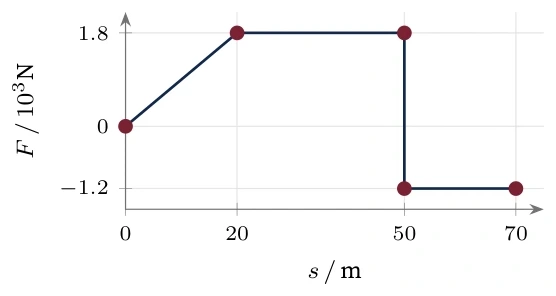
A 900\,\mathrm{kg} go-kart starts from rest on a straight level track. The graph shows the resultant force F on it against displacement s: F rises uniformly from 0 to 1.8\times10^{3}\,\mathrm{N} over the first 20\,\mathrm{m}, stays at 1.8\times10^{3}\,\mathrm{N} until s=50\,\mathrm{m}, then is -1.2\times10^{3}\,\mathrm{N} (braking) from 50\,\mathrm{m} to 70\,\mathrm{m}.
(a) Determine the work done by the resultant force in the first 50\,\mathrm{m}. [2]
(b) Calculate the speed at s=50\,\mathrm{m}. [2]
(c) Calculate the speed at s=70\,\mathrm{m}. [2]
Diagram for A.3 question A4
Show solutionHide solution
(a) Area under the graph: triangle \tfrac12(20)(1.8\times10^{3})=1.8\times10^{4}\,\mathrm{J} plus rectangle 30(1.8\times10^{3})=5.4\times10^{4}\,\mathrm{J} (M1); total 7.2\times10^{4}\,\mathrm{J} (A1). Reading the axis as 1.8\,\mathrm{N} gives 72\,\mathrm{J} and no mark. (b) Work by the resultant force =\Delta E_k: \tfrac12(900)v^2=7.2\times10^{4} (M1), v=12.6\,\mathrm{m\,s^{-1}} (A1). (c) The area below the axis is negative: -1.2\times10^{3}(20)=-2.4\times10^{4}\,\mathrm{J} (M1), so E_k=4.8\times10^{4}\,\mathrm{J} and v=10.3\,\mathrm{m\,s^{-1}} (A1).

Final answer

(a) 7.2\times10^{4}\,\mathrm{J} (b) 12.6\,\mathrm{m\,s^{-1}} (c) 10.3\,\mathrm{m\,s^{-1}}

Question A5

Type A5 · P1A · Advanced · Predicted type · force-from-work · net-work[1 mark]
A 0.20\,\mathrm{kg} puck slides in a straight line on ice and slows from 6.0\,\mathrm{m\,s^{-1}} to 4.0\,\mathrm{m\,s^{-1}} over 25\,\mathrm{m}. What is the average friction force on the puck?
A. 0.016\,\mathrm{N}   B. 0.080\,\mathrm{N}   C. 0.16\,\mathrm{N}   D. 50\,\mathrm{N}
Show solutionHide solution
Friction is the resultant force, so its work equals the change in kinetic energy: The energy removed is \tfrac12(0.20)(6.0^2-4.0^2)=2.0\,\mathrm{J}, so friction does -2.0\,\mathrm{J} of work. Its magnitude is F=2.0/25=0.080\,\mathrm{N}. A squares the change in speed, C drops the \tfrac12, D multiplies by the distance.

Final answer

B

Question C4

Type C4 · P2 · Advanced · spring-fall[6 marks]
A 0.40\,\mathrm{kg} ball is tied to one end of a light elastic cord of natural length 1.2\,\mathrm{m}. The other end is fixed to a beam and the ball is released from rest beside the fixed end. Within its linear region the cord has spring constant 50\,\mathrm{N\,m^{-1}}. Ignore air resistance.
(a) Calculate the speed of the ball when the cord first becomes taut. [1]
(b) Show that the greatest extension of the cord is about 0.52\,\mathrm{m}. [3]
(c) A student says the ball is lowest where the cord's pull equals its weight. Explain why this is wrong. [1]
(d) Calculate the largest force the cord exerts on the ball. [1]
Show solutionHide solution
(a) v=\sqrt{2(9.8)(1.2)}=4.85\,\mathrm{m\,s^{-1}} (A1). (b) At the lowest point the ball is at rest, so all the gravitational energy lost over the whole fall (1.2+x) is stored in the cord (M1): 0.40(9.8)(1.2+x)=\tfrac12(50)x^2 (M1), so 25x^2-3.92x-4.704=0 and x=0.519\,\mathrm{m} (A1). (c) Where kx=mg (x=0.078\,\mathrm{m}) the two forces balance. With no resultant there the ball stops gaining speed: this is its fastest point, and it carries on downwards past it (A1). (d) F=kx=50(0.519)=26\,\mathrm{N} (A1).

Final answer

(a) 4.85\,\mathrm{m\,s^{-1}} (b) 0.519\,\mathrm{m} (c) there the ball is moving fastest (d) 26\,\mathrm{N}

Question E5

Type E5 · P2 · Advanced · stored-water[6 marks]
The upper reservoir of a pumped-storage scheme holds 2.0\times10^{6}\,\mathrm{m^3} of water in a layer 20\,\mathrm{m} deep with vertical sides. The bottom of the reservoir is 300\,\mathrm{m} above the turbines. The density of water is 1000\,\mathrm{kg\,m^{-3}}.
(a) State the average height through which the water falls. [1]
(b) Calculate the gravitational potential energy released when the reservoir empties. [2]
(c) Calculate the energy per kilogram of the stored water and state its unit. [1]
(d) The turbines and generators are 85\% efficient and the reservoir empties in 6.0 hours. Determine the average electrical power output. [2]
Show solutionHide solution
(a) The centre of the water layer is 10\,\mathrm{m} above the bottom: 310\,\mathrm{m} (A1). (b) m=\rho V=2.0\times10^{9}\,\mathrm{kg} (M1); \Delta E_p=mgh=2.0\times10^{9}(9.8)(310)=6.08\times10^{12}\,\mathrm{J} (A1). (c) gh=3.04\times10^{3}\,\mathrm{J\,kg^{-1}}, a specific energy, not an energy density (A1). (d) 0.85(6.08\times10^{12})/(6.0\times3600) (M1) =2.39\times10^{8}\,\mathrm{W} (A1).

Final answer

(a) 310\,\mathrm{m} (b) 6.08\times10^{12}\,\mathrm{J} (c) 3.04\times10^{3}\,\mathrm{J\,kg^{-1}} (d) 2.39\times10^{8}\,\mathrm{W}

Connected questions

Question X1

Type X1 · P2 · Connected · A.3 + A.2[8 marks]
A 15\,\mathrm{g} dart is fired horizontally into a 0.585\,\mathrm{kg} wooden block hanging at rest on light strings, and sticks in it. The block and dart swing up until their centre of mass is 0.20\,\mathrm{m} higher than at the start.
(a) Show that the speed of the block and dart just after the impact is about 2.0\,\mathrm{m\,s^{-1}}. [2]
(b) Calculate the speed of the dart before the impact. [2]
(c) Determine the fraction of the dart's kinetic energy that is not recovered as gravitational potential energy. [2]
(d) Explain why momentum, not kinetic energy, must be used for the impact, and energy, not momentum, for the swing. [2]
Show solutionHide solution
(a) A.3: during the swing only gravity does work (the string pull is perpendicular to the motion): \tfrac12Mv^2=Mgh (M1), v=\sqrt{2(9.8)(0.20)}=1.98\,\mathrm{m\,s^{-1}} (A1). (b) A.2: momentum is conserved in the impact: 0.015u=0.600(1.98) (M1), u=79.2\,\mathrm{m\,s^{-1}} (A1). (c) E_k before =\tfrac12(0.015)(79.2)^2=47.0\,\mathrm{J}; E_p gained =0.600(9.8)(0.20)=1.18\,\mathrm{J} (M1); fraction lost =1-1.18/47.0=0.975 (A1). (d) The impact is totally inelastic, so kinetic energy is not conserved, but no external horizontal impulse acts in the short impact (A1). During the swing gravity and the string tension act, so momentum changes, but only gravity does work, so mechanical energy is conserved (A1).

Final answer

(a) 1.98\,\mathrm{m\,s^{-1}} (b) 79.2\,\mathrm{m\,s^{-1}} (c) 0.975 (d) impact: horizontal momentum is conserved but kinetic energy is lost; swing: mechanical energy is conserved while momentum changes

Question X2

Type X2 · P2 · Connected · A.3 + B.1[7 marks]
A 1200\,\mathrm{kg} car descends a straight road 600\,\mathrm{m} long, losing 45\,\mathrm{m} of height, at a steady 15\,\mathrm{m\,s^{-1}} with the brakes applied. Ignore air resistance and rolling resistance.
(a) Explain why the energy transferred to the brakes equals the gravitational potential energy lost, and calculate it. [2]
(b) Calculate the average power dissipated in the brakes. [2]
(c) The brake discs have a total mass of 8.0\,\mathrm{kg} and specific heat capacity 460\,\mathrm{J\,kg^{-1}\,K^{-1}}. Calculate their temperature rise if they keep all this energy. [2]
(d) Suggest why the actual temperature rise is smaller. [1]
Show solutionHide solution
(a) Constant speed, so E_k does not change; the mechanical energy lost is all E_p and the brakes' friction does that much negative work (M1): mgh=1200(9.8)(45)=5.29\times10^{5}\,\mathrm{J} (A1). (b) Time =600/15=40\,\mathrm{s} (M1); P=5.29\times10^{5}/40=1.32\times10^{4}\,\mathrm{W} (A1). (c) B.1: Q=mc\Delta T (M1), \Delta T=5.29\times10^{5}/(8.0\times460)=144\,\mathrm{K} (A1). (d) The hot discs lose energy to the air by convection and radiation during the descent (A1).

Final answer

(a) 5.29\times10^{5}\,\mathrm{J} (b) 1.32\times10^{4}\,\mathrm{W} (c) 144\,\mathrm{K} (d) the discs transfer energy to the air (and pads, wheels) as they warm

Question X3

Type X3 · P2 · Connected · A.3 + B.5[8 marks]
An electric bicycle and rider, total mass 100\,\mathrm{kg}, climb a straight hill inclined at 4.0^\circ at a steady 6.0\,\mathrm{m\,s^{-1}}. The resistive forces total 25\,\mathrm{N}. The motor takes a current of 15\,\mathrm{A} from a 48\,\mathrm{V} battery and the rider does not pedal.
(a) Calculate the gain in gravitational potential energy per second. [2]
(b) Calculate the useful power output of the motor. [1]
(c) Determine the efficiency of the motor. [2]
(d) The battery stores 0.50\,\mathrm{kW\,h}. Calculate the greatest distance it can drive the bicycle up this hill. [2]
(e) State where the wasted power goes. [1]
Show solutionHide solution
(a) Height gained per second =v\sin4.0^\circ (M1): mgv\sin\theta=100(9.8)(6.0)(0.0698)=410\,\mathrm{W} (A1). (b) Add work against resistance: 25(6.0)=150\,\mathrm{W}; total 560\,\mathrm{W} (A1). (c) B.5: P=IV=15(48)=720\,\mathrm{W} (M1); \eta=560/720=0.78 (A1). (d) 0.50\,\mathrm{kW\,h}=1.8\times10^{6}\,\mathrm{J}; time =1.8\times10^{6}/720=2500\,\mathrm{s} (M1); distance =6.0(2500)=1.5\times10^{4}\,\mathrm{m} (A1). (e) About 160\,\mathrm{W} heats the motor coils and wiring (A1).

Final answer

(a) 410\,\mathrm{W} (b) 560\,\mathrm{W} (c) 78\% (d) 15\,\mathrm{km} (e) internal energy of the motor and wiring (heating)

Question X4

Type X4 · P2 · Connected · A.3 + C.1[8 marks]
A 0.40\,\mathrm{kg} glider on a level air track is attached to a horizontal spring of spring constant 160\,\mathrm{N\,m^{-1}}. It is pulled 5.0\,\mathrm{cm} from its equilibrium position and released. Friction is negligible.
(a) Calculate the energy stored in the spring at release. [1]
(b) Determine the greatest speed of the glider and state where it occurs. [2]
(c) Calculate the speed of the glider when it is 3.0\,\mathrm{cm} from equilibrium. [2]
(d) Calculate the period of the oscillation. [1]
(e) Sketch, on one set of axes, how the kinetic energy and the elastic potential energy vary with displacement from -5.0\,\mathrm{cm} to +5.0\,\mathrm{cm}. [2]
Show solutionHide solution
(a) \tfrac12(160)(0.050)^2=0.20\,\mathrm{J} (A1). (b) At equilibrium the spring stores nothing, so \tfrac12(0.40)v^2=0.20 (M1), v=1.0\,\mathrm{m\,s^{-1}} at the equilibrium position (A1). (c) E_k=0.20-\tfrac12(160)(0.030)^2=0.128\,\mathrm{J} (M1); v=0.80\,\mathrm{m\,s^{-1}} (A1). (d) C.1: T=2\pi\sqrt{m/k}=2\pi\sqrt{0.40/160}=0.31\,\mathrm{s} (A1). (e) E_H=\tfrac12kx^2 is a parabola through the origin reaching 0.20\,\mathrm{J} at the ends (A1); E_k is its mirror image, 0.20\,\mathrm{J} at x=0 and zero at the ends, so the two always add to 0.20\,\mathrm{J} (A1).

Final answer

(a) 0.20\,\mathrm{J} (b) 1.0\,\mathrm{m\,s^{-1}} at equilibrium (c) 0.80\,\mathrm{m\,s^{-1}} (d) 0.31\,\mathrm{s} (e) E_H an upward parabola from 0 to 0.20\,\mathrm{J}, E_k an inverted parabola from 0.20\,\mathrm{J} to 0, sum constant

From the book

Photon Physics: Study Guide for the IB Diploma (SL & HL)

Work, energy and power from the core ideas to full exam questions, with question types, worked examples and graded practice.

About the book