Free worked solutions · 2026 Edition

IB Maths HL Paper 3 Chapter 14: Voronoi diagrams, vectors and optimal shapes worked solutions

Worked solutions to the investigations in Chapter 14 of Photon Guidebook: Mathematics HL Paper 3 for the IB Diploma (2026 Edition). Each solution shows every step with the mark it earns, the way an IB mark scheme does.

  • Chapter 14 of 18
  • 9 practice questions
  • 2 Going further
  • Free, no sign-up

Investigations

The practice investigations of the chapter, each with its full worked solution and mark scheme.

Investigation 1

[16 marks]
This question asks you to use a Voronoi diagram to decide which ambulance station should answer a call.
Three ambulance stations are at \mathrm{P}(0,0), \mathrm{Q}(6,0) and \mathrm{R}(0,4), in kilometres, in a district 0\le x\le6, 0\le y\le4.
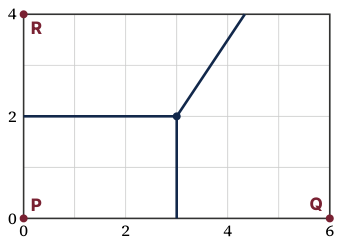
Original Photon diagram
(a) Find the equations of the three perpendicular bisectors.
[4]
(b) Show that the Voronoi vertex is the midpoint of \mathrm{QR}, and explain why.
[3]
(c) A call comes from (4,3). State which station is nearest and find its distance.
[2]
(d) Rainfall readings are 12 mm at P, 18 mm at Q and 9 mm at R. Use nearest-neighbour interpolation to estimate the rainfall at (4,3) and at (1,1).
[3]
(e) A fourth station is built at \mathrm{S}(6,4). Find the area of each cell inside the district, and describe the new diagram.
[4]
Show solutionHide solution
(a) PQ have the same y, so the bisector is x=3 [A1]; PR have the same x, so it is y=2 [A1]; QR has midpoint (3,2) and gradient -\frac23 [M1], so the bisector has gradient \frac32 and equation 3x-2y=5 [A1].
(b) x=3 and y=2 meet at (3,2) [M1]; this is the midpoint of QR [A1]; the angle at P is a right angle, so the circle through P, Q, R has QR as a diameter, and its centre, which is equidistant from all three stations, is the midpoint of QR [R1].
(c) distances from (4,3): P 5, Q \sqrt{13}, R \sqrt{17} [M1]; Q is nearest, 3.61 km [A1].
(d) (4,3) is nearest Q [M1], so the estimate is 18 mm [A1]; (1,1) is nearest P, so 12 mm [A1].
(e) the bisector of QS is y=2 and the bisector of RS is x=3 [M1]; with (a), the diagram is the cross x=3, y=2, and all four cells meet at (3,2) [A1]; the four stations are the corners of a rectangle, so they lie on one circle with centre (3,2) [R1]; each cell is a 3\times2 rectangle of area 6 km^2 [A1].

Final answer

  • (a) x=3; y=2; 3x-2y=5
  • (b) vertex (3,2)
  • (c) Q, 3.61 km
  • (d) 18 mm and 12 mm
  • (e) four cells of 6 km^2.

Investigation 2

[22 marks]
This question asks you to use velocity vectors to plan a kayak crossing against a current.
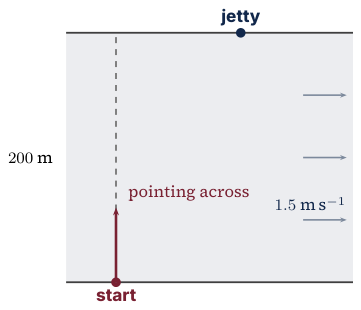
A river is 200 m wide with straight parallel banks, and flows east at 1.5 m s^{-1}. Kofi can paddle at 2 m s^{-1} relative to the water. Take the x-axis east along the near bank and the y-axis across the river.
Original Photon diagram
(a) Kofi points his kayak straight across. Find his resultant velocity, the time to cross and how far downstream he lands.
[4]
(b) Kofi wants to land directly opposite his start. Find the angle, upstream from straight across, at which he should point, and the time taken.
[5]
(c) Show that he cannot land directly opposite if the current is faster than 2 m s^{-1}.
[2]
(d) A jetty is 100 m downstream of the opposite point on the far bank. Find the angle at which he should point to reach it, and the time taken.
[6]
(e) Find the angle between his resultant velocities in (a) and (b).
[3]
(f) State two assumptions of the model.
[2]
Show solutionHide solution
(a) resultant =(1.5,0)+(0,2) [M1] =(1.5,2) m s^{-1} [A1]; time 200\div2=100 s [A1]; downstream distance 1.5\times100=150 m [A1].
(b) the upstream part of his paddling must cancel the current: 2\sin\alpha=1.5 [M1]; \sin\alpha=0.75 [A1]; \alpha=48.6^\circ [A1]; speed across the river 2\cos\alpha=1.32 m s^{-1} [M1]; time 200\div1.323=151 s [A1].
(c) cancelling the current needs 2\sin\alpha=c, where c is the speed of the current [M1]; \sin\alpha\le1, so c\le2, and a current faster than 2 m s^{-1} cannot be cancelled [R1].
(d) velocity =(1.5-2\sin\alpha,\;2\cos\alpha) [M1]; the landing point is 100 m along for 200 m across, so \frac{1.5-2\sin\alpha}{2\cos\alpha}=\frac{100}{200} [M1]; 1.5-2\sin\alpha=\cos\alpha [A1]; solving this on a GDC [M1] gives \alpha=15.6^\circ [A1]; time \frac{200}{2\cos15.6^\circ}=104 s [A1].
(e) in (a) the resultant is (1.5,2) and in (b) it is (0,1.32) [M1]; \cos\theta=\frac{2\times1.323}{2.5\times1.323}=0.8 [A1]; \theta=36.9^\circ [A1].
(f) the current is the same all the way across the river [R1]; Kofi holds a constant speed relative to the water on a constant heading, with no wind [R1].

Final answer

  • (a) (1.5,2), 100 s, 150 m
  • (b) 48.6^\circ, 151 s
  • (d) 15.6^\circ, 104 s
  • (e) 36.9^\circ.

Investigation 3

[26 marks]
This question asks you to find where to stand in a gallery so that a painting looks as large as possible.
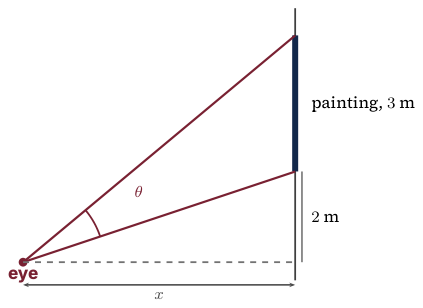
A painting 3 m tall hangs on a vertical wall with its lower edge 2 m above a visitor's eye level. The visitor stands x m from the wall. In a vertical plane, the eye is at the origin, the lower edge at (x,2) and the upper edge at (x,5).
Original Photon diagram
(a) Write down the vectors \mathbf{u} and \mathbf{v} from the eye to the lower and upper edges.
[1]
(b) By using the scalar product and the magnitude of the vector product, show that the angle \theta subtended at the eye satisfies \tan\theta=\dfrac{3x}{x^2+10}.
[6]
(c) Use your GDC to find the value of x that maximises \theta, and the maximum angle in degrees.
[3]
(d) Show that \dfrac{\mathrm{d}}{\mathrm{d}x}\left(\dfrac{3x}{x^2+10}\right)=0 when x=\sqrt{10}, and explain why maximising \tan\theta maximises \theta.
[5]
(e) For a painting with lower edge a m and upper edge b m above eye level, where 0<a<b, show that the best distance is \sqrt{ab} m.
[5]
(f) A rope keeps visitors at least 4 m from the wall. Find the best place to stand and the angle.
[3]
(g) State two assumptions the model makes about the visitor and the painting, and give one reason why visitors may not stand at the best distance.
[3]
Show solutionHide solution
(a) \mathbf{u}=\begin{pmatrix}x\\2\end{pmatrix}, \mathbf{v}=\begin{pmatrix}x\\5\end{pmatrix} [A1].
(b) \cos\theta=\frac{\mathbf{u}\cdot\mathbf{v}}{|\mathbf{u}||\mathbf{v}|} [M1]; \sin\theta=\frac{|\mathbf{u}\times\mathbf{v}|}{|\mathbf{u}||\mathbf{v}|} [M1]; so \tan\theta=\frac{|\mathbf{u}\times\mathbf{v}|}{\mathbf{u}\cdot\mathbf{v}} [M1]; \mathbf{u}\cdot\mathbf{v}=x^2+10 [A1]; with z=0 in both vectors, \mathbf{u}\times\mathbf{v}=(0,0,5x-2x) [M1]; |\mathbf{u}\times\mathbf{v}|=3x [A1], so \tan\theta=\frac{3x}{x^2+10}.
(c) graph \theta=\tan^{-1}\frac{3x}{x^2+10} in degrees [M1]; maximum at x=3.16 m [A1]; \theta=25.4^\circ [A1].
(d) quotient rule: \frac{3(x^2+10)-3x\cdot2x}{(x^2+10)^2} [M1] =\frac{30-3x^2}{(x^2+10)^2} [A1]; =0 when x^2=10, so x=\sqrt{10} [A1]; \theta is acute, and \tan is increasing on 0<\theta<90^\circ [R1], so the largest \tan\theta gives the largest \theta; the derivative is positive before \sqrt{10} and negative after, so this is a maximum [R1].
(e) \mathbf{u}\cdot\mathbf{v}=x^2+ab and |\mathbf{u}\times\mathbf{v}|=(b-a)x [M1]; \tan\theta=\frac{(b-a)x}{x^2+ab} [A1]; derivative \frac{(b-a)(x^2+ab)-(b-a)x\cdot2x}{(x^2+ab)^2} [M1] =\frac{(b-a)(ab-x^2)}{(x^2+ab)^2} [A1]; zero when x^2=ab, so x=\sqrt{ab} since x>0 [A1].
(f) \sqrt{10}=3.16<4, and \theta decreases for x>\sqrt{10} [M1]; so the best allowed place is the nearest one to the optimum, x=4 m [R1]; \tan\theta=\frac{12}{26}, so \theta=24.8^\circ [A1].
(g) the visitor's eye is at a fixed height and the visitor looks straight at the wall [R1]; the painting is flat and seen from directly in front, with no glare [R1]; for example, other visitors block the best spot, or the detail of the painting needs a closer look [R1].

Final answer

  • (b) \mathbf{u}\cdot\mathbf{v}=x^2+10, |\mathbf{u}\times\mathbf{v}|=3x
  • (c) x=3.16 m, \theta=25.4^\circ
  • (e) \tan\theta=\frac{(b-a)x}{x^2+ab}
  • (f) x=4 m, \theta=24.8^\circ.

Investigation 4

[20 marks]
This question asks you to estimate the average rainfall over a valley from three gauges, using the cells of a Voronoi diagram.
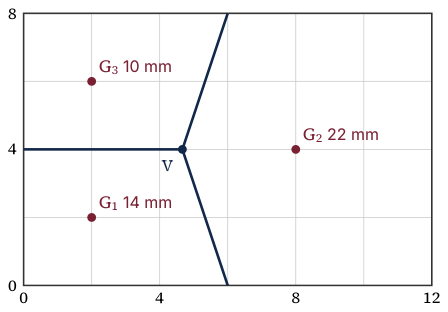
A rectangular valley occupies 0\le x\le12, 0\le y\le8, with distances in kilometres. Rain gauges are at \mathrm{G_1}(2,2), \mathrm{G_2}(8,4) and \mathrm{G_3}(2,6). In one storm they record 14 mm, 22 mm and 10 mm.
Original Photon diagram
(a) State the equation of the line of points equally far from \mathrm{G_1} and \mathrm{G_3}.
[1]
(b) Show that the perpendicular bisector of \mathrm{G_1G_2} has equation 3x+y=18.
[3]
(c) The bisectors meet at the vertex V. Find the coordinates of V, and verify that it is equidistant from \mathrm{G_1} and \mathrm{G_2}.
[3]
(d) Find the area of each cell inside the valley.
[3]
(e) Use nearest-neighbour interpolation to estimate the rainfall at (10,1) and at (3,5).
[2]
(f) Estimate the mean rainfall over the valley by weighting each reading by the area of its cell, and compare it with the mean of the three readings. Suggest a reason for the difference.
[4]
(g) A fourth gauge \mathrm{G_4}(10,6) records 20 mm. Find the area of its cell, and find the new area-weighted mean rainfall.
[4]
Show solutionHide solution
(a) \mathrm{G_1} and \mathrm{G_3} have the same x, with midpoint (2,4), so the line is y=4 [A1].
(b) midpoint of \mathrm{G_1G_2} is (5,3) [M1]; gradient of \mathrm{G_1G_2} is \frac{4-2}{8-2}=\frac13, so the perpendicular gradient is −3 [M1]; y-3=-3(x-5) [A1], that is 3x+y=18.
(c) put y=4 into 3x+y=18 [M1]; \mathrm{V}=\left(\frac{14}{3},4\right) [A1]; \mathrm{VG_1}=\sqrt{\left(\frac83\right)^2+2^2}=\frac{10}{3} and \mathrm{VG_2}=8-\frac{14}{3}=\frac{10}{3}, so 3.33 km from each [A1].
(d) the cell of \mathrm{G_1} has vertices (0,0), (6,0), V and (0,4) [M1]; area \frac12\left(6+\frac{14}{3}\right)\times4=21.3 km^2, and the cell of \mathrm{G_3} is its mirror image, also 21.3 [A1]; the cell of \mathrm{G_2} is 96-2\times21.33=53.3 km^2 [A1].
(e) (10,1) is nearest \mathrm{G_2}, so 22 mm [A1]; (3,5) is nearest \mathrm{G_3}, so 10 mm [A1].
(f) \frac{21.33\times14+53.33\times22+21.33\times10}{96} [M1] =17.6 mm [A1]; the mean of the readings is \frac{14+22+10}{3}=15.3 mm [A1]; the wettest gauge covers more than half the valley, so the weighted mean is higher [R1].
(g) the bisector of \mathrm{G_4G_2} is x+y=14 and of \mathrm{G_4G_3} is x=6 [M1]; the cell of \mathrm{G_4} is the triangle (6,8), (12,8), (12,2) with area \frac12\times6\times6=18 km^2 [A1]; only \mathrm{G_2} loses area, so its cell is 53.33-18=35.33 km^2 and the new mean is \frac{21.33\times14+35.33\times22+21.33\times10+18\times20}{96}=17.2 mm [A1]; it is lower than before because \mathrm{G_4} reads less than \mathrm{G_2} on the part of the valley it takes over [R1].

Final answer

  • (a) y=4
  • (c) \left(\frac{14}{3},4\right), 3.33 km
  • (d) 21.3, 53.3, 21.3 km^2
  • (e) 22 mm, 10 mm
  • (f) 17.6 mm against 15.3 mm
  • (g) 18 km^2, 17.2 mm.

Investigation 5

[20 marks]
This question asks you to use relative velocity to find how close two ships come to each other.
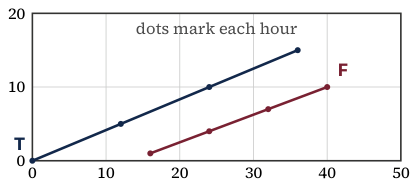
At 06{:}00 a trawler T is at the origin of a map and a ferry F is at (40,10), with distances in kilometres. The trawler moves with constant velocity (12,5) km h^{-1} and the ferry with constant velocity (-8,-3) km h^{-1}.
Original Photon diagram
(a) Find the velocity of F relative to T.
[2]
(b) Find the position of F relative to T at time t hours after 06{:}00, and show that the distance d km between the ships satisfies d^2=464t^2-1760t+1700.
[4]
(c) Find the time at which the ships are closest.
[3]
(d) Find the least distance between the ships.
[3]
(e) Find the times between which the ships are within 8 km of each other.
[4]
(f) A rule requires ships to stay at least 6 km apart. State, with a reason, whether the rule is broken.
[2]
(g) State two assumptions of the model.
[2]
Show solutionHide solution
(a) \begin{pmatrix}-8\\-3\end{pmatrix}-\begin{pmatrix}12\\5\end{pmatrix} [M1] =\begin{pmatrix}-20\\-8\end{pmatrix} km h^{-1} [A1].
(b) F relative to T at t=0 is \begin{pmatrix}40\\10\end{pmatrix} [M1]; at time t it is \begin{pmatrix}40-20t\\10-8t\end{pmatrix} [A1]; d^2=(40-20t)^2+(10-8t)^2 [M1]; =1600-1600t+400t^2+100-160t+64t^2 [A1], so d^2=464t^2-1760t+1700.
(c) \frac{\mathrm{d}}{\mathrm{d}t}(d^2)=928t-1760=0 [M1]; t=1.90 hours [A1]; the time is 07{:}54 [A1].
(d) d^2=464(1.8966)^2-1760(1.8966)+1700 [M1] =31.0 [A1]; d=5.57 km [A1].
(e) d^2<64: 464t^2-1760t+1636<0 [M1]; the roots are t=1.63 and t=2.16 [A1]; so between 07{:}38 and 08{:}10 [A1]; a duration of 32 minutes [A1].
(f) the least distance is 5.57 km [M1]; this is less than 6 km, so the rule is broken [R1].
(g) both ships keep a constant velocity, with no change of speed or course [R1]; each ship is treated as a point, so its length is ignored [R1].

Final answer

  • (a) (-20,-8)
  • (c) 1.90 h, 07{:}54
  • (d) 5.57 km
  • (e) 07{:}38 to 08{:}10
  • (f) broken, 5.57<6.

Investigation 6

[20 marks]
This question asks you to use vectors in three dimensions to describe a tent and its ropes.
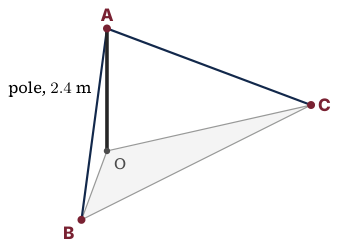
The top of a tent pole is at \mathrm{A}(0,0,2.4). Two guy ropes run in straight lines from A to pegs in the ground at \mathrm{B}(3,1,0) and \mathrm{C}(-2,3,0), with distances in metres. The ground is the plane z=0.
Original Photon diagram
(a) Write down the vectors \overrightarrow{\mathrm{AB}} and \overrightarrow{\mathrm{AC}}.
[2]
(b) Find the length of the rope AB.
[2]
(c) Find the angle between the rope AB and the ground.
[3]
(d) Use the scalar product to find angle \mathrm{BAC}.
[4]
(e) The canvas triangle ABC is flat. Use the vector product to find its area.
[3]
(f) Hence find the angle between the plane of the canvas triangle and the ground.
[4]
(g) State two assumptions the model makes about the ropes and the pole.
[2]
Show solutionHide solution
(a) \overrightarrow{\mathrm{AB}}=\begin{pmatrix}3\\1\\-2.4\end{pmatrix} [A1], \overrightarrow{\mathrm{AC}}=\begin{pmatrix}-2\\3\\-2.4\end{pmatrix} [A1].
(b) |\overrightarrow{\mathrm{AB}}|=\sqrt{9+1+5.76} [M1] =3.97 m [A1].
(c) the height of A above the ground is 2.4, so \sin\varphi=\frac{2.4}{3.970} [M1]; \sin\varphi=0.605 [A1]; \varphi=37.2^\circ [A1].
(d) \overrightarrow{\mathrm{AB}}\cdot\overrightarrow{\mathrm{AC}}=-6+3+5.76=2.76 [M1]; |\overrightarrow{\mathrm{AC}}|=\sqrt{18.76}=4.331 [A1]; \cos\mathrm{BAC}=\frac{2.76}{3.970\times4.331}=0.1605 [M1]; \mathrm{BAC}=80.8^\circ [A1].
(e) \overrightarrow{\mathrm{AB}}\times\overrightarrow{\mathrm{AC}} [M1] =\begin{pmatrix}4.8\\12\\11\end{pmatrix} [A1]; area =\frac12\sqrt{288.04}=8.49 m^2 [A1].
(f) the vector \mathbf{n}=(4.8,12,11) is perpendicular to the canvas, and \mathbf{k}=(0,0,1) is perpendicular to the ground [M1]; the angle between the planes is the angle between \mathbf{n} and \mathbf{k}: \cos\psi=\frac{11}{16.97} [M1]; \cos\psi=0.648 [A1]; \psi=49.6^\circ [A1].
(g) the ropes are straight and taut, so they do not sag [R1]; the pole is vertical and the ground is flat [R1].

Final answer

  • (b) 3.97 m
  • (c) 37.2^\circ
  • (d) 80.8^\circ
  • (e) 8.49 m^2
  • (f) 49.6^\circ.

Investigation 7

[16 marks]
This question asks you to find the shape of a fenced plot that needs the least fencing, and the shape that costs least.
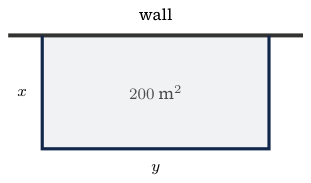
Mr Tan makes a rectangular vegetable plot against a long straight wall. He fences the other three sides: two sides of length x m perpendicular to the wall, and one side of length y m parallel to the wall. The plot has area 200 m^2.
Original Photon diagram
(a) Show that the length of fencing is L=2x+\dfrac{200}{x}.
[3]
(b) Find the value of x that minimises L, justify that it is a minimum, and state the least length of fencing and the value of y.
[5]
(c) The wall is only 15 m long, so y\le15. Find the least length of fencing now needed.
[3]
(d) Ignoring the wall length, the sides perpendicular to the wall cost 24 dollars per metre and the side parallel to the wall costs 18 dollars per metre. Find the dimensions that minimise the cost, and the least cost.
[5]
Show solutionHide solution
(a) area: xy=200 [M1]; y=\frac{200}{x} [A1]; fencing L=2x+y [M1], so L=2x+\frac{200}{x}.
(b) L'=2-\frac{200}{x^2} [M1]; L'=0 gives x^2=100 [M1]; x=10 m [A1]; L''=\frac{400}{x^3}>0, so a minimum [R1]; L=40 m and y=20 m [A1].
(c) y\le15 gives \frac{200}{x}\le15, so x\ge13.3 [M1]; L is increasing for x>10, so the least value is at x=13.3 [R1]; L=26.7+15=41.7 m [A1].
(d) cost K=2\times24x+18\times\frac{200}{x} [M1] =48x+\frac{3600}{x} [A1]; K'=48-\frac{3600}{x^2}=0 [M1]; x=8.66 m, with y=23.1 m [A1]; K=831 dollars [A1].

Final answer

  • (b) x=10, y=20, L=40 m
  • (c) 41.7 m
  • (d) x=8.66 m, y=23.1 m, 831 dollars.

Investigation 8

[24 marks]
This question asks you to find the cone of greatest volume that can be rolled from a circular sheet of paper.
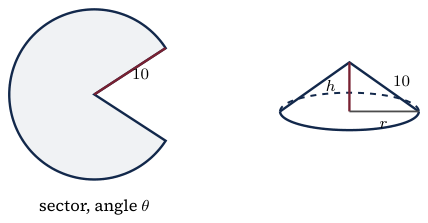
A paper cup is made by cutting a sector from a circular sheet of radius 10 cm and rolling it into a cone, with the straight edges of the sector joined. The cone has base radius r cm and vertical height h cm. The slant height is the radius of the sheet.
Original Photon diagram
(a) Show that r^2=100-h^2.
[2]
(b) Hence show that the cup holds V=\dfrac{\pi}{3}\left(100h-h^3\right) cm^3 when its height is h cm.
[2]
(c) Find \dfrac{\mathrm{d}V}{\mathrm{d}h}, and hence find the value of h for which V is stationary.
[4]
(d) Justify that this value of h gives a maximum.
[2]
(e) Find the greatest volume of the cup.
[2]
(f) Find the angle \theta of the sector, in radians and in degrees, that gives this cup.
[4]
(g) Find the percentage of the circular sheet that is used for the sector.
[2]
(h) A cup must hold at least 300 cm^3. Find the range of values of h for which this is possible.
[4]
(i) State two reasons why a real cup would hold less than the model predicts.
[2]
Show solutionHide solution
(a) the slant height is the radius of the sheet, so r^2+h^2=10^2 [A1], hence r^2=100-h^2 [A1].
(b) V=\frac13\pi r^2h [M1]; substitute r^2=100-h^2 [A1] to get V=\frac{\pi}{3}(100h-h^3).
(c) \frac{\mathrm{d}V}{\mathrm{d}h}=\frac{\pi}{3}(100-3h^2) [M1, A1]; =0 when h^2=\frac{100}{3} [M1]; h=5.77 cm [A1].
(d) \frac{\mathrm{d}^2V}{\mathrm{d}h^2}=\frac{\pi}{3}(-6h)=-2\pi h [M1]; this is negative for h>0, so a maximum [R1].
(e) V=\frac{\pi}{3}(100\times5.774-5.774^3) [M1] =403 cm^3 [A1].
(f) r=\sqrt{100-\frac{100}{3}}=8.16 cm [A1]; the arc length of the sector is the circumference of the base, so 10\theta=2\pi r [M1]; \theta=\frac{2\pi\times8.165}{10}=5.13 radians [A1]; 294^\circ [A1].
(g) fraction \frac{5.130}{2\pi} [M1] =81.6\% [A1].
(h) solve \frac{\pi}{3}(100h-h^3)=300 on a GDC [M1]; h=3.19 [A1] and h=8.02 [A1]; the volume is at least 300 cm^3 for 3.19\le h\le8.02 [A1].
(i) the paper has thickness and the join overlaps, so the inside is smaller than the model [R1]; the rim is not perfectly circular and the cone is not perfectly rolled [R1].

Final answer

  • (c) h=5.77 cm
  • (e) 403 cm^3
  • (f) 5.13 rad, 294^\circ
  • (g) 81.6%
  • (h) 3.19\le h\le8.02.

Investigation 9

[23 marks]
This question asks you to find the speed that makes a river trip cheapest, and then the cheapest speed that meets a timetable.
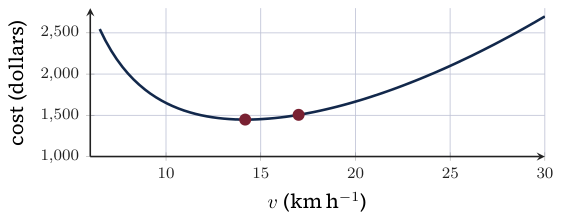
A barge must travel 120 km upstream against a current of 2 km h^{-1}. At speed v km h^{-1} through the water, with v>2, the fuel costs 0.02v^3 dollars per hour, and the crew costs 90 dollars per hour.
Original Photon diagram
(a) Show that the cost of the trip is C=\dfrac{120\left(0.02v^3+90\right)}{v-2} dollars.
[3]
(b) Find the cost when v=10 and when v=15.
[2]
(c) Show that \dfrac{\mathrm{d}C}{\mathrm{d}v}=0 leads to v^3-3v^2-2250=0.
[5]
(d) Solve this equation for v>2.
[2]
(e) Justify that this value of v gives a minimum cost.
[2]
(f) Find the least cost and the time the trip takes at this speed.
[3]
(g) The company wants the trip to take at most 8 hours. Find the cheapest way to meet this, and its cost.
[4]
(h) State one limitation of the cost model.
[2]
Show solutionHide solution
(a) speed over the ground is v-2, so the time is \frac{120}{v-2} hours [M1]; cost per hour is 0.02v^3+90 [A1]; C=\text{time}\times\text{cost per hour}=\frac{120(0.02v^3+90)}{v-2} [M1].
(b) C(10)=\frac{120\times110}{8}=1650 dollars [A1]; C(15)=\frac{120\times157.5}{13}=1454 dollars [A1].
(c) quotient rule: C'=120\,\frac{0.06v^2(v-2)-(0.02v^3+90)}{(v-2)^2} [M1, A1]; numerator =0.04v^3-0.12v^2-90 [A1]; the denominator is never zero for v>2, so C'=0 when 0.04v^3-0.12v^2-90=0 [R1]; multiply by 25 to get v^3-3v^2-2250=0 [A1].
(d) solve on a GDC [M1]; v=14.2 km h^{-1} [A1].
(e) C' is negative for v just below 14.2 and positive just above, for example C(10)>C(14.2)<C(17) [M1]; so the stationary point is a minimum [R1].
(f) C=1450 dollars [A1]; time \frac{120}{14.18-2}=9.85 hours [M1, A1].
(g) \frac{120}{v-2}\le8 gives v\ge17 [M1]; the minimum of C is at 14.2<17, so C is increasing for v\ge17 [R1]; the cheapest allowed speed is v=17 km h^{-1} [A1]; C(17)=1506 dollars [A1].
(h) for example, the fuel cost is not exactly proportional to v^3 [R1]; the current and the crew rate change along the river and through the day [R1].

Final answer

  • (b) 1650 and 1454 dollars
  • (d) v=14.2 km h^{-1}
  • (f) 1450 dollars, 9.85 h
  • (g) v=17 km h^{-1}, 1506 dollars.

Going further

Beyond the syllabus: the worked examples and investigations of the chapter's Going further pages.

Investigation

[26 marks]
Worked investigation 1: Docks for a bike-share scheme.
This question asks you to divide a town between bike-share docks using a Voronoi diagram, and to judge where to add a dock.
A town occupies the rectangle 0\le x\le10, 0\le y\le8, with distances in kilometres. Bike docks are at \mathrm{A}(2,2), \mathrm{B}(8,2) and \mathrm{C}(5,6). Riders return bikes to the nearest dock.
(a) State an equation of the line of points that are equally far from A and B.
[1]
(b) Show that the perpendicular bisector of AC has equation 3x+4y=26.5.
[3]
(c) Find an equation of the line of points that are equally far from B and C.
[2]
(d) Find the coordinates of the vertex \mathrm{V} of the Voronoi diagram, and verify that it is equidistant from A, B and C.
[4]
(e) Sketch the Voronoi diagram inside the town.
[2]
(f) Find the area of each cell inside the town.
[4]
(g) A rider finishes at (7,5). State which dock the rider should use, and find the distance to it.
[2]
(h) A fourth dock is planned at \mathrm{D}(9,7). Find the area of the cell of D, and state which existing cells lose area and by how much.
[5]
(i) State the assumption about distance that the diagram makes, and give two reasons why riders might not use the dock that the diagram assigns to them.
[3]
Show solutionHide solution
(a) x=5 [A1]
(b) midpoint of AC is (3.5,\,4) [M1]
gradient of AC is \dfrac{6-2}{5-2}=\dfrac43, so the perpendicular gradient is -\dfrac34 [M1]
y-4=-\dfrac34(x-3.5) [A1]
3x+4y=26.5 [AG]
(c) midpoint of BC is (6.5,\,4); gradient of BC is -\dfrac43, so the perpendicular gradient is \dfrac34 [M1]
y-4=\dfrac34(x-6.5), that is 3x-4y=3.5 [A1]
(d) put x=5 into 3x+4y=26.5 [M1]
\mathrm{V}=(5,\,2.875) [A1]
\mathrm{VA}^2=3^2+0.875^2=9.766 and \mathrm{VC}^2=0^2+3.125^2=9.766 [M1]
\mathrm{VA}=\mathrm{VB}=\mathrm{VC}=3.125 km [A1]
(e) three segments meet at \mathrm{V}: one down to (5,0), two going up [A1]
the other two end on the boundary at (0,\,6.625) and (10,\,6.625) [A1]
(f) cell A has vertices (0,0), (5,0), (5,\,2.875), (0,\,6.625) [M1]
area =\dfrac12(6.625+2.875)\times5 [M1]
A =23.75 km^2, and B =23.75 km^2 by symmetry [A1]
C =80-2\times23.75=32.5 km^2 [A1]
(g) squared distances from (7,5): A 34, B 10, C 5 [M1]
dock C, at distance \sqrt5=2.24 km [A1]
(h) bisector of CD: 8x+2y=69; bisector of BD: x+5y=31 [M1]
these meet at \mathrm{W}(7.45,\,4.71); the other ends are (6.625,\,8) and (10,\,4.2) [A1]
shoelace formula on (7.447,\,4.711), (10,\,4.2), (10,\,8), (6.625,\,8) [M1]
cell D has area 10.4 km^2 [A1]
B loses 3.10 km^2 and C loses 7.31 km^2; A is unchanged [A1]
(i) the diagram uses straight-line distance [R1]
riders follow roads, one-way streets or paths, so the nearest dock by road may be a different dock [R1]
the nearest dock may be full or empty, so a rider goes to another one [R1]

Final answer

  • (a) x=5
  • (d) \mathrm{V}=(5,\,2.875), 3.125 km from each dock
  • (f) A 23.75, B 23.75, C 32.5 km^2
  • (g) dock C, 2.24 km
  • (h) D 10.4 km^2, B loses 3.10, C loses 7.31.

Investigation

[26 marks]
Worked investigation 2: A chocolate prism.
This question asks you to find the dimensions of a box that uses the least card, and then the least cost.
A chocolate box is a prism whose cross-section is an equilateral triangle of side x cm, and whose length is l cm. The volume of the box is 500\ \mathrm{cm}^3.
(a) Show that l=\dfrac{2000}{\sqrt3\,x^2}.
[3]
(b) Show that the total surface area is S=\dfrac{\sqrt3}{2}x^2+\dfrac{6000}{\sqrt3\,x}.
[3]
(c) Find the value of x that minimises S, justify that it is a minimum, and find the corresponding l.
[5]
(d) Show that at the minimum l=\dfrac{x}{\sqrt3}, and comment on the shape of the box.
[3]
The two triangular ends are made of thick card costing 0.8 cents per \mathrm{cm}^2, and the three rectangular faces of thin card costing 0.5 cents per \mathrm{cm}^2.
(e) Find the dimensions that minimise the cost of card, and the minimum cost.
[6]
(f) The manufacturer, Ms Haddad, wants a box at least 12 cm long so that it fits a standard bar. Find the least cost with this restriction.
[4]
(g) Suggest two reasons why the shape found in (e) may not be chosen in practice.
[2]
Show solutionHide solution
(a) area of an end =\dfrac12x^2\sin60^\circ [M1]
=\dfrac{\sqrt3}{4}x^2 [A1]
volume: \dfrac{\sqrt3}{4}x^2\,l=500 [M1]
l=\dfrac{2000}{\sqrt3\,x^2} [AG]
(b) S=2\times\text{end}+3\times(x\times l) [M1]
ends: 2\times\dfrac{\sqrt3}{4}x^2=\dfrac{\sqrt3}{2}x^2 [A1]
rectangles: 3x\times\dfrac{2000}{\sqrt3x^2}=\dfrac{6000}{\sqrt3x} [M1]
S=\dfrac{\sqrt3}{2}x^2+\dfrac{6000}{\sqrt3\,x} [AG]
(c) S'(x)=\sqrt3\,x-\dfrac{6000}{\sqrt3\,x^2} [M1]
S'=0: \sqrt3\,x=\dfrac{6000}{\sqrt3\,x^2}, so 3x^3=6000 [M1]
x^3=2000, so x=12.6 cm [A1]
S''(x)=\sqrt3+\dfrac{12000}{\sqrt3\,x^3}>0 for x>0, so a minimum [R1]
l=\dfrac{2000}{\sqrt3\times12.6^2}=7.27 cm, and S=412 cm^2 [A1]
(d) at the minimum 2000=x^3 [M1]
l=\dfrac{x^3}{\sqrt3\,x^2} [M1]
l=\dfrac{x}{\sqrt3} [AG]
l=0.577x: the box is short compared with the side of its end, 7.27 cm against 12.6 cm [R1]
(e) cost of the ends: 0.8\times\dfrac{\sqrt3}{2}x^2=0.4\sqrt3\,x^2 [M1]
cost of the sides: 0.5\times\dfrac{6000}{\sqrt3x}=\dfrac{3000}{\sqrt3\,x} [M1]
C=0.4\sqrt3\,x^2+\dfrac{3000}{\sqrt3\,x} [A1]
C'=0.8\sqrt3\,x-\dfrac{3000}{\sqrt3\,x^2}=0, so 2.4x^3=3000 [M1]
x^3=1250: x=10.8 cm and l=\dfrac{2000}{\sqrt3\times10.8^2}=9.95 cm [A1]
C=241 cents, about 2.41 dollars [A1]
(f) l\ge12: \dfrac{2000}{\sqrt3\,x^2}\ge12 [M1]
x^2\le\dfrac{2000}{12\sqrt3}=96.2, so x\le9.81 [A1]
the minimum of C is at x=10.8>9.81, so C is decreasing for x\le9.81 and the least cost is at x=9.81 [R1]
C(9.81)=243 cents [A1]
(g) a triangular box is awkward to stack, pack or put on a shelf [R1]
the model ignores waste card and glue, and printing and cutting costs [R1]

Final answer

  • (c) x=12.6 cm, l=7.27 cm, S=412 cm^2
  • (e) x=10.8 cm, l=9.95 cm, 241 cents
  • (f) 243 cents.

From the book

Photon Guidebook: Mathematics HL Paper 3 for the IB Diploma

Chapter 14 teaches voronoi diagrams, vectors and optimal shapes: how the IB builds this kind of Paper 3 question, the techniques, marked worked investigations, and practice investigations like these.

About the book