Investigation 1
[16 marks]This question asks you to find the cheapest set of paths that links all the shelters in a nature park.
The park has shelters A to G, marked in the diagram. The possible paths and their lengths, in hundreds of metres, are AB 4, AC 7, BC 3, BD 6, CD 5, CE 8, DE 2, DF 9, EF 7, EG 6 and FG 4.
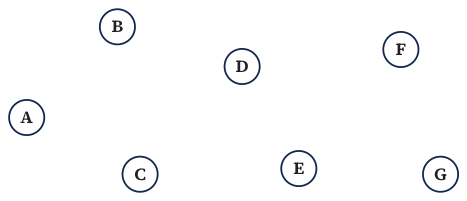
(a) Draw the network, labelling every path with its length.
[2]
(b) Use Kruskal's algorithm to find a minimum spanning tree, listing the edges in the order they are chosen.
[4]
(c) State the total length of the spanning tree.
[1]
(d) Resurfacing costs 30 dollars per metre. Find the cost of resurfacing only the paths in your tree.
[2]
(e) The path DE is closed. Find the new minimum spanning tree and the increase in cost.
[4]
(f) Explain why a minimum spanning tree is not a route a ranger could walk to visit every shelter.
[3]
Show solutionHide solution
(a) all seven shelters joined by the eleven paths [A1]; each path labelled with its length [A1].
(b) Kruskal: take the shortest remaining path that does not make a cycle [M1]; DE 2, BC 3 [A1]; AB 4 and FG 4, in either order [A1]; CD 5, then BD 6 is rejected (it makes a cycle), then EG 6 [A1].
(c) 2+3+4+4+5+6=24, that is 2400 m [A1].
(d) 2400\times30 [M1] =72\,000 dollars [A1].
(e) without DE, Kruskal gives BC 3, AB 4, FG 4, CD 5, EG 6, CE 8 [M1 A1]; total 30, that is 3000 m [A1]; the increase is 600 m, which costs 18 000 dollars [A1].
(f) a tree has no cycle, so some shelters are dead ends [R1]; a ranger who walks to a dead end has to come back along the same path [R1]; so a walking route repeats paths and is longer than the tree [R1].
Final answer
- (b) DE 2, BC 3, AB 4, FG 4, CD 5, EG 6
- (c) 24, that is 2400 m
- (d) 72 000 dollars
- (e) BC, AB, FG, CD, EG, CE: 3000 m, an increase of 600 m, 18 000 dollars
- (f) a tree has dead ends, so a walk repeats paths.