Free worked solutions · 2026 Edition

IB Maths HL Paper 3 Chapter 11: Coupled systems, Euler and phase portraits worked solutions

Worked solutions to the investigations in Chapter 11 of Photon Guidebook: Mathematics HL Paper 3 for the IB Diploma (2026 Edition). Each solution shows every step with the mark it earns, the way an IB mark scheme does.

  • Chapter 11 of 18
  • 8 practice questions
  • 2 Going further
  • Free, no sign-up

Investigations

The practice investigations of the chapter, each with its full worked solution and mark scheme.

Investigation 1

[16 marks]
This question asks you to classify linear systems from their eigenvalues and sketch their phase portraits.
For each system \dot{\mathbf{x}} = M\mathbf{x} below, find the eigenvalues, describe the equilibrium at the origin and sketch the phase portrait. The arrows show the direction of motion at a grid of points; copy each picture and add trajectories.
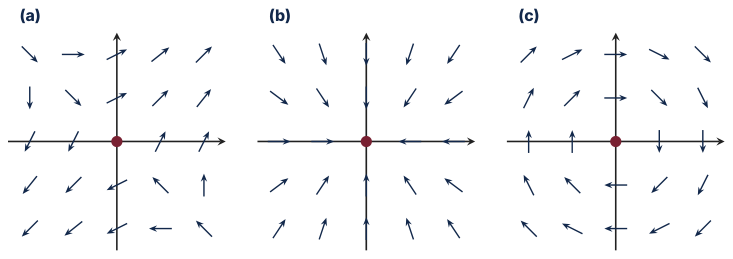
Original Photon diagram
(a) M = \begin{pmatrix} 1 & 2 \\ 2 & 1 \end{pmatrix}
[6]
(b) M = \begin{pmatrix} -2 & 0 \\ 0 & -3 \end{pmatrix}
[4]
(c) M = \begin{pmatrix} 0 & 2 \\ -2 & 0 \end{pmatrix}
[4]
(d) For system (a), describe what happens to a trajectory that starts at (1, -1).
[2]
Show solutionHide solution
(a) (1-\lambda)^2-4=0 [M1]; \lambda=3 and \lambda=-1 [A1]; solve (M-\lambda I)\mathbf{v}=\mathbf{0} [M1]: (1,1) and (1,-1) [A1]; eigenvalues of opposite sign, so a saddle [A1]; sketch with the lines y=x and y=-x, arrows away from the origin along y=x and towards it along y=-x, curved trajectories between them [A1].
(b) \lambda=-2 and \lambda=-3, with eigenvectors along the axes [A1]; both negative: a stable node [A1]; every trajectory moves in towards the origin [A1]; near the origin they are tangent to the x-axis, the slow direction \lambda=-2 [A1].
(c) \lambda^2+4=0 [M1]; \lambda=\pm2i [A1]; purely imaginary: a centre, with closed loops (circles) [A1]; at (1,0), \dot y=-2<0, so clockwise [A1].
(d) M(1,-1)^T=(-1,1)^T=-1\times(1,-1)^T, so (1,-1) is an eigenvector with \lambda=-1 [M1]; the trajectory stays on the line y=-x and moves in towards the origin [A1].

Final answer

  • (a) 3 with (1,1), −1 with (1,-1): saddle
  • (b) −2, −3: stable node
  • (c) \pm2i: centre, clockwise
  • (d) it stays on y=-x and moves into the origin.

Investigation 2

[18 marks]
This question asks you to model a medicine that is absorbed from the gut into the blood and then removed.
A patient swallows a 100 mg dose. Let x mg be the amount in the gut and y mg the amount in the blood after t hours. They are modelled by \dfrac{dx}{dt}=-0.5x and \dfrac{dy}{dt}=0.5x-0.2y, with x=100 and y=0 at t=0.
Original Photon diagram
(a) Explain why the equation for x has no term in y, and what the term 0.5x means in the equation for y.
[2]
(b) Find the eigenvalues of the matrix of the system, and an eigenvector for each.
[4]
(c) Find the general solution, and the solution for the given initial values.
[3]
(d) Complete an Euler table with step 1 hour from t=0 to t=3, giving x and y at each time.
[4]
(e) Find the time at which the amount in the blood is greatest, and find that amount.
[3]
(f) Give one reason why the model may be too simple for a real tablet.
[2]
Show solutionHide solution
(a) nothing returns from the blood to the gut, so \dot x depends on x only [R1]; 0.5x is the amount absorbed per hour, a gain for the blood and the loss from the gut [R1].
(b) (-0.5-\lambda)(-0.2-\lambda)=0 [M1]; \lambda=-0.5 and \lambda=-0.2 [A1]; solve (M-\lambda I)\mathbf{v}=\mathbf{0} [M1]: (3,-5) for −0.5 and (0,1) for −0.2 [A1].
(c) \mathbf{x}=\alpha e^{-0.5t}\binom{3}{-5}+\beta e^{-0.2t}\binom{0}{1} [A1]; 3\alpha=100 and -5\alpha+\beta=0 [M1]; x=100e^{-0.5t}, y=\tfrac{500}{3}\left(e^{-0.2t}-e^{-0.5t}\right) [A1].
(d) each new row uses the slopes of the row above [M1]; t=1: (50,50) [A1]; t=2: (25,65) [A1]; t=3: (12.5,64.5) [A1].
(e) \dot y=\tfrac{500}{3}\left(-0.2e^{-0.2t}+0.5e^{-0.5t}\right)=0 [M1]; e^{0.3t}=2.5, so t=\dfrac{\ln2.5}{0.3}=3.05 hours [A1]; y=54.3 mg [A1].
(f) for example, a tablet dissolves over time rather than being absorbed at a rate proportional to what is left [R1]; the removal rate of a real drug can depend on the patient's body and on other medicines, so 0.2 would not be fixed [R1].

Final answer

  • (b) −0.5 with (3,-5), −0.2 with (0,1)
  • (c) x=100e^{-0.5t}, y=\frac{500}{3}(e^{-0.2t}-e^{-0.5t})
  • (d) (50,50), (25,65), (12.5,64.5)
  • (e) t=3.05 hours, 54.3 mg.

Investigation 3

[22 marks]
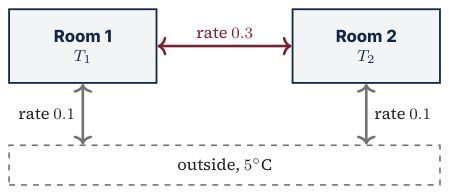
This question asks you to model heat flowing between two rooms and out of the house.
Two rooms are at temperatures T_1 and T_2 (^\circC) on a night when the outside temperature is 5^\circC. With t in hours, \dfrac{dT_1}{dt} = -0.3(T_1 - T_2) - 0.1(T_1 - 5) and \dfrac{dT_2}{dt} = -0.3(T_2 - T_1) - 0.1(T_2 - 5). At t = 0, T_1 = 25 and T_2 = 15.
Original Photon diagram
(a) Explain the meaning of the two terms in \dfrac{dT_1}{dt}.
[2]
(b) Let u_1 = T_1 - 5 and u_2 = T_2 - 5. Show that \dot{\mathbf{u}} = \begin{pmatrix} -0.4 & 0.3 \\ 0.3 & -0.4 \end{pmatrix}\mathbf{u}.
[3]
(c) Find the eigenvalues and eigenvectors and hence find T_1 and T_2 in terms of t.
[7]
(d) Find the time after which the two temperatures differ by less than 0.5^\circC.
[3]
(e) Find when the cooler room first falls below 12^\circC.
[3]
(f) Explain, using the eigenvalues, why the temperatures become equal long before they reach the outside temperature.
[2]
(g) Suggest one improvement to the model.
[2]
Show solutionHide solution
(a) -0.3(T_1-T_2): heat passes to room 2 at a rate proportional to how much warmer room 1 is [R1]; -0.1(T_1-5): heat is lost to the outside at a rate proportional to the difference from 5^\circC [R1].
(b) substitute T_1=u_1+5 and T_2=u_2+5 [M1]; \dot u_1=-0.3(u_1-u_2)-0.1u_1=-0.4u_1+0.3u_2 [A1]; \dot u_2=-0.3(u_2-u_1)-0.1u_2=0.3u_1-0.4u_2 [A1]; the matrix form is the required result [AG].
(c) (-0.4-\lambda)^2-0.09=0 [M1]; \lambda=-0.1 and \lambda=-0.7 [A1]; solve (M-\lambda I)\mathbf{v}=\mathbf{0} [M1]: (1,1) and (1,-1) [A1]; \mathbf{u}=\alpha e^{-0.1t}(1,1)+\beta e^{-0.7t}(1,-1) [A1]; u(0)=(20,10) gives \alpha+\beta=20, \alpha-\beta=10 [M1]; T_1=5+15e^{-0.1t}+5e^{-0.7t} and T_2=5+15e^{-0.1t}-5e^{-0.7t} [A1].
(d) T_1-T_2=10e^{-0.7t} [M1]; 10e^{-0.7t}<0.5 [A1]; t>\dfrac{\ln20}{0.7}=4.28 hours [A1].
(e) T_2=12 [M1]; 15e^{-0.1t}-5e^{-0.7t}=7 [A1]; t=7.59 hours [A1].
(f) the difference decays like e^{-0.7t}, seven times faster in the exponent than the average, which decays like e^{-0.1t} [R1]; so after a few hours only the slow term remains, with both rooms at the same temperature, still above 5^\circC [R1].
(g) for example, let the outside temperature change during the night [R1]; or let the heat loss of each room differ, since a room with more windows loses heat faster [R1].

Final answer

  • (c) −0.1 with (1,1), −0.7 with (1,-1); T_1=5+15e^{-0.1t}+5e^{-0.7t}, T_2=5+15e^{-0.1t}-5e^{-0.7t}
  • (d) 4.28 hours
  • (e) 7.59 hours.

Investigation 4

[22 marks]
This question asks you to model two species that each depend on the other, and to describe the long-term outcome.
On an island, x hundred clover plants and y hundred bumblebees change over t years according to \dfrac{dx}{dt}=-0.2x+0.5y and \dfrac{dy}{dt}=0.4x-0.3y. At t=0, x=9 and y=0.
Original Photon diagram
(a) Explain why the diagonal entries of the matrix of the system are negative and the other entries positive.
[2]
(b) Write the system as \dot{\mathbf{x}}=M\mathbf{x}. Find the eigenvalues of M and an eigenvector for each.
[5]
(c) Find the solution for the given initial values.
[4]
(d) Classify the equilibrium at the origin, and find the limit of y/x as t\to\infty.
[2]
(e) Find the time at which y first reaches 3, and the value of x then.
[3]
(f) Sketch the phase portrait, showing both eigenvector lines and the trajectory from (9,0).
[3]
(g) State two limitations of this model for the long term.
[3]
Show solutionHide solution
(a) each species dies off without the other, so its own coefficient is negative [R1]; each species helps the other to increase, so the coefficient of the other variable is positive [R1].
(b) M=\begin{pmatrix}-0.2&0.5\\0.4&-0.3\end{pmatrix} [A1]; (-0.2-\lambda)(-0.3-\lambda)-0.2=0, that is \lambda^2+0.5\lambda-0.14=0 [M1]; \lambda=0.2 and \lambda=-0.7 [A1]; solve (M-\lambda I)\mathbf{v}=\mathbf{0} [M1]; (5,4) for 0.2 and (1,-1) for −0.7 [A1].
(c) \mathbf{x}=\alpha e^{0.2t}(5,4)+\beta e^{-0.7t}(1,-1) [A1]; 5\alpha+\beta=9 and 4\alpha-\beta=0 [M1]; \alpha=1, \beta=4 [A1]; x=5e^{0.2t}+4e^{-0.7t} and y=4e^{0.2t}-4e^{-0.7t} [A1].
(d) eigenvalues of opposite sign: a saddle [R1]; the e^{0.2t} terms dominate, so y/x\to\frac45=0.8 [A1].
(e) 4e^{0.2t}-4e^{-0.7t}=3 [M1]; t=1.04 years [A1]; x=8.09 [A1].
(f) dashed lines y=0.8x and y=-x [A1]; arrows away from the origin along y=0.8x and towards it along y=-x [A1]; the trajectory from (9,0) moves up and to the right and bends to follow y=0.8x [A1].
(g) growth at 20% a year for ever means unlimited populations [R1]; real populations are limited by space, nectar and other species, so the model holds only for small populations [R1]; the model gives no way for either species to die out from a positive start, although a bad winter could cause it [R1].

Final answer

  • (b) 0.2 with (5,4), −0.7 with (1,-1)
  • (c) x=5e^{0.2t}+4e^{-0.7t}, y=4e^{0.2t}-4e^{-0.7t}
  • (d) saddle, y/x\to0.8
  • (e) t=1.04 years, x=8.09.

Investigation 5

[24 marks]
This question asks you to find and classify the equilibria of a non-linear model for two fish species.
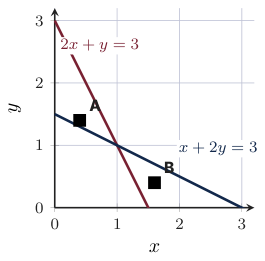
The populations x and y (in thousands) of perch and roach in a lake satisfy \dfrac{dx}{dt}=x(3-2x-y) and \dfrac{dy}{dt}=y(3-x-2y), where t is in years. The lines on which \dot x=0 (claret) and \dot y=0 (navy) are drawn, with two starting points A and B.
Original Photon diagram
(a) Find the four equilibrium points.
[3]
(b) Show that the Jacobian matrix is \begin{pmatrix}3-4x-y&-x\\-y&3-x-4y\end{pmatrix}.
[3]
(c) Classify the equilibrium at (1,1).
[4]
(d) Classify the equilibria at (0,0) and (1.5,0).
[4]
(e) Starting at A, (0.4,1.4), apply two Euler steps of length 0.1 to estimate the populations.
[3]
(f) Describe the long-term outcome from A and from B, (1.6,0.4).
[4]
(g) Explain, using the coefficients, why this model predicts that the two species coexist.
[3]
Show solutionHide solution
(a) x=0 or 3-2x-y=0, and y=0 or 3-x-2y=0 [M1]; (0,0), (1.5,0), (0,1.5) [A1]; (1,1) [A1].
(b) write \dot x=3x-2x^2-xy and \dot y=3y-xy-2y^2 [M1]; \dfrac{\partial\dot x}{\partial x}=3-4x-y and \dfrac{\partial\dot x}{\partial y}=-x [A1]; \dfrac{\partial\dot y}{\partial x}=-y and \dfrac{\partial\dot y}{\partial y}=3-x-4y [A1].
(c) at (1,1) the Jacobian is \begin{pmatrix}-2&-1\\-1&-2\end{pmatrix} [M1]; (-2-\lambda)^2-1=0 [M1]; \lambda=-1 and \lambda=-3 [A1]; both negative: a stable node [R1].
(d) at (0,0) the Jacobian is \begin{pmatrix}3&0\\0&3\end{pmatrix}, so \lambda=3,3 [A1]; positive: an unstable node [R1]; at (1.5,0) it is \begin{pmatrix}-3&-1.5\\0&1.5\end{pmatrix}, so \lambda=-3 and 1.5 [A1]; opposite signs: a saddle [R1].
(e) at A, \dot x=0.32 and \dot y=-0.28 [M1]; (0.432,1.372) [A1]; (0.465,1.348) [A1].
(f) (1,1) is the only stable equilibrium, and the others are unstable or saddles [R1]; trajectories from the positive quadrant cannot lie on the stable direction of a saddle on an axis [R1]; from A the populations approach (1,1) [A1]; from B they also approach (1,1) [A1].
(g) each species limits itself more strongly (coefficient 2) than it limits the other (coefficient 1) [R1]; so a species that becomes rare recovers, because its own crowding falls faster than the pressure from the other [R1]; neither species can exclude the other, so the coexistence point is a stable node [R1].

Final answer

  • (a) (0,0), (1.5,0), (0,1.5), (1,1)
  • (c) −1, −3: stable node
  • (d) unstable node; saddle
  • (e) (0.432,1.372), (0.465,1.348)
  • (f) both approach (1,1).

Investigation 6

[26 marks]
This question asks you to find the long-term outcome when two species of algae compete in a pond.
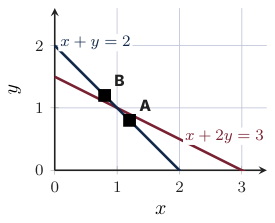
The biomasses x and y (in kg) of two species of algae satisfy \dfrac{dx}{dt}=x(3-x-2y) and \dfrac{dy}{dt}=y(2-x-y), with t in weeks. The lines on which \dot x=0 (claret) and \dot y=0 (navy) are drawn, with two starting points A and B.
Original Photon diagram
(a) Explain why each species on its own grows towards a limit, and state the limits.
[3]
(b) Find all four equilibrium points.
[4]
(c) The Jacobian matrix of the system at (x, y) is \begin{pmatrix} 3 - 2x - 2y & -2x \\ -y & 2 - x - 2y \end{pmatrix}. Classify the equilibrium at (1, 1).
[5]
(d) Classify the equilibria at (3, 0) and (0, 2).
[4]
(e) Starting from A, (1.2, 0.8), apply two Euler steps of length 0.1 to estimate the biomasses.
[3]
(f) Use your GDC, or the results of (c) and (d), to describe the long-term outcome from A and from B, (0.8, 1.2).
[4]
(g) Explain what this model predicts about the coexistence of the two species.
[3]
Show solutionHide solution
(a) with y=0, \dot x=x(3-x): positive for x<3 and negative for x>3, so x settles at 3 [R1]; the limit for x is 3 kg [A1]; with x=0, \dot y=y(2-y) and the limit for y is 2 kg [A1].
(b) x=0 or 3-x-2y=0, and y=0 or 2-x-y=0 [M1]; (0,0) [A1]; (3,0) and (0,2) [A1]; (1,1) [A1].
(c) the Jacobian at (1,1) is \begin{pmatrix}-1&-2\\-1&-1\end{pmatrix} [A1]; (-1-\lambda)^2-2=0 [M1]; \lambda=-1\pm\sqrt2 [A1]; \lambda=0.414 and \lambda=-2.41, opposite signs [A1]; a saddle, so the equilibrium is unstable [R1].
(d) at (3,0) the Jacobian is \begin{pmatrix}-3&-6\\0&-1\end{pmatrix}, so \lambda=-3,-1 [A1]; a stable node [A1]; at (0,2) it is \begin{pmatrix}-1&0\\-2&-2\end{pmatrix}, so \lambda=-1,-2 [A1]; a stable node [A1].
(e) at A, \dot x=0.24 and \dot y=0 [M1]; (1.224,0.8) [A1]; (1.2455,0.7981) [A1].
(f) the saddle at (1,1) separates the starting points: the stable direction of the saddle divides the basins of the two nodes [M1]; from A the biomasses approach (3,0), so x survives and y dies out [A1]; from B they approach (0,2), so y survives [A1]; a trajectory can only reach (1,1) by lying exactly on the saddle's stable direction [R1].
(g) the coexistence equilibrium is a saddle, so it is unstable [R1]; the model predicts that one species excludes the other [R1]; which species survives depends on the starting biomasses [R1].

Final answer

  • (a) limits 3 and 2
  • (b) (0,0), (3,0), (0,2), (1,1)
  • (c) -1\pm\sqrt2: saddle
  • (d) both stable nodes
  • (e) (1.224,0.8), (1.2455,0.7981)
  • (f) A to (3,0), B to (0,2)
  • (g) coexistence is unstable.

Investigation 7

[25 marks]
This question asks you to examine how Euler's method behaves on an oscillating system.
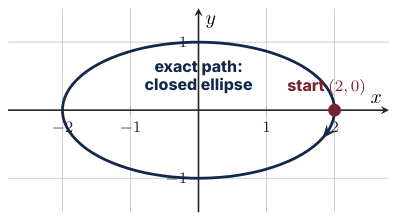
A buoy floats without friction in a calm sea. Its displacement x metres from the rest position and its velocity y metres per second satisfy \dot x=y and \dot y=-0.25x, with x=2 and y=0 at t=0. The graph shows the exact path in the (x,y) plane.
Original Photon diagram
(a) Show that the eigenvalues of the system are \pm0.5i, and state the period of the motion.
[3]
(b) Let E=\tfrac14x^2+y^2. Show that E is constant along every exact solution.
[3]
(c) Complete an Euler table with step 0.5 from t=0 to t=2, giving x and y to 3 significant figures.
[4]
(d) Find E at t=0.5 and at t=1 in your table.
[3]
(e) Euler's method with step h takes (x,y) to (x+hy,\,y-0.25hx). Show that E is multiplied by 1+\tfrac14h^2 at every step.
[4]
(f) Find the number of steps of length 0.5 after which E first exceeds twice its initial value, and the time that this takes.
[3]
(g) Explain what the results show about using Euler's method for this system.
[3]
(h) For a step of 0.1, find the factor by which E has grown when t=12.6.
[2]
Show solutionHide solution
(a) \lambda^2+0.25=0 [M1]; \lambda=\pm0.5i [A1]; a centre: the motion repeats with period \dfrac{2\pi}{0.5}=12.6 seconds [R1].
(b) \dfrac{dE}{dt}=\tfrac12x\dot x+2y\dot y [M1]; =\tfrac12xy+2y(-\tfrac14x)=0 [A1]; so E is constant, and the path is the ellipse \tfrac14x^2+y^2=1 [R1].
(c) each row uses the slopes from the row above [M1]; t=0.5: (2,-0.25) [A1]; t=1: (1.88,-0.5) [A1]; t=1.5: (1.63,-0.734) and t=2: (1.26,-0.938) [A1].
(d) E=\tfrac14(2)^2+(-0.25)^2 [M1]; E=1.0625 at t=0.5 [A1]; E=1.13 at t=1 [A1].
(e) E_{\text{new}}=\tfrac14(x+hy)^2+(y-\tfrac14hx)^2 [M1]; =\tfrac14x^2+\tfrac12hxy+\tfrac14h^2y^2+y^2-\tfrac12hxy+\tfrac1{16}h^2x^2 [A1]; the terms in hxy cancel, leaving E+\tfrac14h^2(y^2+\tfrac14x^2) [A1]; =\left(1+\tfrac14h^2\right)E, and for h=0.5 this is 1.0625, as in (d) [R1].
(f) E_n=1.0625^n\times E_0>2E_0 [M1]; n>\dfrac{\ln2}{\ln1.0625}=11.4 [A1]; 12 steps, so t=6 seconds [A1].
(g) the exact motion keeps E constant, but Euler's E grows at every step, so the computed path spirals outwards instead of repeating [R1]; a smaller step reduces the factor 1+\tfrac14h^2 [R1]; but the error still accumulates over many oscillations, so Euler's method is poor for long-term oscillations [R1].
(h) 126 steps, each multiplying E by 1+\tfrac14(0.1)^2=1.0025 [M1]; 1.0025^{126}=1.37 [A1].

Final answer

  • (a) \pm0.5i, period 12.6 s
  • (c) (2,-0.25), (1.88,-0.5), (1.63,-0.734), (1.26,-0.938)
  • (d) 1.0625, 1.13
  • (f) 12 steps, t=6 s
  • (h) 1.37.

Investigation 8

[26 marks]
This question asks you to model chlorine that is added to a pool, passes to a balance tank and is lost there.
A pool receives 6 g of chlorine per hour. The mass of chlorine in the pool is x g and in the balance tank is y g, after t hours, with \dfrac{dx}{dt}=6-0.5x and \dfrac{dy}{dt}=0.5x-0.25y. Initially x=0 and y=0.
Original Photon diagram
(a) Explain the terms 6 and 0.5x in the equations, and find the masses at which both x and y are unchanging.
[3]
(b) Let u=x-12 and v=y-24. Show that \dot u=-0.5u and \dot v=0.5u-0.25v, and find the eigenvalues of the matrix of this system.
[4]
(c) Find eigenvectors, and hence find x and y in terms of t.
[5]
(d) Complete an Euler table with step 1 hour from t=0 to t=3.
[4]
(e) Find the time at which the mass in the tank first reaches 20 g.
[4]
(f) Sketch the phase portrait of (x,y) for this start, marking the equilibrium.
[3]
(g) Find the times at which the pool and the tank first reach 90% of their equilibrium masses, and explain which is slower and why.
[3]
Show solutionHide solution
(a) 6 is the chlorine added each hour, and 0.5x is the amount passing from the pool to the tank each hour [R1]; both unchanging: 6-0.5x=0 and 0.5x-0.25y=0 [M1]; x=12 and y=24 [A1].
(b) substitute x=u+12 and y=v+24 [M1]; \dot u=6-0.5(u+12)=-0.5u [A1]; \dot v=0.5(u+12)-0.25(v+24)=0.5u-0.25v [A1]; the matrix \begin{pmatrix}-0.5&0\\0.5&-0.25\end{pmatrix} has eigenvalues −0.5 and −0.25 [A1].
(c) solve (M-\lambda I)\mathbf{v}=\mathbf{0} [M1]: (1,-2) for −0.5 and (0,1) for −0.25 [A1]; \binom{u}{v}=\alpha e^{-0.5t}\binom{1}{-2}+\beta e^{-0.25t}\binom{0}{1} [A1]; u(0)=-12 and v(0)=-24 give \alpha=-12 and \beta=-48 [M1]; x=12-12e^{-0.5t} and y=24+24e^{-0.5t}-48e^{-0.25t} [A1].
(d) each row uses the slopes from the row above [M1]; t=1: (6,0) [A1]; t=2: (9,3) [A1]; t=3: (10.5,6.75) [A1].
(e) with s=e^{-0.25t}: 24+24s^2-48s=20 [M1]; 6s^2-12s+1=0 [A1]; s=0.0871 or s=1.91, and s=1.91 is rejected because s\le1 [R1]; t=-4\ln0.0871=9.76 hours [A1].
(f) the equilibrium (12,24) marked [A1]; a trajectory from (0,0) moving up and to the right with an arrow towards (12,24) [A1]; it ends tangent to the vertical line x=12, the slow direction \lambda=-0.25 [A1].
(g) pool: 12e^{-0.5t}=1.2 gives t=2\ln10=4.61 hours [A1]; tank: y=21.6 gives t=11.9 hours [A1]; the tank is slower, because its approach is governed by the slower eigenvalue −0.25 and it must wait for the pool to fill [R1].

Final answer

  • (a) x=12, y=24
  • (c) x=12-12e^{-0.5t}, y=24+24e^{-0.5t}-48e^{-0.25t}
  • (d) (6,0), (9,3), (10.5,6.75)
  • (e) 9.76 hours
  • (g) 4.61 hours, 11.9 hours.

Going further

Beyond the syllabus: the worked examples and investigations of the chapter's Going further pages.

Investigation

[27 marks]
Worked investigation 1: Pollution in two connected lakes.
This question asks you to model how a pollutant moves between two lakes joined by streams and leaves the system.
After a spill, the masses of a pollutant, x tonnes in Lake Ardo and y tonnes in Lake Bryn, are modelled by \dfrac{dx}{dt} = -0.4x + 0.2y and \dfrac{dy}{dt} = 0.2x - 0.4y, where t is in years. Initially x = 10 and y = 2.
(a) Explain the meaning of the terms 0.2y and -0.4x in the first equation.
[2]
(b) Write the system in the form \dot{\mathbf{x}} = M\mathbf{x}, and find the eigenvalues of M and a corresponding eigenvector for each.
[5]
(c) Write down the general solution, and find the particular solution for these initial values.
[4]
(d) Use Euler's method with a step of 0.5 years to estimate x and y when t = 1, and compare with your solution.
[4]
(e) Find the time at which the mass of pollutant in Lake Bryn is greatest, and find that mass.
[4]
(f) Find the time after which the total mass of pollutant in both lakes is less than 1 tonne.
[2]
(g) Sketch the phase portrait, showing the trajectory from (10, 2) and the directions of the eigenvectors.
[4]
(h) Comment on one assumption of the model.
[2]
Show solutionHide solution
(a) 0.2y: pollutant flowing into Lake Ardo from Lake Bryn, 0.2 tonnes per year for each tonne in Bryn [R1]
-0.4x: pollutant leaving Ardo, 0.2 to Bryn and 0.2 out of the system, so 0.4 tonnes per year for each tonne in Ardo [R1]
(b) \dot{\mathbf{x}}=\begin{pmatrix}-0.4&0.2\\0.2&-0.4\end{pmatrix}\mathbf{x} [A1]
\det(M-\lambda I)=(-0.4-\lambda)^2-0.04=0 [M1]
-0.4-\lambda=\pm0.2, so \lambda=-0.2 and \lambda=-0.6 [A1]
for \lambda=-0.2: -0.2x+0.2y=0; for \lambda=-0.6: 0.2x+0.2y=0 [M1]
\lambda=-0.2 with \mathbf{v}=\begin{pmatrix}1\\1\end{pmatrix}; \lambda=-0.6 with \mathbf{v}=\begin{pmatrix}1\\-1\end{pmatrix} [A1]
(c) \mathbf{x}=\alpha e^{-0.2t}\begin{pmatrix}1\\1\end{pmatrix}+\beta e^{-0.6t}\begin{pmatrix}1\\-1\end{pmatrix} [A1]
at t=0: \alpha+\beta=10 and \alpha-\beta=2 [M1]
\alpha=6, \beta=4 [A1]
x=6e^{-0.2t}+4e^{-0.6t}, \;y=6e^{-0.2t}-4e^{-0.6t} [A1]
(d) x_1=10+0.5(-0.4\times10+0.2\times2)=8.2, \;y_1=2+0.5(0.2\times10-0.4\times2)=2.6 [M1 A1]
x_2=8.2+0.5(-3.28+0.52)=6.82, \;y_2=2.6+0.5(1.64-1.04)=2.9 [A1]
exact values x(1)=7.11, y(1)=2.72: Euler is 0.29 too low for x and 0.18 too high for y [R1]
(e) \dfrac{dy}{dt}=-1.2e^{-0.2t}+2.4e^{-0.6t}=0 [M1]
e^{0.4t}=2 [A1]
t=\dfrac{\ln2}{0.4}=1.73 years [A1]
y=6\cdot2^{-1/2}-4\cdot2^{-3/2}=2\sqrt2=2.83 tonnes [A1]
(f) x+y=12e^{-0.2t}<1 [M1]
t>5\ln12=12.4 years [A1]
(g) axes x and y, dashed lines y=x and y=-x through the origin [A1]
trajectory from (10,2) drawn into the origin, arrow towards the origin [A1]
the trajectory bends and arrives tangent to y=x [A1]
other trajectories also enter the origin, with arrows, along the line y=-x in towards the origin [A1]
(h) for example, the lakes are well mixed, so one rate describes each lake [R1]
flow rates change with the seasons, so in a wet season the pollutant would clear faster than predicted [R1]

Final answer

  • (b) -0.2 with (1,1), -0.6 with (1,-1)
  • (c) x=6e^{-0.2t}+4e^{-0.6t}, y=6e^{-0.2t}-4e^{-0.6t}
  • (d) (8.2,2.6), (6.82,2.9), exact (7.11,2.72)
  • (e) t=1.73 years, 2.83 tonnes
  • (f) 12.4 years.

Investigation

[26 marks]
Worked investigation 2: Two hormones that overshoot.
This question asks you to model two hormone levels that push each other back towards normal.
After a meal, the deviations of two hormone levels from their normal values, x and y (in suitable units), satisfy \dfrac{dx}{dt} = -y and \dfrac{dy}{dt} = 0.5x - 0.2y, where t is in hours. At t = 0, x = 2 and y = 0.
(a) Find the rates of change of x and y at t = 0, and interpret them.
[2]
(b) Show that the eigenvalues of the matrix of the system are -0.1 \pm 0.7i.
[4]
(c) Describe the behaviour of the levels near normal, and state the time taken for one full oscillation.
[3]
(d) Find the time for the size of the oscillations to halve.
[3]
(e) Taking two Euler steps of length 0.1, estimate x and y at t = 0.2.
[4]
(f) Sketch the phase portrait, showing the direction of rotation.
[3]
(g) Find the general solution for x in the form x = e^{-0.1t}(A\cos 0.7t + B\sin 0.7t), and find A and B.
[5]
(h) Suggest one reason why a real body may not behave like this model.
[2]
Show solutionHide solution
(a) at t=0: \dot x=-0=0 and \dot y=0.5\times2-0.2\times0=1 [A1]
x is momentarily unchanging (at its largest deviation), while y is rising at 1 unit per hour [R1]
(b) \det(M-\lambda I)=\begin{vmatrix}-\lambda&-1\\0.5&-0.2-\lambda\end{vmatrix}=0 [M1]
\lambda^2+0.2\lambda+0.5=0 [A1]
\lambda=\dfrac{-0.2\pm\sqrt{0.04-2}}{2} [M1]
\sqrt{-1.96}=1.4i, so \lambda=\dfrac{-0.2\pm1.4i}{2} [A1]
\lambda=-0.1\pm0.7i [AG]
(c) complex eigenvalues with negative real part: the levels oscillate with decreasing size, spiralling in to the normal values [R1]
period =\dfrac{2\pi}{0.7} [M1]
8.98 hours [A1]
(d) the size is multiplied by e^{-0.1t}, so e^{-0.1t}=\tfrac12 [M1]
t=10\ln2=6.93 hours [A1]
the size halves again after another 6.93 hours, as e^{-0.1t} multiplies both x and y [R1]
(e) x_1=2+0.1(0)=2, \;y_1=0+0.1(1)=0.1 [M1 A1]
\dot x=-0.1, \dot y=0.5\times2-0.2\times0.1=0.98; \;x_2=1.99, \;y_2=0.198 [M1 A1]
(f) spiral starting at (2,0) winding in towards the origin [A1]
arrows anticlockwise [A1]
each loop smaller than the last [A1]
(g) x(0)=2, so A=2 [M1 A1]
\dot x=e^{-0.1t}\big[(-0.1A+0.7B)\cos0.7t+(-0.1B-0.7A)\sin0.7t\big] [M1]
\dot x(0)=-y(0)=0, so -0.1(2)+0.7B=0 [M1]
B=\dfrac27=0.286 [A1]
(h) for example, other hormones and feedback are not included [R1]
a second meal would disturb the levels again, but the model settles for ever [R1]

Final answer

  • (a) 0 and 1
  • (b) \lambda^2+0.2\lambda+0.5=0
  • (c) stable spiral, period 8.98 hours
  • (d) 6.93 hours
  • (e) (2,0.1), (1.99,0.198)
  • (g) A=2, B=\frac27=0.286.

From the book

Photon Guidebook: Mathematics HL Paper 3 for the IB Diploma

Chapter 11 teaches coupled systems, euler and phase portraits: how the IB builds this kind of Paper 3 question, the techniques, marked worked investigations, and practice investigations like these.

About the book