Free worked solutions · 2026 Edition

IB Maths HL Paper 3 Chapter 10: One rate law, one differential equation worked solutions

Worked solutions to the investigations in Chapter 10 of Photon Guidebook: Mathematics HL Paper 3 for the IB Diploma (2026 Edition). Each solution shows every step with the mark it earns, the way an IB mark scheme does.

  • Chapter 10 of 18
  • 9 practice questions
  • 2 Going further
  • Free, no sign-up

Investigations

The practice investigations of the chapter, each with its full worked solution and mark scheme.

Investigation 1

[16 marks]
This question asks you to use Newton's law of cooling to plan when a loaf can be sliced.
A loaf leaves the oven at 200^\circC into a kitchen at 20^\circC. Its temperature T after t minutes satisfies \dfrac{\mathrm{d}T}{\mathrm{d}t}=-k(T-20), where k>0. After 10 minutes the loaf is at 140^\circC.
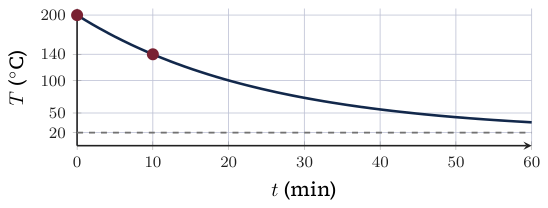
Original Photon diagram
(a) Show that T=20+180e^{-kt}.
[4]
(b) Find the value of k.
[3]
(c) The baker, Mrs Osei, slices bread when it reaches 50^\circC. Find when she can slice the loaf.
[3]
(d) Find the rate of cooling at that moment.
[2]
(e) Explain why the model may be less accurate for the first few minutes.
[2]
(f) State what the model predicts for very large t.
[2]
Show solutionHide solution
(a) \int\frac{\mathrm{d}T}{T-20}=-k\int\mathrm{d}t [M1]; \ln(T-20)=-kt+c [A1]; T=200 at t=0 gives c=\ln180 [M1]; T-20=180\mathrm{e}^{-kt} [A1], so T=20+180\mathrm{e}^{-kt}.
(b) 140=20+180\mathrm{e}^{-10k}, so \mathrm{e}^{-10k}=\frac23 [M1]; -10k=\ln\frac23 [A1]; k=0.0405 per minute [A1].
(c) 50=20+180\mathrm{e}^{-kt}, so \mathrm{e}^{-kt}=\frac16 [M1]; t=\ln6\div0.0405 [A1] =44.2 minutes [A1].
(d) \frac{\mathrm{d}T}{\mathrm{d}t}=-0.0405\times(50-20) [M1] =-1.22^\circC per minute [A1].
(e) the crust is much cooler than the centre at first, so the loaf has no single temperature [R1]; the law assumes one temperature for the whole loaf, which is only reasonable once heat has spread through it [R1].
(f) T\to20^\circC [A1]; the loaf ends at the temperature of the kitchen, the equilibrium of the law [R1].

Final answer

  • (b) k=0.0405 per minute
  • (c) 44.2 min
  • (d) -1.22^\circC per min
  • (f) T\to20^\circC.

Investigation 2

[20 marks]
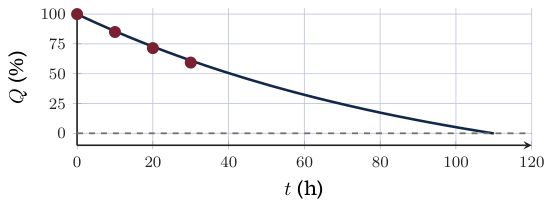
This question asks you to model the charge of a battery that powers a field sensor.
The charge Q (%) of a sensor's battery satisfies \dfrac{\mathrm{d}Q}{\mathrm{d}t}=-0.01Q-0.5, where t is in hours and Q=100 at t=0.
Original Photon diagram
(a) Explain the two terms on the right-hand side in context.
[2]
(b) Solve the equation.
[5]
(c) Find when the battery is empty.
[2]
(d) Use a step of 10 hours in Euler's method to estimate Q when t=30, and find the percentage error.
[5]
(e) The engineer, Kofi, wants the battery to last at least 150 hours. Find the greatest constant drain rate, in % per hour, that allows this, with the same self-discharge term.
[4]
(f) Comment on one assumption of the model.
[2]
Show solutionHide solution
(a) -0.01Q: the battery loses 1% of its remaining charge each hour by self-discharge [R1]; −0.5: the sensor draws a steady 0.5 percentage points per hour [R1].
(b) \frac{\mathrm{d}Q}{\mathrm{d}t}=-0.01(Q+50), so \int\frac{\mathrm{d}Q}{Q+50}=-0.01\int\mathrm{d}t [M1]; \ln(Q+50)=-0.01t+c [A1]; Q=100 at t=0 gives c=\ln150 [M1]; Q+50=150\mathrm{e}^{-0.01t} [A1]; Q=150\mathrm{e}^{-0.01t}-50 [A1].
(c) 150\mathrm{e}^{-0.01t}=50 [M1]; t=100\ln3=110 hours [A1].
(d) Q_{n+1}=Q_n+10(-0.01Q_n-0.5) [M1]; Q at 10, 20, 30 hours is 85, 71.5, 59.35, so Q(30)\approx59.4\% [A1]; exact value 150\mathrm{e}^{-0.3}-50=61.1\% [A1]; percentage error \frac{61.12-59.35}{61.12}\times100 [M1] =2.90\% [A1].
(e) with drain d: \frac{\mathrm{d}Q}{\mathrm{d}t}=-0.01Q-d, so Q=(100+100d)\mathrm{e}^{-0.01t}-100d [M1 A1]; Q=0 at t=150: (100+100d)\mathrm{e}^{-1.5}=100d [M1]; d=\dfrac{\mathrm{e}^{-1.5}}{1-\mathrm{e}^{-1.5}}=0.287\% per hour [A1].
(f) for example, the drain is constant, but a real sensor draws more power when it transmits [R1]; the self-discharge rate also changes with temperature [R1].

Final answer

  • (b) Q=150\mathrm{e}^{-0.01t}-50
  • (c) 110 h
  • (d) 59.4%, error 2.90%
  • (e) 0.287% per hour.

Investigation 3

[25 marks]
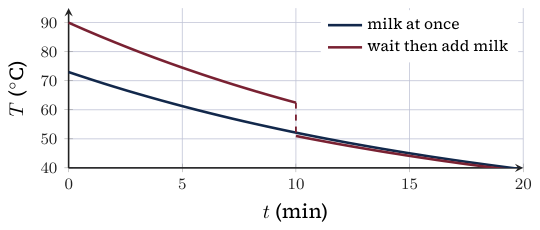
This question asks you to decide when to add cold milk to hot coffee so that the coffee is as cool as possible later.
Dev pours 200 mL of coffee at 90^\circC in a room at 20^\circC. He also has 50 mL of milk at 5^\circC. When liquids are mixed, the temperature of the mixture is the volume-weighted mean of their temperatures. The coffee, or the mixture, cools according to \dfrac{\mathrm{d}T}{\mathrm{d}t}=-0.05(T-20), with t in minutes. The milk stays at 5^\circC until it is used.
Original Photon diagram
(a) Dev adds the milk at once. Find the temperature of the mixture after 10 minutes.
[5]
(b) Dev instead waits 10 minutes and then adds the milk. Find the final temperature.
[5]
(c) State which method gives cooler coffee, and by how much.
[1]
(d) For coffee of volume a at temperature T_0, milk of volume b at temperature T_m<20 and a wait of t minutes, show that the second method gives a temperature lower than the first by \dfrac{b(20-T_m)\left(1-e^{-0.05t}\right)}{a+b}.
[8]
(e) Explain why the difference is zero when t=0 and increases with t.
[2]
(f) Explain what would change if the milk were at room temperature.
[2]
(g) Suggest one physical reason why the model is a simplification.
[2]
Show solutionHide solution
(a) mixture temperature \frac{200\times90+50\times5}{250} [M1] =73^\circC [A1]; for the mixture, T=20+(73-20)\mathrm{e}^{-0.05t} [M1], so T=20+53\mathrm{e}^{-0.05t} [A1]; at t=10, T=52.1^\circC [A1].
(b) coffee alone: T=20+(90-20)\mathrm{e}^{-0.05t} [M1], so T=20+70\mathrm{e}^{-0.05t} [A1]; at t=10, T=62.5^\circC [A1]; mixing, \frac{200\times62.46+50\times5}{250} [M1] =51.0^\circC [A1].
(c) the second method (waiting) is cooler, by 1.18^\circC [A1].
(d) write E=\mathrm{e}^{-0.05t}. First method: the mixture starts at \frac{aT_0+bT_m}{a+b} [M1], so T_1=20+\left(\frac{aT_0+bT_m}{a+b}-20\right)E [A1]. Second method: the coffee cools to 20+(T_0-20)E [M1 A1], then T_2=\frac{a\left(20+(T_0-20)E\right)+bT_m}{a+b} [M1 A1]. Subtract over the common denominator a+b: the terms in aT_0E and 20aE cancel [M1], leaving T_1-T_2=\frac{b(20-T_m)(1-E)}{a+b} [A1].
(e) at t=0, E=1, so the factor 1-E is zero [R1]; as t grows E falls, so 1-E rises towards 1 and the difference increases [R1].
(f) T_m=20 makes the factor 20-T_m zero, so the difference is zero [R1]; milk at room temperature neither warms nor cools relative to the room, so mixing early or late gives the same temperature [R1].
(g) for example, the cooling constant would depend on the surface area and volume of the drink, which change when milk is added [R1]; heat also leaves by evaporation, which is not proportional to the excess temperature [R1].

Final answer

  • (a) 73^\circC, then 52.1^\circC
  • (b) 62.5^\circC, then 51.0^\circC
  • (c) waiting, by 1.18^\circC
  • (f) no difference.

Investigation 4

[17 marks]
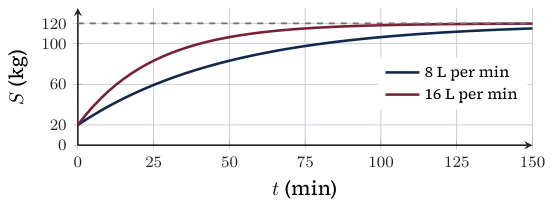
This question asks you to model the mass of sugar in a vat when syrup is pumped in and the mixture is pumped out.
A vat holds 400 litres of liquid throughout. Syrup containing 0.3 kg of sugar per litre is pumped in at 8 litres per minute. The liquid in the vat is kept well mixed, and the mixture leaves at 8 litres per minute. The mass of sugar in the vat is S kg at time t minutes, and S=20 at t=0.
Original Photon diagram
(a) Show that \dfrac{\mathrm{d}S}{\mathrm{d}t}=2.4-0.02S.
[3]
(b) Find the value of S at which the mass of sugar stops changing, and explain why this value is reasonable.
[2]
(c) Solve the differential equation to find S in terms of t.
[4]
(d) Find the time at which the vat holds 100 kg of sugar.
[2]
(e) Find the concentration of sugar, in kg per litre, after 30 minutes.
[2]
The pumps are changed so that both flows are 16 litres per minute, the vat still holding 400 litres.
(f) Find the time at which the vat now holds 100 kg of sugar.
[2]
(g) State two assumptions made in the model.
[2]
Show solutionHide solution
(a) sugar in: 8\times0.3=2.4 kg per minute [M1]; concentration in the vat is \frac{S}{400} kg per litre, so sugar out is 8\times\frac{S}{400}=0.02S [A1]; rate of change is in minus out, \frac{\mathrm{d}S}{\mathrm{d}t}=2.4-0.02S [A1].
(b) 2.4-0.02S=0 gives S=120 kg [A1]; this is 400\times0.3, so the vat ends with the concentration of the incoming syrup [R1].
(c) \frac{\mathrm{d}S}{\mathrm{d}t}=0.02(120-S), so \int\frac{\mathrm{d}S}{120-S}=0.02\int\mathrm{d}t [M1]; -\ln(120-S)=0.02t+c [A1]; S=20 at t=0 gives c=-\ln100 [M1]; S=120-100\mathrm{e}^{-0.02t} [A1].
(d) 100=120-100\mathrm{e}^{-0.02t} gives \mathrm{e}^{-0.02t}=0.2 [M1]; t=50\ln5=80.5 minutes [A1].
(e) S(30)=120-100\mathrm{e}^{-0.6}=65.1 kg [M1]; concentration 65.1\div400=0.163 kg per litre [A1].
(f) the new rate constant is \frac{16}{400}=0.04 and the inflow of sugar is 4.8, so S=120-100\mathrm{e}^{-0.04t} [M1]; t=25\ln5=40.2 minutes [A1].
(g) the liquid is mixed perfectly at once, so the concentration leaving equals the concentration in the vat [R1]; the volume stays at 400 litres and the flows are exactly constant [R1].

Final answer

  • (b) 120 kg
  • (c) S=120-100\mathrm{e}^{-0.02t}
  • (d) 80.5 min
  • (e) 0.163 kg per litre
  • (f) 40.2 min.

Investigation 5

[21 marks]
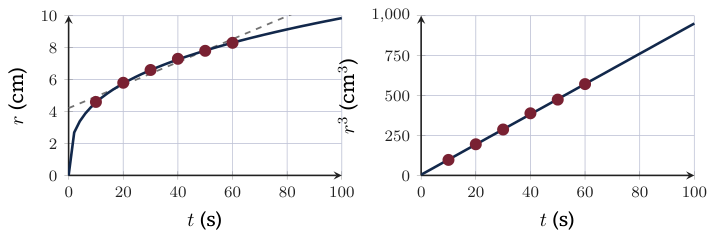
This question asks you to model the radius of a balloon that is filled at a steady rate, and to fit the model to measurements.
Zoe's balloon is a sphere, and air is pumped in at a constant 40 cm^3 per second. At time t seconds the radius is r cm and the volume is V cm^3, where V=\frac43\pi r^3. Zoe measures the radius every 10 seconds.
\begin{array}{|l|r|r|r|r|r|r|}\hline t\ \text{(s)} & 10 & 20 & 30 & 40 & 50 & 60\\\hline r\ \text{(cm)} & 4.6 & 5.8 & 6.6 & 7.3 & 7.8 & 8.3\\\hline r^3\ \text{(cm}^3) & 97.3 & 195.1 & 287.5 & 389.0 & 474.6 & 571.8\\\hline\end{array}
Original Photon diagram
(a) Show that \dfrac{\mathrm{d}r}{\mathrm{d}t}=\dfrac{10}{\pi r^2}.
[3]
(b) Solve this equation, given that r=0 when t=0, to show that r^3=\dfrac{30t}{\pi}.
[4]
(c) Find the time at which the radius reaches 12 cm.
[2]
(d) Find the equation of the least-squares line of r against t.
[2]
(e) The residuals for this line are −0.33, 0.15, 0.23, 0.21, −0.01, −0.23. Explain why a straight line is not a suitable model for r.
[2]
(f) Find the equation of the least-squares line of r^3 against t.
[2]
(g) Use the gradient in (f) to estimate the rate, in cm^3 per second, at which air is pumped in.
[2]
(h) Use your line in (f) to estimate the radius at t=90.
[2]
(i) Comment on the reliability of your estimate in (h).
[2]
Show solutionHide solution
(a) \frac{\mathrm{d}V}{\mathrm{d}r}=4\pi r^2 [M1]; \frac{\mathrm{d}V}{\mathrm{d}t}=\frac{\mathrm{d}V}{\mathrm{d}r}\times\frac{\mathrm{d}r}{\mathrm{d}t}, so 40=4\pi r^2\frac{\mathrm{d}r}{\mathrm{d}t} [M1]; \frac{\mathrm{d}r}{\mathrm{d}t}=\frac{10}{\pi r^2} [A1].
(b) \int r^2\,\mathrm{d}r=\int\frac{10}{\pi}\,\mathrm{d}t [M1]; \frac{r^3}{3}=\frac{10t}{\pi}+c [A1]; r=0 at t=0 gives c=0 [M1]; r^3=\frac{30t}{\pi} [A1].
(c) 12^3=\frac{30t}{\pi} [M1]; t=\frac{1728\pi}{30}=181 seconds [A1].
(d) r=4.21+0.0720t [A1 A1].
(e) the residuals are negative, then positive, then negative: a curved pattern, not a random scatter [R1]; the radius rises quickly at first and then more slowly, which a straight line cannot show [R1].
(f) r^3=4.63+9.46t [A1 A1].
(g) r^3=\frac{30}{\pi}t means V=\frac{4}{3}\pi r^3=\frac{4\pi}{3}\times\text{gradient}\times t [M1]; \frac{4\pi}{3}\times9.46=39.6 cm^3 per second [A1].
(h) r^3=4.63+9.46\times90=856 [M1]; r=9.50 cm [A1].
(i) t=90 is outside the data (10 to 60 seconds), so this is an extrapolation [R1]; as the rubber stretches the balloon needs more force, and it may burst, so a constant rate of filling may not continue [R1].

Final answer

  • (c) 181 s
  • (d) r=4.21+0.0720t
  • (f) r^3=4.63+9.46t
  • (g) 39.6 cm^3 per s
  • (h) 9.50 cm.

Investigation 6

[22 marks]
This question asks you to model the height of a cone of sand that grows as sand falls from a conveyor.
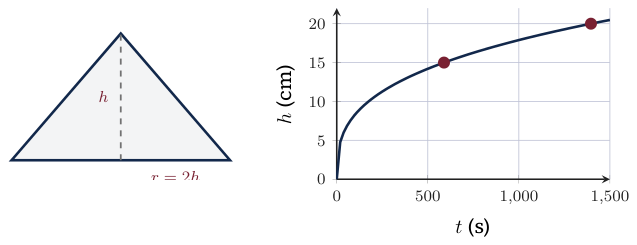
Sand falls from a conveyor at a constant 24 cm^3 per second and forms a cone whose base radius r cm is always twice its height h cm. At time t seconds the volume of sand is V cm^3. The pile is empty when t=0.
Original Photon diagram
(a) Show that V=\frac43\pi h^3.
[2]
(b) Show that \dfrac{\mathrm{d}h}{\mathrm{d}t}=\dfrac{6}{\pi h^2}.
[3]
(c) Find the rate at which the height is increasing when h=10.
[2]
(d) Solve the differential equation to show that h^3=\dfrac{18t}{\pi}.
[4]
(e) Find the time at which the pile is 15 cm high.
[2]
(f) Find the rate at which the base radius is increasing at that time.
[2]
(g) Explain why the height increases more and more slowly although the sand arrives at a constant rate.
[2]
The pile stands on a circular table of radius 40 cm.
(h) Find the time at which the base of the pile first reaches the edge of the table.
[3]
(i) Give one reason why the model may be inaccurate for a real pile of sand.
[2]
Show solutionHide solution
(a) V=\frac13\pi r^2h with r=2h [M1] gives V=\frac13\pi(4h^2)h=\frac43\pi h^3 [A1].
(b) \frac{\mathrm{d}V}{\mathrm{d}h}=4\pi h^2 [M1]; \frac{\mathrm{d}V}{\mathrm{d}t}=4\pi h^2\frac{\mathrm{d}h}{\mathrm{d}t}=24 [M1]; \frac{\mathrm{d}h}{\mathrm{d}t}=\frac{6}{\pi h^2} [A1].
(c) \frac{6}{\pi\times100} [M1] =0.0191 cm per second [A1].
(d) \int h^2\,\mathrm{d}h=\int\frac6\pi\,\mathrm{d}t [M1]; \frac{h^3}{3}=\frac{6t}{\pi}+c [A1]; h=0 at t=0 gives c=0 [M1]; h^3=\frac{18t}{\pi} [A1].
(e) 15^3=\frac{18t}{\pi} [M1]; t=\frac{3375\pi}{18}=589 seconds [A1].
(f) r=2h, so \frac{\mathrm{d}r}{\mathrm{d}t}=2\frac{\mathrm{d}h}{\mathrm{d}t}=\frac{12}{\pi h^2} [M1]; at h=15 this is 0.0170 cm per second [A1].
(g) the same volume of sand arrives each second [R1]; it has to cover a larger and larger cone, since the volume grows with h^3, so each second adds less height [R1].
(h) r=40 means h=20 [M1]; 20^3=\frac{18t}{\pi} [M1]; t=\frac{8000\pi}{18}=1400 seconds (1396) [A1].
(i) the slope of a real pile is set by the sand, and the sides slide when it is too steep, so r=2h may not hold throughout [R1]; sand falling from a height also bounces and scatters, so not all of it joins the pile [R1].

Final answer

  • (c) 0.0191 cm per s
  • (e) 589 s
  • (f) 0.0170 cm per s
  • (h) 1400 s (1396 s).

Investigation 7

[22 marks]
This question asks you to fit Newton's law of cooling to measurements by turning the curve into a straight line.
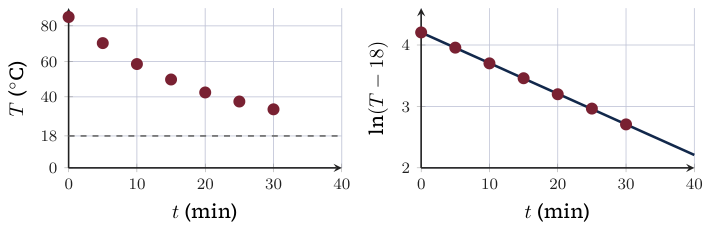
Neha makes hot chocolate in a room at 18^\circC. She measures its temperature T^\circC every 5 minutes, where t is the time in minutes after she made it.
\begin{array}{|l|r|r|r|r|r|r|r|}\hline t & 0 & 5 & 10 & 15 & 20 & 25 & 30\\\hline T & 85.0 & 70.3 & 58.5 & 49.8 & 42.5 & 37.4 & 33.0\\\hline\end{array}
Original Photon diagram
Neha assumes that \dfrac{\mathrm{d}T}{\mathrm{d}t}=-k(T-18), where k>0.
(a) Show that T=18+67e^{-kt}.
[4]
(b) Calculate \ln(T-18) for each value of t.
[2]
(c) Find the equation of the least-squares line of \ln(T-18) against t.
[2]
(d) Use your line to estimate k, and the value of T(0)-18 that the line suggests.
[2]
(e) Estimate the time at which the hot chocolate reaches 40^\circC.
[2]
(f) Explain why Neha plots \ln(T-18) rather than \ln T.
[2]
(g) Find the correlation coefficient for your line in (c), and say what it shows.
[2]
(h) Estimate the rate at which the hot chocolate is cooling when t=10.
[3]
Neha can drink the hot chocolate once it is at or below 55^\circC.
(i) Find when this happens, and give one reason why the model may be inaccurate.
[3]
Show solutionHide solution
(a) \int\frac{\mathrm{d}T}{T-18}=-k\int\mathrm{d}t [M1]; \ln(T-18)=-kt+c [A1]; T=85 at t=0 gives c=\ln67 [M1]; T-18=67\mathrm{e}^{-kt} [A1], so T=18+67\mathrm{e}^{-kt}.
(b) 4.20, 3.96, 3.70, 3.46, 3.20, 2.97, 2.71 [A1 A1], one mark for the first four values and one for the last three.
(c) \ln(T-18)=4.20-0.0498t [A1 A1].
(d) \ln(T-18)=-kt+\ln67, so k=0.0498 per minute [A1]; the intercept gives \mathrm{e}^{4.2038}=66.9, which agrees with 85-18=67 [A1].
(e) \ln22=4.2038-0.04983t [M1]; t=22.3 minutes [A1].
(f) the law makes the excess T-18 decay exponentially, so \ln(T-18) is linear in t [R1]; T itself decays to 18, not to zero, so \ln T is not linear in t [R1].
(g) r=-1.00 (−0.99995) [A1]; the points lie almost exactly on a line, so an exponential decay of the excess temperature fits well for 0\le t\le30 [R1].
(h) the model gives T(10)=18+66.9\mathrm{e}^{-0.498}=58.7 [M1], an excess of 40.7 [A1]; \frac{\mathrm{d}T}{\mathrm{d}t}=-0.0498\times40.7=-2.03^\circC per minute [A1].
(i) \ln37=4.2038-0.04983t [M1] gives t=11.9 minutes [A1]; for example, evaporation from the open surface cools the drink and is not part of the law, so the cooling rate is not proportional to the excess temperature alone [R1].

Final answer

  • (c) \ln(T-18)=4.20-0.0498t
  • (d) k=0.0498, 66.9
  • (e) 22.3 min
  • (g) r=-1.00
  • (h) -2.03^\circC per min
  • (i) 11.9 min.

Investigation 8

[26 marks]
This question asks you to analyse a model for how a rumour spreads, using an exact solution and Euler's method.
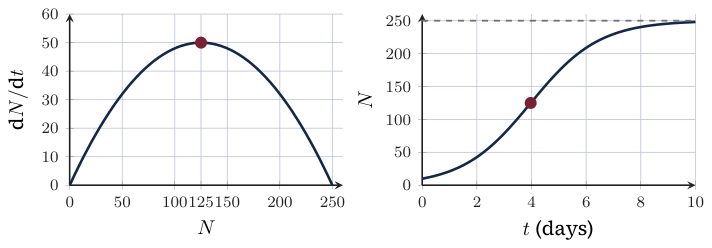
A school has 250 pupils. At time t days, N pupils have heard a rumour. Hana, a student, models the spread by \dfrac{\mathrm{d}N}{\mathrm{d}t}=0.8N\left(1-\dfrac{N}{250}\right), with N=10 when t=0.
Original Photon diagram
(a) Show that N=250 is an equilibrium of the model, and explain what it means.
[2]
(b) Find the rate at which the rumour is spreading when t=0.
[2]
(c) Use a step of 0.5 days in Euler's method to estimate N when t=1.5.
[4]
(d) Show that N=\dfrac{250}{1+24e^{-0.8t}} satisfies both the differential equation and the initial condition.
[5]
(e) Find the exact value of N at t=1.5 and the percentage error in your answer to (c).
[3]
(f) Find when half of the pupils have heard the rumour.
[2]
(g) Show that the rate of spread is greatest when N=125, and find that greatest rate.
[4]
(h) Find when 90% of the pupils will have heard the rumour.
[2]
(i) Give one reason why the model is unrealistic.
[2]
Show solutionHide solution
(a) when N=250, 1-\frac{N}{250}=0, so \frac{\mathrm{d}N}{\mathrm{d}t}=0 [A1]; every pupil has heard the rumour, so nobody is left to hear it and the number cannot change [R1].
(b) 0.8\times10\times\left(1-\frac{10}{250}\right) [M1] =7.68 pupils per day [A1].
(c) N_{n+1}=N_n+0.5\times0.8N_n\left(1-\frac{N_n}{250}\right) [M1]; N(0.5)=13.84 [A1]; N(1)=19.07 [A1]; N(1.5)\approx26.1 pupils [A1].
(d) N(0)=\frac{250}{1+24}=10 [A1]. Write E=\mathrm{e}^{-0.8t}. Then \frac{\mathrm{d}N}{\mathrm{d}t}=\frac{250\times24\times0.8E}{(1+24E)^2} [M1 A1]. Also 1-\frac N{250}=1-\frac1{1+24E}=\frac{24E}{1+24E}, so 0.8N\left(1-\frac N{250}\right)=0.8\times\frac{250}{1+24E}\times\frac{24E}{1+24E} [M1], which is the same expression [A1].
(e) N(1.5)=\frac{250}{1+24\mathrm{e}^{-1.2}}=30.4 [A1]; percentage error \frac{30.38-26.12}{30.38}\times100 [M1] =14.0\% [A1]; Euler underestimates here because the curve is bending upwards.
(f) \frac{250}{1+24E}=125 gives 24\mathrm{e}^{-0.8t}=1 [M1]; t=\frac{\ln24}{0.8}=3.97 days [A1].
(g) \frac{\mathrm{d}N}{\mathrm{d}t}=0.8N-\frac{0.8}{250}N^2, a quadratic in N, with derivative 0.8-\frac{1.6}{250}N [M1 A1]; this is zero at N=125, a maximum because the quadratic opens downwards [A1]; greatest rate 0.8\times125\times0.5=50 pupils per day [A1].
(h) N=225: 1+24\mathrm{e}^{-0.8t}=\frac{250}{225} [M1]; t=\frac{\ln216}{0.8}=6.72 days [A1].
(i) for example, the model assumes every pupil is equally likely to meet every other, but pupils talk in friend groups and year groups [R1]; it also ignores that a rumour loses interest and that absent pupils cannot hear it [R1].

Final answer

  • (b) 7.68 per day
  • (c) 26.1
  • (e) 30.4, error 14.0%
  • (f) 3.97 days
  • (g) 50 pupils per day
  • (h) 6.72 days.

Investigation 9

[26 marks]
This question asks you to model the phosphate in a lake, to test Euler's method against an exact solution, and to choose how much of the load a treatment plant must remove.
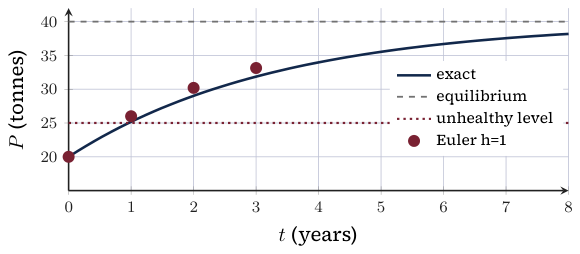
A lake receives 12 tonnes of phosphate per year from the farmland around it. Flushing removes phosphate at a rate of 0.3P tonnes per year, where P tonnes is the amount in the lake at time t years. At t=0, P=20. The lake becomes unhealthy if P exceeds 25.
Original Photon diagram
(a) Find the equilibrium level of phosphate, and explain what it means.
[3]
(b) Solve the differential equation for P in terms of t.
[4]
(c) Find when the lake holds 35 tonnes.
[2]
(d) Find when the lake first becomes unhealthy.
[2]
A treatment plant removes a fraction x of the 12 tonnes per year before it reaches the lake.
(e) Find the least value of x that stops the long-term level from exceeding 25 tonnes.
[3]
(f) With no plant, use a step of 1 year in Euler's method to estimate P when t=3.
[3]
(g) Find the exact value of P at t=3 and the percentage error in (f).
[2]
(h) Explain why Euler's method overestimates P here.
[2]
(i) Repeat (f) with a step of 0.5 years, and comment on the error.
[3]
(j) Give one reason why the model may not describe the lake well.
[2]
Show solutionHide solution
(a) 12-0.3P=0 [M1]; P=40 tonnes [A1]; at 40 tonnes the flushing equals the load, so the amount of phosphate stops changing [R1].
(b) \int\frac{\mathrm{d}P}{12-0.3P}=\int\mathrm{d}t, giving -\frac1{0.3}\ln(12-0.3P)=t+c [M1 A1]; P=20 at t=0 gives 12-0.3P=6\mathrm{e}^{-0.3t} [M1]; P=40-20\mathrm{e}^{-0.3t} [A1].
(c) 35=40-20\mathrm{e}^{-0.3t} gives \mathrm{e}^{-0.3t}=0.25 [M1]; t=\frac{\ln4}{0.3}=4.62 years [A1].
(d) 25=40-20\mathrm{e}^{-0.3t} gives \mathrm{e}^{-0.3t}=0.75 [M1]; t=0.959 years, about 11.5 months [A1].
(e) the load is now 12(1-x), so the equilibrium is \frac{12(1-x)}{0.3}=40(1-x) [M1]; 40(1-x)\le25 [A1]; x\ge0.375, so the plant must remove at least 37.5% [A1].
(f) P_{n+1}=P_n+1\times(12-0.3P_n) [M1]; P(1)=26, P(2)=30.2 [A1]; P(3)\approx33.1 tonnes [A1].
(g) exact P(3)=40-20\mathrm{e}^{-0.9}=31.9 [A1]; percentage error \frac{33.14-31.87}{31.87}\times100=3.99\% [A1].
(h) the rate 12-0.3P falls as P rises, so the curve bends downwards [R1]; each tangent step lies above the curve, so every Euler value is too high [R1].
(i) six steps of 0.5 years [M1] give P(3)\approx32.5 tonnes [A1]; the error is 0.588 against 1.27 before, so halving the step roughly halves the error [R1].
(j) for example, the load from farmland changes with the seasons and the weather, not a constant 12 tonnes [R1]; flushing also depends on rainfall and on how well the lake mixes [R1].

Final answer

  • (a) 40 tonnes
  • (b) P=40-20\mathrm{e}^{-0.3t}
  • (c) 4.62 yr
  • (d) 0.959 yr
  • (e) x\ge0.375
  • (f) 33.1
  • (g) 31.9, error 3.99%
  • (i) 32.5.

Going further

Beyond the syllabus: the worked examples and investigations of the chapter's Going further pages.

Investigation

[26 marks]
Worked investigation 1: A melting snowball.
This question asks you to model how a snowball melts and to improve the model when the air warms up.
Leo keeps a snowball in a garden in spring and measures its radius, r cm, every half hour, where t is the time in hours.
\begin{array}{|l|r|r|r|r|r|r|r|}\hline t\ \text{(h)} & 0 & 0.5 & 1 & 1.5 & 2 & 2.5 & 3\\\hline r\ \text{(cm)} & 12.0 & 11.3 & 10.5 & 9.6 & 8.6 & 7.5 & 6.3\\\hline\end{array}
Leo assumes that the snowball stays spherical and that its volume V decreases at a rate proportional to its surface area S, so that \dfrac{\mathrm{d}V}{\mathrm{d}t}=-kS, where k>0.
(a) Show that this assumption gives \dfrac{\mathrm{d}r}{\mathrm{d}t}=-k.
[4]
(b) Find the equation of the least-squares line of r against t.
[2]
(c) Hence estimate k, stating its units.
[1]
(d) Use the line to predict when the snowball will have melted completely.
[2]
(e) Find the percentage of the original volume that remains after 3 hours.
[2]
(f) The residuals at t=0, 1.5 and 3 are -0.25, 0.2 and -0.25. Explain what the pattern of residuals suggests about Leo's model.
[2]
As the day warms up, Leo replaces his model with \dfrac{\mathrm{d}r}{\mathrm{d}t}=-c(1+0.2t), where c is a positive constant.
(g) Solve this equation with r=12 when t=0.
[3]
(h) Find c, given that r=6.3 when t=3.
[2]
(i) Find when the new model predicts that the snowball will have melted, and compare your answer with (d).
[3]
(j) Find the rate at which the volume is decreasing when t=1, according to the new model.
[3]
(k) Give two reasons why the new model may still be inaccurate.
[2]
Show solutionHide solution
(a) \dfrac{\mathrm{d}V}{\mathrm{d}t}=\dfrac{\mathrm{d}V}{\mathrm{d}r}\times\dfrac{\mathrm{d}r}{\mathrm{d}t} [M1]
V=\frac43\pi r^3, so \dfrac{\mathrm{d}V}{\mathrm{d}r}=4\pi r^2 [A1]
S=4\pi r^2, so 4\pi r^2\dfrac{\mathrm{d}r}{\mathrm{d}t}=-k\times4\pi r^2 [M1]
divide both sides by 4\pi r^2 (non-zero) [A1]
\dfrac{\mathrm{d}r}{\mathrm{d}t}=-k [AG]
(b) gradient -1.90 [A1]
r=12.25-1.90t [A1]
(c) k=1.90 cm per hour [A1]
(d) 12.25-1.90t=0 [M1]
t=6.45 hours [A1]
(e) \left(\dfrac{6.3}{12}\right)^3 [M1]
0.145, so 14.5\% remains [A1]
(f) the residuals are negative, positive, negative: a curved pattern, not a random scatter [R1]
the points curve downwards, so the radius falls faster as time goes on and the rate is not constant [R1]
(g) r=\int-c(1+0.2t)\,\mathrm{d}t [M1]
r=-c\left(t+0.1t^2\right)+K [A1]
r=12 at t=0 gives K=12, so r=12-c\left(t+0.1t^2\right) [A1]
(h) 6.3=12-c(3+0.9) [M1]
c=\dfrac{5.7}{3.9}=1.46 [A1]
(i) 12=1.4615\left(t+0.1t^2\right), so 0.1t^2+t-8.21=0 [M1]
t=5.35 hours [A1]
this is 6.45-5.35=1.1 hours sooner than the straight-line prediction, because the radius falls faster later [R1]
(j) r(1)=12-1.4615(1.1)=10.39 cm [M1]
\dfrac{\mathrm{d}r}{\mathrm{d}t}=-1.4615\times1.2=-1.754 cm h^{-1} [A1]
\dfrac{\mathrm{d}V}{\mathrm{d}t}=4\pi(10.39)^2(-1.754)=-2380 cm^3 h^{-1} [A1]
(k) for example, the snowball is not spherical because it sits on the ground [R1]
for example, melting depends on sunshine and wind, not only on the time of day [R1]

Final answer

  • (b) r=12.25-1.90t
  • (c) k=1.90 cm per hour
  • (d) 6.45 h
  • (e) 14.5\%
  • (g) r=12-c(t+0.1t^2)
  • (h) c=1.46
  • (i) 5.35 h, about 1.1 h sooner
  • (j) -2380 cm^3 per hour.

Investigation

[27 marks]
Worked investigation 2: A reservoir that seeps.
This question asks you to model the volume of water in a reservoir with a steady inflow and seepage.
The volume of water in a reservoir is V megalitres (ML) at time t days. A river supplies 50 ML per day, and water seeps away at a rate of 0.02V ML per day. At t=0, V=1000.
(a) Write down a differential equation for V, and explain the meaning of the constant 0.02.
[2]
(b) Solve your equation to show that V=2500-1500\mathrm{e}^{-0.02t}.
[5]
(c) Find the time at which the reservoir holds 2000 ML.
[2]
(d) Describe what happens to the volume in the long term, and explain the value you find in context.
[2]
(e) Find the least constant river inflow that would keep the long-term volume at or above 2000 ML.
[2]
The inflow in fact varies with the seasons, so that \dfrac{\mathrm{d}V}{\mathrm{d}t}=50+20\sin\left(\dfrac{2\pi t}{365}\right)-0.02V.
(f) Use a step of 10 days in Euler's method to estimate V when t=30.
[4]
(g) Compare your answer with the value given by the model in (b), and explain the difference.
[2]
At a later time the reservoir is full at 2500 ML when a drought stops the river completely for 30 days.
(h) Find the volume at the end of the drought.
[3]
(i) After the drought the river returns to 50 ML per day. Find how long it takes for the volume to return to 2400 ML.
[3]
(j) Suggest one way in which the seepage term 0.02V might be unrealistic.
[2]
Show solutionHide solution
(a) \dfrac{\mathrm{d}V}{\mathrm{d}t}=50-0.02V [A1]
each day 2% of the stored volume seeps away [R1]
(b) \displaystyle\int\dfrac{\mathrm{d}V}{50-0.02V}=\int\mathrm{d}t [M1]
-50\ln(50-0.02V)=t+c [A1]
V=1000 at t=0: c=-50\ln30, so \ln\dfrac{50-0.02V}{30}=-0.02t [M1]
50-0.02V=30\mathrm{e}^{-0.02t} [A1]
V=2500-1500\mathrm{e}^{-0.02t} [A1]
(c) 2000=2500-1500\mathrm{e}^{-0.02t}, so \mathrm{e}^{-0.02t}=\frac13 [M1]
t=50\ln3=54.9 days [A1]
(d) V\to2500 ML [A1]
at 2500 ML the seepage 0.02\times2500=50 ML per day equals the inflow, so the volume stops changing [R1]
(e) inflow I: long-term volume is I\div0.02\ge2000 [M1]
I\ge40 ML per day [A1]
(f) V_{n+1}=V_n+10\left(50+20\sin\frac{2\pi t_n}{365}-0.02V_n\right) [M1]
V(10)\approx1300 [A1]
V(20)\approx1574 [A1]
V(30)\approx1830 ML [A1]
(g) model (b) gives V(30)=2500-1500\mathrm{e}^{-0.6}=1677 ML [A1]
the seasonal term gives more than 50 ML per day for the first half year, so more water arrives early [R1]
(h) no inflow: \dfrac{\mathrm{d}V}{\mathrm{d}t}=-0.02V [M1]
V=2500\mathrm{e}^{-0.02t} [A1]
V(30)=2500\mathrm{e}^{-0.6}=1372 ML [A1]
(i) V=2500-1128\mathrm{e}^{-0.02t}, using V(0)=1372 [M1]
2400=2500-1128\mathrm{e}^{-0.02t}, so \mathrm{e}^{-0.02t}=\dfrac{100}{1128} [M1]
t=50\ln11.28=121 days [A1]
(j) seepage depends on the wetted area and the ground, which is not proportional to the volume [R1]
so 0.02V may over- or under-estimate the loss when the reservoir is nearly empty or nearly full [R1]

Final answer

  • (a) \mathrm{d}V/\mathrm{d}t=50-0.02V
  • (c) 54.9 days
  • (d) V\to2500 ML
  • (e) 40 ML per day
  • (f) 1830 ML
  • (g) 1677 ML
  • (h) 1372 ML
  • (i) 121 days.

From the book

Photon Guidebook: Mathematics HL Paper 3 for the IB Diploma

Chapter 10 teaches one rate law, one differential equation: how the IB builds this kind of Paper 3 question, the techniques, marked worked investigations, and practice investigations like these.

About the book