Free worked solutions · 2026 Edition

IB Maths AI SL Chapter 7: Voronoi diagrams worked solutions

Worked solutions to the practice questions in Chapter 7 of Photon Guidebook: Mathematics Applications and Interpretation SL for the IB Diploma (2026 Edition). Each solution shows every step with the mark it earns, the way an IB mark scheme does.

  • Chapter 7 of 15
  • 25 practice questions
  • 2 Going further
  • Free, no sign-up

Basics

One idea at a time, in the order the chapter teaches them.

Question 1

[3 marks]
A(3,-9) and B(3,7) are endpoints of a segment.
Find its perpendicular bisector, explaining its direction.
[3]
Show solutionHide solution
Midpoint is (3,-1).
A1
AB is vertical, so its bisector is horizontal.
R1
Equation y=-1.
A1

Final answer

y=-1 (horizontal, through the midpoint (3,-1))

Question 2

[4 marks]
A segment joins A(3,-7) and B(11,5).
Find the equation of its perpendicular bisector. Give exact coefficients.
[4]
Show solutionHide solution
Midpoint M=(7,-1).
A1
m_{AB}=(5-(-7))/(11-(3)), so m_\perp=-\frac{2}{3}.
M1
y-(-1)=-\frac{2}{3}(x-(7)).
M1
y=-\frac{2}{3}x+(\frac{11}{3}).
A1

Final answer

y=-\frac23x+\frac{11}3

Question 3

[3 marks]
A point P(x,y) is equidistant from A(-4,2) and B(6,8).
Use equality of squared distances to derive a linear equation for its locus.
[3]
Show solutionHide solution
(x+4)^2+(y-2)^2=(x-6)^2+(y-8)^2.
M1
x^2+8x+16+y^2-4y+4=x^2-12x+36+y^2-16y+64.
M1
20x+12y=80, or 5x+3y=20.
A1

Final answer

5x+3y=20

Question 4

[4 marks]
Sites are A(1, 1), B(9, 1) and C(4, 6) on a Cartesian map. A request arrives at P(3, 2).
Compare squared distances and identify the nearest site or sites. State whether the request is in a cell interior or on a boundary.
[4]
Show solutionHide solution
PA^2=5, PB^2=37, PC^2=17.
A2
Nearest: A.
A1
It is in a cell interior.
R1

Final answer

PA^2=5, PB^2=37, PC^2=17; site A; inside the cell of A

Question 5

[5 marks]
Three non-collinear points are A(-2,1), B(6,5) and C(0,9).
(a) Write linear equations for the perpendicular bisectors of AB and AC.
[2]
(b) Find their intersection and explain why it is equidistant from all three points.
[3]
Show solutionHide solution
(a) AB: 8x+(4)y=28.
A1
AC: 2x+(8)y=38.
A1
(b) Solve the two bisector equations simultaneously.
M1
P=(\frac{9}{7},\frac{31}{7}).
A1
PA=PB on the first bisector and PA=PC on the second, so all three distances agree.
R1

Final answer

(a) y=-2x+7 and y=-\frac x4+\frac{19}4 (b) \left(\frac97,\frac{31}7\right)

Question 6

[3 marks]
Sites are A(0,0), B(6,0) and C(0,8). The full perpendicular bisector of AB is x=3.
Find which part of x=3 is an actual Voronoi edge shared by A and B, by comparing with C.
[3]
Show solutionHide solution
On x=3, PA^2=9+y^2 and PC^2=9+(y-8)^2.
M1
9+y^2\le9+(y-8)^2 gives y\le4.
M1
The edge is x=3, y\le4; beyond that C is closer.
A1

Final answer

x=3 with y\le4

Question 7

[3 marks]
A diagram has two sites A(-4,0) and B(4,0), separated by edge x=0. A new site N(0,5) is added.
Find the new vertex and the remaining portion of the old A/B edge.
[3]
Show solutionHide solution
On x=0, equal A,N distances give 16+y^2=(y-5)^2.
M1
10y=9, so vertex (0,0.9).
A1
A and B remain nearest on x=0, y\le0.9.
A1

Final answer

vertex (0,0.9); the old edge x=0 remains for y\le0.9

Question 8

[9 marks]
On map 0\le x\le12, 0\le y\le10, sites A(0,0) and B(12,0) are joined by new site N(6,6).
(a) Derive two inequalities defining N's closed cell before clipping to the map.
[4]
(b) Give all vertices of N's cell after clipping to the rectangle.
[3]
(c) Find the area of that cell.
[2]
Show solutionHide solution
(a) PN^2\le PA^2 gives (x-6)^2+(y-6)^2\le x^2+y^2.
M1
x+y\ge6.
A1
PN^2\le PB^2 gives (x-6)^2+(y-6)^2\le(x-12)^2+y^2.
M1
y\ge x-6.
A1
(b) The sloping boundaries meet at (6,0).
A1
Other vertices: (0,6) and (12,6).
A1
Top vertices: (0,10) and (12,10).
A1
(c) Area =12(10)-2(\frac12(6)(6)).
M1
Area =84 square units.
A1

Final answer

(a) x+y\ge6 and y\ge x-6 (b) (6,0), (0,6), (0,10), (12,10), (12,6) (c) 84 square units

Question 9

[3 marks]
Nearest-neighbour interpolation assigns the recorded value at the nearest site. Soil probes A(2,2), B(10,2) and C(4,9) record moisture percentages 24.8, 28.3 and 31.7 respectively.
Estimate the soil moisture percentage at P(5,8), showing squared-distance comparisons.
[3]
Show solutionHide solution
PA^2=45, PB^2=61, PC^2=2.
M1
C is uniquely nearest.
A1
Estimate 31.7% soil moisture.
A1

Final answer

C is nearest (PC^2=2): 31.7%

Question 10

[3 marks]
A proposed refuge centre is P(3,4), with service sites A(0,0), B(8,0) and C(3,9). Its clearance is defined as the distance to its nearest site.
Find its clearance and state all sites that attain it.
[3]
Show solutionHide solution
PA=5, PB=\sqrt{41}, PC=5.
M1
Clearance is 5 units.
A1
Sites A and C attain it.
A1

Final answer

clearance 5 units, attained at A and C

Tutorial

Exam-style questions on each question type, with the marks the IB would give.

Question 11

[6 marks]
Daniyar has placed seven vending machines around a shopping centre and is drawing the Voronoi diagram of the machines. He writes four statements.
(i) The diagram has exactly seven cells.
(ii) Every cell is a closed region completely surrounded by edges.
(iii) A vertex is a point that is the same distance from exactly two machines.
(iv) An edge between two neighbouring cells is perpendicular to the straight line joining the two machines.
(a) For each statement, write down whether it is true or false.
[4]
(b) Correct each of the false statements.
[2]
Show solutionHide solution
(a) (i) True.
A1[1]
(ii) False.
A1[1]
(iii) False.
A1[1]
(iv) True.
A1[1]
(b) (ii) Cells around the outside of the diagram are unbounded: nothing beyond them stops them extending (only the map border does).
A1[1]
(iii) A vertex is the same distance from three (or more) machines; a point equidistant from exactly two machines is on an edge.
A1[1]

Final answer

(a) true, false, false, true (b) outer cells are unbounded; a vertex is equidistant from three or more machines

Question 12

[7 marks]
Two gelato carts stand at A(1,\,8) and B(7,\,4) on a promenade map with coordinates in hundreds of metres. The boundary between the areas served by the two carts is the Voronoi edge between A and B.
(a) Find the coordinates of the midpoint of [AB] and the gradient of AB.
[2]
(b) Find the equation of the Voronoi edge between A and B, in the form y=mx+c.
[2]
(c) A visitor stands at P(3,\,3). Show, by calculating PA and PB, which cart's cell contains P.
[2]
(d) Show that the answer to (c) agrees with the edge: state which side of the line y=\frac32x the point P is on.
[1]
Show solutionHide solution
(a) Midpoint =\left(\dfrac{1+7}{2},\dfrac{8+4}{2}\right)=(4,\,6).
A1[1]
m_{AB}=\dfrac{4-8}{7-1}=-\dfrac23.
A1[1]
(b) The edge is the perpendicular bisector: gradient \dfrac32, through (4,\,6).
M1[1]
y-6=\dfrac32(x-4) \Rightarrow y=\dfrac32x.
A1[1]
(c) PA=\sqrt{(3-1)^2+(3-8)^2}=\sqrt{29}\approx5.39 and PB=\sqrt{(3-7)^2+(3-4)^2}=\sqrt{17}\approx4.12.
M1[1]
PB<PA, so P is in the cell of B.
A1[1]
(d) At x=3 the line has y=4.5; P has y=3<4.5, so P is below the line, on the same side as B(7,\,4) (which is below y=10.5 at x=7).
R1[1]

Final answer

(a) (4,6); -\frac23 (b) y=\frac32x (c) PA=5.39, PB=4.12: cell of B (d) below the line, like B

Question 13

[8 marks]
Three mobile-phone masts stand at A(1,\,7), B(8,\,10) and C(11,\,3) on a map with coordinates in kilometres. A repeater is to be placed at the Voronoi vertex of the three masts.
(a) Find the equation of the Voronoi edge between A and B.
[3]
(b) Find the equation of the Voronoi edge between A and C.
[3]
(c) Use your GDC to find the coordinates of the repeater, and show that it is \sqrt{29} km from each mast.
[2]
Show solutionHide solution
(a) Midpoint (4.5,\,8.5); m_{AB}=\dfrac{10-7}{8-1}=\frac{3}{7}, so the perpendicular gradient is -\frac{7}{3}; y-8.5=-\frac{7}{3}(x-4.5) \Rightarrow y=-\frac{7}{3}x+19. A1M1A1
[3]
(b) Midpoint (6,\,5); m_{AC}=\dfrac{3-7}{11-1}=-0.4, so the perpendicular gradient is 2.5; y-5=2.5(x-6) \Rightarrow y=2.5x-10. A1M1A1
[3]
(c) Intersection of the two edges (GDC graph intersection or solve the system): (6,\,5).
A1[1]
\sqrt{(6-1)^2+(5-7)^2}=\sqrt{29}, \sqrt{(6-8)^2+(5-10)^2}=\sqrt{29}, \sqrt{(6-11)^2+(5-3)^2}=\sqrt{29}.
A1[1]

Final answer

(a) y=-\frac73x+19 (b) y=2.5x-10 (c) (6,5); \sqrt{29} km from each

Question 14

[7 marks]
Three radio beacons are at A(3,\,2), B(10,\,9) and C(c,\,1), where c>7 and coordinates are in kilometres. The Voronoi vertex of the three beacons is V(7,\,5).
(a) Show that V is equidistant from A and B, and find this distance.
[2]
(b) Find the value of c.
[3]
(c) Find the equation of the Voronoi edge between B and C, and verify that it passes through V.
[2]
Show solutionHide solution
(a) VA=\sqrt{(7-3)^2+(5-2)^2}=5.
A1[1]
VB=\sqrt{(7-10)^2+(5-9)^2}=5, so equal; the distance is 5 km.
A1[1]
(b) VC=5 \Rightarrow (c-7)^2+(1-5)^2=25.
M1[1]
(c-7)^2=9 \Rightarrow c=7\pm3=4 or 10.
A1[1]
Since c>7, c=10.
A1[1]
(c) B(10,\,9) and C(10,\,1) have the same x-coordinate, so the edge is horizontal through the midpoint (10,\,5): y=5. M1A1
[2]
It passes through V(7,\,5) since y=5 there.

Final answer

(a) 5 km (b) c=10 (c) y=5, which passes through V

Question 15

[9 marks]
Two ferry piers are at A(3,\,9) and B(9,\,3) on a lake map with coordinates in kilometres. The Voronoi edge between them is the line y=x. A third pier N(10,\,10) is built.
(a) Find the equation of the Voronoi edge between A and N.
[3]
(b) Find the equation of the Voronoi edge between B and N.
[3]
(c) The three edges meet at a new vertex V on the line y=x. Find the coordinates of V.
[2]
(d) Describe what happens to the old edge y=x after pier N is built.
[1]
Show solutionHide solution
(a) Midpoint (6.5,\,9.5); m_{AN}=\dfrac{10-9}{10-3}=\frac{1}{7}, so the perpendicular gradient is −7; y-9.5=-7(x-6.5) \Rightarrow y=-7x+55. A1M1A1
[3]
(b) Midpoint (9.5,\,6.5); m_{BN}=\dfrac{10-3}{10-9}=7, so the perpendicular gradient is -\frac{1}{7}; y-6.5=-\frac{1}{7}(x-9.5) \Rightarrow y=-\frac{1}{7}x+\frac{55}{7}. A1M1A1
[3]
(c) Solve y=x with y=-7x+55: 8x=55.
M1[1]
V=(6.875,\,6.875), that is (6.88,\,6.88) to 3 s.f.
A1[1]
(d) Only the part of y=x below and to the left of V (that is x\le6.875) remains an edge; beyond V the points are nearer to N than to A or B, so that part of the line is no longer an edge.
R1[1]

Final answer

(a) y=-7x+55 (b) y=-\frac x7+\frac{55}7 (c) (6.88,6.88) (d) only the part with x\le6.875 remains

Question 16

[7 marks]
Two bike-share docks are at A(2,\,6) and B(12,\,2), with coordinates in hundreds of metres, and average 140 and 95 rides per day respectively. A third dock N(9,\,8) opens and averages 110 rides per day. Riders use the nearest dock, and nearest-neighbour interpolation estimates the daily usage near a point.
(a) Find the equation of the Voronoi edge between A and N.
[3]
(b) Two homes are at H(7,\,6) and K(9,\,5). Show that both switch to N when it opens, by comparing distances.
[3]
(c) Write down the estimated daily usage at H before and after N opens.
[1]
Show solutionHide solution
(a) Midpoint (5.5,\,7); m_{AN}=\dfrac{8-6}{9-2}=\frac{2}{7}, so the perpendicular gradient is −3.5; y-7=-3.5(x-5.5) \Rightarrow y=-3.5x+26.25. A1M1A1
[3]
(b) H: HA=5.00, HN=2.83.
M1[1]
K: KB=4.24, KN=3.00.
A1[1]
In each case N is the nearest dock, so both switch.
R1[1]
(c) Before: 140 (nearest is A). After: 110 (nearest is N).
A1[1]

Final answer

(a) y=-3.5x+26.25 (b) HA=5.00, HN=2.83; KB=4.24, KN=3.00: both switch to N (c) 140, then 110

Question 17

[4 marks]
A ski resort measures the snow depth at three stations S_1(2,\,8), S_2(10,\,9) and S_3(7,\,2), with coordinates in kilometres. The depths are 142\,\text{cm}, 118\,\text{cm} and 96\,\text{cm} respectively. The resort wants to estimate the depth at a lift station P(8,\,6) using nearest-neighbour interpolation.
(a) Calculate the distance from P to each of the three stations.
[2]
(b) Hence estimate the snow depth at P.
[1]
(c) State one assumption made by this method.
[1]
Show solutionHide solution
(a) PS_1=\sqrt{(2-8)^2+(8-6)^2}=\sqrt{40}=2 \sqrt{10}\approx 6.32 km, PS_2=\sqrt{(10-8)^2+(9-6)^2}=\sqrt{13}\approx 3.61 km, PS_3=\sqrt{(7-8)^2+(2-6)^2}=\sqrt{17}\approx 4.12 km. M1A1
[2]
(b) S_2 is nearest (3.61 km), so the estimate is 118 cm.
A1[1]
(c) The snow depth is the same at every point nearer to S_2 than to the other stations (it is constant across a cell).
R1[1]

Final answer

(a) 6.32, 3.61, 4.12 km (b) 118 cm (c) the depth is constant over a cell

Question 18

[7 marks]
A farmer measures the pollen count (grains per cubic metre) at three stations P_1(2,\,5), P_2(12,\,3) and P_3(6,\,12), with coordinates in kilometres. The readings are 120, 85 and 150 respectively. A fourth station P_4(7,\,7) is installed and reads 110. The farmer uses nearest-neighbour interpolation to estimate the count at four orchards Q_1(9,\,5), Q_2(8,\,8), Q_3(5,\,10) and Q_4(4,\,8).
(a) Copy and complete the table.
\begin{array}{l|c|c|c|c} \text{pt} & \text{old} & \text{est.} & \text{new} & \text{est.} \\ \hline Q_1\,(9,5) & {} & {} & {} & {} \\ Q_2\,(8,8) & {} & {} & {} & {} \\ Q_3\,(5,10) & {} & {} & {} & {} \\ Q_4\,(4,8) & {} & {} & {} & {} \end{array}
[4]
(b) State how many of the four estimates change when P_4 is added, and find the largest change.
[2]
(c) Suggest why the estimate at Q_3 did not change.
[1]
Show solutionHide solution
(a) Compare distances to P_1,P_2,P_3 (old) and to P_1,P_2,P_3,P_4 (new) using the GDC:
\begin{array}{l|c|c|c|c} \text{location} & \text{old nearest} & \text{old estimate} & \text{new nearest} & \text{new estimate} \\ \hline Q_1\,(9,5) & P_2 & \text{85} & P_4 & \text{110} \\ Q_2\,(8,8) & P_3 & \text{150} & P_4 & \text{110} \\ Q_3\,(5,10) & P_3 & \text{150} & P_3 & \text{150} \\ Q_4\,(4,8) & P_1 & \text{120} & P_4 & \text{110} \end{array}
M1A1A1A1
[4]
(b) Three estimates change (Q_1, Q_2, Q_4).
A1[1]
Changes: Q_1: 110-85=+25; Q_2: 110-150=-40; Q_4: 110-120=-10. The largest change is 40 (at Q_2, a decrease).
A1[1]
(c) Q_3 is still nearest to P_3 (2.24 km, compared with 3.61 km to P_4), so it stays in the cell of P_3.
R1[1]

Final answer

Q_1 85 to 110; Q_2 150 to 110; Q_3 150 to 150; Q_4 120 to 110; three change, largest change 40 (Q_2)

Question 19

[10 marks]
A beekeeper wants to place a new hive inside the triangular meadow with corners at three farmhouses A(3,\,6), B(8,\,1) and C(12,\,9), with coordinates in hundreds of metres, as far as possible from the nearest farmhouse. The Voronoi edge between A and B is the line y=x-2.
(a) Find the equation of the Voronoi edge between B and C.
[3]
(b) Hence find the coordinates of the Voronoi vertex V, and the distance from V to each farmhouse (in hundreds of metres).
[2]
(c) The midpoint of the side [AC] is M. Calculate the distance from M to its nearest farmhouse and explain why M is a worse site for the hive than V.
[3]
(d) Explain why V is inside the meadow and state the best position for the hive and its distance from the nearest farmhouse.
[2]
Show solutionHide solution
(a) Midpoint (10,\,5); m_{BC}=\dfrac{9-1}{12-8}=2, so the perpendicular gradient is −0.5; y-5=-0.5(x-10) \Rightarrow y=-0.5x+10. A1M1A1
[3]
(b) Solve y=x-2 and y=-\frac12x+10 (GDC): V=(8,\,6).
A1[1]
VA=\sqrt{(8-3)^2+(6-6)^2}=5 hundred metres; VB=5 and VC=\sqrt{4^2+3^2}=5.
A1[1]
(c) M=(7.5,\,7.5).
A1[1]
MA=MC=\sqrt{4.5^2+1.5^2}=\sqrt{22.5}\approx4.74 and MB=\sqrt{0.5^2+6.5^2}\approx6.52, so the nearest distance is 4.74.
M1[1]
4.74<5, so at M the hive is nearer to a farmhouse than at V.
R1[1]
(d) V(8,\,6) lies inside triangle ABC (it is on the same side of each side as the opposite corner).
R1[1]
The hive should be at V(8,\,6), 500 m from the nearest farmhouse.
A1[1]

Final answer

(a) y=-0.5x+10 (b) V(8,6), 5 (500 m) (c) M(7.5,7.5), 4.74 <5 (d) at V, 500 m

Mastery

Full exam questions that mix question types, at Paper 1 and Paper 2 standard.

Question 20

[10 marks]
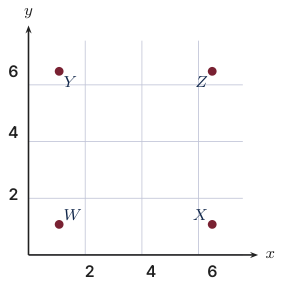
An environmental agency measures soil pH at four sampling posts. Their positions and readings are shown below (units in km).
Original Photon diagram
PostCoordinatespH
W(1,1)6.2
X(6,1)7.1
Y(1,6)6.8
Z(6,6)7.4
(a) A field station is at F(2,\,4). By finding the distance from F to each post, determine which post is nearest to F.
[4]
(b) Using nearest-neighbour interpolation, estimate the soil pH at F.
[1]
(c) A second location G(5,\,5) lies in the cell of post Z. State the estimated pH at G using nearest-neighbour interpolation, and give one limitation of this estimation method.
[3]
(d) By symmetry, the four cells meet at a single Voronoi vertex. Write down its coordinates.
[2]
Show solutionHide solution
(a) FW=\sqrt{(2-1)^2+(4-1)^2}=\sqrt{1+9}=\sqrt{10}\approx3.16.
FX=\sqrt{(2-6)^2+(4-1)^2}=\sqrt{16+9}=5.
FY=\sqrt{(2-1)^2+(4-6)^2}=\sqrt{1+4}=\sqrt5\approx2.24.
FZ=\sqrt{(2-6)^2+(4-6)^2}=\sqrt{16+4}=\sqrt{20}\approx4.47.
Smallest is FY, so post Y is nearest.
[4]
(b) Estimated pH at F = pH at Y =6.8.
[1]
(c) Estimated pH at G=7.4 (the value at Z). Limitation: nearest-neighbour gives the same value everywhere in a cell and jumps abruptly at boundaries, so it ignores gradual variation between posts.
[3]
(d) By the symmetry of the square, the vertex is the centre (3.5,\,3.5).
[2]

Final answer

(a) Y is nearest (\sqrt5=2.24) (b) 6.8 (c) 7.4; one limitation (d) (3.5,3.5)

Question 21

[11 marks]
A drone-landing area is the rectangle 0\le x\le12, 0\le y\le8 (units of 100\,\text{m}). Three charging posts are at A(1,\,2), B(3,\,6) and C(6,\,3). A new weather beacon is to be built in the rectangle, as far as possible from the nearest post. The Voronoi edge between A and B is the line y=-\frac12x+5.
(a) Find the equation of the Voronoi edge between A and C.
[3]
(b) Hence find the Voronoi vertex V, and the distance from V to the nearest post, to 3 significant figures.
[2]
(c) Calculate the distance from each corner of the rectangle to its nearest post, to 2 decimal places.
[3]
(d) State the best site for the beacon, the distance to the nearest post in metres to the nearest 10 m, and explain why the vertex is not the best site.
[3]
Show solutionHide solution
(a) Midpoint (3.5,\,2.5); m_{AC}=\dfrac{3-2}{6-1}=0.2, so the perpendicular gradient is −5; y-2.5=-5(x-3.5) \Rightarrow y=-5x+20. A1M1A1
[3]
(b) Solve y=-\frac12x+5 and y=-5x+20 (GDC): V=(3.33,\,3.33).
A1[1]
VA=\sqrt{(3.33-1)^2+(3.33-2)^2}=2.69 (hundred metres).
A1[1]
(c) (0,0): nearest A, 2.24; (12,0): nearest C, 6.71. M1A1
[2]
(12,8): nearest C, 7.81; (0,8): nearest B, 3.61.
A1[1]
(d) The best site is the corner (12,\,8).
A1[1]
The distance is \sqrt{61}\times100\approx780 m.
A1[1]
The vertex is only 2.69 hundred metres from the nearest post, much less than 7.81 at the corner: in a bounded region the corners and boundary points can be further from every site than any vertex.
R1[1]

Final answer

(a) y=-5x+20 (b) (3.33,3.33), 2.69 (c) 2.24, 6.71, 7.81, 3.61 (d) corner (12,8), 780 m

Question 22

[12 marks]
A rectangular nature reserve is the region 0\le x\le14, 0\le y\le12, where one unit represents 100\,\text{m}. Three warden posts are at A(2,\,4), B(10,\,2) and C(7,\,9). Each part of the reserve is patrolled by the nearest post.
(a) Find the equations of the Voronoi edges between A and B, and between A and C.
[5]
(b) Hence find the coordinates of the Voronoi vertex V.
[2]
(c) Write down the coordinates of the point where the edge A|B meets the boundary y=0 and of the point where the edge A|C meets the boundary x=0.
[2]
(d) The cell of A is the quadrilateral with vertices (0,\,0), (5.25,\,0), V and (0,\,11). Find its area, in square kilometres.
[3]
Show solutionHide solution
(a) A|B: midpoint (6,\,3); m_{AB}=\dfrac{2-4}{10-2}=-\dfrac14, so the perpendicular gradient is 4; y-3=4(x-6)\Rightarrow y=4x-21. A1M1A1
[3]
A|C: midpoint (4.5,\,6.5); m_{AC}=\dfrac{9-4}{7-2}=1, so the perpendicular gradient is −1; y-6.5=-(x-4.5)\Rightarrow y=-x+11. A1A1
[2]
(b) 4x-21=-x+11 \Rightarrow x=6.4 (GDC intersection).
M1[1]
V=(6.4,\,4.6).
A1[1]
(c) y=0: 4x-21=0\Rightarrow x=5.25, point (5.25,\,0).
A1[1]
x=0: y=11, point (0,\,11).
A1[1]
(d) Split the quadrilateral into two triangles by the diagonal from (0,0) to V: one has base 5.25 on the x-axis and height 4.6, the other has base 11 on the y-axis and height 6.4. Area =\tfrac12(5.25\times4.6+11\times6.4).
M1[1]
=\tfrac12(24.15+70.4)=47.275 square units.
A1[1]
1 unit^2=0.01\,\text{km}^2, so area \approx0.473\,\text{km}^2.
A1[1]

Final answer

(a) y=4x-21; y=-x+11 (b) (6.4,4.6) (c) (5.25,0), (0,11) (d) 47.275 square units, so 0.473 km^2

Question 23

[14 marks]
Three polling stations are at P_1(4,\,7), P_2(6,\,3) and P_3(13,\,10) in the town of Kestrel Bay, with coordinates in kilometres. Voters go to the nearest station.
(a) Show that the Voronoi edge between P_1 and P_2 has equation 2y=x+5.
[3]
(b) Find the equation of the Voronoi edge between P_2 and P_3.
[3]
(c) Find the coordinates of the Voronoi vertex V of the three stations, and the distance from V to each station.
[3]
(d) A fourth station P_4(15,\,3) opens. Show that V is still a vertex of the new diagram.
[2]
(e) A new vertex W appears where the cells of P_2, P_3 and P_4 meet. Find the equation of the edge between P_2 and P_4, and the equation of the edge between P_3 and P_4, and hence find the coordinates of W.
[3]
Show solutionHide solution
(a) Midpoint (5,\,5); m_{P_1P_2}=\dfrac{3-7}{6-4}=-2, so the perpendicular gradient is \dfrac12. A1M1
[2]
y-5=\dfrac12(x-5).
A1[1]
2y-10=x-5 \Rightarrow 2y=x+5.
AG
(b) Midpoint (9.5,\,6.5); m_{P_2P_3}=\dfrac{10-3}{13-6}=1, so the perpendicular gradient is −1; y-6.5=-1(x-9.5) \Rightarrow y=-x+16. A1M1A1
[3]
(c) Solve 2y=x+5 and y=-x+16 (GDC): V=(9,\,7). M1A1
[2]
VP_1=\sqrt{5^2+0^2}=5 km (and VP_2=\sqrt{3^2+4^2}=5, VP_3=\sqrt{4^2+3^2}=5).
A1[1]
(d) VP_4=\sqrt{(15-9)^2+(3-7)^2}=\sqrt{52}\approx7.21 km.
M1[1]
7.21>5, so P_4 is further from V than the other three stations, and V remains a vertex.
R1[1]
(e) P_2 and P_4 have the same y-coordinate: the edge is the vertical line through the midpoint (10.5,\,3), so x=10.5.
A1[1]
Midpoint (14,\,6.5); m_{P_3P_4}=\dfrac{3-10}{15-13}=-3.5, so the perpendicular gradient is \frac{2}{7}; y-6.5=\frac{2}{7}(x-14) \Rightarrow y=\frac{2}{7}x+2.5.
M1[1]
At x=10.5: y=\tfrac27(10.5-14)+6.5=5.5, so W=(10.5,\,5.5).
A1[1]

Final answer

(b) y=-x+16 (c) V(9,7), 5 km (d) VP_4=7.21>5, so V is still a vertex (e) x=10.5; y=\frac27x+2.5; W(10.5,5.5)

Question 24

[12 marks]
An old survey map of three lighthouses A, B and C has been damaged. The only information that can be read is: lighthouse A is at (3,\,4); the Voronoi edge between A and B is the line 2x+y=20; the Voronoi edge between A and C is the line y=8. Coordinates are in kilometres.
(a) Find the coordinates of the Voronoi vertex V of the three lighthouses.
[2]
(b) The edge A|B is the perpendicular bisector of [AB]. Find the gradient of AB, and hence the coordinates of B.
[5]
(c) Find the coordinates of C.
[1]
(d) Verify that the Voronoi edge between B and C passes through V.
[2]
(e) A fourth lighthouse is built at D(8,\,11). Determine whether V is still a vertex.
[2]
Show solutionHide solution
(a) Substitute y=8 into 2x+y=20: 2x=12.
M1[1]
V=(6,\,8).
A1[1]
(b) The edge has gradient −2, so AB has gradient \dfrac12.
A1[1]
The line through A with gradient \dfrac12 is y=4+\dfrac12(x-3); it meets the edge where 2x+4+\dfrac12(x-3)=20, giving the midpoint M(7,\,6). M1A1
[2]
M is the midpoint of [AB], so B=(2\times7-3, 2\times6-4)=(11,\,8). M1A1
[2]
(c) A and C are reflections in the horizontal line y=8, so C=(3,\,2\times8-4)=(3,\,12).
A1[1]
(d) Midpoint of [BC] is (7,\,10); m_{BC}=\dfrac{12-8}{3-11}=-\dfrac12, so the perpendicular gradient is 2 and the edge is y=2x-4.
M1[1]
At x=6: y=8, so it passes through V(6,\,8).
A1[1]
(e) VA=\sqrt{(6-3)^2+(8-4)^2}=5 and VD=\sqrt{(6-8)^2+(8-11)^2}=\sqrt{13}\approx3.61.
M1[1]
VD<5, so D is nearer to V than A, B or C: V is no longer a vertex.
R1[1]

Final answer

(a) V(6,8) (b) \frac12; B(11,8) (c) C(3,12) (d) y=2x-4 passes through V (e) VD=3.61<5: no longer a vertex

Question 25

[18 marks]
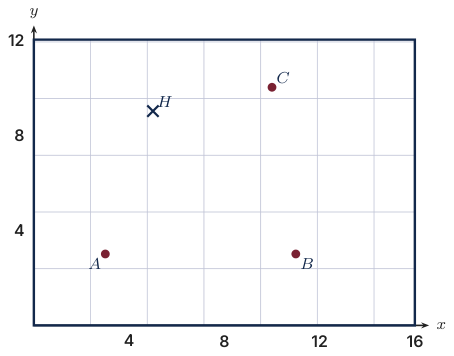
A national park is the rectangle 0\le x\le16, 0\le y\le12, where one unit represents 1 km. Ranger stations are at A(3,3), B(11,3) and C(10,10). A visitor who needs help is sent to the nearest station.
Original Photon diagram
(a) Write down the equation of the Voronoi edge between A and B.
[1]
(b) Show that the Voronoi edge between A and C is x+y=13.
[3]
(c) Find the coordinates of the Voronoi vertex V, and show that V is 5 km from each station.
[3]
(d) A hiker at H(5,9) needs help. Determine which station is sent, and find its distance from the hiker.
[2]
(e) On one day the rainfall recorded at A, B and C is 31 mm, 24 mm and 40 mm. Use nearest-neighbour interpolation to estimate the rainfall at H.
[1]
The cell of A within the park is the polygon with vertices (0,0), (7,0), V, (1,12) and (0,12).
(f) Find the area of the cell of A.
[3]
(g) A park officer says that station A will receive the most calls for help because its cell is the largest. Give one reason why this may not be true.
[1]
A fourth station is to be built at the point of the park that is furthest from its nearest station. A planner suggests V.
(h) Show that the corner (0,12) is a better choice than V, and find its distance from the nearest station.
[3]
(i) The point of the park furthest from its nearest station is the corner (0,12). The park wants every point within 10 km of a station. Determine whether the three stations achieve this.
[1]
Show solutionHide solution
(a) x=7 A1 (b) midpoint (6.5,6.5), m_{AC}=1, so the edge has gradient −1 M1A1 y-6.5=-(x-6.5)\Rightarrow x+y=13 A1AG (c) x=7\Rightarrow y=6, so V(7,6) A1 VA^2=16+9=25, VB^2=16+9=25, VC^2=9+16=25 M1 each is 5 km A1 (d) HA^2=40, HB^2=72, HC^2=26 M1 station C, \sqrt{26}=5.10 km A1 (e) C is nearest, so 40 mm A1 (f) split at y=6: a rectangle 7\times6=42 and a trapezium \frac12(7+1)(6)=24 M1A1 area 66 km^2 A1 (g) e.g. calls depend on where visitors walk (trails, car parks), not on the area of the cell R1 (h) V is 5 km from its nearest station M1 the corner (0,12) is \sqrt{9+81}=\sqrt{90}=9.49 km from A, \sqrt{104}=10.2 km from C and further from B M1 9.49>5, so the corner is better, 9.49 km from A A1 (i) 9.49<10, so yes
R1

Final answer

(a) x=7 (b) shown (c) V(7,6), 5 km (d) station C, 5.10 km (e) 40 mm (f) 66 km^2 (g) a named factor, e.g. where visitors walk (h) 9.49 km from A (i) yes, 9.49<10

Going further

Beyond the syllabus: the worked examples and investigations of the chapter's Going further pages.

G1 The worst-served point decides the radius

G1 Worked example

[4 marks]
A rural radio network serves a rectangular valley 0\le x\le10, 0\le y\le6, where coordinates are in kilometres. Two masts stand at A(2,3) and B(8,3), and every point is served by the nearer mast. The company needs a radius R that reaches every point of the valley.
(a) Write down the equation of the Voronoi edge between A and B.
[1]
(b) The cell of A has corners (0,0), (5,0), (5,6) and (0,6). Find the distance from A to each corner.
[2]
(c) Hence write down the radius R needed, in kilometres.
[1]
Show solutionHide solution
(a) x=5 A1 (b) A(2,3) to (0,0): \sqrt{4+9}=3.61 km, to (0,6): 3.61 km, to (5,0): \sqrt{9+9}=4.24 km, to (5,6): 4.24 km M1A1 (c) R=4.24 km, since the cell of B is the mirror image
A1

Final answer

(a) x=5 (b) 3.61, 4.24, 4.24, 3.61 km (c) R=4.24 km

G3 Investigation: where should two masts go?

G3 Investigation

[15 marks]
A mobile network covers a square valley 0\le x\le8, 0\le y\le8, where coordinates are in kilometres, with two masts. Every point is served by the nearer mast, and the company needs the radius R that reaches every point of the valley.
(a) The masts are at A(1,4) and B(7,4). Write down the Voronoi edge between them.
[1]
(b) Find the distance from the corner (0,0) to its nearest mast, and from the point (4,0) to its nearest mast.
[2]
(c) The worst-served points of the cell of A are among its corners. Hence write down the radius R needed.
[1]
(d) The masts are moved to A(a,4) and B(8-a,4), where 0<a<4. Show that the corner (0,0) is \sqrt{a^2+16} from A and that the point (4,0) is \sqrt{(4-a)^2+16} from A.
[2]
(e) Explain why the radius needed is the larger of these two distances.
[1]
(f) Use your GDC to sketch both distances for 0<a<4, and find the value of a that makes the radius needed as small as possible. State this radius.
[3]
(g) A planner suggests masts at A(2,2) and B(6,6) instead. Find the Voronoi edge between them, and show that this placement needs a radius of 6.32 km.
[3]
(h) State one assumption of this model that may not hold in a real valley.
[2]
Show solutionHide solution
(a) x=4 A1 (b) \sqrt{1+16}=\sqrt{17}=4.12 km from A; the point (4,0) is \sqrt{9+16}=5 km from A A1A1 (c) the corners of the cell of A are at 4.12, 5, 5 and 4.12 km, so R=5 km A1 (d) \sqrt{(a-0)^2+(4-0)^2}=\sqrt{a^2+16} A1 \sqrt{(4-a)^2+(0-4)^2}=\sqrt{(4-a)^2+16} A1 (e) every point of the cell of A must be within R of A; its furthest points are the corners (0,0), (0,8) at \sqrt{a^2+16} and (4,0), (4,8) at \sqrt{(4-a)^2+16}, and the cell of B is the mirror image R1 (f) sketch both curves M1 they cross at a=2 A1 R=\sqrt{20}=4.47 km, with masts at (2,4) and (6,4) A1 (g) midpoint (4,4), gradient of AB is 1, so the edge is x+y=8 M1A1 the corners (8,0) and (0,8) are on the edge, each \sqrt{36+4}=\sqrt{40}=6.32 km from both masts, and the other corners are nearer, so R=6.32 km A1 (h) e.g. hills block the signal, so coverage is not a circle R1 e.g. demand is not spread evenly, or masts cannot go anywhere
R1

Final answer

(a) x=4 (b) 4.12 km; 5 km (c) R=5 km (f) a=2, R=4.47 km (g) x+y=8

From the book

Photon Guidebook: Mathematics Applications and Interpretation SL for the IB Diploma

Chapter 7 teaches voronoi diagrams from the basics to full exam questions: how the IB asks it, every question type with a marked example, and these practice questions in three steps.

About the book