Free worked solutions · 2026 Edition

IB Maths AI SL Chapter 6: Three-dimensional geometry worked solutions

Worked solutions to the practice questions in Chapter 6 of Photon Guidebook: Mathematics Applications and Interpretation SL for the IB Diploma (2026 Edition). Each solution shows every step with the mark it earns, the way an IB mark scheme does.

  • Chapter 6 of 15
  • 24 practice questions
  • 2 Going further
  • Free, no sign-up

Basics

One idea at a time, in the order the chapter teaches them.

Question 1

[3 marks]
In three dimensions, distance is \sqrt{(x_2-x_1)^2+(y_2-y_1)^2+(z_2-z_1)^2}. Points are P(2,-1,3) and Q(8,2,7).
Find PQ exactly and to 3 significant figures.
[3]
Show solutionHide solution
PQ=\sqrt{6^2+3^2+4^2}.
M1
PQ=\sqrt{61}.
A1
PQ=7.81 units (3 s.f.).
A1

Final answer

\sqrt{61}=7.81

Question 2

[3 marks]
Points P=(0,0,0) and Q=(2,3,z) are 7 units apart, and z>0.
Find z exactly and explain why the other algebraic possibility is excluded.
[3]
Show solutionHide solution
2^2+3^2+z^2=7^2, so z^2=36.
M1
z=6.
A1
The root −6 is excluded by the condition z>0.
R1

Final answer

z=6; −6 is excluded by z>0

Question 3

[2 marks]
For 3D points, average all three corresponding coordinates to find a midpoint. E=(-4,6,1) and F=(2,-2,9).
Find the midpoint of EF.
[2]
Show solutionHide solution
M=((-4+2)/2,(6-2)/2,(1+9)/2).
M1
M=(-1,2,5).
A1

Final answer

(-1,\,2,\,5)

Question 4

[4 marks]
A straight brace joins floor point A(1,2,0) to attachment point B(4,6,7) in metres. The floor is z=0.
Find the brace length and its angle with the floor, both to 3 significant figures.
[4]
Show solutionHide solution
AB=\sqrt{3^2+4^2+7^2}=\sqrt{74} m.
M1
AB=8.60 m.
A1
Horizontal projection is \sqrt{3^2+4^2}=5 m, so \theta=\arctan(7/5).
M1
\theta=54.5^\circ.
A1

Final answer

8.60 m; 54.5^\circ

Question 5

[3 marks]
The volume of a prism is base area times perpendicular length. A triangular prism has triangular base area 7.2\text{ cm}^2 and length 8.5 cm.
Find its volume and explain why the units are cubic centimetres.
[3]
Show solutionHide solution
V=7.2(8.5).
M1
V=61.2\text{ cm}^3.
A1
Area units multiplied by length units give \text{cm}^2\times\text{cm}=\text{cm}^3.
R1

Final answer

61.2 cm^3; area \times length gives cm^2\times cm

Question 6

[4 marks]
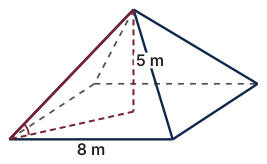
A square pyramid has base side 8 m and vertical height 5 m, with its apex directly above the base centre. Consider the edge from a base corner to the apex.
Original Photon diagram
Find its horizontal projection length and the angle it makes with the base plane to 3 significant figures.
[4]
Show solutionHide solution
Centre-to-corner projection =\sqrt{4^2+4^2}=\sqrt{32} m. M1A1
\theta=\arctan(5/\sqrt{32}).
M1
\theta=41.5^\circ (3 s.f.).
A1

Final answer

\sqrt{32}=5.66 m; 41.5^\circ

Question 7

[3 marks]
A sphere has diameter 7 cm. Its volume is V=\frac43\pi r^3.
Calculate its volume to 3 significant figures, showing how the radius is found.
[3]
Show solutionHide solution
r=7/2=3.5 cm.
M1
V=\frac43\pi(3.5)^3.
M1
V=180\text{ cm}^3 (3 s.f.).
A1

Final answer

180 cm^3

Question 8

[4 marks]
A closed cylinder has radius 1.8 cm and height 5.2 cm. The curved area is 2\pi rh; each circular end has area \pi r^2.
Find its total surface area to 3 significant figures, separating curved and flat parts.
[4]
Show solutionHide solution
Curved area =2\pi(1.8)(5.2).
M1
Two ends contribute 2\pi(1.8)^2.
M1
Total S=2\pi(1.8)(5.2)+2\pi(1.8)^2=25.2\pi.
A1
S=79.2\text{ cm}^2 (3 s.f.).
A1

Final answer

25.2\pi=79.2 cm^2

Question 9

[6 marks]
A solid consists of a cylinder of radius 2 cm and height 5 cm, with a hemisphere of radius 2 cm fully joined to its top. Its circular bottom is exposed. Cylinder curved area is 2\pi rh; hemisphere curved area is 2\pi r^2.
A coating calculation gives the exposed area as 36\pi\text{ cm}^2 by counting the joining circle as exposed. Find the correct exposed area as a multiple of \pi. Calculate the excess area and the percentage overestimate relative to the correct area. Explain why the joining circle must be excluded.
[6]
Show solutionHide solution
Exposed area =2\pi(2)(5)+2\pi(2)^2+\pi(2)^2.
M1
The correct area is 32\pi\text{ cm}^2.
A1
Excess area =36\pi-32\pi=4\pi\text{ cm}^2.
A1
Percentage overestimate =\frac{4\pi}{32\pi}\times100.
M1
The percentage overestimate is 12.5%.
A1
The joining circle is hidden inside the solid and does not receive exterior coating.
R1

Final answer

32\pi cm^2; excess 4\pi cm^2, 12.5%; the join is inside the solid

Question 10

[6 marks]
A right square pyramid has base side 6 cm. Its face slant height, from the apex to the midpoint of a base edge, is 5 cm. The apex is directly above the base centre. Pyramid volume is one third of base area times vertical height.
Find the vertical height and the true volume. A student uses 5 cm as the height in the volume formula. Calculate the resulting overestimate and explain the error.
[6]
Show solutionHide solution
The horizontal distance from the centre to a side midpoint is 3 cm, so h^2+3^2=5^2.
M1
h=4 cm.
A1
True volume =\frac13(6^2)(4).
M1
True volume =48\text{ cm}^3.
A1
The claimed volume is \frac13(36)(5)=60\text{ cm}^3, overestimating by 60-48=12\text{ cm}^3.
A1
5 cm is a slant height; the volume formula requires the perpendicular height 4 cm.
R1

Final answer

h=4 cm; 48 cm^3; overestimate 12 cm^3

Tutorial

Exam-style questions on each question type, with the marks the IB would give.

Question 11

[8 marks]
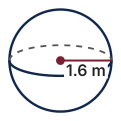
A spherical rainwater tank has radius 1.6 m.
Original Photon diagram
(a) Find the volume of the tank in cubic metres.
[2]
(b) Write the capacity of the tank in litres.
[1]
(c) The tank is filled from a mains tap at 25 litres per minute. Find the time taken to fill it from empty, in hours to 3 significant figures.
[2]
(d) The outside of the tank is to be painted. One litre of paint covers 8 m^2. Find how many whole litres of paint must be bought.
[3]
Show solutionHide solution
(a) V = \dfrac43\pi(1.6)^3
M1[1]
= 17.2 m^3 (3 s.f.).
A1[1]
(b) 1 m^3 = 1000 litres, so 17.157 \times 1000 = 17\,200 litres (3 s.f.).
A1[1]
(c) \dfrac{17\,157.3}{25} = 686.3 minutes
M1[1]
= 11.4 hours (3 s.f.).
A1[1]
(d) Surface area = 4\pi(1.6)^2 = 32.17 m^2 M1A1
[2]
Paint needed = \dfrac{32.17}{8} = 4.02 litres, so 5 litres must be bought.
A1[1]

Final answer

  • (a) 17.2 m^3
  • (b) 17 200 litres
  • (c) 11.4 hours
  • (d) 5 litres

Question 12

[7 marks]
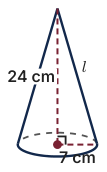
A solid wooden cone has base radius 7 cm and vertical height 24 cm. Its slant height is l.
Original Photon diagram
(a) Find the slant height l.
[2]
(b) Find the total surface area of the cone.
[2]
(c) Find the volume of the cone.
[2]
(d) A student uses l = 25 in the volume formula instead of h = 24. Explain why this is wrong.
[1]
Show solutionHide solution
(a) l = \sqrt{7^2 + 24^2} = \sqrt{625}
M1[1]
= 25 cm.
A1[1]
(b) Total surface area = \pi r^2 + \pi r l = \pi(7)^2 + \pi(7)(25)
M1[1]
= 224\pi = 704 cm^2 (3 s.f.).
A1[1]
(c) V = \dfrac13\pi(7)^2(24)
M1[1]
= 392\pi = 1\,230 cm^3 (3 s.f.).
A1[1]
(d) The volume formula needs the perpendicular (vertical) height h from the base to the apex; the slant height l runs along the curved surface and is longer than h, so it would overestimate the volume.
R1[1]

Final answer

  • (a) 25 cm
  • (b) 704 cm^2
  • (c) 1230 cm^3
  • (d) the volume needs the vertical height

Question 13

[7 marks]
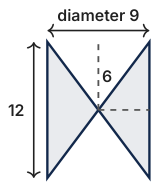
A solid wooden cylinder has radius 4.5 cm and height 12 cm. A conical hole, with the same radius as the cylinder, is drilled into each flat end, to a depth of 6 cm, as shown in the cross-section.
Original Photon diagram
(a) Show that the slant height of each conical hole is 7.5 cm.
[1]
(b) Find the volume of wood that remains.
[3]
(c) Find the total surface area of the remaining solid.
[3]
Show solutionHide solution
(a) l = \sqrt{4.5^2 + 6^2} = \sqrt{56.25}
M1[1]
= 7.5 cm.
AG
(b) Cylinder: \pi(4.5)^2(12) = 763.41 cm^3
A1[1]
Each cone: \dfrac13\pi(4.5)^2(6) = 127.23 cm^3
A1[1]
Remaining = 763.41 - 2(127.23) = 509 cm^3 (3 s.f.).
A1[1]
(c) The two circular ends are completely removed, so the surface is the curved cylinder surface plus the two conical surfaces:
R1[1]
2\pi(4.5)(12) + 2\left[\pi(4.5)(7.5)\right]
M1[1]
= 551 cm^2 (3 s.f.).
A1[1]

Final answer

  • (a) shown
  • (b) 509 cm^3
  • (c) 551 cm^2

Question 14

[10 marks]
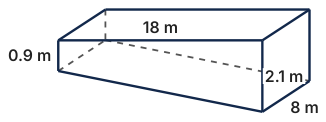
A swimming pool is 8 m wide. Its length is 18 m, and its floor slopes steadily from a depth of 0.9 m at the shallow end to a depth of 2.1 m at the deep end, so that the pool is a prism with a trapezium cross-section, as shown (the depths are exaggerated).
Original Photon diagram
(a) Find the area of the trapezium cross-section.
[2]
(b) Find the volume of water in the pool when it is full, in litres.
[2]
(c) The pool is filled at 2400 litres per minute. Find the time taken to fill it from empty, in hours.
[2]
(d) Find the angle that the sloping floor makes with the horizontal.
[2]
(e) A safety rope is to be fixed along the whole length of the sloping floor. Find the length of the rope.
[2]
Show solutionHide solution
(a) \dfrac12(0.9 + 2.1)\times 18
M1[1]
= 27 m^2.
A1[1]
(b) Volume = 27 \times 8 = 216 m^3
M1[1]
= 216\,000 litres.
A1[1]
(c) \dfrac{216\,000}{2400} = 90 minutes
M1[1]
= 1.5 hours.
A1[1]
(d) \tan\theta = \dfrac{2.1 - 0.9}{18}
M1[1]
\theta = 3.81^\circ (3 s.f.).
A1[1]
(e) \sqrt{18^2 + 1.2^2}
M1[1]
= 18.0 m (3 s.f.).
A1[1]

Final answer

  • (a) 27 m^2
  • (b) 216 000 litres
  • (c) 1.5 hours
  • (d) 3.81^\circ
  • (e) 18.0 m

Question 15

[8 marks]
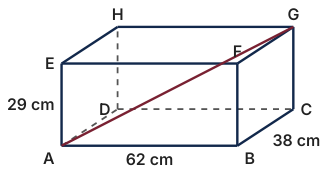
A packing carton for fishing rods is a cuboid ABCDEFGH with internal length \text{AB} = 62 cm, width \text{BC} = 38 cm and height \text{AE} = 29 cm. The longest rod that fits goes from A to G.
Original Photon diagram
(a) Find the length of the longest straight rod that fits inside the carton.
[3]
(b) Decide whether a rod of length 75 cm fits, and whether a rod of length 80 cm fits. Give reasons.
[2]
(c) The carton is stood on end, so that the 38 cm by 29 cm face is on the ground and the 62 cm edge is vertical. Find the angle that the longest rod makes with the ground.
[3]
Show solutionHide solution
(a) \text{AG} = \sqrt{62^2 + 38^2 + 29^2} M1M1
[2]
= \sqrt{6129} = 78.3 cm (3 s.f.).
A1[1]
(b) 75 < 78.29, so it fits.
A1[1]
80 > 78.29, so it does not fit.
A1[1]
(c) The height of G above the ground is now 62 cm
A1[1]
\sin\theta = \dfrac{62}{78.288}
M1[1]
\theta = 52.4^\circ (3 s.f.).
A1[1]

Final answer

  • (a) 78.3 cm
  • (b) 75 cm fits, 80 cm does not
  • (c) 52.4^\circ

Question 16

[8 marks]
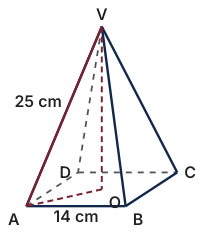
A stone ornament on a gatepost is a right pyramid VABCD. The base ABCD is a horizontal square of side 14 cm. Each sloping edge, such as VA, has length 25 cm. O is the centre of the base and V is vertically above O.
Original Photon diagram
(a) Find the length AO.
[2]
(b) Find the height VO of the ornament.
[2]
(c) Find the angle between the edge VA and the base.
[2]
(d) Find the volume of the ornament.
[2]
Show solutionHide solution
(a) \text{AC} = 14\sqrt2, so \text{AO} = 7\sqrt2
M1[1]
= 9.90 cm (3 s.f.).
A1[1]
(b) \text{VO}^2 = 25^2 - (7\sqrt2)^2 = 625 - 98
M1[1]
\text{VO} = \sqrt{527} = 23.0 cm (3 s.f.).
A1[1]
(c) \cos\theta = \dfrac{\text{AO}}{\text{VA}} = \dfrac{9.899}{25}
M1[1]
\theta = 66.7^\circ (3 s.f.).
A1[1]
(d) V = \dfrac13\times 14^2\times 22.956
M1[1]
= 1\,500 cm^3 (3 s.f.).
A1[1]

Final answer

  • (a) 9.90 cm
  • (b) 23.0 cm
  • (c) 66.7^\circ
  • (d) 1500 cm^3

Question 17

[8 marks]
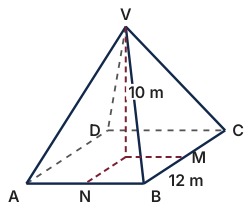
A campsite shelter has a roof in the shape of a right pyramid VABCD. The base ABCD is a horizontal rectangle with \text{AB} = 9 m and \text{BC} = 12 m. The apex V is 10 m vertically above the centre O of the base. M is the midpoint of BC.
Original Photon diagram
(a) Find the angle between the line VM and the base.
[2]
(b) N is the midpoint of AB. Find the angle between the line VN and the base, and state which of the faces VBC and VAB is the steeper, giving a reason.
[3]
(c) Find the length of the sloping edge VA.
[3]
Show solutionHide solution
(a) \text{OM} = \dfrac12\text{AB} = 4.5
A1[1]
\tan\phi = \dfrac{10}{4.5}, so \phi = 65.8^\circ (3 s.f.).
A1[1]
(b) \text{ON} = \dfrac12\text{BC} = 6, so \tan\psi = \dfrac{10}{6} and \psi = 59.0^\circ M1A1
[2]
65.8^\circ > 59.0^\circ, so the face VBC is steeper, because its midline is closer to the centre of the base (4.5 < 6).
R1[1]
(c) \text{AC} = \sqrt{9^2 + 12^2} = 15, so \text{AO} = 7.5
M1[1]
\text{VA} = \sqrt{10^2 + 7.5^2} = \sqrt{156.25}
M1[1]
= 12.5 m.
A1[1]

Final answer

  • (a) 65.8^\circ
  • (b) 59.0^\circ; VBC is steeper
  • (c) 12.5 m

Question 18

[10 marks]
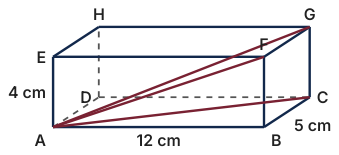
The diagram shows a cuboid ABCDEFGH with a horizontal rectangular base ABCD, where \text{AB} = 12 cm, \text{BC} = 5 cm and \text{AE} = 4 cm. The lines AC, AF and AG are drawn.
Original Photon diagram
(a) Find the length of the diagonal AC of the base.
[2]
(b) Find the length of the space diagonal AG.
[2]
(c) Find the angle between AG and the base ABCD.
[2]
(d) Find the angle between AG and the vertical face ABFE. Explain which line is the projection of AG onto this face.
[4]
Show solutionHide solution
(a) \text{AC} = \sqrt{12^2 + 5^2} = \sqrt{169}
M1[1]
= 13 cm.
A1[1]
(b) Triangle ACG has a right angle at C, so \text{AG} = \sqrt{13^2 + 4^2} = \sqrt{185}
M1[1]
= 13.6 cm (3 s.f.).
A1[1]
(c) The angle is \angle GAC, in the right-angled triangle ACG: \tan\theta = \dfrac{\text{CG}}{\text{AC}} = \dfrac{4}{13}
M1[1]
\theta = 17.1^\circ (3 s.f.).
A1[1]
(d) G lies directly above the point F in the face ABFE (GF is perpendicular to the face), so the projection of AG onto the face is AF
R1[1]
\text{AF} = \sqrt{12^2 + 4^2} = 12.649 cm
A1[1]
\tan\phi = \dfrac{\text{FG}}{\text{AF}} = \dfrac{5}{12.649}, so \phi = 21.6^\circ (3 s.f.). M1A1
[2]

Final answer

  • (a) 13 cm
  • (b) 13.6 cm
  • (c) 17.1^\circ
  • (d) 21.6^\circ

Question 19

[8 marks]
A survey team uses two drones above a quarry. Positions are given relative to the base station O at ground level, using coordinates (x, y, z) in metres, where x is the distance east of O, y the distance north of O and z the height above ground. Drone D is at (120, 85, 46) and drone E is at (-40, 150, 70).
(a) Find the distance from the base station O to drone D.
[2]
(b) Find the angle of elevation of drone D from O.
[3]
(c) Find the distance between the two drones.
[2]
(d) A relay beacon is placed at the midpoint M of DE. Write down the coordinates of M.
[1]
Show solutionHide solution
(a) \text{OD} = \sqrt{120^2 + 85^2 + 46^2}
M1[1]
= \sqrt{23\,741} = 154 m (3 s.f.).
A1[1]
(b) Horizontal distance = \sqrt{120^2 + 85^2} = 147.05 m
A1[1]
\tan\theta = \dfrac{46}{147.05}, so \theta = 17.4^\circ (3 s.f.). M1A1
[2]
(c) \text{DE} = \sqrt{(120+40)^2 + (85-150)^2 + (46-70)^2}
M1[1]
= \sqrt{30\,401} = 174 m (3 s.f.).
A1[1]
(d) M = \left(\dfrac{120 - 40}{2}, \dfrac{85 + 150}{2}, \dfrac{46 + 70}{2}\right) = (40, 117.5, 58).
A1[1]

Final answer

  • (a) 154 m
  • (b) 17.4^\circ
  • (c) 174 m
  • (d) (40,\,117.5,\,58)

Mastery

Full exam questions that mix question types, at Paper 1 and Paper 2 standard.

Question 20

[14 marks]
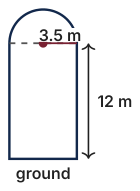
A grain silo is a cylinder of radius 3.5 m and height 12 m, with a hemispherical roof of the same radius. It stands on a concrete base.
Original Photon diagram
(a) Find the volume of the silo.
[3]
(b) Wheat has a mass of 0.75 tonnes per m^3. Find the mass of wheat in the silo when it is full.
[1]
(c) The outside of the silo, except the base, is painted. Find the area painted.
[3]
(d) Two coats are needed. One litre of paint covers 10 m^2 for one coat, and paint is sold in 5-litre tins. Find the number of tins needed.
[3]
(e) Each tin costs 48 US dollars. Find the cost of the paint.
[1]
(f) Kofi says that the roof holds less than 10% of the volume of the silo. Determine whether Kofi is correct.
[3]
Show solutionHide solution
(a) \pi(3.5)^2(12)+\frac23\pi(3.5)^3 M1M1 =552 m^3 (551.61) A1 (b) 551.61\times0.75=414 tonnes A1 (c) 2\pi(3.5)(12)+2\pi(3.5)^2 M1M1 =341 m^2 (340.86) A1 (d) \frac{2\times340.86}{10}=68.2 litres M1A1 68.2\div5=13.6, so 14 tins A1 (e) 14\times48=672 US dollars A1 (f) roof \frac23\pi(3.5)^3=89.80 m^3 M1 \frac{89.80}{551.61}\times100=16.3\% A1 more than 10%, so Kofi is not correct
R1

Final answer

  • (a) 552 m^3
  • (b) 414 tonnes
  • (c) 341 m^2
  • (d) 14 tins
  • (e) 672 US dollars
  • (f) no: 16.3%

Question 21

[12 marks]
A funnel is made by joining the two straight edges of a sector of thin plastic, radius 30 cm and angle 240^\circ, without overlap, to form an open cone.
(a) Find the arc length of the sector.
[2]
(b) Show that the radius of the rim of the funnel is 20 cm.
[1]
(c) Find the vertical height of the cone.
[2]
(d) Find the volume of the cone, in litres.
[3]
(e) Find the area of plastic used.
[2]
A smaller funnel uses a sector of the same radius, 30 cm, with an angle \theta^\circ that is less than 240^\circ. It holds 3 litres.
(f) Use your GDC to find \theta.
[2]
Show solutionHide solution
(a) \frac{240}{360}\times 2\pi(30) M1 =40\pi=126 cm A1 (b) 2\pi r=40\pi, so r=20 cm A1AG (c) \sqrt{30^2-20^2}=\sqrt{500} M1 =22.4 cm (22.36) A1 (d) \frac13\pi(20)^2(22.36\ldots) M1 =9366 cm^3 A1 =9.37 litres A1 (e) \frac{240}{360}\pi(30)^2 M1 =600\pi=1880 cm^2 (1884.96) A1 (f) r=\frac{30\theta}{360}=\frac{\theta}{12} and \frac13\pi\left(\frac{\theta}{12}\right)^2\sqrt{900-\left(\frac{\theta}{12}\right)^2}=3000 M1 GDC: \theta=121 (120.8)
A1

Final answer

  • (a) 126 cm
  • (b) shown
  • (c) 22.4 cm
  • (d) 9.37 litres
  • (e) 1880 cm^2
  • (f) 121^\circ

Question 22

[13 marks]
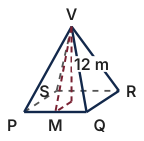
A square-based pyramid is used as the roof of a garden gazebo. The square base PQRS has side length 10 m, and the apex V is directly above the centre O of the base at a height of 12 m.
Original Photon diagram
(a) Find the length of the slant height from V to the midpoint of edge PQ.
[3]
(b) Find the length of a slanted edge VP.
[3]
(c) Find the angle that a triangular roof face makes with the horizontal base.
[3]
(d) Find the angle that the edge VP makes with the base.
[4]
Show solutionHide solution
(a) The midpoint M of PQ is 5 m horizontally from O. Slant height VM = \sqrt{12^2 + 5^2} = \sqrt{169} = 13 m.
[3]
(b) Half-diagonal OP = \tfrac{1}{2}\sqrt{10^2+10^2} = 5\sqrt{2} = 7.071 m.
VP = \sqrt{12^2 + (5\sqrt{2})^2} = \sqrt{144+50} = \sqrt{194} = 13.9 m.
[3]
(c) Using triangle VOM: \tan\theta = \dfrac{12}{5}, so \theta = \tan^{-1}(2.4) = 67.4^{\circ}.
[3]
(d) Using triangle VOP: \tan\phi = \dfrac{12}{5\sqrt{2}} = \dfrac{12}{7.071}, so \phi = \tan^{-1}(1.697) = 59.5^{\circ}.
[4]

Final answer

  • (a) 13 m
  • (b) 13.9 m
  • (c) 67.4^\circ
  • (d) 59.5^\circ

Question 23

[6 marks]
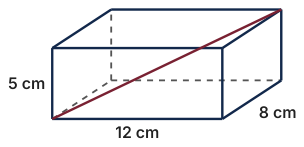
A storage box is a rectangular cuboid measuring 12 cm by 8 cm by 5 cm. A thin straight rod is placed inside so that it runs from one bottom corner to the opposite top corner (the space diagonal).
Original Photon diagram
(a) Find the length of the rod.
[3]
(b) Find the angle the rod makes with the base of the box.
[3]
Show solutionHide solution
(a) Space diagonal = \sqrt{12^2 + 8^2 + 5^2} = \sqrt{233} = 15.3 cm.
[3]
(b) Base diagonal = \sqrt{12^2 + 8^2} = \sqrt{208} = 14.42 cm.
\tan\theta = \dfrac{5}{14.42}, so \theta = \tan^{-1}(0.3467) = 19.1^{\circ}.
[3]

Final answer

  • (a) 15.3 cm
  • (b) 19.1^\circ

Question 24

[17 marks]
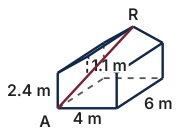
A garden shed is a prism of length 6 m. Its cross-section is a rectangle 4 m wide and 2.4 m high, with an isosceles triangle on top whose apex, the ridge, is 1.1 m above the tops of the walls. The floor is horizontal.
Original Photon diagram
(a) Find the area of the cross-section.
[2]
(b) Find the volume of the shed.
[2]
(c) Find the angle between a sloping roof face and the horizontal.
[2]
(d) Find the length of one sloping edge of the cross-section.
[2]
(e) Find the total area of the roof.
[2]
(f) Roofing felt costs 38.50 US dollars per m^2, and 10% extra must be bought for overlaps. Find the cost of the felt.
[2]
(g) A string is stretched from a corner A of the floor to the far end R of the ridge. Find the length AR.
[3]
(h) Find the angle between AR and the floor.
[2]
Show solutionHide solution
(a) 4\times2.4+\frac12(4)(1.1) M1 =11.8 m^2 A1 (b) 11.8\times6 M1 =70.8 m^3 A1 (c) \tan^{-1}\frac{1.1}{2} M1 =28.8^\circ (28.81) A1 (d) \sqrt{2^2+1.1^2} M1 =2.28 m (2.2825) A1 (e) 2\times2.2825\times6 M1 =27.4 m^2 (27.39) A1 (f) 27.39\times1.1\times38.50 M1 =1159.99 US dollars A1 (g) R is 2 m across, 6 m along and 3.5 m up from A A1 \mathrm{AR}=\sqrt{2^2+6^2+3.5^2} M1 =7.23 m (7.2284) A1 (h) floor projection \sqrt{2^2+6^2}=6.325 M1 \tan^{-1}\frac{3.5}{6.325}=29.0^\circ (28.96)
A1

Final answer

  • (a) 11.8 m^2
  • (b) 70.8 m^3
  • (c) 28.8^\circ
  • (d) 2.28 m
  • (e) 27.4 m^2
  • (f) 1160 US dollars (1159.99)
  • (g) 7.23 m
  • (h) 29.0^\circ

Going further

Beyond the syllabus: the worked examples and investigations of the chapter's Going further pages.

G1 Why a pyramid is one third of a prism

G1 Worked example

[6 marks]
Rania rolls a sector of a paper circle of radius 10 cm, with angle 270^\circ, into a cone so that its straight edges just meet.
(a) Find the radius of the base of the cone.
[2]
(b) Find the vertical height of the cone.
[2]
(c) Find the volume of the cone.
[2]
Show solutionHide solution
(a) arc =\frac{270}{360}\times2\pi(10)=15\pi M1 2\pi r=15\pi, so r=7.5 cm A1 (b) h=\sqrt{10^2-7.5^2}=\sqrt{43.75} M1 =6.61 cm (6.6144) A1 (c) \frac13\pi(7.5)^2(6.6144\ldots) M1 =390 cm^3 (389.6)
A1

Final answer

(a) r=7.5 cm (b) h=6.61 cm (c) V=390 cm^3

G2 The same card, different cones

G2 Investigation

[14 marks]
A cone is made by rolling a sector of a paper circle of radius 10 cm, with angle \theta^\circ, so that its straight edges just meet.
(a) Show that the radius of the base of the cone is r=\dfrac{\theta}{36} cm.
[2]
(b) Show that the vertical height of the cone is h=\sqrt{100-\dfrac{\theta^2}{1296}} cm.
[2]
(c) Write down an expression for the volume V of the cone in terms of \theta.
[1]
(d) Use your GDC to complete a table of V for \theta=90,\,180,\,240,\,270,\,300,\,330.
[3]
(e) Use your GDC to find the angle that gives the greatest volume, and the greatest volume.
[2]
(f) For this cone, find r and h, and show that h is about 0.707 times r.
[3]
(g) Explain why the sector cannot be the whole circle (\theta=360).
[1]
Show solutionHide solution
(a) arc =\frac{\theta}{360}\times2\pi(10) M1 2\pi r=\frac{\theta}{360}\times20\pi, so r=\frac{\theta}{36} A1AG (b) slant height 10, so h=\sqrt{10^2-r^2} M1 h=\sqrt{100-\frac{\theta^2}{1296}} A1AG (c) V=\frac13\pi\left(\frac{\theta}{36}\right)^2\sqrt{100-\frac{\theta^2}{1296}} A1 (d) GDC table of V: 63.4, 227, 347, 390, 402, 352 cm^3 M1A1A1 (e) greatest value of the graph of V for 0<\theta<360 M1 \theta=294^\circ (293.9), V=403 cm^3 A1 (f) r=\frac{293.9}{36}=8.16 cm, h=5.77 cm A1A1 \frac hr=\frac{5.774}{8.165}=0.707 A1 (g) then r=10 and h=0: there is no cone, the card is flat
R1

Final answer

(a) shown (b) shown (c) V=\frac13\pi\left(\frac{\theta}{36}\right)^2\sqrt{100-\frac{\theta^2}{1296}} (d) 63.4, 227, 347, 390, 402, 352 cm^3 (e) \theta=294^\circ, V=403 cm^3 (f) r=8.16 cm, h=5.77 cm, \frac hr=0.707 (g) r=10 and h=0: the card is flat

From the book

Photon Guidebook: Mathematics Applications and Interpretation SL for the IB Diploma

Chapter 6 teaches three-dimensional geometry from the basics to full exam questions: how the IB asks it, every question type with a marked example, and these practice questions in three steps.

About the book