Free worked solutions · 2026 Edition

IB Maths AI SL Chapter 5: Triangles, bearings and circles worked solutions

Worked solutions to the practice questions in Chapter 5 of Photon Guidebook: Mathematics Applications and Interpretation SL for the IB Diploma (2026 Edition). Each solution shows every step with the mark it earns, the way an IB mark scheme does.

  • Chapter 5 of 15
  • 26 practice questions
  • 3 Going further
  • Free, no sign-up

Basics

One idea at a time, in the order the chapter teaches them.

Question 1

[2 marks]
A right triangle has hypotenuse 11.3 m and the side opposite acute angle x is 6.8 m.
Calculate x in degrees, to 3 significant figures.
[2]
Show solutionHide solution
\sin x=6.8/11.3.
M1
x=37.0^\circ.
A1

Final answer

37.0^\circ

Question 2

[2 marks]
An observation deck is 46.2 m above level ground. A marker on the ground has angle of depression 17^\circ from the deck.
Find the horizontal distance from the marker to the point directly below the deck, to 3 significant figures.
[2]
Show solutionHide solution
\tan17^\circ=46.2/d.
M1
d=151 m.
A1

Final answer

151 m

Question 3

[3 marks]
Two ground observation points lie on the same straight line with the base of a vertical tower, both on the same side of it. The nearer point has elevation 51^\circ; the farther point, 18 m further away, has elevation 32^\circ. Ground is level; observer height is ignored.
Find the tower height to 3 significant figures.
[3]
Show solutionHide solution
Let nearer distance be x: h=x\tan51^\circ=(x+18)\tan32^\circ.
M1
x=18\tan32^\circ/(\tan51^\circ-\tan32^\circ).
M1
x=18.437927 m and h=22.8 m.
A1

Final answer

22.8 m

Question 4

[2 marks]
In triangle ABC, b=15.8 cm, c=19.3 cm and A=112^\circ.
Calculate a, to 3 significant figures.
[2]
Show solutionHide solution
a^2=15.8^2+19.3^2-2(15.8)(19.3)\cos 112^\circ.
M1
a=29.2 cm.
A1

Final answer

29.2 cm

Question 5

[2 marks]
Triangle ABC has a=21.6, b=17.4 and c=12.8 cm.
Find angle A, to 3 significant figures.
[2]
Show solutionHide solution
\cos A=(17.4^2+12.8^2-21.6^2)/(2(17.4)(12.8)).
M1
A=90.0^\circ.
A1

Final answer

90.0^\circ

Question 6

[3 marks]
In triangle ABC, A=63^\circ, B=39^\circ and a=18.6 cm. Standard opposite-side notation is used.
(a) Find C.
[1]
(b) Calculate b, to 3 significant figures.
[2]
Show solutionHide solution
(a) C=180-63-39=78^\circ.
A1
(b) b=18.6\sin 39^\circ/\sin 63^\circ.
M1
b=13.1 cm.
A1

Final answer

  • (a) 78^\circ
  • (b) 13.1 cm

Question 7

[2 marks]
The bearing of beacon B from A is 147^\circ.
Find the bearing of A from B.
[2]
Show solutionHide solution
147^\circ+180^\circ=327^\circ.
M1
The reverse bearing is 327^\circ.
A1

Final answer

327^\circ

Question 8

[3 marks]
From a radio base A, marker B is 12.3 km away on bearing 194^\circ, and marker C is 18.6 km away on bearing 266^\circ.
(a) Find angle BAC.
[1]
(b) Find BC to 3 significant figures.
[2]
Show solutionHide solution
(a) \angle BAC=266-194=72^\circ.
A1
(b) BC^2=12.3^2+18.6^2-2(12.3)(18.6)\cos72^\circ.
M1
BC=18.9 km.
A1

Final answer

  • (a) 72^\circ
  • (b) 18.9 km

Question 9

[2 marks]
A circle has radius 12.9 cm. An arc subtends a central angle 135^\circ.
Find the arc length to 3 significant figures.
[2]
Show solutionHide solution
L=(135/360)\,2\pi(12.9).
M1
L=30.4 cm.
A1

Final answer

30.4 cm

Question 10

[5 marks]
A chord joins the ends of a minor arc in a circle of radius 14.3 cm. The central angle is 76^\circ. The minor segment is the region between the chord and minor arc.
(a) Find the area of the triangle formed by the two radii, to 3 significant figures.
[2]
(b) Find the minor segment area to 3 significant figures.
[3]
Show solutionHide solution
(a) K_\triangle=\frac12(14.3)^2\sin76^\circ.
M1
K_\triangle=99.2 cm^2.
A1
(b) K_\mathrm{sector}=(76/360)\pi(14.3)^2.
M1
K_\mathrm{segment}=K_\mathrm{sector}-K_\triangle, using unrounded values.
M1
K_\mathrm{segment}=36.4 cm^2.
A1

Final answer

  • (a) 99.2 cm^2
  • (b) 36.4 cm^2

Tutorial

Exam-style questions on each question type, with the marks the IB would give.
Question 11

[9 marks]
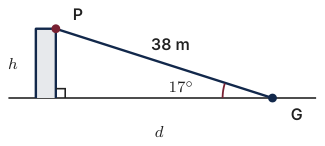
A zip wire runs in a straight line from a platform P at the top of a vertical post, down to a ground anchor G. The wire is 38 m long and makes an angle of 17^\circ with the horizontal ground. The platform is a height h above the ground, and G is a horizontal distance d from the foot of the post.
Original Photon diagram
(a) Find the height h of the platform.
[2]
(b) Find the horizontal distance d.
[2]
(c) The anchor is moved so that the wire is steeper, making an angle of 24^\circ with the ground, while the platform stays where it is. Find the new length of the wire and the new horizontal distance of the anchor from the foot of the post.
[5]
Show solutionHide solution
(a) The wire is the hypotenuse and h is opposite the 17^\circ angle: h = 38\sin 17^\circ
M1[1]
= 11.1 m (3 s.f.).
A1[1]
(b) d = 38\cos 17^\circ
M1[1]
= 36.3 m (3 s.f.).
A1[1]
(c) Platform height h = 11.110 m
A1[1]
\sin 24^\circ = \dfrac{11.110}{\text{length}}, so length = 27.3 m M1A1
[2]
\tan 24^\circ = \dfrac{11.110}{d}, so d = 25.0 m (3 s.f.). M1A1
[2]

Final answer

  • (a) 11.1 m
  • (b) 36.3 m
  • (c) 27.3 m and 25.0 m

Question 12

[7 marks]
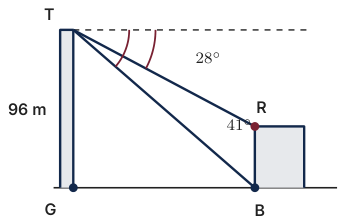
Aisha stands on the observation deck T of a tower GT, which is 96 m high. A shorter office building stands on level ground, at the same level as G, with its nearest wall vertical. From T, the angle of depression of the base B of the wall is 41^\circ and the angle of depression of the roof edge R directly above B is 28^\circ.
Original Photon diagram
(a) Find the horizontal distance from the tower to the building.
[2]
(b) Find the height of the building.
[3]
(c) Find the angle of elevation of R from G.
[2]
Show solutionHide solution
(a) \tan 41^\circ = \dfrac{96}{\text{GB}}
M1[1]
\text{GB} = \dfrac{96}{\tan 41^\circ} = 110 m (3 s.f.).
A1[1]
(b) Drop in height from T to R = \text{GB}\tan 28^\circ = 58.72 m M1A1
[2]
Height of building = 96 - 58.72 = 37.3 m (3 s.f.).
A1[1]
(c) \tan\phi = \dfrac{37.28}{110.44}
M1[1]
\phi = 18.7^\circ (3 s.f.).
A1[1]

Final answer

  • (a) 110 m
  • (b) 37.3 m
  • (c) 18.7^\circ

Question 13

[7 marks]
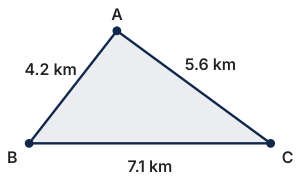
Three villages A, B and C are joined by straight roads. \text{AB} = 4.2 km, \text{AC} = 5.6 km and \text{BC} = 7.1 km.
Original Photon diagram
(a) Find the size of the largest angle of triangle ABC.
[3]
(b) Find the size of the smallest angle.
[2]
(c) Find the area enclosed by the three roads.
[2]
Show solutionHide solution
(a) The largest angle is at A, opposite BC: \cos A = \dfrac{4.2^2 + 5.6^2 - 7.1^2}{2(4.2)(5.6)}
M1[1]
= -0.0300
A1[1]
A = 91.7^\circ (3 s.f.).
A1[1]
(b) The smallest angle is at C, opposite AB: \dfrac{\sin C}{4.2} = \dfrac{\sin 91.718^\circ}{7.1}
M1[1]
C = 36.2^\circ (3 s.f.).
A1[1]
(c) Area = \dfrac12(4.2)(5.6)\sin 91.718^\circ
M1[1]
= 11.8 km^2 (3 s.f.).
A1[1]

Final answer

  • (a) 91.7^\circ
  • (b) 36.2^\circ
  • (c) 11.8 km^2

Question 14

[7 marks]
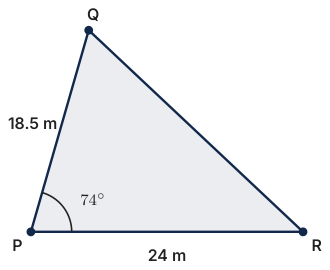
A triangular vegetable plot PQR has \text{PQ} = 18.5 m, \text{PR} = 24 m and angle \text{QPR} = 74^\circ.
Original Photon diagram
(a) Find the length of QR.
[2]
(b) A fence costs S$14.80 per metre. Find the cost of fencing the whole boundary of the plot.
[2]
(c) Find the area of the plot.
[2]
(d) Compost is spread over the whole plot to a depth of 3 cm. Find the volume of compost needed, in cubic metres.
[1]
Show solutionHide solution
(a) \text{QR}^2 = 18.5^2 + 24^2 - 2(18.5)(24)\cos 74^\circ = 673.48
M1[1]
\text{QR} = 26.0 m (3 s.f.).
A1[1]
(b) Perimeter = 18.5 + 24 + 25.952 = 68.452 m
M1[1]
Cost = 68.452 \times 14.80 = \text{S\$}1013.08.
A1[1]
(c) Area = \dfrac12(18.5)(24)\sin 74^\circ
M1[1]
= 213 m^2 (3 s.f.).
A1[1]
(d) 213.40 \times 0.03 = 6.40 m^3 (3 s.f.).
A1[1]

Final answer

  • (a) 26.0 m
  • (b) S$1013.08
  • (c) 213 m^2
  • (d) 6.40 m^3

Question 15

[9 marks]
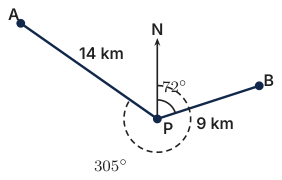
Two rescue boats leave a port P at the same time. Boat A travels 14 km on a bearing of 305^\circ and boat B travels 9 km on a bearing of 072^\circ, each in a straight line.
Original Photon diagram
(a) Find how far west and how far north of P boat A is.
[2]
(b) Find how far east and how far north of P boat B is.
[2]
(c) Hence find the distance between the two boats.
[2]
(d) Find the bearing of boat B from boat A, to the nearest degree.
[3]
Show solutionHide solution
(a) The bearing 305^\circ is 55^\circ west of North. West: 14\sin 55^\circ = 11.468 km
A1[1]
North: 14\cos 55^\circ = 8.030 km
A1[1]
(b) East: 9\sin 72^\circ = 8.560 km
A1[1]
North: 9\cos 72^\circ = 2.781 km
A1[1]
(c) East difference = 8.560 + 11.468 = 20.028 km; north difference = 8.030 - 2.781 = 5.249 km
M1[1]
\text{AB} = \sqrt{20.028^2 + 5.249^2} = 20.7 km (3 s.f.).
A1[1]
(d) Angle below the east line: \tan\phi = \dfrac{5.249}{20.028}, so \phi = 14.69^\circ M1A1
[2]
Bearing = 090^\circ + 14.69^\circ = 104.69^\circ, that is 105^\circ.
A1[1]

Final answer

  • (a) 11.5 km west, 8.03 km north
  • (b) 8.56 km east, 2.78 km north
  • (c) 20.7 km
  • (d) 105^\circ

Question 16

[9 marks]
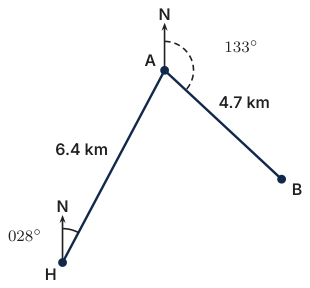
A mountain-rescue search party leaves its base camp H and walks 6.4 km on a bearing of 028^\circ to a cabin A. It then walks 4.7 km on a bearing of 133^\circ to a frozen lake B.
Original Photon diagram
(a) Show that angle \text{HAB} = 75^\circ.
[2]
(b) Find the distance HB.
[2]
(c) Find the area of triangle HAB.
[2]
(d) Find the bearing of B from H, to the nearest degree.
[3]
Show solutionHide solution
(a) The bearing of H from A is 028^\circ + 180^\circ = 208^\circ
M1[1]
\angle HAB = 208^\circ - 133^\circ = 75^\circ
M1[1]
as required.
AG
(b) \text{HB}^2 = 6.4^2 + 4.7^2 - 2(6.4)(4.7)\cos 75^\circ = 47.479
M1[1]
\text{HB} = 6.89 km (3 s.f.).
A1[1]
(c) \dfrac12(6.4)(4.7)\sin 75^\circ
M1[1]
= 14.5 km^2 (3 s.f.).
A1[1]
(d) \dfrac{\sin\angle AHB}{4.7} = \dfrac{\sin 75^\circ}{6.891}, so \angle AHB = 41.21^\circ M1A1
[2]
B is clockwise of the first leg: bearing = 028^\circ + 41.21^\circ = 69.21^\circ, that is 069^\circ.
A1[1]

Final answer

  • (b) 6.89 km
  • (c) 14.5 km^2
  • (d) 069^\circ

Question 17

[9 marks]
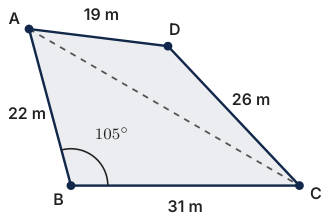
A school playground is a quadrilateral ABCD. \text{AB} = 22 m, \text{BC} = 31 m, \text{CD} = 26 m, \text{DA} = 19 m and angle \text{ABC} = 105^\circ.
Original Photon diagram
(a) Find the length of the diagonal AC.
[3]
(b) Find angle ADC.
[3]
(c) Find the area of the playground.
[3]
Show solutionHide solution
(a) \text{AC}^2 = 22^2 + 31^2 - 2(22)(31)\cos 105^\circ = 1798.03 M1A1
[2]
\text{AC} = 42.4 m (3 s.f.).
A1[1]
(b) \cos D = \dfrac{26^2 + 19^2 - 1798.03}{2(26)(19)} M1A1
[2]
D = 140^\circ (3 s.f.).
A1[1]
(c) Area = \dfrac12(22)(31)\sin 105^\circ + \dfrac12(26)(19)\sin 140.378^\circ M1M1
[2]
= 329.38 + 157.52 = 487 m^2 (3 s.f.).
A1[1]

Final answer

  • (a) 42.4 m
  • (b) 140^\circ
  • (c) 487 m^2

Question 18

[8 marks]
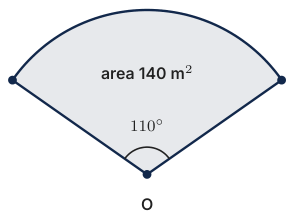
A fan-shaped flower bed is a sector of a circle with centre O. Its angle is 110^\circ and its area is 140 m^2.
Original Photon diagram
(a) Find the radius of the sector.
[3]
(b) Find the perimeter of the flower bed.
[3]
(c) A second bed has the same radius, and its curved edge is 15 m long. Find its angle.
[2]
Show solutionHide solution
(a) \dfrac{110}{360}\times \pi r^2 = 140
M1[1]
r^2 = \dfrac{140\times 360}{110\pi} = 145.84, so r = 12.1 m (3 s.f.). A1A1
[2]
(b) Arc = \dfrac{110}{360}\times 2\pi(12.077) = 23.19 m M1A1
[2]
Perimeter = 23.19 + 2(12.077) = 47.3 m (3 s.f.).
A1[1]
(c) \dfrac{\theta}{360}\times 2\pi(12.077) = 15
M1[1]
\theta = 71.2^\circ (3 s.f.).
A1[1]

Final answer

  • (a) 12.1 m
  • (b) 47.3 m
  • (c) 71.2^\circ

Question 19

[9 marks]
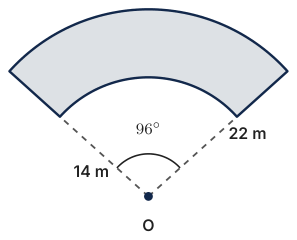
A curved block of seats in an amphitheatre is the region between two circular arcs with the same centre O, with radii 14 m (front row) and 22 m (back row). The block spans an angle of 96^\circ at O, as shown. All answers are to be given in metres or square metres.
Original Photon diagram
(a) Find the area of the seating block.
[3]
(b) Find the length of the back row of seats along its curved edge.
[2]
(c) A safety barrier is fixed around the whole boundary of the block. Find the total length of the barrier.
[4]
Show solutionHide solution
(a) Large sector minus small sector: \dfrac{96}{360}\pi(22^2) - \dfrac{96}{360}\pi(14^2) M1M1
[2]
= 241 m^2 (3 s.f.).
A1[1]
(b) \dfrac{96}{360}\times 2\pi(22)
M1[1]
= 36.9 m (3 s.f.).
A1[1]
(c) Front arc = \dfrac{96}{360}\times 2\pi(14) = 23.457 m
A1[1]
The two straight sides are each 22 - 14 = 8 m
A1[1]
Total = 36.861 + 23.457 + 2(8) = 76.3 m (3 s.f.). M1A1
[2]

Final answer

  • (a) 241 m^2
  • (b) 36.9 m
  • (c) 76.3 m

Question 20

[10 marks]
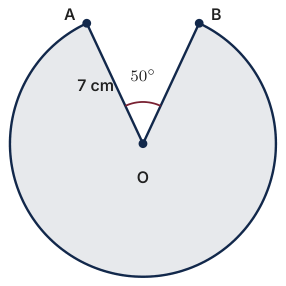
Zainab designs a badge in the shape of a circle of radius 7 cm and centre O, with a sector AOB removed to make a “mouth”. Angle \text{AOB} = 50^\circ and the badge is the shaded region.
Original Photon diagram
(a) Find the perimeter of the badge.
[3]
(b) Find the area of the badge.
[2]
(c) Zainab changes the design: the mouth is closed by the straight line AB, so that the badge is bounded by the major arc and the chord AB. Find the perimeter and the area of this new badge.
[5]
Show solutionHide solution
(a) Major arc = \dfrac{310}{360}\times 2\pi(7) = 37.874 cm M1A1
[2]
Perimeter = 37.874 + 2(7) = 51.9 cm (3 s.f.).
A1[1]
(b) \dfrac{310}{360}\times \pi(7)^2
M1[1]
= 133 cm^2 (3 s.f.).
A1[1]
(c) \text{AB} = 2\times 7\sin 25^\circ = 5.917 cm (or cosine rule) M1A1
[2]
Perimeter = 37.874 + 5.917 = 43.8 cm (3 s.f.)
A1[1]
The new badge is the old badge plus the triangle OAB: 132.56 + \dfrac12(7)^2\sin 50^\circ = 132.56 + 18.77 = 151 cm^2 (3 s.f.). M1A1
[2]

Final answer

  • (a) 51.9 cm
  • (b) 133 cm^2
  • (c) 43.8 cm and 151 cm^2

Mastery

Full exam questions that mix question types, at Paper 1 and Paper 2 standard.
Question 21

[5 marks]
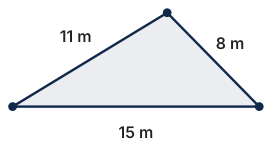
A triangular plot of land has sides of length 8 m, 11 m and 15 m.
Original Photon diagram
(a) Find the size of the largest angle in the triangle.
[3]
(b) Hence find the area of the plot.
[2]
Show solutionHide solution
(a) The largest angle is opposite the longest side (15 m):
\cos\theta = \dfrac{8^2 + 11^2 - 15^2}{2(8)(11)} = \dfrac{-40}{176} = -0.2273.
\theta = 103^{\circ}.
[3]
(b) Area = \tfrac{1}{2}(8)(11)\sin 103^{\circ} = 42.9 m^2.
[2]

Final answer

  • (a) 103^\circ
  • (b) 42.8 m^2

Question 22

[6 marks]
Two hiking trails leave a car park P. Trail A is 55 m long and trail B is 72 m long, and the angle between them at P is 78^{\circ}. The ends of the two trails are joined by a new footpath.
(a) Find the length of the new footpath joining the ends of the two trails.
[3]
(b) Find the area of the triangular region enclosed by the two trails and the footpath.
[3]
Show solutionHide solution
(a) Cosine rule: d^2 = 55^2 + 72^2 - 2(55)(72)\cos 78^{\circ} = 6562.
d = 81.0 m.
[3]
(b) Area = \tfrac{1}{2}(55)(72)\sin 78^{\circ} = 1936.7\ldots = 1940 m^2 (3 s.f.).
[3]

Final answer

  • (a) 81.0 m
  • (b) 1940 m^2

Question 23

[13 marks]
A ferry sails from harbour A to island B, a distance of 30 km on a bearing of 075^{\circ}. From B it then sails to lighthouse C, a distance of 45 km on a bearing of 160^{\circ}.
(a) Show that the angle A\hat{B}C = 95^{\circ}.
[2]
(b) Find the direct distance AC from the harbour to the lighthouse.
[3]
(c) Find the size of the angle B\hat{A}C.
[3]
(d) Hence find the bearing of the lighthouse C from the harbour A.
[2]
(e) Find the area of the triangle ABC.
[3]
Show solutionHide solution
(a) Back-bearing from B to A is 075^{\circ}+180^{\circ}=255^{\circ}. Angle A\hat{B}C = 255^{\circ}-160^{\circ}=95^{\circ}.
[2]
(b) AC^2 = 30^2 + 45^2 - 2(30)(45)\cos 95^{\circ} = 3160.3.
AC = 56.2 km.
[3]
(c) Sine rule: \dfrac{\sin(B\hat{A}C)}{45} = \dfrac{\sin 95^{\circ}}{56.2}, so \sin(B\hat{A}C) = 0.7975.
B\hat{A}C = 52.9^{\circ}.
[3]
(d) Bearing of C from A = 075^{\circ} + 52.9^{\circ} = 128^{\circ}.
[2]
(e) Area = \tfrac{1}{2}(30)(45)\sin 95^{\circ} = 672 km^2.
[3]

Final answer

  • (b) 56.2 km
  • (c) 52.9^\circ
  • (d) 128^\circ
  • (e) 672 km^2

Question 24

[12 marks]
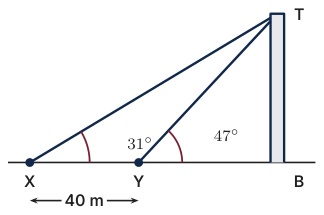
A monument stands on level ground. A surveyor standing at point X measures the angle of elevation to the top T of the monument to be 31^{\circ}. She then walks 40 m directly towards the base B of the monument to point Y, where the angle of elevation to T is 47^{\circ}.
Original Photon diagram
(a) Show that the angle X\hat{T}Y = 16^{\circ}.
[2]
(b) Find the distance TY.
[4]
(c) Hence find the height of the monument.
[3]
(d) Find the distance from Y to the base B of the monument.
[3]
Show solutionHide solution
(a) In triangle XTY, angle T\hat{Y}B = 47^{\circ}, so angle X\hat{Y}T = 180^{\circ}-47^{\circ}=133^{\circ}. Then X\hat{T}Y = 180^{\circ}-31^{\circ}-133^{\circ}=16^{\circ}.
[2]
(b) Sine rule in triangle XTY: \dfrac{TY}{\sin 31^{\circ}} = \dfrac{40}{\sin 16^{\circ}}, so TY = \dfrac{40\sin 31^{\circ}}{\sin 16^{\circ}} = 74.7 m.
[4]
(c) Height TB = TY\sin 47^{\circ} = 74.7 \times 0.7314 = 54.7 m.
[3]
(d) YB = TY\cos 47^{\circ} = 74.7 \times 0.6820 = 51.0 m.
[3]

Final answer

  • (b) 74.7 m
  • (c) 54.7 m
  • (d) 51.0 m

Question 25

[11 marks]
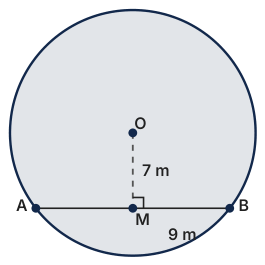
A circular pond has centre O. A straight boardwalk AB crosses the pond, with A and B on its edge, and AB = 18 m. The midpoint M of AB is 7 m from O.
Original Photon diagram
(a) Find the radius of the pond.
[2]
(b) Show that angle A\hat{O}B=104^\circ, correct to the nearest degree.
[2]
(c) Find the length of the shorter arc AB.
[2]
(d) Find the area of the smaller part of the pond, between the boardwalk and the shorter arc.
[3]
(e) A fence is built along the shorter arc. Fencing costs 42.50 euros per metre. Find the cost of the fence.
[2]
Show solutionHide solution
(a) \sqrt{9^2+7^2}=\sqrt{130} M1 =11.4 m (11.402) A1 (b) \tfrac12 A\hat{O}B=\tan^{-1}\frac97=52.13^\circ M1 A\hat{O}B=104.25^\circ=104^\circ A1AG (c) \frac{104.25}{360}\times2\pi(11.402) M1 =20.7 m (20.746) A1 (d) sector \frac{104.25}{360}\pi(130)=118.27 M1 triangle \tfrac12(18)(7)=63 M1 segment =55.3 m^2 (55.27) A1 (e) 20.746\times42.50 M1 = EUR 881.69
A1

Final answer

  • (a) 11.4 m
  • (b) shown
  • (c) 20.7 m
  • (d) 55.3 m^2
  • (e) EUR 881.69

Question 26

[17 marks]
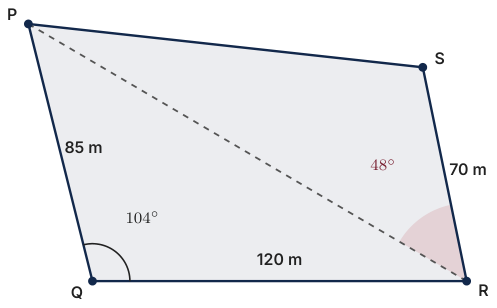
A community park is the quadrilateral PQRS, with PQ = 85 m, QR = 120 m, angle PQR = 104^\circ, RS = 70 m and angle PRS = 48^\circ.
Original Photon diagram
(a) Find the length PR.
[3]
(b) Find the size of angle QPR.
[3]
(c) Find the length SP.
[3]
(d) Find the area of the park.
[4]
A play area is the sector with centre R and radius 25 m, between RS and RP.
(e) Find the area of the play area.
[2]
(f) Find the percentage of the park used by the play area.
[2]
Show solutionHide solution
(a) PR^2=85^2+120^2-2(85)(120)\cos104^\circ M1A1 PR=163 m (162.97) A1 (b) \frac{\sin Q\hat{P}R}{120}=\frac{\sin104^\circ}{162.97} M1A1 angle QPR is opposite QR, shorter than PR, so it is acute: Q\hat{P}R=45.6^\circ (45.598) A1 (c) SP^2=162.97^2+70^2-2(162.97)(70)\cos48^\circ M1A1 SP=127 m (127.25) A1 (d) \tfrac12(85)(120)\sin104^\circ=4948.5 M1A1 \tfrac12(162.97)(70)\sin48^\circ=4238.9 M1 total =9190 m^2 (9187.4) A1 (e) \frac{48}{360}\pi(25)^2 M1 =262 m^2 (261.80) A1 (f) \frac{261.80}{9187.4}\times100 M1 =2.85\%
A1

Final answer

  • (a) 163 m
  • (b) 45.6^\circ
  • (c) 127 m
  • (d) 9190 m^2
  • (e) 262 m^2
  • (f) 2.85%

Going further

Beyond the syllabus: the worked examples and investigations of the chapter's Going further pages.

G1 Two routes to the area from three sides

G1 Worked example

[7 marks]
Ravi edges a triangular herb bed with sides 9 m, 10 m and 17 m.
(a) Use Heron's formula to find the area of the bed.
[2]
(b) Find the angle opposite the longest side, and use it to check the area.
[3]
(c) Find the shortest distance from the corner opposite the longest side to that side.
[2]
Show solutionHide solution
(a) s=18 and \sqrt{18\times9\times8\times1} M1 =36 m^2 A1 (b) \cos C=\frac{9^2+10^2-17^2}{2(9)(10)}=-0.6 M1 C=127^\circ (126.87) A1 \tfrac12(9)(10)\sin126.87^\circ=36 m^2, the same area A1 (c) \frac{2\times36}{17} M1 =4.24 m
A1

Final answer

(a) 36 m^2 (b) 127^\circ and 36 m^2 (c) 4.24 m

G2 Fixed fence, biggest area

G2 Worked example

[5 marks]
Mei has 60 m of fencing for a triangular plot.
(a) Find the area when the sides are 25 m, 25 m and 10 m.
[2]
(b) Find the area when the sides are 22 m, 22 m and 16 m.
[2]
(c) Find the area when all three sides are 20 m, and say which of the three plots encloses most.
[1]
Show solutionHide solution
(a) s=30 and \sqrt{30\times5\times5\times20} M1 =122 m^2 (122.47) A1 (b) \sqrt{30\times8\times8\times14} M1 =164 m^2 (163.95) A1 (c) \sqrt{30\times10\times10\times10}=173 m^2 (173.2), the largest
A1

Final answer

(a) 122 m^2 (b) 164 m^2 (c) 173 m^2; the equilateral plot

G3 Investigation

[17 marks]
(a) A triangle has sides 13 m, 14 m and 15 m. Use the cosine rule to find the angle opposite the side of 15 m, and hence find the area of the triangle.
[3]
(b) Show that Heron's formula gives the same area.
[2]
Ana has 60 m of fencing to make a triangular pen. One side of the pen is 20 m long, and the other two sides are x m and (40-x) m.
(c) Use Heron's formula to show that the area of the pen is A=\sqrt{300(30-x)(x-10)} m^2.
[2]
(d) Use your GDC to complete a table of A for x=12, 15, 18, 20, 22, 25.
[2]
(e) Write down the value of x that gives the greatest area, and describe the shape of the pen.
[2]
(f) Explain why x must lie between 10 and 30.
[1]
Now no side is fixed. The pen is an isosceles triangle with base b m and two equal sides, with perimeter 60 m.
(g) Use a GDC graph of the area against b to find the base that gives the greatest area, and that area.
[3]
(h) Compare your answer to (g) with the area of a square pen and of a circular pen made from 60 m of fencing.
[2]
Show solutionHide solution
(a) \cos C=\frac{13^2+14^2-15^2}{2(13)(14)} M1 C=67.4^\circ (67.38) A1 \tfrac12(13)(14)\sin67.38^\circ=84 m^2 A1 (b) s=21 and \sqrt{21\times8\times7\times6} M1 =84 m^2 A1 (c) s=30 and s-20=10, s-x=30-x, s-(40-x)=x-10 M1 A=\sqrt{30\times10\times(30-x)(x-10)}=\sqrt{300(30-x)(x-10)} A1AG (d) 104, 150, 170, 173, 170, 150 (103.9, 150, 169.7, 173.2, 169.7, 150) A2 (e) x=20 A1 the sides are 20, 20 and 20, an equilateral triangle, with area 173 m^2 A1 (f) each side must be shorter than the other two together: x+20>40-x and (40-x)+20>x R1 (g) A=\frac b2\sqrt{900-30b} M1 maximum at b=20 A1 A=173 m^2 (173.2): again equilateral A1 (h) square: side 15 m, 225 m^2 A1 circle: r=\frac{60}{2\pi}, area =286 m^2 (286.5)
A1

Final answer

(a) 67.4^\circ, 84 m^2 (b) shown (c) shown (d) 104, 150, 170, 173, 170, 150 (e) x=20, an equilateral triangle of area 173 m^2 (f) each side must be shorter than the other two together (g) b=20, 173 m^2 (h) square 225 m^2, circle 286 m^2; both larger

From the book

Photon Guidebook: Mathematics Applications and Interpretation SL for the IB Diploma

Chapter 5 teaches triangles, bearings and circles from the basics to full exam questions: how the IB asks it, every question type with a marked example, and these practice questions in three steps.

About the book