Free worked solutions · 2026 Edition

IB Maths AI SL Chapter 4: Modelling with functions worked solutions

Worked solutions to the practice questions in Chapter 4 of Photon Guidebook: Mathematics Applications and Interpretation SL for the IB Diploma (2026 Edition). Each solution shows every step with the mark it earns, the way an IB mark scheme does.

  • Chapter 4 of 15
  • 26 practice questions
  • 2 Going further
  • Free, no sign-up

Basics

One idea at a time, in the order the chapter teaches them.

Question 1

[4 marks]
A refill service uses C(n)=an+b. It charges 23 dollars for 2 bottles and 41 dollars for 5 bottles.
Find a,b and interpret the fixed charge.
[4]
Show solutionHide solution
2a+b=23, 5a+b=41.
M1
Subtracting gives a=6.
A1
b=11, so C(n)=6n+11.
A1
The fixed charge is 11 dollars even before any per-bottle charge.
R1

Final answer

a=6, b=11; the fixed charge is 11 dollars

Question 2

[3 marks]
A scale display Y is modelled as directly proportional to x^2: Y=kx^2. The display reads 54 when x=3.
Find the rule and the positive setting producing Y=150.
[3]
Show solutionHide solution
54=k(3)^2, so k=6. M1A1
6x^2=150 gives the positive setting x=5.
A1

Final answer

k=6; x=5

Question 3

[4 marks]
Illumination L is modelled by L=k/d^2, where d>0 is distance in metres. At d=3, L=44 units.
Find k and predict L at d=6. Explain the change.
[4]
Show solutionHide solution
k=44(3)^2=396. M1A1
L(6)=396/36=11 units.
A1
Doubling distance multiplies its square by 4, so the output is quartered.
R1

Final answer

k=396; L=11, a quarter of the value at d=3

Question 4

[4 marks]
A decorative arch profile is h(x)=ax^2+c, symmetric about x=0. Its height is 5.7 metres at the centre and 4.5 metres at x=2.
Find a,c and predict the height at x=3.
[4]
Show solutionHide solution
h(0)=c=5.7.
A1
4a+5.7=4.5.
M1
a=-0.3, giving h(x)=-0.3x^2+5.7.
A1
h(3)=3.0 m.
A1

Final answer

c=5.7, a=-0.3; the height at x=3 is 3.0 m

Question 5

[4 marks]
A calibration model is Q(x)=ax^2+bx+c. Measurements are Q(0)=7, Q(1)=10, Q(3)=28.
Form the equations and use technology to find the three coefficients.
[4]
Show solutionHide solution
c=7.
A1
a+b+c=10, 9a+3b+c=28.
M1
The simultaneous solver gives a=2, b=1. A1A1
The rule is Q(x)=2x^2+x+7.

Final answer

a=2, b=1, c=7

Question 6

[5 marks]
A cubic calibration has form C(x)=ax^3+bx^2+cx+d. Its readings at inputs 0,1,2,3 are 2,4,16,44, respectively.
Form four equations and use a GDC simultaneous solver to find a,b,c,d.
[5]
Show solutionHide solution
d=2, a+b+c+d=4.
M1
8a+4b+2c+d=16, 27a+9b+3c+d=44.
M1
a=1, b=2. A1A1
c=-1, d=2.
A1
C(x)=x^3+2x^2-x+2.

Final answer

a=1, b=2, c=-1, d=2

Question 7

[4 marks]
A culture count is modelled by P(t)=ab^t, where t is in days. P(0)=260 and P(3)=449.28.
Find a,b with technology and state the daily percentage growth.
[4]
Show solutionHide solution
a=260.
A1
Solve 260b^3=449.28 for b>0.
M1
b=1.2.
A1
The daily growth is 20%.
A1

Final answer

a=260, b=1.2; growth of 20% a day

Question 8

[4 marks]
A repeating lighting intensity is modelled by I(t)=a\sin(bt)+d, with angles in degrees. Its maximum is 84, minimum 28 and period 18 seconds. Assume a,b>0. Amplitude is half the difference of maximum and minimum; d is their midpoint; b=360/\text{period}.
Find a,b,d and predict I(0).
[4]
Show solutionHide solution
a=(84-28)/2=28.
A1
b=360/18=20.
A1
d=(84+28)/2=56.
A1
I(0)=56.
A1

Final answer

a=28, b=20, d=56; I(0)=56

Question 9

[5 marks]
A daily sound-level index is L(t)=7\sin(15t)+25, for 0\leq t\leq24 hours, using degrees.
Use a GDC in degree mode to find all inputs where L(t)=29, to 3 significant figures, and state the interval where the index exceeds 29.
[5]
Show solutionHide solution
Graph/intersect 7\sin(15t)+25=29 across the full domain.
M1
t=2.32 and t=9.68 hours (3 s.f.). A1A1
2.32<t<9.68, using rounded boundaries.
A1
The strict condition excludes equality at the two crossing times.
R1

Final answer

t=2.32 and t=9.68; above 29 for 2.32<t<9.68

Question 10

[3 marks]
At inputs x=2,4,8, outputs are 18,9,4.5. Candidate forms are y=kx and y=k/x.
Calculate the three products xy and select a form with a reason.
[3]
Show solutionHide solution
The products are 36,36,36.
A1
Choose y=k/x, with k=36.
A1
Constant xy is the signature of inverse variation.
R1

Final answer

the products are all 36, so y=36/x

Tutorial

Exam-style questions on each question type, with the marks the IB would give.

Question 11

[7 marks]
A caterer charges a fixed set-up fee plus a fixed price for each guest. A party of 40 guests costs SGD 1320 and a party of 65 guests costs SGD 1970. The cost C Singapore dollars (SGD) for n guests is modelled by a linear function.
(a) Find the price charged for each guest.
[2]
(b) Write down the equation of the model in the form C=an+b.
[2]
(c) Interpret the value of b in this context.
[1]
(d) Find the cost of a party of 100 guests.
[1]
(e) A customer has a budget of SGD 3500. Find the greatest number of guests the caterer can serve within this budget.
[1]
Show solutionHide solution
(a) a=\dfrac{1970-1320}{65-40}
M1[1]
=26, so the price is SGD 26 per guest.
A1[1]
(b) 1320=26(40)+b
M1[1]
b=280, so C=26n+280.
A1[1]
(c) b=280 is the set-up fee (the cost when n=0): SGD 280.
A1[1]
(d) C=26(100)+280=2880, so SGD 2880.
A1[1]
(e) 26n+280\le3500\Rightarrow n\le123.8\ldots, so the greatest number of guests is 123.
A1[1]

Final answer

SGD 26; C=26n+280; SGD 280 set-up fee; SGD 2880; 123

Question 12

[7 marks]
The time T hours taken by a team to paint a long fence is inversely proportional to the number n of painters, so that T=\dfrac{a}{n}. Four painters take 15 hours.
(a) Find the value of a.
[2]
(b) Find the time taken by 10 painters.
[1]
(c) Find the least number of painters needed to finish the fence in less than 5 hours.
[2]
(d) State one assumption that the model makes about the painters.
[1]
(e) Explain why n=0 is not in the domain of the model.
[1]
Show solutionHide solution
(a) 15=\dfrac{a}{4}
M1[1]
a=60.
A1[1]
(b) T=\dfrac{60}{10}=6 hours.
A1[1]
(c) \dfrac{60}{n}<5\Rightarrow n>12
M1[1]
so the least number of painters is 13.
A1[1]
(d) For example: every painter works at the same rate and they do not get in each other's way.
R1[1]
(e) With no painters the fence would never be painted (\frac{60}{0} is undefined).
R1[1]

Final answer

a=60; 6 h; 13 painters; equal work rates; 60/0 is undefined

Question 13

[7 marks]
Ayesha posts a video. The number of views V of the video t days after it is posted is modelled by V=k\,a^{t}. When it is posted there are 240 views, and 3 days later it has had 810 views.
(a) Write down the value of k.
[1]
(b) Find the value of a.
[2]
(c) Find the percentage increase in the number of views each day.
[1]
(d) Predict the number of views after 7 days.
[1]
(e) Find how many days it takes for the number of views to reach 10 000. Give your answer correct to 3 significant figures.
[2]
Show solutionHide solution
(a) k=240 (the value when t=0).
A1[1]
(b) 240a^{3}=810
M1[1]
a^{3}=3.375\Rightarrow a=1.5.
A1[1]
(c) a=1.5, so the views increase by 50% each day.
A1[1]
(d) V=240(1.5)^{7}=4100.6\ldots\approx 4100 views.
A1[1]
(e) Solve 240(1.5)^{t}=10\,000 on the GDC (graph intersection or numerical solver).
M1[1]
t=9.20 days.
A1[1]

Final answer

k=240; a=1.5; 50% a day; 4100 views; 9.20 days

Question 14

[8 marks]
A tidal turbine has a rotor of diameter 11 m. Its axle is 12 m above the sea bed and the rotor turns 15 times per minute. A marker on the tip of one blade is level with the axle and moving upwards at t=0. Let h=a\sin(bt)+d metres be the height of the marker above the sea bed after t seconds, with the angle bt in degrees.
(a) Write down the values of a and d.
[2]
(b) Find the period of the rotation and the value of b.
[2]
(c) Write down the model and find the height of the marker when t=0.7 s.
[2]
(d) Kofi writes a=11. Explain his mistake.
[1]
(e) Write down the greatest and least heights of the marker above the sea bed.
[1]
Show solutionHide solution
(a) The amplitude is the radius, a=\dfrac{11}{2}=5.5.
A1[1]
The principal axis is at axle height, d=12.
A1[1]
(b) 15 turns per minute is one turn every \dfrac{60}{15}=4 s.
M1[1]
b=\dfrac{360}{4}=90.
A1[1]
(c) h=5.5\sin(90t)^{\circ}+12.
A1[1]
h(0.7)=12+5.5\sin 63^{\circ}=12+4.90\ldots=16.9 m (3 s.f.).
A1[1]
(d) The amplitude is half the diameter (the radius), not the diameter itself.
R1[1]
(e) Greatest height 12+5.5=17.5 m; least height 12-5.5=6.5 m.
A1[1]

Final answer

a=5.5, d=12; 4 s, b=90; 16.9 m; a is the radius; 17.5 m, 6.5 m

Question 15

[8 marks]
Mei Ling models the arch of a footbridge by a quadratic function y=ax^{2}+bx+c, where y metres is the height of the arch above the water at a horizontal distance of x metres from the left bank. She measures three points on the arch: (0,\,1.5), (4,\,7.5) and (10,\,1.5).
(a) Write down three equations for a, b and c.
[2]
(b) Use your GDC to solve these equations to find a, b and c.
[2]
(c) Find the greatest height of the arch above the water and the horizontal distance from the left bank at which it occurs.
[2]
(d) A boat can only pass under the arch where the arch is at least 6 m above the water. Find the width of the channel in which the boat can pass.
[2]
Show solutionHide solution
(a) c=1.5
A1[1]
16a+4b+c=7.5 and 100a+10b+c=1.5
A1[1]
(b) Simultaneous equation solver on the GDC (three unknowns):
M1[1]
a=-0.25, b=2.5, c=1.5.
A1[1]
(c) Vertex at x=-\dfrac{2.5}{2(-0.25)}=5 m
A1[1]
y=-0.25(25)+2.5(5)+1.5=7.75 m.
A1[1]
(d) Solve -0.25x^{2}+2.5x+1.5=6: x=2.354\ldots and x=7.646\ldots
M1[1]
width =7.646-2.354=5.29 m.
A1[1]

Final answer

a=-0.25, b=2.5, c=1.5; 7.75 m at 5 m; width 5.29 m

Question 16

[7 marks]
A hiking app models the height h metres of a trail above the trailhead by a cubic function with no constant term,
h=ax^{3}+bx^{2}+cx,
where x kilometres is the distance walked along the trail. Three readings are taken: h=6.8 at x=2, h=5 at x=5 and h=3.2 at x=8.
(a) Explain why the model has no constant term.
[1]
(b) Write down three equations and use your GDC to find a, b and c.
[3]
(c) Find the height and distance of the highest point of the first climb (the local maximum).
[2]
(d) Find the height and distance of the lowest point after that (the local minimum).
[1]
Show solutionHide solution
(a) At the trailhead x=0 and the height above the trailhead is 0, so h(0)=0 forces the constant term to be zero.
R1[1]
(b) 8a+4b+2c=6.8, 125a+25b+5c=5, 512a+64b+8c=3.2
M1[1]
GDC simultaneous solver:
M1[1]
a=0.1, b=-1.5, c=6.
A1[1]
(c) Graph h=0.1x^{3}-1.5x^{2}+6x, Analyze Graph, Maximum:
M1[1]
x=2.76 km, h=7.24 m.
A1[1]
(d) Analyze Graph, Minimum: x=7.24 km, h=2.76 m.
A1[1]

Final answer

h(0)=0; a=0.1, b=-1.5, c=6; maximum 7.24 m at 2.76 km; minimum 2.76 m at 7.24 km

Question 17

[8 marks]
Lena, an ecologist, models the water temperature, W\,{}^\circC, of a lake t months after the start of April by W=a\sin(bt)+c, where the period of the model is 12 months. She records 19.8\,{}^\circC at t=3 and 11.1\,{}^\circC at t=7.
(a) Find the value of b.
[1]
(b) Write down two equations in a and c.
[2]
(c) Find the values of a and c.
[2]
(d) A reading of 16.5\,{}^\circC was taken at t=1. Determine whether this reading lies above or below the graph of the model.
[2]
(e) Write down the greatest temperature predicted by the model.
[1]
Show solutionHide solution
(a) b=\frac{360}{12}=30 A1 (b) \sin 90^\circ=1, so a+c=19.8 A1 \sin 210^\circ=-0.5, so -0.5a+c=11.1 A1 (c) Subtracting gives 1.5a=8.7 M1 a=5.8, c=14.0 A1 (d) W(1)=5.8\sin 30^\circ+14=16.9 M1 16.5<16.9, so the reading lies below the graph A1 (e) a+c=19.8\,{}^\circC
A1

Final answer

b=30; a=5.8, c=14.0; W(1)=16.9, below; 19.8 ^\circC

Question 18

[9 marks]
A windpump on a farm has blades of length 3 m. The centre of the blades is 9 m above the ground and the blades turn at 20 revolutions per minute. The tip of one blade is at its lowest point at t=0. The height of the tip above the ground, h metres, t seconds later is modelled by h=d-a\cos(bt).
(a) Write down the greatest and least heights of the tip.
[2]
(b) Find the time for one revolution and the value of b.
[2]
(c) Sketch the graph of h for one revolution, labelling the highest and lowest points.
[2]
(d) A wall 10.5 m high stands beside the windpump. Find the length of time in each revolution for which the tip is above the top of the wall.
[2]
(e) Find the probability that, at a randomly chosen moment, the tip is above the top of the wall.
[1]
Show solutionHide solution
(a) Greatest height 12 m A1 least height 6 m A1 (b) 60\div20=3 s A1 b=\frac{360}{3}=120 A1 (c) A cosine shape, inverted, starting at the lowest point (0,6), rising to (1.5,12) and returning to (3,6) A1A1 (d) 9-3\cos(120t)=10.5 gives \cos(120t)=-0.5, so t=1 and t=2 M1 the tip is above the wall for 1 s A1 (e) \frac13
A1

Final answer

12 m, 6 m; 3 s, b=120; sketch; 1 s; \frac13

Question 19

[10 marks]
In a poultry shed on a farm the air temperature has a daily cycle. The coldest temperature of the day is 14.5\,{}^{\circ}C, reached at 04:00, and the warmest is 31.5\,{}^{\circ}C, reached 12 hours later. Let T=d-a\cos(bt) degrees Celsius, where t is the number of hours after 04:00 and the angle bt is in degrees.
(a) Find the values of a, b and d, and write down the model.
[4]
(b) Find the temperature at 10:30.
[2]
(c) Find the times of day, during the 24 hours starting at 04:00, at which the temperature is 28\,{}^{\circ}C.
[3]
(d) Find the number of hours in a day for which the temperature is above 28\,{}^{\circ}C.
[1]
Show solutionHide solution
(a) a=\dfrac{31.5-14.5}{2}=8.5 A1 [1] and d=\dfrac{31.5+14.5}{2}=23.
A1[1]
The coldest time is t=0 and the warmest is t=12, half a period later, so the period is 24 hours and b=\dfrac{360}{24}=15.
A1[1]
Coldest at t=0 means a minus cosine: T=23-8.5\cos(15t)^{\circ}.
A1[1]
(b) 10{:}30 is t=6.5: T=23-8.5\cos 97.5^{\circ}.
M1[1]
T=23+1.109\ldots=24.1\,{}^{\circ}C (3 s.f.).
A1[1]
(c) Solve 23-8.5\cos(15t)^{\circ}=28 on the GDC (graph y=T and y=28 for 0\le t\le 24).
M1[1]
t=8.40 and t=15.6.
A1[1]
Times: 04{:}00+8.40 h =12{:}24 and 04{:}00+15.6 h =19{:}36.
A1[1]
(d) 15.598\ldots-8.402\ldots=7.20 hours.
A1[1]

Final answer

a=8.5, b=15, d=23; 24.1 ^\circC; 12:24 and 19:36; 7.20 hours

Question 20

[10 marks]
The sea temperature at two beaches is modelled over a year by
\begin{gathered}T_{A}=21-6\cos(30m),\\ T_{B}=19-3\cos(30m),\\ 0\le m\le 12,\end{gathered}
where T is in ^{\circ}C and m is the number of months after the start of January. The angle is in degrees.
(a) For beach A, find the coldest and the warmest temperatures, and the month in which each first occurs.
[3]
(b) Write down the period of each model.
[1]
(c) Find the temperature at beach A at m=9.
[1]
(d) Use your GDC to find the two values of m for which the two beaches have the same temperature. Give your answers correct to 3 significant figures.
[3]
(e) Find the percentage of the year for which beach A is warmer than beach B. Give your answer correct to 3 significant figures.
[2]
Show solutionHide solution
(a) coldest =21-6=15^{\circ}C, when \cos(30m)=1, at m=0 (start of January)
A1[1]
warmest =21+6=27^{\circ}C
A1[1]
when \cos(30m)=-1, 30m=180, m=6 (start of July).
A1[1]
(b) \dfrac{360}{30}=12 months for both.
A1[1]
(c) T_{A}=21-6\cos270^{\circ}=21^{\circ}C.
A1[1]
(d) Solve 21-6\cos(30m)=19-3\cos(30m), that is \cos(30m)=\tfrac23.
M1[1]
m=1.61
A1[1]
m=10.4 (symmetric about m=6).
A1[1]
(e) Beach A is warmer when \cos(30m)<\tfrac23, i.e. for 1.606<m<10.394, which is 8.788 months.
M1[1]
\dfrac{8.788}{12}\times100=73.2\%.
A1[1]

Final answer

15 ^\circC at m=0, 27 ^\circC at m=6; 12; 21 ^\circC; 1.61, 10.4; 73.2%

Mastery

Full exam questions that mix question types, at Paper 1 and Paper 2 standard.

Question 21

[13 marks]
A town's population P (in thousands) is recorded at the start of each year, for five years: t=0,1,2,3,4 give 20.0, 21.0, 22.4, 24.2, 26.5 respectively. The town council considers two models for t between 0 and 4:
Model Q: P=at^{2}+bt+c, passing through the data points at t=0, t=2 and t=4.
Model E: P=k\,a^{t}, passing through the data points at t=0 and t=4.
(a) Find the values of a, b and c for Model Q.
[4]
(b) Find the values of k and a for Model E.
[3]
(c) For t=1, t=2 and t=3, compare the values predicted by each model with the data. Give your answers to 3 significant figures.
[3]
(d) Predict the population at t=10 using each model, and comment on the difference.
[2]
(e) The council wants a model that is reliable up to t=10. Which of the two would you recommend? Justify your answer using the shape of the data and the range of t.
[1]
Show solutionHide solution
(a) c=20.0
A1[1]
4a+2b+20=22.4 and 16a+4b+20=26.5
A1[1]
GDC simultaneous solver
M1[1]
a=0.2125, b=0.775.
A1[1]
(b) k=20.0
A1[1]
20a^{4}=26.5\Rightarrow a^{4}=1.325
M1[1]
a=1.0729.
A1[1]
(c) Model Q: 21.0, 22.4, 24.2 (unrounded 20.9875, 22.4, 24.2375): exact or almost exact.
A1[1]
Model E: 21.5, 23.0, 24.7 (the model over-estimates at t=1,2,3).
A1[1]
Data: 21.0, 22.4, 24.2; Model Q matches the data to within 0.04 (before rounding), Model E is out by about 0.5 to 0.6 thousand.
A1[1]
(d) Model Q: 0.2125(100)+0.775(10)+20=49.0 thousand; Model E: 20(1.0729)^{10}=40.4 thousand.
A1[1]
The predictions differ by about 8.6 thousand, since they have different long-term shapes (quadratic against exponential) although they agree at the data.
R1[1]
(e) Model Q fits all five data points far better; the successive increases (1.0,1.4,1.8,2.3) change by about 0.4 each year (a quadratic pattern), whereas the ratios (1.050,1.067,1.080,1.095) are not constant. But t=10 is well outside the data, so either prediction needs caution: recommend Q, and monitor.
R1[1]

Final answer

Q: a=0.2125, b=0.775, c=20.0; E: k=20.0, a=1.0729; E is 0.5 to 0.6 too high; t=10: Q 49.0, E 40.4; recommend Q
Question 22

[12 marks]
The clock on a town hall has its centre 6.0 m above the ground. Its minute hand is 1.2 m long and its hour hand is 0.8 m long.
(a) Find how far apart the ends of the two hands are at 2:00.
[2]
The end of the minute hand is h metres above the ground t minutes after 2:00, where h=a\cos(bt)+d.
(b) Find the values of a, b and d.
[3]
(c) Find h at 2:40.
[1]
(d) Find the number of minutes in each hour for which the end of the minute hand is less than 5.5 m above the ground.
[3]
(e) Write down a model for H, the height in metres of the end of the hour hand above the ground, t minutes after 2:00.
[2]
(f) Find H at 3:00.
[1]
Show solutionHide solution
(a) The angle between the hands is 2\times30^\circ=60^\circ M1 d^2=1.2^2+0.8^2-2(1.2)(0.8)\cos 60^\circ=1.12, so the distance is 1.06 m A1 (b) a=1.2 A1 b=\frac{360}{60}=6 A1 d=6.0 A1 (c) h(40)=1.2\cos 240^\circ+6=5.4 m A1 (d) 1.2\cos(6t)+6=5.5 gives t=19.10 and t=40.90 M1A1 40.90-19.10=21.8 minutes A1 (e) At 2:00 the hour hand is 60^\circ from the vertical and it turns 0.5^\circ a minute A1 H=6+0.8\cos(60+0.5t) A1 (f) t=60: H=6+0.8\cos 90^\circ=6.0 m
A1

Final answer

1.06 m; a=1.2, b=6, d=6.0; 5.4 m; 21.8 minutes; H=6+0.8\cos(60+0.5t); 6.0 m

Question 23

[15 marks]
An island's electricity demand D (in megawatts, MW) is modelled by
D=85+35\cos(15t),\qquad 0\le t\le 24,
where t is the number of hours after 18:00 and the angle is in degrees.
(a) Find the period of the model, and the greatest and least demand.
[3]
(b) Find the demand at t=5 and at t=14, correct to 3 significant figures.
[2]
(c) Use your GDC to find the total number of hours, in the 24 hours from 18:00, for which the demand exceeds 100 MW. Give the times at which the demand crosses 100 MW correct to the nearest minute.
[4]
(d) The hourly cost K (in thousands of Singapore dollars) of generating D MW is linear in D. Generating 60 MW costs 150 thousand and generating 100 MW costs 230 thousand. Find the equation K=aD+b.
[3]
(e) Find the hourly cost at the greatest demand and at the least demand.
[2]
(f) Interpret the value of b in this context.
[1]
Show solutionHide solution
(a) period =\dfrac{360}{15}=24 hours
A1[1]
greatest =85+35=120 MW
A1[1]
least =85-35=50 MW.
A1[1]
(b) t=5: 85+35\cos75^{\circ}=94.1 MW
A1[1]
t=14: 85+35\cos210^{\circ}=54.7 MW.
A1[1]
(c) Solve 85+35\cos(15t)=100, i.e. \cos(15t)=\tfrac37 (GDC intersection).
M1[1]
t=4.308 and t=19.692 (the demand exceeds 100 MW for 0\le t<4.308 and for 19.692<t\le24).
A1[1]
18{:}00+4.308\text{ h}=22{:}18 and 18{:}00+19.692\text{ h}=13{:}42 (next day).
A1[1]
Total time =4.308+(24-19.692)=8.62 hours.
A1[1]
(d) a=\dfrac{230-150}{100-60}=2 M1A1
[2]
150=2(60)+b\Rightarrow b=30, so K=2D+30.
A1[1]
(e) D=120: K=2(120)+30=270 thousand SGD
A1[1]
D=50: K=2(50)+30=130 thousand SGD.
A1[1]
(f) b=30: a fixed hourly cost of SGD 30 000 of running the generators even at zero output.
A1[1]

Final answer

24 h, 120 MW, 50 MW; 94.1, 54.7 MW; 22:18, 13:42, 8.62 h; K=2D+30; 270, 130 thousand SGD; fixed cost

Question 24

[12 marks]
A car ferry crosses a river estuary from a ramp at Seal Point. High water, of depth 5.9 m at the ramp, occurs at 02:00 and the following low water, of depth 2.3 m, occurs at 08:00. The depth of water at the ramp, D metres, t hours after 02:00 is modelled by D=a\cos(bt)+d.
(a) Find the values of a, b and d.
[3]
(b) Find the depth of water at the ramp at 06:30.
[1]
The ferry can only use the ramp when the depth is more than 3.2 m. The actual depth may differ from the model by up to 0.2 m above or below.
(c) Find the latest time after 02:00, before the low water, at which it could still be possible for the ferry to use the ramp. Give your answer to the nearest minute.
[3]
(d) Find the earliest time after the low water at which the ferry is certain to be able to use the ramp.
[3]
(e) The ferry leaves the ramp at the time found in (d). Each crossing takes 35 minutes. Find the greatest length of time the ferry can spend at the far side and still be certain of using the ramp when it returns the same day.
[2]
Show solutionHide solution
(a) a=\frac{5.9-2.3}{2}=1.8 A1 d=\frac{5.9+2.3}{2}=4.1 A1 high water to low water is 6 h, so the period is 12 h and b=30 A1 (b) D(4.5)=1.8\cos 135^\circ+4.1=2.83 m A1 (c) It could be possible when D+0.2>3.2, that is D>3.0 M1 t=4.2557 A1 the latest time is 06:15 A1 (d) It is certain when D-0.2>3.2, that is D>3.4 M1 t=8.2372 A1 the earliest time is 10:14 A1 (e) The certain window closes at t=15.763, which is 17:46 M1 15.763-8.237-\frac{70}{60}=6.36 hours
A1

Final answer

a=1.8, b=30, d=4.1; 2.83 m; 06:15; 10:14; 6.36 hours

Question 25

[14 marks]
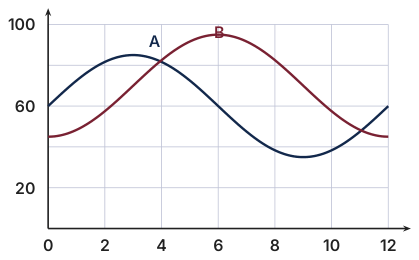
Two robotic arms A and B on a production line move vertically. The heights of their end points, in centimetres above the floor, at time t seconds are
\begin{gathered}h_A=60+25\sin(30t)^{\circ},\\ h_B=70-25\cos(30t)^{\circ},\\ 0\le t\le 12.\end{gathered}
(a) Find the height of each end point at t=0.
[2]
(b) Sketch the graphs of h_A and h_B on the same axes for 0\le t\le 12, labelling which curve is which.
[3]
(c) Find the times at which the two end points are at the same height.
[3]
(d) Find the greatest distance by which B is above A, and the time at which this happens.
[3]
(e) Find the percentage of each cycle for which A is higher than B.
[3]
Show solutionHide solution
(a) h_A(0)=60+25\sin 0^{\circ}=60 cm.
A1[1]
h_B(0)=70-25\cos 0^{\circ}=45 cm.
A1[1]
(b) h_A is a sine curve with axis 60, starting on its axis and rising, with maximum 85 and minimum 35; h_B is an inverted cosine with axis 70, starting at its minimum 45 and with maximum 95; both have period 12 s.
Two sinusoids with the correct starting values (0,60) and (0,45):
A1[1]
Original Photon diagram
Correct maxima, minima and period for both curves, with each curve labelled.
A1[1]A1[1]
(c) Graph y=h_A and y=h_B and use Intersection on 0\le t\le 12.
M1[1]
t=3.95 s A1 [1] and t=11.0 s.
A1[1]
(d) Graph y=h_B-h_A (that is, y=10-25\cos(30t)-25\sin(30t)) and use Maximum.
M1[1]
Greatest distance 45.4 cm A1 [1] at t=7.5 s.
A1[1]
(e) h_A>h_B for 0\le t<3.952 and 11.05<t\le 12, a total of 3.952+(12-11.048)=4.905 s per cycle.
M1[1]
\dfrac{4.905}{12}\times 100=40.9\%.
A1[1]
Hence A is higher for 40.9% of each cycle.
A1[1]

Final answer

60, 45 cm; sketch; 3.95 s, 11.0 s; 45.4 cm at 7.5 s; 40.9%

Question 26

[18 marks]
Two invasive water plants are spreading across a reservoir. The area covered by plant A, A m^2, t weeks after a survey is modelled by A=40(1.35)^t. The area covered by plant B, B m^2, is modelled by B=ka^t. At the survey plant B covered 150 m^2, and 4 weeks later it covered 311.04 m^2.
(a) Write down the area covered by plant A at the survey.
[1]
(b) Find the area covered by plant A 3 weeks and 4 days after the survey.
[2]
(c) Find the value of k and show that a=1.2.
[3]
(d) Write down the weekly percentage increase in the area covered by plant B.
[1]
(e) Find the area covered by plant B 10 weeks after the survey.
[2]
(f) Find the time at which the two plants cover the same area. Give your answer in weeks and days, to the nearest day.
[3]
(g) The surface of the reservoir has an area of 2.4\times10^5 m^2. Find the time at which the model predicts that plant A covers the whole surface.
[2]
(h) Comment on the validity of model A for times close to your answer to (g).
[1]
Instead, at t=10 a team removes 60% of plant A. Afterwards plant A grows from the remaining area by 35% each week, so that A=0.4\times40(1.35)^t for t\ge10.
(i) Find the time at which plant A now covers the same area as plant B.
[3]
Show solutionHide solution
(a) 40 m^2 A1 (b) t=3\frac47 and 40(1.35)^{25/7}=117 m^2 M1A1 (c) k=150 A1 150a^4=311.04, so a^4=2.0736 M1 a=1.2 A1AG (d) 20% A1 (e) 150(1.2)^{10}=929 m^2 M1A1 (f) 40(1.35)^t=150(1.2)^t M1 t=11.22 weeks A1 0.222\times7=1.55 days, so 11 weeks 2 days A1 (g) 40(1.35)^t=240\,000 M1 t=29.0 weeks A1 (h) Growth slows as space and nutrients run out, and the model cannot exceed the area of the reservoir R1 (i) 16(1.35)^t=150(1.2)^t M1A1 t=19.0 weeks
A1

Final answer

40 m^2; 117 m^2; k=150, a=1.2; 20%; 929 m^2; 11 weeks 2 days; 29.0 weeks; growth must slow; 19.0 weeks

Going further

Beyond the syllabus: the worked examples and investigations of the chapter's Going further pages.

G1 A tide that does not fit a day

G1 Worked example

[4 marks]
The depth of water in a harbour, D metres, t hours after midnight on Monday is modelled by D=3+1.5\cos(bt), where the period is 12.4 hours. Boats can enter when the depth is more than 3.75 m. Find the total time in the 48 hours from midnight on Monday during which boats can enter.
[4]
Show solutionHide solution
b=\frac{360}{12.4}=29.03 A1 D>3.75 means \cos(bt)>0.5 M1 each window is \frac{12.4}{3}=4.13 h long, centred on a high water at t=0,\,12.4,\,24.8,\,37.2 (and 49.6) A1 the windows are 0–2.07, 10.33–14.47, 22.73–26.87, 35.13–39.27 and 47.53–48, so the total is 2.067+3(4.133)+0.467=14.9 hours
A1

Final answer

14.9 hours

G2 Which three points fix a quadratic?

G2 Investigation

[16 marks]
Nadia throws a ball. Its height, y metres, at a horizontal distance of x metres from her hand is measured at four points: (0,\,2.0), (1,\,5.1), (2,\,6.0) and (3,\,4.6). Any three of these points fix a model y=ax^2+bx+c.
(a) Find the model through the first three points.
[2]
(b) Use this model to predict y at x=3, and find the difference between the measured and predicted values.
[2]
(c) Repeat (a) and (b) for the three other choices of three points, leaving out x=2, x=1 and x=0 in turn.
[6]
(d) Explain why each model's largest difference from the four measured values occurs at the point it leaves out.
[2]
(e) A fifth measurement is (4,\,1.05). Determine which of the four models predicts this value most closely.
[2]
(f) Each model predicts where the ball would hit the ground. Find the greatest and least of these predictions and comment on how much the choice of points matters.
[2]
Show solutionHide solution
(a) c=2, a+b=3.1, 4a+2b=4 M1 y=-1.1x^2+4.2x+2 A1 (b) y(3)=4.7 A1 difference 4.6-4.7=-0.1 A1 (c) Leave out x=2: y=-1.11667x^2+4.21667x+2, predicts 5.96667 at x=2, difference 0.0333 A1A1 leave out x=1: y=-1.13333x^2+4.26667x+2, predicts 5.13333, difference -0.0333 A1A1 leave out x=0: y=-1.15x^2+4.35x+1.9, predicts 1.9 at x=0, difference 0.1 A1A1 (d) Each model passes exactly through its three chosen points R1 so the only non-zero difference is at the fourth point R1 (e) Predictions at x=4 are 1.2, 1.0, 0.933 and 0.9 M1 the model that leaves out x=2 is closest, with a difference of 0.05 A1 (f) The landing distances are 4.178, 4.186, 4.202 and 4.246 m, so the greatest is 4.25 m and the least is 4.18 m A1 they differ by about 7 cm, so the landing prediction hardly depends on the choice of points, while the height at x=4 varies by 0.3 m
R1

Final answer

(a) y=-1.1x^2+4.2x+2 (b) 4.7, difference -0.1 (c) see the online solution (d) each model is exact at its three points (e) the model that leaves out x=2 (f) 4.25 m and 4.18 m, about 7 cm apart

From the book

Photon Guidebook: Mathematics Applications and Interpretation SL for the IB Diploma

Chapter 4 teaches modelling with functions from the basics to full exam questions: how the IB asks it, every question type with a marked example, and these practice questions in three steps.

About the book