Free worked solutions · 2026 Edition

IB Maths AI SL Chapter 3: Functions and graphs worked solutions

Worked solutions to the practice questions in Chapter 3 of Photon Guidebook: Mathematics Applications and Interpretation SL for the IB Diploma (2026 Edition). Each solution shows every step with the mark it earns, the way an IB mark scheme does.

  • Chapter 3 of 15
  • 25 practice questions
  • 2 Going further
  • Free, no sign-up

Basics

One idea at a time, in the order the chapter teaches them.

Question 1

[4 marks]
Jaya packs 64 kits into 13 full boxes. A compact box holds 4 kits; a large box holds 7. Let c and b count compact and large boxes. Form and solve a system for both counts.
[4]
Show solutionHide solution
c+b=13.
M1
4c+7b=64.
M1
c=9 compact boxes.
A1
b=4 large boxes.
A1

Final answer

9 compact boxes, 4 large boxes

Question 2

[5 marks]
Amir buys sensors priced a,b,c Singapore dollars each. One of each costs SGD 49; two A, one B and three C cost SGD 102; three A, two B and one C cost SGD 88. Form three equations and use a GDC to find the unit prices.
[5]
Show solutionHide solution
a+b+c=49.
M1
2a+b+3c=102.
M1
3a+2b+c=88.
M1
a=11, b=17 Singapore dollars.
A1
c=21 Singapore dollars.
A1

Final answer

SGD 11.00, SGD 17.00 and SGD 21.00.

Question 3

[4 marks]
Siti uses the guide line y=\frac34x+2. Using m_1m_2=-1 for perpendicular non-vertical lines, find the perpendicular gradient and the perpendicular line through (3,1).
[4]
Show solutionHide solution
m=-1/(3/4)=-4/3.
A1
1=(-4/3)(3)+c.
M1
c=5.
A1
y=-\frac43x+5.
A1

Final answer

gradient -\frac43; y = -\frac43x + 5

Question 4

[5 marks]
Dev compares printing charges A=0.12n+28 and B=0.20n+12 Singapore dollars for n pages, a positive whole number. Find where the charges agree. Identify the cheaper service for 250 pages and the saving.
[5]
Show solutionHide solution
0.12n+28=0.20n+12.
M1
n=200 pages.
A1
At 250 pages, A costs 58 Singapore dollars and B costs 62 Singapore dollars.
A1
Service A is cheaper.
R1
Saving 4 Singapore dollars.
A1

Final answer

Equal at 200 pages. At 250 pages A costs SGD 58.00 and B SGD 62.00; A saves SGD 4.00.

Question 5

[4 marks]
Nurin uses h(x)=x^2+2 on the continuous domain -4<x\le3. Use a GDC graph or the square rule to find the range. Explain whether each end value is included.
[4]
Show solutionHide solution
Minimum output 2 occurs at allowed input x=0.
A1
Outputs approach 18 as x approaches −4 from above.
A1
18 is not attained: x=-4 and x=4 are not in the domain.
R1
Range 2\leq h(x)<18.
A1

Final answer

2 \le h(x) < 18

Question 6

[3 marks]
Kai uses h(x)=37/(x+5) on 0\le x\le32, with one input for each output. Find h^{-1}(3.7) and verify it by substitution.
[3]
Show solutionHide solution
37/(x+5)=3.7, so x+5=10.
M1
h^{-1}(3.7)=5.
A1
h(5)=37/10=3.7.
A1

Final answer

h^{-1}(3.7) = 5

Question 7

[2 marks]
Dale's function maps 2,5,8,11 to respective outputs 9,16,21,30. Each output has one input. Find the inverse value at 21 and the inverse's domain.
[2]
Show solutionHide solution
f^{-1}(21)=8.
A1
Inverse domain \{9,16,21,30\}, the original outputs.
A1

Final answer

f^{-1}(21) = 8; domain \{9, 16, 21, 30\}

Question 8

[4 marks]
Mei graphs y=x^2-6x+5 on her GDC. Sketch it, labelling both horizontal-axis intercepts, the vertical-axis intercept and the minimum.
[4]
Show solutionHide solution
The upward-opening parabola has horizontal crossings (1,0),(5,0).
A1
The vertical crossing is (0,5).
A1
GDC minimum is (3,-4).
A1
A smooth upward parabola through these points, symmetric about x=3, completes the sketch.
A1

Final answer

(1, 0), (5, 0), (0, 5); minimum (3, -4)

Question 9

[4 marks]
Rory uses f(x)=30/x and g(x)=x+1 for x>0. Find their intersection and solve f(x)>g(x) on the domain.
[4]
Show solutionHide solution
Solve 30/x=x+1, giving x^2+x-30=0.
M1
The allowed crossing is x=5 (common output 6).
A1
f>g for 0<x<5.
A1
Zero is excluded by the domain, and 5 is excluded by the strict inequality.
R1

Final answer

meet at x = 5 (output 6); f > g for 0 < x < 5

Question 10

[5 marks]
The curve y=x^3-6x^2+8x is graphed for 0\leq x\leq4.
Find the three horizontal-axis crossings. Use a GDC to find both turning points to 3 significant figures, and use them to describe the curve between crossings.
[5]
Show solutionHide solution
x(x-2)(x-4)=0 gives (0,0),(2,0),(4,0). M1A1
GDC local maximum is (0.845,3.08).
A1
GDC local minimum is (3.15,-3.08).
A1
It rises above the axis before crossing at 2, dips below it, and returns to the axis at 4.
R1

Final answer

zeros 0, 2, 4; max (0.845, 3.08), min (3.15, -3.08)

Tutorial

Exam-style questions on each question type, with the marks the IB would give.

Question 11

[6 marks]
A charity hires a coach for SGD 1260 and shares the cost equally among the n students who travel, so the cost per student, in Singapore dollars, is
C(n) = \frac{1260}{n}, \qquad 20 \le n \le 45, n \in \mathbb{Z}.
(a) Find C(20) and C(45).
[2]
(b) Explain why these are the greatest and least costs per student, and write down the range limits of C.
[2]
(c) For which value of n would the formula \dfrac{1260}{n} be undefined? Explain why this value is not in the domain for a reason other than the formula.
[2]
Show solutionHide solution
(a) C(20) = \dfrac{1260}{20} = 63 Singapore dollars.
A1[1]
C(45) = \dfrac{1260}{45} = 28 Singapore dollars.
A1[1]
(b) As n increases the same SGD 1260 is shared among more students, so C decreases.
R1[1]
The greatest cost per student is SGD 63 (at n = 20) and the least is SGD 28 (at n = 45): 28 \le C \le 63.
A1[1]
(c) The formula is undefined at n = 0 (division by zero).
A1[1]
With no students there is nobody to share the cost, and the stated domain starts at 20 students.
R1[1]

Final answer

(a) SGD 63.00 and SGD 28.00. (b) Decreasing; limits 28\le C\le63. (c) n=0, with nobody to share the cost.

Question 12

[7 marks]
Two companies hire out kayaks. Lakeside charges a SGD 38 deposit plus SGD 24 for each day of hire. Rapids charges a SGD 90 deposit plus SGD 11 for each day of hire.
(a) Write down a model for the cost, in Singapore dollars, of hiring a kayak for d days from each company.
[2]
(b) Use your GDC to find the number of days for which the two companies charge the same, and that cost.
[2]
(c) Find the cost of a 3-day hire and of a 7-day hire from each company, and state which company is cheaper in each case.
[3]
Show solutionHide solution
(a) Lakeside: L(d) = 38 + 24d.
A1[1]
Rapids: R(d) = 90 + 11d.
A1[1]
(b) Graph both and use Intersection: (4, 134).
M1[1]
The costs are equal for a 4-day hire, when each company charges SGD 134.
A1[1]
(c) 3 days: Lakeside 38 + 72 = SGD 110; Rapids 90 + 33 = SGD 123.
A1[1]
7 days: Lakeside 38 + 168 = SGD 206; Rapids 90 + 77 = SGD 167.
A1[1]
Lakeside is cheaper for 3 days; Rapids is cheaper for 7 days (the line with the smaller gradient is cheaper once past the intersection).
R1[1]

Final answer

(a) L = 38 + 24d, R = 90 + 11d (b) 4 days, 134 Singapore dollars (c) 3 days: 110 vs 123 (Lakeside); 7 days: 206 vs 167 (Rapids)

Question 13

[9 marks]
A nature reserve is drawn on a map with distances in kilometres. A boardwalk W follows the line y = 0.5x + 2. A campsite is at the point C(8, -2).
(a) Find the equation of the line through C that is parallel to the boardwalk.
[2]
(b) A path runs from the campsite at right angles to the boardwalk. Find the equation of this path, in the form y = mx + c.
[3]
(c) Find the coordinates of the point where the path meets the boardwalk.
[2]
(d) Hence find the shortest distance from the campsite to the boardwalk, to 3 significant figures.
[2]
Show solutionHide solution
(a) Parallel lines have equal gradients: m = 0.5. (M1)
[1]
-2 = 0.5(8) + c, so c = -6: y = 0.5x - 6.
A1[1]
(b) Perpendicular gradient: m = -\dfrac{1}{0.5} = -2.
M1[1]
y - (-2) = -2(x - 8).
M1[1]
y = -2x + 14.
A1[1]
(c) Solve 0.5x + 2 = -2x + 14 (GDC Intersection or algebra): 2.5x = 12.
M1[1]
x = 4.8, y = 0.5(4.8) + 2 = 4.4: the point (4.8, 4.4).
A1[1]
(d) The shortest distance is along the perpendicular: \sqrt{(8 - 4.8)^2 + (-2 - 4.4)^2} = \sqrt{10.24 + 40.96} = \sqrt{51.2}.
M1[1]
= 7.155\ldots = 7.16 km.
A1[1]

Final answer

(a) y = 0.5x - 6 (b) y = -2x + 14 (c) (4.8, 4.4) (d) 7.16 km

Question 14

[7 marks]
Two straight roads on a map (units in kilometres) have equations
\begin{gathered}\text{Road 1: } 3x + 4y = 36, \end{gathered}
\begin{gathered}\text{Road 2: } 4x - 3y = 12.\end{gathered}
(a) Find the gradient of each road, and show that the roads are perpendicular.
[3]
(b) Find the coordinates of the junction where the roads meet.
[2]
(c) A third road passes through the point (0, 3) and is parallel to Road 1. Find its equation in the form ax + by = c where a, b and c are integers.
[2]
Show solutionHide solution
(a) Road 1: 4y = -3x + 36, so y = -\dfrac{3}{4}x + 9, gradient -\dfrac{3}{4}. M1A1
[2]
Road 2: 3y = 4x - 12, so y = \dfrac{4}{3}x - 4, gradient \dfrac{4}{3}.
Product of gradients = -\dfrac{3}{4} \times \dfrac{4}{3} = -1, so the roads are perpendicular.
R1[1]
(b) Solve the pair simultaneously (GDC Intersection or the simultaneous-equation solver).
M1[1]
Junction: (6.24, 4.32).
A1[1]
(c) Parallel to Road 1: gradient -\dfrac{3}{4}, passing through (0, 3): y = -\dfrac{3}{4}x + 3.
M1[1]
3x + 4y = 12.
A1[1]

Final answer

(a) -\frac34, \frac43, product −1 (b) (6.24, 4.32) (c) 3x + 4y = 12

Question 15

[7 marks]
A scooter rider leaves a ramp and her height above the ground, in metres, t seconds later is modelled by
h(t) = -4.9t^2 + 12t + 1.
(a) Use your GDC to find the greatest height reached by the rider, and hence explain why she never reaches a height of 9 m.
[3]
(b) Explain, using the graph of y = h(t) and the line y = 8, why the rider reaches a height of 8 m twice.
[2]
(c) Find the two times at which the height is 8 m, to 3 significant figures.
[2]
Show solutionHide solution
(a) Graph y = -4.9t^2 + 12t + 1 and use Maximum.
M1[1]
Maximum at t = 1.2245\ldots, height 8.3469\ldots = 8.35 m.
A1[1]
The greatest height is below 9 m, so the rider never reaches 9 m (the line y = 9 lies above the whole graph).
R1[1]
(b) The greatest height 8.35 m is above 8 m, so the line y = 8 lies below the top of the graph and cuts the parabola in two places.
M1[1]
So 8 m is reached twice: once on the way up and once on the way down.
R1[1]
(c) Graph y = h(t) and y = 8 and use Intersection twice (or solve the quadratic).
M1[1]
t = 0.958 s and t = 1.49 s.
A1[1]

Final answer

(a) 8.35 m, below 9 m. (b) y=8 meets the curve once while rising and once while falling. (c) 0.958 s and 1.49 s.

Question 16

[8 marks]
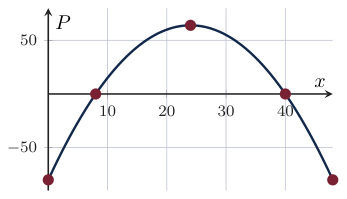
Elif sells hand-made bracelets at a market. Her daily profit, P Singapore dollars, from selling x bracelets is modelled by the curve shown, for 0 \le x \le 48.
Original Photon diagram
(a) Write down the y-intercept of the graph and explain what it means for Elif.
[2]
(b) Write down the two x-intercepts and explain what they mean.
[2]
(c) Write down the coordinates of the maximum point and interpret them.
[2]
(d) Write down the range of P for 0 \le x \le 48.
[1]
(e) Write down the values of x for which Elif makes a profit.
[1]
Show solutionHide solution
(a) The y-intercept is (0, -80).
A1[1]
If Elif sells no bracelets she makes a loss of SGD 80: her fixed daily cost (stall fee).
A1[1]
(b) x = 8 and x = 40.
A1[1]
These are the break-even points: the profit is zero when she sells 8 or 40 bracelets.
A1[1]
(c) The maximum point is (24, 64).
A1[1]
Her greatest daily profit is SGD 64, which she makes when she sells 24 bracelets.
A1[1]
(d) The lowest value is −80 (at both ends of the domain) and the highest is 64: -80 \le P \le 64.
A1[1]
(e) The curve is above the x-axis between the intercepts: 8 < x < 40.
A1[1]

Final answer

(a) (0, -80): a loss of 80 Singapore dollars (b) 8 and 40 (c) (24, 64) (d) -80 \le P \le 64 (e) 8 < x < 40

Question 17

[6 marks]
A mobile plan costs P(g) = 12 + 8.5g Singapore dollars per month for g gigabytes (GB) of data, for 0 \le g \le 20.
(a) Find P(5).
[1]
(b) Find P^{-1}(63) and interpret your answer.
[2]
(c) Write down the domain and range of P^{-1}.
[2]
(d) Explain why P has an inverse function.
[1]
Show solutionHide solution
(a) P(5) = 12 + 8.5(5) = 54.5 Singapore dollars.
A1[1]
(b) P^{-1}(63) is the value of g with P(g) = 63: 12 + 8.5g = 63.
M1[1]
g = 6: a monthly bill of SGD 63 buys 6 GB of data, so P^{-1}(63) = 6.
A1[1]
(c) P(0) = 12 and P(20) = 182, so the domain of P^{-1} is 12 \le x \le 182.
A1[1]
The range of P^{-1} is the domain of P: 0 \le y \le 20.
A1[1]
(d) P is a straight line with positive gradient, so it is always increasing: each monthly bill comes from exactly one amount of data (it is one-to-one), so P has an inverse function.
R1[1]

Final answer

(a) SGD 54.50. (b) 6 GB. (c) Domain 12\le x\le182; range 0\le y\le20. (d) Each bill corresponds to one data amount.

Question 18

[6 marks]
At a supermarket, the average time, in minutes, that a customer waits in the queue when n staff are on the tills is modelled by
C(n) = \frac{12}{n - 2} + 3, \qquad n > 2.
(a) Find C(5).
[1]
(b) Find C^{-1}(5) and interpret your answer.
[2]
(c) Write down the domain and range of C^{-1}.
[2]
(d) Interpret the horizontal asymptote of the graph of C.
[1]
Show solutionHide solution
(a) C(5) = \dfrac{12}{3} + 3 = 7 minutes.
A1[1]
(b) C^{-1}(5) is the n with C(n) = 5: \dfrac{12}{n - 2} + 3 = 5, so \dfrac{12}{n - 2} = 2.
M1[1]
n = 8: with 8 staff the average wait is 5 minutes.
A1[1]
(c) The range of C is C > 3 (horizontal asymptote C = 3), so the domain of C^{-1} is x > 3.
A1[1]
The range of C^{-1} is the domain of C: y > 2.
A1[1]
(d) The horizontal asymptote is C = 3: however many staff are working, the average wait never falls below 3 minutes.
A1[1]

Final answer

(a) 7 min (b) C^{-1}(5) = 8 staff (c) x > 3; y > 2 (d) never below 3 min

Question 19

[7 marks]
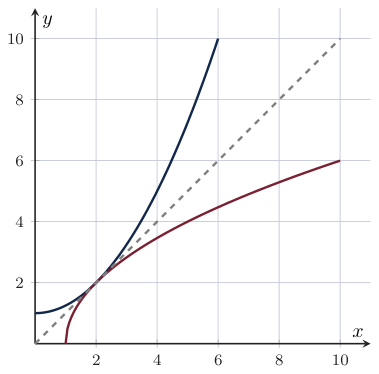
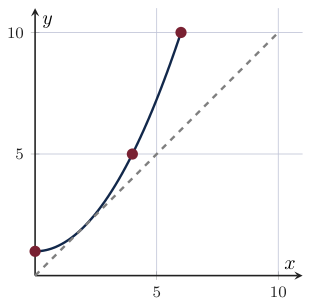
The graph shows the profile of a grassy embankment beside a cycle path: y = f(x) is the height in metres of the embankment surface at a horizontal distance of x metres from the start, for 0 \le x \le 6. The function is f(x) = \dfrac{x^2}{4} + 1. The dashed line is y = x.
Original Photon diagram
(a) Use the graph to find f^{-1}(5) and interpret it.
[1]
(b) Write down the domain and range of f^{-1}.
[2]
(c) The points (0, 1), (4, 5) and (6, 10) lie on the graph of f. Write down the coordinates of the corresponding points on the graph of f^{-1}.
[2]
(d) The graphs of f and f^{-1} meet at exactly one point. Write down its coordinates and say why it lies on the line y = x.
[2]
Show solutionHide solution
(a) f^{-1}(5) is the x with f(x) = 5: from the graph, f(4) = 5, so f^{-1}(5) = 4.
A1[1]
(The embankment is 5 m high at 4 m from the start.)
(b) Range of f: f(0) = 1 to f(6) = 10, so the domain of f^{-1} is 1 \le x \le 10.
A1[1]
The range of f^{-1} is the domain of f: 0 \le y \le 6.
A1[1]
(c) Reflection in y = x swaps the coordinates: (1, 0), (5, 4) and (10, 6). A1A1
[2]
(d) The graph of f just touches the line y = x at (2, 2); the point is (2, 2).
A1[1]
A point on both f and its reflection f^{-1} must be unchanged by swapping coordinates, so x = y: it lies on the mirror line.
R1[1]
Original Photon diagram

Final answer

(a) f^{-1}(5) = 4 (b) 1 \le x \le 10; 0 \le y \le 6 (c) (1, 0), (5, 4), (10, 6) (d) (2, 2)

Question 20

[12 marks]
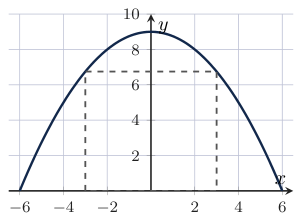
A hall has a parabolic arched roof. With the origin at the centre of the floor, the height of the roof, in metres, at a horizontal distance of x metres from the centre is y = 9 - \dfrac{x^2}{4}, for -6 \le x \le 6. A rectangular banner is hung against the wall below the arch, with its lower corners on the floor at (-a, 0) and (a, 0) and its upper corners touching the arch.
Original Photon diagram
(a) Show that the area of the banner is A(a) = 18a - \dfrac{a^3}{2} square metres.
[3]
(b) Write down the domain of A.
[2]
(c) Use your GDC to find the greatest area of the banner, and the value of a that gives it, each to 3 significant figures.
[2]
(d) Find the width and height of the banner of greatest area, to 3 significant figures.
[1]
(e) Find the two values of a for which the banner has area 30 m^2, to 3 significant figures.
[2]
(f) The banner must not be wider than 5 m. Find the greatest area it can have, to 3 significant figures.
[2]
Show solutionHide solution
(a) The width is 2a.
A1[1]
The height is the height of the arch at x = a: 9 - \dfrac{a^2}{4}.
M1[1]
A = 2a\left(9 - \dfrac{a^2}{4}\right) = 18a - \dfrac{a^3}{2}.
M1[1]
(b) The banner has positive width, a > 0.
R1[1]
It must lie under the arch, which ends at x = 6: 0 < a < 6.
R1[1]
(c) Graph y = 18x - x^3/2 and use Maximum.
M1[1]
a = 3.46, A = 41.6 m^2.
A1[1]
(d) Width 2a = 6.93 m (6.928…), height 9 - \dfrac{12}{4} = 6.00 m.
A1[1]
(e) Graph y = 30 as well and use Intersection on both sides of the maximum.
M1[1]
a = 1.84 and a = 4.86.
A1[1]
(f) Width 2a \le 5, so a \le 2.5.
M1[1]
A is increasing for a < 3.46, so the greatest area is at a = 2.5: A(2.5) = 45 - 7.8125 = 37.2 m^2.
A1[1]

Final answer

(a) A=2a(9-a^2/4)=18a-a^3/2. (b) 0<a<6. (c) a=3.46, A=41.6 m^2. (d) 6.93 m by 6.00 m. (e) 1.84 or 4.86. (f) 37.2 m^2.

Mastery

Full exam questions that mix question types, at Paper 1 and Paper 2 standard.

Question 21

[11 marks]
A skateboard ramp designer models the cross-section of a ramp by the quadratic function
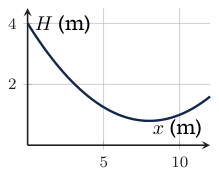
H(x)=0.05x^{2}-0.8x+4,\quad 0\le x\le 12,
where H is the height above the ground (in metres) and x is the horizontal distance (in metres) from the left edge.
Original Photon diagram
(a) Find the height of the ramp at the left edge.
[2]
(b) Find the coordinates of the lowest point of the ramp.
[3]
(c) Find the value of x at which the ramp is 2 m high.
[3]
(d) State the range of H.
[3]
Show solutionHide solution
(a) H(0)=0.05(0)-0.8(0)+4=4 m.
[2]
(b) Vertex at x=\dfrac{0.8}{2(0.05)}=8; H(8)=0.05(64)-0.8(8)+4=3.2-6.4+4=0.8. Lowest point (8,\,0.8).
[3]
(c) 0.05x^{2}-0.8x+4=2\Rightarrow 0.05x^{2}-0.8x+2=0\Rightarrow x^{2}-16x+40=0. Using GDC, x=8\pm\sqrt{24}, so x\approx 3.10 m and x\approx 12.9 m; only x\approx 3.10 m lies in the domain. (Second value 12.9>12.)
[3]
(d) Minimum 0.8 (at x=8); endpoints H(0)=4, H(12)=0.05(144)-9.6+4=7.2-9.6+4=1.6. Maximum is 4. Range: 0.8\le H\le 4.
[3]

Final answer

(a) 4 m (b) (8, 0.8) (c) x = 3.10 (d) 0.8 \le H \le 4

Question 22

[12 marks]
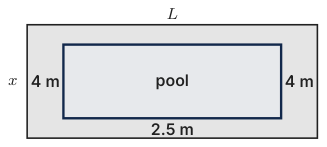
Sofia manages a hotel. A hotel owns a rectangular plot of land with an area of 1500 m^2. The plot is x metres wide and L metres long. A
rectangular swimming pool is built on the plot, leaving a paved strip 4 m wide at each end of the plot and a paved strip
2.5 m wide along each side.
(a) Write down an expression for the length of the pool in terms of x.
[1]
(b) Show that the area of the pool, A m^2, is A = 1540 - 8x - \dfrac{7500}{x}.
[3]
(c) Explain why 5 < x < 187.5.
[2]
(d) The hotel wants a pool with an area of 1000 m^2. Find the two possible widths of the plot.
[3]
(e) Find the greatest possible area of the pool and the dimensions of the plot that give it. [3]
Original Photon diagram
Show solutionHide solution
(a) xL=1500, so L=1500/x and the pool length is 1500/x-8 m. [A1]
(b) The pool width is x-5 [M1]. Hence A=(x-5)(1500/x-8) [A1]. Expanding gives 1500-8x-7500/x+40=1540-8x-7500/x [A1].
(c) Positive width needs x>5 [R1]. Positive length needs 1500/x>8, hence x<187.5 [R1].
(d) Solve 1540-8x-7500/x=1000 [M1]. The two plot widths are 19.6 m [A1] and 47.9 m [A1], both inside the domain.
(e) Find the greatest output on 5<x<187.5 [M1]. It occurs at x=\sqrt{937.5}=30.6186\ldots m and is 1050.102\ldots m^2, or 1.05\times10^3 m^2 [A1]. The plot dimensions are 30.6 m by 1500/30.6186\ldots=49.0 m [A1]. The plan assumes strips of constant width.

Final answer

(a) 1500/x-8. (b) 1540-8x-7500/x. (c) 5<x<187.5. (d) 19.6 m or 47.9 m. (e) 1.05\times10^3 m^2; 30.6 m by 49.0 m.

Question 23

[10 marks]
Hana organises a charity run. A school orders T-shirts for a charity run. Supplier P charges a
set-up fee plus a fixed price for each shirt. An order of 40 shirts from P costs GBP 290 and an order of 100 shirts costs GBP 590.
(a) Find the price of each shirt and the set-up fee.
[3]
(b) Supplier Q charges GBP 6.80 for each shirt and no set-up fee. Find the numbers of shirts for which supplier P is cheaper.
[3]
(c) The school orders 160 shirts from supplier P in sizes small, medium and large. It orders twice as many medium shirts as
small shirts, and 20 more large shirts than small shirts. Find the number of shirts of each size.
[3]
(d) Find the cost of this order.
[1]
Show solutionHide solution
(a) Let p be the price per shirt and f the set-up fee, in GBP. f+40p=290 and f+100p=590 [M1]. Subtracting gives p=5 [A1], then f=90 [A1].
(b) 90+5n<6.80n [M1] gives n>50 [A1]. At 50 both cost GBP 340.00; at 51 P costs GBP 345.00 and Q costs GBP 346.80. Thus 51 shirts or more [A1].
(c) s+m+l=160, m=2s, l=s+20 [M1,A1]. Then 4s+20=160: 35 small, 70 medium and 55 large [A1].
(d) 90+5(160)= GBP 890.00 [A1].

Final answer

(a) GBP 5.00 each; GBP 90.00 set-up. (b) 51 shirts or more. (c) 35 small, 70 medium, 55 large. (d) GBP 890.00.

Question 24

[10 marks]
Omar investigates a dimensionless function. Let f(x) = 4 - \dfrac{6}{x + 3}, for -6 \le x \le 3, x \ne -3.
(a) Write down an equation for the vertical asymptote of the graph of f.
[1]
(b) Sketch the graph of f, labelling the end points.
[2]
(c) Find the range of f.
[3]
(d) Find f^{-1}(1).
[2]
(e) Find the values of k for which the equation f(x) = k has no solution.
[2]
Show solutionHide solution
(a) x=-3 [A1].
(b) The left branch rises from (-6,6) towards arbitrarily large positive values [A1]. The right branch rises from arbitrarily large negative values to (3,3) [A1].
(c) f(-6)=6, f(3)=3 [M1]. The graph increases on each separate branch [M1]. The range is f(x)\le3 or f(x)\ge6 [A1].
(d) 4-6/(x+3)=1 gives x+3=2 [M1], so f^{-1}(1)=-1 [A1].
(e) A horizontal line misses both branches only in the gap [M1]: 3<k<6 [A1]. The end levels 3 and 6 are reached.

Final answer

(a) x=-3. (b) End points (-6,6),(3,3). (c) f(x)\le3 or f(x)\ge6. (d) −1. (e) 3<k<6.

Question 25

[18 marks]
Original Photon diagram
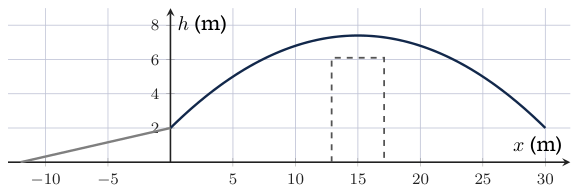
Arun plans a footbridge across a 30 m wide canal. Let x metres measure horizontal distance from the west bank. The underside height above water is h(x)=-0.024x^2+0.72x+2 metres, for 0\le x\le30.
(a) Find the height at each bank.
[1]
(b) Find the maximum height and its horizontal position.
[2]
(c) A 4.2 m wide boat with its roof 6.1 m above water travels centrally. Determine whether it can pass. Justify your answer.
[3]
(d) Find the greatest boat width that can pass with its roof 6.1 m above water.
[3]
(e) For 0\le x\le15, h has an inverse. Find h^{-1}(5) and interpret the value.
[2]
(f) A straight access ramp joins A(-12,0) to B(0,2) on the west bank. Find its equation y=mx+c and its length.
[3]
(g) A boat company charges a fixed adult price and a fixed child price. Two adults and three children pay EUR 57.50; three adults and one child pay EUR 60.00. Find both prices.
[3]
(h) State one limitation of the arch model.
[1]
Show solutionHide solution
(a) h(0)=h(30)=2 m [A1].
(b) The maximum occurs at x=15 [M1], with height h(15)=7.4 m [A1].
(c) The boat edges are at 15\pm2.1 [M1]. The arch height at each edge is h(12.9)=7.29416 m [A1]. This exceeds 6.1 m, so the boat can pass under the ideal arch [R1].
(d) Solve h(x)=6.1 [M1]. The inputs are 7.640199\ldots and 22.359800\ldots [A1]. The largest width is their difference, 14.7 m [A1].
(e) h(x)=5 gives x=5 or 25, but only 5 is in the stated domain [A1]. The arch is 5 m above water 5 m from the west bank [R1].
(f) Gradient =2/12=1/6 [M1]. The ramp is y=x/6+2 [A1]. Its length is \sqrt{12^2+2^2}=12.2 m [A1].
(g) With adult price a and child price c, 2a+3c=57.50 and 3a+c=60 [M1]. Adult EUR 17.50 [A1], child EUR 7.50 [A1].
(h) The model has no allowance for arch thickness or changing water level [R1].

Final answer

(a) 2 m. (b) 7.4 m at x=15. (c) Yes: 7.29 m >6.1 m. (d) 14.7 m. (e) 5 m from the west bank. (f) y=x/6+2; 12.2 m. (g) EUR 17.50 adult, EUR 7.50 child. (h) The arch has no thickness in the model.

Going further

Beyond the syllabus: the worked examples and investigations of the chapter's Going further pages.

G1 When two facts do not give one point

G1 Worked example

[4 marks]
Mei checks two proposed systems for map coordinates in kilometres. Solve each pair and explain the result by describing the lines.
(a) 2x+3y=12 and 4x+6y=30.
[2]
(b) 2x+3y=12 and 6x+9y=36.
[2]
Show solutionHide solution
(a) Dividing the second equation by 2 gives 2x+3y=15, inconsistent with 12 [M1]. The lines have gradient -2/3 but intercepts 4 and 5, so there is no solution [R1]. (b) The second equation is three times the first [M1]. They describe the same line, y=4-2x/3, with infinitely many solutions [R1].

Final answer

Parallel distinct lines: no solution. The same line: infinitely many solutions.

G2 Nearest and fairest need different points

G2 Investigation

[16 marks]
Mei plans a bus stop on a straight road, y=0.5x+1, with map distances in kilometres. The houses are H(2,6) and K(9,2).
(a) Find the perpendicular from H to the road, its foot on the road and the shortest distance from H to the road.
[5]
(b) Show that the houses lie on opposite sides of the road. Find the nearest point on the road to K and its distance from K.
[3]
(c) A stop S on the road must be equally far from the houses. Explain why it lies on the perpendicular bisector of HK, then find S.
[4]
(d) Show that S is 4.05 km from each house, to 3 significant figures.
[1]
(e) Let Q be where the line HK crosses the road. Find Q. Compare HQ+QK with HS+SK, and explain the trade-off for the stop.
[3]
Show solutionHide solution
(a) The road gradient is 1/2, so the perpendicular gradient is -2 [M1]. Through H this is y=-2x+10 [A1]. Solve -2x+10=x/2+1 [M1] to obtain (3.6,2.8) [A1]. The distance is \sqrt{1.6^2+(-3.2)^2}=3.58 km [A1].
(b) At x=2 the road has height 2, below H; at x=9 it has height 5.5, above K [R1]. The perpendicular through K is y=-2x+20, meeting the road at (7.6,4.8) [A1]. Its distance from K is \sqrt{(-1.4)^2+2.8^2}=3.13 km [A1].
(c) The equal-distance locus is the perpendicular bisector [R1]. HK has midpoint (5.5,4) and gradient -4/7 [M1]. Thus the bisector is y-4=(7/4)(x-5.5) [M1]. Solve with the road to obtain S(5.3,3.65) [A1].
(d) HS^2=3.3^2+(-2.35)^2=16.4125 and KS^2=(-3.7)^2+1.65^2=16.4125. Both distances are \sqrt{16.4125}=4.05 km [A1].
(e) HK has equation y-6=-(4/7)(x-2). Its meeting with the road is Q(86/15,58/15)\approx(5.73,3.87) [M1]. Since Q lies between H and K, HQ+QK=HK=\sqrt{65}=8.06 km [A1]. The sum through S is 2\sqrt{16.4125}=8.10 km: Q gives a shorter total route, while S gives equal distances [R1]. These straight-line distances ignore fences, road crossings and access paths.

Final answer

(a) y=-2x+10; (3.6,2.8); 3.58 km. (b) (7.6,4.8); 3.13 km. (c) S(5.3,3.65). (d) 4.05 km each. (e) Q(5.73,3.87); 8.06 km versus 8.10 km.
From the book

Photon Guidebook: Mathematics Applications and Interpretation SL for the IB Diploma

Chapter 3 teaches functions and graphs from the basics to full exam questions: how the IB asks it, every question type with a marked example, and these practice questions in three steps.

About the book