Free worked solutions · 2026 Edition

IB Maths AI HL Chapter 22: Coupled systems and phase portraits worked solutions

Worked solutions to the practice questions in Chapter 22 of Photon Guidebook: Mathematics Applications and Interpretation HL for the IB Diploma (2026 Edition). Each solution shows every step with the mark it earns, the way an IB mark scheme does.

  • Chapter 22 of 24
  • Volume 2
  • 25 practice questions
  • 3 Going further
  • Free, no sign-up

Basics

One idea at a time, in the order the chapter teaches them.

Question 1

[2 marks]
The system is x\prime=3x-y, y\prime=x+2y.
Find the direction vector at (1,2).
[2]
Show solutionHide solution
(x\prime,y\prime)=(1,5), pointing right and up. A1A1

Final answer

(1,5): the point moves right and up.

Question 2

[2 marks]
For x\prime=4-y, y\prime=x-2, consider (3,5).
Find the equilibrium and direction at that point.
[2]
Show solutionHide solution
Equilibrium (2,4).
A1
Derivative (-1,1) points left and up.
A1

Final answer

Equilibrium (2,4); at (3,5) the direction is (-1,1), left and up.

Question 3

[2 marks]
A real two-dimensional linear system has distinct eigenvalues -3,2.
Classify the origin and justify its forward stability.
[2]
Show solutionHide solution
The origin is a saddle.
A1
One direction decays and the other grows; the equilibrium is unstable.
R1

Final answer

Saddle; unstable.

Question 4

[2 marks]
A real two-dimensional linear system has distinct eigenvalues -0.4\pm1.6i.
Classify the origin and justify its forward stability.
[2]
Show solutionHide solution
The origin is a stable spiral.
A1
The negative real part causes decay and the nonzero imaginary part causes rotation.
R1

Final answer

Stable spiral.

Question 5

[3 marks]
A second-order equation is y\prime\prime+9y=0. Introduce v=y\prime.
Write an equivalent first-order coupled system and classify its phase portrait in (y,v).
[3]
Show solutionHide solution
y\prime=v, v\prime=-9y.
A1
Eigenvalues \pm3i, so a centre with closed elliptical trajectories about the origin. M1R1

Final answer

y'=v, v'=-9y; eigenvalues \pm3i; closed elliptical paths about the origin.

Question 6

[3 marks]
For a second-order equation introduce v=y\prime, so that y\prime=v. Consider y\prime\prime+4y\prime+3y=0, y(0)=5, y\prime(0)=-2.
Write the equivalent first-order coupled system, its matrix and initial state.
[3]
Show solutionHide solution
y\prime=v, v\prime=-3y-4v.
A1
\begin{pmatrix}y\prime\\v\prime\end{pmatrix}=\begin{pmatrix}0&1\\-3&-4\end{pmatrix}\begin{pmatrix}y\\v\end{pmatrix}, initial state (5,-2)^T. A1A1

Final answer

y'=v, v'=-3y-4v; \begin{pmatrix}0&1\\-3&-4\end{pmatrix}; initial state (5,-2).

Question 7

[3 marks]
The equation is y\prime\prime+2y\prime-8y=0.
Find its general solution and state which mode grows for t\ge0.
[3]
Show solutionHide solution
Roots 2,-4, so y=Ae^{2t}+Be^{-4t}. M1A1
The e^{2t} mode grows unless its coefficient vanishes.
R1

Final answer

Ae^{2t}+Be^{-4t}; the e^{2t} term grows.

Question 8

[4 marks]
For y\prime\prime+5y\prime+4y=0, y(0)=6, y\prime(0)=-9.
Find the particular solution.
[4]
Show solutionHide solution
y=Ae^{-t}+Be^{-4t}.
M1
A+B=6, -A-4B=-9 give A=5, B=1. M1A1
y=5e^{-t}+e^{-4t}.
A1

Final answer

y=5e^{-t}+e^{-4t}.

Question 9

[5 marks]
A second-order model has y\prime\prime=4e^{-t}, y(0)=7, y\prime(0)=1. Let v=y\prime.
Write a coupled system and use Euler with h=0.15 for two simultaneous steps to estimate y(0.3),v(0.3).
[5]
Show solutionHide solution
y\prime=v, v\prime=4e^{-t}.
A1
At t=0.15, (y_1,v_1)=(7.15,1.6). M1A1
At t=0.3, y_2=7.15+0.15(1.6)=7.39 and v_2=1.6+0.6e^{-0.15}=2.11642479\ldots. M1A1

Final answer

(7.15,\,1.6), then y(0.3)\approx7.39, v(0.3)\approx2.12.

Question 10

[4 marks]
A saddle model has eigenvectors \mathbf v_1=(1,2)^T for \lambda_1=-3 and \mathbf v_2=(2,-1)^T for \lambda_2=1. A state begins at (5,0).
(a) Write the solution using eigenmodes.
[3]
(b) Find the line of initial states that instead approach the origin.
[1]
Show solutionHide solution
(a) (5,0)=c_1(1,2)+c_2(2,-1) gives c_1=1, c_2=2. M1A1
\mathbf z=e^{-3t}(1,2)^T+2e^t(2,-1)^T.
A1
(b) The growing-mode coefficient must vanish, so initial states lie on the stable eigenvector line y=2x.
R1

Final answer

\mathbf z=e^{-3t}\binom12+2e^{t}\binom{2}{-1}; the stable line is y=2x.

Tutorial

Exam-style questions on each question type, with the marks the IB would give.

Question 11

[9 marks]
Two coffee chains, A and B, compete in a city. Let x and y be the deviations (in hundreds of customers per week) of their weekly customer numbers from the long-term averages, at time t weeks, where \frac{dx}{dt} = -0.5x + 0.3y, \qquad \frac{dy}{dt} = 0.4x - 0.6y. The path of (x, y) in the xy-plane is a trajectory.
(a) Show that the gradient of a trajectory is \dfrac{dy}{dx} = \dfrac{0.4x - 0.6y}{-0.5x + 0.3y}.
[2]
(b) Find the gradient of the trajectory at the point (6, 2).
[2]
(c) Find the equation of the line on which every trajectory has a horizontal tangent, and of the line on which every trajectory has a vertical tangent.
[3]
(d) At the point (6, 2), state in words what is happening to each chain's customer deviation, and explain why the gradient in part (b) is negative.
[2]
Show solutionHide solution
(a) By the chain rule, \dfrac{dy}{dx} = \dfrac{dy/dt}{dx/dt}.
[1]
So \dfrac{dy}{dx} = \dfrac{0.4x - 0.6y}{-0.5x + 0.3y}.
[1]
(b) At (6, 2): numerator 0.4(6) - 0.6(2) = 1.2; denominator -0.5(6) + 0.3(2) = -2.4.
[1]
Gradient = \dfrac{1.2}{-2.4} = -0.5.
[1]
(c) Horizontal tangent: \dfrac{dy}{dt} = 0 (with \dfrac{dx}{dt} ≠ 0): 0.4x - 0.6y = 0, so y = \dfrac{2}{3}x.
[2]
Vertical tangent: \dfrac{dx}{dt} = 0: -0.5x + 0.3y = 0, so y = \dfrac{5}{3}x.
[1]
(d) \dfrac{dx}{dt} = -2.4 < 0 and \dfrac{dy}{dt} = 1.2 > 0: chain A's deviation is falling while chain B's is rising.
[1]
The two quantities move in opposite directions, so x decreases as y increases: the path slopes downwards to the right (\text{gradient} < 0) in the xy-plane.
[1]

Final answer

  • (b) −0.5
  • (c) horizontal on y=\frac23x, vertical on y=\frac53x
  • (d) A is falling and B is rising.

Question 12

[4 marks]
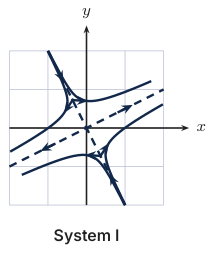
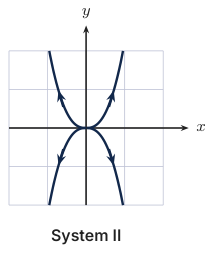
Each of the phase portraits below shows trajectories of a linear system \dot{\mathbf{v}}=A\mathbf{v} near the origin.
Original Photon diagram
The eigenvalues of the two systems are, in some order, \{2,\,5\} and \{-1,\,3\}.
(a) State which set of eigenvalues corresponds to System I and which to System II, justifying your answer.
[2]
(b) Classify the equilibrium at the origin for each system.
[2]
Show solutionHide solution
(a) System I shows trajectories approaching along one direction and leaving along another (a saddle), which requires eigenvalues of opposite sign: \{-1,3\}.
System II shows all trajectories moving away from the origin (a source), requiring both eigenvalues positive: \{2,5\}.
[2]
(b) System I: saddle point (unstable). System II: unstable node (source).
[2]

Final answer

System I: \{-1,3\}, a saddle; System II: \{2,5\}, an unstable node.

Question 13

[8 marks]
Chen stocks a pond with trout and carp. At time t months the pond holds x hundred trout and y hundred carp, and \frac{dx}{dt} = -0.4x + 0.1y + 20, \qquad \frac{dy}{dt} = 0.2x - 0.5y + 8. The constant terms are the monthly restocking rates.
(a) Find the equilibrium point of the system. Give the numbers of trout and carp in the pond at equilibrium.
[3]
(b) Let u = x - 60 and v = y - 40. Show that \dfrac{du}{dt} = -0.4u + 0.1v and find the corresponding equation for \dfrac{dv}{dt}.
[3]
(c) The matrix of the system is M = \begin{pmatrix} -0.4 & 0.1 \\ 0.2 & -0.5 \end{pmatrix}. Explain why the same matrix M appears in part (b), and state the effect of the restocking terms on the equilibrium.
[2]
Show solutionHide solution
(a) Set both rates to zero: -0.4x + 0.1y = -20 and 0.2x - 0.5y = -8.
[1]
GDC (simultaneous equation solver, or M^{-1} times the constant column): x = 60, y = 40.
[1]
At equilibrium there are 6000 trout and 4000 carp (the unit is hundreds).
[1]
(b) \dfrac{du}{dt} = \dfrac{dx}{dt} = -0.4(u + 60) + 0.1(v + 40) + 20.
[1]
= -0.4u + 0.1v + (-24 + 4 + 20) = -0.4u + 0.1v.
[1]
Similarly \dfrac{dv}{dt} = 0.2(u + 60) - 0.5(v + 40) + 8 = 0.2u - 0.5v + (12 - 20 + 8) = 0.2u - 0.5v.
[1]
(c) Moving the origin to the equilibrium only subtracts a constant, which does not change any derivative, and the constants cancel because (60,40) is the equilibrium. So the deviations (u, v) satisfy \mathbf{U}' = M\mathbf{U} with the same M.
[1]
The restocking terms only decide where the equilibrium is, moving it from (0,0) to (60,40); the behaviour around it is still controlled by M.
[1]

Final answer

  • (a) (60,40): 6000 trout and 4000 carp
  • (b) \frac{dv}{dt}=0.2u-0.5v
  • (c) the shift removes the constants, so the matrix is unchanged and the restocking only moves the equilibrium from O to (60,40).

Question 14

[9 marks]
Two connected lakes, P and Q, are polluted by a chemical spill. At time t years, the lakes hold x tonnes and y tonnes of the chemical, and \frac{dx}{dt} = -0.4x + 0.1y, \qquad \frac{dy}{dt} = 0.2x - 0.3y.
(a) Show that the eigenvalues of M = \begin{pmatrix} -0.4 & 0.1 \\ 0.2 & -0.3 \end{pmatrix} satisfy \lambda^2 + 0.7\lambda + 0.1 = 0, and find them.
[3]
(b) Find an eigenvector for each eigenvalue.
[3]
(c) Write down the general solution of the system.
[2]
(d) Explain why both lakes are eventually free of the chemical, whatever the starting amounts.
[1]
Show solutionHide solution
(a) \det(M - \lambda I) = (-0.4 - \lambda)(-0.3 - \lambda) - (0.1)(0.2) = \lambda^2 + 0.7\lambda + 0.12 - 0.02.
[1]
So \lambda^2 + 0.7\lambda + 0.1 = 0.
AG
(\lambda + 0.2)(\lambda + 0.5) = 0, so \lambda_1 = -0.2 and \lambda_2 = -0.5.
[2]
(GDC check: store M, then eigenvalues.)
(b) \lambda = -0.2: (M + 0.2I)\mathbf{v} = \mathbf{0} gives -0.2x + 0.1y = 0, so y = 2x and \mathbf{v}_1 = \begin{pmatrix} 1 \\ 2 \end{pmatrix}.
[2]
\lambda = -0.5: 0.1x + 0.1y = 0, so y = -x and \mathbf{v}_2 = \begin{pmatrix} 1 \\ -1 \end{pmatrix}.
[1]
(c) \mathbf{X} = Ae^{-0.2t}\begin{pmatrix} 1 \\ 2 \end{pmatrix} + Be^{-0.5t}\begin{pmatrix} 1 \\ -1 \end{pmatrix}, i.e. x = Ae^{-0.2t} + Be^{-0.5t} and y = 2Ae^{-0.2t} - Be^{-0.5t}.
[2]
(d) Both eigenvalues are negative, so e^{-0.2t} \to 0 and e^{-0.5t} \to 0 as t \to \infty; hence x \to 0 and y \to 0 for any A and B.
[1]

Final answer

Eigenvalues −0.2, −0.5; eigenvectors (1,2), (1,-1); both lakes clear (both eigenvalues negative).

Question 15

[10 marks]
A mass of 0.5 kg hangs on a spring in a tub of oil. Its displacement from equilibrium is x metres at time t seconds, and 0.5\frac{d^2x}{dt^2} + 3.5\frac{dx}{dt} + 3x = 0. Let v = \dfrac{dx}{dt}.
(a) Show that \dfrac{dv}{dt} = -6x - 7v.
[2]
(b) Write the pair of equations for \dfrac{dx}{dt} and \dfrac{dv}{dt} in the form \mathbf{X}' = M\mathbf{X}, where \mathbf{X} = \begin{pmatrix} x \\ v \end{pmatrix}, stating M.
[2]
(c) Find the eigenvalues of M, and show that they are the roots of the auxiliary equation 0.5\lambda^2 + 3.5\lambda + 3 = 0.
[3]
(d) Classify the equilibrium, say whether the system is overdamped or underdamped, and write down the general solution for x.
[3]
Show solutionHide solution
(a) \dfrac{dv}{dt} = \dfrac{d^2x}{dt^2}, so 0.5\dfrac{dv}{dt} + 3.5v + 3x = 0.
[1]
Dividing by 0.5: \dfrac{dv}{dt} = -6x - 7v.
[1]
(b) \dfrac{dx}{dt} = v and \dfrac{dv}{dt} = -6x - 7v, so M = \begin{pmatrix} 0 & 1 \\ -6 & -7 \end{pmatrix}.
[2]
(c) \det(M - \lambda I) = (-\lambda)(-7 - \lambda) + 6 = \lambda^2 + 7\lambda + 6.
[1]
(\lambda + 1)(\lambda + 6) = 0, so \lambda = -1 or \lambda = -6.
[1]
Multiplying \lambda^2 + 7\lambda + 6 = 0 by 0.5 gives the auxiliary equation 0.5\lambda^2 + 3.5\lambda + 3 = 0 (same roots).
[1]
(d) Both eigenvalues are real and negative: a stable node, so the system is overdamped (returns to rest without oscillating).
[2]
x = Ae^{-t} + Be^{-6t}.
[1]

Final answer

  • (b) M=\begin{pmatrix}0&1\\-6&-7\end{pmatrix}
  • (c) −1 and −6
  • (d) stable node, overdamped; x=Ae^{-t}+Be^{-6t}.

Question 16

[9 marks]
On an island, a population of rabbits x (hundreds) and foxes y (tens) is modelled by the predator-prey system
\frac{dx}{dt}=0.6x-0.02xy, \qquad \frac{dy}{dt}=-0.5y+0.01xy,
with t in years. Initially x=30 and y=20.
(a) Explain the meaning of the term -0.02xy in the first equation.
[1]
(b) Use Euler's method with step length h=0.5 to complete the table of estimates below.
[4]
txy
03020
0.5
1.0
(c) Find the non-zero equilibrium point (x^*,y^*) of the system.
[4]
Show solutionHide solution
(a) It represents the rate at which rabbits are lost due to encounters with foxes; the loss is proportional to the product of the two populations.
[1]
(b) At t=0: \dot{x}=0.6(30)-0.02(30)(20)=18-12=6, \dot{y}=-0.5(20)+0.01(30)(20)=-10+6=-4.
x_1=30+0.5(6)=33, y_1=20+0.5(-4)=18.
At t=0.5: \dot{x}=0.6(33)-0.02(33)(18)=19.8-11.88=7.92, \dot{y}=-0.5(18)+0.01(33)(18)=-9+5.94=-3.06.
x_2=33+0.5(7.92)=36.96, y_2=18+0.5(-3.06)=16.47.
txy
0.53318
1.036.9616.47
[4]
(c) Setting \dot{x}=0 with x\ne 0: 0.6-0.02y=0\Rightarrow y^*=30. Setting \dot{y}=0 with y\ne 0: -0.5+0.01x=0\Rightarrow x^*=50.
Equilibrium at (50,30).
[4]

Final answer

  • (b) (33,18) then (36.96,\,16.47)
  • (c) (50,30).

Question 17

[10 marks]
After drinking a cup of coffee, Dan has x mg of caffeine in his stomach and y mg in his bloodstream at time t hours, where \frac{dx}{dt} = -0.5x, \qquad \frac{dy}{dt} = 0.5x - 0.2y. Initially x = 40 and y = 0. The system is solved approximately using Euler's method with step h = 0.5.
(a) Write down the Euler formulae for x_{n+1} and y_{n+1} for this system.
[2]
(b) Use Euler's method, by hand, to estimate x and y when t = 1. Show each step.
[4]
(c) The exact solution for the stomach is x = 40e^{-0.5t}. Find the percentage error in the Euler estimate of x at t = 1.
[2]
(d) Explain why the Euler estimate of x is too low, and say what could be done to make it more accurate.
[2]
Show solutionHide solution
(a) x_{n+1} = x_n + 0.5(-0.5x_n) and y_{n+1} = y_n + 0.5(0.5x_n - 0.2y_n) (with t_{n+1} = t_n + 0.5).
[2]
(b) Step 1 (t = 0 \to 0.5): rates at (40, 0) are −20 and 20, so x_1 = 40 + 0.5(-20) = 30 and y_1 = 0 + 0.5(20) = 10.
[2]
Step 2 (t = 0.5 \to 1): rates at (30, 10) are −15 and 15 - 2 = 13, so x_2 = 30 + 0.5(-15) = 22.5 and y_2 = 10 + 0.5(13) = 16.5.
[2]
At t = 1: x \approx 22.5 mg and y \approx 16.5 mg.
(c) Exact: x(1) = 40e^{-0.5} = 24.3.
[1]
Percentage error = \dfrac{24.3 - 22.5}{24.3} \times 100\% = 7.26\% (too low).
[1]
(d) Euler uses the slope at the start of each step, but the exact x is a convex decreasing curve whose slope becomes less steep, so each step undershoots.
[1]
Using a smaller step h (more steps) would reduce the error.
[1]

Final answer

  • (b) 22.5 and 16.5
  • (c) 7.26%
  • (d) convex curve, so Euler underestimates; a smaller h reduces the error.

Question 18

[12 marks]
A robot arm joint is commanded to return to its home position. The angle x radians between the arm and its home position at time t seconds satisfies \frac{d^2x}{dt^2} + 8\frac{dx}{dt} + 15x = 0. The arm is released from rest at x = 0.3, so x = 0.3 and \dfrac{dx}{dt} = 0 at t = 0.
(a) By writing v = \dfrac{dx}{dt}, express the equation as a system \mathbf{X}' = M\mathbf{X} and find the eigenvalues of M.
[3]
(b) Hence write down the general solution for x, and find the particular solution.
[4]
(c) Find the time at which the arm first comes within 0.01 radians of home.
[2]
(d) Show that the arm never swings through x = 0 (the home position) for t \geq 0, and say why this is expected from the eigenvalues.
[3]
Show solutionHide solution
(a) \dfrac{dx}{dt} = v and \dfrac{dv}{dt} = -15x - 8v, so M = \begin{pmatrix} 0 & 1 \\ -15 & -8 \end{pmatrix}.
[1]
\lambda^2 + 8\lambda + 15 = 0 \Rightarrow (\lambda + 3)(\lambda + 5) = 0, so \lambda = -3 or \lambda = -5.
[2]
(b) x = Ae^{-3t} + Be^{-5t}.
[1]
x(0) = A + B = 0.3; \dfrac{dx}{dt}(0) = -3A - 5B = 0.
[1]
So B = -\tfrac{3}{5}A and A\left(1 - \tfrac{3}{5}\right) = 0.3, giving A = 0.75 and B = -0.45.
[1]
x = 0.75e^{-3t} - 0.45e^{-5t}.
[1]
(c) Solve 0.75e^{-3t} - 0.45e^{-5t} = 0.01 on the GDC (graph intersection with y = 0.01).
[1]
t = 1.43 seconds.
[1]
(d) x = 0 \Rightarrow 0.75e^{-3t} = 0.45e^{-5t} \Rightarrow e^{2t} = 0.6.
[1]
This gives t = \tfrac{1}{2}\ln 0.6 < 0, which is before the release, so x ≠ 0 for all t \geq 0.
[1]
The eigenvalues are real and negative (overdamped): no oscillation, so the arm returns home without overshooting.
[1]

Final answer

Eigenvalues −3, −5; x=0.75e^{-3t}-0.45e^{-5t}; t=1.43 s; x never reaches 0.
Question 19

[7 marks]
In a reservoir, the deviations of the amounts of algae, x, and zooplankton, y, in thousands of cells per litre, from their seasonal averages satisfy \dfrac{dx}{dt}=0.5x-2y and \dfrac{dy}{dt}=2.5x-1.5y, where t is in days. When t=0, x=3 and y=1.
(a) Find the gradient of the trajectory, \dfrac{dy}{dx}, at the start.
[2]
(b) Show that the eigenvalues of the system are -0.5\pm2i.
[2]
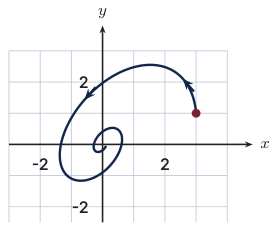
(c) Sketch the trajectory that starts at (3,1), showing its direction and its long-term behaviour.
[3]
Show solutionHide solution
(a) \dfrac{dx}{dt}=0.5(3)-2(1)=-0.5 and \dfrac{dy}{dt}=2.5(3)-1.5(1)=6.
M1
\dfrac{dy}{dx}=\dfrac{6}{-0.5}=-12.
A1
(b) The trace is −1 and the determinant is -0.75+5=4.25, so \lambda^2+\lambda+4.25=0.
M1
\lambda=\dfrac{-1\pm\sqrt{1-17}}{2}=-0.5\pm2i.
A1AG
(c) The path leaves (3,1) moving left and steeply upwards (gradient −12).
A1
It turns anticlockwise, because x\frac{dy}{dt}-y\frac{dx}{dt}=18.5>0.
A1
The real part −0.5 is negative, so it spirals in to the origin and both deviations die away.
A1
Original Photon diagram

Final answer

  • (a) −12
  • (c) anticlockwise inward spiral from (3,1) to the origin.

Mastery

Full exam questions that mix question types, at Paper 1 and Paper 2 standard.

Question 20

[12 marks]
Two online communities, a cycling forum and a running forum, recruit members from each other. At time t months, the cycling forum has x thousand members and the running forum has y thousand members, where \frac{dx}{dt} = 0.5x + 0.2y, \qquad \frac{dy}{dt} = 0.1x + 0.4y. Initially x = 3 and y = 1.
(a) Find the eigenvalues of M = \begin{pmatrix} 0.5 & 0.2 \\ 0.1 & 0.4 \end{pmatrix} and a corresponding eigenvector for each.
[4]
(b) Find the particular solution for x and y.
[4]
(c) Find the month in which the total membership x + y first exceeds 100 thousand.
[2]
(d) Describe the long-term behaviour of the system, and the long-term ratio of cycling to running members.
[2]
Show solutionHide solution
(a) \lambda^2 - 0.9\lambda + 0.18 = 0, from trace 0.9 and determinant 0.2 - 0.02 = 0.18.
[1]
(\lambda - 0.3)(\lambda - 0.6) = 0, so \lambda = 0.3 and \lambda = 0.6.
[1]
\lambda = 0.3: 0.2x + 0.2y = 0, so \mathbf{v} = \begin{pmatrix} 1 \\ -1 \end{pmatrix}.
[1]
\lambda = 0.6: -0.1x + 0.2y = 0, so \mathbf{v} = \begin{pmatrix} 2 \\ 1 \end{pmatrix}.
[1]
(b) \mathbf{X} = Ae^{0.6t}\begin{pmatrix} 2 \\ 1 \end{pmatrix} + Be^{0.3t}\begin{pmatrix} 1 \\ -1 \end{pmatrix}. At t = 0: 2A + B = 3 and A - B = 1.
[2]
A = \dfrac{4}{3} and B = \dfrac{1}{3}.
[1]
x = \dfrac{8}{3}e^{0.6t} + \dfrac{1}{3}e^{0.3t} and y = \dfrac{4}{3}e^{0.6t} - \dfrac{1}{3}e^{0.3t}.
[1]
(c) x + y = 4e^{0.6t} = 100 (the e^{0.3t} terms cancel), so e^{0.6t} = 25.
[1]
t = \dfrac{\ln 25}{0.6} = 5.36, so the total first exceeds 100 thousand during month 6.
[1]
(d) Both eigenvalues are positive, so both forums grow without bound (exponentially). The mode e^{0.6t} dominates, so \mathbf{X} \approx \dfrac{4}{3}e^{0.6t}\begin{pmatrix} 2 \\ 1 \end{pmatrix}.
[1]
The cycling : running ratio tends to 2 : 1 (and the total grows without limit, so the model cannot hold for ever).
[1]

Final answer

Eigenvalues 0.3, 0.6; x=\frac83e^{0.6t}+\frac13e^{0.3t}, y=\frac43e^{0.6t}-\frac13e^{0.3t}; month 6; ratio 2:1.
Question 21

[13 marks]
Two neighbouring towns exchange influence over a local trend. Letting x and y be standardised measures of the trend's strength, a modeller proposes
\frac{dx}{dt}=x+2y, \qquad \frac{dy}{dt}=2x+y.
Initially x=3 and y=1.
(a) Find the eigenvalues and corresponding eigenvectors of the coefficient matrix.
[5]
(b) Write down the general solution and find the particular solution satisfying the initial conditions.
[4]
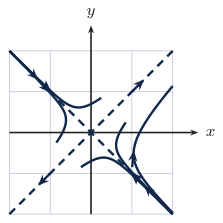
(c) The phase portrait for this system is shown below, with the two eigenvector directions drawn as dashed lines.
Original Photon diagram
Using your eigenvalues, classify the origin and state which eigenvector direction the trajectory approaches as t\to\infty.
[4]
Show solutionHide solution
(a) A=\begin{pmatrix} 1 & 2 \\ 2 & 1 \end{pmatrix}. \det(A-\lambda I)=(1-\lambda)^2-4=0\Rightarrow 1-\lambda=\pm 2, so \lambda_1=3, \lambda_2=-1.
For \lambda=3: (1-3)x+2y=0\Rightarrow -2x+2y=0, eigenvector \begin{pmatrix} 1 \\ 1 \end{pmatrix}.
For \lambda=-1: 2x+2y=0\Rightarrow x+y=0, eigenvector \begin{pmatrix} 1 \\ -1 \end{pmatrix}.
[5]
(b) General: \begin{pmatrix} x \\ y \end{pmatrix}=c_1 e^{3t}\begin{pmatrix} 1 \\ 1 \end{pmatrix}+c_2 e^{-t}\begin{pmatrix} 1 \\ -1 \end{pmatrix}.
At t=0: c_1+c_2=3, c_1-c_2=1, so c_1=2, c_2=1.
Particular: x=2e^{3t}+e^{-t}, y=2e^{3t}-e^{-t}.
[4]
(c) Eigenvalues 3>0 and -1<0 have opposite signs, so the origin is a saddle point (unstable). As t\to\infty the e^{3t} term dominates, so the trajectory approaches the direction of the eigenvector \begin{pmatrix} 1 \\ 1 \end{pmatrix} (the line y=x).
[4]

Final answer

Eigenvalues 3 with (1,1) and −1 with (1,-1); x=2e^{3t}+e^{-t}, y=2e^{3t}-e^{-t}; saddle, approaching y=x.

Question 22

[13 marks]
A lake contains a prey fish population x (thousands) and a predator fish population y (hundreds), modelled by
\begin{aligned}\frac{dx}{dt}&=0.8x-0.004xy,\\ \frac{dy}{dt}&=-0.6y+0.002xy,\end{aligned}
with t in years. Initially x=250 and y=180.
(a) Find the coordinates of the non-zero equilibrium point.
[4]
(b) Using Euler's method with step length h=0.5, estimate x and y at t=1. Give your answers to the nearest whole number.
[5]
(c) Explain why, near the non-zero equilibrium, the populations are expected to cycle rather than settle to constant values, and describe what the trajectory looks like in the xy phase plane.
[4]
Show solutionHide solution
(a) Non-zero equilibrium: from \dot{x}=0 with x\ne 0, 0.8-0.004y=0\Rightarrow y^*=200. From \dot{y}=0 with y\ne 0, -0.6+0.002x=0\Rightarrow x^*=300.
Equilibrium at (300\,200).
[4]
(b) At t=0: \dot{x}=0.8(250)-0.004(250)(180)=200-180=20, \dot{y}=-0.6(180)+0.002(250)(180)=-108+90=-18.
x_1=250+0.5(20)=260, y_1=180+0.5(-18)=171.
At t=0.5: \dot{x}=0.8(260)-0.004(260)(171)=208-177.84=30.16, \dot{y}=-0.6(171)+0.002(260)(171)=-102.6+88.92=-13.68.
x_2=260+0.5(30.16)=275.08, y_2=171+0.5(-13.68)=164.16.
At t=1: x\approx 275 (thousand prey), y\approx 164 (hundred predators).
[5]
(c) A predator-prey system of this type has purely oscillatory dynamics around the interior equilibrium: when prey are plentiful predators increase, which then reduces prey, which then reduces predators, allowing prey to recover, and so on. In the xy phase plane the trajectory forms a closed loop (a cycle) encircling the equilibrium point (300\,200).
[4]

Final answer

Equilibrium (300\,200); (275,\,164); closed cycles about the equilibrium.

Question 23

[15 marks]
A simplified model of owls and mice on an island uses x hundred owls and y hundred mice at time t years: \frac{dx}{dt} = -0.7x + 0.5y, \qquad \frac{dy}{dt} = -x + 0.8y. Owls decline without mice, and mice grow without owls.
(a) Show that the eigenvalues of the system are −0.2 and 0.3, and find an eigenvector for each. Classify the equilibrium at the origin.
[5]
(b) Initially x = 40 and y = 35. Show that x = 45e^{-0.2t} - 5e^{0.3t} and find the corresponding expression for y.
[3]
(c) Find the time at which the mice die out in this model, and the number of owls at that time.
[3]
(d) The conservation team can introduce extra mice at t = 0, with x = 40 unchanged. By writing x_0 = a + b and y_0 = a + 2b, find the least number of mice that must be introduced (to the nearest mouse) so that the mice do not die out.
[3]
(e) Explain what happens to the two populations if the starting values satisfy y_0 = x_0 exactly.
[1]
Show solutionHide solution
(a) \lambda^2 - (\operatorname{tr}M)\lambda + \det M = \lambda^2 - 0.1\lambda - 0.06, with \operatorname{tr}M = 0.1 and \det M = -0.56 + 0.5 = -0.06.
[1]
(\lambda + 0.2)(\lambda - 0.3) = 0, so \lambda = -0.2 or \lambda = 0.3.
[1]
\lambda = -0.2: -0.5x + 0.5y = 0, so \mathbf{v} = \begin{pmatrix} 1 \\ 1 \end{pmatrix}.
[1]
\lambda = 0.3: -x + 0.5y = 0, so \mathbf{v} = \begin{pmatrix} 1 \\ 2 \end{pmatrix}.
[1]
The eigenvalues are real with opposite signs: a saddle point.
[1]
(b) \mathbf{X} = ae^{-0.2t}\begin{pmatrix} 1 \\ 1 \end{pmatrix} + be^{0.3t}\begin{pmatrix} 1 \\ 2 \end{pmatrix}; t = 0: a + b = 40 and a + 2b = 35.
[1]
So b = -5 and a = 45, giving x = 45e^{-0.2t} - 5e^{0.3t}.
[1]
y = 45e^{-0.2t} - 10e^{0.3t}.
[1]
(c) y = 0 \Rightarrow 45e^{-0.2t} = 10e^{0.3t}, so e^{0.5t} = 4.5.
[1]
t = 2\ln 4.5 = 3.01 years.
[1]
Then x = 45e^{-0.2t} - 5e^{0.3t} = 12.3 hundred, about 1233 owls.
[1]
(d) In general b = y_0 - x_0 and a = 2x_0 - y_0. The mice persist (the growing mode has b > 0) only if y_0 > x_0 = 40.
[2]
Currently y_0 = 35 (hundred), so at least 40 - 35 = 5 hundred more are needed, and strictly more than that: the least whole number is 501 mice.
[1]
(e) b = 0: the start lies on the stable eigenline y = x, and both populations then decline together at the rate e^{-0.2t} towards zero (this is a knife-edge case).
[1]

Final answer

Eigenvalues −0.2 with (1,1) and 0.3 with (1,2), a saddle; y=45e^{-0.2t}-10e^{0.3t}; 3.01 years, about 1230 owls; 501 mice; on the stable line both decline to 0.

Question 24

[11 marks]
Two vats are connected in series. The concentrations (in g per litre) of a dye in vat A and vat B at time t minutes satisfy \frac{dx}{dt} = -x, \qquad \frac{dy}{dt} = x - 2y, with x = 1 and y = 0 at t = 0. The exact solution is x = e^{-t} and y = e^{-t} - e^{-2t}.
(a) Use Euler's method with h = 0.2 to estimate x and y at t = 0.4.
[4]
(b) Calculate the exact values of x and y at t = 0.4, and find the error in the Euler estimate of y.
[2]
(c) Repeat the Euler estimate of y at t = 0.4 using h = 0.1 (four steps), and find the new error.
[3]
(d) Comment on how the error changes when h is halved. Use this to suggest, with a reason, roughly how small h must be to get y correct to 3 decimal places.
[2]
Show solutionHide solution
(a) Rates: x_{n+1} = x_n + 0.2(-x_n), y_{n+1} = y_n + 0.2(x_n - 2y_n).
[1]
\begin{array}{c|ccccc} \hline n & t & x & y & f_1 & f_2 \\ \hline \text{0} & \text{0.0} & \text{1.0000} & \text{0.0000} & \text{-1.0000} & \text{1.0000} \\ \text{1} & \text{0.2} & \text{0.8000} & \text{0.2000} & \text{-0.8000} & \text{0.4000} \\ \text{2} & \text{0.4} & \text{0.6400} & \text{0.2800} & \text{---} & \text{---} \\ \hline \end{array}
x \approx 0.640 and y \approx 0.280 at t = 0.4.
[3]
(b) Exact: x(0.4) = e^{-0.4} = 0.670 and y(0.4) = e^{-0.4} - e^{-0.8} = 0.221.
[1]
Error in y = 0.280 - 0.221, i.e. |\text{error}| = 0.0590.
[1]
(c) With h = 0.1 (GDC table, four rows):
[1]
\begin{array}{c|ccccc} \hline n & t & x & y & f_1 & f_2 \\ \hline \text{0} & \text{0.0} & \text{1.0000} & \text{0.0000} & \text{-1.0000} & \text{1.0000} \\ \text{1} & \text{0.1} & \text{0.9000} & \text{0.1000} & \text{-0.9000} & \text{0.7000} \\ \text{2} & \text{0.2} & \text{0.8100} & \text{0.1700} & \text{-0.8100} & \text{0.4700} \\ \text{3} & \text{0.3} & \text{0.7290} & \text{0.2170} & \text{-0.7290} & \text{0.2950} \\ \text{4} & \text{0.4} & \text{0.6561} & \text{0.2465} & \text{---} & \text{---} \\ \hline \end{array}
y \approx 0.246.
[1]
Error = 0.0255.
[1]
(d) Halving h reduced the error from 0.0590 to 0.0255, roughly halving it (ratio 2.31): the error is roughly proportional to h.
[1]
If error \approx kh, then k \approx \dfrac{0.0255}{0.1} = 0.255. For an error below 0.0005 (3 decimal places) we need h < \dfrac{0.0005}{k} = 0.00196, which is about 205 steps to reach t = 0.4.
[1]

Final answer

(0.64,\,0.28); error 0.0590; with h=0.1 the value is 0.246, error 0.0255; the error roughly halves; h\approx0.002.

Question 25

[20 marks]
When a jogger lands on a footbridge, the vertical displacement of the deck below its rest position, x cm, t seconds later, is modelled by \dfrac{d^2x}{dt^2}+2.6\dfrac{dx}{dt}+1.2x=0. When t=0, x=0 and \dfrac{dx}{dt}=7.
(a) Let y=\dfrac{dx}{dt}. Show that the system can be written as \dfrac{d}{dt}\begin{pmatrix}x\\y\end{pmatrix}=\begin{pmatrix}0&1\\-1.2&-2.6\end{pmatrix}\begin{pmatrix}x\\y\end{pmatrix}.
[2]
(b) Taking steps of 0.1, apply Euler's method to find an approximate displacement of the deck when t=0.5.
[4]
(c) Find the eigenvalues of the matrix and an eigenvector for each.
[4]
(d) Hence find the exact solution for x.
[3]
(e) Find the percentage error in your estimate from part (b).
[2]
(f) Find the greatest displacement of the deck and the time when it occurs.
[2]
(g) Find the length of time for which the deck is more than 1 cm below its rest position.
[2]
(h) Classify the equilibrium point of the system and describe the motion of the deck in the long term.
[1]
Show solutionHide solution
(a) \dfrac{dx}{dt}=y.
M1
From the equation, \dfrac{dy}{dt}=-1.2x-2.6y, which is the printed matrix equation.
A1AG
(b) x_{n+1}=x_n+0.1y_n and y_{n+1}=y_n+0.1(-1.2x_n-2.6y_n), five steps from (0,7).
M1
The rows are (0.7,\,5.18), (1.218,\,3.7492), (1.5929,\,2.6282), (1.8557,\,1.7538).
A1A1
x(0.5)\approx2.0311, so 2.03 cm.
A1
(c) \lambda^2+2.6\lambda+1.2=0.
M1
\lambda=-0.6 or −2.
A1
Eigenvectors \begin{pmatrix}1\\-0.6\end{pmatrix} (or \begin{pmatrix}5\\-3\end{pmatrix}) and \begin{pmatrix}1\\-2\end{pmatrix}.
A1A1
(d) x=Ae^{-0.6t}+Be^{-2t} with A+B=0.
M1
-0.6A-2B=7.
M1
x=5e^{-0.6t}-5e^{-2t}.
A1
(e) The exact value is x(0.5)=1.8647, and \dfrac{2.0311-1.8647}{1.8647}\times100.
M1
=8.93\%.
A1
(f) \dfrac{dx}{dt}=0 gives e^{1.4t}=\dfrac{10}{3}, so t=0.860 s.
M1
The greatest displacement is 2.09 cm.
A1
(g) x=1 at t=0.180 and t=2.64.
M1
The deck is more than 1 cm below rest for 2.46 s.
A1
(h) Both eigenvalues are real and negative: a stable node. The deck returns to rest without oscillating.
R1

Final answer

  • (b) 2.03 cm
  • (c) −0.6 and −2
  • (d) x=5e^{-0.6t}-5e^{-2t}
  • (e) 8.93%
  • (f) 2.09 cm at 0.860 s
  • (g) 2.46 s
  • (h) stable node, no oscillation.

Going further

Beyond the syllabus: the worked examples and investigations of the chapter's Going further pages.

G1 The trace and determinant tell you the portrait

G1 Worked

[12 marks]
Layla studies the system \dfrac{dx}{dt}=-x+ky, \dfrac{dy}{dt}=x-y, where k is a constant that sets how strongly the second quantity feeds back on the first.
(a) Show that the matrix of the system has trace -2 and determinant 1-k.
[2]
(b) Classify the origin for k=2, for k=0.5 and for k=-3, giving the eigenvalues in each case.
[6]
(c) Find the range of values of k for which the origin is a saddle, a stable node and a stable spiral.
[4]
Show solutionHide solution
(a) The matrix is \begin{pmatrix}-1&k\\1&-1\end{pmatrix}. Its trace is -2 (A1) and its determinant is (-1)(-1)-k(1)=1-k (A1). (b) For k=2: \lambda^2+2\lambda-1=0, so \lambda=-1\pm\sqrt2, about 0.414 and -2.41 (A1); opposite signs, a saddle (R1). For k=0.5: \lambda^2+2\lambda+0.5=0, so \lambda=-1\pm\sqrt{0.5}, about -0.293 and -1.71 (A1); both negative, a stable node (R1). For k=-3: \lambda^2+2\lambda+4=0, so \lambda=-1\pm\sqrt3\,i (A1); the real part -1 is negative, a stable spiral (R1). (c) T^2-4D=4-4(1-k)=4k, and D<0 exactly when k>1 (M1). For k>1 the origin is a saddle (A1). For 0<k<1, D>0 and 4k>0, a stable node (A1). For k<0, D>0 and 4k<0, a stable spiral (A1).

Final answer

T=-2, D=1-k; k=2 saddle, k=0.5 stable node, k=-3 stable spiral; k>1 saddle, 0<k<1 stable node, k<0 stable spiral.

G2 Euler's method cannot draw a closed loop

G2 Worked

[5 marks]
Euler's method with step length h is applied to \dfrac{dx}{dt}=-3y, \dfrac{dy}{dt}=3x, starting from (1,0).
(a) Show that each step multiplies x^2+y^2 by 1+9h^2.
[2]
(b) Find the distance from the origin after 20 steps of length 0.05, and the number of steps of this length after which the distance first exceeds 2.
[3]
Show solutionHide solution
(a) x_{n+1}=x_n-3hy_n and y_{n+1}=y_n+3hx_n (M1). Then x_{n+1}^2+y_{n+1}^2=x_n^2-6hx_ny_n+9h^2y_n^2+y_n^2+6hx_ny_n+9h^2x_n^2=(1+9h^2)(x_n^2+y_n^2) (A1 AG). (b) With h=0.05 the factor is 1+9(0.0025)=1.0225 (M1). After 20 steps x^2+y^2=1.0225^{20}, so the distance is 1.0225^{10}=1.25 (A1). The distance exceeds 2 when 1.0225^{n/2}>2, that is n>62.3, so after 63 steps (A1).

Final answer

Shown; the distance is 1.0225^{10}=1.25 after 20 steps, and it first exceeds 2 after 63 steps.

G3 How stiff should the damper be?

G3 Investigation

[18 marks]
A car designer tests a seat spring with damping constant c. The displacement of the seat, x cm, satisfies \dfrac{d^2x}{dt^2}+c\dfrac{dx}{dt}+9x=0, with x=4 and \dfrac{dx}{dt}=0 when t=0.
(a) Show that the eigenvalues of the equivalent system satisfy \lambda^2+c\lambda+9=0.
[1]
(b) Find the values of c>0 for which the seat oscillates as it settles.
[2]
(c) For c=10, find x in terms of t.
[4]
(d) For c=10, find the time after which the seat stays within 0.1 cm of equilibrium.
[2]
(e) Repeat part (d) for c=7.5.
[3]
(f) Show that, for c>6, the eigenvalue closer to zero is \dfrac{-c+\sqrt{c^2-36}}{2}, and explain why a very stiff damper makes the seat settle slowly.
[3]
(g) Suggest, with a reason, the value of c the designer should choose.
[2]
(h) State one limitation of the model.
[1]
Show solutionHide solution
(a) With y=\frac{dx}{dt}: \frac{dx}{dt}=y and \frac{dy}{dt}=-9x-cy. The determinant \begin{vmatrix}-\lambda&1\\-9&-c-\lambda\end{vmatrix}=\lambda(c+\lambda)+9=\lambda^2+c\lambda+9 (A1). (b) The seat oscillates when the roots are complex, so c^2-36<0 (M1), which gives 0<c<6 (A1). (c) For c=10: \lambda^2+10\lambda+9=0, so \lambda=-1 or -9 (M1 A1). With x=Ae^{-t}+Be^{-9t}: A+B=4 and -A-9B=0 (M1), so x=4.5e^{-t}-0.5e^{-9t} (A1). (d) Solving 4.5e^{-t}-0.5e^{-9t}=0.1 on the GDC gives t=3.81 s (M1 A1); x is decreasing from then on. (e) For c=7.5: \lambda^2+7.5\lambda+9=0, so \lambda=-1.5 or -6 (A1), and x=\frac{16}{3}e^{-1.5t}-\frac43e^{-6t} (A1). Solving x=0.1 gives t=2.65 s (A1). (f) \lambda=\frac{-c\pm\sqrt{c^2-36}}{2}, and the root closer to zero is \frac{-c+\sqrt{c^2-36}}{2} (A1). The two roots multiply to 9 (A1), so the slow root is 9 divided by the fast root. As c grows the fast root grows in size and the slow root tends to 0: for c=20 it is -0.461, so the seat creeps back slowly (A1). (g) A value just above 6, for example c=6.2: there is no oscillation and the slow root is close to -3, the largest decay rate available (M1 A1). (h) For example, real springs are not linear, or damping changes with temperature (A1).

Final answer

Shown; 0<c<6; x=4.5e^{-t}-0.5e^{-9t}; 3.81 s; 2.65 s; shown; a value just above 6; for example, real springs are not linear.

From the book

Photon Guidebook: Mathematics Applications and Interpretation HL for the IB Diploma

Chapter 22 teaches coupled systems and phase portraits from the basics to full exam questions: how the IB asks it, every question type with a marked example, and these practice questions in three steps.

About the book