Free worked solutions · 2026 Edition

IB Maths AI HL Chapter 21: Differential equations worked solutions

Worked solutions to the practice questions in Chapter 21 of Photon Guidebook: Mathematics Applications and Interpretation HL for the IB Diploma (2026 Edition). Each solution shows every step with the mark it earns, the way an IB mark scheme does.

  • Chapter 21 of 24
  • Volume 2
  • 26 practice questions
  • 3 Going further
  • Free, no sign-up

Basics

One idea at a time, in the order the chapter teaches them.

Question 1

[2 marks]
The mass m grams of a material decreases at a rate proportional to the mass present. Time t is measured in hours. At m=48, the rate of change is −3.6 grams per hour.
Write a differential equation using a positive constant k, then find k.
[2]
Show solutionHide solution
\dfrac{dm}{dt}=-km, k>0.
A1
-3.6=-48k, so k=0.075 per hour.
A1

Final answer

\dfrac{dm}{dt}=-km with k=0.075 per hour.

Question 2

[4 marks]
For t\ge0, \dfrac{dy}{dt}=0.4(15-y) and y(0)=6.
(a) Find y(t) by separation.
[3]
(b) State the limiting value of y.
[1]
Show solutionHide solution
(a) \dfrac{dy}{15-y}=0.4\,dt, so -\ln|15-y|=0.4t+C.
M1
15-y=Ae^{-0.4t} and A=9.
M1
y=15-9e^{-0.4t}.
A1
(b) As t\to\infty, y\to15.
A1

Final answer

(a) y=15-9e^{-0.4t}. (b) 15.

Question 3

[3 marks]
For x\ge0, \dfrac{dy}{dx}=\dfrac{6x}{y} and y(0)=4.
Find y(x), choosing the branch required by the initial condition.
[3]
Show solutionHide solution
y\,dy=6x\,dx, so y^2/2=3x^2+C.
M1
y^2=6x^2+16.
M1
y=\sqrt{6x^2+16} because y(0)>0.
A1

Final answer

y=\sqrt{6x^2+16}.

Question 4

[5 marks]
For x\ge0, \dfrac{dy}{dx}=0.3y(1-y) and y(0)=0.2. You may use \dfrac1{y(1-y)}=\dfrac1y+\dfrac1{1-y}.
(a) Solve the differential equation.
[4]
(b) State the two constant solutions of the equation.
[1]
Show solutionHide solution
(a) \int\left(\dfrac1y+\dfrac1{1-y}\right)dy=\int0.3\,dx.
M1
\ln\left|\dfrac{y}{1-y}\right|=0.3x+C.
A1
y/(1-y)=Ae^{0.3x} and A=0.2/0.8=1/4.
M1
y=1/(1+4e^{-0.3x}).
A1
(b) y=0 and y=1, since either makes the right-hand side zero.
A1

Final answer

(a) y=\dfrac{1}{1+4e^{-0.3x}}. (b) y=0 and y=1.

Question 5

[2 marks]
An isocline is a set of points where slope has a specified constant value. Consider dy/dx=x+y.
Find the zero-slope isocline and the isocline of slope 3.
[2]
Show solutionHide solution
y=-x and y=3-x, respectively. A1A1

Final answer

Zero slope: y=-x. Slope 3: y=3-x.

Question 6

[3 marks]
For dy/dx=0.6y(8-y), restrict to y\ge0. An equilibrium is a constant solution.
Find the equilibria and classify their forward stability from signs.
[3]
Show solutionHide solution
Equilibria are y=0 and y=8.
A1
For 0<y<8 slopes are positive; for y>8 negative.
R1
0 is unstable to positive perturbations; 8 is stable.
R1

Final answer

y=0 (unstable) and y=8 (stable).

Question 7

[3 marks]
Use Euler for dy/dx=2x-y with y(0)=4 and step h=0.2.
Estimate y(0.4) using two steps, showing each update.
[3]
Show solutionHide solution
y_1=4+0.2(-4)=3.2.
M1
y_2=3.2+0.2(-2.8)=2.64. M1A1

Final answer

y(0.4)\approx2.64.

Question 8

[4 marks]
For dy/dx=2y, y(0)=1.3, the exact solution is 1.3e^{2x}.
Use h=0.12 to estimate y(0.6) and calculate its percentage error.
[4]
Show solutionHide solution
Each step multiplies y by 1.24, so y_5=1.3(1.24)^5=3.811112581. M1A1
Exact 1.3e^{1.2}=4.316152; percentage error =100(4.316152-3.811112581)/4.316152=11.7\%. M1A1

Final answer

Estimate 3.81; percentage error 11.7%.

Question 9

[2 marks]
A solution has y\prime\prime(x)<0 throughout a step beginning at the exact value y(x_0).
Explain whether the one-step Euler estimate at x_0+h, h>0, overestimates or underestimates.
[2]
Show solutionHide solution
Concavity down places the tangent above the curve to the right.
R1
Euler follows that tangent, so its one-step estimate overestimates.
R1

Final answer

An over-estimate: the tangent lies above a curve that is concave down.

Question 10

[3 marks]
The equation is dy/dx=x-y.
Find slopes at (0,2), (2,0) and (2,2).
[3]
Show solutionHide solution
−2, 2 and 0, respectively. A1A1A1

Final answer

−2, 2 and 0.

Tutorial

Exam-style questions on each question type, with the marks the IB would give.

Question 11

[7 marks]
Write each statement as a differential equation. You are not asked to solve them.
(a) A paddling pool is leaking. The volume V litres of water in the pool decreases at a rate proportional to \sqrt{V}, where t is the time in minutes.
[2]
(b) A sports club has M members at time t years. Its membership grows at 5% of its current size per year, but 40 members resign each year (treat both changes as continuous).
[2]
(c) A cup of tea has temperature T^{\circ}C at time t minutes in a room at 22^{\circ}C. Its temperature falls at a rate proportional to the difference between T and the room temperature.
[2]
(d) State the order of each of the three equations you wrote down.
[1]
Show solutionHide solution
(a) \dfrac{dV}{dt} = -k\sqrt{V},
[1]
with k > 0: the volume is decreasing, so the rate of change is negative.
[1]
(b) Growth adds 0.05M members per year and resignations remove 40 per year.
[1]
\dfrac{dM}{dt} = 0.05M - 40.
[1]
(c) The rate of change is proportional to T - 22, and the tea is cooling, so the constant is negative:
[1]
\dfrac{dT}{dt} = -k(T - 22) with k > 0.
[1]
(d) Each equation contains only a first derivative, so all three are first order.
[1]

Final answer

(a) \dfrac{dV}{dt}=-k\sqrt V, k>0. (b) \dfrac{dM}{dt}=0.05M-40. (c) \dfrac{dT}{dt}=-k(T-22), k>0. (d) All three are first order.

Question 12

[8 marks]
A circular patch of mould grows on a petri dish. Its radius r mm, t hours after it was first measured, satisfies \frac{dr}{dt} = \frac{3}{r}, and the radius is 2 mm at t = 0.
(a) Show that r = \sqrt{6t + 4}.
[4]
(b) Find the radius of the patch after 5 hours, to 3 significant figures.
[1]
(c) The patch is classed as hazardous when its area reaches 100\ \text{mm}^2. Find the time at which this happens.
[3]
Show solutionHide solution
(a) \displaystyle\int r\,dr = \int 3\,dt.
[1]
\dfrac{r^2}{2} = 3t + C.
[1]
r(0) = 2: 2 = C.
[1]
So r^2 = 6t + 4, and since r > 0, r = \sqrt{6t + 4}.
[1]
(b) r(5) = \sqrt{34} = 5.830\ldots \approx \mathbf{5.83} mm.
[1]
(c) Area = \pi r^2 = 100, so r^2 = \dfrac{100}{\pi}.
[1]
6t + 4 = \dfrac{100}{\pi} = 31.83\ldots
[1]
t = 4.638\ldots \approx \mathbf{4.64} hours.
[1]

Final answer

(a) Shown. (b) 5.83 mm. (c) 4.64 hours.

Question 13

[10 marks]
A pot of tea is poured at 92^{\circ}C into a room kept at 21^{\circ}C. Its temperature T^{\circ}C after t minutes satisfies Newton's law of cooling, \frac{dT}{dt} = -k(T - 21), \qquad k > 0.
(a) Solve the differential equation by separation of variables to show that T = 21 + 71e^{-kt}.
[4]
(b) After 4 minutes the tea is at 79^{\circ}C. Find the value of k, to 3 significant figures.
[2]
(c) Tea is comfortable to drink at 60^{\circ}C. Find the time after pouring at which this temperature is reached.
[2]
(d) Explain why the model predicts that the tea never reaches exactly 21^{\circ}C, and find the time at which the tea is first within 0.5^{\circ}C of the room temperature.
[2]
Show solutionHide solution
(a) \displaystyle\int \dfrac{1}{T - 21}\,dT = \int -k\,dt.
[1]
\ln|T - 21| = -kt + C.
[1]
T - 21 = Ae^{-kt}.
[1]
T(0) = 92: A = 71, so T = 21 + 71e^{-kt}.
[1]
(b) 79 = 21 + 71e^{-4k} \Rightarrow e^{-4k} = \dfrac{58}{71}.
[1]
k = \dfrac{1}{4}\ln\dfrac{71}{58} = 0.05056\ldots \approx \mathbf{0.0506} per minute.
[1]
(c) Solve 21 + 71e^{-kt} = 60 (GDC solver, or e^{-kt} = \tfrac{39}{71}).
[1]
t = \dfrac{\ln(71/39)}{k} = 11.85\ldots \approx \mathbf{11.8} minutes.
[1]
(d) 71e^{-kt} > 0 for every t, so T > 21 always and the tea only approaches 21^{\circ}C.
[1]
71e^{-kt} = 0.5 \Rightarrow t = \dfrac{\ln 142}{k} = 98.0\ldots \approx \mathbf{98.0} minutes.
[1]

Final answer

(a) Shown. (b) k=0.0506 per minute. (c) 11.8 minutes. (d) The model gives T>21 for every t; 98.0 minutes.

Question 14

[8 marks]
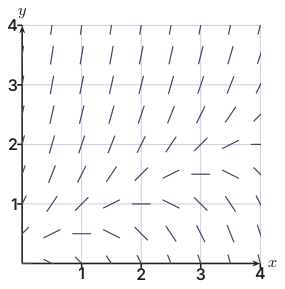
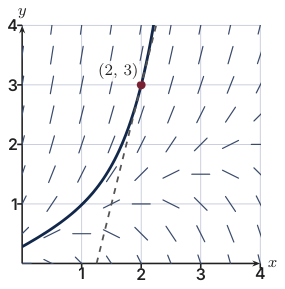
A differential equation has the form \dfrac{dy}{dx} = ax + by, where a and b are constants. Its slope field for 0 \le x \le 4 is shown. The segments are horizontal along the line y = \tfrac12 x, and the gradient of a solution curve at the point (0, 1) is 2.
Original Photon diagram
The slope field for 0\le x\le4.
(a) Find the values of a and b.
[3]
(b) Find the equation of the tangent at the point (2, 3) to the solution curve that passes through this point.
[2]
(c) Use the tangent to estimate the value of y on the solution curve when x = 2.1.
[1]
(d) Find \dfrac{d^2y}{dx^2} at (2, 3), and hence state, with a reason, whether your estimate in part (c) is an over-estimate or an under-estimate.
[2]
Show solutionHide solution
(a) At (0,1): 2 = a(0) + b(1), so b = 2.
[1]
Horizontal along y = \tfrac12x: ax + b\left(\tfrac12x\right) = 0 for all x.
[1]
a + \tfrac{b}{2} = 0, so a = -1. The equation is \dfrac{dy}{dx} = 2y - x.
[1]
(b) Gradient at (2,3): 2(3) - 2 = 4.
[1]
Tangent: y - 3 = 4(x - 2), i.e. y = 4x - 5.
[1]
(c) At x = 2.1: y \approx 4(2.1) - 5 = \mathbf{3.4}.
[1]
(d) Differentiating, \dfrac{d^2y}{dx^2} = 2\dfrac{dy}{dx} - 1, which at (2,3) is 2(4) - 1 = 7.
[1]
The second derivative is positive, so the curve is concave up and lies above its tangent: the estimate 3.4 is an under-estimate.
[1]
(The exact solution has y(2.1) = 3.437\ldots.)
Original Photon diagram
The slope field, the solution curve through (2,\,3) and its tangent there (dashed).

Final answer

(a) a=-1, b=2. (b) y=4x-5. (c) 3.4. (d) \dfrac{d^2y}{dx^2}=7>0: an under-estimate.

Question 15

[9 marks]
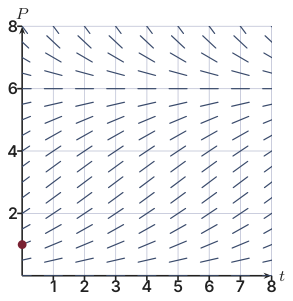
A population P (in thousands) satisfies \dfrac{dP}{dt} = 0.5P\left(1 - \dfrac{P}{6}\right), with t in years. Part of its slope field is shown.
Original Photon diagram
The slope field for 0\le t\le8, with t in years and P in thousands; the point (0,\,1) is marked.
(a) Write down the two equilibrium values of P and use the slope field to say which one is stable (nearby solutions move towards it).
[2]
(b) On the slope field, sketch the solution curve through (0, 1).
[2]
(c) Show that the solution curve is steepest when P = 3.
[2]
(d) Use Euler's method with h = 1 to estimate P when t = 2, and mark your Euler points on your sketch.
[3]
Show solutionHide solution
(a) Equilibria: P = \mathbf{0} and P = \mathbf{6}.
[1]
Segments just below P = 6 slope up and just above slope down, so solutions move towards 6: P = \mathbf{6} is stable.
[1]
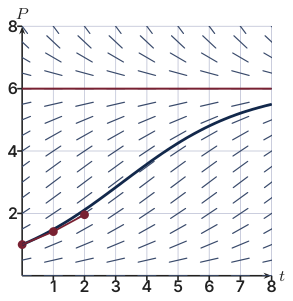
(b) The curve starts slowly at (0,1), steepens to its steepest point at P = 3 (about t = 3.2), then flattens and approaches P = 6 without crossing it: an S-shape.
[2]
Original Photon diagram
The solution curve through (0,\,1), the equilibrium P=6 and the Euler points for h=1.
(c) f(P) = 0.5P - \dfrac{P^2}{12}.
[1]
f'(P) = 0.5 - \dfrac{P}{6} = 0 at P = 3, and f is a downward quadratic, so the gradient \dfrac{dP}{dt} is greatest at P = 3.
[1]
(d) P_1 = 1 + 1\times 0.5(1)\left(1 - \tfrac16\right) = 1.4167.
[2]
P_2 = 1.4167 + 0.5(1.4167)\left(1 - \tfrac{1.4167}{6}\right) = \mathbf{1.958}.
[1]
The Euler points (0,1), (1,1.417), (2,1.958) are marked on the sketch (gold); they lie slightly below the solution curve, which at t = 2 is 2.11.

Final answer

(a) P=0 and P=6; P=6 is stable. (b) An S-shaped curve towards 6. (c) Shown. (d) 1.96 thousand.

Question 16

[9 marks]
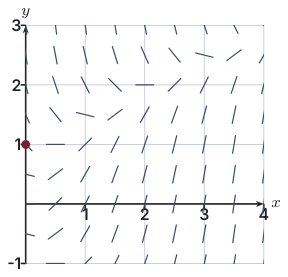
Consider the differential equation \dfrac{dy}{dx} = 2x - y^2, whose slope field is shown for 0 \le x \le 4.
Original Photon diagram
The slope field for 0\le x\le4; the point (0,\,1) is marked.
(a) Find the gradient of a solution curve at the point (2, 1).
[1]
(b) Show that every stationary point of every solution curve lies on the curve 2x = y^2.
[1]
(c) Use the slope field and part (b) to explain why a solution curve that starts at (0, 1) must decrease at first and later increase.
[2]
(d) By differentiating the differential equation with respect to x, show that \dfrac{d^2y}{dx^2} = 2 - 2y\dfrac{dy}{dx}, and hence prove that every stationary point is a local minimum.
[3]
(e) Sketch on the slope field the solution curve that passes through (0, 1).
[2]
Show solutionHide solution
(a) \dfrac{dy}{dx} = 2(2) - 1^2 = \mathbf{3}.
[1]
(b) A stationary point has \dfrac{dy}{dx} = 0, so 2x - y^2 = 0, i.e. 2x = y^2.
[1]
(c) At (0,1) the gradient is 0 - 1 = -1 < 0, and the segments slope downward wherever y^2 > 2x (above the curve y = \sqrt{2x}) and upward wherever y^2 < 2x.
[1]
The curve y = \sqrt{2x} rises, so the falling solution meets it; there the gradient is 0, and beyond it y^2 < 2x, so the solution slopes upward.
[1]
(d) Differentiate \dfrac{dy}{dx} = 2x - y^2 with respect to x: \dfrac{d^2y}{dx^2} = 2 - 2y\dfrac{dy}{dx}.
[2]
At a stationary point \dfrac{dy}{dx} = 0, so \dfrac{d^2y}{dx^2} = 2 > 0: every stationary point is a local minimum.
[1]
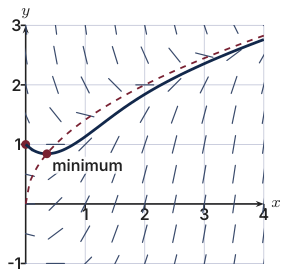
(e) From (0,1) the gradient is −1, so the curve falls, flattens as it meets the curve 2x = y^2 near (0.36, 0.84) (a minimum), then rises, staying close to y = \sqrt{2x}.
[2]
Original Photon diagram
The solution curve through (0,\,1) and the curve 2x=y^2 (dashed) that holds the minimum points.

Final answer

(a) 3. (b) Shown. (c) Explained. (d) \dfrac{d^2y}{dx^2}=2>0, so every stationary point is a minimum. (e) A minimum near (0.36,\,0.84).
Question 17

[7 marks]
Wei Ling runs a start-up. Its cash balance C thousand dollars, t months after launch, satisfies \frac{dC}{dt} = 0.08C + 12 - 2t, \qquad C(0) = 50. She uses Euler's method with step length h = 1 month.
(a) Write down the two Euler update formulas for t_{n+1} and C_{n+1} for this equation.
[2]
(b) Complete a table of t_n, C_n and \dfrac{dC}{dt} and hence estimate the balance after 3 months.
[4]
(c) State what the value of \dfrac{dC}{dt} in the row for t = 2 tells Wei Ling about her balance.
[1]
Show solutionHide solution
(a) t_{n+1} = t_n + 1
[1]
C_{n+1} = C_n + 1\times\bigl(0.08C_n + 12 - 2t_n\bigr)
[1]
(b)
\begin{array}{c|c|c|c} n & t_n & C_n & \dfrac{dC}{dt} = 0.08C_n + 12 - 2t_n \\ \hline \text{0} & \text{0} & \text{50} & \text{16} \\ \text{1} & \text{1} & \text{66} & \text{15.28} \\ \text{2} & \text{2} & \text{81.28} & \text{14.5024} \\ \text{3} & \text{3} & \text{95.7824} & \text{--} \\ \end{array}
First step: C_1 = 50 + 16 = 66.
[2]
C_2 = 66 + 15.28 = 81.28.
[1]
C_3 = 81.28 + 14.5024 = 95.7824, so the balance after 3 months is about \mathbf{95.8} thousand dollars.
[1]
(c) At t = 2 the balance is still rising, at about 14.5 thousand dollars per month.
[1]

Final answer

(a) t_{n+1}=t_n+1 and C_{n+1}=C_n+0.08C_n+12-2t_n. (b) 66, 81.28 and 95.8 thousand dollars. (c) Still rising, at about 14.5 thousand dollars a month.

Question 18

[8 marks]
Dye is released into a stream. The concentration c of dye (relative to its starting value) at a distance x km downstream satisfies \frac{dc}{dx} = -2xc, \qquad c(0) = 1.
(a) Use Euler's method to estimate c(1) with step lengths h = 0.5 and h = 0.25.
[3]
(b) Solve the differential equation by separation of variables and find the exact value of c(1).
[2]
(c) Use a spreadsheet to estimate c(1) with h = 0.1 and h = 0.05, and find the error of all four estimates.
[2]
(d) Describe how the error changes as the step length is halved.
[1]
Show solutionHide solution
(a) h = 0.5: c_1 = 1 + 0.5(0) = 1, c_2 = 1 + 0.5(-2(0.5)(1)) = 0.5, so c(1) \approx \mathbf{0.5}.
[2]
h = 0.25: c_1 = 1, c_2 = 1 + 0.25(-2\times0.25\times1) = 0.875, c_3 = 0.875 + 0.25(-2\times0.5\times0.875) = 0.65625, c_4 = 0.65625 + 0.25(-2\times0.75\times0.65625) = 0.41016.
[1]
So c(1) \approx \mathbf{0.410}.
(b) \displaystyle\int \dfrac{1}{c}\,dc = \int -2x\,dx \Rightarrow \ln c = -x^2 + C, and c(0) = 1 gives C = 0: c = e^{-x^2}.
[1]
c(1) = e^{-1} = \mathbf{0.368} (0.36788\ldots).
[1]
(c) Spreadsheet: h = 0.1 gives 0.38171; h = 0.05 gives 0.37438.
[1]
\begin{array}{c|c|c|c|c} h & \text{0.5} & \text{0.25} & \text{0.1} & \text{0.05} \\ \hline \text{estimate} & \text{0.5} & \text{0.41016} & \text{0.38171} & \text{0.37438} \\ \text{error} & \text{0.1321} & \text{0.0423} & \text{0.0138} & \text{0.0065} \\ \end{array}
[1]
(d) For the smaller step lengths, halving h roughly halves the error (0.0138 \to 0.0065).
[1]

Final answer

(a) 0.5 and 0.410. (b) e^{-1}=0.368. (c) 0.382 and 0.374; errors 0.132, 0.0423, 0.0138 and 0.0065. (d) The error roughly halves.

Question 19

[12 marks]
A swimming pool has volume 50\ \text{m}^3. An automatic doser adds 90 g of chlorine per hour, and sunlight destroys chlorine at a rate of 12% of the mass present per hour. Let C grams be the mass of chlorine in the pool after t hours, with C = 100 when t = 0.
(a) Show that \dfrac{dC}{dt} = 90 - 0.12C.
[2]
(b) Find the value of C for which \dfrac{dC}{dt} = 0, and interpret it.
[2]
(c) Solve the differential equation to show that C = 750 - 650e^{-0.12t}.
[5]
(d) The pool needs at least 10\ \text{g} of chlorine per \text{m}^3. Find the time at which this is first achieved.
[2]
(e) The long-term concentration should not exceed 20\ \text{g\,m}^{-3}. Determine whether this condition is met.
[1]
Show solutionHide solution
(a) Chlorine is added at 90 g per hour.
[1]
It is destroyed at 12% of C, which is 0.12C per hour, so \dfrac{dC}{dt} = 90 - 0.12C.
[1]
(b) 90 - 0.12C = 0 \Rightarrow C = \dfrac{90}{0.12} = \mathbf{750} g.
[1]
At 750 g the dosing exactly balances the destruction, so the mass of chlorine stays constant (the equilibrium level).
[1]
(c) \displaystyle\int \dfrac{1}{90 - 0.12C}\,dC = \int 1\,dt.
[1]
-\dfrac{1}{0.12}\ln|90 - 0.12C| = t + c.
[1]
90 - 0.12C = Be^{-0.12t}.
[1]
C(0) = 100: B = 90 - 12 = 78.
[1]
C = \dfrac{90 - 78e^{-0.12t}}{0.12} = 750 - 650e^{-0.12t}.
[1]
(d) 10\ \text{g\,m}^{-3} in 50\ \text{m}^3 means C = 500: 750 - 650e^{-0.12t} = 500.
[1]
e^{-0.12t} = \dfrac{250}{650}, so t = \dfrac{\ln 2.6}{0.12} = 7.96\ldots \approx \mathbf{7.96} hours.
[1]
(e) Long-term C = 750 g, which is \dfrac{750}{50} = 15\ \text{g\,m}^{-3} < 20: the condition is met.
[1]

Final answer

(a) Shown. (b) 750 g: dosing equals loss. (c) Shown. (d) 7.96 hours. (e) 15 g m^{-3} is below 20, so the condition is met.

Question 20

[9 marks]
Consider the differential equation \dfrac{dy}{dx} = 2x - y^2 with y(0) = 1. (Every stationary point of a solution lies on the curve 2x = y^2, and every such point is a local minimum.)
(a) Use Euler's method with h = 0.1 to complete a table of values of x_n, y_n and \dfrac{dy}{dx} for x = 0 to x = 0.5.
[4]
(b) Hence state between which two values of x the gradient changes sign, and estimate the coordinates of the minimum point of the solution.
[2]
(c) Use the fact that 2x = y^2 at a stationary point to check that your answer to part (b) is consistent.
[1]
(d) Use a spreadsheet with h = 0.05 to obtain an improved estimate of the minimum point, and say which of the two estimates you trust more.
[2]
Show solutionHide solution
(a)
\begin{array}{c|c|c|c} n & x_n & y_n & 2x_n - y_n^2 \\ \hline \text{0} & \text{0} & \text{1} & -1 \\ \text{1} & \text{0.1} & \text{0.9} & -0.61 \\ \text{2} & \text{0.2} & \text{0.839} & -0.30392 \\ \text{3} & \text{0.3} & \text{0.80861} & -0.05385 \\ \text{4} & \text{0.4} & \text{0.80322} & +0.15483 \\ \text{5} & \text{0.5} & \text{0.81871} & +0.32972 \\ \end{array}
y_1 = 1 + 0.1(-1) = 0.9.
[2]
y_2 = 0.9 + 0.1(-0.61) = 0.839, and so on with unrounded values.
[1]
Values continuing to y_5 = 0.81871.
[1]
(b) The gradient is negative at x = 0.3 and positive at x = 0.4, so it changes sign between \mathbf{x = 0.3} and \mathbf{x = 0.4}.
[1]
The smallest tabulated y is at x = 0.4: minimum near \mathbf{(0.4,\ 0.803)}.
[1]
(c) At a stationary point 2x = y^2. At x = 0.3, y^2 = 0.654 > 0.6 = 2x (so 2x - y^2 < 0, gradient negative) and at x = 0.4, y^2 = 0.645 < 0.8 (gradient positive), so the sign change lies between them, as found.
[1]
(d) With h = 0.05 the gradient changes sign between x = 0.30 (−0.0859) and x = 0.35 (+0.0212); the lowest value is at x = 0.35: minimum near \mathbf{(0.35,\ 0.824)}.
[1]
The true minimum is where 2x = y^2 (about (0.36, 0.84)); the h = 0.05 estimate is closer in both coordinates, so it is the one to trust.
[1]

Final answer

(a) Table. (b) The sign changes between x=0.3 and x=0.4; minimum near (0.4,\,0.803). (c) Consistent. (d) With h=0.05, near (0.35,\,0.824), which is more reliable.

Mastery

Full exam questions that mix question types, at Paper 1 and Paper 2 standard.

Question 21

[10 marks]
A forensic scientist uses Newton's Law of Cooling to estimate a time of death. A body is found in a room kept at 22\,{}^{\circ}C. The body temperature follows
\frac{dT}{dt}=-k\,(T-22),
with t in hours after discovery. At discovery (t=0) the temperature is 30\,{}^{\circ}C, and one hour later it is 27\,{}^{\circ}C.
(a) Show that the solution has the form T=22+8\,e^{-kt}.
[3]
(b) Use the reading at t=1 to find k, giving your answer to 3 significant figures.
[3]
(c) Assuming a normal living body temperature of 37\,{}^{\circ}C, estimate how many hours before discovery the person died.
[4]
Show solutionHide solution
(a) Separating, \displaystyle\int\frac{dT}{T-22}=\int -k\,dt gives \ln|T-22|=-kt+c, so T-22=Ce^{-kt}. At t=0, T=30\Rightarrow C=8. Thus T=22+8e^{-kt}.
[3]
(b) At t=1, T=27: 27=22+8e^{-k}\Rightarrow e^{-k}=\dfrac{5}{8}=0.625. So k=-\ln 0.625\approx 0.470.
[3]
(c) Death corresponds to T=37. Solve 37=22+8e^{-0.470t}\Rightarrow e^{-0.470t}=\dfrac{15}{8}=1.875. Then -0.470t=\ln 1.875=0.6286, so t=\dfrac{0.6286}{-0.470}\approx -1.34. The negative sign means death occurred about 1.34 hours before discovery.
[4]

Final answer

(a) Shown. (b) k=0.470. (c) About 1.34 hours before discovery.

Question 22

[12 marks]
A large water tank contains 500 litres of pure-water solution in which 10 kg of salt is dissolved. Brine containing 0.05 kg of salt per litre flows into the tank at 8 litres per minute, and the well-mixed solution flows out at the same rate. Let S be the mass of salt (kg) in the tank after t minutes.
(a) Explain why the volume of solution in the tank stays constant at 500 litres.
[1]
(b) Show that \dfrac{dS}{dt}=0.4-0.016\,S.
[3]
(c) Solve this differential equation, given S(0)=10, to show that S=25-15\,e^{-0.016t}.
[5]
(d) Find the mass of salt in the tank after 30 minutes, and state the long-term mass of salt.
[3]
Show solutionHide solution
(a) Inflow rate equals outflow rate (8 L/min each), so the volume neither rises nor falls: it stays at 500 L.
[1]
(b) Salt in =0.05\times 8=0.4 kg/min. Salt out =(\text{concentration})\times 8=\dfrac{S}{500}\times 8=0.016\,S kg/min. Hence \dfrac{dS}{dt}=0.4-0.016\,S.
[3]
(c) Separate: \displaystyle\int\frac{dS}{0.4-0.016S}=\int dt. This gives -\dfrac{1}{0.016}\ln|0.4-0.016S|=t+c. Rearranging, 0.4-0.016S=B\,e^{-0.016t}, so S=25-\dfrac{B}{0.016}e^{-0.016t}. At t=0, S=10: 10=25-\dfrac{B}{0.016}, so \dfrac{B}{0.016}=15. Therefore S=25-15\,e^{-0.016t}.
[5]
(d) S(30)=25-15\,e^{-0.48}=25-15(0.6188)\approx 15.72 kg. As t\to\infty, e^{-0.016t}\to 0, so the long-term mass is 25 kg.
[3]

Final answer

(a) Inflow equals outflow. (b) Shown. (c) Shown. (d) 15.7 kg; 25 kg in the long term.

Question 23

[12 marks]
An engineer models the temperature T (^{\circ}C) of a component being cooled by
\frac{dT}{dt}=-0.08\,(T-20),\qquad T(0)=95,
with t in minutes. She first estimates the solution numerically using Euler's method with step length h=2.
(a) Complete the Euler iteration to estimate T at t=2,4,6. Give each value to 2 decimal places.
[4]
(b) Solve the differential equation exactly to show that T=20+75\,e^{-0.08t}.
[4]
(c) (i) Find the exact temperature at t=6.
[1]
(ii) Hence find the absolute error in the Euler estimate at t=6, and comment on how the estimate could be improved.
[3]
Show solutionHide solution
(a) Euler: T_{n+1}=T_n+2\,(-0.08)(T_n-20)=T_n-0.16(T_n-20).
T(2)=95-0.16(75)=83.00,\quad T(4)=83-0.16(63)=72.92,\quad T(6)=72.92-0.16(52.92)=64.45.
[4]
(b) Separating, \displaystyle\int\frac{dT}{T-20}=\int -0.08\,dt gives \ln|T-20|=-0.08t+c, so T-20=Ce^{-0.08t}. At t=0, T=95\Rightarrow C=75. Thus T=20+75e^{-0.08t}.
[4]
(c)(i) T(6)=20+75e^{-0.48}=20+75(0.61878)\approx 66.41\,{}^{\circ}C.
[1]
(c)(ii) Absolute error =66.41-64.45=1.96\,{}^{\circ}C. Using a smaller step length h would reduce the error, since Euler's method becomes more accurate as h\to 0.
[3]

Final answer

(a) 83.00, 72.92 and 64.45 ^\circC. (b) Shown. (c) 66.41 ^\circC; error 1.96 ^\circC; use a smaller step.

Question 24

[6 marks]
The end of a diving board vibrates after a diver jumps off. Its vertical displacement y metres, t seconds later, satisfies \dfrac{d^2y}{dt^2}=-16y-0.8\dfrac{dy}{dt}, with y=0.05 and \dfrac{dy}{dt}=0 when t=0.
(a) By letting v=\dfrac{dy}{dt}, write the equation as two first-order differential equations.
[2]
(b) Taking steps of h=0.1, use Euler's method to estimate the displacement when t=0.3.
[4]
Show solutionHide solution
(a) \dfrac{dy}{dt}=v
A1
\dfrac{dv}{dt}=-16y-0.8v
A1
(b) y_{n+1}=y_n+0.1v_n and v_{n+1}=v_n+0.1(-16y_n-0.8v_n), each from the old row.
M1
(y,v): (0.05,\,0)\to(0.05,\,-0.08)\to(0.042,\,-0.1536).
A1
\to(0.02664,\,-0.20851).
M1
y(0.3)\approx0.0266 m.
A1

Final answer

(a) \dfrac{dy}{dt}=v and \dfrac{dv}{dt}=-16y-0.8v. (b) 0.0266 m.

Question 25

[13 marks]
A retiree invests $200 000 in a fund earning interest continuously at 6% per year, and withdraws money continuously at a constant rate of $13 000 per year. The value V (dollars) after t years satisfies
\frac{dV}{dt}=0.06\,V-13\,000.
(a) Find the value of V for which \dfrac{dV}{dt}=0, and interpret this value.
[2]
(b) Solve the differential equation, given V(0)=200\,000, to show that
V=216\,666.67-16\,666.67\,e^{0.06t}.
[5]
(c) Find the value of the fund after 5 years.
[2]
(d) Determine, to the nearest year, when the fund will be exhausted (reaches $0).
[4]
Show solutionHide solution
(a) Set 0.06V-13\,000=0\Rightarrow V=\dfrac{13\,000}{0.06}=216\,666.67. If the fund starts exactly here, interest earned each year exactly matches withdrawals, so the balance stays constant.
[2]
(b) Write \dfrac{dV}{dt}=0.06\left(V-216\,666.67\right). Separating,
\int\frac{dV}{V-216\,666.67}=\int 0.06\,dt\Rightarrow \ln|V-216\,666.67|=0.06t+c.
So V-216\,666.67=De^{0.06t}. At t=0, V=200\,000: D=200\,000-216\,666.67=-16\,666.67. Hence V=216\,666.67-16\,666.67\,e^{0.06t}.
[5]
(c) V(5)=216\,666.67-16\,666.67\,e^{0.3}=216\,666.67-16\,666.67(1.34986)\approx \$194\,169.02.
[2]
(d) Set V=0: 16\,666.67\,e^{0.06t}=216\,666.67\Rightarrow e^{0.06t}=13. So t=\dfrac{\ln 13}{0.06}=\dfrac{2.5649}{0.06}\approx 42.7, i.e. after about 43 years.
[4]

Final answer

(a) 216 666.67 dollars: interest equals withdrawals. (b) Shown. (c) 194 169.02 dollars. (d) About 43 years.

Question 26

[19 marks]
A reservoir supplying a village holds V thousand m^3 of water, t days after the start of a dry season. A river adds water at a constant 6 thousand m^3 per day, and water is drawn off at a rate proportional to V. When V=150, water is drawn off at 4.5 thousand m^3 per day.
(a) Show that \dfrac{dV}{dt}=6-0.03V.
[3]
(b) Find the value of V at which the volume stays constant.
[1]
At t=0 the reservoir holds 120 thousand m^3.
(c) Taking steps of h=5 days, use Euler's method to estimate V when t=20.
[3]
(d) By solving the differential equation, show that V=200-80e^{-0.03t}.
[5]
(e) Find the percentage error in your estimate from part (c).
[2]
(f) Find the time at which the reservoir first holds 180 thousand m^3.
[2]
At t=30 the river dries up completely and water continues to be drawn off as before.
(g) Write down the new differential equation and find the volume of water in the reservoir when t=60.
[3]
Show solutionHide solution
(a) Outflow is kV.
M1
4.5=k(150).
M1
k=0.03.
A1
Rate in minus rate out gives \dfrac{dV}{dt}=6-0.03V.
AG
(b) 6-0.03V=0, so V=200 thousand m^3.
A1
(c) V_{n+1}=V_n+5(6-0.03V_n)=0.85V_n+30.
M1
V_1=132, V_2=142.2, V_3=150.87.
A1
V_4=158.2395, so V(20)\approx158 thousand m^3.
A1
(d) \displaystyle\int\frac{1}{6-0.03V}\,dV=\int dt.
M1
-\dfrac{1}{0.03}\ln(6-0.03V)=t+c.
A1
t=0, V=120: c=-\dfrac{1}{0.03}\ln2.4.
M1
\ln\dfrac{6-0.03V}{2.4}=-0.03t.
M1
6-0.03V=2.4e^{-0.03t}.
A1
V=200-80e^{-0.03t}.
AG
(e) Exact V(20)=200-80e^{-0.6}=156.10.
M1
\dfrac{158.2395-156.10}{156.10}\times100=1.37\%.
A1
(f) 80e^{-0.03t}=20.
M1
t=\dfrac{\ln4}{0.03}=46.2 days.
A1
(g) \dfrac{dV}{dt}=-0.03V.
A1
V(30)=200-80e^{-0.9}=167.47 and V=167.47e^{-0.03(t-30)}.
M1
V(60)=167.47e^{-0.9}=68.1 thousand m^3.
A1

Final answer

(a) Shown. (b) 200. (c) 158. (d) Shown. (e) 1.37%. (f) 46.2 days. (g) \dfrac{dV}{dt}=-0.03V; 68.1 thousand m^3.

Going further

Beyond the syllabus: the worked examples and investigations of the chapter's Going further pages.

G1 Two cheap estimates beat one expensive one

G1 Worked

[4 marks]
A laboratory culture contains N thousand cells, t days after it is started, with \dfrac{dN}{dt}=0.4N and N=50 when t=0. Euler's method gives N(2)\approx103.68 with h=0.5 and N(2)\approx107.1794 with h=0.25.
(a) Use 2E\left(\frac h2\right)-E(h) to find an improved estimate of N(2).
[2]
(b) Find the percentage error of the improved estimate, using the exact value 50e^{0.8}.
[2]
Show solutionHide solution
(a) 2(107.1794)-103.68=110.6788 (M1), so the improved estimate is 110.68 thousand (A1). (b) Exact N(2)=50e^{0.8}=111.2770 (M1). Percentage error =\dfrac{111.2770-110.6788}{111.2770}\times100=0.538\% (A1), compared with 6.83% and 3.68% for the two Euler runs.

Final answer

(a) 110.68 thousand. (b) 0.538%.

G2 Test a model by making it straight

G2 Worked

[5 marks]
Hye-jin records the temperature of a cup of tea in a room at 20 degrees Celsius: 75 degrees at 0 minutes, 53.4 degrees at 10 minutes and 40.2 degrees at 20 minutes.
(a) Find \ln(T-20) at each time.
[2]
(b) Show that the points lie close to a straight line, and find its gradient.
[2]
(c) Write down the value of k in \dfrac{dT}{dt}=-k(T-20).
[1]
Show solutionHide solution
(a) \ln55=4.007, \ln33.4=3.509, \ln20.2=3.006 (A1 A1). (b) The values fall by 0.499 and then by 0.503 over equal steps of 10 minutes (M1), so they lie close to a line with gradient \dfrac{3.0057-4.0073}{20}=-0.0501 (A1). (c) The gradient is -k, so k=0.0501 per minute (A1).

Final answer

(a) 4.007, 3.509, 3.006. (b) Gradient -0.0501. (c) k = 0.0501 per minute.

G3 Investigation

[20 marks]
Zara takes a pie out of the oven and records its temperature every 5 minutes in a kitchen at 20 degrees Celsius.
\begin{array}{c|cccccc}\text{Time (minutes)}&0&5&10&15&20&25\\\hline\text{Temperature}&90&71.9&58.4&48.5&41.1&35.6\end{array}
She tests the model \dfrac{dT}{dt}=-k(T-20).
(a) Show that the model gives \ln(T-20)=\ln A-kt, and explain why a straight-line graph of \ln(T-20) against t supports the model.
[3]
(b) Use linear regression to find k and A.
[3]
(c) Taking k=0.06 and steps of h=5 minutes, use Euler's method to estimate T when t=25, and show that each step multiplies T-20 by 0.7. Then write down the exact solution and find T when t=25.
[5]
(d) Repeat the Euler estimate with h=2.5 minutes and find the error of both estimates. Show that halving the step roughly halves the error, and use 2E(2.5)-E(5) to find a better estimate and its error.
[5]
(e) Zara then finds that the room was at 22 degrees. Using only the first and last readings, find k for this room temperature and comment on the effect on the model. Give one reason why the model may fail for a real pie.
[4]
Show solutionHide solution
(a) Separating, \int\frac{1}{T-20}\,dT=\int-k\,dt gives \ln(T-20)=-kt+c (M1 A1). Writing c=\ln A gives \ln(T-20)=\ln A-kt. A straight line of gradient -k and intercept \ln A is exactly what this equation predicts, so points on a line support the model (R1). (b) Regress \ln(T-20) on t: gradient -0.0600 (A1), intercept 4.25 (A1), r=-1.000. So k=0.0600 and A=e^{4.25}=70.0 (A1). (c) T_{n+1}-20=(T_n-20)-5(0.06)(T_n-20)=0.7(T_n-20) (M1). Rows of T: 69, 54.3, 44.01, 36.807, 31.7649 (A1), so T(25)\approx31.8 degrees (A1). The exact solution is T=20+70e^{-0.06t} (A1), so T(25)=35.6 degrees (A1). (d) With h=2.5 each step multiplies T-20 by 0.85, so after ten steps T=20+70(0.85)^{10}=33.8 (A1). The errors are 35.62-31.76=3.85 and 35.62-33.78=1.84 degrees (A1). The ratio is 2.10, about 2, so halving the step roughly halves the error (R1). The better estimate is 2(33.78)-31.76=35.80 (M1) with error 0.178 degrees (A1). (e) k=-\frac{1}{25}\ln\frac{35.6-22}{90-22}=0.0644 per minute (M1 A1). This is larger than 0.0600, but the fit for 20 degrees was almost perfect (r=-1.000) and agrees with the two-point value for 20 degrees, so the data support a room at 20 degrees (R1): k depends on the room temperature assumed. One reason the model may fail: the crust and the filling cool at different rates, or a draught changes the room temperature (A1).

Final answer

(a) Shown. (b) k = 0.0600, A = 70.0. (c) 31.8; T = 20 + 70e^(-0.06t), 35.6. (d) 33.8; errors 3.85 and 1.84; ratio about 2; better estimate 35.8, error 0.178. (e) k = 0.0644; the data support 20 degrees; any valid reason.

From the book

Photon Guidebook: Mathematics Applications and Interpretation HL for the IB Diploma

Chapter 21 teaches differential equations from the basics to full exam questions: how the IB asks it, every question type with a marked example, and these practice questions in three steps.

About the book