Free worked solutions · 2026 Edition

IB Maths AI HL Chapter 8: Trigonometry and three-dimensional geometry worked solutions

Worked solutions to the practice questions in Chapter 8 of Photon Guidebook: Mathematics Applications and Interpretation HL for the IB Diploma (2026 Edition). Each solution shows every step with the mark it earns, the way an IB mark scheme does.

  • Chapter 8 of 24
  • Volume 1
  • 26 practice questions
  • 2 Going further
  • Free, no sign-up

Basics

One idea at a time, in the order the chapter teaches them.

Question 1

[2 marks]
A ground observer is 38.6 m horizontally from the base of a mast on level ground. The angle of elevation of its top is 42^\circ. Ignore observer height.
Find the height to 3 significant figures.
[2]
Show solutionHide solution
h=38.6\tan42^\circ.
M1
h=34.8 m.
A1

Final answer

34.8 m

Question 2

[2 marks]
In triangle ABC, b=8.3 cm, c=12.9 cm and A=58^\circ.
Calculate a, to 3 significant figures.
[2]
Show solutionHide solution
a^2=8.3^2+12.9^2-2(8.3)(12.9)\cos 58^\circ.
M1
a=11.0 cm.
A1

Final answer

11.0 cm

Question 3

[3 marks]
From a radio base A, marker B is 9.1 km away on bearing 028^\circ, and marker C is 14.7 km away on bearing 109^\circ.
(a) Find angle BAC.
[1]
(b) Find BC to 3 significant figures.
[2]
Show solutionHide solution
(a) \angle BAC=109-28=81^\circ.
A1
(b) BC^2=9.1^2+14.7^2-2(9.1)(14.7)\cos81^\circ.
M1
BC=16.0 km.
A1

Final answer

  • (a) 81^\circ
  • (b) 16.0 km

Question 4

[3 marks]
An annular sector lies between concentric circles of radii 4.8 m and 8.1 m, over angle 112^\circ. It has two curved boundaries and two radial straight ends.
Find its full perimeter to 3 significant figures.
[3]
Show solutionHide solution
L_{\rm outer}+L_{\rm inner}=(112/360)2\pi(8.1+4.8).
M1
Two ends total 2(8.1-4.8)=6.6 m.
A1
P=31.8 m.
A1

Final answer

31.8 m

Question 5

[3 marks]
A circular plate has radius 9.6 cm. A 95^\circ sector is removed.
Find the area left, to 3 significant figures.
[3]
Show solutionHide solution
Remaining angle =360-95=265^\circ.
A1
K=(265/360)\pi(9.6)^2.
M1
K=213 cm^2.
A1

Final answer

213 cm^2

Question 6

[4 marks]
A closed cone has radius 3 cm and vertical height 4 cm. Its curved area is \pi r\ell, where \ell is slant height, and its base area is \pi r^2.
Find \ell and the total surface area to 3 significant figures.
[4]
Show solutionHide solution
\ell=\sqrt{3^2+4^2}=5 cm. M1A1
Total S=\pi(3)(5)+\pi(3)^2=24\pi.
M1
S=75.4\text{ cm}^2 (3 s.f.).
A1

Final answer

\ell=5 cm; 75.4 cm^2 (24\pi)

Question 7

[4 marks]
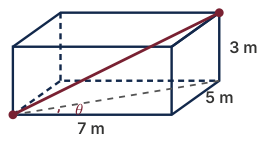
A cuboid has base sides 5 m and 7 m and vertical height 3 m. A space diagonal runs from a bottom corner to the opposite top corner. Its projection onto the base plane is the base diagonal. For the angle \theta between a line and its plane projection, \tan\theta=\text{vertical rise}/\text{projection length}.
Original Photon diagram
Find the projection length and calculate \theta to 3 significant figures in degrees.
[4]
Show solutionHide solution
Projection length =\sqrt{5^2+7^2}=\sqrt{74} m. M1A1
\theta=\arctan(3/\sqrt{74}), in degree mode.
M1
\theta=19.2^\circ (3 s.f.).
A1

Final answer

projection \sqrt{74}=8.60 m; 19.2^\circ

Question 8

[4 marks]
A shelf has opposite corners at A(-2,1,0) and B(4,5,3), in metres.
Find the centre coordinates and the distance from A to the centre to 3 significant figures.
[4]
Show solutionHide solution
Centre is M=((-2+4)/2,(1+5)/2,(0+3)/2)=(1,3,1.5). M1A1
AM=\sqrt{3^2+2^2+1.5^2}=\sqrt{15.25}.
M1
AM=3.91 m (3 s.f.).
A1

Final answer

centre (1,\,3,\,1.5); 3.91 m

Question 9

[4 marks]
In triangle ABC, A=34^\circ, a=9.8 cm and b=14.1 cm.
Find all possible values of B and the corresponding values of C, to 3 significant figures.
[4]
Show solutionHide solution
\sin B=14.1\sin34^\circ/9.8.
M1
B_1=53.6^\circ, B_2=126^\circ.
A2
C_1=92.4^\circ, C_2=19.6^\circ. Both are positive.
A1

Final answer

B=53.6^\circ, C=92.4^\circ or B=126^\circ, C=19.6^\circ

Question 10

[3 marks]
Sector area is A=\frac12r^2\theta for radian angle \theta. A sector of radius 5 cm has angle 7\pi/10.
Find its exact area and the fraction of the complete disk it occupies.
[3]
Show solutionHide solution
A=\frac12(25)(7\pi/10)=35\pi/4\text{ cm}^2. M1 A1 Its fraction of the disk is (7\pi/10)/(2\pi)=7/20.
A1

Final answer

\frac{35\pi}{4} cm^2; \frac{7}{20} of the disc

Tutorial

Exam-style questions on each question type, with the marks the IB would give.

Question 11

[9 marks]
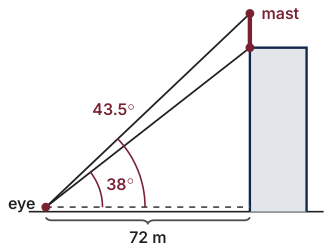
Ngozi stands on level ground 72 m from the foot of an office block. Her eyes are 1.6 m above the ground. A flag mast stands on the roof of the block. She measures the angle of elevation of the bottom of the mast as 38^\circ and of the top of the mast as 43.5^\circ.
Original Photon diagram
(a) Find the height of the roof of the block above the ground.
[2]
(b) Find the height of the top of the mast above the ground.
[2]
(c) Hence find the length of the mast.
[2]
(d) Ngozi walks directly away from the building until the angle of elevation of the top of the mast is 30^\circ. Find how far from the foot of the block she then stands.
[3]
Show solutionHide solution
(a) Height above her eye level = 72\tan 38^\circ = 56.253 m
[1]
Roof height = 56.253 + 1.6 = 57.9 m (3 s.f.).
[1]
(b) 72\tan 43.5^\circ + 1.6
[1]
= 69.9 m (3 s.f.).
[1]
(c) 69.925 - 57.853 using unrounded values
[1]
= 12.1 m (3 s.f.).
[1]
(d) Top of mast is 69.925 - 1.6 = 68.325 m above her eye level.
[1]
\text{distance} = \dfrac{68.325}{\tan 30^\circ}
[1]
= 118 m (3 s.f.).
[1]

Final answer

  • (a) 57.9 m
  • (b) 69.9 m
  • (c) 12.1 m
  • (d) 118 m

Question 12

[9 marks]
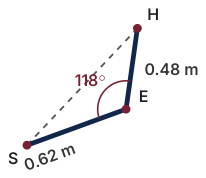
A robot arm has an upper arm of length 0.62 m joined at an elbow E to a forearm of length 0.48 m. The shoulder is at S and the hand is at H. The elbow angle \angle\text{SEH} can be varied.
Original Photon diagram
(a) The elbow angle is 118^\circ. Find the distance SH from the shoulder to the hand.
[3]
(b) The hand must touch a switch that is 0.90 m from the shoulder. Find the elbow angle required.
[3]
(c) For the elbow angle 118^\circ, find the area of triangle SEH.
[2]
(d) State the maximum possible distance SH, and the elbow angle for which it occurs.
[1]
Show solutionHide solution
(a) \text{SH}^2 = 0.62^2 + 0.48^2 - 2(0.62)(0.48)\cos 118^\circ
[2]
\text{SH} = 0.946 m (3 s.f.).
[1]
(b) \cos E = \dfrac{0.62^2 + 0.48^2 - 0.90^2}{2(0.62)(0.48)}
[2]
= -0.3280, so E = 109^\circ (3 s.f.).
[1]
(c) \dfrac12(0.62)(0.48)\sin 118^\circ
[1]
= 0.131 m^2 (3 s.f.).
[1]
(d) The maximum occurs when the arm is straight, \text{E} = 180^\circ: 0.62 + 0.48 = 1.10 m.
[1]

Final answer

  • (a) 0.946 m
  • (b) 109^\circ
  • (c) 0.131 m^2
  • (d) 1.10 m, at 180^\circ

Question 13

[8 marks]
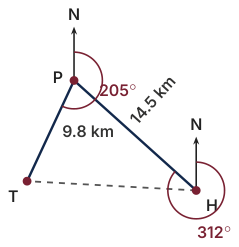
A rescue helicopter flies from its base H on a bearing of 312^\circ for 14.5 km to an oil platform P. It then flies on a bearing of 205^\circ for 9.8 km to a trawler T.
Original Photon diagram
(a) Show that \angle\text{HPT} = 73^\circ.
[1]
(b) Find the direct distance HT.
[3]
(c) Find the bearing of T from H, to the nearest degree.
[3]
(d) Find the bearing on which the helicopter must fly to return directly from T to H, to the nearest degree.
[1]
Show solutionHide solution
(a) The bearing of H from P is 312^\circ - 180^\circ = 132^\circ.
[1]
The bearing of T from P is 205^\circ, so \angle\text{HPT} = 205^\circ - 132^\circ = 73^\circ.
AG
(b) \text{HT}^2 = 14.5^2 + 9.8^2 - 2(14.5)(9.8)\cos 73^\circ
[2]
\text{HT} = 14.9 km (3 s.f.).
[1]
(c) Sine rule: \dfrac{\sin\angle\text{PHT}}{9.8} = \dfrac{\sin 73^\circ}{14.940}
[1]
\angle\text{PHT} = 38.85^\circ
[1]
T lies anticlockwise of P as seen from H, so the bearing is 312^\circ - 38.85^\circ = 273.15^\circ, i.e. 273^\circ to the nearest degree.
[1]
(d) Back-bearing: 273.15^\circ - 180^\circ = 93.15^\circ, i.e. 093^\circ to the nearest degree.
[1]

Final answer

  • (b) 14.9 km
  • (c) 273^\circ
  • (d) 093^\circ

Question 14

[8 marks]
A metal bracket is cut from a triangular plate in which two edges have lengths 9.0 cm and 12.0 cm. The area of the plate is 40 cm^2. Let \theta be the angle between the two given edges.
(a) Show that \sin\theta = 0.741 to 3 significant figures.
[2]
(b) Find the two possible values of \theta.
[2]
(c) For each value of \theta, find the length of the third edge of the plate.
[3]
(d) The bracket must fit into a slot that is 15 cm long. State which plate can be used, and justify your answer.
[1]
Show solutionHide solution
(a) Area = \dfrac12(9)(12)\sin\theta = 54\sin\theta = 40
[1]
\sin\theta = \dfrac{40}{54} = 0.7407\ldots = 0.741 (3 s.f.)
[1]
AG
(b) \theta = \sin^{-1}(0.7407) = 47.79^\circ
[1]
or \theta = 180^\circ - 47.79^\circ = 132.21^\circ.
[1]
(c) c^2 = 9^2 + 12^2 - 2(9)(12)\cos\theta
[1]
\theta = 47.79^\circ: c = 8.94 cm (3 s.f.).
[1]
\theta = 132.21^\circ: c = 19.2 cm (3 s.f.).
[1]
(The cosine of the obtuse angle is negative, giving the longer edge.)
(d) The plate with the 8.94 cm third edge: its longest edge is 12.0 cm < 15 cm, while the other plate has an edge of 19.2 cm > 15 cm.
[1]

Final answer

  • (b) 47.8^\circ, 132^\circ
  • (c) 8.94 cm, 19.2 cm
  • (d) the plate with the 8.94 cm edge

Question 15

[9 marks]
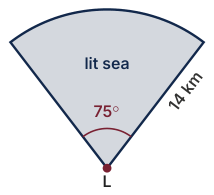
A lighthouse lamp at L lights a sector of sea. The range of the beam is 14 km and the beam covers an angle of 75^\circ at L.
Original Photon diagram
(a) Find the length of the curved boundary of the lit region.
[3]
(b) Find the area of sea that is lit.
[2]
(c) A patrol boat travels along the curved boundary at a constant speed of 22 km h^{-1}. Find the time it takes, in minutes.
[2]
(d) The lamp is replaced so that the lit area doubles while the range stays the same. Write down the new angle, and explain your reasoning.
[2]
Show solutionHide solution
(a) The sector is \dfrac{75}{360} of a circle of radius 14 km.
[1]
Arc length = \dfrac{75}{360} \times 2\pi \times 14
[1]
= 18.3 km (3 s.f.).
[1]
(b) Area = \dfrac{75}{360} \times \pi \times 14^2
[1]
= 128 km^2 (3 s.f.).
[1]
(c) time = \dfrac{18.326}{22} hours
[1]
= 50.0 minutes (3 s.f.).
[1]
(d) 150^\circ: for a fixed radius the area is proportional to the angle, so doubling the area doubles the angle.
[2]

Final answer

  • (a) 18.3 km
  • (b) 128 km^2
  • (c) 50.0 minutes
  • (d) 150^\circ

Question 16

[10 marks]
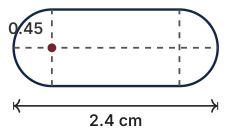
A medicine capsule is made from a cylinder with a hemisphere attached to each end. The whole capsule has length 2.4 cm and each hemisphere has radius 0.45 cm.
Original Photon diagram
(a) Find the length of the cylindrical part.
[1]
(b) Find the volume of one capsule.
[3]
(c) Find the outer surface area of one capsule.
[3]
(d) Each capsule is filled with powder to 90% of its volume. Find the greatest number of capsules that can be filled from 2.5 litres of powder.
[3]
Show solutionHide solution
(a) 2.4 - 2(0.45) = 1.5 cm.
[1]
(b) The two hemispheres make one sphere: V = \pi(0.45)^2(1.5) + \dfrac43\pi(0.45)^3
[2]
= 0.954 + 0.382 = 1.34 cm^3 (3 s.f.).
[1]
(c) Curved surface of the cylinder + surface of one sphere: 2\pi(0.45)(1.5) + 4\pi(0.45)^2
[2]
= 6.79 cm^2 (3 s.f.).
[1]
(d) Powder per capsule = 0.9 \times 1.3360 = 1.2024 cm^3
[1]
2.5 litres = 2500 cm^3, and \dfrac{2500}{1.2024} = 2079.2
[1]
So at most 2079 capsules can be completely filled.
[1]

Final answer

  • (a) 1.5 cm
  • (b) 1.34 cm^3
  • (c) 6.79 cm^2
  • (d) 2079 capsules

Question 17

[10 marks]
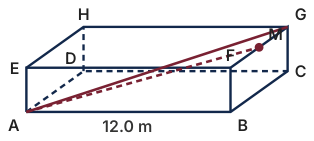
A shipping container is a cuboid ABCDEFGH with base ABCD (horizontal) and vertical edges AE, BF, CG, DH. Its length is \text{AB} = 12.0 m, its width is \text{BC} = 2.4 m and its height is \text{AE} = 2.6 m. M is the midpoint of the top edge FG.
Original Photon diagram
(a) Find the length of the space diagonal AG.
[2]
(b) Find the length of the line AM.
[2]
(c) Find the angle that AM makes with the base ABCD.
[3]
(d) Find the angle \angle\text{MAG} between the lines AM and AG.
[3]
Show solutionHide solution
(a) \text{AG} = \sqrt{12.0^2 + 2.4^2 + 2.6^2}
[1]
= 12.5 m (3 s.f.).
[1]
(b) M is 12.0 m along, 1.2 m across and 2.6 m up from A.
[1]
\text{AM} = \sqrt{12.0^2 + 1.2^2 + 2.6^2} = 12.3 m (3 s.f.).
[1]
(c) The projection of AM on the base has length \sqrt{12.0^2 + 1.2^2} = 12.060 m, and the vertical rise is 2.6 m.
[1]
\tan\theta = \dfrac{2.6}{12.060}, so \theta = 12.2^\circ (3 s.f.).
[2]
(d) In triangle AMG, \text{MG} = 1.2 m.
[1]
\cos\angle\text{MAG} = \dfrac{12.337^2 + 12.511^2 - 1.2^2}{2(12.337)(12.511)} = 0.99543
[1]
\angle\text{MAG} = 5.48^\circ (3 s.f.).
[1]

Final answer

  • (a) 12.5 m
  • (b) 12.3 m
  • (c) 12.2^\circ
  • (d) 5.48^\circ

Question 18

[7 marks]
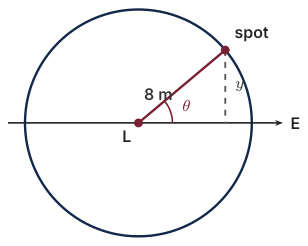
A searchlight at the centre L of a circular courtyard wall of radius 8 m shines a spot of light on the wall. The beam makes an angle \theta radians with the positive x-axis (pointing East), measured anticlockwise, where 0 \le \theta < 2\pi. The height of the spot above the east–west line through L is y = 8\sin\theta metres, which is negative when the spot is below that line.
Original Photon diagram
(a) Find the values of \theta for which the spot is 3 m above the east–west line.
[3]
(b) Find the values of \theta for which the spot is 5 m below the east–west line.
[3]
(c) Explain, using a sketch of the unit circle, why each value of y with -8 < y < 8 gives exactly two possible values of \theta.
[1]
Show solutionHide solution
(a) 8\sin\theta = 3 \Rightarrow \sin\theta = 0.375.
[1]
GDC (radians): \theta = 0.384.
[1]
By symmetry about the y-axis, \theta = \pi - 0.384 = 2.757.
[1]
(b) \sin\theta = -0.625; the related acute angle is \sin^{-1}(0.625) = 0.675.
[1]
The sine is negative in quadrants 3 and 4: \theta = \pi + 0.675 = 3.817
[1]
and \theta = 2\pi - 0.675 = 5.608.
[1]
(c) A horizontal line at height \dfrac{y}{8} with -1 < \dfrac y8 < 1 cuts the unit circle at exactly two points, which are mirror images in the y-axis, and each point corresponds to one angle in [0, 2\pi).
[1]

Final answer

  • (a) 0.384, 2.76
  • (b) 3.82, 5.61
  • (c) a horizontal line meets the circle twice

Question 19

[6 marks]
A record turntable rotates at a constant 45 revolutions per minute.
(a) Write down the angle turned through in one revolution, in radians, giving your answer in terms of \pi.
[1]
(b) Find the angle turned through in 1.5 seconds, in radians. Give your answer in terms of \pi.
[2]
(c) Convert your answer to part (b) to degrees.
[1]
(d) A fly sits on the record at a point 15 cm from the centre. Find the distance that the fly travels in 1.5 seconds. Give your answer in centimetres to 3 significant figures.
[2]
Show solutionHide solution
(a) 2\pi radians.
[1]
(b) 45 revolutions per minute is \dfrac{45}{60} = 0.75 revolutions per second.
[1]
In 1.5 s: 0.75 \times 1.5 \times 2\pi = \dfrac{9\pi}{4} radians.
[1]
(c) \dfrac{9\pi}{4} \times \dfrac{180}{\pi} = 405^\circ.
[1]
(d) s = r\theta = 15 \times \dfrac{9\pi}{4}
[1]
= 106 cm (3 s.f.), with the GDC in radian mode.
[1]

Final answer

  • (a) 2\pi
  • (b) \frac{9\pi}{4}
  • (c) 405^\circ
  • (d) 106 cm

Question 20

[9 marks]
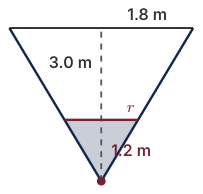
A grain hopper is a cone with its vertex at the bottom, pointing downwards. The top of the hopper is a circle of radius 1.8 m and the hopper has a vertical height of 3.0 m. Grain is poured in until the depth of grain, measured from the vertex, is 1.2 m.
Original Photon diagram
(a) Find the capacity of the hopper.
[2]
(b) Find the radius of the surface of the grain.
[2]
(c) Find the volume of grain in the hopper.
[2]
(d) Find the percentage of the capacity that is filled, and comment on the fact that the grain is only 40% of the way up the hopper.
[3]
Show solutionHide solution
(a) V = \dfrac13\pi(1.8)^2(3.0)
[1]
= 10.2 m^3 (3 s.f.).
[1]
(b) The cone of grain is similar to the whole hopper, so \dfrac{r}{1.2} = \dfrac{1.8}{3.0}
[1]
r = 0.72 m.
[1]
(c) V = \dfrac13\pi(0.72)^2(1.2)
[1]
= 0.651 m^3 (3 s.f.).
[1]
(d) \dfrac{0.651}{10.179} \times 100 = 6.40\%
[2]
Volume scales with the cube of length: 0.4^3 = 0.064, so a depth of 40% of the height holds only 6.4% of the volume.
[1]

Final answer

  • (a) 10.2 m^3
  • (b) 0.72 m
  • (c) 0.651 m^3
  • (d) 6.40%

Mastery

Full exam questions that mix question types, at Paper 1 and Paper 2 standard.

Question 21

[6 marks]
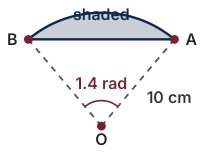
A stained-glass window is shaped like a circular segment. It is formed from a circle of radius 10 cm, cut off by a chord that subtends an angle of 1.4 radians at the centre.
Original Photon diagram
(a) Find the area of the sector OAB.
[2]
(b) Find the area of triangle OAB.
[2]
(c) Hence find the area of the shaded segment.
[2]
Show solutionHide solution
(a) Sector area = \tfrac{1}{2}r^2\theta = \tfrac{1}{2}(10)^2(1.4) = 70 cm^2.
[2]
(b) Triangle area = \tfrac{1}{2}r^2\sin\theta = \tfrac{1}{2}(10)^2\sin 1.4 = 49.3 cm^2.
[2]
(c) Segment = 70 - 49.3 = 20.7 cm^2.
[2]

Final answer

  • (a) 70 cm^2
  • (b) 49.3 cm^2
  • (c) 20.7 cm^2

Question 22

[12 marks]
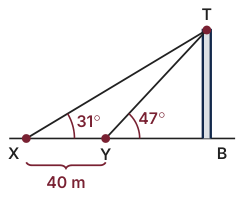
A monument stands on level ground. A surveyor standing at point X measures the angle of elevation to the top T of the monument to be 31^{\circ}. She then walks 40 m directly towards the base B of the monument to point Y, where the angle of elevation to T is 47^{\circ}.
Original Photon diagram
(a) Show that the angle X\hat{T}Y = 16^{\circ}.
[2]
(b) Find the distance TY.
[4]
(c) Hence find the height of the monument.
[3]
(d) Find the distance from Y to the base B of the monument.
[3]
Show solutionHide solution
(a) In triangle XTY, angle T\hat{Y}B = 47^{\circ}, so angle X\hat{Y}T = 180^{\circ}-47^{\circ}=133^{\circ}. Then X\hat{T}Y = 180^{\circ}-31^{\circ}-133^{\circ}=16^{\circ}.
[2]
(b) Sine rule in triangle XTY: \dfrac{TY}{\sin 31^{\circ}} = \dfrac{40}{\sin 16^{\circ}}, so TY = \dfrac{40\sin 31^{\circ}}{\sin 16^{\circ}} = 74.7 m.
[4]
(c) Height TB = TY\sin 47^{\circ} = 74.7 \times 0.7314 = 54.7 m.
[3]
(d) YB = TY\cos 47^{\circ} = 74.7 \times 0.6820 = 51.0 m.
[3]

Final answer

  • (b) 74.7 m
  • (c) 54.7 m
  • (d) 51.0 m

Question 23

[14 marks]
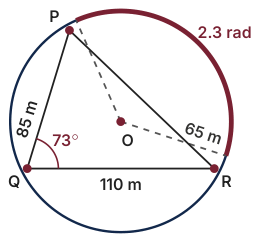
A circular athletics field has centre O and radius 65 m. A triangular practice zone PQR is marked inside the field, and a curved warm-up track follows an arc of the boundary circle.
In the triangle PQR, PQ = 85 m, QR = 110 m and the angle P\hat{Q}R = 73^{\circ}.
Original Photon diagram
(a) Find the length PR.
[3]
(b) Find the size of the angle Q\hat{P}R.
[3]
(c) Find the area of the triangular practice zone PQR.
[3]
The curved warm-up track is an arc of the boundary circle (radius 65 m) that subtends an angle of 2.3 radians at the centre O.
(d) Find the length of the warm-up track.
[2]
(e) Find the area of the sector of the field enclosed by this arc and the two radii to its ends.
[3]
Show solutionHide solution
(a) Cosine rule: PR^2 = 85^2 + 110^2 - 2(85)(110)\cos 73^{\circ} = 13\,857.
PR = 118 m.
[3]
(b) Sine rule: \dfrac{\sin(Q\hat{P}R)}{110} = \dfrac{\sin 73^{\circ}}{117.7}, so \sin(Q\hat{P}R) = 0.8937.
Q\hat{P}R = 63.3^{\circ}.
[3]
(c) Area = \tfrac{1}{2}(85)(110)\sin 73^{\circ} = 4470 m^2.
[3]
(d) Arc length = r\theta = 65 \times 2.3 = 149.5 m (150 m to 3 s.f.).
[2]
(e) Sector area = \tfrac{1}{2}r^2\theta = \tfrac{1}{2}(65)^2(2.3) = 4858.75 \approx 4860 m^2.
[3]

Final answer

  • (a) 118 m
  • (b) 63.3^\circ
  • (c) 4470 m^2
  • (d) 150 m
  • (e) 4860 m^2

Question 24

[13 marks]
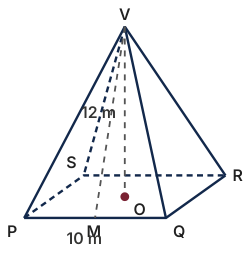
A square-based pyramid is used as the roof of a garden gazebo. The square base PQRS has side length 10 m, and the apex V is directly above the centre O of the base at a height of 12 m.
Original Photon diagram
(a) Find the length of the slant height from V to the midpoint of edge PQ.
[3]
(b) Find the length of a slanted edge VP.
[3]
(c) Find the angle that a triangular roof face makes with the horizontal base.
[3]
(d) Find the angle that the edge VP makes with the base.
[4]
Show solutionHide solution
(a) The midpoint M of PQ is 5 m horizontally from O. Slant height VM = \sqrt{12^2 + 5^2} = \sqrt{169} = 13 m.
[3]
(b) Half-diagonal OP = \tfrac{1}{2}\sqrt{10^2+10^2} = 5\sqrt{2} = 7.071 m.
VP = \sqrt{12^2 + (5\sqrt{2})^2} = \sqrt{144+50} = \sqrt{194} = 13.9 m.
[3]
(c) Using triangle VOM: \tan\theta = \dfrac{12}{5}, so \theta = \tan^{-1}(2.4) = 67.4^{\circ}.
[3]
(d) Using triangle VOP: \tan\phi = \dfrac{12}{5\sqrt{2}} = \dfrac{12}{7.071}, so \phi = \tan^{-1}(1.697) = 59.5^{\circ}.
[4]

Final answer

  • (a) 13 m
  • (b) 13.9 m
  • (c) 67.4^\circ
  • (d) 59.5^\circ

Question 25

[9 marks]
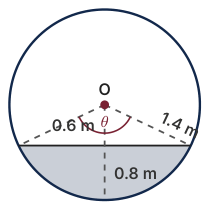
A horizontal cylindrical tank has circular cross-sections of radius 1.4 m and length 5.2 m. It is partly filled with liquid to a depth of 0.8 m. The diagram shows the circular cross-section with centre O; the shaded segment is the part filled with liquid, and it subtends an angle of \theta radians at O.
Original Photon diagram
(a) Show that \theta = 2\cos^{-1}\!\left(\dfrac{3}{7}\right), and evaluate \theta.
[2]
(b) Find the area of the liquid's cross-section.
[3]
(c) Find the volume of the liquid, in litres.
[2]
(d) Find the percentage of the tank's full capacity that this volume represents.
[2]
Show solutionHide solution
(a) The distance from O to the surface is 1.4 - 0.8 = 0.6 m.
[1]
In the right-angled triangle formed by half the surface chord, \cos\dfrac{\theta}{2} = \dfrac{0.6}{1.4} = \dfrac37, so \theta = 2\cos^{-1}\!\left(\dfrac37\right).
AG
\theta = 2.26 radians (3 s.f.)
[1]
(b) Segment = \dfrac12 r^2(\theta - \sin\theta)
[1]
= 0.98(2.2558 - 0.7744)
[1]
= 1.45 m^2 (3 s.f.).
[1]
(c) 1.4517 \times 5.2 = 7.549 m^3
[1]
1\,\text{m}^3 = 1000 litres, so volume = 7\,550 litres (3 s.f.).
[1]
(d) Full capacity = \pi(1.4)^2(5.2) = 32.019 m^3
[1]
\dfrac{7.549}{32.019} \times 100 = 23.6\% (3 s.f.).
[1]

Final answer

  • (a) 2.26
  • (b) 1.45 m^2
  • (c) 7550 litres
  • (d) 23.6%

Question 26

[16 marks]
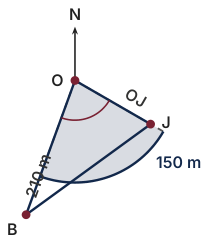
A vertical observation tower OT, 32 m tall, stands at O on level ground beside a lake. From the top T, the angle of depression of a jetty J is 14^\circ, and J is on a bearing of 120^\circ from O. A boathouse B is 210 m from O on a bearing of 200^\circ. The points O, J and B are on the same level.
Original Photon diagram
(a) Find the distance OJ.
[2]
(b) Write down the size of angle JOB, and find the distance JB.
[3]
(c) Find the bearing of B from J.
[4]
(d) Find the angle of elevation of T from B.
[2]
At night a lamp on the tower lights the part of the lake inside the sector with centre O and radius 150 m, between the bearings 120^\circ and 200^\circ.
(e) Write down the angle of this sector in radians, as an exact value.
[1]
(f) Find the area of the lit sector.
[2]
(g) Find the perimeter of the lit sector.
[2]
Show solutionHide solution
(a) \mathrm{OJ}=\dfrac{32}{\tan14^\circ} M1 =128 m (128.34\ldots) A1 (b) \mathrm{J\hat{O}B}=200^\circ-120^\circ=80^\circ A1 \mathrm{JB}^2=128.34^2+210^2-2(128.34)(210)\cos80^\circ M1 \mathrm{JB}=226 m (226.30\ldots) A1 (c) \dfrac{\sin\mathrm{O\hat{J}B}}{210}=\dfrac{\sin80^\circ}{226.30} M1 \mathrm{O\hat{J}B}=66.05^\circ, acute because 210<226.30 A1 bearing of O from J =300^\circ A1 bearing of B from J =300^\circ-66.05^\circ=234^\circ (233.95^\circ) A1 (d) \tan^{-1}\dfrac{32}{210} M1 =8.66^\circ A1 (e) 80^\circ=\dfrac{4\pi}{9} A1 (f) \tfrac12(150)^2\left(\dfrac{4\pi}{9}\right) M1 =15\,700 m^2 (15 708) A1 (g) 2(150)+150\left(\dfrac{4\pi}{9}\right) M1 =509 m (509.44)
A1

Final answer

  • (a) 128 m
  • (b) 80^\circ, 226 m
  • (c) 234^\circ
  • (d) 8.66^\circ
  • (e) \frac{4\pi}{9}
  • (f) 15 700 m^2
  • (g) 509 m

Going further

Beyond the syllabus: the worked examples and investigations of the chapter's Going further pages.

G1 Chord versus arc

G1 Worked example

[8 marks]
Anya jogs round a circular path of radius 120 m. Between the gate G and the café C the path turns through an angle of 0.6 radians at the centre. A straight track also joins G and C.
(a) Find the length of the path from G to C.
[2]
(b) Find the length of the straight track.
[2]
(c) Find the percentage by which the straight track is shorter than the path.
[2]
(d) Show that the straight track is \dfrac{\sin(\theta/2)}{\theta/2} times the length of the path, where \theta is the angle in radians.
[2]
Show solutionHide solution
(a) arc =r\theta=120\times0.6 M1 =72 m A1 (b) chord =2r\sin\frac\theta2=2\times120\times\sin0.3 M1 =70.9 m (70.925\ldots) A1 (c) \dfrac{72-70.925\ldots}{72}\times100 M1 =1.49\% A1 (d) \dfrac{2r\sin(\theta/2)}{r\theta} M1 =\dfrac{\sin(\theta/2)}{\theta/2}, the radius cancelling
AG

Final answer

  • (a) 72 m
  • (b) 70.9 m
  • (c) 1.49%
  • (d) shown

G2 Circles on a sphere

G2 Investigation

[18 marks]
Model the Earth as a sphere of radius 6371 km with centre O. Two cities P and Q are both on the latitude 50^\circ N, and their longitudes differ by 100^\circ.
(a) (i) Show that the circle of latitude 50^\circ N has radius 4095 km, to the nearest km.
[2]
(ii) Find the distance from P to Q measured along the circle of latitude.
[2]
(b) (i) Show that the straight-line distance PQ through the Earth is 6274 km, to the nearest km.
[2]
(ii) Use the cosine rule in triangle POQ to find the angle POQ.
[2]
(c) (i) Hence find the great-circle distance from P to Q.
[2]
(ii) Find the percentage of the distance in (a)(ii) that is saved by flying along the great circle.
[1]
(d) (i) Repeat the calculation for two cities on the equator whose longitudes differ by 100^\circ, and explain the result.
[2]
(ii) Find the percentage saving for two cities 100^\circ of longitude apart on the latitudes 30^\circ N, 70^\circ N and 89^\circ N. Describe how the saving changes with latitude.
[4]
(e) Explain why flights from Europe to North America look curved towards the Arctic on a flat map.
[1]
Show solutionHide solution
(a) (i) radius =6371\cos50^\circ M1 =4095 km (4095.2\ldots) AG (ii) 4095.2\times\dfrac{100\pi}{180} M1 =7147 km A1 (b) (i) PQ =2(4095.2)\sin50^\circ, half the longitude difference, in the circle of latitude M1 =6274 km AG (ii) \cos\mathrm{P\hat{O}Q}=\dfrac{2(6371)^2-6274.2^2}{2(6371)^2} M1 \mathrm{P\hat{O}Q}=59.0^\circ A1 (c) (i) 6371\times\dfrac{59.0\pi}{180} M1 =6560 km A1 (ii) \dfrac{7147.5-6560.2}{7147.5}\times100=8.22\% A1 (d) (i) on the equator the circle of latitude is a great circle, so the saving is 0\% R1A1 (ii) 30^\circ N: 4.02\%, 70^\circ N: 11.2\%, 89^\circ N: 12.2\% M1A1A1 the saving grows as the latitude rises, because the circle of latitude gets smaller and bends more R1 (e) the shortest route is a great circle, which bends towards the pole, where circles of latitude are small
R1

Final answer

  • (a) 4095 km; 7147 km
  • (b) 6274 km; 59.0 degrees
  • (c) 6560 km; 8.22%
  • (d) 0%, then 4.02%, 11.2%, 12.2%, rising towards the pole
  • (e) the shortest route bends towards the pole

From the book

Photon Guidebook: Mathematics Applications and Interpretation HL for the IB Diploma

Chapter 8 teaches trigonometry and three-dimensional geometry from the basics to full exam questions: how the IB asks it, every question type with a marked example, and these practice questions in three steps.

About the book