Free worked solutions · 2026 Edition

IB Maths AI HL Chapter 9: Voronoi diagrams worked solutions

Worked solutions to the practice questions in Chapter 9 of Photon Guidebook: Mathematics Applications and Interpretation HL for the IB Diploma (2026 Edition). Each solution shows every step with the mark it earns, the way an IB mark scheme does.

  • Chapter 9 of 24
  • Volume 1
  • 26 practice questions
  • 1 Going further
  • Free, no sign-up

Basics

One idea at a time, in the order the chapter teaches them.

Question 1

[3 marks]
A(-5,2) and B(7,8) are two points.
(a) Find the gradient of AB.
[2]
(b) Find the gradient of its perpendicular bisector.
[1]
Show solutionHide solution
(a) m_{AB}=(8-(2))/(7-(-5)).
M1
m_{AB}=\frac{1}{2}.
A1
(b) m_\perp=-1/m_{AB}=-2.
A1

Final answer

  • (a) \frac12
  • (b) −2.

Question 2

[3 marks]
A(3,-9) and B(3,7) are endpoints of a segment.
Find its perpendicular bisector, explaining its direction.
[3]
Show solutionHide solution
Midpoint is (3,-1).
A1
AB is vertical, so its bisector is horizontal.
R1
Equation y=-1.
A1

Final answer

y=-1; horizontal.

Question 3

[4 marks]
A segment joins A(3,-7) and B(11,5).
Find the equation of its perpendicular bisector. Give exact coefficients.
[4]
Show solutionHide solution
Midpoint M=(7,-1).
A1
m_{AB}=(5-(-7))/(11-(3)), so m_\perp=-\frac{2}{3}.
M1
y-(-1)=-\frac{2}{3}(x-(7)).
M1
y=-\frac{2}{3}x+(\frac{11}{3}).
A1

Final answer

y=-\frac23x+\frac{11}3.

Question 4

[3 marks]
A point P(x,y) is equidistant from A(-4,2) and B(6,8).
Use equality of squared distances to derive a linear equation for its locus.
[3]
Show solutionHide solution
(x+4)^2+(y-2)^2=(x-6)^2+(y-8)^2.
M1
x^2+8x+16+y^2-4y+4=x^2-12x+36+y^2-16y+64.
M1
20x+12y=80, or 5x+3y=20.
A1

Final answer

5x+3y=20.

Question 5

[4 marks]
Sites are A(1, 1), B(9, 1) and C(4, 6) on a Cartesian map. A request arrives at P(3, 2).
Compare squared distances and identify the nearest site or sites. State whether the request is in a cell interior or on a boundary.
[4]
Show solutionHide solution
PA^2=5, PB^2=37, PC^2=17.
A2
Nearest: A.
A1
It is in a cell interior.
R1

Final answer

PA^2=5, PB^2=37, PC^2=17; A, cell interior.

Question 6

[5 marks]
Three non-collinear points are A(-2,1), B(6,5) and C(0,9).
(a) Write linear equations for the perpendicular bisectors of AB and AC.
[2]
(b) Find their intersection and explain why it is equidistant from all three points.
[3]
Show solutionHide solution
(a) AB: 8x+(4)y=28.
A1
AC: 2x+(8)y=38.
A1
(b) Solve the two bisector equations simultaneously.
M1
P=(\frac{9}{7},\frac{31}{7}).
A1
PA=PB on the first bisector and PA=PC on the second, so all three distances agree.
R1

Final answer

  • (a) 2x+y=7, x+4y=19
  • (b) (9/7,31/7); bisectors give PA=PB=PC.

Question 7

[3 marks]
Sites are A(0,0), B(6,0) and C(0,8). The full perpendicular bisector of AB is x=3.
Find which part of x=3 is an actual Voronoi edge shared by A and B, by comparing with C.
[3]
Show solutionHide solution
On x=3, PA^2=9+y^2 and PC^2=9+(y-8)^2.
M1
9+y^2\le9+(y-8)^2 gives y\le4.
M1
The edge is x=3, y\le4; beyond that C is closer.
A1

Final answer

x=3, y\le4.

Question 8

[3 marks]
A diagram has two sites A(-4,0) and B(4,0), separated by edge x=0. A new site N(0,5) is added.
Find the new vertex and the remaining portion of the old A/B edge.
[3]
Show solutionHide solution
On x=0, equal A,N distances give 16+y^2=(y-5)^2.
M1
10y=9, so vertex (0,0.9).
A1
A and B remain nearest on x=0, y\le0.9.
A1

Final answer

Vertex (0,0.9); old edge remains for y\le0.9.

Question 9

[3 marks]
Nearest-neighbour interpolation assigns the recorded value at the nearest site. Soil probes A(2,2), B(10,2) and C(4,9) record moisture percentages 24.8, 28.3 and 31.7 respectively.
Estimate the soil moisture percentage at P(5,8), showing squared-distance comparisons.
[3]
Show solutionHide solution
PA^2=45, PB^2=61, PC^2=2.
M1
C is uniquely nearest.
A1
Estimate 31.7% soil moisture.
A1

Final answer

31.7%; C is nearest.

Question 10

[3 marks]
A proposed refuge centre is P(3,4), with service sites A(0,0), B(8,0) and C(3,9). Its clearance is defined as the distance to its nearest site.
Find its clearance and state all sites that attain it.
[3]
Show solutionHide solution
PA=5, PB=\sqrt{41}, PC=5.
M1
Clearance is 5 units.
A1
Sites A and C attain it.
A1

Final answer

5 map units; A and C.

Tutorial

Exam-style questions on each question type, with the marks the IB would give.

Question 11

[8 marks]
Three lifeguard towers on a long beach park are at A(2,\,3), B(10,\,3) and C(4,\,9), where units are 100\,\text{m}. The park authority wants the equation of each Voronoi edge between pairs of towers.
(a) Show that the edge between A and B is the line x=6.
[2]
(b) Find the equation of the edge between A and C, in the form y=mx+c.
[3]
(c) Find the equation of the edge between B and C, in the form y=mx+c.
[3]
Show solutionHide solution
(a) A and B have the same y-coordinate, so [AB] is horizontal and its perpendicular bisector is vertical.
[1]
It passes through the midpoint (6,\,3), so the edge is x=6.
[1]
(b) Midpoint of [AC] is (3,\,6).
[1]
m_{AC}=\dfrac{9-3}{4-2}=3, so the edge has gradient -\dfrac13.
[1]
y-6=-\dfrac13(x-3)\ \Rightarrow\ y=-\dfrac13x+7.
[1]
(c) Midpoint of [BC] is (7,\,6).
[1]
m_{BC}=\dfrac{9-3}{4-10}=-1, so the edge has gradient 1.
[1]
y-6=1(x-7)\ \Rightarrow\ y=x-1.
[1]

Final answer

  • (a) x=6
  • (b) y=-x/3+7
  • (c) y=x-1.

Question 12

[10 marks]
Zainab is siting a flood-warning siren that must be the same distance from three pumping stations A(2,\,4), B(10,\,2) and C(7,\,12), where coordinates are in kilometres.
(a) Find the equation of the Voronoi edge between A and B.
[3]
(b) Find the equation of the Voronoi edge between A and C.
[3]
(c) Hence find the coordinates of the siren, giving each coordinate to 3 significant figures.
[2]
(d) Find the distance from the siren to each pumping station.
[2]
Show solutionHide solution
(a) Midpoint of [AB] is (6,\,3).
[1]
m_{AB}=\dfrac{2-4}{10-2}=-\dfrac14, so the edge has gradient 4.
[1]
y-3=4(x-6)\ \Rightarrow\ y=4x-21.
[1]
(b) Midpoint of [AC] is (4.5,\,8).
[1]
m_{AC}=\dfrac{12-4}{7-2}=\dfrac85, so the edge has gradient -\dfrac58.
[1]
y-8=-\dfrac58(x-4.5)\ \Rightarrow\ y=-\dfrac58x+\dfrac{173}{16}.
[1]
(c) Solve 4x-21=-\frac58x+\frac{173}{16} using the GDC (or by hand): x=6.8784\ldots
[1]
y=4x-21=6.5135\ldots, so the siren is at (6.88,\,6.51).
[1]
(d) VA=\sqrt{(6.8784-2)^2+(6.5135-4)^2}
[1]
=5.49\,\text{km} (and VB, VC give the same value).
[1]

Final answer

  • (a) y=4x-21
  • (b) y=-5x/8+173/16
  • (c) (6.88,6.51)
  • (d) 5.49 km.

Question 13

[6 marks]
A planner marks a cell tower at A(1,\,2) on a map (units of 1\,\text{km}). A second tower B is planned so that the Voronoi edge between A and B is the line 2x+y=14.
(a) Find the gradient of the edge, and hence the gradient of the line AB.
[2]
(b) The midpoint M of [AB] lies on both the line AB and the edge. Find the coordinates of M.
[3]
(c) Hence find the coordinates of B.
[1]
Show solutionHide solution
(a) The edge y=-2x+14 has gradient −2.
[1]
The line AB is perpendicular to the edge, so m_{AB}=\dfrac12.
[1]
(b) Line AB: y-2=\dfrac12(x-1), i.e. y=\dfrac12x+\dfrac32.
[1]
\dfrac12x+\dfrac32=14-2x\ \Rightarrow\ \dfrac52x=\dfrac{25}{2}\ \Rightarrow\ x=5.
[1]
y=14-10=4, so M=(5,\,4).
[1]
(c) B=2M-A=(10-1,\,8-2)=(9,\,6).
[1]

Final answer

  • (a) −2, \frac12
  • (b) (5,4)
  • (c) (9,6).

Question 14

[9 marks]
Two bakeries are at A(2,\,3) and B(10,\,3), with coordinates in kilometres. Their Voronoi edge is the line x=6. Lucia opens a third bakery at N(8,\,9).
(a) Find the equation of the edge between A and N.
[3]
(b) Find the equation of the edge between B and N.
[3]
(c) Show that both of these edges meet the old edge x=6 at the same point, and find its coordinates.
[2]
(d) Describe what happens to the old edge x=6 after the new bakery opens.
[1]
Show solutionHide solution
(a) Midpoint of [AN] is (5,\,6).
[1]
m_{AN}=\dfrac{9-3}{8-2}=1, so the edge has gradient −1.
[1]
y-6=-(x-5)\ \Rightarrow\ y=-x+11.
[1]
(b) Midpoint of [BN] is (9,\,6).
[1]
m_{BN}=\dfrac{9-3}{8-10}=-3, so the edge has gradient \dfrac13.
[1]
y-6=\dfrac13(x-9)\ \Rightarrow\ y=\dfrac13x+3.
[1]
(c) At x=6: y=-6+11=5 on the edge A|N.
[1]
At x=6: y=\dfrac13(6)+3=5 on the edge B|N. All three edges meet at (6,\,5).
[1]
(d) Only the part of the line x=6 below (6,\,5) (y\le 5) remains an edge; the part above it is now closer to N than to A or B, so it is removed.
[1]

Final answer

  • (a) y=-x+11
  • (b) y=x/3+3
  • (c) (6,5)
  • (d) only y\le5 remains.

Question 15

[8 marks]
Three bike-repair shops are at A(1,\,1), B(9,\,1) and C(1,\,7), with coordinates in kilometres. Their Voronoi diagram has one vertex V.
(a) Find the coordinates of V and the distance from V to each shop.
[3]
(b) A new shop N_1 opens at (7,\,7). Find the distance VN_1 and hence decide whether V is still a vertex of the new diagram.
[2]
(c) Instead, a new shop N_2 opens at (10,\,9). Decide whether V is still a vertex.
[2]
(d) Write down a rule for deciding whether a vertex survives when a new site is added.
[1]
Show solutionHide solution
(a) Angle BAC=90^\circ (AB is horizontal and AC is vertical), so V is the midpoint of the hypotenuse [BC].
[1]
V=\left(\dfrac{9+1}{2},\dfrac{1+7}{2}\right)=(5,\,4).
[1]
VA=\sqrt{(5-1)^2+(4-1)^2}=5\,\text{km} (and VB=VC=5\,\text{km}).
[1]
(b) VN_1=\sqrt{(7-5)^2+(7-4)^2}=\sqrt{13}\approx3.61\,\text{km}.
[1]
This is less than 5\,\text{km}, so N_1 is nearer to V than A, B or C: V is no longer a vertex.
[1]
(c) VN_2=\sqrt{(10-5)^2+(9-4)^2}=\sqrt{50}\approx7.07\,\text{km}.
[1]
This is more than 5\,\text{km}, so no site is nearer to V than A, B and C: V is still a vertex.
[1]
(d) A vertex with radius r survives if the new site is at distance greater than r from it (outside the circle through the three sites); it is removed if the new site is inside that circle.
[1]

Final answer

  • (a) (5,4), 5 km
  • (b) 3.61 km: removed
  • (c) 7.07 km: survives
  • (d) a nearer new site removes the vertex.

Question 16

[7 marks]
Three rain gauges record last month's rainfall: G_1(3,\,10) recorded 112\,\text{mm}, G_2(12,\,8) recorded 96\,\text{mm} and G_3(7,\,2) recorded 134\,\text{mm}. Coordinates are in kilometres. Farmers want to estimate the rainfall at their farms using nearest-neighbour interpolation.
(a) Estimate the rainfall at farm F_1(6,\,7), showing the distance from F_1 to each gauge.
[3]
(b) Estimate the rainfall at farms F_2(10,\,4) and F_3(9,\,6).
[3]
(c) A student suggests averaging the three readings to estimate the rainfall at each farm. Explain why this is not nearest-neighbour interpolation.
[1]
Show solutionHide solution
(a) G_1F_1=4.24, G_2F_1=6.08, G_3F_1=5.10
[2]
The nearest gauge is G_1, so the estimate is 112\,\text{mm}.
[1]
(b) F_2: G_1F_2=9.22, G_2F_2=4.47, G_3F_2=3.61; nearest is G_3, estimate 134\,\text{mm}.
[2]
F_3: G_1F_3=7.21, G_2F_3=3.61, G_3F_3=4.47; nearest is G_2, estimate 96\,\text{mm}.
[1]
(c) Nearest-neighbour interpolation uses the reading of the single nearest gauge only; it does not combine or weight the other readings.
[1]

Final answer

  • (a) 112 mm
  • (b) 134, 96 mm
  • (c) use one nearest reading.

Question 17

[7 marks]
Three villages are at A(2,\,3), B(12,\,3) and C(7,\,13), with coordinates in kilometres. A go-kart track is to be built inside the triangle ABC, as far as possible from the nearest village.
(a) Find the coordinates of the Voronoi vertex of the three villages.
[4]
(b) Find the distance from the vertex to each village.
[2]
(c) Explain why the track should be built at the vertex.
[1]
Show solutionHide solution
(a) Edge A|B: the villages have equal y-coordinates, so the edge is x=7.
[1]
Edge A|C: midpoint (4.5,\,8), m_{AC}=\dfrac{13-3}{7-2}=2, so the edge has gradient -\dfrac12: y-8=-\dfrac12(x-4.5), i.e. y=-\dfrac12x+10.25.
[2]
At x=7: y=-3.5+10.25=6.75, so the vertex is (7,\,6.75).
[1]
(b) \sqrt{(7-2)^2+(6.75-3)^2}=\sqrt{25+14.0625}
[1]
=\sqrt{39.0625}=6.25\,\text{km}.
[1]
(c) No village lies inside the circle of radius 6.25\,\text{km} centred at the vertex, so the vertex is further from its nearest village than any other point in the triangle (the largest empty circle).
[1]

Final answer

  • (a) (7,6.75)
  • (b) 6.25 km
  • (c) greatest nearest-village distance.

Question 18

[9 marks]
A delivery firm has three depots at A(0,\,0), B(14,\,0) and C(6,\,8), with coordinates in kilometres. It wants a new charging hub to be as far as possible from its nearest depot, within the triangle ABC.
(a) Find the exact distance from the Voronoi vertex of the three depots to each depot.
[5]
(b) A council member proposes the point P(7,\,4), saying it is “in the middle” of the depots. Find the distance from P to its nearest depot.
[2]
(c) A second proposal, from the finance team, is the midpoint M of [AB]. Find the distance from M to its nearest depot, and state, with reasons, which of P, M and V is the best location.
[2]
Show solutionHide solution
(a) Edge A|B is x=7.
[1]
Edge A|C: midpoint (3,\,4), m_{AC}=\dfrac{8}{6}=\dfrac43, so the edge has gradient -\dfrac34: y-4=-\dfrac34(x-3).
[2]
At x=7: y=4-3=1, so the vertex is V(7,\,1).
[1]
VA=\sqrt{7^2+1^2}=\sqrt{50}=5\sqrt2\,\text{km}\approx7.07\,\text{km}.
[1]
(b) PA=\sqrt{65}\approx8.06, PB=\sqrt{65} and PC=\sqrt{(7-6)^2+(4-8)^2}=\sqrt{17}\approx4.12.
[1]
The nearest depot is C, at 4.12\,\text{km}.
[1]
(c) M(7,\,0): MA=MB=7 and MC=\sqrt{65}\approx8.06, so the nearest depot is 7\,\text{km} away.
[1]
Comparing nearest-depot distances, V (7.07) >M (7) >P (4.12), so the vertex V is best: its empty circle is the largest.
[1]

Final answer

  • (a) 5\sqrt2 km
  • (b) \sqrt{17}=4.12 km
  • (c) 7 km; V is best.

Question 19

[6 marks]
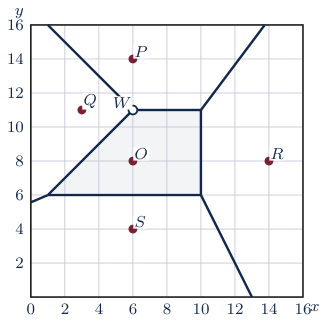
Five fire stations O(6,\,8), P(6,\,14), Q(3,\,11), R(14,\,8) and S(6,\,4) are shown on a map, with their Voronoi diagram. One unit on the map represents 2\,\text{km}. The cell of station O is shaded; its vertices are (1,\,6), (10,\,6), (10,\,11) and W(6,\,11).
Original Photon diagram
(a) Show that W is equidistant from O, P and Q.
[2]
(b) The shaded cell is a trapezium with parallel sides along y=6 and y=11. Find its area in square units.
[2]
(c) Find the real area of the cell of station O, in \text{km}^2.
[1]
(d) Station O and station R have cells of different areas but receive about the same number of calls per year. Suggest a reason.
[1]
Show solutionHide solution
(a) WO=\sqrt{(6-6)^2+(11-8)^2}=3 and WP=\sqrt{(6-6)^2+(11-14)^2}=3.
[1]
WQ=\sqrt{(6-3)^2+(11-11)^2}=3. All three are equal.
[1]
(b) The parallel sides have lengths 10-1=9 and 10-6=4, and the distance between them is 5.
[1]
Area =\dfrac12(9+4)\times5=32.5 square units.
[1]
(c) One square unit is 2\times2=4\,\text{km}^2, so the area is 32.5\times4=130\,\text{km}^2.
[1]
(d) The number of calls depends on how many people live in the cell, not on its area; population density differs from place to place.
[1]

Final answer

  • (a) WO=WP=WQ=3
  • (b) 32.5 units^2
  • (c) 130 km^2
  • (d) different population densities.

Question 20

[14 marks]
Three rainfall stations on a plantation record the mean daily rainfall over a month: S_1(2,\,3) records 85\,\text{mm}, S_2(10,\,2) records 62\,\text{mm} and S_3(5,\,10) records 104\,\text{mm}. Coordinates are in kilometres. The manager uses nearest-neighbour interpolation to estimate the rainfall at three fields F_1(6,\,5), F_2(8,\,8) and F_3(3,\,8).
(a) Estimate the rainfall at F_1 and at F_2, showing the distances from each field to the three stations. Give distances to 3 significant figures.
[4]
(b) Find the equation of the Voronoi edge between S_1 and S_3.
[3]
(c) Use the equation in part (b) to show that F_3 is nearer to S_3 than to S_1.
[2]
(d) A fourth station S_4(7,\,6) is installed and records 70\,\text{mm}. Show that the estimate at F_1 changes, and find the percentage change in the estimate.
[3]
(e) Show that the estimate at F_3 does not change when S_4 is installed.
[2]
Show solutionHide solution
(a) F_1: S_1F_1=4.47, S_2F_1=5.00, S_3F_1=5.10
[2]
Nearest is S_1: estimate 85\,\text{mm}.
F_2: S_1F_2=7.81, S_2F_2=6.32, S_3F_2=3.61
[2]
Nearest is S_3: estimate 104\,\text{mm}.
(b) Midpoint of [S_1S_3] is (3.5,\,6.5).
[1]
m_{S_1S_3}=\dfrac{10-3}{5-2}=\dfrac73, so the edge has gradient -\dfrac37.
[1]
y-6.5=-\dfrac37(x-3.5)\ \Rightarrow\ y=-\dfrac37x+8.
[1]
(c) At x=3 the edge has y=-\dfrac97+8\approx6.71, and F_3 has y=8, so F_3 is above the edge.
[1]
S_3(5,\,10) is also above the edge (at x=5 the edge has y\approx5.86), so F_3 is on the side of S_3.
[1]
(d) S_4F_1=\sqrt{(6-7)^2+(5-6)^2}=\sqrt2\approx1.41<4.47, so S_4 is now the nearest station and the estimate is 70\,\text{mm}.
[2]
Percentage change =\dfrac{70-85}{85}\times100\approx-17.6\% (a decrease of 17.6%).
[1]
(e) S_4F_3=\sqrt{(3-7)^2+(8-6)^2}=\sqrt{20}\approx4.47
[1]
The distance to S_3 is \sqrt8\approx2.83<4.47, so S_3 is still nearest and the estimate stays at 104\,\text{mm}.
[1]

Final answer

  • (a) 85, 104 mm
  • (b) y=-3x/7+8
  • (c) same side as S_3
  • (d) 70 mm, 17.6% decrease
  • (e) 104 mm.

Mastery

Full exam questions that mix question types, at Paper 1 and Paper 2 standard.

Question 21

[10 marks]
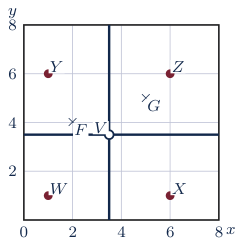
An environmental agency measures soil pH at four sampling posts. Their positions and readings are shown below (units in km).
Original Photon diagram
PostCoordinatespH
W(1,1)6.2
X(6,1)7.1
Y(1,6)6.8
Z(6,6)7.4
(a) A field station is at F(2,\,4). By finding the distance from F to each post, determine which post is nearest to F.
[4]
(b) Using nearest-neighbour interpolation, estimate the soil pH at F.
[1]
(c) A second location G(5,\,5) lies in the cell of post Z. State the estimated pH at G using nearest-neighbour interpolation, and give one limitation of this estimation method.
[3]
(d) By symmetry, the four cells meet at a single Voronoi vertex. Write down its coordinates.
[2]
Show solutionHide solution
(a) FW=\sqrt{(2-1)^2+(4-1)^2}=\sqrt{1+9}=\sqrt{10}\approx3.16.
FX=\sqrt{(2-6)^2+(4-1)^2}=\sqrt{16+9}=5.
FY=\sqrt{(2-1)^2+(4-6)^2}=\sqrt{1+4}=\sqrt5\approx2.24.
FZ=\sqrt{(2-6)^2+(4-6)^2}=\sqrt{16+4}=\sqrt{20}\approx4.47.
Smallest is FY, so post Y is nearest.
[4]
(b) Estimated pH at F = pH at Y =6.8.
[1]
(c) Estimated pH at G=7.4 (the value at Z). Limitation: nearest-neighbour gives the same value everywhere in a cell and jumps abruptly at boundaries, so it ignores gradual variation between posts.
[3]
(d) By the symmetry of the square, the vertex is the centre (3.5,\,3.5).
[2]

Final answer

  • (a) Y, 2.24 km
  • (b) 6.8
  • (c) 7.4, ignores gradual variation
  • (d) (3.5,3.5).

Question 22

[7 marks]
A coastal rescue service has four radio masts at T_1(2,\,3), T_2(8,\,2), T_3(5,\,8) and T_4(11,\,7), with coordinates in kilometres. A boat can only be heard by a mast that is within 3.5\,\text{km} of it. Three boats are at b_1(4,\,5), b_2(7,\,5) and b_3(9,\,10).
(a) For each boat, find the nearest mast and decide whether the boat is within 3.5\,\text{km} of it. Give distances to 3 significant figures.
[6]
(b) Explain why it is enough to check the distance to the nearest mast when deciding whether a boat can be heard by any mast.
[1]
Show solutionHide solution
(a) b_1: T_1b_1=2.83, T_2b_1=5.00, T_3b_1=3.16, T_4b_1=7.28
[1]
Nearest mast T_1 at 2.83\,\text{km}<3.5: in range.
[1]
b_2: T_1b_2=5.39, T_2b_2=3.16, T_3b_2=3.61, T_4b_2=4.47
[1]
Nearest mast T_2 at 3.16\,\text{km}<3.5: in range.
[1]
b_3: T_1b_3=9.90, T_2b_3=8.06, T_3b_3=4.47, T_4b_3=3.61
[1]
Nearest mast T_4 at 3.61\,\text{km}>3.5: out of range.
[1]
(b) If the nearest mast is further than 3.5\,\text{km} then every other mast is further still, and if the nearest is within range the boat can be heard.
[1]

Final answer

  • (a) b_1: T_1, 2.83 km, in; b_2: T_2, 3.16 km, in; b_3: T_4, 3.61 km, out
  • (b) the other masts are further away.

Question 23

[10 marks]
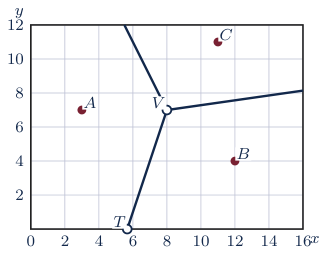
A marine reserve is the rectangle 0\le x\le 16, 0\le y\le 12 (units of 1\,\text{km}). Three ranger stations are at A(3,\,7), B(12,\,4) and C(11,\,11). Nirmala must choose a spot in the reserve for a new bird hide, as far as possible from the nearest ranger station.
Original Photon diagram
(a) The Voronoi vertex of the three stations is V(8,\,7). Find the distance from V to each station.
[2]
(b) The edge between A and B meets the line y=0 at the point T. Find the coordinates of T and its distance from A.
[3]
(c) The other two points where edges meet the boundary of the reserve are 5.59\,\text{km} and 5.76\,\text{km} from their nearest stations. Find the distance from each corner of the reserve to its nearest station.
[3]
(d) Hence find the best location for the hide and its distance from the nearest station. Comment on the vertex V.
[2]
Show solutionHide solution
Original Photon diagram
(a) VA=\sqrt{(8-3)^2+(7-7)^2}=5\,\text{km}
[1]
VB=\sqrt{(8-12)^2+(7-4)^2}=5 and VC=\sqrt{(8-11)^2+(7-11)^2}=5; so 5\,\text{km} for each station.
[1]
(b) Midpoint of [AB] is (7.5,\,5.5) and m_{AB}=\dfrac{4-7}{12-3}=-\dfrac13, so the edge has gradient 3: y=3x-17.
[2]
At y=0: x=\dfrac{17}{3}, so T=\left(\dfrac{17}{3},\,0\right), and TA=\sqrt{\left(\dfrac{17}{3}-3\right)^2+49}\approx7.49\,\text{km}.
[1]
(c) (0,\,0): \sqrt{58}\approx7.62 (nearest A)
[2]
(0,\,12): \sqrt{34}\approx5.83 (A); (16,\,0): \sqrt{32}\approx5.66 (B); (16,\,12): \sqrt{26}\approx5.10 (C).
[1]
(d) The distances compared are: corner (0,\,0) 7.62; T 7.49; (0,\,12) 5.83; boundary points 5.76, 5.59; (16,\,0) 5.66; (16,\,12) 5.10; vertex V 5.00. The largest is at the corner (0,\,0), 7.62\,\text{km} from A.
[2]
(The vertex is not the best choice here because the region is bounded: the corner is further from every station than V is, so the boundary must also be checked.)

Final answer

  • (a) 5 km each
  • (b) (17/3,0), 7.49 km
  • (c) nearest distances 7.62, 5.66, 5.83, 5.10 km at (0,0), (16,0), (0,12), (16,12) respectively
  • (d) (0,0), 7.62 km.

Question 24

[13 marks]
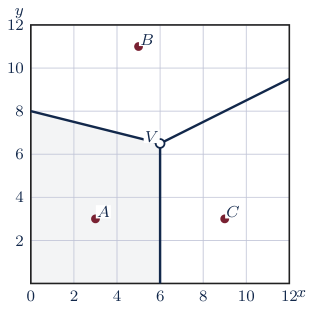
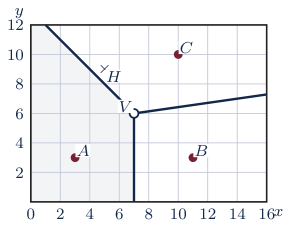
Three hospitals A(3,\,3), B(5,\,11) and C(9,\,3) serve a square region 0\le x\le12, 0\le y\le12. One unit on the map represents 2\,\text{km}. Patients attend the nearest hospital.
Original Photon diagram
(a) Show that the Voronoi edge between A and C is the line x=6.
[2]
(b) Find the equation of the Voronoi edge between A and B.
[3]
(c) The edge between B and C is y=\dfrac12x+\dfrac72. Find the coordinates of the Voronoi vertex.
[2]
(d) The cell of A is bounded by the two edges found above and by the sides x=0 and y=0 of the square region. Find the area of this cell in \text{km}^2.
[3]
(e) The cells of B and C have areas 52.5 and 48 square units. Hospitals A, B and C treat 5220, 5250 and 7680 patients per year. Find the number of patients per \text{km}^2 of each cell.
[2]
(f) Hospital C treats the most patients per \text{km}^2. Suggest one reason why a nearest-hospital model may not match real patient numbers.
[1]
Show solutionHide solution
Original Photon diagram
Diagram (cell of A shaded):
(a) A and C have equal y-coordinates, so the edge is vertical.
[1]
It passes through the midpoint \left(\dfrac{3+9}{2},\,3\right)=(6,\,3), so the edge is x=6.
[1]
(b) Midpoint of [AB] is (4,\,7).
[1]
m_{AB}=\dfrac{11-3}{5-3}=4, so the edge has gradient -\dfrac14.
[1]
y-7=-\dfrac14(x-4)\ \Rightarrow\ y=-\dfrac14x+8.
[1]
(c) At x=6 on B|C: y=3+3.5=6.5.
[1]
Check on A|B: -\dfrac64+8=6.5. The vertex is (6,\,6.5).
[1]
(d) The vertices of the cell are (0,\,0), (6,\,0), the vertex (6,\,6.5) from part (c), and (0,\,8) (where y=-\frac14x+8 meets x=0). The cell is a trapezium with parallel sides 8 and 6.5 (along x=0 and x=6) and width 6.
[1]
Area =\dfrac12(8+6.5)\times6=43.5 square units.
[1]
One square unit is 4\,\text{km}^2, so the area is 174\,\text{km}^2.
[1]
(e) Areas in \text{km}^2: A: 174, B: 210, C: 192.
[1]
Patients per \text{km}^2: A: \dfrac{5220}{174}=30; B: \dfrac{5250}{210}=25; C: \dfrac{7680}{192}=40.
[1]
(f) People do not always choose the nearest hospital (services, reputation, roads), and population is not spread evenly over each cell.
[1]

Final answer

  • (a) x=6
  • (b) y=-x/4+8
  • (c) (6,6.5)
  • (d) 174 km^2
  • (e) 30, 25, 40 patients/km^2
  • (f) roads or uneven population.

Question 25

[13 marks]
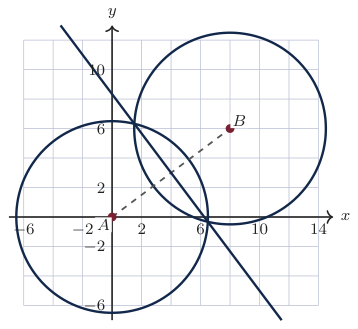
Two radio towers are at A(0,\,0) and B(8,\,6), with coordinates in kilometres. Each tower broadcasts to a circular area of radius 6.5\,\text{km} centred on it. A receiver connects to the nearer tower.
(a) Find the equation of the Voronoi edge between A and B.
[3]
(b) Find the perpendicular distance from A to the edge.
[1]
(c) The circle of coverage of A crosses the edge at two points. Find the distance between these two points, to 3 significant figures.
[3]
(d) Find the angle \theta, in degrees, that this chord subtends at A. Give your answer to 3 significant figures.
[2]
(e) The part of the coverage circle of A that lies beyond the edge (on the side of B) is a circular segment. Find its area.
[3]
(f) Explain what this area represents for a person who owns a receiver inside it.
[1]
Original Photon diagram
Show solutionHide solution
(a) Midpoint of [AB] is (4,\,3).
[1]
m_{AB}=\dfrac68=\dfrac34, so the edge has gradient -\dfrac43.
[1]
y-3=-\dfrac43(x-4)\ \Rightarrow\ y=-\dfrac43x+\dfrac{25}3.
[1]
(b) The edge is the perpendicular bisector of [AB], so the distance from A is \dfrac12AB=\dfrac12\sqrt{8^2+6^2}=5\,\text{km}.
[1]
(c) Half-chord =\sqrt{6.5^2-5^2}
[2]
=\sqrt{17.25}\approx4.15, so the chord has length 2\times4.15\approx8.31\,\text{km}.
[1]
(d) \cos\dfrac\theta2=\dfrac{5}{6.5}, so \dfrac\theta2=39.715\ldots^\circ
[1]
\theta=79.430\ldots^\circ\approx79.4^\circ.
[1]
(e) Segment area = sector - triangle =\dfrac{\theta}{360}\pi r^2-\dfrac12r^2\sin\theta
[1]
=\dfrac{79.430}{360}\pi(6.5)^2-\dfrac12(6.5)^2\sin79.430^\circ=29.286\ldots-20.767\ldots
[1]
\approx8.52\,\text{km}^2.
[1]
(f) Receivers in this region are inside the range of A but nearer to B, so they connect to B even though A's signal also reaches them.
[1]
Original Photon diagram

Final answer

  • (a) y=-4x/3+25/3
  • (b) 5 km
  • (c) 8.31 km
  • (d) 79.4^\circ
  • (e) 8.52 km^2
  • (f) A reaches it, but B is nearer.

Question 26

[18 marks]
Ranger Anil reviews the park's service map. A national park is the rectangle 0 \le x \le 16, 0 \le y \le 12, where one unit represents 1 km. Ranger stations are at A(3,3), B(11,3) and C(10,10). A visitor who needs help is sent to the nearest station.
(a) Write down the equation of the Voronoi edge between A and B.
[1]
(b) Show that the Voronoi edge between A and C is x + y = 13.
[3]
(c) Find the coordinates of the Voronoi vertex V, and show that V is 5 km from each station.
[3]
(d) A hiker at H(5,9) needs help. Determine which station is sent, and find its distance from the hiker.
[2]
(e) On one day the rainfall recorded at A, B and C is 31 mm, 24 mm and 40 mm. Use nearest-neighbour interpolation to estimate the rainfall at H.
[1]
The cell of A within the park is the polygon with vertices (0,0), (7,0), V, (1,12) and (0,12).
(f) Find the area of the cell of A.
[3]
(g) A park officer says that station A will receive the most calls for help because its cell is the largest. Give one reason why this may not be true.
[1]
A fourth station is to be built at the point of the park that is furthest from its nearest station. A planner suggests V.
(h) Show that the corner (0,12) is a better choice than V, and find its distance from the nearest station.
[3]
(i) The point of the park furthest from its nearest station is the corner (0,12). The park wants every point within 10 km of a station. Determine whether the three stations achieve this.
[1]
Original Photon diagram
Show solutionHide solution
(a) x=7 [A1].
(b) Midpoint (6.5,6.5), m_{AC}=1 [M1], so the edge gradient is −1 [A1]. Thus y-6.5=-(x-6.5), giving x+y=13 [A1].
(c) x=7 gives y=6, so V=(7,6) [A1]. The squared distances to A, B and C are 16+9, 16+9 and 9+16 [M1]. Each distance is 5 km [A1].
(d) HA^2=40, HB^2=72, HC^2=26 [M1]. Station C is nearest, \sqrt{26}=5.10 km away [A1].
(e) Copy C's reading: 40 mm [A1].
(f) Split the cell at y=6: rectangle 7\times6 [M1], trapezium \tfrac12(7+1)6=24 [A1]. Total 42+24=66 km^2 [A1].
(g) Calls depend on visitors' locations and trails, rather than cell area alone [R1].
(h) V has nearest-station distance 5 km [M1]. At (0,12) the distances to A, B and C are \sqrt{90}, \sqrt{202} and \sqrt{104} km [M1]. The smallest is \sqrt{90}=9.49 km, greater than 5 km, so the corner is better [A1].
(i) The greatest nearest-station distance is \sqrt{90}<10 km, so every point is within the required range [R1].

Final answer

  • (a) x=7
  • (b) x+y=13
  • (c) (7,6), 5 km
  • (d) C, \sqrt{26}=5.10 km
  • (e) 40 mm
  • (f) 66 km^2
  • (g) visitors are unevenly spread
  • (h) (0,12), \sqrt{90}=9.49 km
  • (i) yes.

Going further

Beyond the syllabus: the worked examples and investigations of the chapter's Going further pages.

G1 Investigate: a city of blocks

G1 Investigation

[18 marks]
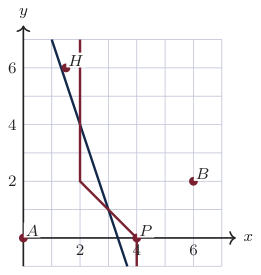
Nia compares bicycle-hire stations in a city of rectangular blocks. Stations A(0,0) and B(6,2) have coordinates in hundreds of metres. Street travel uses taxicab distance d_T=|x_1-x_2|+|y_1-y_2|.
(a) Calculate both distances between A and B. At P(4,0), compare the distances to A and B under both models.
[4]
(b) Within 0\le x\le6, 0\le y\le2, derive the equal-taxicab-distance boundary. Extend your reasoning to y\ge2 and y\le0, still with 0\le x\le6.
[5]
(c) Derive the straight-line bisector. Sketch both boundaries, then compare them on the street y=0, 0\le x\le6. Give the separation of the two crossing points in metres.
[5]
(d) At H(1.5,6), show that the models select different nearest stations. Explain which distance better suits a cyclist, and which suits a delivery drone.
[4]
Show solutionHide solution
(a) Taxicab distance =6+2=8 units, or 800 m [A1]. Straight distance =\sqrt{6^2+2^2}=\sqrt{40}=6.32 units, or 632 m [A1]. At P, street distances are 4 to A and 2+2=4 to B [A1]. Straight distances are 4 and \sqrt8=2.83 units, so P is nearer B under that model [A1].
(b) In the rectangle, d_A=x+y and d_B=6-x+2-y [M1]; equality gives x+y=4 [A1]. Above it, x+y=6-x+y-2 [M1], giving x=2 [A1]. Below it, x-y=6-x+2-y, giving x=4 [A1]. The boundary consists of two vertical rays joined by the segment from (2,2) to (4,0).
(c) Midpoint (3,1), segment gradient 1/3 [M1], so the edge is y-1=-3(x-3), or y=-3x+10 [A1]. Sketch the two rays and joining segment, and this oblique line; both pass through (3,1) [A1]. On y=0, the taxicab crossing is (4,0) and the straight-line crossing is (10/3,0) [A1]. Their separation is (4-10/3)100=200/3 m, about 67 m [A1].
(d) Straight distances from H are \sqrt{38.25}=6.18 to A and \sqrt{36.25}=6.02 to B, so B is nearer [A1]. Taxicab distances are 1.5+6=7.5 and 4.5+4=8.5, so A is nearer [A1]. A cyclist follows streets, favouring the taxicab model [R1]; a drone can fly directly, favouring the straight-line model [R1]. Both models omit obstacles and unequal travel speeds.
Original Photon diagram

Final answer

(a) 800 m, 632 m; at P: street distances 400, 400 m, straight distances 400, 283 m. (b) x+y=4 in the rectangle; x=2 above, x=4 below. (c) y=-3x+10; street crossings (4,0) and (10/3,0), 200/3\approx67 m apart. (d) H: straight 6.18, 6.02 units (B); street 7.5, 8.5 units (A). Cyclist: streets; drone: straight.

From the book

Photon Guidebook: Mathematics Applications and Interpretation HL for the IB Diploma

Chapter 9 teaches voronoi diagrams from the basics to full exam questions: how the IB asks it, every question type with a marked example, and these practice questions in three steps.

About the book