Free worked solutions · 2026 Edition

IB Maths AI HL Chapter 6: Functions and graphs worked solutions

Worked solutions to the practice questions in Chapter 6 of Photon Guidebook: Mathematics Applications and Interpretation HL for the IB Diploma (2026 Edition). Each solution shows every step with the mark it earns, the way an IB mark scheme does.

  • Chapter 6 of 24
  • Volume 1
  • 25 practice questions
  • 2 Going further
  • Free, no sign-up

Basics

One idea at a time, in the order the chapter teaches them.

Question 1

[4 marks]
A workshop packs 64 kits into two sizes of box. Each compact box holds 4 kits and each large box holds 7 kits. There are 13 boxes, all full. Let c and b be the numbers of compact and large boxes.
Form and solve a system to find the number of each box type.
[4]
Show solutionHide solution
c+b=13.
M1
4c+7b=64.
M1
c=9 compact boxes.
A1
b=4 large boxes.
A1

Final answer

9 compact boxes, 4 large boxes

Question 2

[4 marks]
For perpendicular non-vertical lines with non-zero gradients, m_1m_2=-1. A guide line has equation y=\frac34x+2.
Find the gradient of a perpendicular line, then find the perpendicular line passing through (3,1).
[4]
Show solutionHide solution
m=-1/(3/4)=-4/3.
A1
1=(-4/3)(3)+c.
M1
c=5.
A1
y=-\frac43x+5.
A1

Final answer

gradient -\frac43; y = -\frac43x + 5

Question 3

[5 marks]
Two printing services charge A=0.12n+28 and B=0.20n+12 Singapore dollars for n pages, where n is a positive whole number.
Find the page count at which the charges agree. Determine which service is cheaper for 250 pages and quantify the saving.
[5]
Show solutionHide solution
0.12n+28=0.20n+12.
M1
n=200 pages.
A1
At 250 pages, A costs 58 dollars and B costs 62 dollars.
A1
Service A is cheaper.
R1
Saving 4 dollars.
A1

Final answer

equal at 200 pages; at 250 pages A costs 58 dollars, B 62: A cheaper by 4 dollars

Question 4

[4 marks]
A function is h(x)=x^2+2 with continuous domain -4<x\leq3. Use a GDC graph or the square rule to inspect its outputs; no differentiation is required.
Find its range. Explain whether each endpoint is included.
[4]
Show solutionHide solution
Minimum output 2 occurs at allowed input x=0.
A1
Outputs approach 18 as x approaches −4 from above.
A1
18 is not attained: x=-4 and x=4 are not in the domain.
R1
Range 2\leq h(x)<18.
A1

Final answer

2 \le h(x) < 18

Question 5

[3 marks]
A function is h(x)=\frac{37}{x+5} on 0\leq x\leq32. Each of its outputs has a unique input.
Find h^{-1}(3.7) and verify your answer by substituting in h.
[3]
Show solutionHide solution
37/(x+5)=3.7, so x+5=10.
M1
h^{-1}(3.7)=5.
A1
h(5)=37/10=3.7.
A1

Final answer

h^{-1}(3.7) = 5

Question 6

[2 marks]
A function has domain \{2,5,8,11\} and respectively gives outputs 9,16,21,30. Each output has a unique input.
Find the inverse value at output 21 and state the domain of the inverse.
[2]
Show solutionHide solution
f^{-1}(21)=8.
A1
Inverse domain \{9,16,21,30\}, the original outputs.
A1

Final answer

f^{-1}(21) = 8; domain \{9, 16, 21, 30\}

Question 7

[4 marks]
For x>0, graph f(x)=30/x and g(x)=x+1.
Find their intersection and solve f(x)>g(x) on the domain.
[4]
Show solutionHide solution
Solve 30/x=x+1, giving x^2+x-30=0.
M1
The allowed crossing is x=5 (common output 6).
A1
f>g for 0<x<5.
A1
Zero is excluded by the domain, and 5 is excluded by the strict inequality.
R1

Final answer

meet at x = 5 (output 6); f > g for 0 < x < 5

Question 8

[3 marks]
A production line first maps a positive input x to s(x)=\dfrac{9}{x}, then applies t(y)=y+4.
(a) Give a formula for the combined rule (t\circ s)(x).
[1]
(b) Find the positive input producing combined output 7.6.
[2]
Show solutionHide solution
(a) t(s(x))=\dfrac9x+4, for x>0.
A1
(b) \dfrac9x+4=7.6, so \dfrac9x=3.6. M1 Thus x=9/3.6=2.5.
A1

Final answer

(t \circ s)(x) = \frac9x + 4; x = 2.5

Question 9

[4 marks]
A response curve is r(x)=7+\dfrac{18}{x-2} for x>2.
(a) Derive r^{-1}(x) and its domain.
[3]
(b) Calculate r^{-1}(11.5).
[1]
Show solutionHide solution
(a) y-7=18/(x-2) gives (y-7)(x-2)=18. M1 Solving gives r^{-1}(x)=2+\dfrac{18}{x-7}. A1 For x>2, the original response ranges over (7,\infty), so the inverse domain is x>7.
A1
(b) r^{-1}(11.5)=2+18/(11.5-7)=6.
A1

Final answer

r^{-1}(x) = 2 + \frac{18}{x - 7}, x > 7; r^{-1}(11.5) = 6

Question 10

[2 marks]
The graph y=f(x) has a vertical asymptote x=-2 and a horizontal asymptote y=3. Define g(x)=\dfrac12 f(2x-6)-4.
Determine the two asymptotes of g using coordinate changes.
[2]
Show solutionHide solution
The vertical asymptote occurs where 2x-6=-2, giving x=2. M1 The horizontal asymptote becomes y=\frac12(3)-4=-\frac52.
A1

Final answer

x = 2, y = -2.5

Tutorial

Exam-style questions on each question type, with the marks the IB would give.

Question 11

[7 marks]
A tank holds 480 litres when full. It leaks at a constant rate while a pump is filling it. When the pump delivers r litres per minute, the time, in minutes, needed to fill the tank is modelled by T(r) = \frac{480}{r - 6}.
(a) Write down the value of r that must be excluded from the domain because of the algebra.
[1]
(b) Explain why the practical domain is r > 6.
[1]
(c) Find T(14) and interpret your answer.
[2]
(d) Find the pump rate needed to fill the tank in exactly 15 minutes.
[2]
(e) Write down the range of T for r > 6.
[1]
Show solutionHide solution
(a) The denominator is zero when r - 6 = 0, so r = 6 is excluded.
[1]
(b) The tank leaks 6 litres per minute (the net filling rate is r - 6 litres per minute). If r \le 6 the pump does not fill faster than the leak empties the tank, so the tank never fills; only r > 6 makes sense.
[1]
(c) T(14) = \dfrac{480}{14 - 6} = \dfrac{480}{8} = 60.
[1]
It takes 60 minutes to fill the tank when the pump delivers 14 litres per minute.
[1]
(d) Solve \dfrac{480}{r - 6} = 15: r - 6 = 32.
[1]
r = 38 litres per minute.
[1]
(e) As r > 6, r - 6 > 0, so T > 0 and T can take any positive value (no zero, no upper limit): range T > 0.
[1]

Final answer

(a) r=6. (b) The pump must exceed the leak rate: r>6. (c) 60 min. (d) 38 L/min. (e) T>0.

Question 12

[7 marks]
Nuwan dives from a platform that is 10 m above the water. His height above the water, in metres, t seconds after he leaves the platform is modelled by h(t) = 10 + 4.5t - 4.9t^2.
(a) Find h(1) and say what it means in this context.
[2]
(b) Find the time at which Nuwan enters the water.
[2]
(c) Hence write down the largest sensible domain of the model.
[1]
(d) Find the range of h on this domain.
[2]
Show solutionHide solution
(a) h(1) = 10 + 4.5 - 4.9 = 9.6.
[1]
After 1 second Nuwan is 9.6 m above the water.
[1]
(b) He enters the water when h(t) = 0. On the GDC graph y = 10 + 4.5t - 4.9t^2 and use Zero (the positive root).
[1]
t = 1.9597\ldots \approx 1.96 seconds.
[1]
(c) Domain: 0 \le t \le 1.96 (negative times and times after he is in the water make no sense).
[1]
(d) The greatest height is at the vertex. GDC Maximum: (0.459, 11.03), so the greatest height is 11.03\ldots m.
[1]
Range: 0 \le h \le 11.0 (3 s.f.).
[1]

Final answer

(a) 9.6 m (b) 1.96 s (c) 0 \le t \le 1.96 (d) 0 \le h \le 11.0

Question 13

[9 marks]
Two window-cleaning platforms start rising up a tower at the same moment. Platform A rises at a steady rate, so its height after t seconds is A(t) = 5 + 2t metres. Platform B follows a varying speed with height B(t) = 1 + 5t - 0.3t^2 metres, for 0 \le t \le 12.
(a) State the starting height of each platform.
[2]
(b) Show that the height of B above A is g(t) = -0.3t^2 + 3t - 4.
[2]
(c) Find the two times at which the platforms are level. Give your answers to 3 significant figures.
[2]
(d) Find the period of time during which B is at least 3 m above A. Give your answers to 3 significant figures.
[3]
Show solutionHide solution
(a) A(0) = 5 m and B(0) = 1 m. [1]
[1]
(b) g(t) = B(t) - A(t) = 1 + 5t - 0.3t^2 - 5 - 2t.
[1]
= -0.3t^2 + 3t - 4, as required.
AG[1]
(c) Level when g(t) = 0: GDC Zero on y = -0.3x^2 + 3x - 4.
[1]
t = 1.58 s and t = 8.42 s.
[1]
(d) Graph y = g(t) and y = 3; use Intersection (or solve 0.3t^2 - 3t + 7 = 0).
[1]
t = 3.71\ldots and t = 6.29\ldots
[1]
B is at least 3 m above A for 3.71 \le t \le 6.29.
[1]

Final answer

(a) A: 5 m; B: 1 m. (b) g(t)=-0.3t^2+3t-4. (c) 1.58 s and 8.42 s. (d) 3.71\le t\le6.29.

Question 14

[7 marks]
The cost, in Singapore dollars, of printing n flyers is C(n) = 0.06n + 25, for 0 \le n \le 2000.
(a) Find C(300).
[1]
(b) Find the value of n for which C(n) = 61. Hence write down C^{-1}(61) and interpret it.
[3]
(c) Find the domain of C^{-1}.
[2]
(d) Write down the range of C^{-1}.
[1]
Show solutionHide solution
(a) C(300) = 0.06(300) + 25 = \text{SGD }43.
[1]
(b) 0.06n + 25 = 61, so 0.06n = 36.
[1]
n = 600, hence C^{-1}(61) = 600.
[1]
For \text{SGD }61 the shop can print 600 flyers.
[1]
(c) The domain of C^{-1} is the range of C. C(0) = 25 and C(2000) = 145 and C is increasing.
[1]
Domain of C^{-1}: 25 \le x \le 145.
[1]
(d) The range of C^{-1} is the domain of C: 0 \le y \le 2000.
[1]

Final answer

(a) 43 dollars (b) C^{-1}(61) = 600 flyers (c) 25 \le x \le 145 (d) 0 \le y \le 2000

Question 15

[7 marks]
In a Singapore shop (all prices are in SGD), goods are charged 9% GST, and customers hold a \text{SGD }15 voucher. Let g(x) = 1.09x (adding GST to a price x) and f(x) = x - 15 (using the voucher).
(a) Find simplified expressions for (f \circ g)(x) and (g \circ f)(x).
[3]
(b) A jacket is marked at \text{SGD }280. Find the amount paid when the voucher is used (i) after GST is added, (ii) before GST is added.
[2]
(c) Show that, for any marked price, one order is cheaper than the other by a fixed amount, and state which order the customer prefers.
[2]
Show solutionHide solution
(a) (f \circ g)(x) = f(1.09x) = 1.09x - 15. [1]
[1]
(g \circ f)(x) = g(x - 15) = 1.09(x - 15) = 1.09x - 16.35.
[1]
(b) (i) Voucher after GST: (f \circ g)(280) = 1.09(280) - 15 = \text{SGD }290.20.
[1]
(ii) Voucher before GST: (g \circ f)(280) = 1.09(265) = \text{SGD }288.85.
[1]
(c) The difference is (1.09x - 15) - (1.09x - 16.35) = 1.35 for every price x.
[1]
Using the voucher before GST is always \text{SGD }1.35 cheaper, because GST is then charged on a smaller amount; the customer prefers g \circ f.
[1]

Final answer

(a) 1.09x - 15; 1.09x - 16.35 (b) 290.20, 288.85 dollars (c) voucher first, 1.35 dollars cheaper

Question 16

[8 marks]
The stopping distance, in metres, of a car travelling at v kilometres per hour is modelled by d(v) = 0.006v^2 + 0.2v, for v \ge 0.
(a) Explain why d has an inverse function on v \ge 0, even though a parabola does not usually have one.
[2]
(b) Find an expression for d^{-1}(x).
[3]
(c) A driver must be able to stop within 45 m. Find the greatest speed allowed, to 3 significant figures.
[2]
(d) Write down the domain of d^{-1}.
[1]
Show solutionHide solution
(a) The vertex of the parabola is at v = -\dfrac{0.2}{2(0.006)} = -16.7, which is to the left of the domain v \ge 0.
[1]
So on v \ge 0 the graph only rises and passes the horizontal line test (it is one-to-one), so an inverse exists.
[1]
(b) Swap: x = 0.006y^2 + 0.2y, so 0.006y^2 + 0.2y - x = 0.
[1]
Quadratic formula: y = \dfrac{-0.2 \pm \sqrt{0.04 + 0.024x}}{0.012}.
[1]
y \ge 0 so take the positive root: d^{-1}(x) = \dfrac{-0.2 + \sqrt{0.04 + 0.024x}}{0.012}.
[1]
(c) d^{-1}(45) = \dfrac{-0.2 + \sqrt{0.04 + 1.08}}{0.012} = \dfrac{-0.2 + 1.0583}{0.012}.
[1]
= 71.5 km h^{-1}.
[1]
(d) The domain of d^{-1} is the range of d: x \ge 0.
[1]

Final answer

(a) vertex at v = -16.7, outside the domain (b) d^{-1}(x) = \frac{-0.2 + \sqrt{0.04 + 0.024x}}{0.012} (c) 71.5 km/h (d) x \ge 0

Question 17

[8 marks]
The graph of y = f(x) is the cross-section of a sand dune, and the point P(6, 5) lies on it. Four new curves are formed from it: g(x) = f(x - 4) + 2, \qquad h(x) = 3f(x), \qquad k(x) = f(2x), \qquad m(x) = -f(x).
For each of g, h, k and m, describe the transformation that maps the graph of f onto it, and write down the coordinates of the image of P.
[8]
Show solutionHide solution
g(x) = f(x - 4) + 2: translation 4 units right and 2 units up, i.e. by \begin{pmatrix}4\\2\end{pmatrix}.
[1]
Image of P: (10, 7).
[1]
h(x) = 3f(x): vertical stretch with scale factor 3 (away from the x-axis).
[1]
Image of P: (6, 15).
[1]
k(x) = f(2x): horizontal stretch with scale factor \dfrac{1}{2} (towards the y-axis).
[1]
Image of P: (3, 5).
[1]
m(x) = -f(x): reflection in the x-axis.
[1]
Image of P: (6, -5).
[1]

Final answer

g: translation by \binom42, image (10,7); h: vertical stretch factor 3, x-axis invariant, (6,15); k: horizontal stretch factor 1/2, y-axis invariant, (3,5); m: reflection in x-axis, (6,-5).

Question 18

[7 marks]
A technician models a sensor's response using the reciprocal function r(x) = \dfrac{1}{x}, x \ne 0. After recalibration the response is modelled by g(x) = \dfrac{2}{x + 3} - 1.
(a) Describe, in order, a sequence of transformations that maps the graph of y = r(x) onto the graph of y = g(x).
[3]
(b) Write down the equations of the asymptotes of the graph of g.
[2]
(c) Find the coordinates of the points where the graph of g meets the axes.
[2]
Show solutionHide solution
(a) \dfrac{1}{x} \to \dfrac{1}{x + 3}: translation 3 units to the left.
[1]
\dfrac{1}{x + 3} \to \dfrac{2}{x + 3}: vertical stretch with scale factor 2.
[1]
\dfrac{2}{x + 3} \to \dfrac{2}{x + 3} - 1: translation 1 unit down. (The stretch must come before the vertical translation.)
[1]
(b) Vertical asymptote x = -3; horizontal asymptote y = -1. [1]
[1]
(c) y-intercept: g(0) = \dfrac{2}{3} - 1 = -\dfrac{1}{3}, i.e. \left(0, -\dfrac{1}{3}\right).
[1]
x-intercept: \dfrac{2}{x + 3} = 1, so x = -1, i.e. (-1, 0).
[1]

Final answer

(a) left 3, vertical stretch 2, down 1 (b) x = -3, y = -1 (c) (0, -\frac13), (-1, 0)

Question 19

[8 marks]
Fish are introduced into a lake. After t months the number of fish is modelled by P(t) = \frac{2400}{1 + 11e^{-0.45t}}.
(a) Find the number of fish that were introduced.
[2]
(b) Write down the carrying capacity of the lake and explain what it means.
[2]
(c) Find the number of fish after 5 months, to the nearest ten.
[2]
(d) Find how long the population takes to grow from 600 fish to 1800 fish. Give your answer in months to 3 significant figures.
[2]
Show solutionHide solution
(a) P(0) = \dfrac{2400}{1 + 11} = 200.
[1]
200 fish were introduced.
[1]
(b) As t \to \infty, e^{-0.45t} \to 0, so P \to 2400.
[1]
The carrying capacity is 2400 fish: the largest population the lake can sustain in the long term.
[1]
(c) P(5) = \dfrac{2400}{1 + 11e^{-2.25}} = 1111.4\ldots
[1]
About 1110 fish.
[1]
(d) Find the time for each population (GDC Intersection with y = 600 and y = 1800). For 600: 1 + 11e^{-0.45t} = 4, so t = \dfrac{\ln(11/3)}{0.45} = 2.887\ldots months. For 1800: 1 + 11e^{-0.45t} = \dfrac{4}{3}, so t = \dfrac{\ln 33}{0.45} = 7.770\ldots months.
[1]
Time taken = 7.770\ldots - 2.887\ldots = 4.88 months.
[1]

Final answer

(a) 200 fish (b) 2400 (c) about 1110 (d) 4.88 months

Question 20

[10 marks]
The concentration of a pollutant, in mg L^{-1}, in a settling tank t hours after a spill is modelled by V(t) = 0.1t(t - 9)^2, for 0 \le t \le 12.
(a) Show that V(3) = V(12) = 10.8.
[2]
(b) Use your GDC to find the coordinates of the local maximum and the local minimum of the graph, and explain how the local minimum can be found from the factorised form.
[2]
(c) Let k be a constant. Determine the number of solutions of V(t) = k in the interval 0 \le t \le 12 in each case: (i) k < 0; (ii) k = 0; (iii) 0 < k < 10.8; (iv) k = 10.8; (v) k > 10.8.
[4]
(d) The concentration is unsafe when it exceeds 8 mg L^{-1}. Find the total time, in hours, for which the tank is unsafe. Give your answer to 3 significant figures.
[2]
Show solutionHide solution
(a) V(3) = 0.1(3)(-6)^2 = 0.1 \times 3 \times 36 = 10.8.
[1]
V(12) = 0.1(12)(3)^2 = 10.8.
[1]
(b) GDC Maximum and Minimum: local maximum (3, 10.8), local minimum (9, 0).
[1]
The factor (t - 9)^2 is never negative, so V \ge 0 for t \ge 0 and V = 0 at t = 9: the graph touches the axis there, which is the minimum.
[1]
(c) The graph rises from (0, 0) to (3, 10.8), falls to (9, 0) and then rises to (12, 10.8) at the end of the domain.
(i) k < 0 and (v) k > 10.8: no solutions (0).
[1]
(ii) k = 0: t = 0 and t = 9, so 2 solutions.
[1]
(iii) 0 < k < 10.8: one solution on each of the rising, falling and final rising sections: 3 solutions.
[1]
(iv) k = 10.8: t = 3 and t = 12 only, so 2 solutions.
[1]
(d) V(t) = 8 has solutions t = 1.377\ldots, t = 5 (exactly: 0.1 \times 5 \times 16 = 8) and t = 11.623\ldots (GDC Intersection).
[1]
V > 8 for 1.377 < t < 5 and for 11.623 < t \le 12: total time (5 - 1.377) + (12 - 11.623) = 4.00 hours.
[1]

Final answer

(a) V(3)=V(12)=10.8. (b) Maximum (3,10.8); minimum (9,0). (c) 0, 2, 3, 2, 0 solutions. (d) 4.00 h.
Mastery

Full exam questions that mix question types, at Paper 1 and Paper 2 standard.

Question 21

[11 marks]
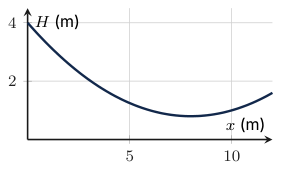
A skateboard ramp designer models the cross-section of a ramp by the quadratic function
H(x)=0.05x^{2}-0.8x+4,\quad 0\le x\le 12,
where H is the height above the ground (in metres) and x is the horizontal distance (in metres) from the left edge.
Original Photon diagram
(a) Find the height of the ramp at the left edge.
[2]
(b) Find the coordinates of the lowest point of the ramp.
[3]
(c) Find the value of x at which the ramp is 2 m high.
[3]
(d) State the range of H.
[3]
Show solutionHide solution
(a) H(0)=0.05(0)-0.8(0)+4=4 m.
[2]
(b) Vertex at x=\dfrac{0.8}{2(0.05)}=8; H(8)=0.05(64)-0.8(8)+4=3.2-6.4+4=0.8. Lowest point (8,\,0.8).
[3]
(c) 0.05x^{2}-0.8x+4=2\Rightarrow 0.05x^{2}-0.8x+2=0\Rightarrow x^{2}-16x+40=0. Using GDC, x=8\pm\sqrt{24}, so x\approx 3.10 m and x\approx 12.9 m; only x\approx 3.10 m lies in the domain. (Second value 12.9>12.)
[3]
(d) Minimum 0.8 (at x=8); endpoints H(0)=4, H(12)=0.05(144)-9.6+4=7.2-9.6+4=1.6. Maximum is 4. Range: 0.8\le H\le 4.
[3]

Final answer

(a) 4 m (b) (8, 0.8) (c) x = 3.10 (d) 0.8 \le H \le 4

Question 22

[12 marks]
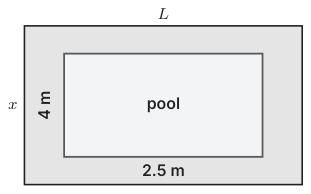
A hotel owns a rectangular plot of land with an area of 1500 m^2. The plot is x metres wide and L metres long. A
rectangular swimming pool is built on the plot, leaving a paved strip 4 m wide at each end of the plot and a paved strip
2.5 m wide along each side.
(a) Write down an expression for the length of the pool in terms of x.
[1]
(b) Show that the area of the pool, A m^2, is A = 1540 - 8x - \dfrac{7500}{x}.
[3]
(c) Explain why 5 < x < 187.5.
[2]
(d) The hotel wants a pool with an area of 1000 m^2. Find the two possible widths of the plot.
[3]
(e) Find the greatest possible area of the pool and the dimensions of the plot that give it. [3]Original Photon diagram
Show solutionHide solution
(a) L = \frac{1500}{x} so pool length \frac{1500}{x} - 8 (A1). (b) pool width x - 5 (M1); A = (x - 5)\left(\frac{1500}{x} - 8\right)
(A1) = 1500 - 8x - \frac{7500}{x} + 40 (A1). (c) pool width x - 5 > 0 (R1); pool length \frac{1500}{x} - 8 > 0 \Rightarrow x < 187.5 (R1).
(d) GDC intersection of A with y = 1000 (M1): x = 19.6 m (A1) or x = 47.9 m (A1) (19.5527..., 47.9473...). (e) GDC maximum
(M1): A = 1.05\times10^3 m^2 at x = 30.6 m (A1); plot 30.6 m by \frac{1500}{30.618\ldots} = 49.0 m (A1).

Final answer

(a) 1500/x-8. (b) A=(x-5)(1500/x-8)=1540-8x-7500/x. (c) Both pool lengths must be positive: 5<x<187.5. (d) 19.6 m or 47.9 m. (e) 1.05\times10^3 m^2; plot 30.6 m by 49.0 m.

Question 23

[11 marks]
The profile of a skate track is modelled by a function f, where y = f(x) is the height in metres at a horizontal distance
of x metres from the start. For 2 \le x \le 6 the profile is the straight line y = 0.5x + 1. For 0 \le x \le 2 it is the
curve y = px^2 + qx + r, which starts at a height of 1.4 m and joins the straight line at x = 2 with the same gradient. For
6 \le x \le 10 it is the curve y = sx^2 + tx + u, which joins the straight line at x = 6 with the same gradient and has a
horizontal tangent (gradient 0) at x = 10. The gradient of the curve y = ax^2 + bx + c at x = k is 2ak + b.
(a) Find the heights of the track at x = 2 and at x = 6.
[1]
(b) Write down three equations in p, q and r, and solve them.
[4]
(c) Find s, t and u.
[4]
(d) Write down f(x) as a piecewise function, and state the height of the track at its end.
[2]
Show solutionHide solution
(a) 2 m and 4 m (A1). (b) r = 1.4; 4p + 2q + r = 2; 4p + q = 0.5 (M1 M1 for the join and gradient equations);
GDC: p = 0.1, q = 0.1, r = 1.4 (A1 A1). (c) 12s + t = 0.5, 20s + t = 0, 36s + 6t + u = 4 (M1 M1); s = -0.0625,
t = 1.25, u = -1.25 (A1 A1). (d) f(x) = 0.1x^2 + 0.1x + 1.4 for 0 \le x < 2; 0.5x + 1 for 2 \le x \le 6;
-0.0625x^2 + 1.25x - 1.25 for 6 < x \le 10 (A1, exactly one definition at each join); height at the end f(10) = 5 m (A1).

Final answer

(a) 2 m, 4 m (b) p = q = 0.1, r = 1.4 (c) s = -0.0625, t = 1.25, u = -1.25 (d) end height 5 m Piecewise formula: 0.1x^2+0.1x+1.4 on [0,2); 0.5x+1 on [2,6]; -0.0625x^2+1.25x-1.25 on (6,10].

Question 24

[10 marks]
A bakery oven has a dial with settings s from 1 to 9. At setting s the oven temperature is C(s) = 25s + 25 degrees
Celsius. A temperature of c degrees Celsius is F(c) = 1.8c + 32 degrees Fahrenheit.
(a) Find (F \circ C)(6) and interpret it in context.
[2]
(b) Find an expression for (F \circ C)(s).
[2]
(c) Find (F \circ C)^{-1}(x) and use it to find the setting for an oven temperature of 392 degrees Fahrenheit.
[3]
(d) Write down the domain and the range of (F \circ C)^{-1}.
[2]
(e) Explain why (C \circ F)(x) has no meaning in this context.
[1]
Show solutionHide solution
(a) C(6) = 175 (M1); F(175) = 347: setting 6 heats the oven to 347 ^\circF (A1). (b) 1.8(25s + 25) + 32 (M1) = 45s + 77 (A1).
(c) y = 45s + 77 \Rightarrow s = \frac{y - 77}{45} (M1); (F \circ C)^{-1}(x) = \frac{x - 77}{45} (A1); \frac{392 - 77}{45} = 7 (A1).
(d) domain 122 \le x \le 482 (A1); range 1 \le s \le 9 (A1). (e) F gives degrees Fahrenheit, but C needs a dial setting (R1).

Final answer

(a) 347 ^\circF (b) 45s + 77 (c) \frac{x - 77}{45}; setting 7 (d) 122 \le x \le 482; 1 \le s \le 9 (e) F outputs Fahrenheit; C needs a dial setting.

Question 25

[18 marks]
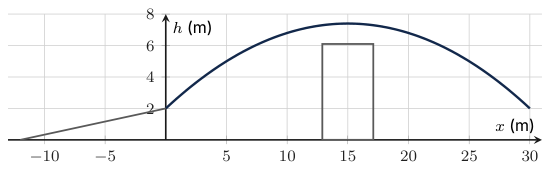
A footbridge is planned over a canal. On a plan, x is the horizontal distance in metres from the west bank, and the east bank
is at x = 30. The underside of the arch is modelled by h(x) = -0.024x^2 + 0.72x + 2, for 0 \le x \le 30, where h is the
height in metres above the water.
(a) Find the height of the arch above the water at each bank.
[1]
(b) Find the maximum height of the arch and the value of x at which it occurs.
[2]
(c) A tour boat is 4.2 m wide and its roof is 6.1 m above the water. Determine whether the boat can pass under the arch when
it travels along the middle of the canal. Justify your answer.
[3]
(d) Find the greatest width of a boat with a roof 6.1 m above the water that could pass under the arch.
[3]
(e) For 0 \le x \le 15 the function h has an inverse. Find h^{-1}(5) and interpret your answer in context.
[2]
(f) An access ramp on the west bank is a straight line from A(-12, 0) to B(0, 2). Find the equation of the ramp in the form
y = mx + c, and the length of the ramp.
[3]
(g) A smaller copy of the bridge is designed for a narrower canal. Its arch is modelled by k(x) = 0.8h(1.25x).
(i) Describe the two transformations that map the graph of h onto the graph of k.
(ii) Find the width of the narrower canal and the maximum height of the smaller arch.
[3]
(h) State one limitation of using this model for the arch. [1]Original Photon diagram
Show solutionHide solution
(a) h(0) = h(30) = 2 m (A1). (b) x = 15 (M1), 7.4 m (A1). (c) edges at x = 15 \pm 2.1 (M1); h(12.9) = 7.29 m (A1);
7.29 > 6.1, so it can pass (R1). (d) h(x) = 6.1: x = 7.64, x = 22.36 (M1 A1); width 22.36 - 7.64 = 14.7 m (A1).
(e) h(x) = 5 gives x = 5 or x = 25; on 0 \le x \le 15, h^{-1}(5) = 5 (A1): 5 m from the west bank the arch is 5 m above
the water (R1). (f) m = \frac{2}{12} = \frac16 (M1); y = \frac{x}{6} + 2 (A1); length \sqrt{12^2 + 2^2} = 12.2 m (A1). (g)(i)
horizontal stretch, scale factor 0.8, y-axis invariant; vertical stretch, scale factor 0.8, x-axis invariant (A1 A1);
(ii) width 0.8 \times 30 = 24 m, maximum 0.8 \times 7.4 = 5.92 m (A1). (h) e.g. the arch is drawn with no thickness; a real
arch may not be an exact parabola (R1).

Final answer

(a) 2 m (b) 7.4 m at x = 15 (c) 7.29 m > 6.1 m: yes (d) 14.7 m (e) 5 (f) y = \frac{x}{6} + 2; 12.2 m (g) stretches, factor 0.8 each way; 24 m, 5.92 m (h) The arch has no thickness in this model.

Going further

Beyond the syllabus: the worked examples and investigations of the chapter's Going further pages.

G1 Reverse the order

G1 Worked

[5 marks]
Nia calibrates two electronic stages using dimensionless signal ratios: g(x)=x^3 followed by f(x)=2x+3. Show that reversing the chain gives (f\circ g)^{-1}(x)=\sqrt[3]{(x-3)/2}=g^{-1}(f^{-1}(x)), and test an output of 19. [5]
Show solutionHide solution
(f\circ g)(x)=2x^3+3 (M1). Solving y=2x^3+3 gives x=\sqrt[3]{(y-3)/2} (A1). Also f^{-1}(x)=(x-3)/2 and g^{-1}(x)=\sqrt[3]x (A1), so their reverse-order composite agrees (R1). At output 19, the inverse gives 2 and the forward chain returns 2(2^3)+3=19 (A1).

Final answer

\sqrt[3]{(x-3)/2}; output 19 returns input 2.

G2 A fixed point makes repetition manageable

G2 Investigation

[18 marks]
Mei changes Singapore dollars (SGD) into euros (EUR) at an airport bureau. For s SGD she receives E(s)=0.67s-3 euros. When she returns, the bureau changes e euros back into S(e)=1.43e-4 SGD.
(a) Find E(500) and (S\circ E)(500). Then show that the round trip R=S\circ E is R(s)=0.9581s-8.29.
[4]
(b) Find the percentage lost starting with SGD 500. Show that the percentage loss from s SGD is 4.19+829/s, and find the starting amount for exactly 5\% loss.
[5]
(c) Find E^{-1}(e) and explain why S is not the inverse of E.
[3]
(d) Starting with SGD 1000, show that after n round trips Mei has 0.9581^n(1000+p)-p SGD, where p=8.29/0.0419. Find the first number of complete trips giving less than SGD 500, and explain why the model must eventually fail.
[6]
Show solutionHide solution
(a) E(500)=0.67(500)-3=332 euros (A1); S(332)=1.43(332)-4=470.76 SGD (A1). Composing gives 1.43(0.67s-3)-4 (M1), hence R(s)=0.9581s-8.29 (A1).
(b) The loss is 500-470.76=29.24 SGD, so 100(29.24/500)=5.848\%\approx5.85\% (M1 A1). In general 100(s-R(s))/s=100(0.0419s+8.29)/s=4.19+829/s (M1). Set this equal to 5: s=829/(5-4.19) (M1), giving SGD 1023.46 to the nearest cent (A1).
(c) Solving e=0.67s-3 gives E^{-1}(e)=(e+3)/0.67 (M1 A1). For every non-negative e, this exceeds 1.43e-4, so the second exchange does not reverse the first: the rates differ and a second fee is taken (R1).
(d) The fixed point solves z=0.9581z-8.29, so z=-p=-8.29/0.0419 (M1). Adding p to each balance gives R(s)+p=0.9581(s+p) (M1). Repeating gives s_n=0.9581^n(1000+p)-p (A1). To test the threshold, s_{12}=518.84 SGD and s_{13}=488.81 SGD to the nearest cent (M1); the balance decreases while positive, so 13 is the first complete trip below SGD 500 (A1). Eventually the expression is negative; the bureau would refuse a transaction that cannot cover its fees, so the rule must stop before then (R1).

Final answer

(a) EUR 332; SGD 470.76; R(s)=0.9581s-8.29. (b) 5.85\%; loss 4.19+829/s percent; SGD 1023.46. (c) (e+3)/0.67; different rates and two fees. (d) 0.9581^n(1000+p)-p; 13 trips; fees eventually exceed the balance.

From the book

Photon Guidebook: Mathematics Applications and Interpretation HL for the IB Diploma

Chapter 6 teaches functions and graphs from the basics to full exam questions: how the IB asks it, every question type with a marked example, and these practice questions in three steps.

About the book