Free worked solutions · 2026 Edition

IB Maths AI HL Chapter 5: Matrices, eigenvalues and Markov chains worked solutions

Worked solutions to the practice questions in Chapter 5 of Photon Guidebook: Mathematics Applications and Interpretation HL for the IB Diploma (2026 Edition). Each solution shows every step with the mark it earns, the way an IB mark scheme does.

  • Chapter 5 of 24
  • Volume 1
  • 26 practice questions
  • 3 Going further
  • Free, no sign-up

Basics

One idea at a time, in the order the chapter teaches them.

Question 1

[2 marks]
Let C=\begin{pmatrix}4&-1\\-5&3\end{pmatrix} and D=\begin{pmatrix}2&7\\1&-4\end{pmatrix}.
Calculate 3C-2D.
[2]
Show solutionHide solution
3C=\begin{pmatrix}12&-3\\-15&9\end{pmatrix} and 2D=\begin{pmatrix}4&14\\2&-8\end{pmatrix}.
M1
3C-2D=\begin{pmatrix}8&-17\\-17&17\end{pmatrix}.
A1

Final answer

\begin{pmatrix}8&-17\\-17&17\end{pmatrix}.

Question 2

[4 marks]
A sensor mixes two true quantities x,y according to \begin{pmatrix}u\\v\end{pmatrix}=A_k\begin{pmatrix}x\\y\end{pmatrix}, where A_k=\begin{pmatrix}1&2\\3&k\end{pmatrix}.
(a) Find the value of k for which the true quantities cannot be uniquely recovered.
[2]
(b) For k=6.2, readings are u=17.4, v=53.8. Find x,y. Then find the change in x if only v rises by 0.1.
[2]
Show solutionHide solution
(a) \det A_k=k-6.
M1
At k=6 the matrix is singular, so unique recovery is impossible.
A1
(b) y=(v-3u)/(k-6)=(53.8-52.2)/0.2=8, so x=17.4-16=1.4.
M1
\Delta y=0.1/0.2=0.5, hence \Delta x=-2(0.5)=-1.
R1

Final answer

(a) k=6. (b) x=1.4, y=8; x falls by 1.

Question 3

[2 marks]
The singular matrix A=\begin{pmatrix}3&6\\1&2\end{pmatrix} appears in Av=\begin{pmatrix}24\\9\end{pmatrix}.
Explain why this equation has no solution rather than infinitely many solutions.
[2]
Show solutionHide solution
The first row of A is three times the second row, so its output entries must have the same relation.
R1
But 24\ne3(9), so the two equations are inconsistent.
R1

Final answer

The rows of A are in the ratio 3:1, but 24\ne3\times9, so the equations are inconsistent.

Question 4

[3 marks]
Let T=\begin{pmatrix}1&3\\0&1\end{pmatrix}.
Calculate T^2 and T^3, then suggest a formula for T^n for positive integer n.
[3]
Show solutionHide solution
T^2=\begin{pmatrix}1&6\\0&1\end{pmatrix}.
A1
T^3=\begin{pmatrix}1&9\\0&1\end{pmatrix}.
A1
T^n=\begin{pmatrix}1&3n\\0&1\end{pmatrix}.
A1

Final answer

T^2=\begin{pmatrix}1&6\\0&1\end{pmatrix}, T^3=\begin{pmatrix}1&9\\0&1\end{pmatrix}, T^n=\begin{pmatrix}1&3n\\0&1\end{pmatrix}.

Question 5

[2 marks]
Let M=\begin{pmatrix}4&k\\2&3\end{pmatrix}. It is known that 6 is an eigenvalue.
Find k and the other eigenvalue.
[2]
Show solutionHide solution
\det(M-6I)=(-2)(-3)-2k=0, hence k=3.
M1
The trace is 7, so the other eigenvalue is 1.
A1

Final answer

k=3; the other eigenvalue is 1.

Question 6

[3 marks]
Let P=\begin{pmatrix}1&2\\1&-1\end{pmatrix} and D=\begin{pmatrix}7&0\\0&1\end{pmatrix}.
Calculate M=PDP^{-1}.
[3]
Show solutionHide solution
P^{-1}=\dfrac13\begin{pmatrix}1&2\\1&-1\end{pmatrix}.
M1
PD=\begin{pmatrix}7&2\\7&-1\end{pmatrix}.
M1
M=\begin{pmatrix}3&4\\2&5\end{pmatrix}.
A1

Final answer

M=\begin{pmatrix}3&4\\2&5\end{pmatrix}.

Question 7

[2 marks]
A chain in order (S,T) has T=\begin{pmatrix}0.72&0.16\\0.28&0.84\end{pmatrix} and starts in S.
Find the probability of the path S\to T\to T\to S, and explain why it is different from the probability of being in S after three steps.
[2]
Show solutionHide solution
The path probability is 0.28(0.84)(0.16)=0.037632\approx0.0376.
M1
The three-step state probability includes every path ending in S, not only this specified path.
R1

Final answer

0.0376; the state probability adds every path that ends in S.

Question 8

[2 marks]
For a column-vector chain, T=\begin{pmatrix}1-a&0.35\\a&0.65\end{pmatrix}. The stationary vector is \begin{pmatrix}0.7\\0.3\end{pmatrix}.
Find a and check it is a valid transition probability.
[2]
Show solutionHide solution
0.7a=0.35(0.3) from balance of the two flows.
M1
a=0.15, which lies between 0 and 1; the columns sum to one.
A1

Final answer

a=0.15.

Question 9

[2 marks]
A chain has T=\begin{pmatrix}0&1\\1&0\end{pmatrix} and starts in its first state. Column vectors are used.
Find a stationary vector and explain why the actual state distribution does not converge to it.
[2]
Show solutionHide solution
\mathbf p=\begin{pmatrix}0.5\\0.5\end{pmatrix} satisfies T\mathbf p=\mathbf p.
A1
Starting in the first state, the distribution alternates between (1,0)^{\mathsf T} and (0,1)^{\mathsf T}, so no limit exists.
R1

Final answer

\begin{pmatrix}0.5\\0.5\end{pmatrix}; the state alternates, so there is no limit.

Question 10

[2 marks]
A column transition matrix is T=\begin{pmatrix}a&0.22&0.41\\0.26&b&0.17\\0.34&0.28&c\end{pmatrix}.
Find a,b,c and explain the constraint used.
[2]
Show solutionHide solution
Every column must sum to one.
R1
a=0.40, b=0.50, c=0.42.
A1

Final answer

a=0.40, b=0.50, c=0.42; every column sums to 1.

Tutorial

Exam-style questions on each question type, with the marks the IB would give.

Question 11

[6 marks]
A sensor is calibrated using the matrix \mathbf{P} = \begin{pmatrix} k & 5 \\ 2 & k - 3 \end{pmatrix}, where k is a constant.
(a) Find an expression for \det \mathbf{P} in terms of k.
[2]
(b) The calibration fails when \mathbf{P} has no inverse. Find the possible values of k.
[2]
(c) For k = 6, find \mathbf{P}^{-1}.
[2]
Show solutionHide solution
(a) \det \mathbf{P} = k(k-3) - 5(2) [1] = k^2 - 3k - 10.
[1]
(b) No inverse means \det\mathbf{P} = 0: k^2 - 3k - 10 = (k-5)(k+2) = 0 (or GDC solve).
[1]
k = 5 or k = -2.
[1]
(c) For k = 6: \mathbf{P} = \begin{pmatrix} 6 & 5 \\ 2 & 3 \end{pmatrix} and \det\mathbf{P} = 8, so
[1]
\mathbf{P}^{-1} = \dfrac18\begin{pmatrix} 3 & -5 \\ -2 & 6 \end{pmatrix} = \begin{pmatrix} \frac{3}{8} & - \frac{5}{8} \\ - \frac{1}{4} & \frac{3}{4} \end{pmatrix}.
[1]

Final answer

(a) k^2-3k-10. (b) k=5 or k=-2. (c) \frac18\begin{pmatrix}3&-5\\-2&6\end{pmatrix}.

Question 12

[6 marks]
A photo-editing app applies compression \mathbf{B} and then filter \mathbf{A} to the colour values of a pixel, so the combined process has matrix \mathbf{AB}, where \mathbf{A} = \begin{pmatrix} 3 & 1 \\ 5 & 2 \end{pmatrix} \quad \text{and} \quad \mathbf{B} = \begin{pmatrix} 2 & 1 \\ 1 & 1 \end{pmatrix}. Dana claims that the combined process can be undone using \mathbf{A}^{-1}\mathbf{B}^{-1}.
(a) Find \mathbf{AB} and (\mathbf{AB})^{-1}.
[3]
(b) Find \mathbf{A}^{-1}\mathbf{B}^{-1} and show that it is not equal to (\mathbf{AB})^{-1}.
[2]
(c) Show that \mathbf{B}^{-1}\mathbf{A}^{-1} = (\mathbf{AB})^{-1} for these matrices, and write down the general rule.
[1]
Show solutionHide solution
(a) \mathbf{AB} = \begin{pmatrix} 7 & 4 \\ 12 & 7 \end{pmatrix}.
[1]
\det(\mathbf{AB}) = 1, so (\mathbf{AB})^{-1} = \begin{pmatrix} 7 & -4 \\ -12 & 7 \end{pmatrix} (or GDC (a*b)^(-1)).
[2]
(b) \mathbf{A}^{-1} = \begin{pmatrix} 2 & -1 \\ -5 & 3 \end{pmatrix} and \mathbf{B}^{-1} = \begin{pmatrix} 1 & -1 \\ -1 & 2 \end{pmatrix}, so
[1]
\mathbf{A}^{-1}\mathbf{B}^{-1} = \begin{pmatrix} 3 & -4 \\ -8 & 11 \end{pmatrix}, which differs from (\mathbf{AB})^{-1}.
[1]
(c) \mathbf{B}^{-1}\mathbf{A}^{-1} = \begin{pmatrix} 7 & -4 \\ -12 & 7 \end{pmatrix} = (\mathbf{AB})^{-1}: in general (\mathbf{AB})^{-1} = \mathbf{B}^{-1}\mathbf{A}^{-1}, the order reverses.
[1]

Final answer

(a) AB=\begin{pmatrix}7&4\\12&7\end{pmatrix}, (AB)^{-1}=\begin{pmatrix}7&-4\\-12&7\end{pmatrix}. (b) \begin{pmatrix}3&-4\\-8&11\end{pmatrix}, which is different. (c) (AB)^{-1}=B^{-1}A^{-1}.

Question 13

[10 marks]
Ahmed runs two social-media pages, F and G. Each week the number of followers of page F doubles, while page G keeps its own followers and gains as many new followers as page F had the week before. Let F_n and G_n be the numbers of followers (in hundreds) after n weeks, and write \mathbf{x}_n = \begin{pmatrix} F_n \\ G_n \end{pmatrix}, so that \mathbf{x}_{n+1} = \mathbf{A}\mathbf{x}_n.
(a) Write down the matrix \mathbf{A}.
[2]
(b) Initially \mathbf{x}_0 = \begin{pmatrix} 50 \\ 20 \end{pmatrix}. Find \mathbf{x}_1, \mathbf{x}_2 and \mathbf{x}_3.
[3]
(c) Find \mathbf{A}^2 and \mathbf{A}^3 and hence suggest an expression for \mathbf{A}^n.
[3]
(d) Use your GDC to find \mathbf{x}_{10}.
[2]
Show solutionHide solution
(a) F_{n+1} = 2F_n + 0G_n and G_{n+1} = F_n + G_n.
[1]
\mathbf{A} = \begin{pmatrix} 2 & 0 \\ 1 & 1 \end{pmatrix}.
[1]
(b) \mathbf{x}_1 = \mathbf{A}\mathbf{x}_0 = \begin{pmatrix} 100 \\ 70 \end{pmatrix}, [1] \mathbf{x}_2 = \begin{pmatrix} 200 \\ 170 \end{pmatrix}, [1] \mathbf{x}_3 = \begin{pmatrix} 400 \\ 370 \end{pmatrix}.
[1]
(c) \mathbf{A}^2 = \begin{pmatrix} 4 & 0 \\ 3 & 1 \end{pmatrix}, [1] \mathbf{A}^3 = \begin{pmatrix} 8 & 0 \\ 7 & 1 \end{pmatrix}.
[1]
The top-left element is 2^n and the bottom-left is one less: \mathbf{A}^n = \begin{pmatrix} 2^n & 0 \\ 2^n - 1 & 1 \end{pmatrix}.
[1]
(d) \mathbf{x}_{10} = \mathbf{A}^{10}\mathbf{x}_0 (GDC: a^ 10*x), where \mathbf{A}^{10} = \begin{pmatrix} 1024 & 0 \\ 1023 & 1 \end{pmatrix}.
[1]
\mathbf{x}_{10} = \begin{pmatrix} 51\,200 \\ 51\,170 \end{pmatrix}, that is 5 120 000 and 5 117 000 followers.
[1]

Final answer

(a) \begin{pmatrix}2&0\\1&1\end{pmatrix}. (b) (100,70), (200\,170), (400\,370). (c) A^n=\begin{pmatrix}2^n&0\\2^n-1&1\end{pmatrix}. (d) (51\,200,\ 51\,170).

Question 14

[10 marks]
A retailer's online orders, in hundreds, from its East region (x_n) and its West region (y_n) in month n satisfy \begin{pmatrix} x_{n+1} \\ y_{n+1} \end{pmatrix} = C\begin{pmatrix} x_n \\ y_n \end{pmatrix}, \qquad C = \begin{pmatrix} 1.2 & 0.1 \\ 0.7 & 0.6 \end{pmatrix}, \qquad x_0 = 9,\ y_0 = 1.
(a) Show that the eigenvalues of C are 1.3 and 0.5.
[3]
(b) Find an eigenvector of C for each eigenvalue, with integer entries.
[2]
(c) Hence show that x_n = 8(1.3)^n + (0.5)^n and find a similar expression for y_n.
[3]
(d) Describe the long-term behaviour of the orders: the percentage growth per month, and the long-term ratio x_n : y_n.
[2]
Show solutionHide solution
(a) \operatorname{tr} C = 1.8 and \det C = 0.72 - 0.07 = 0.65, so \lambda^2 - 1.8\lambda + 0.65 = 0.
[2]
(\lambda - 1.3)(\lambda - 0.5) = 0, so \lambda = 1.3 or \lambda = 0.5.
[1]
(b) \lambda = 1.3: \begin{pmatrix} -0.1 & 0.1 \\ 0.7 & -0.7 \end{pmatrix} gives x = y, eigenvector \begin{pmatrix} 1 \\ 1 \end{pmatrix}.
[1]
\lambda = 0.5: \begin{pmatrix} 0.7 & 0.1 \\ 0.7 & 0.1 \end{pmatrix} gives y = -7x, eigenvector \begin{pmatrix} 1 \\ -7 \end{pmatrix}.
[1]
(c) \begin{pmatrix} 9 \\ 1 \end{pmatrix} = a\begin{pmatrix} 1 \\ 1 \end{pmatrix} + b\begin{pmatrix} 1 \\ -7 \end{pmatrix} gives a + b = 9, a - 7b = 1, so a = 8, b = 1.
[1]
\begin{pmatrix} x_n \\ y_n \end{pmatrix} = 8(1.3)^n\begin{pmatrix} 1 \\ 1 \end{pmatrix} + (0.5)^n\begin{pmatrix} 1 \\ -7 \end{pmatrix}, so x_n = 8(1.3)^n + (0.5)^n.
[1]
y_n = 8(1.3)^n - 7(0.5)^n.
[1]
(d) (0.5)^n \to 0, so the orders grow by about 30% per month.
[1]
Both regions approach 8(1.3)^n, so x_n : y_n \to 1 : 1.
[1]

Final answer

(b) (1,1) and (1,-7). (c) y_n=8(1.3)^n-7(0.5)^n. (d) 30% a month; ratio 1:1.

Question 15

[6 marks]
The deviations x and y, in centimetres, of the water levels in two connected tanks from their resting levels satisfy \dfrac{dx}{dt}=2x-5y and \dfrac{dy}{dt}=x-2y.
(a) Write down the matrix A of this system.
[1]
(b) Find the characteristic equation of A and its eigenvalues.
[3]
(c) Describe the path of (x,y) in the long term.
[1]
(d) Determine whether the path turns clockwise or anticlockwise about the origin.
[1]
Show solutionHide solution
(a) A=\begin{pmatrix}2&-5\\1&-2\end{pmatrix}.
A1
(b) (2-\lambda)(-2-\lambda)+5=0.
M1
\lambda^2+1=0.
A1
\lambda=\pm i.
A1
(c) The real part is 0 and the imaginary part is not, so the path is a closed loop round the origin: the levels oscillate for ever, without settling or growing.
R1
(d) At (1,0): \frac{dx}{dt}=2 and \frac{dy}{dt}=1>0, so the path moves upwards through the positive x-axis: anticlockwise.
A1

Final answer

(a) \begin{pmatrix}2&-5\\1&-2\end{pmatrix}. (b) \lambda^2+1=0, \lambda=\pm i. (c) Closed loops round the origin, no spiral. (d) Anticlockwise.

Question 16

[11 marks]
The number of followers f_n (in thousands) of a new channel in month n is modelled by f_{n+1} = f_n + 6f_{n-1}, \qquad f_0 = 1, \quad f_1 = 2, because each month the channel keeps all its followers and gains six times as many as it had two months earlier, through referrals.
(a) Find a matrix M such that \begin{pmatrix} f_{n+1} \\ f_n \end{pmatrix} = M\begin{pmatrix} f_n \\ f_{n-1} \end{pmatrix}.
[2]
(b) Find the eigenvalues of M.
[2]
(c) Find an eigenvector of M for each eigenvalue.
[2]
(d) By writing \begin{pmatrix} f_1 \\ f_0 \end{pmatrix} as a combination of the two eigenvectors, show that f_n = \dfrac{4 \cdot 3^n + (-2)^n}{5}.
[4]
(e) Write down the value that f_{n+1}/f_n approaches as n \to \infty, and say how it is related to the eigenvalues.
[1]
Show solutionHide solution
(a) f_{n+1} = f_n + 6f_{n-1} and f_n = f_n, so M = \begin{pmatrix} 1 & 6 \\ 1 & 0 \end{pmatrix}.
[2]
(b) \det(M - \lambda I) = (1 - \lambda)(-\lambda) - 6 = \lambda^2 - \lambda - 6.
[1]
(\lambda - 3)(\lambda + 2) = 0, so \lambda = 3 or \lambda = -2.
[1]
(c) \lambda = 3: \begin{pmatrix} -2 & 6 \\ 1 & -3 \end{pmatrix} gives x = 3y, eigenvector \begin{pmatrix} 3 \\ 1 \end{pmatrix}.
[1]
\lambda = -2: \begin{pmatrix} 3 & 6 \\ 1 & 2 \end{pmatrix} gives x = -2y, eigenvector \begin{pmatrix} -2 \\ 1 \end{pmatrix}.
[1]
(d) \begin{pmatrix} 2 \\ 1 \end{pmatrix} = a\begin{pmatrix} 3 \\ 1 \end{pmatrix} + b\begin{pmatrix} -2 \\ 1 \end{pmatrix} gives 3a - 2b = 2 and a + b = 1.
[1]
a = \tfrac45, b = \tfrac15.
[1]
\begin{pmatrix} f_{n+1} \\ f_n \end{pmatrix} = M^n\begin{pmatrix} f_1 \\ f_0 \end{pmatrix} = a\,3^n\begin{pmatrix} 3 \\ 1 \end{pmatrix} + b(-2)^n\begin{pmatrix} -2 \\ 1 \end{pmatrix}, because each eigenvector is only multiplied by its eigenvalue.
[1]
The second row gives f_n = \dfrac45 \cdot 3^n + \dfrac15(-2)^n = \dfrac{4 \cdot 3^n + (-2)^n}{5}.
[1]
(e) The ratio approaches 3, the eigenvalue with the larger magnitude (the dominant eigenvalue), because 3^n outgrows (-2)^n.
[1]

Final answer

(a) \begin{pmatrix}1&6\\1&0\end{pmatrix}. (b) 3 and −2. (c) (3,1) and (-2,1). (e) 3, the larger eigenvalue.

Question 17

[8 marks]
A farmer plants either corn (C) or beans (B) in a field each year. After a corn crop, the probability of planting beans the next year is 0.9. After a bean crop, the probability of planting corn the next year is 0.7. The transition matrix, with states in the order C, B, is T = \begin{pmatrix} 0.1 & 0.7 \\ 0.9 & 0.3 \end{pmatrix}.
(a) Find the eigenvalues of T.
[2]
(b) Find the steady-state vector.
[2]
(c) The field is planted with corn in year 0. Find the probability of corn in each of years 1, 2, 3 and 4.
[2]
(d) Use the eigenvalues to explain the pattern in your answers to part (c).
[2]
Show solutionHide solution
(a) \lambda = 1, and \operatorname{tr} T = 0.4 so the other eigenvalue is 0.4 - 1 = -0.6.
[2]
(b) T\mathbf{s} = \mathbf{s}, row 1: 0.1x + 0.7y = x, so 0.7y = 0.9x and x = \tfrac79 y.
[1]
With x + y = 1: \mathbf{s} = \begin{pmatrix} 7/16 \\ 9/16 \end{pmatrix} = \begin{pmatrix} 0.4375 \\ 0.5625 \end{pmatrix}.
[1]
(c) \mathbf{s}_0 = \begin{pmatrix} 1 \\ 0 \end{pmatrix}, \mathbf{s}_1 = \begin{pmatrix} 0.1 \\ 0.9 \end{pmatrix}, \mathbf{s}_2 = \begin{pmatrix} 0.64 \\ 0.36 \end{pmatrix}.
[1]
Probability of corn: 0.1, 0.64, 0.316, 0.5104 (from \mathbf{s}_3 = \begin{pmatrix} 0.316 \\ 0.684 \end{pmatrix}, \mathbf{s}_4 = \begin{pmatrix} 0.5104 \\ 0.4896 \end{pmatrix}).
[1]
(d) The second eigenvalue −0.6 is negative, so the distance from the steady state 0.4375 changes sign every year: the corn probabilities alternate below and above 0.4375.
[1]
Its magnitude is 0.6 < 1, so the distance shrinks by a factor of 0.6 each year (0.3375, then 0.2025, …) and the values converge to 0.4375.
[1]

Final answer

(a) 1 and −0.6. (b) \left(\frac{7}{16},\frac{9}{16}\right). (c) 0.1, 0.64, 0.316, 0.5104. (d) \lambda_2 is negative, so the values alternate above and below 0.4375 and converge.

Question 18

[7 marks]
Each week a learner on an online platform is either Active (A) or Inactive (I). The transition matrix, with states in the order A, I, is T = \begin{pmatrix} 0.75 & 0.2 \\ 0.25 & 0.8 \end{pmatrix}. This week the state vector is \mathbf{s}_1 = \begin{pmatrix} 0.42 \\ 0.58 \end{pmatrix}. The platform wants to know the state vector \mathbf{s}_0 for last week.
(a) Find T^{-1} and hence find \mathbf{s}_0.
[3]
(b) Show that the columns of T^{-1} sum to 1, but that T^{-1} is not a valid transition matrix.
[2]
(c) Show that a state vector \begin{pmatrix} 0.1 \\ 0.9 \end{pmatrix} could never occur as \mathbf{s}_1 for this chain.
[2]
Show solutionHide solution
(a) \det T = 0.6 - 0.05 = 0.55, so T^{-1} = \dfrac{1}{0.55}\begin{pmatrix} 0.8 & -0.2 \\ -0.25 & 0.75 \end{pmatrix}.
[2]
\mathbf{s}_0 = T^{-1}\mathbf{s}_1 = \dfrac{1}{0.55}\begin{pmatrix} 0.336 - 0.116 \\ -0.105 + 0.435 \end{pmatrix} = \begin{pmatrix} 0.4 \\ 0.6 \end{pmatrix}.
[1]
(b) Column 1: \frac{0.8 - 0.25}{0.55} = 1, column 2: \frac{-0.2 + 0.75}{0.55} = 1.
[1]
But T^{-1} has negative entries (-\tfrac{4}{11} and -\tfrac{5}{11}), and probabilities cannot be negative.
[1]
(c) If \mathbf{s}_1 = \begin{pmatrix} 0.1 \\ 0.9 \end{pmatrix} then \mathbf{s}_0 = T^{-1}\mathbf{s}_1 = \dfrac{1}{0.55}\begin{pmatrix} 0.08 - 0.18 \\ -0.025 + 0.675 \end{pmatrix} = \begin{pmatrix} -0.182 \\ 1.18 \end{pmatrix}.
[1]
An entry of \mathbf{s}_0 would be negative, which is impossible for a state vector, so \begin{pmatrix} 0.1 \\ 0.9 \end{pmatrix} cannot occur.
[1]

Final answer

(a) \mathbf s_0=(0.4,\ 0.6). (b) Shown: T^{-1} has negative entries. (c) (-0.182,\ 1.18): impossible.

Question 19

[10 marks]
A security guard patrols three zones, X, Y and Z, moving between them at the end of each hour. The transition matrix, with states in the order X, Y, Z and each column showing the move from one zone, is T = \begin{pmatrix} 0.5 & 0.3 & x \\ 0.2 & y & 0.3 \\ z & 0.2 & w \end{pmatrix}. The manager designs the patrol so that, in addition to every column summing to 1, every row also sums to 1.
(a) Find the values of x, y, z and w.
[3]
(b) Show that \mathbf{s} = \dfrac13\begin{pmatrix} 1 \\ 1 \\ 1 \end{pmatrix} is a steady-state vector of the chain.
[2]
(c) Prove that if every row and every column of a 3 \times 3 transition matrix sums to 1, then \dfrac13\begin{pmatrix} 1 \\ 1 \\ 1 \end{pmatrix} is a steady-state vector.
[3]
(d) Use your GDC to evaluate T^{30} and say what you notice. Over 1500 hourly checks, state the long-run number of checks at which the guard is in zone X.
[2]
Show solutionHide solution
(a) Row 1: 0.5 + 0.3 + x = 1, so x = 0.2. Column 1: 0.5 + 0.2 + z = 1, so z = 0.3.
[2]
Column 2: 0.3 + y + 0.2 = 1, so y = 0.5. Column 3: 0.2 + 0.3 + w = 1, so w = 0.5 (and rows 2 and 3 then sum to 1).
[1]
(b) T\mathbf{s} = \dfrac13\begin{pmatrix} 0.5 + 0.3 + 0.2 \\ 0.2 + 0.5 + 0.3 \\ 0.3 + 0.2 + 0.5 \end{pmatrix}.
[1]
= \dfrac13\begin{pmatrix} 1 \\ 1 \\ 1 \end{pmatrix} = \mathbf{s}.
[1]
(c) Let T = (t_{ij}) with every row sum \sum_j t_{ij} = 1.
[1]
Then row i of T\mathbf{s} is \tfrac13(t_{i1} + t_{i2} + t_{i3}) = \tfrac13 for i = 1, 2, 3.
[1]
So T\mathbf{s} = \mathbf{s}, and the entries of \mathbf{s} add to 1, so it is a steady-state vector.
[1]
(d) T^{30} has every entry equal to 0.333 (to 3 s.f.): all columns are \dfrac13\begin{pmatrix} 1 \\ 1 \\ 1 \end{pmatrix}.
[1]
Zone X: \tfrac13 \times 1500 = 500 checks.
[1]

Final answer

(a) x=0.2, y=0.5, z=0.3, w=0.5. (b), (c) Shown. (d) Every entry is 0.333; 500 checks.

Question 20

[7 marks]
A language-learning app records whether a learner completes (C) or skips (K) each daily lesson. If a learner completes a lesson, the probability that they complete the next is 0.7. If a learner skips a lesson, the probability that they complete the next is p. The transition matrix, with states in the order C, K, is T = \begin{pmatrix} 0.7 & p \\ 0.3 & 1 - p \end{pmatrix}. In the long run, learners complete exactly half of their lessons.
(a) Find the value of p.
[3]
(b) Find the second eigenvalue of T.
[2]
(c) A new learner completes today's lesson. Use your GDC to find the smallest number of days n after which the probability that the learner completes the lesson is within 0.01 of its long-run value.
[2]
Show solutionHide solution
(a) The steady state is \mathbf{s} = \begin{pmatrix} 0.5 \\ 0.5 \end{pmatrix} and T\mathbf{s} = \mathbf{s}.
[1]
Row 1: 0.7(0.5) + p(0.5) = 0.5.
[1]
0.35 + 0.5p = 0.5, so p = 0.3.
[1]
(b) The eigenvalues sum to \operatorname{tr} T = 0.7 + 0.7 = 1.4, and one is 1.
[1]
The second eigenvalue is 0.4.
[1]
(c) With T = \begin{pmatrix} 0.7 & 0.3 \\ 0.3 & 0.7 \end{pmatrix} and \mathbf{s}_0 = \begin{pmatrix} 1 \\ 0 \end{pmatrix}, the probability is the entry in row 1, column 1 of T^n; this equals 0.5 + 0.5(0.4)^n. GDC: n = 4 gives 0.5128 (difference 0.0128) and n = 5 gives 0.50512 (difference 0.0051).
[1]
The smallest value is n = 5.
[1]

Final answer

(a) p=0.3. (b) 0.4. (c) n=5.

Mastery

Full exam questions that mix question types, at Paper 1 and Paper 2 standard.

Question 21

[5 marks]
A control-systems engineer studies a feedback loop modelled by
C=\begin{pmatrix}1 & -2\\ 1 & 3\end{pmatrix}.
(a) Show that C has no real eigenvalues.
[3]
(b) Find the two complex eigenvalues of C, giving your answers in the form a\pm bi.
[2]
Show solutionHide solution
(a) \det(C-\lambda I)=(1-\lambda)(3-\lambda)-(-2)(1)=\lambda^{2}-4\lambda+5=0.
Discriminant =(-4)^{2}-4(1)(5)=16-20=-4<0, so there are no real roots.
[3]
(b) \lambda=\dfrac{4\pm\sqrt{-4}}{2}=\dfrac{4\pm2i}{2}=2\pm i.
[2]

Final answer

(a) Discriminant -4<0. (b) 2\pm i.

Question 22

[12 marks]
An economist models two coupled markets with the matrix
A=\begin{pmatrix}2 & 1\\ 0 & 3\end{pmatrix},
so that the state after n quarters is \mathbf{x}_n=A^{n}\mathbf{x}_0.
(a) Find the eigenvalues of A and an eigenvector for each.
[4]
(b) Write A=PDP^{-1} with D diagonal, and find P^{-1}.
[3]
(c) Show that A^{n}=\begin{pmatrix}2^{n} & 3^{n}-2^{n}\\ 0 & 3^{n}\end{pmatrix}.
[3]
(d) The initial state is \mathbf{x}_0=\begin{pmatrix}5\\2\end{pmatrix} (in millions). Find \mathbf{x}_4.
[2]
Show solutionHide solution
(a) \det(A-\lambda I)=(2-\lambda)(3-\lambda)=0, so \lambda=2 or \lambda=3.
\lambda=2: (2-2)x+y=0\Rightarrow y=0, eigenvector \begin{pmatrix}1\\0\end{pmatrix}.
\lambda=3: (2-3)x+y=0\Rightarrow y=x, eigenvector \begin{pmatrix}1\\1\end{pmatrix}.
[4]
(b) P=\begin{pmatrix}1 & 1\\ 0 & 1\end{pmatrix}, D=\begin{pmatrix}2 & 0\\ 0 & 3\end{pmatrix}; \det P=1, so P^{-1}=\begin{pmatrix}1 & -1\\ 0 & 1\end{pmatrix}.
[3]
(c) A^{n}=PD^{n}P^{-1}=\begin{pmatrix}1 & 1\\ 0 & 1\end{pmatrix}\begin{pmatrix}2^{n} & 0\\ 0 & 3^{n}\end{pmatrix}\begin{pmatrix}1 & -1\\ 0 & 1\end{pmatrix}=\begin{pmatrix}2^{n} & 3^{n}\\ 0 & 3^{n}\end{pmatrix}\begin{pmatrix}1 & -1\\ 0 & 1\end{pmatrix}=\begin{pmatrix}2^{n} & 3^{n}-2^{n}\\ 0 & 3^{n}\end{pmatrix}.
[3]
(d) With n=4: 2^{4}=16, 3^{4}=81, so A^{4}=\begin{pmatrix}16 & 65\\ 0 & 81\end{pmatrix}.
\mathbf{x}_4=\begin{pmatrix}16 & 65\\ 0 & 81\end{pmatrix}\begin{pmatrix}5\\2\end{pmatrix}=\begin{pmatrix}80+130\\ 162\end{pmatrix}=\begin{pmatrix}210\\162\end{pmatrix} million.
[2]

Final answer

(a) 2: (1,0); 3: (1,1). (b) P^{-1}=\begin{pmatrix}1&-1\\0&1\end{pmatrix}. (c) Shown. (d) \mathbf x_4=(210,\ 162) million.

Question 23

[12 marks]
A streaming service places every subscriber in one of three plans each month: Basic (B), Standard (S) or Premium (P). The transition matrix, with columns and rows ordered B,S,P, is
T=\begin{pmatrix}0.70 & 0.10 & 0.05\\ 0.20 & 0.60 & 0.15\\ 0.10 & 0.30 & 0.80\end{pmatrix}.
(a) Verify that the columns of T are valid probability distributions.
[2]
(b) This month there are 20 000 Basic, 30 000 Standard and 50 000 Premium subscribers. Using your GDC, find the expected numbers in each plan next month.
[3]
(c) The long-run distribution \mathbf{p} is the eigenvector of T with eigenvalue 1, scaled so its entries sum to 1. Using your GDC, find \mathbf{p}, giving each proportion to 3 significant figures.
[4]
(d) The company has 100 000 subscribers in total. Estimate the long-run number of Premium subscribers.
[3]
Show solutionHide solution
(a) Column sums: 0.70+0.20+0.10=1, 0.10+0.60+0.30=1, 0.05+0.15+0.80=1. All columns are non-negative and sum to 1.
[2]
(b) T\begin{pmatrix}20\,000\\30\,000\\50\,000\end{pmatrix}=\begin{pmatrix}19\,500\\29\,500\\51\,000\end{pmatrix} (Basic 19 500, Standard 29 500, Premium 51 000).
[3]
(c) Solving T\mathbf{p}=\mathbf{p} with \sum p_i=1 (GDC eigenvector for \lambda=1) gives
\mathbf{p}\approx\begin{pmatrix}0.184\\ 0.289\\ 0.526\end{pmatrix}.
[4]
(d) Long-run Premium \approx 0.526\times100\,000\approx 52\,600 subscribers.
[3]

Final answer

(a) Shown. (b) 19 500, 29 500, 51 000. (c) (0.184,\ 0.289,\ 0.526). (d) 52 600.

Question 24

[13 marks]
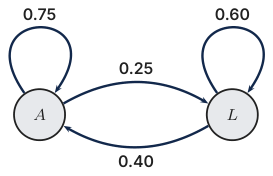
A gaming studio tracks whether each player is Active (A) or Lapsed (L) each week. The transition diagram is shown.
Original Photon diagram
(a) Write down the transition matrix M with rows and columns ordered A then L.
[2]
(b) Find the eigenvalues of M.
[3]
(c) Find the steady-state proportions of Active and Lapsed players.
[4]
(d) The studio starts a season with 8000 Active and 2000 Lapsed players. Comment, with justification, on whether the proportion of Active players will rise or fall towards the steady state.
[4]
Show solutionHide solution
(a) M=\begin{pmatrix}0.75 & 0.40\\ 0.25 & 0.60\end{pmatrix}.
[2]
(b) Trace =1.35, det =0.75(0.60)-0.40(0.25)=0.45-0.10=0.35, so \lambda^{2}-1.35\lambda+0.35=0, giving
\lambda=\dfrac{1.35\pm\sqrt{1.35^{2}-4(0.35)}}{2}=\dfrac{1.35\pm0.65}{2}=1 \;\text{or}\;0.35.
[3]
(c) Steady state has eigenvalue 1: with \mathbf{p}=\begin{pmatrix}a\\1-a\end{pmatrix}, 0.75a+0.40(1-a)=a\Rightarrow0.40=0.65a\Rightarrow a=\tfrac{0.40}{0.65}=\tfrac{8}{13}\approx0.615.
So Active \approx0.615, Lapsed \approx0.385.
[4]
(d) Currently Active proportion =\tfrac{8000}{10\,000}=0.80, which is above the steady-state value \tfrac{8}{13}\approx0.615. Because the second eigenvalue 0.35 has |\lambda|<1, the distribution converges to the steady state, so the Active proportion will fall from 0.80 towards about 0.615.
[4]

Final answer

(a) \begin{pmatrix}0.75&0.40\\0.25&0.60\end{pmatrix}. (b) 1 and 0.35. (c) Active \frac{8}{13}\approx0.615, Lapsed 0.385. (d) Falls from 0.80 towards 0.615.

Question 25

[9 marks]
A music app changes the volumes (left, right) of a track with filters. Filter F has matrix F=\begin{pmatrix}4&3\\1&1\end{pmatrix}.
(a) Find \det F and F^{-1}.
[2]
(b) A second filter G is applied after filter F. The two filters together have matrix C=\begin{pmatrix}11&8\\5&4\end{pmatrix}. Find the matrix of filter G.
[3]
(c) Find the matrix H for which FH=C, and explain why H is different from the matrix of filter G.
[2]
(d) A faulty filter has matrix K=\begin{pmatrix}2&-6\\-1&3\end{pmatrix}. Show that every output of this filter lies on one straight line through the origin, and find the equation of that line.
[2]
Show solutionHide solution
(a) \det F=4-3=1.
A1
F^{-1}=\begin{pmatrix}1&-3\\-1&4\end{pmatrix}.
A1
(b) F first, then G, so GF=C.
M1
G=CF^{-1}.
M1
G=\begin{pmatrix}3&-1\\1&1\end{pmatrix}.
A1
(c) H=F^{-1}C=\begin{pmatrix}-4&-4\\9&8\end{pmatrix}.
A1
FH means H first and then F, and matrix products do not commute, so H\ne G.
R1
(d) K\begin{pmatrix}x\\y\end{pmatrix}=\begin{pmatrix}2x-6y\\-x+3y\end{pmatrix}=(x-3y)\begin{pmatrix}2\\-1\end{pmatrix}.
M1
Every output is a multiple of (2,-1), so it lies on the line X+2Y=0.
A1

Final answer

(a) \det F=1; F^{-1}=\begin{pmatrix}1&-3\\-1&4\end{pmatrix}. (b) \begin{pmatrix}3&-1\\1&1\end{pmatrix}. (c) H=\begin{pmatrix}-4&-4\\9&8\end{pmatrix}, not the matrix of G. (d) X+2Y=0.

Question 26

[18 marks]
The 26 000 residents of a seaside town each spend Saturday either at the Beach (B) or at the Mall (M). Of those at the Beach one Saturday, 70% are at the Beach the next Saturday; of those at the Mall, 35% are at the Beach the next Saturday.
(a) Write down the transition matrix T, using the state order B, M.
[2]
This Saturday 9100 residents are at the Beach and 16 900 are at the Mall.
(b) Find the expected numbers at the Beach and at the Mall next Saturday.
[2]
(c) Find the numbers at the Beach and at the Mall last Saturday.
[3]
(d) Explain why the model cannot be used to find the numbers two Saturdays ago.
[1]
(e) Find the eigenvalues of T and an eigenvector for each eigenvalue.
[4]
(f) Taking this Saturday as week 0, show that the expected number at the Beach after n weeks is 14\,000-4900(0.35)^n.
[3]
(g) Find the least number of weeks after which the expected number at the Beach is within one person of its long-term value.
[2]
(h) Give one reason why the model may not describe the town well over a whole year.
[1]
Show solutionHide solution
(a) T=\begin{pmatrix}0.7&0.35\\0.3&0.65\end{pmatrix}.
A1A1
(b) T\begin{pmatrix}9100\\16\,900\end{pmatrix}.
M1
=\begin{pmatrix}12\,285\\13\,715\end{pmatrix}: 12 285 at the Beach and 13 715 at the Mall.
A1
(c) \det T=0.455-0.105=0.35, so T^{-1}=\frac{1}{0.35}\begin{pmatrix}0.65&-0.35\\-0.3&0.7\end{pmatrix}.
M1
Last Saturday's vector is T^{-1}\begin{pmatrix}9100\\16\,900\end{pmatrix}.
M1
=\begin{pmatrix}0\\26\,000\end{pmatrix}: nobody at the Beach, everybody at the Mall.
A1
(d) One more step back gives \begin{pmatrix}-26\,000\\52\,000\end{pmatrix}. Negative numbers of residents are impossible, so the model cannot be run back that far.
R1
(e) \lambda^2-1.35\lambda+0.35=0.
M1
\lambda=1 or \lambda=0.35.
A1
\lambda=1: (7,6).
A1
\lambda=0.35: (1,-1).
A1
(f) Long run: 26\,000\times\frac{7}{13}=14\,000 at the Beach.
M1
\begin{pmatrix}9100\\16\,900\end{pmatrix}=2000\begin{pmatrix}7\\6\end{pmatrix}-4900\begin{pmatrix}1\\-1\end{pmatrix}.
M1
So B_n=14\,000-4900(0.35)^n.
A1AG
(g) 4900(0.35)^n<1: n=8 gives 1.10 and n=9 gives 0.386.
M1
The least number of weeks is 9.
A1
(h) For example, the probabilities depend on the weather and the season, so they are not constant.
R1

Final answer

(a) \begin{pmatrix}0.7&0.35\\0.3&0.65\end{pmatrix}. (b) 12 285 and 13 715. (c) 0 and 26 000. (d) The answer would be negative. (e) 1 with (7,6); 0.35 with (1,-1). (f) Shown. (g) 9 weeks. (h) The probabilities change with weather and season.
Going further

Beyond the syllabus: the worked examples and investigations of the chapter's Going further pages.

G1 The dominant eigenvalue runs the long run

G1 Worked

[6 marks]
The otter model of Worked example 5.6 has matrix M=\begin{pmatrix}0&1.4\\0.3&0.75\end{pmatrix} for juveniles and adults.
(a) Show that the eigenvalues of M satisfy \lambda^2-0.75\lambda-0.42=0.
[2]
(b) Find the dominant eigenvalue.
[1]
(c) Find the long-term ratio of juveniles to adults.
[2]
(d) Interpret your answers to (b) and (c) for the reserve.
[1]
Show solutionHide solution
(a) The trace is 0.75 and the determinant is 0\times0.75-1.4\times0.3=-0.42 (M1), so \lambda^2-0.75\lambda-0.42=0 (A1 AG). (b) \lambda=\frac{0.75\pm\sqrt{2.2425}}{2}, and the larger root is \lambda_1=1.12 (A1). (c) Row 1 of (M-\lambda_1I)\mathbf v=\mathbf 0 gives -\lambda_1J+1.4A=0 (M1), so J:A=1.4:\lambda_1=1.25:1 (A1). (d) In the long run the population grows by about 12.4% a year, with about 1.25 juveniles for every adult, whatever the 2025 counts were (R1).

Final answer

Shown; 1.12; 1.25:1; about 12.4% growth a year with 1.25 juveniles per adult.

G2 Why every transition matrix has the eigenvalue 1

G2 Worked

[5 marks]
The members of a chess club play online (O) or at the club (C) each week, with transition matrix T=\begin{pmatrix}0.8&0.3\\0.2&0.7\end{pmatrix} and state order O, C.
(a) Show that \det(T-I)=0.
[2]
(b) Find the other eigenvalue of T.
[1]
(c) The distance of the weekly proportion online from its long-run value is c\lambda_2^n. Find the least number of weeks for this distance to fall below 1% of c.
[2]
Show solutionHide solution
(a) T-I=\begin{pmatrix}-0.2&0.3\\0.2&-0.3\end{pmatrix} (M1), and \det(T-I)=0.06-0.06=0 (A1). (b) The trace is 1.5, so \lambda_2=1.5-1=0.5 (A1). (c) 0.5^n<0.01: n=6 gives 0.0156 and n=7 gives 0.0078 (M1), so the least number of weeks is 7 (A1).

Final answer

Shown; 0.5; 7 weeks.

G3 Investigation

[18 marks]
A wildlife trust counts juvenile (j_n) and adult (a_n) hedgehogs in a park in year n, where \begin{pmatrix}j_{n+1}\\a_{n+1}\end{pmatrix}=L\begin{pmatrix}j_n\\a_n\end{pmatrix} with L=\begin{pmatrix}0&1.1\\0.5&0.6\end{pmatrix}. In year 0 there are 200 juveniles and 100 adults.
(a) Find the numbers in years 1 and 2.
[2]
(b) Show that the eigenvalues of L are 1.1 and -0.5.
[2]
(c) Find an eigenvector for each eigenvalue.
[2]
(d) Hence find expressions for j_n and a_n.
[3]
(e) Write down the long-term annual growth factor of the population and the long-term ratio of juveniles to adults.
[2]
(f) For a general model L=\begin{pmatrix}0&f\\s&a\end{pmatrix}, show that 1 is an eigenvalue exactly when fs+a=1.
[3]
(g) A new predator reduces the juvenile survival rate s to 0.25, while f stays 1.1. Find the least adult survival rate a that stops the population declining in the long term.
[3]
(h) Comment on your answer to (g) in context.
[1]
Show solutionHide solution
(a) Year 1: j_1=1.1(100)=110 and a_1=0.5(200)+0.6(100)=160 (A1). Year 2: j_2=176 and a_2=0.5(110)+0.6(160)=151 (A1). (b) The trace is 0.6 and the determinant is -0.55, so \lambda^2-0.6\lambda-0.55=0 (M1), which factorises as (\lambda-1.1)(\lambda+0.5)=0 (A1 AG). (c) For 1.1: -1.1x+1.1y=0, so (1,1) (A1). For -0.5: 0.5x+1.1y=0, so (11,-5) (A1). (d) \begin{pmatrix}200\\100\end{pmatrix}=c_1\begin{pmatrix}1\\1\end{pmatrix}+c_2\begin{pmatrix}11\\-5\end{pmatrix} gives c_1=131.25 and c_2=6.25 (M1). Then j_n=131.25(1.1)^n+68.75(-0.5)^n (A1) and a_n=131.25(1.1)^n-31.25(-0.5)^n (A1). (e) The term in (-0.5)^n dies away, so the growth factor is 1.1 (10% a year) (A1) and the ratio of juveniles to adults tends to 1:1 (A1). (f) \det(L-I)=\det\begin{pmatrix}-1&f\\s&a-1\end{pmatrix} (M1) =-(a-1)-fs=1-a-fs (A1). This is zero exactly when fs+a=1 (R1). (g) The polynomial q(\lambda)=\lambda^2-a\lambda-fs opens upwards and q(0)=-fs<0, so it has one positive root (M1). That root is at least 1 exactly when q(1)\le0, that is a\ge1-fs (M1). With f=1.1 and s=0.25, a\ge1-0.275=0.725 (A1). With a=0.6 the larger eigenvalue is 0.904, a decline. (h) Adult survival must rise from 0.6 to at least 0.725, for example by protecting adults from traffic, or the population falls by about 10% a year (R1).

Final answer

(a) Year 1: 110 and 160; year 2: 176 and 151. (b) Shown. (c) (1,1) and (11,-5). (d) j_n=131.25(1.1)^n+68.75(-0.5)^n, a_n=131.25(1.1)^n-31.25(-0.5)^n. (e) 1.1; 1:1. (f) Shown. (g) a=0.725. (h) Adult survival must rise from 0.6 to at least 0.725.

From the book

Photon Guidebook: Mathematics Applications and Interpretation HL for the IB Diploma

Chapter 5 teaches matrices, eigenvalues and markov chains from the basics to full exam questions: how the IB asks it, every question type with a marked example, and these practice questions in three steps.

About the book