Free worked solutions · 2026 Edition

IB Maths AI HL Chapter 4: Complex numbers worked solutions

Worked solutions to the practice questions in Chapter 4 of Photon Guidebook: Mathematics Applications and Interpretation HL for the IB Diploma (2026 Edition). Each solution shows every step with the mark it earns, the way an IB mark scheme does.

  • Chapter 4 of 24
  • Volume 1
  • 26 practice questions
  • 2 Going further
  • Free, no sign-up

Basics

One idea at a time, in the order the chapter teaches them.

Question 1

[2 marks]
Let z=5+7i and w=3-2i.
Find zw in Cartesian form.
[2]
Show solutionHide solution
zw=15-10i+21i-14i^2.
M1
zw=29+11i.
A1

Final answer

29+11i

Question 2

[3 marks]
For real a,b, a complex number z=a+bi satisfies 2z+3\overline z=25+8i.
Find z.
[3]
Show solutionHide solution
2(a+bi)+3(a-bi)=5a-bi.
M1
5a=25 and -b=8, giving a=5, b=-8.
A1
z=5-8i.
A1

Final answer

z=5-8i

Question 3

[2 marks]
A calculation gives q=\dfrac{7+4i}{2-3i}.
Use the conjugate of 2-3i to write q=a+bi, giving exact real values for a and b.
[2]
Show solutionHide solution
\dfrac{(7+4i)(2+3i)}{(2-3i)(2+3i)}=\dfrac{2+29i}{13}.
M1
=\dfrac2{13}+\dfrac{29}{13}i.
A1

Final answer

\frac{2}{13}+\frac{29}{13}i

Question 4

[3 marks]
Consider x^2-10x+34=0. Complex solutions are allowed.
(a) Solve the equation, expressing the roots in Cartesian form.
[2]
(b) Find the modulus of either root.
[1]
Show solutionHide solution
(a) The discriminant is 100-136=-36.
M1
x=\dfrac{10\pm6i}{2}=5\pm3i.
A1
(b) |5\pm3i|=\sqrt{34}.
A1

Final answer

  • (a) 5\pm3i
  • (b) \sqrt{34}=5.83

Question 5

[3 marks]
Points A and B on an Argand diagram represent -3+8i and 10-4i, respectively. The distance AB is the modulus of their difference.
Find the midpoint as a complex number and find AB to three significant figures.
[3]
Show solutionHide solution
The midpoint is \dfrac{(-3+8i)+(10-4i)}2=3.5+2i.
A1
AB=|(10-4i)-(-3+8i)|=|13-12i|.
M1
AB=\sqrt{313}=17.7 to three significant figures.
A1

Final answer

midpoint 3.5+2i; AB=\sqrt{313}=17.7

Question 6

[2 marks]
Let z=-9+5i. Use principal arguments in -\pi<\theta\le\pi.
State the quadrant and find the principal argument to three significant figures.
[2]
Show solutionHide solution
The point lies in quadrant II.
A1
\theta=\pi-\tan^{-1}(5/9)=2.63 radians.
A1

Final answer

second quadrant; \arg z=2.63

Question 7

[2 marks]
Polar form is r(\cos\theta+i\sin\theta); Euler form is re^{i\theta}, where \theta is in radians. Let z=3-3\sqrt3\,i.
Write z in both forms, using its principal argument.
[2]
Show solutionHide solution
r=\sqrt{9+27}=6, and \theta=-\pi/3.
M1
z=6(\cos(-\pi/3)+i\sin(-\pi/3))=6e^{-i\pi/3}.
A1

Final answer

6\left(\cos\left(-\frac{\pi}{3}\right)+i\sin\left(-\frac{\pi}{3}\right)\right)=6e^{-\frac{\pi}{3}i}

Question 8

[2 marks]
Let z=2e^{i5\pi/12}.
Find z^3 in Euler form with principal argument.
[2]
Show solutionHide solution
z^3=8e^{i5\pi/4}.
M1
5\pi/4-2\pi=-3\pi/4, so z^3=8e^{-i3\pi/4}.
A1

Final answer

8e^{-\frac{3\pi}{4}i}

Question 9

[2 marks]
Multiplication by g=\rho e^{i\alpha} rotates points about the origin through \alpha and scales distances by \rho. Let g=1.8e^{-i\pi/3}.
Describe the transformation w=gz, including direction of rotation.
[2]
Show solutionHide solution
Rotation clockwise through \pi/3 about the origin.
A1
Distances from the origin are multiplied by 1.8.
A1

Final answer

rotation through \frac{\pi}{3} clockwise about the origin and enlargement, scale factor 1.8

Question 10

[3 marks]
Two oscillations of the same angular frequency have phasors 4.7e^{i0.8} and 3.2e^{-i0.5}.
Find their sum in Cartesian form and its amplitude, to three significant figures.
[3]
Show solutionHide solution
Add components: (4.7\cos0.8+3.2\cos0.5)+i(4.7\sin0.8-3.2\sin0.5).
M1
=6.08+1.84i to three significant figures.
A1
The amplitude is 6.35 to three significant figures, using unrounded components.
A1

Final answer

6.08+1.84i; amplitude 6.35

Tutorial

Exam-style questions on each question type, with the marks the IB would give.

Question 11

[6 marks]
A mixing circuit multiplies two complex gains, (a + 2i) and (3 - bi), where a and b are real. The product is 11 + 3i.
(a) Show that 3a + 2b = 11 and ab = 3.
[3]
(b) Use your GDC to find the two possible pairs (a, b).
[3]
Show solutionHide solution
(a) (a + 2i)(3 - bi) = 3a - abi + 6i - 2bi^2.
[1]
= (3a + 2b) + (6 - ab)i.
[1]
Equating real parts: 3a + 2b = 11. Equating imaginary parts: 6 - ab = 3, so ab = 3.
[1]
(b) Eliminate b = \dfrac{3}{a}: 3a + \dfrac{6}{a} = 11, so 3a^2 - 11a + 6 = 0 (or enter the two equations in the GDC's numerical solver, b = (11 - 3a)/2 and b = 3/a, and find the intersections).
[1]
a = 3,\; b = 1.
[1]
a = \dfrac23,\; b = \dfrac92.
[1]

Final answer

  • (a) shown
  • (b) a=3,\ b=1 or a=\frac23,\ b=\frac92

Question 12

[7 marks]
A triangular sail has its corners at O, A and B on a plan drawn on an Argand diagram (one unit = 1 m). O is the origin, A represents 7 + i and B represents 3 + 4i.
(a) Find the lengths OA, OB and AB, giving OA and AB exactly where possible.
[4]
(b) Write down what type of triangle OAB is, justifying your answer, and find the perimeter of the sail to 3 significant figures.
[3]
Show solutionHide solution
(a) OA = |7 + i| = \sqrt{49 + 1} = \sqrt{50} = 5\sqrt2.
[1]
OB = |3 + 4i| = \sqrt{9 + 16} = 5.
[1]
AB = |(7 + i) - (3 + 4i)| = |4 - 3i|.
[1]
= \sqrt{16 + 9} = 5.
[1]
(b) Two sides have equal length (OB = AB = 5), so the triangle is isosceles.
[1]
Perimeter = 5\sqrt2 + 5 + 5.
[1]
= 17.1 m (3 s.f.).
[1]

Final answer

  • (a) OA=5\sqrt2, OB=5, AB=5
  • (b) isosceles, perimeter 17.1 m

Question 13

[7 marks]
A damped system has the characteristic equation x^2 + kx + 20 = 0, where k is a real constant.
(a) Find the set of values of k for which the equation has no real solutions.
[3]
(b) For k = 4, solve the equation, giving your answers in the form p \pm qi.
[2]
(c) The two solutions in part (b) are plotted on an Argand diagram. Find the distance between them.
[2]
Show solutionHide solution
(a) No real solutions requires k^2 - 4(1)(20) < 0.
[1]
k^2 < 80, so -\sqrt{80} < k < \sqrt{80}.
[1]
That is -4\sqrt5 < k < 4\sqrt5 (about -8.94 < k < 8.94).
[1]
(b) x = \dfrac{-4 \pm \sqrt{16 - 80}}{2} = \dfrac{-4 \pm 8i}{2}.
[1]
x = -2 \pm 4i.
[1]
(c) The points are (-2, 4) and (-2, -4), and the difference of the two numbers is (-2 + 4i) - (-2 - 4i) = 8i.
[1]
Distance = |8i| = 8.
[1]

Final answer

  • (a) -4\sqrt5<k<4\sqrt5
  • (b) -2\pm4i
  • (c) 8

Question 14

[6 marks]
A graphic designer maps every point z of a logo to a new point w = (1 + \sqrt3\,i)\,z.
(a) Write 1 + \sqrt3\,i in the form r\,\mathrm{cis}\,\theta, with \theta in degrees.
[2]
(b) Hence describe the geometric effect of the map on the logo.
[2]
(c) Find the image of the point P at 3 + 4i, in the form a + bi, with a and b to 3 significant figures.
[2]
Show solutionHide solution
(a) r = \sqrt{1 + 3} = 2 and \theta = \arctan\sqrt3 = 60^\circ (1st quadrant).
[1]
1 + \sqrt3\,i = 2\,\mathrm{cis}\,60^\circ.
[1]
(b) Multiplying by 2\,\mathrm{cis}\,60^\circ doubles the modulus of every point: an enlargement with scale factor 2 about O.
[1]
It also adds 60^\circ to every argument: an anticlockwise rotation through 60^\circ about O.
[1]
(c) w = (1 + \sqrt3\,i)(3 + 4i) = 3 + 4i + 3\sqrt3\,i + 4\sqrt3\,i^2.
[1]
= (3 - 4\sqrt3) + (4 + 3\sqrt3)i = -3.93 + 9.20i. (Check: |w| = 2 \times 5 = 10 and \arg w = 53.1^\circ + 60^\circ = 113.1^\circ.)
[1]

Final answer

  • (a) 2\,\mathrm{cis}\,60^\circ
  • (b) enlargement, scale factor 2, and rotation of 60^\circ anticlockwise, both about O
  • (c) -3.93+9.20i

Question 15

[7 marks]
(a) Write z = \sqrt3 + i in the form r\,\mathrm{cis}\,\theta, with \theta in radians.
[2]
(b) A filter multiplies a signal by z at each of 11 identical stages. Find z^{11} in the form a + bi, giving a and b exactly.
[3]
(c) Show that z^{12} is real, and find its value.
[2]
Show solutionHide solution
(a) r = \sqrt{3 + 1} = 2 and \theta = \arctan\dfrac{1}{\sqrt3} = \dfrac{\pi}{6} (1st quadrant), so z = 2\,\mathrm{cis}\dfrac{\pi}{6}.
[2]
(b) z^{11} = 2^{11}\,\mathrm{cis}\dfrac{11\pi}{6} = 2048\,\mathrm{cis}\left(-\dfrac{\pi}{6}\right).
[2]
= 2048\left(\dfrac{\sqrt3}{2} - \dfrac12 i\right) = 1024\sqrt3 - 1024i.
[1]
(c) z^{12} = 2^{12}\,\mathrm{cis}\left(12 \times \dfrac{\pi}{6}\right) = 4096\,\mathrm{cis}\,2\pi.
[1]
\mathrm{cis}\,2\pi = 1, so z^{12} = 4096, which is real.
[1]

Final answer

  • (a) 2\,\mathrm{cis}\,\frac{\pi}{6}
  • (b) 1024\sqrt3-1024i
  • (c) z^{12}=4096

Question 16

[8 marks]
Two sinusoidal voltages of the same angular frequency \omega are v_1(t) = 12\cos(\omega t + 40^\circ) and v_2(t) = 9\cos(\omega t - 65^\circ), in volts. Each is represented by a phasor A\,\mathrm{cis}\,\phi.
(a) Write the phasors for v_1 and v_2 in the form a + bi, with a and b to 3 significant figures.
[2]
(b) Find the phasor for v_1 + v_2 in the form a + bi (use unrounded values from part (a)).
[2]
(c) Find the amplitude R and the phase \Phi (in degrees, 3 significant figures) of the combined voltage.
[3]
(d) Write v_1(t) + v_2(t) in the form R\cos(\omega t + \Phi).
[1]
Show solutionHide solution
(a) V_1 = 12\,\mathrm{cis}\,40^\circ = 12\cos 40^\circ + 12\sin 40^\circ\, i = 9.19 + 7.71i.
[1]
V_2 = 9\,\mathrm{cis}(-65^\circ) = 9\cos 65^\circ - 9\sin 65^\circ\, i = 3.80 - 8.16i.
[1]
(b) Same-frequency signals add as phasors: V = V_1 + V_2.
[1]
V = (9.1925 + 3.8036) + (7.7135 - 8.1568)i = 13.0 - 0.443i.
[1]
(c) R = |V| = \sqrt{12.9961^2 + 0.4433^2} = 13.0 V.
[1]
V is in the 4th quadrant, so \Phi = \arg V = -\arctan\dfrac{0.4433}{12.9961}.
[1]
\Phi = -1.95^\circ.
[1]
(d) v_1(t) + v_2(t) = 13.0\cos(\omega t - 1.95^\circ).
[1]

Final answer

  • (a) 9.19+7.71i, 3.80-8.16i
  • (b) 13.0-0.443i
  • (c) R=13.0 V, \Phi=-1.95^\circ
  • (d) 13.0\cos(\omega t-1.95^\circ)

Question 17

[6 marks]
A voltage is modelled by v(t) = \operatorname{Re}\left(Ve^{i\omega t}\right), where V = 10e^{i\pi/3} and \omega = 100 rad s^{-1}.
(a) Show that v(t) = 10\cos\left(100t + \dfrac{\pi}{3}\right).
[2]
(b) Find v(0.01) to 3 significant figures.
[2]
(c) Find the first time t > 0 at which v reaches its maximum value of 10 V.
[2]
Show solutionHide solution
(a) Ve^{i\omega t} = 10e^{i\pi/3}e^{100ti} = 10e^{i(100t + \pi/3)}.
[1]
= 10\cos\left(100t + \dfrac{\pi}{3}\right) + 10i\sin\left(100t + \dfrac{\pi}{3}\right), and the real part is 10\cos\left(100t + \dfrac{\pi}{3}\right).
[1]
(b) v(0.01) = 10\cos\left(1 + \dfrac{\pi}{3}\right) (radian mode).
[1]
= -4.59 V.
[1]
(c) The maximum occurs when \cos\left(100t + \dfrac{\pi}{3}\right) = 1; the first time with t > 0 has 100t + \dfrac{\pi}{3} = 2\pi.
[1]
t = \dfrac{5\pi}{300} = \dfrac{\pi}{60} = 0.0524 s.
[1]

Final answer

  • (a) shown
  • (b) −4.59 V
  • (c) \frac{\pi}{60}=0.0524 s

Question 18

[8 marks]
Mia is designing a folded-paper spiral on an Argand diagram. Her first point is P_0 = 1 + i, and each later point is found from P_n = \dfrac{1 + i}{2}\,P_{n-1}.
(a) Find P_1 and P_2 in the form a + bi.
[3]
(b) Show that P_3 is a real number, and find its value.
[3]
(c) Find the exact value of |P_{10}|.
[2]
Show solutionHide solution
(a) P_1 = \dfrac{(1 + i)(1 + i)}{2}.
[1]
(1 + i)^2 = 2i, so P_1 = i.
[1]
P_2 = \dfrac{(1 + i)\,i}{2} = \dfrac{i + i^2}{2} = -\dfrac12 + \dfrac12 i.
[1]
(b) P_3 = \dfrac{(1 + i)\left(-\frac12 + \frac12 i\right)}{2}.
[1]
(1 + i)\left(-\tfrac12 + \tfrac12 i\right) = -\tfrac12 + \tfrac12 i - \tfrac12 i + \tfrac12 i^2 = -1.
[1]
So P_3 = -\dfrac12, which has imaginary part 0 and is therefore real.
[1]
(c) P_n = \left(\dfrac{1 + i}{2}\right)^n (1 + i), and \left|\dfrac{1 + i}{2}\right| = \dfrac{\sqrt2}{2}, so |P_{10}| = \left(\dfrac{\sqrt2}{2}\right)^{10}\sqrt2.
[1]
= \dfrac{1}{32}\sqrt2 = \dfrac{\sqrt2}{32} (= 0.0442).
[1]

Final answer

  • (a) P_1=i, P_2=-\frac12+\frac12i
  • (b) P_3=-\frac12
  • (c) \frac{\sqrt2}{32}

Question 19

[6 marks]
A square plot of land OACB is drawn on an Argand diagram (one unit = 1 m), with O at the origin and A at 8 + 6i. Vertex B is obtained by rotating A through 90^\circ anticlockwise about O.
(a) Find the complex number represented by B.
[2]
(b) Find the complex number represented by C.
[1]
(c) Find the area of the plot.
[2]
(d) Find the complex number represented by the centre of the plot.
[1]
Show solutionHide solution
(a) A rotation through 90^\circ anticlockwise is multiplication by i = \mathrm{cis}\,90^\circ.
[1]
B = i(8 + 6i) = 8i + 6i^2 = -6 + 8i.
[1]
(b) C = A + B = (8 - 6) + (6 + 8)i = 2 + 14i.
[1]
(c) Side length = |A| = \sqrt{64 + 36} = 10 m.
[1]
Area = 10^2 = 100 m^2.
[1]
(d) The centre is the midpoint of OC: \dfrac{2 + 14i}{2} = 1 + 7i.
[1]

Final answer

  • (a) -6+8i
  • (b) 2+14i
  • (c) 100 m^2
  • (d) 1+7i

Question 20

[7 marks]
A shell pattern is modelled by the points z_\theta = (2 + 0.4\theta)e^{i\theta} on an Argand diagram, where 0 \le \theta \le 12 is in radians and the units are centimetres.
(a) Find z_\theta in the form a + bi for \theta = \frac{\pi}{3} and for \theta = \frac{4\pi}{3}.
[3]
(b) Find the value of \theta for which |z_\theta| = 5, write this point in the form a + bi and state its quadrant.
[3]
(c) Find the distance between z_{\pi/3} and z_{4\pi/3}.
[1]
Show solutionHide solution
(a) moduli 2 + \frac{0.4\pi}{3} = 2.419 and 2 + \frac{1.6\pi}{3} = 3.676 M1 z_{\pi/3} = 1.21 + 2.09i A1 z_{4\pi/3} = -1.84 - 3.18i A1 (b) 2 + 0.4\theta = 5, so \theta = 7.5 A1 5e^{7.5i} = 1.73 + 4.69i A1 7.5 - 2\pi = 1.22 lies between 0 and \frac{\pi}{2}: first quadrant A1 (c) the two points lie on opposite rays, since \frac{4\pi}{3} - \frac{\pi}{3} = \pi, so the distance is 2.419 + 3.676 = 6.09 cm
A1

Final answer

  • (a) 1.21+2.09i, -1.84-3.18i
  • (b) \theta=7.5, 1.73+4.69i, first quadrant
  • (c) 6.09 cm

Mastery

Full exam questions that mix question types, at Paper 1 and Paper 2 standard.

Question 21

[9 marks]
In an AC electrical circuit, a resistor and an inductor are connected in series. The resistor contributes a resistance of 40\ \Omega and the inductor contributes a reactance of 30\ \Omega. The total impedance is modelled by the complex number Z = R + X i, where R is the resistance and X the reactance (both in ohms).
(a) Write down the impedance Z as a complex number.
[1]
(b) Find
(i) the magnitude |Z| of the impedance;
(ii) the phase angle \arg(Z) in degrees, correct to one decimal place.
[4]
(c) A voltage phasor V = 120 (volts, taken as a real number) is applied. Using I = \dfrac{V}{Z}, find the current phasor I in Cartesian form.
[2]
(d) State the magnitude of the current |I|, in amperes.
[2]
Show solutionHide solution
(a) Z = 40 + 30i
[1]
(b)(i) |Z| = \sqrt{40^2 + 30^2} = \sqrt{2500} = 50\ \Omega
(ii) \arg(Z) = \tan^{-1}\!\left(\tfrac{30}{40}\right) = 36.9^{\circ}
[4]
(c) I = \dfrac{120}{40+30i}\cdot\dfrac{40-30i}{40-30i} = \dfrac{120(40-30i)}{2500} = \dfrac{4800 - 3600i}{2500} = 1.92 - 1.44i (amperes)
[2]
(d) |I| = \sqrt{1.92^2 + 1.44^2} = \sqrt{5.76} = 2.4 A. (Check: |I| = |V|/|Z| = 120/50 = 2.4.)
[2]

Final answer

  • (a) 40+30i
  • (b) 50\ \Omega, 36.9^\circ
  • (c) 1.92-1.44i
  • (d) 2.4 A

Question 22

[11 marks]
A wind-turbine control system uses phasors to combine two oscillating forces of the same frequency. Force A is modelled by z_A = 5(\cos 30^{\circ} + i\sin 30^{\circ}) and force B by z_B = 3(\cos(-45^{\circ}) + i\sin(-45^{\circ})), where the modulus is the amplitude (in newtons) and the argument is the phase.
(a) Express each phasor in Cartesian form, correct to three decimal places.
(i) z_A
(ii) z_B
[4]
(b) The resultant force is z_R = z_A + z_B. Find z_R in Cartesian form.
[2]
(c) Find
(i) the amplitude |z_R| of the resultant force, correct to three significant figures;
(ii) the phase \arg(z_R) in degrees, correct to one decimal place.
[3]
(d) Explain why the amplitude of the resultant is less than 5 + 3 = 8 N.
[2]
Show solutionHide solution
(a)(i) z_A = 5\cos 30^{\circ} + 5i\sin 30^{\circ} = 4.330 + 2.500i
(ii) z_B = 3\cos(-45^{\circ}) + 3i\sin(-45^{\circ}) = 2.121 - 2.121i
[4]
(b) z_R = (4.330 + 2.121) + (2.500 - 2.121)i = 6.451 + 0.379i
[2]
(c)(i) |z_R| = \sqrt{6.451^2 + 0.379^2} = 6.46 N
(ii) \arg(z_R) = \tan^{-1}\!\left(\tfrac{0.379}{6.451}\right) = 3.4^{\circ}
[3]
(d) The two phasors have different phases (arguments), so they do not point in the same direction. Only when both moduli add in-phase would the amplitude reach 8 N; here partial cancellation gives a smaller resultant.
[2]

Final answer

  • (a) 4.330+2.500i, 2.121-2.121i
  • (b) 6.451+0.379i
  • (c) 6.46 N, 3.4^\circ
  • (d) the phases differ, so the forces partly cancel

Question 23

[12 marks]
A mechanical vibration in a turbine blade is modelled by the complex displacement z = 2 + 2i (in mm), rotating in the complex plane.
Original Photon diagram
(a) Find
(i) the modulus |z|, giving an exact value;
(ii) the argument \arg(z) in degrees.
[3]
(b) Hence write z in the Euler form r\,e^{i\theta} with \theta in radians.
[2]
(c) After a rotation the displacement is z^4. Using de Moivre's theorem, find z^4 in Cartesian form.
[4]
(d) State the modulus of z^4 and comment on how the amplitude of the vibration has changed.
[3]
Show solutionHide solution
(a)(i) |z| = \sqrt{2^2 + 2^2} = \sqrt{8} = 2\sqrt{2} mm
(ii) \arg(z) = \tan^{-1}\!\left(\tfrac{2}{2}\right) = 45^{\circ}
[3]
(b) 45^{\circ} = \tfrac{\pi}{4} rad, so z = 2\sqrt{2}\,e^{i\pi/4}
[2]
(c) z^4 = (2\sqrt{2})^4\big(\cos(4\times 45^{\circ}) + i\sin(4\times 45^{\circ})\big). Since (2\sqrt{2})^4 = (8)^2 = 64 and 4\times 45^{\circ} = 180^{\circ}: z^4 = 64(\cos 180^{\circ} + i\sin 180^{\circ}) = 64(-1 + 0i) = -64
[4]
(d) |z^4| = 64 mm. The amplitude has grown from 2\sqrt{2}\approx 2.83 mm to 64 mm, a large increase, indicating the vibration would grow rapidly (unstable) under this repeated scaling.
[3]

Final answer

  • (a) 2\sqrt2 mm, 45^\circ
  • (b) 2\sqrt2\,e^{\frac{\pi}{4}i}
  • (c) −64
  • (d) 64 mm, the amplitude has grown

Question 24

[14 marks]
A series AC circuit has a resistor, an inductor and a capacitor, with R = 12\ \Omega, inductive reactance X_L = 20\ \Omega and capacitive reactance X_C = 8\ \Omega. The current is the real phasor I = 4 A, with angular frequency \omega = 100 rad s^{-1}. The voltage phasor across the resistor is V_R = IR (in phase with the current), across the inductor is V_L = iX_L I (leading by 90^\circ) and across the capacitor is V_C = -iX_C I (lagging by 90^\circ). The supply voltage is V = V_R + V_L + V_C.
(a) Write down V_R, V_L and V_C as complex numbers.
[3]
(b) Find V in the form a + bi.
[2]
(c) Find the amplitude |V| to 3 significant figures, and \arg V in radians.
[3]
(d) The supply voltage at time t is v(t) = |V|\cos(\omega t + \arg V) volts. Find v(0.01), to 3 significant figures.
[2]
The capacitor is now replaced by one with a different reactance X_C, so that the supply voltage is in phase with the current.
(e) Find the new value of X_C.
[2]
(f) Find the new supply amplitude, and explain why it is smaller than your answer to part (c).
[2]
Show solutionHide solution
(a) V_R = 12 \times 4 = 48.
[1]
V_L = i(20)(4) = 80i.
[1]
V_C = -i(8)(4) = -32i.
[1]
(b) V = 48 + 80i - 32i.
[1]
V = 48 + 48i V.
[1]
(c) |V| = \sqrt{48^2 + 48^2} = 48\sqrt2 = 67.9 V.
[1]
1st quadrant with equal parts: \arg V = \arctan 1.
[1]
\arg V = \dfrac{\pi}{4} = 0.785 rad.
[1]
(d) v(0.01) = 67.88\cos(100 \times 0.01 + 0.7854) = 67.88\cos(1.7854) (radian mode).
[1]
= -14.5 V.
[1]
(e) In phase with the current means V is real, so \operatorname{Im}(V) = 0: 4(X_L - X_C) = 0.
[1]
X_C = 20\ \Omega.
[1]
(f) Then V = 48, so the amplitude is 48 V.
[1]
The inductor and capacitor voltages now cancel exactly, leaving only the voltage across the resistor, whereas before they combined (net 48i) at right angles to V_R and increased the amplitude.
[1]

Final answer

  • (a) 48, 80i, -32i
  • (b) 48+48i
  • (c) 67.9 V, 0.785 rad
  • (d) −14.5 V
  • (e) 20\ \Omega
  • (f) 48 V

Question 25

[14 marks]
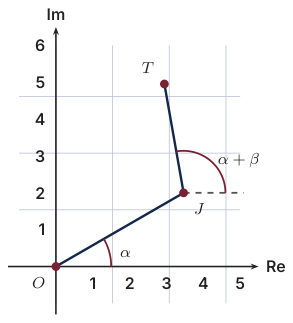
A robot arm has two links. Link 1 has length 4 m and makes an angle \alpha anticlockwise from the positive real axis at the base O; link 2 has length 3 m and makes an angle \alpha + \beta. The joint is at J = 4\,\mathrm{cis}\,\alpha and the tip is at T = 4\,\mathrm{cis}\,\alpha + 3\,\mathrm{cis}(\alpha + \beta) on an Argand diagram. The diagram shows the arm for \alpha = 30^\circ and \beta = 70^\circ.
Original Photon diagram
(a) For \alpha = 30^\circ and \beta = 70^\circ, write J and T in the form a + bi, with a and b to 3 significant figures.
[3]
(b) Find the distance OT for these values, to 3 significant figures.
[2]
(c) Show that T = \mathrm{cis}\,\alpha\,(4 + 3\,\mathrm{cis}\,\beta), and deduce that |T| does not depend on \alpha.
[3]
(d) Find the value of \beta, with 0^\circ < \beta < 180^\circ, for which the tip is exactly 6 m from O. Give \beta to 3 significant figures.
[3]
(e) State the greatest and least possible values of |T| as \beta varies from 0^\circ to 180^\circ, and the value of \beta for each.
[3]
Show solutionHide solution
(a) J = 4\cos 30^\circ + 4\sin 30^\circ\, i = 3.46 + 2.00i.
[1]
T = J + 3\,\mathrm{cis}\,100^\circ = (3.4641 - 0.5209) + (2 + 2.9544)i.
[1]
T = 2.94 + 4.95i.
[1]
(b) |T| = \sqrt{2.9432^2 + 4.9544^2}.
[1]
= 5.76 m.
[1]
(c) 3\,\mathrm{cis}(\alpha + \beta) = 3\,\mathrm{cis}\,\alpha\,\mathrm{cis}\,\beta, so T = \mathrm{cis}\,\alpha\,(4 + 3\,\mathrm{cis}\,\beta).
[2]
|T| = |\mathrm{cis}\,\alpha|\,|4 + 3\,\mathrm{cis}\,\beta| = |4 + 3\,\mathrm{cis}\,\beta| because |\mathrm{cis}\,\alpha| = 1, which contains no \alpha.
[1]
(d) |4 + 3\,\mathrm{cis}\,\beta|^2 = (4 + 3\cos\beta)^2 + (3\sin\beta)^2 = 25 + 24\cos\beta.
[1]
25 + 24\cos\beta = 36, so \cos\beta = \dfrac{11}{24}.
[1]
\beta = 62.7^\circ.
[1]
(e) |T|^2 = 25 + 24\cos\beta is greatest when \cos\beta = 1: |T| = 7 m at \beta = 0^\circ (the arm is straight).
[1]
It is least when \cos\beta = -1: |T| = 1 m at \beta = 180^\circ (the arm is folded back).
[1]
So the reach lies between 4 - 3 and 4 + 3 metres.
[1]

Final answer

  • (a) 3.46+2.00i, 2.94+4.95i
  • (b) 5.76 m
  • (c) shown
  • (d) 62.7^\circ
  • (e) 7 m at 0^\circ, 1 m at 180^\circ

Question 26

[16 marks]
Two generators at a wind farm feed the same line. At time t seconds their voltages, in volts, are v_1 = 340\cos(100\pi t) and v_2 = 340\cos(100\pi t + \varphi), where the constant \varphi satisfies 0 \le \varphi < 2\pi.
(a) Show that v_1 + v_2 = \operatorname{Re}\left[\left(340 + 340e^{i\varphi}\right)e^{100\pi t i}\right].
[1]
(b) Let \varphi = \frac{\pi}{3}.
(i) Write 340 + 340e^{i\pi/3} in the form Re^{i\theta}.
(ii) Hence write v_1 + v_2 in the form A\cos(100\pi t + C).
[4]
(c) Show that \left|340 + 340e^{i\varphi}\right|^2 = 231\,200(1 + \cos\varphi).
[2]
(d) The line needs an amplitude of at least 500 V. Find the values of \varphi, with 0 \le \varphi \le \pi, for which this holds.
[3]
(e) For \varphi = \frac{\pi}{3} the combined voltage drives a current through a load of impedance Z = 30 + 40i ohms. The current phasor is \frac{V}{Z}, where V is your answer to part (b)(i). Find the modulus and the argument of the current phasor.
[3]
(f) Hence write the current, in amperes, in the form B\cos(100\pi t + D).
[1]
(g) Write down the value of \varphi for which the two voltages cancel completely, and explain this using an Argand diagram.
[2]
Show solutionHide solution
(a) 340e^{i(100\pi t + \varphi)} = 340e^{i\varphi}e^{100\pi t i} M1 adding the two terms, factoring out e^{100\pi t i} and taking real parts gives the result AG (b)(i) 340 + 340\left(\frac12 + \frac{\sqrt3}{2}i\right) = 510 + 294.4i M1 R = 340\sqrt3 = 589 A1 \theta = \arctan\frac{294.4}{510} = \frac{\pi}{6} A1 (ii) v_1 + v_2 = 589\cos\left(100\pi t + \frac{\pi}{6}\right) A1 (c) \left|340 + 340e^{i\varphi}\right|^2 = (340 + 340\cos\varphi)^2 + (340\sin\varphi)^2 M1 = 340^2(2 + 2\cos\varphi), using \cos^2\varphi + \sin^2\varphi = 1 M1 = 231\,200(1 + \cos\varphi) AG (d) 231\,200(1 + \cos\varphi) \ge 500^2 M1 \cos\varphi \ge 0.0813 A1 0 \le \varphi \le 1.49 A1 (e) |Z| = 50, \arg Z = 0.927 M1 modulus \frac{588.9}{50} = 11.8 A A1 argument \frac{\pi}{6} - 0.927 = -0.404 A1 (f) i(t) = 11.8\cos(100\pi t - 0.404) A1 (g) \varphi = \pi A1 the phasors 340 and 340e^{i\pi} = -340 are equal arrows pointing in opposite directions, so their sum is 0
R1

Final answer

  • (a) shown
  • (b) 340\sqrt3\,e^{\frac{\pi}{6}i}, 589\cos\left(100\pi t+\frac{\pi}{6}\right)
  • (c) shown
  • (d) 0\le\varphi\le1.49
  • (e) 11.8 A, −0.404
  • (f) 11.8\cos(100\pi t-0.404)
  • (g) \varphi=\pi

Going further

Beyond the syllabus: the worked examples and investigations of the chapter's Going further pages.

G1 A fixed point that is not the origin

G1 Worked example

[3 marks]
Show that the map w=iz+2 leaves exactly one point fixed, and describe it as a single rotation.
[3]
Show solutionHide solution
z=iz+2, so z=\frac{2}{1-i} M1 z=1+i, and this is the only solution of a linear equation with 1-i\ne0 A1 w-(1+i)=i\left(z-(1+i)\right), a rotation through \frac{\pi}{2} anticlockwise about 1+i, with no enlargement since |i|=1
R1

Final answer

the only fixed point is 1+i; a rotation through \frac{\pi}{2} anticlockwise about 1+i

G2 Repeating the map

G2 Investigation

[18 marks]
A robot lawnmower starts at its shed, at the origin of an Argand diagram with units in metres. Each move takes it from z_n to z_{n+1}=qz_n+c, where q=0.6+0.6i and c=5-i, and z_0=0.
(a) Find z_1 and z_2.
[2]
(b) Show that p=5+5i is the only point that a move leaves unchanged.
[2]
(c) Show that z_{n+1}-p=q(z_n-p), and hence describe one move as a rotation and an enlargement about P.
[3]
(d) Show that z_n=p(1-q^n).
[2]
(e) Find the least number of moves after which the mower is within 0.5 m of P.
[3]
(f) Show that the length of move n+1 is |q|^n|z_1-z_0|, and find the total distance the mower would travel if it kept moving for ever.
[4]
(g) The owner wants each move to turn through \frac{\pi}{2} with the same shrink factor. Write down the new value of q and describe the path.
[2]
Show solutionHide solution
(a) z_1=c=5-i A1 z_2=qz_1+c=8.6+1.4i A1 (b) a fixed point has z=qz+c, so z=\frac{c}{1-q} M1 p=\frac{5-i}{0.4-0.6i}=5+5i, and since q\ne1 this equation has one solution only A1 (c) subtract p=qp+c from z_{n+1}=qz_n+c M1 z_{n+1}-p=q(z_n-p) AG |q|=0.6\sqrt2=0.849 and \arg q=\frac{\pi}{4}: an enlargement with scale factor 0.849 and a rotation through \frac{\pi}{4} anticlockwise A1 both about P A1 (d) applying the result of (c) n times, z_n-p=q^n(z_0-p) M1 with z_0=0, z_n=p-q^np=p(1-q^n) M1 (e) |z_n-p|=|q|^n|p|=5\sqrt2\,(0.849)^n<0.5 M1 n>\frac{\ln\left(0.5/(5\sqrt2)\right)}{\ln0.849}=16.1 M1 n=16 gives 0.511 m and n=17 gives 0.433 m, so 17 moves A1 (f) z_{n+1}-z_n=q^n(z_1-z_0), from (d) M1 so the length of move n+1 is |q|^n|z_1-z_0| AG |z_1-z_0|=|5-i|=\sqrt{26} A1 total =\frac{\sqrt{26}}{1-0.6\sqrt2}, a sum to infinity with ratio |q|<1 M1 =33.7 m A1 (g) q=0.6\sqrt2\,i=0.849i A1 each move is a quarter turn about the new fixed point, so the path is a spiral of right-angle turns closing in on it
A1

Final answer

  • (a) 5-i, 8.6+1.4i
  • (b) shown
  • (c) rotation through \frac{\pi}{4} anticlockwise and enlargement, scale factor 0.849, about P
  • (d) shown
  • (e) 17 moves
  • (f) shown, 33.7 m
  • (g) q=0.849i, a spiral of right-angle turns

From the book

Photon Guidebook: Mathematics Applications and Interpretation HL for the IB Diploma

Chapter 4 teaches complex numbers from the basics to full exam questions: how the IB asks it, every question type with a marked example, and these practice questions in three steps.

About the book