Free worked solutions · 2026 Edition

IB Maths AI HL Chapter 3: Exponents and logarithms worked solutions

Worked solutions to the practice questions in Chapter 3 of Photon Guidebook: Mathematics Applications and Interpretation HL for the IB Diploma (2026 Edition). Each solution shows every step with the mark it earns, the way an IB mark scheme does.

  • Chapter 3 of 24
  • Volume 1
  • 26 practice questions
  • 2 Going further
  • Free, no sign-up

Basics

One idea at a time, in the order the chapter teaches them.

Question 1

[3 marks]
Technician Idris claims that 6^2+6^3=6^5 because the exponents add.
Calculate both sides and explain why the claim is false.
[3]
Show solutionHide solution
6^2+6^3=36+216=252.
A1
6^5=7776.
A1
Adding exponents applies to multiplication of powers with the same base; this expression adds their values.
R1

Final answer

252\ne7776; exponent addition applies to multiplication.
Question 2

[3 marks]
Nia's sensor model is V=18x^{-2} volts, where x is a positive dimensionless setting.
Find V when x=3, and explain the negative exponent.
[3]
Show solutionHide solution
V=18/3^2.
M1
V=2 volts.
A1
x^{-2} is the reciprocal of x^2, not the negative of x^2.
R1

Final answer

2 V; x^{-2}=1/x^2.

Question 3

[3 marks]
Zac's device assigns the number L=\log_{10}275 to a positive measurement.
Use a GDC to find L to 3 significant figures and check that it lies between 2 and 3.
[3]
Show solutionHide solution
Use the base-ten logarithm key.
M1
L=2.44.
A1
10^2<275<10^3, so 2<L<3.
R1

Final answer

2.44; 2<L<3.

Question 4

[5 marks]
Arun's calibration formula is D=8+5\log_{10}x for positive dimensionless x.
(a) Find D when x=1000.
[2]
(b) Find x when D=18.
[3]
Show solutionHide solution
(a) \log_{10}1000=3.
A1
D=8+5(3)=23.
A1
(b) 18=8+5\log_{10}x gives \log_{10}x=2.
M1
x=10^2.
M1
x=100.
A1

Final answer

(a) 23. (b) 100.

Question 5

[2 marks]
Ivo uses the rule for a positive dimensionless base, a^{m/n}=(\sqrt[n]{a})^m.
Evaluate 125^{4/3} exactly.
[2]
Show solutionHide solution
125^{4/3}=(\sqrt[3]{125})^4=5^4.
M1
=625.
A1

Final answer

625.

Question 6

[2 marks]
For a dimensionless calibration setting x>2, Eva considers \ln(x-2)+\ln(x+6)-\ln4.
Write this as one logarithm and explain why the stated domain makes every logarithm valid.
[2]
Show solutionHide solution
\ln\left((x-2)(x+6)/4\right).
A1
x>2 makes x-2, x+6 and 4 positive.
R1

Final answer

\ln((x-2)(x+6)/4); all original arguments are positive for x>2.

Question 7

[3 marks]
For his dimensionless setting x, Luca uses 2\ln x=\ln(7x+18).
Find all real solutions, checking the original logarithms.
[3]
Show solutionHide solution
x>0; combine to give x^2=7x+18.
M1
(x-9)(x+2)=0.
M1
x=9 only; x=-2 makes \ln x undefined.
A1

Final answer

x=9 only.

Question 8

[3 marks]
Jo models a dimensionless quality score by Q(t)=57(1.08)^t, where t is time in weeks, t\ge0.
Use logarithms to find the first whole week at which Q(t)>130.
[3]
Show solutionHide solution
t\ln1.08>\ln(130/57).
M1
t>\ln(130/57)/\ln1.08=10.712\ldots.
A1
The first whole week is week 11.
R1

Final answer

Week 11; crossing t=10.7 weeks.

Question 9

[3 marks]
Sana's communications model assigns a score S=12\log_{10}(I/I_0) to positive intensity I. Two operating settings differ by 7.8 score units, with setting A higher than setting B.
(a) Find I_A/I_B to three significant figures.
[2]
(b) A technician says the ratio would change if both intensities were measured in a unit 1000 times smaller. Explain why this is incorrect.
[1]
Show solutionHide solution
(a) 7.8=12\log_{10}(I_A/I_B).
M1
I_A/I_B=10^{7.8/12}=4.47.
A1
(b) Both numerical intensities are multiplied by 1000, so their ratio is unchanged.
R1

Final answer

(a) 4.47. (b) Both intensities scale equally; the ratio is unchanged.

Question 10

[3 marks]
Lena's scale model relates mass M in grams to a positive length L in centimetres by M=2.7L^{3/4}.
Find M when L=81, then find L when M=22.
[3]
Show solutionHide solution
M=2.7(81)^{3/4}=72.9 g.
A1
L=(22/2.7)^{4/3}.
M1
L=16.4 cm to three significant figures.
A1

Final answer

72.9 g; 16.4 cm.

Tutorial

Exam-style questions on each question type, with the marks the IB would give.

Question 11

[7 marks]
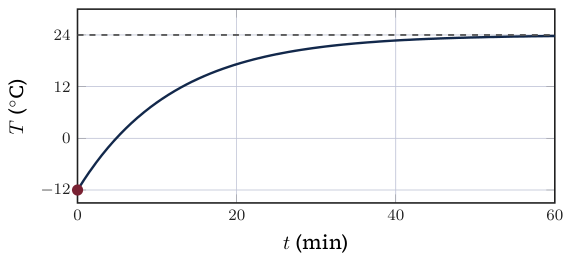
Gwen takes a tub of ice cream from a freezer at −12° C and leaves it on a kitchen counter. Its temperature, T° C, after t minutes is modelled by T=24-36(0.92)^{t},\qquad t\ge 0.
(a) Write down the initial temperature of the ice cream.
[1]
(b) Write down the temperature that the model says the ice cream approaches after a very long time.
[1]
(c) State, with a reason, whether T is increasing or decreasing with t.
[1]
(d) Find the temperature of the ice cream after 10 minutes, correct to 3 significant figures.
[2]
(e) Sketch the graph of T against t for 0\le t\le 60, showing the T-intercept and the horizontal asymptote.
[2]
Show solutionHide solution
(a) T(0)=24-36=-12^\circC.
[1]
(b) As t grows, 0.92^t\to0, so T\to24^\circC.
[1]
(c) Increasing: a smaller positive quantity is subtracted from 24 as t increases.
[1]
(d) T(10)=24-36(0.92)^{10} [1] =8.36^\circC.
[1]
(e) The curve rises from (0,-12) [1] and approaches the horizontal asymptote T=24 from below. [1] Original Photon diagram

Final answer

(a) -12^\circC. (b) 24^\circC. (c) Increasing: less is subtracted. (d) 8.36^\circC. (e) Rises from (0,-12) towards T=24.

Question 12

[7 marks]
Forester Ayu measures a bushfire burning an area of 3.5 hectares when it is first measured. Its area A hectares after t hours is modelled by A=A_{0}e^{kt}. After 5 hours the fire covers 14.2 hectares.
(a) Write down A_{0} and find the value of k, correct to 3 significant figures.
[3]
(b) Find the area of the fire after 12 hours, to the nearest hectare.
[2]
(c) Find the time at which the area first exceeds 500 hectares. Give your answer in hours to 3 significant figures.
[2]
Show solutionHide solution
(a) A_{0}=3.5 (the area at t=0).
[1]
3.5\mathrm{e}^{5k}=14.2\Rightarrow\mathrm{e}^{5k}=\dfrac{14.2}{3.5}
[1]
k=\dfrac{1}{5}\ln\dfrac{14.2}{3.5}=0.2801\ldots=\mathbf{0.280}.
[1]
(b) A=3.5\mathrm{e}^{12k} using the unrounded k
[1]
=100.9\ldots=101 hectares.
[1]
(c) Solve 3.5\mathrm{e}^{kt}=500 (GDC intersect with y=500):
[1]
t=17.7 hours.
[1]

Final answer

(a) A_0=3.5, k=0.280 h^{-1}. (b) 101 ha. (c) Crossing at 17.7 h.

Question 13

[6 marks]
Kai models the value of a delivery drone, V Singapore dollars, t years after it is bought is modelled by V=ka^{t}+c. The drone cost S\$1800 when new. The model predicts that its value will approach a scrap value of S\$150 in the long run, and its value after 2 years is S\$1050.
(a) Write down the value of c.
[1]
(b) Find the value of k.
[1]
(c) Find the value of a, correct to 3 significant figures.
[3]
(d) Find the value of the drone after 5 years, to the nearest dollar.
[1]
Show solutionHide solution
(a) The long-run value is the horizontal asymptote y=c, so c=150.
[1]
(b) New value: t=0 gives k+c=1800, so k=1650.
[1]
(c) t=2: 1650a^{2}+150=1050
[1]
a^{2}=\dfrac{900}{1650}=0.5454\ldots
[1]
a=0.7385\ldots=\mathbf{0.739} (3 s.f.; take the positive root).
[1]
(d) V=1650(0.73855)^{5}+150=512.6\ldots=S\$513.
[1]

Final answer

(a) 150. (b) 1650. (c) 0.739. (d) S$513.

Question 14

[7 marks]
The sound level L decibels (dB) of a sound of intensity I W m^{-2} is L=10\log\!\left(\dfrac{I}{I_{0}}\right), where I_{0}=1.0\times 10^{-12} W m^{-2}.
(a) A whisper in a library has a sound level of 30 dB. Find its intensity.
[2]
(b) Kenji works near a pneumatic drill of intensity 1.6\times 10^{-2} W m^{-2}. Find the sound level of the drill, correct to 3 significant figures.
[2]
(c) A piece of machinery is 250 times as intense as the drill. Find its sound level, correct to 3 significant figures.
[2]
(d) Hearing protection must be worn when the sound level is above 85 dB. Find the intensity at which this begins, correct to 3 significant figures.
[1]
Show solutionHide solution
(a) 30=10\log\!\left(\dfrac{I}{10^{-12}}\right)\Rightarrow\dfrac{I}{10^{-12}}=10^{3}
[1]
I=1.0\times 10^{-9} W m^{-2}.
[1]
(b) L=10\log\!\left(\dfrac{1.6\times 10^{-2}}{10^{-12}}\right)=10\log\left(1.6\times 10^{10}\right)
[1]
=102.04\ldots=\mathbf{102} dB.
[1]
(c) Intensity =250\times 1.6\times 10^{-2}=4.0 W m^{-2}
[1]
L=10\log\!\left(\dfrac{4.0}{10^{-12}}\right)=126 dB (equivalently 102.04+10\log 250=126.0).
[1]
(d) 85=10\log\!\left(\dfrac{I}{10^{-12}}\right)\Rightarrow I=10^{-12+8.5}=10^{-3.5}=3.16\times 10^{-4} W m^{-2}.
[1]

Final answer

(a) 1.00\times10^{-9} W m^{-2}. (b) 102 dB. (c) 126 dB. (d) 3.16\times10^{-4} W m^{-2}.

Question 15

[6 marks]
Nabil measures the strength of a Wi-Fi signal is given in dBm: P_{\text{dBm}}=10\log\!\left(\dfrac{P}{1\text{ mW}}\right), where P is the power in milliwatts (mW).
(a) A router transmits at 200 mW. Find this power in dBm, correct to 3 significant figures.
[2]
(b) A phone can only connect if the received signal is at least −82 dBm. Find the smallest received power, in mW, in the form a\times 10^{k} with a correct to 3 significant figures.
[2]
(c) Find how many times stronger a signal of −60 dBm is than a signal of −82 dBm, correct to 3 significant figures.
[2]
Show solutionHide solution
(a) P_{\text{dBm}}=10\log 200
[1]
=23.01\ldots=\mathbf{23.0} dBm.
[1]
(b) -82=10\log P\Rightarrow\log P=-8.2
[1]
P=10^{-8.2}=6.31\times 10^{-9} mW.
[1]
(c) The difference is -60-(-82)=22 dBm, and every 10 dBm is a factor of 10 in power: 10^{22/10}=10^{2.2}
[1]
=158.5\ldots=\mathbf{158} times stronger.
[1]

Final answer

(a) 23.0 dBm. (b) 6.31\times10^{-9} mW. (c) 158 times.

Question 16

[6 marks]
Sam models bacteria on a kitchen chopping board, which increase in number according to N=40(3)^{h}, where h is the number of hours since the board was last cleaned.
(a) Show that N=5000 when h=\dfrac{\ln 125}{\ln 3}.
[3]
(b) Find this value of h to 3 significant figures.
[1]
(c) A second board has M=25(2)^{h} bacteria. Find the value of h for which N=M and explain what your answer tells you about the two boards.
[2]
Show solutionHide solution
(a) 40(3)^{h}=5000\Rightarrow 3^{h}=125.
[1]
Take logarithms: \ln 3^{h}=\ln 125\Rightarrow h\ln 3=\ln 125 (power law).
[2]
h=\dfrac{\ln 125}{\ln 3}.
AG
(b) h=\dfrac{4.8283}{1.0986}=\mathbf{4.39} hours.
[1]
(c) 40(3)^{h}=25(2)^{h}\Rightarrow\left(\dfrac{3}{2}\right)^{h}=\dfrac{25}{40}=0.625, so h=\dfrac{\ln 0.625}{\ln 1.5}=-1.16.
[1]
This is negative, so the first board always has more bacteria than the second for h\ge 0 (they were never equal after cleaning).
[1]

Final answer

(a) h=\ln125/\ln3. (b) 4.39 h. (c) h=-1.16; never equal for h\ge0.

Question 17

[6 marks]
Designer Faye's rectangular banner is x metres long and (x-6) metres wide. She records the sum of the base-2 logarithms of its length and its width and finds that it equals 4, so that \log_{2}x+\log_{2}(x-6)=4.
(a) Show that this can be written as x^{2}-6x-16=0.
[3]
(b) Hence find the length of the banner, justifying which solution(s) of the equation you keep.
[3]
Show solutionHide solution
(a) Product law: \log_{2}\left[x(x-6)\right]=4.
[1]
Exponential form: x(x-6)=2^{4}
[1]
=16
[1]
so x^{2}-6x-16=0.
AG
(b) (x-8)(x+2)=0, so x=8 or x=-2.
[2]
For x=-2, \log_{2}(x-6)=\log_{2}(-8) is undefined (and a width cannot be negative), so reject it. The banner is x=8 m long.
[1]

Final answer

(a) x^2-6x-16=0. (b) 8 m; reject −2.

Question 18

[6 marks]
Vet Rosa estimates the daily energy need, B kilocalories, of a mammal of mass m kg using B = 70\,m^{3/4}.
(a) Find, exactly, the energy need of a mammal of mass 16 kg and of a mammal of mass 81 kg.
[2]
(b) A farm animal needs 4480 kilocalories per day. Find its mass.
[2]
(c) Show that doubling the mass multiplies the energy need by 2^{3/4}, and hence find the percentage increase in the energy need when the mass is doubled, correct to 3 significant figures.
[2]
Show solutionHide solution
(a) m=16: 16^{3/4}=\left(\sqrt[4]{16}\right)^{3}=2^{3}=8, so B=70\times 8=560 kilocalories.
[1]
m=81: 81^{3/4}=\left(\sqrt[4]{81}\right)^{3}=3^{3}=27, so B=70\times 27=1890 kilocalories.
[1]
(b) 70\,m^{3/4}=4480\Rightarrow m^{3/4}=64.
[1]
m=64^{4/3}=\left(\sqrt[3]{64}\right)^{4}=4^{4}=256 kg.
[1]
(c) New need =70(2m)^{3/4}=70\cdot 2^{3/4}\,m^{3/4}=2^{3/4}\times B.
[1]
2^{3/4}=1.6818\ldots, an increase of \mathbf{68.2\%} (3 s.f.).
[1]

Final answer

(a) 560, 1890 kilocalories per day. (b) 256 kg. (c) 68.2% increase.

Question 19

[8 marks]
The populations P (thousands) of the six largest towns in a region are shown against their rank r (the largest town has rank 1).
\begin{array}{c|cccccc} \text{Rank} r & \text{1} & \text{2} & \text{3} & \text{4} & \text{5} & \text{6} \\ \hline \text{Population} P & \text{905} & \text{520} & \text{372} & \text{298} & \text{246} & \text{214} \\ \end{array}
Planner Dilan models the data by P=ar^{b}.
(a) Complete a table of \ln r and \ln P, to 3 decimal places.
[2]
(b) Use your GDC to find the regression line of \ln P on \ln r.
[2]
(c) Hence find the values of a and b, correct to 3 significant figures.
[2]
(d) Use the model to predict the population of the town of rank 10, and state what the value of b tells you about how the population changes as the rank doubles.
[2]
Show solutionHide solution
(a) \ln r: 0,0.693,1.099,1.386,1.609,1.792 [1]. \ln P: 6.808,6.254,5.919,5.697,5.505,5.366 [1].
(b) Regression on the full stored logarithms gives m=-0.8065480194\ldots [1], c=6.8092567802\ldots [1]. Thus \ln P=-0.807\ln r+6.81 to 3 significant figures.
(c) a=e^c=906 [1], b=m=-0.807 [1].
(d) With the unrounded line, P(10)=e^{c+m\ln10}=141 thousand [1]. Doubling rank multiplies the population by 2^m=0.572, a decrease of 42.8% [1]. This is an extrapolated population estimate.

Final answer

(a) \ln r: 0,.693,1.099,1.386,1.609,1.792; \ln P: 6.808,6.254,5.919,5.697,5.505,5.366. (b) \ln P=-0.807\ln r+6.81. (c) a=906, b=-0.807. (d) 141 thousand; doubling rank multiplies population by 0.572.

Question 20

[8 marks]
Amira records the number of electric vehicles registered in a city, y thousand, at t years after 2018.
\begin{array}{c|ccccccc} t & \text{1} & \text{2} & \text{3} & \text{4} & \text{5} & \text{6} & \text{7} \\ \hline y \text{(thousand)} & \text{2.1} & \text{2.9} & \text{4.2} & \text{5.9} & \text{8.4} & \text{11.8} & \text{16.9} \\ \end{array}
(a) Use your GDC to find the exponential regression model y=ab^{t}. Give a and b to 3 significant figures.
[3]
(b) Interpret the value of b in this context.
[1]
(c) Use your model to predict the number of registrations when t=10.
[1]
(d) Find the calendar year in which the model first predicts more than 100 thousand registrations.
[2]
(e) The GDC gives R^{2}=0.9999. Comment on what this suggests about the model.
[1]
Show solutionHide solution
(a) Fit using the full stored data. [1] The unrounded coefficients are a=1.4673646413\ldots [1], b=1.4168420488\ldots [1], so the displayed model is y=1.47(1.42)^t.
(b) The stored multiplier represents a 41.7% increase in registrations per year.
[1]
(c) The unrounded model gives y(10)=47.8 thousand.
[1]
(d) t=12 gives 96.0274\ldots thousand; t=13 gives 136.0557 thousand [1], so the first calendar year is 2018+13=2031.
[1]
(e) The supplied R^2 near 1 indicates a close fit to these observations; it does not establish continued growth.
[1]

Final answer

(a) y=1.47(1.42)^t. (b) 41.7% annual rise. (c) 47.8 thousand. (d) 2031. (e) Close fit to the data; no guarantee for the future.

Mastery

Full exam questions that mix question types, at Paper 1 and Paper 2 standard.

Question 21

[12 marks]
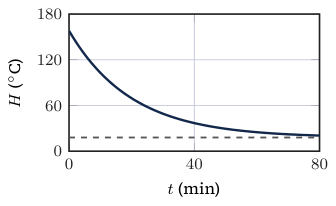
Marek leaves a hot metal bar to cool in a workshop kept at 18^{\circ}C. Its temperature after t minutes is modelled by
H(t) = 18 + 140 \, e^{-0.05t}
in degrees Celsius.
(a) Find the initial temperature of the bar.
[2]
(b) Find the temperature of the bar after 30 minutes.
[2]
(c) State the temperature that the bar approaches after a long time, and explain why.
[3]
(d) Use your GDC to find how long it takes for the bar to cool to 50^{\circ}C.
[3]
(e) On the axes below, the horizontal asymptote of H(t) is shown as a dashed line. State the equation of this asymptote.
Original Photon diagram
[2]
Show solutionHide solution
(a) H(0)=18+140e^0 [1] =158^\circC.
[1]
(b) H(30)=18+140e^{-1.5} [1] =49.2^\circC.
[1]
(c) e^{-0.05t}\to0 [1], so H\to18^\circC [1], the workshop temperature. The model approaches this temperature from above without reaching it at finite time.
[1]
(d) 18+140e^{-0.05t}=50 [1], hence e^{-0.05t}=32/140 [1] and t=29.5 minutes.
[1]
(e) The limiting value is 18 [1], so the horizontal asymptote is H=18.
[1]

Final answer

(a) 158^\circC. (b) 49.2^\circC. (c) Approaches 18^\circC as the exponential term tends to zero. (d) 29.5 min. (e) H=18.

Question 22

[10 marks]
Dr Sara models a radioactive tracer used in medical imaging decays so that the amount remaining after t hours is A(t) = 50 \times (0.5)^{\frac{t}{6}} milligrams.
(a) State the initial amount of tracer.
[1]
(b) Show that the half-life of the tracer is 6 hours.
[2]
(c) Find the amount remaining after 18 hours.
[3]
(d) Use your GDC to find the time, to the nearest hour, at which only 5 mg remains.
[2]
(e) Explain what happens to A(t) as t \to \infty.
[2]
Show solutionHide solution
(a) A(0) = 50 \times (0.5)^{0} = 50 mg.
[1]
(b) At t = 6: A(6) = 50 \times (0.5)^{\frac{6}{6}} = 50 \times 0.5 = 25 mg, which is half of 50 mg, so the half-life is 6 hours.
[2]
(c) A(18) = 50 \times (0.5)^{\frac{18}{6}} = 50 \times (0.5)^{3} = 50 \times 0.125 = 6.25 mg.
[3]
(d) Solve 50 \times (0.5)^{\frac{t}{6}} = 5. Using a GDC, t = 19.93 hours \approx 20 hours.
[2]
(e) As t \to \infty, (0.5)^{\frac{t}{6}} \to 0, so A(t) \to 0: the amount of tracer approaches zero but never reaches it.
[2]

Final answer

(a) 50 mg. (b) A(6)=25 mg. (c) 6.25 mg. (d) 20 h. (e) Tends to zero without reaching it.

Question 23

[10 marks]
Astronomer Noor measures the apparent brightness of stars using the magnitude scale. If two stars have apparent magnitudes m_1 and m_2, the ratio of their brightnesses b_1 and b_2 satisfies
m_1 - m_2 = -2.5\log_{10}\left(\dfrac{b_1}{b_2}\right).
A smaller magnitude means a brighter star.
(a) Star A has magnitude 2.1 and Star B has magnitude 5.6. Show that Star A is about 25 times brighter than Star B.
[3]
(b) A telescope can just detect stars as faint as magnitude 12.5. The faintest star visible to the unaided eye has magnitude 6.0. Find how many times fainter the telescope's limit is than the unaided-eye limit.
[3]
(c) A variable star changes brightness so that at its brightest it is 4.0 times as bright as at its faintest. Find the difference between its faintest and brightest magnitudes, correct to two decimal places.
[4]
Show solutionHide solution
(a) m_A - m_B = 2.1 - 5.6 = -3.5. So -3.5 = -2.5\log_{10}\left(\dfrac{b_A}{b_B}\right), giving \log_{10}\left(\dfrac{b_A}{b_B}\right) = 1.4.
Then \dfrac{b_A}{b_B} = 10^{1.4} = 25.1 \approx 25. Star A is about 25 times brighter.
[3]
(b) Magnitude difference = 12.5 - 6.0 = 6.5. Here 6.5 = -2.5\log_{10}\left(\dfrac{b_{\text{tel}}}{b_{\text{eye}}}\right), so \log_{10}\left(\dfrac{b_{\text{tel}}}{b_{\text{eye}}}\right) = -2.6.
Thus \dfrac{b_{\text{eye}}}{b_{\text{tel}}} = 10^{2.6} = 398. The telescope's limit is about 398 times fainter.
[3]
(c) With \dfrac{b_{\text{bright}}}{b_{\text{faint}}} = 4.0, the magnitude difference is
m_{\text{faint}} - m_{\text{bright}} = 2.5\log_{10}(4.0) = 2.5\times 0.6021 = 1.51.
The faintest magnitude is 1.51 greater than the brightest.
[4]

Final answer

(a) 25.1 times. (b) 398 times fainter. (c) 1.51.

Question 24

[11 marks]
Researcher Yara believes the surface area A (in cm^2) of a species of leaf is related to its length x (in cm) by a power law A = k x^{n}. She records the data below.
x (cm)1491625
A (cm^2)3.06.09.012.015.0
(a) By taking logarithms of A = kx^{n}, show that \log_{10} A is a linear function of \log_{10} x, and state the gradient and the vertical intercept in terms of n and k.
[3]
(b) Complete a table of values of \log_{10} x and \log_{10} A for the five data points (three significant figures).
[2]
(c) Using your GDC, find the equation of the least-squares regression line of \log_{10} A on \log_{10} x.
[2]
(d) Hence find the values of k and n, correct to two significant figures.
[3]
(e) Use your model to estimate the surface area of a leaf of length 36 cm.
[1]
Show solutionHide solution
(a) \log_{10}A=\log_{10}k+n\log_{10}x [1]; gradient n [1], intercept \log_{10}k [1].
(b) To 3 significant figures, \log_{10}x: 0,0.602,0.954,1.20,1.40 [1]; \log_{10}A: 0.477,0.778,0.954,1.08,1.18 [1]. Store full values for regression.
(c) Using the unrounded transformed data, gradient 0.500 [1], intercept 0.477 [1]: \log_{10}A=0.500\log_{10}x+0.477.
(d) The stored gradient is exactly 1/2, so n=0.50 [1]. The stored intercept is \log_{10}3 [1], giving k=3.0 [1].
(e) A=3\sqrt{36}=18 cm^2 [1]. This extrapolates beyond the measured leaf lengths.

Final answer

(a) \log_{10}A=\log_{10}k+n\log_{10}x. (b) \log_{10}x: 0,.602,.954,1.20,1.40; \log_{10}A: .477,.778,.954,1.08,1.18. (c) \log_{10}A=.500\log_{10}x+.477. (d) n=.50, k=3.0. (e) 18 cm^2.

Question 25

[8 marks]
Mina checks a dimensionless sensor calibration and a sprinkler model.
(a) The calibration y=\ln(x-a)+b passes through (3,2) and (7,2+\ln5). Find a,b.
[4]
(b) Her sprinkler radius R metres is modelled by R=kP^xd^y, where P is pressure in bar and d nozzle diameter in mm. Tests give (P,d,R)=(4,1,4),(9,1,6),(4,16,2). By taking logarithms, find x,y,k.
[4]
Show solutionHide solution
(a) Subtracting the two point equations gives \ln(7-a)-\ln(3-a)=\ln5. [M1] Therefore \ln((7-a)/(3-a))=\ln5. [M1] Hence 7-a=5(3-a), so a=2. [A1] Substitution gives b=2-\ln1=2. [A1] Both original arguments are positive.
(b) \ln R=\ln k+x\ln P+y\ln d. [M1] Subtract the first trial from the second: x=\ln(6/4)/\ln(9/4)=1/2. [A1] The third and first give y=\ln(2/4)/\ln16=-1/4. [A1] Then k=4/4^{1/2}=2. [A1] Thus the model is R=2P^{1/2}d^{-1/4} metres in the specified units. The three trials all check, but the fit alone does not explain the pressure or nozzle physics.

Final answer

(a) a=2, b=2. (b) x=0.5, y=-0.25, k=2.

Question 26

[15 marks]
Kiran launches a fitness app. Users U, in thousands, are modelled by U=ae^{bt}, t weeks after launch. The graph of \ln U against t passes through (2,2.65) and (10,4.25).
(a) Find the line's gradient and vertical intercept.
[2]
(b) Hence find a,b.
[3]
(c) Predict the number of users after 15 weeks.
[1]
(d) Use logarithms to find when users reach 500 thousand.
[3]
Kiran defines a dimensionless server-load index S=10\log_{10}U.
(e) Show that S is linear in t. Find its gradient and intercept.
[3]
(f) Find the first whole week with S>25.
[2]
(g) Give one reason the model may fail for large t.
[1]
Show solutionHide solution
(a) m=(4.25-2.65)/(10-2)=0.2. [A1] c=2.65-0.2(2)=2.25. [A1]
(b) U=e^{0.2t+2.25}=e^{2.25}e^{0.2t}. [M1] a=e^{2.25}=9.49 [A1], b=0.2 week^{-1} [A1].
(c) Using the exact coefficient, U(15)=e^{5.25}=191 thousand users. [A1]
(d) e^{0.2t+2.25}=500 [M1], so 0.2t+2.25=\ln500 [M1], giving t=(\ln500-2.25)/0.2=19.8 weeks [A1].
(e) S=10\log_{10}(e^{2.25+0.2t}) [M1] =10(2.25+0.2t)\log_{10}e [M1]. Thus S=9.77+0.869t to 3 significant figures, a linear function [A1].
(f) Using the unrounded coefficients, t>17.53\ldots; S(17)=24.54\ldots, S(18)=25.41\ldots. [M1] The first whole week is week 18. [A1]
(g) The number of potential users is finite, so indefinite exponential growth is unrealistic. [R1]

Final answer

(a) m=0.2, c=2.25. (b) a=9.49, b=0.2 week^{-1}. (c) 191 thousand. (d) 19.8 weeks. (e) S=9.77+0.869t. (f) Week 18. (g) Finite potential users.

Going further

Beyond the syllabus: the worked examples and investigations of the chapter's Going further pages.

G0 Worked

[4 marks]
Uma measures two independent sources at 72 dB and 78 dB at the same position. Their intensities add. Find the combined sound level.
[4]
Show solutionHide solution
Relative to I_0, the intensities are 10^{7.2} and 10^{7.8}. [M1 A1] Their sum is 10^{7.2}+10^{7.8}. [M1] Hence the combined level is 10\log_{10}(10^{7.2}+10^{7.8})=79.0 dB. [A1] It exceeds 78 dB but is far below the sum of the levels; this assumes the stated additive-intensity model.

Final answer

79.0 dB.

G1 Investigation

[16 marks]
Workshop manager Ada measures one machine at 82 dB at a worker's position. Intensities from independent sources add. Use L=10\log_{10}(I/I_0).
(a) Show that two identical machines give 85.0 dB. Generalise to n machines, showing L=82+10\log_{10}n.
[5]
(b) Ada chooses a modelled operating ceiling of 90 dB. Find the greatest number of these machines that can run together.
[2]
(c) Assume one machine has intensity I=k/d^2 at distance d metres. Show that moving from d_1 to d_2 lowers the level by 20\log_{10}(d_2/d_1) dB. Hence find the distance at which a machine measuring 82 dB at 1 m gives 70 dB.
[5]
(d) A worker is 2 m from each of four machines, each measuring 82 dB at 1 m. Show that the total level at the worker is 82 dB.
[3]
(e) State one assumption that could fail in a real workshop.
[1]
Show solutionHide solution
(a) One intensity is I_0 10^{8.2}, so two give 2I_0 10^{8.2} [M1], with level 10\log_{10}(2\times10^{8.2})=85.0 dB [A1]. For n sources, I=nI_0 10^{8.2} [M1]; the product law gives 10\log_{10}(n10^{8.2})=10\log_{10}n+82 [M1 A1].
(b) 82+10\log_{10}n\le90, so n\le10^{0.8}=6.31\ldots [M1]. At most 6 machines [A1]: 6 give 89.8 dB, while 7 give 90.5 dB.
(c) I_1/I_2=(d_2/d_1)^2 [M1], hence L_1-L_2=10\log_{10}(I_1/I_2) [M1] =20\log_{10}(d_2/d_1) [A1]. For the specified machine, 82-20\log_{10}d=70 [M1], so d=10^{0.6}=3.98 m [A1].
(d) Doubling distance divides each intensity by 4 [M1]; four such intensities sum to the original one-machine intensity [M1]. Equivalently 82-20\log_{10}2+10\log_{10}4=82 dB [A1].
(e) For example, no sound is reflected or absorbed; alternatively sources have independent additive intensities or equal output. Real room acoustics can violate these assumptions. [R1]

Final answer

(a) 85.0 dB; 82+10\log_{10}n. (b) 6 machines. (c) 20\log_{10}(d_2/d_1) dB; 3.98 m. (d) 82 dB. (e) e.g. no echoes.

From the book

Photon Guidebook: Mathematics Applications and Interpretation HL for the IB Diploma

Chapter 3 teaches exponents and logarithms from the basics to full exam questions: how the IB asks it, every question type with a marked example, and these practice questions in three steps.

About the book