Free worked solutions · 2026 Edition

IB Maths HL Paper 3 Chapter 8: Probability models and generating functions worked solutions

Worked solutions to the investigations in Chapter 8 of Photon Guidebook: Mathematics HL Paper 3 for the IB Diploma (2026 Edition). Each solution shows every step with the mark it earns, the way an IB mark scheme does.

  • Chapter 8 of 18
  • 8 practice questions
  • 2 Going further
  • Free, no sign-up

Investigations

The practice investigations of the chapter, each with its full worked solution and mark scheme.

Investigation 1

[16 marks]
This question asks you to find the averages of a continuous random variable.
Original Photon diagram
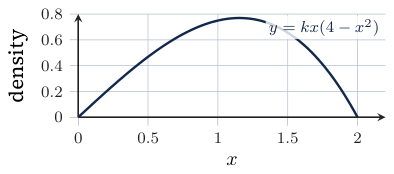
The time, in hours, that a battery in a test rig lasts beyond its warranty is modelled by a continuous random variable X whose density is kx(4 - x^2) on the interval 0 \le x \le 2 and zero elsewhere.
(a) Find the value of the constant k.
[2]
(b) Find the mode of X.
[3]
(c) Find \mathrm{E}(X) and \mathrm{Var}(X).
[5]
(d) Show that the median m satisfies m^4 - 8m^2 + 8 = 0, and hence find the exact value of m.
[4]
(e) Use your answers to describe the skewness of the distribution.
[2]
Show solutionHide solution
(a) The total area is 1: \displaystyle\int_0^2kx(4-x^2)\,\mathrm{d}x=k\left[2x^2-\tfrac{x^4}4\right]_0^2=4k (M1), so k=\tfrac14 (A1).
(b) The mode is where the density is greatest. f(x)=\tfrac14(4x-x^3) and f'(x)=\tfrac14(4-3x^2) (M1), which is zero at x=\tfrac2{\sqrt3} (A1). The sign of f' changes from positive to negative there, so it is a maximum, 1.15 (R1).
(c) \mathrm{E}(X)=\tfrac14\displaystyle\int_0^2(4x^2-x^4)\,\mathrm{d}x (M1) =\tfrac14\left[\tfrac{4x^3}3-\tfrac{x^5}5\right]_0^2=\tfrac14\cdot\tfrac{64}{15}=\tfrac{16}{15} (A1). \mathrm{E}(X^2)=\tfrac14\displaystyle\int_0^2(4x^3-x^5)\,\mathrm{d}x (M1) =\tfrac14\left[x^4-\tfrac{x^6}6\right]_0^2=\tfrac43 (A1). \mathrm{Var}(X)=\tfrac43-\left(\tfrac{16}{15}\right)^2=\tfrac{44}{225}=0.196 (A1).
(d) \displaystyle\int_0^m\tfrac14(4x-x^3)\,\mathrm{d}x=\tfrac14\left(2m^2-\tfrac{m^4}4\right) (M1) =\tfrac12 (A1) gives 2m^2-\tfrac{m^4}4=2, that is m^4-8m^2+8=0 (AG). Then m^2=\dfrac{8\pm\sqrt{32}}2=4\pm2\sqrt2 (M1). Since m<2, m^2=4-2\sqrt2 and m=\sqrt{4-2\sqrt2}=1.08 (A1).
(e) Mean 1.07< median 1.08< mode 1.15 (A1). The tail is on the left, so the distribution is negatively skewed (A1).

Final answer

A curved probability density. (a) k=\tfrac14. (b) \tfrac2{\sqrt3}=1.15. (c) \tfrac{16}{15}=1.07, \tfrac{44}{225}=0.196. (d) m=\sqrt{4-2\sqrt2}=1.08. (e) Mean < median < mode: negatively skewed.
Investigation 2

[16 marks]
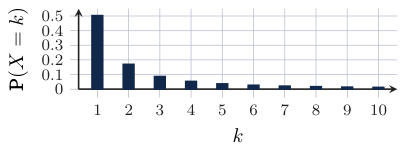
This question asks you to find whether a first success is more likely to come on an odd or an even attempt.
Original Photon diagram
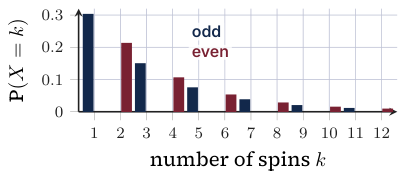
A spinner lands on green with probability 0.3 on each spin, independently. Priya spins until it first lands on green. Let X be the number of spins.
(a) Write down \mathrm{P}(X = k), and find \mathrm{P}(X = 3).
[2]
(b) Show that \mathrm{P}(X \text{ is even}) = \dfrac{7}{17}.
[4]
(c) Find \mathrm{P}(X \text{ is odd}), and the ratio \mathrm{P}(X \text{ is odd}) : \mathrm{P}(X \text{ is even}) in its simplest form.
[2]
(d) For a spinner that lands on green with probability p, show that \mathrm{P}(X \text{ is even}) = \dfrac{1 - p}{2 - p}.
[3]
(e) Find the value of p for which \mathrm{P}(X \text{ is even}) = 0.4.
[3]
(f) Show that \mathrm{P}(X \text{ is even}) < \frac{1}{2} for every p with 0 < p \le 1, and explain this in terms of the first spin.
[2]
Show solutionHide solution
(a) \mathrm{P}(X=k)=0.7^{k-1}\times0.3 (A1). \mathrm{P}(X=3)=0.7^2\times0.3=0.147 (A1).
(b) X is even for k=2,4,6,\dots (M1), so \mathrm{P}=0.7\times0.3+0.7^3\times0.3+0.7^5\times0.3+\dots (A1). This is geometric with first term 0.21 and ratio 0.7^2=0.49 (M1), so \mathrm{P}=\dfrac{0.21}{1-0.49}=\dfrac{0.21}{0.51} (A1) =\dfrac7{17} (AG).
(c) \mathrm{P}(X\text{ is odd})=1-\tfrac7{17}=\tfrac{10}{17}=0.588 (A1). The ratio is 10:7 (A1).
(d) \mathrm{P}(X\text{ is even})=\displaystyle\sum_{j=1}^{\infty}(1-p)^{2j-1}p (M1), geometric with first term p(1-p) and ratio (1-p)^2 (A1), so the sum is \dfrac{p(1-p)}{1-(1-p)^2}=\dfrac{p(1-p)}{p(2-p)} (A1) =\dfrac{1-p}{2-p} (AG).
(e) \dfrac{1-p}{2-p}=0.4 (M1) gives 1-p=0.8-0.4p (A1), so p=\tfrac13 (A1).
(f) \tfrac12-\dfrac{1-p}{2-p}=\dfrac{(2-p)-2(1-p)}{2(2-p)}=\dfrac{p}{2(2-p)}>0 (A1). Each odd value 2j-1 comes just before the even value 2j and is more likely, because the game can end on the spin before (R1).

Final answer

Even or odd. (a) 0.7^{k-1}(0.3), 0.147. (b) \tfrac{0.21}{0.51}=\tfrac7{17}. (c) \tfrac{10}{17}=0.588, 10:7. (d) \tfrac{p(1-p)}{1-(1-p)^2}. (e) p=\tfrac13. (f) \tfrac12-\tfrac{1-p}{2-p}=\tfrac{p}{2(2-p)}>0.

Investigation 3

[20 marks]
This question asks you to compare two old dice bets and to find who is favoured when two players take turns.
Original Photon diagram
Two fair dice are thrown together repeatedly until a double six appears. Let X be the number of throws needed.
(a) Write down the distribution of X and find \mathrm{E}(X).
[2]
(b) Find the least n for which \mathrm{P}(X \le n) > 0.5.
[4]
(c) A gambler bets either on getting at least one six in 4 throws of one die, or on getting at least one double six in 24 throws of two dice. Find both probabilities and state which bet is better.
[4]
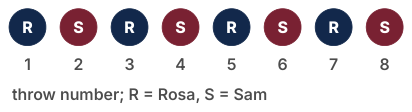
(d) Rosa and Sam take turns to throw the two dice, Rosa first. The first to throw a double six wins. Show that the probability that Rosa wins is \dfrac{36}{71}.
[5]
(e) Find the probability that the game lasts more than 10 throws in total.
[2]
(f) Explain why Rosa's advantage is small, and how it would change if a single six were needed instead.
[3]
Show solutionHide solution
(a) \mathrm{P}(X=k)=\left(\tfrac{35}{36}\right)^{k-1}\tfrac1{36}, a geometric distribution with p=\tfrac1{36} (A1). \mathrm{E}(X)=36 (A1).
(b) \mathrm{P}(X\le n)=1-\left(\tfrac{35}{36}\right)^n>0.5 (M1), so \left(\tfrac{35}{36}\right)^n<0.5 (A1). Take logarithms and divide by \ln\tfrac{35}{36}, which is negative, so the inequality reverses: n>\dfrac{\ln0.5}{\ln(35/36)}=24.6 (M1). The least n is 25 (A1).
(c) Use the complement (M1). One die: 1-\left(\tfrac56\right)^4=0.518 (A1). Two dice: 1-\left(\tfrac{35}{36}\right)^{24}=0.491 (A1). The first bet is better (A1).
(d) Rosa wins on throw 2k+1, for k=0,1,2,\dots, when the first 2k throws have no double six (M1). That has probability \left(\tfrac{35}{36}\right)^{2k}\tfrac1{36} (A1). The sum is geometric with first term \tfrac1{36} and ratio \left(\tfrac{35}{36}\right)^2=\tfrac{1225}{1296} (M1). Since |r|<1 it converges (R1), to \dfrac{1/36}{1-1225/1296}=\dfrac{1/36}{71/1296} (A1) =\dfrac{36}{71} (AG).
(e) The game lasts more than 10 throws if the first 10 have no double six: \left(\tfrac{35}{36}\right)^{10} (M1) =0.754 (A1).
(f) In general \mathrm{P}(\text{Rosa wins})=\dfrac{p}{1-(1-p)^2}=\dfrac1{2-p} (A1). For p=\tfrac1{36} this is \tfrac{36}{71}=0.507, only just above \tfrac12, because the first throw is worth little when a double six is so rare (R1). With a single six, p=\tfrac16 and the probability is \tfrac6{11}=0.545, a larger advantage (A1).

Final answer

Waiting for a double six. (a) Geometric, p=\tfrac1{36}; 36. (b) 25. (c) 0.518, 0.491; the first. (d) \tfrac{1/36}{71/1296}=\tfrac{36}{71}. (e) 0.754. (f) \tfrac1{2-p}; \tfrac6{11}=0.545.

Investigation 4

[20 marks]
This question asks you to study a distribution whose mean does not exist, and the capped version that does.
Original Photon diagram
A discrete random variable X takes the values 1, 2, 3, \dots with \mathrm{P}(X = k) = \dfrac{1}{k(k + 1)}.
(a) Show that \displaystyle\sum_{k=1}^{n} \mathrm{P}(X = k) = 1 - \dfrac{1}{n + 1}, and deduce that the probabilities add to 1.
[4]
(b) Find \mathrm{P}(X > n) and hence the least value of n for which \mathrm{P}(X > n) < 0.01.
[3]
(c) Given that X > 3, find the probability that X = 5.
[3]
(d) Show that \displaystyle\sum_{k=1}^{n} \frac{1}{k + 1} > \ln\!\left(\frac{n + 2}{2}\right) by comparing each term with an area under y = \dfrac{1}{x}, and deduce that \mathrm{E}(X) does not exist.
[4]
(e) A game stops after 10 rounds if it has not ended before. Let Y = X if X \le 10 and Y = 10 otherwise. Find \mathrm{E}(Y).
[4]
(f) Explain why the capped model in (e) is more realistic than the original, and comment on the effect of changing the cap on \mathrm{E}(Y).
[2]
Show solutionHide solution
(a) \dfrac1{k(k+1)}=\dfrac1k-\dfrac1{k+1} (M1). The sum is \left(1-\tfrac12\right)+\left(\tfrac12-\tfrac13\right)+\dots+\left(\tfrac1n-\tfrac1{n+1}\right) (A1), and consecutive terms cancel, leaving 1-\dfrac1{n+1} (AG). As n\to\infty this tends to 1 (A1), so the probabilities add to 1 (R1).
(b) \mathrm{P}(X>n)=1-\left(1-\dfrac1{n+1}\right) (M1) =\dfrac1{n+1} (A1). \dfrac1{n+1}<0.01 needs n+1>100, so the least n is 100 (A1).
(c) \mathrm{P}(X=5\mid X>3)=\dfrac{\mathrm{P}(X=5)}{\mathrm{P}(X>3)} (M1) =\dfrac{1/30}{1/4} (A1) =\dfrac2{15}=0.133 (A1).
(d) The graph of y=\tfrac1x is decreasing, so on [k+1,k+2] it lies below \tfrac1{k+1} and \tfrac1{k+1}>\displaystyle\int_{k+1}^{k+2}\dfrac{\mathrm{d}x}x (M1 A1). Adding for k=1,\dots,n gives \displaystyle\sum_{k=1}^n\tfrac1{k+1}>\int_2^{n+2}\dfrac{\mathrm{d}x}x=\ln\dfrac{n+2}2 (A1). Now \mathrm{E}(X)=\sum k\cdot\dfrac1{k(k+1)}=\sum\dfrac1{k+1}, which exceeds \ln\dfrac{n+2}2, and that grows without bound, so the series diverges and \mathrm{E}(X) does not exist (R1).
(e) \mathrm{E}(Y)=\displaystyle\sum_{k=1}^{9}k\cdot\dfrac1{k(k+1)}+10\,\mathrm{P}(X\ge10) (M1), with \mathrm{P}(X\ge10)=\mathrm{P}(X>9)=\tfrac1{10} (A1). So \mathrm{E}(Y)=\displaystyle\sum_{k=1}^{9}\dfrac1{k+1}+1 (M1) =\left(\tfrac12+\tfrac13+\dots+\tfrac1{10}\right)+1=2.93 (A1).
(f) A real game has a last round, so a cap is realistic and gives a finite mean (A1). With a cap of N rounds the mean is 1+\tfrac12+\dots+\tfrac1N, which grows slowly: doubling the cap from 10 to 20 only raises it from 2.93 to 3.60 (A1).

Final answer

A heavy tail. (a) \tfrac1k-\tfrac1{k+1}, telescoping. (b) \tfrac1{n+1}; n=100. (c) \tfrac2{15}=0.133. (d) \tfrac1{k+1}>\int_{k+1}^{k+2}\tfrac{dx}x; the series diverges. (e) 2.93. (f) A cap of N gives 1+\tfrac12+\dots+\tfrac1N.

Investigation 5

[20 marks]
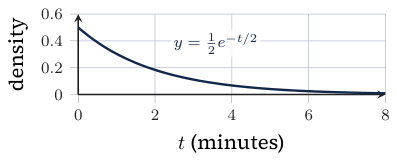
This question asks you to find the averages of a waiting time that has no memory, and to compare it with a discrete one.
Original Photon diagram
The waiting time T, in minutes, for a lift is modelled by a continuous random variable with density f(t) = \tfrac{1}{2}e^{-t/2} for t \ge 0, and 0 otherwise. You may use the fact that b\,e^{-b/2} \to 0 and e^{-b/2} \to 0 as b \to \infty.
(a) Show that f is a valid density function.
[3]
(b) Find \mathrm{P}(T > s) for s \ge 0, and evaluate \mathrm{P}(T > 3).
[3]
(c) Show that \mathrm{P}(T > s + t \mid T > s) = \mathrm{P}(T > t) for s, t \ge 0, and say in words what this means.
[3]
(d) Find the median waiting time.
[3]
(e) Use integration by parts to show that \mathrm{E}(T) = 2.
[5]
(f) A discrete variable X with \mathrm{P}(X > n) = q^n counts the trials needed for a first success. Show that \mathrm{P}(X > n + m \mid X > n) = \mathrm{P}(X > m).
[3]
Show solutionHide solution
(a) f(t)\ge0 for every t (R1). \displaystyle\int_0^b\tfrac12e^{-t/2}\,\mathrm{d}t=\bigl[-e^{-t/2}\bigr]_0^b=1-e^{-b/2} (M1). As b\to\infty this tends to 1 (A1).
(b) \mathrm{P}(T>s)=\displaystyle\lim_{b\to\infty}\bigl[-e^{-t/2}\bigr]_s^b (M1) =e^{-s/2} (A1). \mathrm{P}(T>3)=e^{-1.5}=0.223 (A1).
(c) \mathrm{P}(T>s+t\mid T>s)=\dfrac{\mathrm{P}(T>s+t)}{\mathrm{P}(T>s)} (M1) =\dfrac{e^{-(s+t)/2}}{e^{-s/2}}=e^{-t/2}=\mathrm{P}(T>t) (A1). Having already waited s minutes tells you nothing: the remaining wait has the same distribution as a new wait (R1).
(d) The median m has \mathrm{P}(T>m)=\tfrac12 (M1), so e^{-m/2}=\tfrac12 (A1) and m=2\ln2=1.39 minutes (A1).
(e) \mathrm{E}(T)=\displaystyle\int_0^\infty t\cdot\tfrac12e^{-t/2}\,\mathrm{d}t (M1). By parts with u=t and v'=\tfrac12e^{-t/2}, so v=-e^{-t/2} (M1): \displaystyle\int_0^b=\bigl[-te^{-t/2}\bigr]_0^b+\int_0^be^{-t/2}\,\mathrm{d}t (A1) =-be^{-b/2}+2-2e^{-b/2} (A1). As b\to\infty this tends to 2 (A1).
(f) \mathrm{P}(X>n+m\mid X>n)=\dfrac{\mathrm{P}(X>n+m)}{\mathrm{P}(X>n)} (M1) =\dfrac{q^{n+m}}{q^n} (A1) =q^m=\mathrm{P}(X>m) (A1).

Final answer

No memory. (a) 1-e^{-b/2}\to1. (b) e^{-s/2}; e^{-1.5}=0.223. (c) \tfrac{e^{-(s+t)/2}}{e^{-s/2}}=e^{-t/2}; the wait has no memory. (d) 2\ln2=1.39. (e) 2. (f) \tfrac{q^{n+m}}{q^n}=q^m.

Investigation 6

[22 marks]
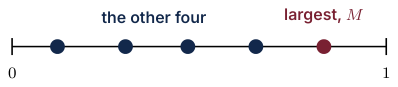
This question asks you to find the distribution of the largest of several numbers chosen at random.
Original Photon diagram
Each of n numbers is chosen independently and at random from the interval [0, 1], all values being equally likely. Let M be the largest of the n numbers.
(a) Show that \mathrm{P}(M \le x) = x^n for 0 \le x \le 1.
[3]
(b) Hence find the density function of M, and show that \mathrm{E}(M) = \dfrac{n}{n + 1}.
[4]
(c) Show that \mathrm{Var}(M) = \dfrac{n}{(n + 1)^2 (n + 2)}.
[4]
(d) Find the median of M when n = 5.
[3]
(e) Find the least value of n for which \mathrm{P}(M > 0.95) > 0.9.
[3]
(f) Describe what happens to the mean and the variance of M as n becomes large, and explain this in words.
[2]
(g) Let L be the smallest of the n numbers. Given that \mathrm{P}(L > x) = (1 - x)^n, find \mathrm{E}(M - L).
[3]
Show solutionHide solution
(a) M\le x exactly when every one of the n numbers is at most x (M1). Each is at most x with probability x, for 0\le x\le1 (A1), and the numbers are independent, so the probability is x^n (A1).
(b) The density is \dfrac{\mathrm{d}}{\mathrm{d}x}x^n=nx^{n-1} on [0,1] (M1 A1). \mathrm{E}(M)=\displaystyle\int_0^1x\cdot nx^{n-1}\,\mathrm{d}x=\int_0^1nx^n\,\mathrm{d}x (M1) =\dfrac n{n+1} (A1).
(c) \mathrm{E}(M^2)=\displaystyle\int_0^1nx^{n+1}\,\mathrm{d}x=\dfrac n{n+2} (M1 A1). \mathrm{Var}(M)=\dfrac n{n+2}-\dfrac{n^2}{(n+1)^2} (M1) =\dfrac{n(n+1)^2-n^2(n+2)}{(n+2)(n+1)^2}=\dfrac n{(n+1)^2(n+2)} (A1).
(d) The median m has m^5=\tfrac12 (M1 A1), so m=2^{-1/5}=0.871 (A1).
(e) \mathrm{P}(M>0.95)=1-0.95^n>0.9 gives 0.95^n<0.1 (M1). Taking logarithms and dividing by \ln0.95<0 reverses the inequality: n>\dfrac{\ln0.1}{\ln0.95}=44.9 (M1), so n=45 (A1).
(f) The mean \dfrac n{n+1} tends to 1 and the variance tends to 0 (A1). With many numbers, the largest is almost certainly very close to 1 (R1).
(g) L has density n(1-x)^{n-1} (M1), so \mathrm{E}(L)=\displaystyle\int_0^1xn(1-x)^{n-1}\,\mathrm{d}x=\dfrac1{n+1} (A1). \mathrm{E}(M-L)=\dfrac n{n+1}-\dfrac1{n+1}=\dfrac{n-1}{n+1} (A1).

Final answer

The largest of n numbers. (a) x^n. (b) nx^{n-1}; \tfrac n{n+1}. (c) \tfrac n{n+2}-\tfrac{n^2}{(n+1)^2}. (d) 2^{-1/5}=0.871. (e) n=45. (f) Mean to 1, variance to 0. (g) \tfrac{n-1}{n+1}.

Investigation 7

[25 marks]
This question asks you to find the probability that the pieces of a randomly broken stick form a triangle.
Original Photon diagram
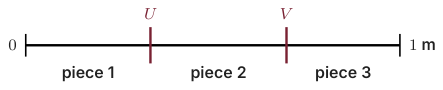
A stick of length 1 metre is broken into three pieces.
(a) Explain why the three pieces form a triangle if and only if every piece is shorter than 0.5 m.
[2]
In method 1, two points are chosen independently and uniformly along the stick, and it is broken at both. Let the points be at distances U and V from the left end.
(b) Show, by shading a suitable region of the unit square, that the probability that the pieces form a triangle is \dfrac{1}{4}.
[6]
In method 2, the stick is broken at a point X chosen uniformly, and then the longer piece is broken at a point chosen uniformly along it.
(c) Given X = x, where x < \frac{1}{2}, show that the probability that the pieces form a triangle is \dfrac{x}{1 - x}.
[5]
(d) Hence show that the probability for method 2 is 2\ln 2 - 1.
[5]
(e) Find the expected length of the longer piece after the first break in method 2.
[3]
(f) Explain why method 2 is more likely to give a triangle than method 1.
[2]
(g) Describe how you could check your answer to (d) with a simulation.
[2]
Show solutionHide solution
(a) Let the pieces be a, b, c with a+b+c=1. A triangle needs each piece shorter than the sum of the other two (M1): a<b+c=1-a gives a<\tfrac12, and the same for b and c. Conversely, if all three are below \tfrac12, each is below the sum of the other two, so a triangle exists (R1).
(b) (U,V) is uniform over the unit square, so the probability is the area of the region (R1). If U<V the pieces are U, V-U, 1-V (M1), and all three below \tfrac12 means U<\tfrac12, V>\tfrac12 and V-U<\tfrac12 (A1). This is the triangle with vertices \left(0,\tfrac12\right), \left(\tfrac12,\tfrac12\right), \left(\tfrac12,1\right) (A1), of area \tfrac12\times\tfrac12\times\tfrac12=\tfrac18 (M1). The region with U>V is its reflection in the line V=U, with the same area (R1). The total is \tfrac18+\tfrac18=\tfrac14 (AG).
(c) Given X=x<\tfrac12, the longer piece has length 1-x and the second break is at Y, uniform on (0,1-x). The pieces are x, Y and 1-x-Y (M1). The first is below \tfrac12 already. Y<\tfrac12 (A1) and 1-x-Y<\tfrac12, that is Y>\tfrac12-x (A1). Since x<\tfrac12, we have \tfrac12<1-x, so the interval \left(\tfrac12-x,\tfrac12\right) lies inside (0,1-x) (R1). It has length x, so the probability is the ratio of lengths \dfrac x{1-x} (M1) (AG).
(d) X and 1-X have the same distribution, so the cases x>\tfrac12 give the same contribution as x<\tfrac12 (R1). With density 1, \mathrm{P}=2\displaystyle\int_0^{1/2}\dfrac x{1-x}\,\mathrm{d}x (M1). Write \dfrac x{1-x}=-1+\dfrac1{1-x} (M1). Then \displaystyle\int_0^{1/2}\left(-1+\dfrac1{1-x}\right)\mathrm{d}x=\bigl[-x-\ln(1-x)\bigr]_0^{1/2} (A1) =-\tfrac12+\ln2 (A1). Doubling gives 2\ln2-1=0.386 (AG).
(e) The longer piece is \max(X,1-X), and by symmetry \mathrm{E}=2\displaystyle\int_{1/2}^1x\,\mathrm{d}x (M1) =\bigl[x^2\bigr]_{1/2}^1 (A1) =1-\tfrac14=\tfrac34 (A1).
(f) In method 2 the second break only ever cuts the longer piece, so the shorter piece from the first break, which is at most \tfrac12, is never cut again and cannot spoil the triangle (R1). Method 1 can fail in more ways, and 0.386>0.25 (A1).
(g) Generate a random x in (0,1) and then a random point along the longer piece, many times (M1). Record the proportion of trials in which all three pieces are below 0.5; it should settle near 0.386 (A1).

Final answer

Breaking a stick. (a) Each piece <\tfrac12. (b) Two triangles of area \tfrac18, total \tfrac14. (c) The second break must fall in an interval of length x out of 1-x. (d) 2\int_0^{1/2}\tfrac x{1-x}dx=2\ln2-1=0.386. (e) \tfrac34. (f) Method 2 never cuts the short piece again. (g) Simulate and count.

Investigation 8

[25 marks]
This question asks you to find how reliable a small network is, and how its reliability depends on the reliability of its parts.
Original Photon diagram
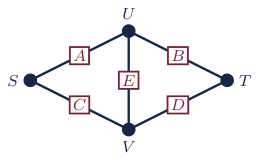
A signal travels from the left end S to the right end T of a network along working links. There are five links: A from S to U, B from U to T, C from S to V, D from V to T, and E between U and V, usable in either direction. Each link works with probability p, independently of the others, and the network works if a signal can get from S to T.
(a) Find, in terms of p, the probability that the route S \to U \to T works, and the probability that at least one of the two routes S \to U \to T and S \to V \to T works.
[3]
(b) Given that E works, show that the probability that the network works is (2p - p^2)^2.
[3]
(c) Show that the probability that the network works is R(p) = 2p^2 + 2p^3 - 5p^4 + 2p^5.
[5]
(d) Find R(0.9), and compare it with the probability 0.9 that a single link works.
[2]
(e) Show that R(p) - p = p(1 - p)(2p - 1)(1 + p - p^2), and hence find the values of p for which the network is more reliable than a single link.
[4]
(f) Find R'(\tfrac{1}{2}) and interpret it.
[3]
(g) Suppose p is itself unknown and uniformly distributed on [0, 1]. Find the probability that the network works.
[3]
(h) State one reason why the assumption that links fail independently may not hold in a real network.
[2]
Show solutionHide solution
(a) The route S\to U\to T needs A and B: p^2 (A1). The two routes use different links, so they are independent, and \mathrm{P}(\text{at least one})=1-(1-p^2)^2 (M1) =2p^2-p^4 (A1).
(b) If E works, U and V are joined, so the signal gets across if (A or C works) and (B or D works) (M1). Each pair works with probability 1-(1-p)^2=2p-p^2 (A1), and the two pairs are independent, so the product is (2p-p^2)^2 (A1).
(c) Condition on E (M1): R(p)=p\,\mathrm{P}(\text{works}\mid E\text{ works})+(1-p)\,\mathrm{P}(\text{works}\mid E\text{ fails}). The first probability is (2p-p^2)^2 from (b) (A1). If E fails the network is two parallel routes, 2p^2-p^4 from (a) (A1). So R(p)=p(2p-p^2)^2+(1-p)(2p^2-p^4) (M1). Expanding, p(2p-p^2)^2=4p^3-4p^4+p^5 and (1-p)(2p^2-p^4)=2p^2-2p^3-p^4+p^5 (A1), which add to 2p^2+2p^3-5p^4+2p^5 (AG).
(d) R(0.9)=0.978 (A1). A single link works with probability 0.9, so the network is more reliable: its failure probability is about 0.022 against 0.1 (A1).
(e) R(p)-p=p\left(2p^4-5p^3+2p^2+2p-1\right) (M1). The quartic is zero at p=1 and at p=\tfrac12, so (p-1)(2p-1) is a factor (A1), and the other factor is p^2-p-1 (A1). Since (p-1)(p^2-p-1)=(1-p)(1+p-p^2), this gives R(p)-p=p(1-p)(2p-1)(1+p-p^2) (AG). For 0<p<1 the factors p, 1-p and 1+p-p^2 are positive, so the sign is that of 2p-1 (R1): the network is more reliable than a single link exactly when \tfrac12<p<1.
(f) R'(p)=4p+6p^2-20p^3+10p^4 (M1), so R'\!\left(\tfrac12\right)=2+1.5-2.5+0.625=\tfrac{13}8 (A1). Near p=\tfrac12 a small change in the link reliability is magnified by a factor 1.625 in the reliability of the network (R1).
(g) \displaystyle\int_0^1R(p)\,\mathrm{d}p (M1) =\tfrac23+\tfrac12-1+\tfrac13 (A1) =\tfrac12 (A1).
(h) Links may share a power supply or be hit by the same storm, so one failure makes another more likely (A1). Then failures cluster, and the network works less often than R(p) says (R1).

Final answer

Five links in a bridge. (a) p^2; 2p^2-p^4. (b) \bigl(1-(1-p)^2\bigr)^2. (c) p(2p-p^2)^2+(1-p)(2p^2-p^4). (d) 0.978. (e) More reliable exactly when \tfrac12<p<1. (f) \tfrac{13}8. (g) \tfrac12. (h) Shared power or weather.

Going further

Beyond the syllabus: the worked examples and investigations of the chapter's Going further pages.

Investigation

[25 marks]
Worked investigation 1: Collecting the whole set.
This question asks you to find how many packets you expect to open to collect a full set of badges.
Each packet of a breakfast cereal contains one of 4 different badges, each equally likely, independently of other packets. Zainab opens packets until she has all 4 badges.
(a) Find the probability that her second packet contains a different badge from her first.
[1]
For 0 < p \le 1, a random variable Y with \mathrm{P}(Y = k) = (1 - p)^{k-1}p, k = 1, 2, 3, \dots, counts the trials needed for the first success.
(b) Show that these probabilities add to 1.
[2]
(c) By differentiating \displaystyle\sum_{k=0}^{\infty} x^k = \frac{1}{1 - x}, show that \mathrm{E}(Y) = \dfrac{1}{p}.
[4]
(d) Explain why the number of packets Zainab opens is the sum of four such variables, and find its expected value.
[3]
(e) Given that \mathrm{Var}(Y) = \dfrac{1 - p}{p^2}, find the standard deviation of the number of packets she opens.
[3]
(f) Find the probability that she collects all 4 badges in her first 4 packets.
[2]
(g) For a set of n badges, write down an expression for the expected number of packets, and evaluate it for n = 10, 20 and 50.
[4]
(h) Comment on how the expected number grows with n, and give one reason why the model may not fit a real promotion.
[2]
(i) Find the probability that Zainab has all 4 badges after opening 6 packets.
[4]
Show solutionHide solution
(a) \dfrac34 (A1).
(b) \displaystyle\sum_{k=1}^{\infty}(1-p)^{k-1}p is geometric: first term p, common ratio 1-p (M1); |1-p|<1, so the sum is \dfrac{p}{1-(1-p)}=1 (A1).
(c) \dfrac{\mathrm{d}}{\mathrm{d}x}\displaystyle\sum_{k=0}^{\infty}x^k=\sum_{k=1}^{\infty}kx^{k-1} (M1); \displaystyle\sum_{k=1}^{\infty}kx^{k-1}=\dfrac{1}{(1-x)^2} (A1); \mathrm{E}(Y)=\displaystyle\sum_{k=1}^{\infty}k(1-p)^{k-1}p=p\sum_{k=1}^{\infty}kx^{k-1} with x=1-p (M1); =\dfrac{p}{(1-x)^2}=\dfrac{p}{p^2} (A1); \mathrm{E}(Y)=\dfrac1p (AG).
(d) With j different badges held, each packet is new with probability \dfrac{4-j}{4}, independently of the others, so the wait for the next new badge is geometric; the four waits (j=0,1,2,3) are consecutive and add up to the total number of packets, N (R1); \mathrm{E}(N)=\dfrac11+\dfrac1{3/4}+\dfrac1{1/2}+\dfrac1{1/4} (M1); =1+\dfrac43+2+4=\dfrac{25}3=8.33 (A1).
(e) The four waits are independent, so \mathrm{Var}(N)=\displaystyle\sum_j\mathrm{Var}(Y_j) (M1); \mathrm{Var}(N)=0+\dfrac{1/4}{9/16}+\dfrac{1/2}{1/4}+\dfrac{3/4}{1/16}=0+\dfrac49+2+12 (A1); \mathrm{Var}(N)=\dfrac{130}9, so the standard deviation is \sqrt{\dfrac{130}9}=3.80 (A1).
(f) \dfrac44\times\dfrac34\times\dfrac24\times\dfrac14 (M1); =\dfrac{24}{256}=\dfrac3{32} (A1).
(g) For n badges the stage probabilities are \dfrac nn,\ \dfrac{n-1}n,\ \dots,\ \dfrac1n (M1); \mathrm{E}(N)=\dfrac nn+\dfrac n{n-1}+\dots+\dfrac n1=n\left(1+\dfrac12+\dots+\dfrac1n\right) (A1); n=10: 29.3 n=20: 72.0 (A1); n=50: 225 (A1).
(h) The expected number grows a little faster than n: doubling n from 10 to 20 multiplies it by about 2.5 (A1); Real badges are rarely equally likely; a rare badge makes the wait longer than the model says (R1).
(i) Let a badge be “missing” if it has not appeared in the 6 packets. \mathrm{P}(\text{some badge is missing}) needs inclusion and exclusion (M1); One given badge missing: \left(\tfrac34\right)^6; two given: \left(\tfrac24\right)^6; three given: \left(\tfrac14\right)^6 (A1); \mathrm{P}(\text{all present})=1-4\left(\tfrac34\right)^6+6\left(\tfrac12\right)^6-4\left(\tfrac14\right)^6 (M1); =\dfrac{195}{512}=0.381 (A1).

Final answer

(a) \tfrac34; (b) proof; (c) proof; (d) \tfrac{25}3=8.33; (e) \sqrt{130/9}=3.80; (f) \tfrac3{32}; (g) n\bigl(1+\tfrac12+\dots+\tfrac1n\bigr): 29.3, 72.0, 225; (h) a little faster than n; badges may not be equally likely; (i) \tfrac{195}{512}=0.381.

Investigation

[25 marks]
Worked investigation 2: Best of three or best of five.
This question asks you to decide how the length of a match changes the chance that the stronger player wins.
In each game of a match between Ana and Ben, Ana wins with probability p, independently of other games, and there are no draws. A “best of n” match ends as soon as one player has won more than half of n games.
(a) Show that the probability that Ana wins a best-of-three match is f_3(p) = p^2(3 - 2p).
[3]
(b) Show that the probability that Ana wins a best-of-five match is f_5(p) = p^3(10 - 15p + 6p^2).
[4]
(c) Find f_3(0.6) and f_5(0.6).
[2]
(d) Show that f_3(p) > p for \frac{1}{2} < p < 1, and interpret this result.
[4]
(e) Find f_3'(\frac{1}{2}) and f_5'(\frac{1}{2}), and explain what these values show about a slightly stronger player.
[3]
(f) Show that the expected number of games in a best-of-three match is 2 + 2p(1 - p), and find its greatest value.
[3]
(g) Suppose instead that p is unknown and is modelled as a value of a random variable uniformly distributed on [0, 1]. Find the probability that Ana wins a best-of-three match and the expected number of games.
[4]
(h) Use your GDC to find the probability that Ana wins a best-of-seven match when p = 0.6.
[2]
Show solutionHide solution
(a) Ana wins the match if the games go AA, ABA or BAA (M1); \mathrm{P}(AA)=p^2, \mathrm{P}(ABA)=p(1-p)p, \mathrm{P}(BAA)=(1-p)p\,p (A1); f_3(p)=p^2+2p^2(1-p) (A1); f_3(p)=p^2(3-2p) (AG).
(b) Ana needs 3 wins and the last game played is hers; she loses 0, 1 or 2 of the games before it (M1); Lose none: p^3 (A1); Lose one of the first 3 games: \dbinom31p^3(1-p)=3p^3(1-p) (A1); Lose two of the first 4 games: \dbinom42p^3(1-p)^2=6p^3(1-p)^2 (A1); f_5(p)=p^3\bigl[1+3(1-p)+6(1-p)^2\bigr]=p^3(10-15p+6p^2) (AG).
(c) f_3(0.6)=0.648 (A1); f_5(0.6)=0.683 (A1).
(d) f_3(p)-p=3p^2-2p^3-p (M1); =p(1-p)(2p-1) (A1); For \tfrac12<p<1 all three factors are positive, so f_3(p)>p (R1); A best-of-three match gives the stronger player a better chance of winning the match than of winning a single game (R1).
(e) f_3'(p)=6p-6p^2 and f_5'(p)=30p^2-60p^3+30p^4 (M1); f_3'\!\left(\tfrac12\right)=\tfrac32 and f_5'\!\left(\tfrac12\right)=\tfrac{15}8 (A1); Near p=\tfrac12 an edge of 0.01 per game becomes about 0.015 per best-of-three match and 0.019 per best-of-five: longer matches magnify a small advantage (R1).
(f) Let G be the number of games: \mathrm{P}(G=2)=p^2+(1-p)^2=1-2p(1-p) and \mathrm{P}(G=3)=2p(1-p) (A1); \mathrm{E}(G)=2\bigl[1-2p(1-p)\bigr]+3\cdot2p(1-p) (M1); \mathrm{E}(G)=2+2p(1-p) (AG); p(1-p) is greatest at p=\tfrac12, so the greatest value is 2+2\cdot\tfrac14=\tfrac52 (A1).
(g) \mathrm{P}(\text{Ana wins})=\displaystyle\int_0^1p^2(3-2p)\,\mathrm{d}p (M1); =\left[p^3-\tfrac12p^4\right]_0^1=\tfrac12 (A1); \mathrm{E}(G) averaged over p: \displaystyle\int_0^1(2+2p-2p^2)\,\mathrm{d}p (M1); =2+1-\tfrac23=\tfrac73 (A1).
(h) Treat all 7 games as played: Ana wins the match if she wins at least 4, and the number of wins is \mathrm{B}(7,0.6) (M1); \mathrm{P}(W\ge4)=0.710 (A1).

Final answer

(a), (b) proofs; (c) 0.648, 0.683; (d) f_3-p=p(1-p)(2p-1)>0; (e) \tfrac32, \tfrac{15}8; (f) proof, greatest value \tfrac52; (g) \tfrac12 and \tfrac73; (h) 0.710.

From the book

Photon Guidebook: Mathematics HL Paper 3 for the IB Diploma

Chapter 8 teaches probability models and generating functions: how the IB builds this kind of Paper 3 question, the techniques, marked worked investigations, and practice investigations like these.

About the book