Free worked solutions · 2026 Edition

IB Maths HL Paper 3 Chapter 3: Polynomials, roots and complex numbers worked solutions

Worked solutions to the investigations in Chapter 3 of Photon Guidebook: Mathematics HL Paper 3 for the IB Diploma (2026 Edition). Each solution shows every step with the mark it earns, the way an IB mark scheme does.

  • Chapter 3 of 18
  • 7 practice questions
  • 2 Going further
  • Free, no sign-up

Investigations

The practice investigations of the chapter, each with its full worked solution and mark scheme.

Investigation 1

[16 marks]
A conjugate pair
This question asks you to use a known complex root to factorise a cubic and study its roots.
Let p(x)=x^3-5x^2+9x-5.
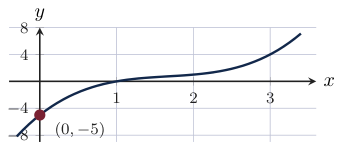
Original Photon diagram
The graph of y=p(x) for -0.3\le x\le3.4.
(a) Show that 2-i is a root of p(x)=0.
[2]
(b) Write down a second complex root, giving a reason.
[2]
(c) Hence factorise p(x) into a linear factor and a quadratic factor with real coefficients.
[3]
(d) Verify your three roots using the sum and the product of the roots.
[3]
(e) Plot the roots on an Argand diagram and find the area of the triangle they form.
[3]
(f) Find a cubic with integer coefficients whose roots are the squares of the roots of p(x)=0.
[3]
Show solutionHide solution
(a) (2-i)^2=3-4i and (2-i)^3=2-11i. Then p(2-i)=(2-11i)-5(3-4i)+9(2-i)-5=0 (M1 A1).
(b) 2+i (A1). The coefficients are real, so non-real roots occur in conjugate pairs (R1).
(c) (x-(2-i))(x-(2+i))=x^2-4x+5 (M1). Dividing, p(x)=(x^2-4x+5)(x-1) (M1 A1).
(d) Roots 1, 2-i, 2+i. Sum =5, which equals -(-5)/1 (M1 A1). Product =1\times(2-i)(2+i)=5, which equals -(-5)/1 (A1).
(e) The points are (1,0), (2,1) and (2,-1) (A1). The side from (2,-1) to (2,1) has length 2 and the distance from it to (1,0) is 1 (M1), so the area is \tfrac12\times2\times1=1 (A1).
(f) The roots are 1, (2+i)^2=3+4i and (2-i)^2=3-4i (M1). The cubic is (x-1)(x^2-6x+25) (A1) =x^3-7x^2+31x-25 (A1).

Final answer

(b) 2+i. (c) (x-1)(x^2-4x+5). (d) sum 5, product 5. (e) area 1. (f) x^3-7x^2+31x-25.
Investigation 2

[20 marks]
When isn^4+4 prime?
This question asks you to factorise z^4+4 using its complex roots and use the result in number theory.
(a) Solve z^4=-4, giving the roots in the form a+bi.
[4]
(b) Plot the roots and describe the shape they form.
[2]
(c) Hence write z^4+4 as a product of two quadratics with real coefficients.
[4]
(d) Show that n^4+4=\left((n+1)^2+1\right)\left((n-1)^2+1\right) for every integer n.
[2]
(e) Hence prove that n^4+4 is prime for exactly one positive integer n.
[5]
(f) Factorise 4m^4+1 in a similar way.
[3]
Show solutionHide solution
(a) -4=4e^{i\pi}, so |z|=\sqrt2 (M1) and \arg z=\frac{\pi+2k\pi}{4} (A1), that is \frac\pi4,\frac{3\pi}4,\frac{5\pi}4,\frac{7\pi}4 (A1). Hence z=\pm1\pm i (A1).
(b) The points (\pm1,\pm1) (A1) are the vertices of a square of side 2 whose vertices lie on the circle |z|=\sqrt2 (A1).
(c) Pair the conjugates: (z-(1+i))(z-(1-i))=z^2-2z+2 (M1 A1) and (z-(-1+i))(z-(-1-i))=z^2+2z+2 (M1 A1). So z^4+4=(z^2-2z+2)(z^2+2z+2).
(d) Put z=n: n^4+4=(n^2-2n+2)(n^2+2n+2) (M1). Since n^2-2n+2=(n-1)^2+1 and n^2+2n+2=(n+1)^2+1 (A1), the result follows.
(e) For n=1 the factors are 1 and 5, so n^4+4=5 is prime (A1). For an integer n\ge2 both factors are integers (M1), (n-1)^2+1\ge2 (R1) and (n+1)^2+1\ge10 (R1), so n^4+4 has two factors each greater than 1 and is not prime. Hence n=1 is the only value (A1).
(f) Multiply by 4: 16m^4+4=(2m)^4+4 (M1). By (c), this equals \big((2m)^2-2(2m)+2\big)\big((2m)^2+2(2m)+2\big)=4(2m^2-2m+1)(2m^2+2m+1) (A1). So 4m^4+1=(2m^2+2m+1)(2m^2-2m+1) (A1).

Final answer

(a) z=\pm1\pm i. (b) a square, vertices on |z|=\sqrt2. (c) (z^2-2z+2)(z^2+2z+2). (e) n=1 gives 5; for n\ge2 both factors exceed 1. (f) (2m^2+2m+1)(2m^2-2m+1).

Investigation 3

[22 marks]
Power sums of roots
This question asks you to find sums of powers of the roots of a cubic without solving it.
The roots of x^3-6x^2+11x-6=0 are \alpha, \beta and \gamma. Let S_k=\alpha^k+\beta^k+\gamma^k.
(a) Write down the values of \alpha+\beta+\gamma, \alpha\beta+\beta\gamma+\gamma\alpha and \alpha\beta\gamma.
[2]
(b) Show that S_2=14.
[2]
(c) By multiplying the equation satisfied by each root by x^k, show that S_{k+3}=6S_{k+2}-11S_{k+1}+6S_k.
[4]
(d) Hence find S_3 and S_4.
[3]
(e) Solve the equation and check your answers to (d).
[2]
(f) Find the cubic whose roots are \dfrac1\alpha, \dfrac1\beta and \dfrac1\gamma, and hence find \dfrac1{\alpha^2}+\dfrac1{\beta^2}+\dfrac1{\gamma^2}.
[5]
(g) Find the cubic whose roots are \alpha+1, \beta+1 and \gamma+1.
[4]
Show solutionHide solution
(a) 6, 11 and 6 (A1 A1).
(b) S_2=(\alpha+\beta+\gamma)^2-2(\alpha\beta+\beta\gamma+\gamma\alpha) (M1) =36-22=14 (A1).
(c) Each root x satisfies x^3=6x^2-11x+6 (M1). Multiplying by x^k gives x^{k+3}=6x^{k+2}-11x^{k+1}+6x^k (A1) for x=\alpha,\beta,\gamma (M1). Adding the three equations gives S_{k+3}=6S_{k+2}-11S_{k+1}+6S_k (A1).
(d) S_0=3 (M1). S_3=6(14)-11(6)+6(3)=36 (A1). S_4=6(36)-11(14)+6(6)=98 (A1).
(e) (x-1)(x-2)(x-3)=0, so the roots are 1,2,3 (A1). Then 1+8+27=36 and 1+16+81=98 (A1).
(f) Put x=1/y and multiply by y^3 (M1): 1-6y+11y^2-6y^3=0, that is 6y^3-11y^2+6y-1=0 (A1). For this cubic the sum of the roots is \frac{11}6 and the sum of pairs is \frac66=1 (A1). Then \sum\frac1{\alpha^2}=\left(\frac{11}6\right)^2-2(1) (M1) =\frac{49}{36} (A1).
(g) Put x=y-1 (M1): (y-1)^3-6(y-1)^2+11(y-1)-6 (A1). Expanding gives y^3-3y^2+3y-1-6y^2+12y-6+11y-11-6 (A1) =y^3-9y^2+26y-24 (A1).

Final answer

(a) 6,\ 11,\ 6. (d) S_3=36, S_4=98. (e) 1,2,3. (f) 6x^3-11x^2+6x-1=0; \frac{49}{36}. (g) x^3-9x^2+26x-24=0.

Investigation 4

[22 marks]
Equilateral triangles
This question asks you to find a condition on three complex numbers that makes them the vertices of an equilateral triangle.
Points A, B and C in the Argand diagram represent the complex numbers a, b and c. Define T=a^2+b^2+c^2-ab-bc-ca.
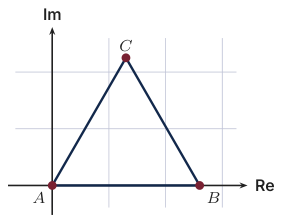
Original Photon diagram
The triangle ABC of part (a).
(a) The points A(0), B(2) and C(1+\sqrt3\,i) form an equilateral triangle. Show that T=0 for these points.
[3]
(b) For the points D(0), E(3) and F(1+i), find T, and show that the triangle DEF is not equilateral.
[2]
(c) Let p=b-a and q=c-a. Show that T=p^2-pq+q^2.
[3]
(d) Prove that, if ABC is equilateral, then T=0.
[4]
(e) Prove that, if T=0 and a\ne b, then ABC is equilateral.
[4]
(f) The points P(1) and Q(5) are two vertices of an equilateral triangle PQR. Find the two possible values of the complex number represented by R.
[3]
(g) Deduce from T=0 that (a+b+c)^2=3(ab+bc+ca), and verify this for the triangle PQR in (f).
[3]
Show solutionHide solution
(a) With a=0, T=b^2+c^2-bc (M1). Then c^2=-2+2\sqrt3\,i and bc=2+2\sqrt3\,i (A1), so T=4+(-2+2\sqrt3\,i)-(2+2\sqrt3\,i)=0 (A1).
(b) T=9+(1+i)^2-3(1+i)=9+2i-3-3i=6-i\ne0 (A1). The side DE=3 but DF=\sqrt2, so the sides are not equal (R1).
(c) Expand p^2-pq+q^2=(b-a)^2-(b-a)(c-a)+(c-a)^2 (M1). This gives b^2-2ab+a^2-(bc-ab-ac+a^2)+c^2-2ac+a^2 (A1) =a^2+b^2+c^2-ab-bc-ca (A1).
(d) Equilateral means |q|=|p| and the angle between AB and AC is \pm\frac\pi3, so q=pe^{\pm i\pi/3} (M1 A1). Then T=p^2\big(1-e^{\pm i\pi/3}+e^{\pm2i\pi/3}\big) (M1). Since e^{\pm i\pi/3}=\frac{1\pm\sqrt3\,i}2 satisfies s^2-s+1=0, T=0 (A1).
(e) p\ne0, and T=0 gives s^2-s+1=0 for s=q/p (M1). So s=\frac{1\pm\sqrt3\,i}2=e^{\pm i\pi/3} (A1). Then |AC|=|AB| and angle BAC=\frac\pi3 (R1), so the triangle is isosceles with apex angle 60^\circ, hence equilateral (R1).
(f) With a=1, b=5, T=0 gives c^2-6c+21=0 (M1 A1), so c=3\pm2\sqrt3\,i (A1).
(g) From a^2+b^2+c^2=ab+bc+ca add 2(ab+bc+ca) to both sides (M1): (a+b+c)^2=3(ab+bc+ca) (A1). For R=3\pm2\sqrt3\,i: (6+c)^2=69\pm36\sqrt3\,i and 3(5+6c)=69\pm36\sqrt3\,i (A1).

Final answer

(b) T=6-i, DE=3, DF=\sqrt2. (f) R=3\pm2\sqrt3\,i. (g) both sides equal 69\pm36\sqrt3\,i.

Investigation 5

[24 marks]
Integers hiding in surds
This question asks you to show that powers of 2+\sqrt3 are almost integers.
Let \alpha=2+\sqrt3 and \beta=2-\sqrt3, and define u_n=\alpha^n+\beta^n for n\in\mathbb N.
(a) Show that \alpha and \beta are the two solutions of x^2-4x+1=0.
[2]
(b) Find u_0, u_1 and u_2.
[3]
(c) By multiplying the equation satisfied by each root by x^n, show that u_{n+2}=4u_{n+1}-u_n.
[3]
(d) Find u_3 and u_4.
[2]
(e) Prove that u_n is an integer for every n\in\mathbb N.
[3]
(f) Show that 0<\beta<1, and hence show that u_n-1<\alpha^n<u_n for n\ge1.
[4]
(g) Write down the integer part of \alpha^{10}.
[3]
(h) Find the least value of n for which \alpha^n is within 10^{-6} of an integer.
[4]
Show solutionHide solution
(a) \alpha+\beta=4 and \alpha\beta=4-3=1 (M1), so both are roots of x^2-4x+1=0 (A1).
(b) u_0=2 (A1), u_1=\alpha+\beta=4 (A1), u_2=(\alpha+\beta)^2-2\alpha\beta=16-2=14 (A1).
(c) Each root satisfies x^2=4x-1 (M1). Multiplying by x^n gives x^{n+2}=4x^{n+1}-x^n (A1). Adding the equations for x=\alpha and x=\beta gives u_{n+2}=4u_{n+1}-u_n (A1).
(d) u_3=4(14)-4=52 (A1) and u_4=4(52)-14=194 (A1).
(e) u_0=2 and u_1=4 are integers (M1). Assume u_k and u_{k+1} are integers; then u_{k+2}=4u_{k+1}-u_k is an integer (M1). By induction (two starting values, two-step rule) every u_n is an integer (R1).
(f) \sqrt3\approx1.732, so 0<\beta<1, because \sqrt3<2 and \sqrt3>1 (A1). Then 0<\beta^n<1 for n\ge1 (M1). Since \alpha^n=u_n-\beta^n (M1), u_n-1<\alpha^n<u_n (A1).
(g) Continue the rule: u_5=724, u_6=2702, u_7=10\,084, u_8=37\,634, u_9=140\,452, u_{10}=524\,174 (M1 A1). By (f) the integer part of \alpha^{10} is u_{10}-1=524\,173 (A1).
(h) \alpha^n is within 10^{-6} of the integer u_n exactly when \beta^n<10^{-6} (M1). \beta^{10}=1.9\times10^{-6} (A1), which is too large, and \beta^{11}=5.1\times10^{-7} (A1). The least value is n=11 (A1).

Final answer

(b) 2,\ 4,\ 14. (d) 52,\ 194. (g) u_{10}=524\,174, so the integer part is 524 173. (h) n=11.

Investigation 6

[25 marks]
A factor test with\omega
This question asks you to decide when x^2+x+1 is a factor of x^{2k}+x^k+1.
Let \omega=e^{2\pi i/3} and P_k(x)=x^{2k}+x^k+1, where k\in\mathbb Z^+.
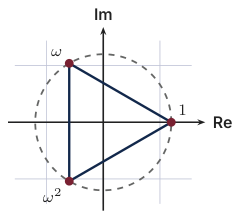
Original Photon diagram
The points 1, \omega and \omega^2 on the unit circle.
(a) Show that \omega^3=1 and 1+\omega+\omega^2=0.
[3]
(b) Show that \omega and \omega^2 are the roots of x^2+x+1=0.
[2]
(c) Find P_k(\omega) when k is a multiple of 3, and when k is not a multiple of 3.
[5]
(d) Hence state the values of k for which x^2+x+1 is a factor of P_k(x), justifying your answer.
[4]
(e) Find the remainder when P_k(x) is divided by x^2+x+1 in the case that k is a multiple of 3.
[5]
(f) Find how many of the polynomials P_1,P_2,\dots,P_{100} have x^2+x+1 as a factor.
[2]
(g) Use your result to show that 1+2^k+4^k is a multiple of 7 whenever k is not a multiple of 3.
[4]
Show solutionHide solution
(a) \omega^3=e^{2\pi i}=1 (A1). Then \omega^3-1=(\omega-1)(\omega^2+\omega+1)=0 (M1), and \omega\ne1, so 1+\omega+\omega^2=0 (R1).
(b) By (a), \omega satisfies x^2+x+1=0 (M1). Also (\omega^2)^2+\omega^2+1=\omega+\omega^2+1=0, and \omega\ne\omega^2, so these are the two roots (A1).
(c) If k=3m then \omega^k=1 and \omega^{2k}=1 (M1), so P_k(\omega)=3 (A1). If k\equiv1\pmod 3 then \omega^k=\omega and \omega^{2k}=\omega^2 (M1); if k\equiv2 then \omega^k=\omega^2 and \omega^{2k}=\omega^4=\omega (A1). In both cases P_k(\omega)=1+\omega+\omega^2=0 (A1).
(d) The quadratic is a factor of P_k if and only if P_k(\omega)=0 and P_k(\omega^2)=0 (M1). The coefficients are real, so P_k(\omega^2)=\overline{P_k(\omega)} (R1). By (c), P_k(\omega)=0 exactly when 3\nmid k (A1), so x^2+x+1 is a factor for every k that is not a multiple of 3, and for no multiple of 3 because P_k(\omega)=3\ne0 (A1).
(e) The remainder has the form ax+b (M1): P_k(x)=(x^2+x+1)Q(x)+ax+b. Put x=\omega: 3=a\omega+b (M1). Put x=\omega^2: 3=a\omega^2+b (M1). Subtracting, a(\omega-\omega^2)=0 and \omega\ne\omega^2, so a=0 (A1) and b=3 (A1). The remainder is 3.
(f) Multiples of 3 up to 100: 33 (M1). So 100-33=67 polynomials (A1).
(g) P_k(2)=4^k+2^k+1 and 2^2+2+1=7 (M1). P_k and the divisor have integer coefficients and the divisor is monic, so the quotient Q has integer coefficients (R1). Hence P_k(2)=7\,Q(2) with Q(2)\in\mathbb Z (A1), so 7 divides 1+2^k+4^k when 3\nmid k (R1).

Final answer

(c) P_k(\omega)=3 if 3\mid k, otherwise 0. (d) all k not divisible by 3. (e) remainder 3. (f) 67. (g) put x=2, since 2^2+2+1=7.

Investigation 7

[25 marks]
Roots on a line
This question asks you to find where the roots of (z+1)^n=z^n lie.
Let n\ge2 be an integer.
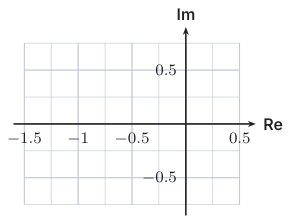
Original Photon diagram
Axes for part (c); the small squares are 0.25 wide.
(a) Solve (z+1)^2=z^2.
[2]
(b) Show that (z+1)^3=z^3 reduces to 3z^2+3z+1=0, and solve it, giving the roots in the form p+qi.
[4]
(c) Plot the roots found in (a) and (b) on an Argand diagram, and suggest a property that all of these roots share.
[3]
(d) Prove that every root z of (z+1)^n=z^n satisfies |z+1|=|z|, and deduce that \operatorname{Re}(z)=-\tfrac12.
[4]
(e) Show that z=0 is not a root, and that w=\dfrac{z+1}{z} satisfies w^n=1.
[3]
(f) Hence show that the roots are z=\dfrac1{e^{2k\pi i/n}-1} for k=1,2,\dots,n-1, and explain why k=0 is excluded.
[4]
(g) For n=4, use (f) to find the three roots in the form p+qi.
[3]
(h) Generalise (d) to the equation (z+a)^n=z^n, where a is a positive real number.
[2]
Show solutionHide solution
(a) z^2+2z+1=z^2 (M1), so z=-\tfrac12 (A1).
(b) (z+1)^3-z^3=3z^2+3z+1, so the equation reduces to 3z^2+3z+1=0 (M1 A1). Then z=\dfrac{-3\pm\sqrt{9-12}}{6} (M1) =-\tfrac12\pm\tfrac{\sqrt3}6\,i (A1).
(c) The points are (-0.5,0), (-0.5,0.289) and (-0.5,-0.289) (A1 A1). All of them have real part -\tfrac12, so they lie on the vertical line \operatorname{Re}(z)=-\tfrac12 (A1).
(d) Take moduli: |z+1|^n=|z|^n (M1). Both sides are positive real numbers, so |z+1|=|z| (A1). With z=x+iy, (x+1)^2+y^2=x^2+y^2 (M1), so 2x+1=0 and \operatorname{Re}(z)=-\tfrac12 (A1).
(e) If z=0 then 1=0, which is false (R1). Dividing by z^n, \left(\dfrac{z+1}z\right)^n=1 (M1), so w^n=1 (A1).
(f) The solutions of w^n=1 are w=e^{2k\pi i/n}, k=0,1,\dots,n-1 (M1). From w=1+\frac1z, z=\dfrac1{w-1} (A1). The value k=0 gives w=1, which would need \frac1z=0 (R1), so k=1,\dots,n-1 (A1). There are n-1 roots, matching the degree n-1 of the equation after z^n cancels.
(g) w=i,-1,-i (M1). z=\dfrac1{i-1}=\dfrac{-1-i}2 (A1), z=\dfrac1{-2}=-\tfrac12, and z=\dfrac1{-i-1}=\dfrac{-1+i}2 (A1).
(h) |z+a|=|z| gives (x+a)^2+y^2=x^2+y^2 (M1), so \operatorname{Re}(z)=-\dfrac a2 (A1).

Final answer

(a) -\tfrac12. (b) -\tfrac12\pm\tfrac{\sqrt3}6\,i. (c) all lie on \operatorname{Re}(z)=-\tfrac12. (g) -\tfrac12, -\tfrac12\pm\tfrac12\,i. (h) \operatorname{Re}(z)=-\tfrac a2.

Going further

Beyond the syllabus: the worked examples and investigations of the chapter's Going further pages.

Investigation

[26 marks]
Worked investigation 1: Roots in geometric progression.
This question asks you to find when the roots of a cubic form a geometric sequence.
Consider the equation x^3+bx^2+cx+d=0, where b,c,d\in\mathbb R, b\ne0 and d\ne0, whose roots are \dfrac ar, a and ar for some non-zero numbers a and r.
(a) Verify that 2, 4 and 8 are the roots of x^3-14x^2+56x-64=0.
[2]
(b) By considering the product of the roots, show that a^3=-d.
[2]
(c) Show that the sum of the roots is a\left(\dfrac1r+1+r\right) and the sum of the products of pairs of roots is a^2\left(\dfrac1r+1+r\right). Hence show that a=-\dfrac cb.
[4]
(d) Hence show that c^3=b^3d.
[3]
(e) Check that the equation in (a) satisfies this condition.
[1]
(f) Find the value of k for which x^3-7x^2+kx-27=0 has roots in geometric progression.
[3]
(g) For this value of k, solve the equation, giving the roots in the form p+qi.
[3]
(h) Show that the three roots lie on one circle centred at the origin, and determine every value that r can take.
[4]
(i) Prove that, whenever such a cubic has a non-real common ratio r, all three roots have modulus |a|.
[4]
Show solutionHide solution
(a) f(2)=8-56+112-64=0, f(4)=64-224+224-64=0 and f(8)=512-896+448-64=0 (M1 A1).
(b) The product of the roots of x^3+bx^2+cx+d is -d (M1). The product of the three roots is \frac ar\times a\times ar=a^3 (A1), so a^3=-d.
(c) The sum of the roots is -b (M1), and \frac ar+a+ar=a\left(\frac1r+1+r\right) (A1). The sum of the products of pairs is c (M1), and \frac{a^2}r+a^2r+a^2=a^2\left(\frac1r+1+r\right) (A1). Write K=\frac1r+1+r. Then -b=aK\ne0 so K\ne0, and \frac c{-b}=\frac{a^2K}{aK}=a, which gives a=-\frac cb.
(d) Substitute a=-\frac cb into a^3=-d (M1): \left(-\frac cb\right)^3=-\frac{c^3}{b^3} (A1) so -\frac{c^3}{b^3}=-d (A1). Multiply by -b^3: c^3=b^3d.
(e) Here b=-14, c=56, d=-64. c^3=175\,616 and b^3d=(-2744)(-64)=175\,616 (A1).
(f) Here b=-7, c=k, d=-27 (M1). The condition c^3=b^3d gives k^3=(-7)^3(-27)=9261 (A1), so k=21 (A1).
(g) The middle root is a=-\frac cb=3 (M1). Dividing, x^3-7x^2+21x-27=(x-3)(x^2-4x+9) (A1). The quadratic has discriminant 16-36=-20, so x=2\pm\sqrt5\,i (A1).
(h) |2\pm\sqrt5\,i|=\sqrt{4+5}=3 (M1) and |3|=3, so all three roots lie on the circle |z|=3 (A1). The middle root is a=3, so ar is 2+\sqrt5\,i or 2-\sqrt5\,i (M1) and r=\frac{2\pm\sqrt5\,i}3, with |r|=1 (A1).
(i) a=-\frac cb is real because b and c are real (R1). If r is not real then \frac ar and ar are the two non-real roots, and as the coefficients are real they are complex conjugates of each other (R1). So \frac ar=a\bar r, which gives r\bar r=1 and |r|=1 (M1). Then \left|\frac ar\right|=|ar|=|a|, and the real root has modulus |a| (R1).

Final answer

(f) k=21. (g) 3, 2\pm\sqrt5\,i. (h) all moduli 3; r=\frac{2\pm\sqrt5\,i}3. (i) |r|=1, so every modulus is |a|.

Investigation

[26 marks]
Worked investigation 2: Polygons of roots.
This question asks you to explore the roots of z^n=w and the sums of their powers.
Let w=16+16\sqrt3\,i.
(a) Write w in the form re^{i\theta}.
[2]
(b) Find the five roots z_k, k=0,1,\dots,4, of z^5=w in the form re^{i\theta}, and plot them on an Argand diagram.
[4]
(c) Show that the roots form a geometric sequence and hence prove that \displaystyle\sum_{k=0}^{4}z_k=0.
[3]
(d) Deduce the value of \displaystyle\sum_{k=0}^{4}\cos\left(\frac\pi{15}+\frac{2k\pi}5\right).
[2]
(e) Find the exact area of the pentagon whose vertices are the five roots.
[3]
(f) Show that \displaystyle\sum_{k=0}^{4}z_k^2=0.
[3]
(g) Find all positive integers m\le10 for which \displaystyle\sum_{k=0}^{4}z_k^m\ne0, and find the value of the sum for each.
[4]
(h) The roots of (z-1)^5=w are u_k, k=0,1,\dots,4. Find \displaystyle\sum_{k=0}^{4}u_k by two different methods.
[3]
(i) Generalise (g) to the roots of z^n=w for any n\ge2.
[2]
Show solutionHide solution
(a) |w|=\sqrt{16^2+(16\sqrt3)^2}=\sqrt{1024}=32 (M1). \tan\theta=\sqrt3 in the first quadrant, so \theta=\frac\pi3 and w=32e^{i\pi/3} (A1).
(b) z^5=32e^{i(\pi/3+2k\pi)} (M1), so z_k=32^{1/5}e^{i(\pi/3+2k\pi)/5} (A1) =2e^{i(\pi/15+2k\pi/5)} (A1). In degrees the arguments are 12^\circ,84^\circ,156^\circ,228^\circ,300^\circ, five points on the circle |z|=2 at equal spacing 72^\circ (A1).
(c) \frac{z_{k+1}}{z_k}=e^{2\pi i/5}=\rho is constant (M1). The sum is z_0\frac{1-\rho^5}{1-\rho} (A1). Since \rho^5=e^{2\pi i}=1 and \rho\ne1, the sum is 0 (R1).
(d) The real part of z_k is 2\cos\left(\frac\pi{15}+\frac{2k\pi}5\right) (M1). The real part of the sum is 0, so the cosine sum is 0 (A1).
(e) The pentagon splits into five triangles with two sides 2 and included angle \frac{2\pi}5 (M1). Area =5\times\frac12\times2\times2\times\sin\frac{2\pi}5 (A1) =10\sin\frac{2\pi}5\approx9.51 (A1). An equivalent exact form is \frac52\sqrt{10+2\sqrt5}.
(f) z_k^2=z_0^2\rho^{2k} is a geometric sequence with ratio \rho^2 (M1). (\rho^2)^5=1 (A1) and \rho^2\ne1 (R1), so the sum is 0.
(g) z_k^m=z_0^m(\rho^m)^k and the sum is z_0^m\frac{1-\rho^{5m}}{1-\rho^m}=0 unless \rho^m=1 (M1). \rho^m=1 exactly when 5\mid m, so m=5 and m=10 (A1). For these the sum is 5z_0^m. m=5: 5w=80+80\sqrt3\,i (A1). m=10: 5w^2=5(-512+512\sqrt3\,i)=-2560+2560\sqrt3\,i (A1).
(h) Method 1: u_k=z_k+1 (M1), so \sum u_k=\sum z_k+5=5 (A1). Method 2: expanding (z-1)^5-w gives z^5-5z^4+\dots, and the sum of the roots is -\frac{-5}1=5 (A1).
(i) If n\mid m then \sum z_k^m=nw^{m/n} (A1). If n\nmid m then \sum z_k^m=0 (A1).

Final answer

(b) 2e^{i(\pi/15+2k\pi/5)}. (e) 10\sin\frac{2\pi}5\approx9.51. (g) m=5: 80+80\sqrt3\,i; m=10: -2560+2560\sqrt3\,i. (h) 5. (i) nw^{m/n} if n\mid m, otherwise 0.

From the book

Photon Guidebook: Mathematics HL Paper 3 for the IB Diploma

Chapter 3 teaches polynomials, roots and complex numbers: how the IB builds this kind of Paper 3 question, the techniques, marked worked investigations, and practice investigations like these.

About the book