Free worked solutions · 2026 Edition

IB Maths HL Paper 3 Chapter 2: Families of curves: explore, conjecture, justify worked solutions

Worked solutions to the investigations in Chapter 2 of Photon Guidebook: Mathematics HL Paper 3 for the IB Diploma (2026 Edition). Each solution shows every step with the mark it earns, the way an IB mark scheme does.

  • Chapter 2 of 18
  • 8 practice questions
  • 3 Going further
  • Free, no sign-up

Investigations

The practice investigations of the chapter, each with its full worked solution and mark scheme.

Investigation 1

[17 marks]
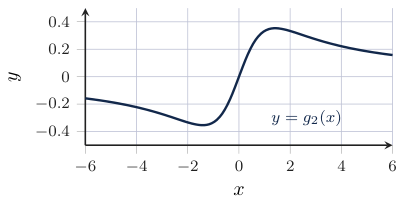
This question asks you to investigate the family g_a(x)=\dfrac{x}{x^2+a}, x\in\mathbb{R}, where a is a positive constant.
Original Photon diagram
(a) Sketch the graphs of y=g_1(x) and y=g_4(x) on the same axes.
[2]
(b) Show that the graph of y=g_a(x) has stationary points at \left(\pm\sqrt{a},\ \pm\dfrac{1}{2\sqrt{a}}\right).
[4]
(c) Show that every stationary point lies on the curve y=\dfrac{1}{2x}.
[2]
(d) The definition of g_a is extended to negative values of a, with x\ne\pm\sqrt{-a}. Show that for a<0 the graph has no stationary points.
[3]
(e) Given that g_a''(x)=\dfrac{2x(x^2-3a)}{(x^2+a)^3}, state the x-coordinate of each point of inflexion of the graph when a>0.
[3]
(f) Show that the area enclosed by y=g_a(x), the x-axis and the line x=\sqrt{a} does not depend on a, and find its value.
[3]
Show solutionHide solution
(a) Both curves are odd, pass through the origin and tend to 0 as x\to\pm\infty (A1). Maximum points \left(1,\tfrac12\right) on g_1 and \left(2,\tfrac14\right) on g_4, with the minimum points at the mirror images (A1).
(b) Quotient rule: g_a'(x)=\dfrac{(x^2+a)-x\cdot2x}{(x^2+a)^2}=\dfrac{a-x^2}{(x^2+a)^2} (M1 A1). Zero when x^2=a, so x=\pm\sqrt{a} (A1). Then y=\dfrac{\pm\sqrt{a}}{2a}=\pm\dfrac{1}{2\sqrt{a}} (A1).
(c) At a stationary point x^2=a, so y=\dfrac{x}{x^2+x^2} (M1) =\dfrac{1}{2x} (A1).
(d) The same derivative holds for a<0: g_a'(x)=\dfrac{a-x^2}{(x^2+a)^2} (M1). The numerator a-x^2 is negative for every x because a<0 (R1), and the denominator is positive, so g_a'(x)<0 and is never 0 (R1).
(e) g_a''(x)=0 needs 2x(x^2-3a)=0 (M1), so x=0 (A1) or x=\pm\sqrt{3a} (A1).
(f) Area =\displaystyle\int_0^{\sqrt{a}}\dfrac{x}{x^2+a}\,\mathrm{d}x (M1) =\left[\tfrac12\ln(x^2+a)\right]_0^{\sqrt{a}}=\tfrac12\ln(2a)-\tfrac12\ln a (A1) =\tfrac12\ln2, which does not contain a (A1).

Final answer

Humps and dips. (b) g_a'=\frac{a-x^2}{(x^2+a)^2}. (c) x^2=a\Rightarrow y=\frac1{2x}. (d) a-x^2<0. (e) x=0,\pm\sqrt{3a}. (f) \tfrac12\ln2.
Investigation 2

[18 marks]
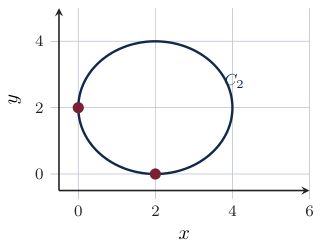
This question asks you to investigate the circles C_a with equation (x-a)^2+(y-a)^2=a^2, where a>0.
Original Photon diagram
(a) On one set of axes, sketch C_1 and C_3, marking where each circle meets the axes.
[2]
(b) Show that every circle C_a touches both coordinate axes, and write down the points of contact in terms of a.
[3]
(c) Find every radius that gives a circle of the family through the point (4,2).
[3]
(d) The point (p,q) has p>0 and q>0. Show that exactly two circles of the family pass through (p,q).
[4]
(e) Hence find the difference between the radii of the two circles that pass through (1,1).
[3]
(f) Find the value of a for which the region between the axes and the arc of C_a nearest the origin has area 1.
[3]
Show solutionHide solution
(a) Circles with centres (1,1) and (3,3), radii 1 and 3 (A1); touching the axes at (1,0), (0,1) and (3,0), (0,3) (A1).
(b) Put y=0: (x-a)^2+a^2=a^2, so (x-a)^2=0 (M1). A repeated root means the x-axis is a tangent (A1). By symmetry in y=x the y-axis is a tangent too, and the points of contact are (a,0) and (0,a) (A1).
(c) (4-a)^2+(2-a)^2=a^2 (M1), so a^2-12a+20=0 (A1) and a=2 or a=10 (A1).
(d) (p-a)^2+(q-a)^2=a^2 gives a^2-2(p+q)a+p^2+q^2=0 (M1 A1). The discriminant is 4(p+q)^2-4(p^2+q^2)=8pq>0, so there are two distinct real roots (A1). Their sum 2(p+q) and product p^2+q^2 are positive, so both roots are positive: two circles (R1).
(e) With (p,q)=(1,1): a^2-4a+2=0 (M1), so r_1+r_2=4 and r_1r_2=2 (A1). Then (r_2-r_1)^2=16-8=8 and the difference is 2\sqrt2 (A1).
(f) The region is the square of side a less a quarter of the disc: area a^2-\tfrac{\pi a^2}{4} (M1 A1). Setting this equal to 1 gives a=\dfrac{2}{\sqrt{4-\pi}}=2.16 (A1).

Final answer

Circles that touch both axes. (b) contact points (a,0) and (0,a). (c) a=2 or 10. (d) discriminant 8pq>0, both roots positive. (e) 2\sqrt2. (f) a=2.16.

Investigation 3

[20 marks]
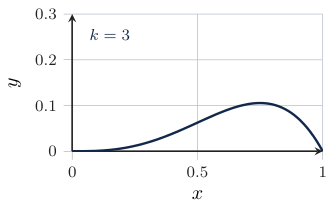
This question asks you to investigate the curves y=x^k(1-x) for 0\le x\le1, where k is a positive real number.
Original Photon diagram
(a) Sketch the curves for k=1, k=2 and k=5 on the same axes.
[2]
(b) Show that the maximum point of the curve occurs at x=\dfrac{k}{k+1}.
[3]
(c) Show that the area between the curve and the x-axis is A(k)=\dfrac{1}{(k+1)(k+2)}.
[3]
(d) Find the value of k for which the area is \dfrac1{12}.
[2]
Let M(k) be the maximum value of x^k(1-x) for 0\le x\le1.
(e) Use your GDC to find (k+1)M(k) for k=1,\,10,\,100 and 1000. Suggest the limit of (k+1)M(k) as k\to\infty.
[3]
(f) Prove your suggestion in part (e).
[5]
(g) Describe how the position and the size of the maximum point change as k increases.
[2]
Show solutionHide solution
(a) Each curve starts at (0,0) and ends at (1,0) (A1), with a single maximum that moves right and becomes lower as k grows: maxima at \left(\tfrac12,\tfrac14\right), \left(\tfrac23,\tfrac4{27}\right) and \left(\tfrac56,\ 0.067\right) (A1).
(b) \dfrac{\mathrm{d}y}{\mathrm{d}x}=kx^{k-1}(1-x)-x^k=x^{k-1}\bigl(k-(k+1)x\bigr) (M1 A1). For 0<x<1 this is zero only at x=\dfrac{k}{k+1} (A1), and it changes from positive to negative there.
(c) A=\displaystyle\int_0^1\left(x^k-x^{k+1}\right)\mathrm{d}x (M1) =\left[\dfrac{x^{k+1}}{k+1}-\dfrac{x^{k+2}}{k+2}\right]_0^1 (A1) =\dfrac1{k+1}-\dfrac1{k+2} (A1) =\dfrac{1}{(k+1)(k+2)}.
(d) (k+1)(k+2)=12 (M1), so k^2+3k-10=0 and k=2 (A1).
(e) M(k)=\left(\dfrac{k}{k+1}\right)^k\dfrac{1}{k+1}, so (k+1)M(k) is 0.5, 0.386, 0.370, 0.368 (A1 A1). It appears to approach \dfrac1{\mathrm{e}}=0.368 (A1).
(f) (k+1)M(k)=\left(\dfrac{k}{k+1}\right)^k (M1). Its logarithm is k\ln\dfrac{k}{k+1}=\dfrac{-\ln(1+u)}{u} with u=\dfrac1k (A1). As u\to0^+ this is \tfrac00, so differentiate top and bottom (M1): \dfrac{-1/(1+u)}{1}\to-1 (A1). The exponential function is continuous, so (k+1)M(k)\to\mathrm{e}^{-1} (R1).
(g) The maximum point is at x=\dfrac{k}{k+1}\to1, so it moves towards the right-hand end (R1). Its height is M(k)\approx\dfrac{1}{\mathrm{e}(k+1)}\to0, so it shrinks (R1).

Final answer

A hump that leans. (d) k=2. (e) 0.5,\ 0.386,\ 0.370,\ 0.368, limit \frac1{\mathrm e}. (f) (k+1)M=\left(\frac{k}{k+1}\right)^k and k\ln\frac k{k+1}\to-1. (g) the maximum moves right and shrinks.

Investigation 4

[21 marks]
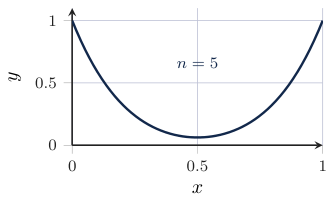
This question asks you to investigate the curves y=f_n(x), where f_n(x)=x^n+(1-x)^n for 0\le x\le1 and n is a positive integer.
Original Photon diagram
(a) Sketch the curves for n=2,\,3 and 4 on the same axes, labelling the lowest point of each.
[3]
(b) Show that f_n(1-x)=f_n(x), and describe the symmetry of the graph that this shows.
[2]
(c) For n\ge2, show that the graph has a stationary point at x=\dfrac12, and find the value of f_n\!\left(\dfrac12\right).
[3]
(d) Prove that, for n\ge2, f_n''(x)>0 for 0<x<1. Hence explain why the stationary point in part (c) is the lowest point of the graph.
[4]
(e) Deduce that 2^{1-n}\le x^n+(1-x)^n\le1 for 0\le x\le1 and n\ge2.
[3]
(f) Use your GDC to find \displaystyle\int_0^1f_n(x)\,\mathrm{d}x for n=1,\,2,\,3 and 4. Suggest a formula for the integral in terms of n.
[3]
(g) Prove your formula in part (f).
[3]
Show solutionHide solution
(a) All three curves run from (0,1) to (1,1) (A1), are symmetric about x=\tfrac12 (A1), and have lowest points \left(\tfrac12,\tfrac12\right), \left(\tfrac12,\tfrac14\right) and \left(\tfrac12,\tfrac18\right) (A1).
(b) f_n(1-x)=(1-x)^n+x^n=f_n(x) (A1). The graph is symmetric about the line x=\tfrac12 (R1).
(c) f_n'(x)=nx^{n-1}-n(1-x)^{n-1} (M1). This is zero when x^{n-1}=(1-x)^{n-1}, that is when x=1-x, so x=\tfrac12 (A1). Then f_n\!\left(\tfrac12\right)=2\left(\tfrac12\right)^n=2^{1-n} (A1).
(d) f_n''(x)=n(n-1)\left[x^{n-2}+(1-x)^{n-2}\right] (M1 A1). Each term in the bracket is positive for 0<x<1, so f_n''(x)>0 (R1). The graph is concave up everywhere and x=\tfrac12 is its only stationary point, so that point is the lowest point (R1).
(e) The lowest value is 2^{1-n} by part (d) (A1). A graph that is concave up has its greatest value at an end point (R1), and f_n(0)=f_n(1)=1 (A1). Hence 2^{1-n}\le f_n(x)\le1.
(f) The integrals are 1, 0.667, 0.5, 0.4 (A1 A1). These fit \dfrac{2}{n+1} (A1).
(g) \displaystyle\int_0^1x^n\,\mathrm{d}x=\dfrac1{n+1} (A1). Substituting u=1-x gives \displaystyle\int_0^1(1-x)^n\,\mathrm{d}x=\int_0^1u^n\,\mathrm{d}u=\dfrac1{n+1} (M1). The sum is \dfrac{2}{n+1} (A1).

Final answer

Two powers that add to a bowl. (b) symmetric about x=\frac12. (c) f_n(\frac12)=2^{1-n}. (d) f_n''=n(n-1)[x^{n-2}+(1-x)^{n-2}]>0. (f) 1,\ 0.667,\ 0.5,\ 0.4; \frac{2}{n+1}.

Investigation 5

[24 marks]
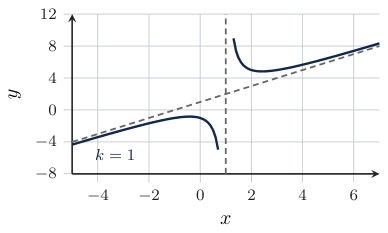
This question asks you to investigate the family f_k(x)=\dfrac{x^2+k}{x-1}, x\ne1, where k\in\mathbb{R}.
Original Photon diagram
(a) Sketch the graphs of y=f_3(x) and y=f_{-2}(x), showing their asymptotes.
[3]
(b) Show that f_k(x)=x+1+\dfrac{k+1}{x-1}, and write down the equations of the asymptotes when k\ne-1.
[3]
(c) Use your GDC to find the number of stationary points for k=-3,\,-1.5,\,0,\,3 and 8. Suggest a condition on k for the graph to have stationary points.
[2]
(d) Prove your suggestion, and find the coordinates of the stationary points in terms of k.
[5]
(e) Prove that, as k varies, the stationary points all lie on a single line through the origin, and state its equation.
[2]
(f) Explain why the graph of y=f_{-1}(x) has no vertical asymptote, and describe it.
[2]
(g) Find the value of k for which the vertical distance between the two stationary points is 8.
[3]
(h) For k>-1, find the set of values of c for which the line y=c does not meet the graph of y=f_k(x).
[4]
Show solutionHide solution
(a) Both graphs have the vertical asymptote x=1 and the oblique asymptote y=x+1 (A1). For k=3 the branches lie above the oblique asymptote for x>1 and below it for x<1 (A1). For k=-2 the branches are the other way round (A1).
(b) x^2+k=(x^2-1)+(k+1)=(x-1)(x+1)+(k+1) (M1 A1). Dividing by x-1 gives x+1+\dfrac{k+1}{x-1}. The asymptotes are x=1 and y=x+1 (A1).
(c) The counts are 0,\ 0,\ 2,\ 2,\ 2 (A1). Conjecture: the graph has stationary points when k>-1 (A1).
(d) f_k'(x)=1-\dfrac{k+1}{(x-1)^2} (M1 A1). Stationary points need (x-1)^2=k+1 (M1). This has real solutions if and only if k+1>0, that is k>-1 (R1). Then x=1\pm\sqrt{k+1} and y=2\pm2\sqrt{k+1} (A1).
(e) y=2\pm2\sqrt{k+1}=2\left(1\pm\sqrt{k+1}\right)=2x (M1), so both lie on y=2x (A1).
(f) For k=-1 the numerator is x^2-1=(x-1)(x+1), so the factor x-1 cancels (A1). The graph is the line y=x+1 with a hole at (1,2) (A1).
(g) The y-coordinates differ by 4\sqrt{k+1} (M1), so 4\sqrt{k+1}=8 (A1) and k=3 (A1).
(h) y=c meets the graph where x^2+k=c(x-1), that is x^2-cx+(k+c)=0 (M1). No solution needs a negative discriminant: c^2-4(k+c)<0 (A1), that is (c-2)^2<4(k+1) (M1). So 2-2\sqrt{k+1}<c<2+2\sqrt{k+1} (A1).

Final answer

A family with a slanted asymptote. (b) x=1 and y=x+1. (c) 0,\,0,\,2,\,2,\,2: k>-1. (d) x=1\pm\sqrt{k+1}, y=2\pm2\sqrt{k+1}. (e) y=2x. (f) the line y=x+1 with a hole at (1,2). (g) k=3. (h) 2-2\sqrt{k+1}<c<2+2\sqrt{k+1}.

Investigation 6

[25 marks]
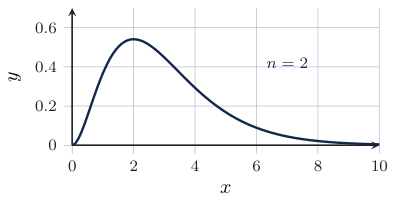
This question asks you to investigate the curves y=x^ne^{-x} for x\ge0, where n is a positive integer.
Original Photon diagram
(a) Sketch the curves for n=1,\,2 and 3 on the same axes, for 0\le x\le8.
[3]
(b) Show that the maximum point of the curve is \left(n,\ n^ne^{-n}\right).
[4]
(c) Show that, as n varies, the maximum points lie on the curve y=\left(\dfrac{x}{e}\right)^x.
[2]
(d) For n\ge2, show that the curve has points of inflexion at x=n\pm\sqrt{n}.
[4]
(e) Use your GDC to find \displaystyle\int_0^{20}x^ne^{-x}\,\mathrm{d}x for n=1,\,2,\,3,\,4 and 5, giving each to three significant figures. Suggest a formula for the integral, taken to infinity, in terms of n.
[3]
(f) Let I_n=\displaystyle\int_0^\infty x^ne^{-x}\,\mathrm{d}x. Given that x^ne^{-x}\to0 as x\to\infty, show that I_n=nI_{n-1} for n\ge1. Hence prove your formula in part (e).
[5]
(g) The horizontal distance between the two points of inflexion is 6. Find n.
[2]
(h) Explain why, as n increases, the maximum point moves to the right and the maximum value grows without bound.
[2]
Show solutionHide solution
(a) Each curve starts at the origin and tends to 0 as x\to\infty (A1). Maxima at \left(1,0.368\right), \left(2,0.541\right) and \left(3,1.34\right) (A1). The n=1 curve is the narrowest and the n=3 curve the widest (A1).
(b) \dfrac{\mathrm{d}y}{\mathrm{d}x}=nx^{n-1}\mathrm{e}^{-x}-x^n\mathrm{e}^{-x}=x^{n-1}\mathrm{e}^{-x}(n-x) (M1 A1). For x>0 this is zero only at x=n (A1), changing from positive to negative, so a maximum with y=n^n\mathrm{e}^{-n} (A1).
(c) y=n^n\mathrm{e}^{-n}=\left(\dfrac{n}{\mathrm{e}}\right)^n (M1), which is \left(\dfrac{x}{\mathrm{e}}\right)^x at x=n (A1).
(d) Differentiating again, y''=x^{n-2}\mathrm{e}^{-x}\left[x^2-2nx+n(n-1)\right] (M1 A1). The bracket is zero when x=\dfrac{2n\pm\sqrt{4n^2-4n(n-1)}}{2} (M1), that is x=n\pm\sqrt{n} (A1), both positive when n\ge2.
(e) The integrals are 1.00, 2.00, 6.00, 24.0 and 120 (A1 A1). These are n!, so the conjecture is \displaystyle\int_0^\infty x^n\mathrm{e}^{-x}\,\mathrm{d}x=n! (A1).
(f) By parts with u=x^n and \mathrm{d}v=\mathrm{e}^{-x}\mathrm{d}x: I_n=\left[-x^n\mathrm{e}^{-x}\right]_0^\infty+n\displaystyle\int_0^\infty x^{n-1}\mathrm{e}^{-x}\,\mathrm{d}x (M1 A1). The bracket is 0 at both limits (R1), so I_n=nI_{n-1} (A1). Since I_0=\displaystyle\int_0^\infty\mathrm{e}^{-x}\,\mathrm{d}x=1, repeating the relation gives I_n=n(n-1)\cdots1=n! (A1).
(g) The distance is 2\sqrt{n} (M1), so 2\sqrt{n}=6 and n=9 (A1).
(h) The maximum point is at x=n, which increases with n (R1). The height is n^n\mathrm{e}^{-n}=\mathrm{e}^{n\ln n-n}, and n\ln n-n=n(\ln n-1)\to\infty (R1).

Final answer

A ridge that moves outwards. (b) y'=x^{n-1}\mathrm{e}^{-x}(n-x). (c) y=(x/\mathrm e)^x. (d) y''=x^{n-2}\mathrm{e}^{-x}[x^2-2nx+n(n-1)]. (e) 1.00,\ 2.00,\ 6.00,\ 24.0,\ 120: n!. (g) n=9.

Investigation 7

[27 marks]
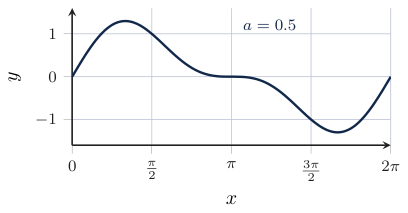
This question asks you to investigate the family of functions f_a(x)=\sin x+a\sin2x, 0\le x\le2\pi, where a is a positive constant.
Original Photon diagram
(a) Draw y=f_{0.25}(x) and y=f_1(x) on one pair of axes, marking where each meets the x-axis.
[3]
(b) Show that f_a(2\pi-x)=-f_a(x), and describe the symmetry of the graph that this shows.
[3]
(c) Show that f_a'(x)=0 is equivalent to 4a\cos^2x+\cos x-2a=0.
[2]
(d) Use your GDC to find the number of stationary points with 0<x<2\pi for a=0.25,\,0.5,\,0.75 and 1, and for other values of a of your choice. Suggest conditions on a for the graph to have two, three and four stationary points.
[3]
(e) Prove your suggestion in part (d).
[5]
(f) Show that, when a=\tfrac12, the stationary point at x=\pi is a point of inflexion.
[3]
(g) (i) Show that \displaystyle\int_0^\pi f_a(x)\,\mathrm{d}x does not depend on a.
[2]
(ii) Explain why, for a>\tfrac12, this integral is not the area between the curve and the x-axis for 0\le x\le\pi.
[2]
(h) For a=1, find the exact area enclosed between the curve and the x-axis for 0\le x\le\pi.
[4]
Show solutionHide solution
(a) Both curves meet the x-axis at x=0, \pi and 2\pi (A1). For a=0.25 there is one positive hump then one negative hump, slightly flattened (A1). For a=1 each half has an extra change of direction, and the curve also meets the axis at x=\dfrac{2\pi}3 and \dfrac{4\pi}3 (A1).
(b) f_a(2\pi-x)=\sin(2\pi-x)+a\sin(4\pi-2x) (M1) =-\sin x-a\sin2x=-f_a(x) (A1). The graph has rotational symmetry of order 2 about the point (\pi,0) (R1).
(c) f_a'(x)=\cos x+2a\cos2x (M1). With \cos2x=2\cos^2x-1 this is \cos x+4a\cos^2x-2a (A1), so f_a'(x)=0\iff4a\cos^2x+\cos x-2a=0.
(d) The counts are 2,\ 3,\ 4,\ 4 (A1 A1). Conjecture: two stationary points when 0<a<\tfrac12, three when a=\tfrac12 and four when a>\tfrac12 (A1).
(e) Let c=\cos x and g(c)=4ac^2+c-2a (M1). The product of the roots is -\tfrac12<0, so there is exactly one positive root c_+ and one negative root c_- (A1). Since g(0)=-2a<0 and g(1)=2a+1>0, c_+\in(0,1), which gives two values of x in (0,2\pi) (R1). Now g(-1)=2a-1. If a>\tfrac12, g(-1)>0>g(0) so c_-\in(-1,0) and gives two more values of x (R1). If a=\tfrac12 then c_-=-1, giving only x=\pi. If a<\tfrac12, g(-1)<0 so c_-<-1, which gives no solution (A1). This gives four, three and two stationary points in the three cases.
(f) With a=\tfrac12: f'(\pi)=-1+1=0 and f''(x)=-\sin x-4a\sin2x gives f''(\pi)=0 (M1). Also f'''(x)=-\cos x-8a\cos2x gives f'''(\pi)=1-4=-3\ne0 (A1). With f'=f''=0 and f'''\ne0 the stationary point is a point of inflexion (R1).
(g) (i) \displaystyle\int_0^\pi f_a\,\mathrm{d}x=\left[-\cos x-\tfrac a2\cos2x\right]_0^\pi (M1) =\left(1-\tfrac a2\right)-\left(-1-\tfrac a2\right)=2 (A1). (ii) f_a(x)=\sin x\,(1+2a\cos x) is negative where \cos x<-\dfrac1{2a}, which happens in (0,\pi) when a>\tfrac12 (R1). The integral counts that part as negative, so it is the difference of two areas, not their sum (R1).
(h) For a=1, f(x)=\sin x(1+2\cos x) is zero at x=\dfrac{2\pi}3 (A1). The area is \displaystyle\int_0^{2\pi/3}f\,\mathrm{d}x-\int_{2\pi/3}^{\pi}f\,\mathrm{d}x (M1). With the antiderivative -\cos x-\tfrac12\cos2x, the first integral is \tfrac94 and the second is -\tfrac14 (A1). The area is \tfrac94+\tfrac14=\tfrac52 (A1).

Final answer

Two waves added. (b) rotation of order 2 about (\pi,0). (d) 2,\,3,\,4,\,4: two if a<\frac12, three if a=\frac12, four if a>\frac12. (f) f'''(\pi)=-3\ne0. (g) the integral is 2. (h) \frac52.

Investigation 8

[27 marks]
This question asks you to investigate the curves y=x^n\ln x, x>0, where n\in\mathbb{Z}^+.
Original Photon diagram
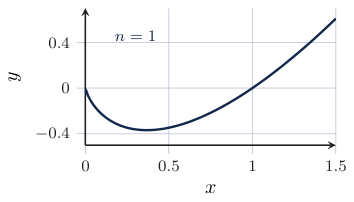
(a) Sketch the curves for n=1,\,2 and 3 for 0<x\le1.5.
[2]
(b) Show, by l'Hôpital's rule, that \displaystyle\lim_{x\to0^+}x^n\ln x=0.
[4]
(c) Show that the minimum point of the curve is \left(e^{-1/n},\ -\dfrac{1}{ne}\right).
[4]
(d) Show that, as n varies, the minimum points lie on the curve y=\dfrac{\ln x}{e}.
[2]
(e) For n=2,\,3,\,4 and 5, use your GDC to locate the point of inflexion and to calculate \ln x at each. Suggest an expression in terms of n for its x-coordinate.
[3]
(f) Prove your suggestion in part (e).
[4]
(g) Show that \displaystyle\int_0^1x^n\ln x\,\mathrm{d}x=-\dfrac{1}{(n+1)^2}.
[5]
(h) Given that \displaystyle\sum_{k=1}^{\infty}\dfrac{1}{k^2}=\dfrac{\pi^2}{6}, find the exact value of \displaystyle\sum_{n=1}^{\infty}\int_0^1x^n\ln x\,\mathrm{d}x.
[3]
Show solutionHide solution
(a) Each curve tends to 0 as x\to0^+, is negative for 0<x<1, passes through (1,0) and is positive for x>1 (A1). The lowest points are at \left(\mathrm{e}^{-1},-\mathrm{e}^{-1}\right), \left(\mathrm{e}^{-1/2},-\tfrac{1}{2\mathrm{e}}\right) and \left(\mathrm{e}^{-1/3},-\tfrac{1}{3\mathrm{e}}\right), moving right and getting shallower (A1).
(b) Write x^n\ln x=\dfrac{\ln x}{x^{-n}}, which is \dfrac{-\infty}{\infty} as x\to0^+ (M1). Differentiating top and bottom: \dfrac{1/x}{-nx^{-n-1}} (M1) =-\dfrac{x^n}{n} (A1), which tends to 0 (A1).
(c) \dfrac{\mathrm{d}y}{\mathrm{d}x}=nx^{n-1}\ln x+x^{n-1}=x^{n-1}(n\ln x+1) (M1 A1). This is zero when \ln x=-\dfrac1n, so x=\mathrm{e}^{-1/n}, and it changes from negative to positive there: a minimum (A1). Then y=\left(\mathrm{e}^{-1/n}\right)^n\left(-\tfrac1n\right)=-\dfrac{1}{n\mathrm{e}} (A1).
(d) At the minimum \ln x=-\dfrac1n, so n=-\dfrac1{\ln x} (M1). Then y=-\dfrac1{n\mathrm{e}}=\dfrac{\ln x}{\mathrm{e}} (A1).
(e) The inflexion points have x=0.223,\ 0.435,\ 0.558,\ 0.638 and \ln x=-1.5,\ -0.833,\ -0.583,\ -0.45 (A1 A1). These are -\dfrac32,\,-\dfrac56,\,-\dfrac7{12},\,-\dfrac9{20}, which fit x=\mathrm{e}^{-(2n-1)/(n(n-1))} (A1).
(f) y''=(n-1)x^{n-2}(n\ln x+1)+x^{n-1}\cdot\dfrac nx=x^{n-2}\bigl[n(n-1)\ln x+2n-1\bigr] (M1 A1). This is zero when \ln x=-\dfrac{2n-1}{n(n-1)} (A1). The bracket increases with x, so y'' changes sign there: an inflexion (R1).
(g) Integrate by parts with u=\ln x and \mathrm{d}v=x^n\mathrm{d}x (M1): \left[\dfrac{x^{n+1}}{n+1}\ln x\right]_0^1-\dfrac1{n+1}\displaystyle\int_0^1x^n\,\mathrm{d}x (A1). The bracket is 0 at x=1 because \ln1=0, and 0 at x=0 by part (b) (R1). The remaining integral is \dfrac{1}{n+1} (A1), so the result is -\dfrac{1}{(n+1)^2} (A1).
(h) The sum is -\displaystyle\sum_{n=1}^\infty\dfrac{1}{(n+1)^2}=-\sum_{k=2}^\infty\dfrac1{k^2} (M1). This is -\left(\dfrac{\pi^2}6-1\right) (A1) =1-\dfrac{\pi^2}6 (A1).

Final answer

Logarithmic dips. (b) \frac{\ln x}{x^{-n}}\to-\frac{x^n}{n}\to0. (d) n=-1/\ln x. (e) 0.223,\,0.435,\,0.558,\,0.638: x=\mathrm e^{-(2n-1)/(n(n-1))}. (f) y''=x^{n-2}[n(n-1)\ln x+2n-1]. (g) by parts. (h) 1-\frac{\pi^2}6.

Going further

Beyond the syllabus: the worked examples and investigations of the chapter's Going further pages.

Investigation

[26 marks]
Worked investigation 1: Wobbly lines.
This question asks you to investigate the family of functions f_a(x)=x+a\sin x, 0\le x\le2\pi, where a is a positive real constant.
(a) Sketch y=f_{0.5}(x) and y=f_2(x) together on one set of axes, labelling the coordinates of the end points.
[3]
(b) (i) Show that every member of the family passes through the points (0,0), (\pi,\pi) and (2\pi,2\pi).
[2]
(b) (ii) Show that f_a(2\pi-x)=2\pi-f_a(x), and describe the symmetry of the graph that this shows.
[2]
(c) Show that, for every value of a, the only point of inflexion of the graph with 0<x<2\pi is at (\pi,\pi).
[3]
(d) Use your GDC to find the number of stationary points with 0<x<2\pi for a=0.5,\,1,\,1.5 and 2. Hence suggest a condition on a for the graph to have two stationary points.
[3]
(e) Prove that the graph has stationary points with 0<x<2\pi if and only if a\ge1, and find their x-coordinates in terms of a when a>1.
[4]
(f) Show that, for a>1, every stationary point lies on the curve y=x-\tan x.
[3]
(g) Find the exact coordinates of the local maximum point and the local minimum point of y=f_2(x).
[3]
(h) Find the greatest value of a for which the graph of y=f_a(x) is contained in the square 0\le x\le2\pi, 0\le y\le2\pi.
[3]
Show solutionHide solution
(a) Both curves start at (0,0) and end at (2\pi,2\pi); both cross at (\pi,\pi) (A1); a=0.5: increasing throughout (A1); a=2: rises to a maximum, falls to a minimum, then rises again (A1).
(b) (i) \sin0=\sin\pi=\sin2\pi=0 (M1); so f_a(0)=0, f_a(\pi)=\pi and f_a(2\pi)=2\pi for every a (A1).
(b) (ii) f_a(2\pi-x)=2\pi-x+a\sin(2\pi-x)=2\pi-x-a\sin x=2\pi-f_a(x) (A1); rotational symmetry of order 2 about (\pi,\pi) (R1).
(c) f_a'(x)=1+a\cos x and f_a''(x)=-a\sin x (A1); f_a''(x)=0 for 0<x<2\pi only at x=\pi (M1); \sin x changes sign at \pi, so f_a'' does too: an inflexion at (\pi,\pi) (R1).
(d) GDC, number of stationary points: a=0.5: 0; a=1: 1; a=1.5: 2; a=2: 2 (A1 A1); Conjecture: two stationary points when a>1 (A1).
(e) f_a'(x)=0\iff\cos x=-\dfrac1a (M1); A solution needs -1\le-\dfrac1a\le1, that is a\ge1 (as a>0); conversely, if a\ge1 then -\dfrac1a\in[-1,0) and a solution exists (R1); For a>1: x=\arccos\!\left(-\dfrac1a\right) or x=2\pi-\arccos\!\left(-\dfrac1a\right) (A1 A1).
(f) At a stationary point \cos x=-\dfrac1a, so a=-\dfrac1{\cos x} (M1); y=x+a\sin x=x-\dfrac{\sin x}{\cos x} (A1); y=x-\tan x (AG); \cos x\ne0 because \cos x=-\dfrac1a (R1).
(g) a=2: \cos x=-\dfrac12, so x=\dfrac{2\pi}3 or \dfrac{4\pi}3 (A1); f_2''\!\left(\dfrac{2\pi}3\right)=-2\sin\dfrac{2\pi}3<0: local maximum at \left(\dfrac{2\pi}3,\ \dfrac{2\pi}3+\sqrt3\right) (A1); local minimum at \left(\dfrac{4\pi}3,\ \dfrac{4\pi}3-\sqrt3\right) (A1).
(h) Local maximum value M(a)=\arccos\!\left(-\dfrac1a\right)+\sqrt{a^2-1} (M1); Solve M(a)=2\pi: a=4.60 (A1); M increases with a; by (b)(ii) the local minimum is 2\pi-M(a), so it stays above 0 exactly when M(a)\le2\pi (R1).

Final answer

(a) sketch; (b) proofs; (c) proof; (d) 0, 1, 2, 2; two stationary points when a>1; (e) x=\arccos(-1/a) and 2\pi-\arccos(-1/a); (f) proof; (g) \left(\tfrac{2\pi}3,\tfrac{2\pi}3+\sqrt3\right) and \left(\tfrac{4\pi}3,\tfrac{4\pi}3-\sqrt3\right); (h) a=4.60.

Investigation

[23 marks]
Worked investigation 2: A parabola that slides.
This question asks you to investigate a family of parabolas whose vertex moves along a straight line. For t\in\mathbb{R}, the curve P_t has equation y=(x-t)^2+2t.
(a) On the same axes, sketch P_0, P_1 and P_2, labelling each vertex.
[2]
(b) Show that the vertex of each curve P_t is a point of the line y=2x.
[1]
(c) Show that, for s\ne t, the curves P_s and P_t meet at exactly one point, and find its x-coordinate in terms of s and t.
[3]
(d) Use your GDC to draw the line y=2x+c with several members of the family, for different values of c. Suggest a value of c for which the line appears to touch every member.
[3]
(e) Prove that the line y=2x-1 is a tangent to every curve P_t, and find the point of contact in terms of t.
[4]
Now consider the family Q_t: y=(x-t)^2+mt, where m is a non-zero constant.
(f) Find the equation of the line that is a tangent to every curve Q_t, giving your answer in terms of m.
[5]
(g) For the family P_t, find the set of points (p,q) that lie on exactly two members, exactly one member and no member.
[5]
Show solutionHide solution
(a) Three congruent upward parabolas with vertices (0,0), (1,2) and (2,4) (A1 A1).
(b) Vertex of P_t is (t,2t); its y-coordinate is twice its x-coordinate (A1).
(c) (x-s)^2+2s=(x-t)^2+2t\Rightarrow-2sx+s^2+2s=-2tx+t^2+2t (M1); 2x(t-s)=(t-s)(t+s)+2(t-s) (M1); since t\ne s: x=\dfrac{s+t}2+1, one solution, so one point (A1).
(d) GDC: for c=0 the line cuts each member twice; for c=-2 it misses them all (A1 A1); c=-1 appears to touch every member (A1).
(e) (x-t)^2+2t=2x-1\Rightarrow x^2-2(t+1)x+(t+1)^2=0 (M1 A1); (x-(t+1))^2=0: a repeated root, so the line is a tangent (R1); point of contact (t+1,\ 2t+1) (A1).
(f) Suppose y=mx+c touches every Q_t: (x-t)^2+mt=mx+c, so x^2-(2t+m)x+t^2+mt-c=0 (M1); \Delta=(2t+m)^2-4(t^2+mt-c)=m^2+4c (A1); Tangent for all t iff m^2+4c=0, so c=-\dfrac{m^2}4 (M1 A1); The line is y=mx-\dfrac{m^2}4 (A1).
(g) (p,q) lies on P_t iff q=(p-t)^2+2t, that is t^2-2(p-1)t+p^2-q=0 (M1 A1); Discriminant 4(p-1)^2-4(p^2-q)=4(q-2p+1) (A1); Two members if q>2p-1; one if q=2p-1; none if q<2p-1 (A1); Points above the common tangent lie on two members, points on it on one, points below on none (R1).

Final answer

(b) proof; (c) x=\tfrac{s+t}2+1; (d) c=-1; (e) contact point (t+1,2t+1); (f) y=mx-\tfrac{m^2}4; (g) two members if q>2p-1, one if q=2p-1, none if q<2p-1.

Investigation

[25 marks]
Worked investigation 3: Partial sums of the exponential series.
This question asks you to investigate the real zeros of the polynomials p_n(x)=\displaystyle\sum_{k=0}^{n}\frac{x^k}{k!}=1+x+\frac{x^2}{2!}+\dots+\frac{x^n}{n!}, where n\in\mathbb{Z}^+.
(a) Write down p_1(x), p_2(x) and p_3(x), and sketch the graphs of y=p_2(x) and y=p_3(x) on the same axes.
[3]
(b) Show that p_n'(x)=p_{n-1}(x) for n\ge2.
[2]
(c) Use your GDC to find the number of real zeros of p_n for n=1,2,\dots,6. Suggest a rule for the number of real zeros of p_n.
[3]
(d) Show that p_n(x)=p_{n-1}(x)+\dfrac{x^n}{n!}. Hence show that, at any stationary point of y=p_n(x), the value of p_n(x) is \dfrac{x^n}{n!}.
[3]
(e) Prove that, when n is even, p_n(x)>0 for all x\in\mathbb{R}.
[5]
(f) Hence prove that, when n is odd, p_n has exactly one real zero.
[4]
(g) Let r_n be the real zero of p_n for odd n. Find r_3, r_5 and r_7.
[3]
(h) Explain why the zeros r_n cannot approach a finite limit as n increases through odd values.
[2]
Show solutionHide solution
(a) p_1=1+x, \ p_2=1+x+\dfrac{x^2}2, \ p_3=1+x+\dfrac{x^2}2+\dfrac{x^3}6 (A1); p_2: parabola above the x-axis with minimum point \left(-1,\tfrac12\right) (A1); p_3: increasing cubic crossing the x-axis once, near -1.6 (A1).
(b) \dfrac{\mathrm{d}}{\mathrm{d}x}\dfrac{x^k}{k!}=\dfrac{kx^{k-1}}{k!}=\dfrac{x^{k-1}}{(k-1)!} for k\ge1; the constant term gives 0 (M1); p_n'(x)=\displaystyle\sum_{k=1}^{n}\frac{x^{k-1}}{(k-1)!}=p_{n-1}(x) (A1).
(c) GDC, real zeros: n=1: 1; n=2: 0; n=3: 1; n=4: 0; n=5: 1; n=6: 0 (A1 A1); Conjecture: one real zero when n is odd, none when n is even (A1).
(d) p_n(x) is p_{n-1}(x) plus its last term, \dfrac{x^n}{n!} (A1); At a stationary point p_n'(x)=p_{n-1}(x)=0 (M1); so p_n(x)=0+\dfrac{x^n}{n!}=\dfrac{x^n}{n!} (A1).
(e) n even: the leading term is positive, so p_n(x)\to+\infty as x\to\pm\infty (R1); so p_n has a global minimum, at a stationary point x=c (R1); p_n(c)=\dfrac{c^n}{n!}\ge0 because n is even (M1); p_n(c)=0 would need c=0, but p_n(0)=1 (R1); so the minimum is positive and p_n(x)>0 for all x (A1).
(f) n odd: p_n'(x)=p_{n-1}(x)>0 for all x, since n-1 is even (part (e); for n=1, p_1'=1>0) (M1 R1); so p_n is strictly increasing and has at most one zero (R1); odd degree: p_n\to-\infty as x\to-\infty and +\infty as x\to+\infty; by continuity there is a zero (R1).
(g) r_3=-1.60, \ r_5=-2.18, \ r_7=-2.76 (A1 A1 A1).
(h) For any fixed x, p_n(x)\to\mathrm{e}^x>0 as n grows (R1); if r_n\to L then near L the values p_n(r_n)=0 would be close to \mathrm{e}^L\ne0: a contradiction, so r_n has no finite limit (R1).

Final answer

(a) sketch; (b), (d), (e), (f), (h) proofs; (c) 1, 0, 1, 0, 1, 0: one zero when n is odd, none when n is even; (g) r_3=-1.60, r_5=-2.18, r_7=-2.76.

From the book

Photon Guidebook: Mathematics HL Paper 3 for the IB Diploma

Chapter 2 teaches families of curves: explore, conjecture, justify: how the IB builds this kind of Paper 3 question, the techniques, marked worked investigations, and practice investigations like these.

About the book