Free worked solutions · 2026 Edition

IB Maths AI SL Chapter 14: Integration worked solutions

Worked solutions to the practice questions in Chapter 14 of Photon Guidebook: Mathematics Applications and Interpretation SL for the IB Diploma (2026 Edition). Each solution shows every step with the mark it earns, the way an IB mark scheme does.

  • Chapter 14 of 15
  • 24 practice questions
  • 3 Going further
  • Free, no sign-up

Basics

One idea at a time, in the order the chapter teaches them.

Question 1

[2 marks]
Find \int(6x^{-3})\,dx.
[2]
Show solutionHide solution
6x^{-2}/(-2)+C.
M1
-3x^{-2}+C.
A1

Final answer

-3x^{-2}+c.

Question 2

[3 marks]
F'(x)=6x+5 and F(2)=19.
Find F(x).
[3]
Show solutionHide solution
F(x)=3x^2+5x+C.
M1
19=12+10+C, so C=-3.
A1
F(x)=3x^2+5x-3.
A1

Final answer

F(x)=3x^2+5x-3.

Question 3

[3 marks]
Evaluate \int_2^5(4x-1)\,dx.
[3]
Show solutionHide solution
F(x)=2x^2-x.
M1
F(5)-F(2)=45-6.
M1
39.
A1

Final answer

39.

Question 4

[3 marks]
The curve y=3x^2+2 is above the x-axis.
Find the area under the curve from x=0 to x=2.
[3]
Show solutionHide solution
A=\int_0^2(3x^2+2)\,dx.
M1
[x^3+2x]_0^2.
M1
A=12 square units.
A1

Final answer

12 square units.

Question 5

[3 marks]
A curve is y=x^2+1. A horizontal line y=5 cuts it at x=-2 and x=2.
Find the area of the bounded region.
[3]
Show solutionHide solution
A=\int_{-2}^2(5-(x^2+1))\,dx.
M1
[4x-x^3/3]_{-2}^2.
M1
A=32/3 square units.
A1

Final answer

\frac{32}{3}\approx10.7 square units.

Question 6

[3 marks]
\int_0^b 6x^2\,dx=128, where b>0.
Find b.
[3]
Show solutionHide solution
[2x^3]_0^b=128.
M1
b^3=64.
M1
b=4.
A1

Final answer

b=4.

Question 7

[3 marks]
A coating rate is r(t)=4t+7 grams per minute, for 0\le t\le3.
Find the mass applied in the first 3 minutes.
[3]
Show solutionHide solution
m=\int_0^3(4t+7)\,dt.
M1
[2t^2+7t]_0^3.
M1
m=39 grams.
A1

Final answer

39 grams.

Question 8

[3 marks]
A pond cross-section has measured depths in metres at equally spaced horizontal distances.
\begin{array}{c|ccccc}x&0&2&4&6&8\\\hline d&0&1.7&2.4&1.1&0\end{array}
Estimate the cross-sectional area.
[3]
Show solutionHide solution
h=2 m.
A1
A=\tfrac22(0+0+2(1.7+2.4+1.1)).
M1
A\approx10.4\text{ m}^2.
A1

Final answer

10.4\ \text{m}^2.

Question 9

[5 marks]
f(x)=x^2+2 on 0\le x\le2.
(a) Use two strips to estimate the integral.
[3]
(b) The exact integral is 20/3. Find the percentage error of your estimate.
[2]
Show solutionHide solution
(a) h=1; ordinates 2,3,6.
A1
T=\tfrac12(2+6+2\cdot3).
M1
T=7.
A1
(b) 100|7-20/3|/(20/3).
M1
5%.
A1

Final answer

(a) 7. (b) 5%.

Tutorial

Exam-style questions on each question type, with the marks the IB would give.

Question 10

[4 marks]
Find each indefinite integral, giving your answer without negative powers.
(a) \displaystyle\int \dfrac{4}{x^{2}}\,dx
[2]
(b) \displaystyle\int \Bigl(x^{3} + \dfrac{3}{x^{4}}\Bigr)\,dx
[2]
Show solutionHide solution
(a) Write the integrand as 4x^{-2}.
M1[1]
\displaystyle\int 4x^{-2}\,dx = \dfrac{4x^{-1}}{-1} + c = -\dfrac{4}{x} + c.
A1[1]
(b) Write \dfrac{3}{x^4} = 3x^{-4}: \displaystyle\int (x^3 + 3x^{-4})\,dx = \dfrac{x^4}{4} + \dfrac{3x^{-3}}{-3} + c.
M1[1]
= \dfrac{x^4}{4} - \dfrac{1}{x^3} + c.
A1[1]

Final answer

(a) -\frac4x+c. (b) \frac{x^4}{4}-\frac{1}{x^3}+c.

Question 11

[7 marks]
Wei Jie keeps a beehive on a roof terrace. The mass M kg of honey stored in the hive changes at a rate of
\frac{dM}{dt} = 0.6 - 0.04t,
where t is the number of days after he first weighs the hive. At t = 0 the hive holds 18 kg of honey.
(a) Find an expression for M in terms of t.
[3]
(b) Find the mass of honey in the hive when t = 10.
[1]
(c) Use your GDC to find the greatest mass of honey in the hive, and the day on which this occurs. You may assume that the model is valid for 0 \le t \le 30.
[3]
Show solutionHide solution
(a) M = \displaystyle\int (0.6 - 0.04t)\,dt = 0.6t - 0.02t^2 + c. M1A1
[2]
When t = 0, M = 18, so c = 18 and M = 18 + 0.6t - 0.02t^2.
A1[1]
(b) M(10) = 18 + 6 - 2 = 22 kg.
A1[1]
(c) The mass is greatest when \dfrac{dM}{dt} = 0 (or: plot M on the GDC and find the maximum).
M1[1]
0.6 - 0.04t = 0 \Rightarrow t = 15 days.
A1[1]
M(15) = 18 + 9 - 4.5 = 22.5 kg.
A1[1]
The mass is greatest on day 15, at 22.5 kg (the graph is a downward parabola, so this is a maximum).

Final answer

(a) M=18+0.6t-0.02t^2. (b) 22 kg. (c) Day 15, 22.5 kg.

Question 12

[7 marks]
A curve y = f(x) has gradient function f'(x) = 3x^{2} - 2x + a, where a is a constant. The tangent to the curve at the point where x = 1 has equation y = 4x - 2.
(a) Find the value of a.
[2]
(b) Find f(x).
[4]
(c) State where the curve crosses the y-axis, as a coordinate pair.
[1]
Show solutionHide solution
(a) The gradient of the tangent is 4, so f'(1) = 4: 3 - 2 + a = 4.
M1[1]
a = 3.
A1[1]
(b) f(x) = \displaystyle\int (3x^2 - 2x + 3)\,dx = x^3 - x^2 + 3x + c. M1A1
[2]
The tangent touches the curve at x = 1, where y = 4(1) - 2 = 2, so f(1) = 2: 1 - 1 + 3 + c = 2.
M1[1]
c = -1, so f(x) = x^3 - x^2 + 3x - 1.
A1[1]
(c) f(0) = -1, so the curve crosses the y-axis at (0,\,-1).
A1[1]

Final answer

(a) a=3. (b) f(x)=x^3-x^2+3x-1. (c) (0,-1).

Question 13

[4 marks]
Use your GDC to answer the following. Write down the integral that you enter.
(a) Evaluate \displaystyle\int_{1}^{5} \bigl(0.2x^{3} - 0.7x^{2} + 3\bigr)\,dx, giving your answer to 3 significant figures.
[2]
(b) Find the value of k > 0 for which \displaystyle\int_{0}^{k} \bigl(0.5x^{2} + 1\bigr)\,dx = 20.
[2]
Show solutionHide solution
(a) Enter \displaystyle\int_1^5 (0.2x^3 - 0.7x^2 + 3)\,dx on the GDC.
M1[1]
The calculator gives 14.2666\ldots = 14.3 (3 s.f.).
A1[1]
(b) \displaystyle\int_0^k (0.5x^2 + 1)\,dx = \dfrac{k^3}{6} + k, so solve \dfrac{k^3}{6} + k = 20 (or plot y = \int_0^x(0.5t^2+1)\,dt and y = 20 and find the intersection).
M1[1]
k = 4.53 (3 s.f.).
A1[1]

Final answer

(a) 14.3. (b) k=4.53.

Question 14

[5 marks]
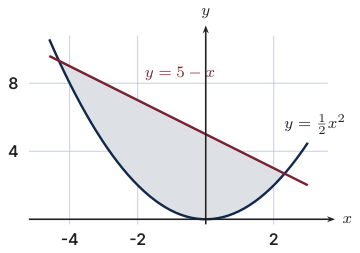
A garden architect plans a pond. On a plan with both axes in metres, the pond is the region enclosed between the straight path y = 5 - x and the curved wall y = \tfrac12 x^{2}.
Original Photon diagram
The pond between the path and the wall. Lengths in metres.
(a) Find the x-coordinates of the points where the path meets the wall.
[2]
(b) Find the area of the pond.
[2]
(c) Explain how you know that the path is above the wall between these two points.
[1]
Show solutionHide solution
(a) Solve \tfrac12x^2 = 5 - x on the GDC (intersection of the two graphs), or x^2 + 2x - 10 = 0.
M1[1]
x = -4.32 and x = 2.32 (3 s.f.).
A1[1]
(b) Area = \displaystyle\int_{-4.3166}^{2.3166} \bigl((5 - x) - \tfrac12x^2\bigr)\,dx
M1[1]
= 24.3 \text{m}^2 (3 s.f.; 24.32).
A1[1]
(c) At x = 0 the path has y = 5 and the wall has y = 0, and the graphs do not cross between the intersection points.
R1[1]

Final answer

(a) −4.32 and 2.32. (b) 24.3\ \text{m}^2. (c) At x=0 the path is at height 5 and the wall at 0.

Question 15

[7 marks]
Aisha manages a community wind turbine. On a windy day the power P kilowatts (kW) produced by the turbine is modelled by
P(t) = 4.8t - 0.4t^{2}, \qquad 0 \le t \le 12,
where t is the number of hours after 06:00. The energy produced, in kilowatt-hours (kWh), is the integral of the power with respect to time.
(a) Find the total energy produced between 06:00 and 18:00.
[2]
(b) Find the energy produced between 08:00 and 10:00.
[2]
(c) The turbine's battery bank holds 60 kWh. Find the time, in hours after 06:00, at which the energy produced since 06:00 first reaches 60 kWh. Give your answer to 3 significant figures.
[3]
Show solutionHide solution
(a) Energy = \displaystyle\int_0^{12} (4.8t - 0.4t^2)\,dt.
M1[1]
= 115.2 kWh.
A1[1]
(b) 08:00 to 10:00 is t = 2 to t = 4: \displaystyle\int_2^4 (4.8t - 0.4t^2)\,dt.
M1[1]
= 21.333\ldots = 21.3 kWh.
A1[1]
(c) Solve \displaystyle\int_0^{T} (4.8t - 0.4t^2)\,dt = 60, that is 2.4T^2 - \dfrac{2}{15}T^3 = 60. M1A1
[2]
Using the GDC (intersection of y = 2.4x^2 - \frac{2}{15}x^3 and y = 60, with 0 < x < 12): T = 6.17 hours, which is about 12:10.
A1[1]

Final answer

(a) 115.2 kWh. (b) 21.3 kWh. (c) 6.17 hours after 06:00.

Question 16

[6 marks]
An archaeologist digs a trench 12 m long. The depth d metres of the trench is measured at equal intervals across its width, where x is the distance in metres from one edge.
\begin{array}{r|ccccccc} x\ (\text{m}) & 0 & 0.8 & 1.6 & 2.4 & 3.2 & 4.0 & 4.8 \\ \hline d\ (\text{m}) & 0 & 0.9 & 1.4 & 1.7 & 1.5 & 0.8 & 0 \end{array}
(a) Use the trapezoidal rule to estimate the area of the cross-section of the trench.
[3]
(b) Hence estimate the volume of soil removed.
[2]
(c) Removing soil costs $85 per cubic metre. Find the cost of removing all the soil.
[1]
Show solutionHide solution
(a) Seven readings give six strips, each of width h = 0.8.
A1[1]
Area \approx \dfrac{0.8}{2}\bigl(0 + 0 + 2(0.9 + 1.4 + 1.7 + 1.5 + 0.8)\bigr).
M1[1]
= 0.4 \times 12.6 = 5.04 \text{m}^2.
A1[1]
(b) Volume \approx 5.04 \times 12
M1[1]
= 60.48 \approx 60.5 \text{m}^3.
A1[1]
(c) Cost = 60.48 \times 85 = \$5140.80.
A1[1]

Final answer

(a) 5.04\ \text{m}^2. (b) 60.5\ \text{m}^3. (c) USD 5140.80.

Question 17

[6 marks]
Let f(x) = 12 - x^{2}.
(a) Use the trapezoidal rule with three strips to estimate \displaystyle\int_0^{3} f(x)\,dx.
[3]
(b) Use your GDC to find the exact value of the integral.
[1]
(c) State whether your estimate in part (a) is an over-estimate or an under-estimate. Give a reason.
[2]
Show solutionHide solution
(a) h = 1 and the ordinates are f(0) = 12, f(1) = 11, f(2) = 8, f(3) = 3.
A1[1]
\displaystyle\int_0^3 f\,dx \approx \dfrac{1}{2}\bigl(12 + 3 + 2(11 + 8)\bigr).
M1[1]
= 26.5.
A1[1]
(b) \displaystyle\int_0^3 (12 - x^2)\,dx = 27.
A1[1]
(c) It is an under-estimate (26.5 < 27).
A1[1]
The graph of y = 12 - x^2 is concave down (a \cap shape), so each chord lies below the curve.
R1[1]

Final answer

(a) 26.5. (b) 27. (c) An under-estimate: the graph bends downward, so each chord lies below it.

Question 18

[8 marks]
Mehmet models the width w metres of a lake, at distance x metres from its northern shore, by w(x) = 30 + 2x - 0.02x^{2} for 0 \le x \le 100. The surface area of the lake is \displaystyle\int_0^{100} w\,dx. With four strips the trapezoidal rule gives an estimate of 6125 \text{m}^2.
(a) Use the trapezoidal rule with eight strips to estimate the surface area.
[3]
(b) Use your GDC to find the surface area, and hence find the percentage error in the estimates with four strips and with eight strips.
[3]
(c) State whether both estimates are over-estimates or under-estimates, giving a reason, and describe the effect of doubling the number of strips on the percentage error.
[2]
Show solutionHide solution
(a) h = 12.5. The ordinates are 30, 51.875, 67.5, 76.875, 80, 76.875, 67.5, 51.875, 30.
A1[1]
Area \approx \dfrac{12.5}{2}\bigl(30 + 30 + 2(51.875 + 67.5 + 76.875 + 80 + 76.875 + 67.5 + 51.875)\bigr).
M1[1]
= 6.25 \times 1005 = 6281.25 \approx 6280 \text{m}^2.
A1[1]
(b) The GDC gives \displaystyle\int_0^{100} w\,dx = 6333.33\ldots \text{m}^2.
A1[1]
Four strips: \dfrac{6333.33 - 6125}{6333.33} \times 100\% = 3.29\%.
A1[1]
Eight strips: \dfrac{6333.33 - 6281.25}{6333.33} \times 100\% = 0.822\%.
A1[1]
(c) Both are under-estimates, because w is a downward parabola (concave down), so the chords lie below the curve.
A1[1]
Doubling the number of strips reduces the percentage error to about one quarter of its value (3.29\% \to 0.822\%).
R1[1]

Final answer

(a) 6280\ \text{m}^2 (6281.25). (b) 6330\ \text{m}^2 (6333.33); errors 3.29% and 0.822%. (c) Both are under-estimates; the error falls to about a quarter.

Mastery

Full exam questions that mix question types, at Paper 1 and Paper 2 standard.

Question 19

[6 marks]
A workshop's marginal cost of producing the xth chair is modelled by
C'(x)=50-0.02x\quad(\text{dollars per chair}).
The fixed set-up cost (when no chairs are produced) is $300.
(a) Find an expression for the total cost C(x) of producing x chairs.
[4]
(b) Find the total cost of producing the first 100 chairs.
[2]
Show solutionHide solution
(a) C(x)=\displaystyle\int (50-0.02x)\,dx = 50x-0.01x^{2}+C.
Fixed cost gives C(0)=300, so C=300:
C(x)=50x-0.01x^{2}+300.
[4]
(b) C(100)=50(100)-0.01(100)^{2}+300=5000-100+300=5200.
The total cost is $5200.00.
[2]

Final answer

(a) C(x)=50x-0.01x^2+300. (b) USD 5200.00.
Question 20

[6 marks]
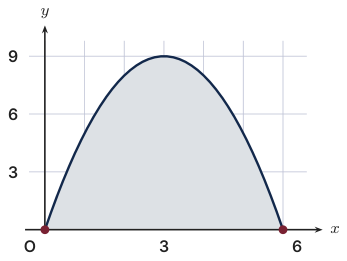
An architect designs an arched window whose upper edge follows the curve
y=6x-x^{2},
where x and y are in metres and the curve meets the floor (the x-axis) at its two ends.
Original Photon diagram
The arched window. Lengths in metres.
(a) Find the x-coordinates of the two points where the curve meets the x-axis.
[2]
(b) Find the exact area of the glass, i.e. the region enclosed between the curve and the x-axis.
[4]
Show solutionHide solution
(a) Set y=0: 6x-x^{2}=x(6-x)=0, so x=0 or x=6.
[2]
(b) Area =\displaystyle\int_0^6 (6x-x^{2})\,dx=\Big[3x^{2}-\tfrac{x^{3}}{3}\Big]_0^6.
=\big(3(36)-\tfrac{216}{3}\big)-0=108-72=36.
The area of the glass is 36\ \text{m}^2.
[4]

Final answer

(a) x=0 and x=6. (b) 36\ \text{m}^2.

Question 21

[10 marks]
The power output P (in watts) of a rooftop solar panel is recorded every 2 hours during daylight, as shown in the table. Time t is measured in hours after midnight.
\begin{array}{r|cccc} t\ (\text{h}) & 6 & 8 & 10 & 12 \\ \hline P\ (\text{W}) & 0 & 220 & 480 & 610 \end{array}
\begin{array}{r|ccc} t\ (\text{h}) & 14 & 16 & 18 \\ \hline P\ (\text{W}) & 500 & 240 & 0 \end{array}
The total energy generated (in watt-hours) equals the area under the power–time graph.
(a) Use the trapezoidal rule with all seven readings to estimate the total energy generated between t=6 and t=18, in watt-hours.
[4]
(b) Convert your answer to kilowatt-hours (kWh).
[2]
(c) Electricity from the grid costs $0.28 per kWh. Estimate the daily saving from using the solar panel.
[2]
(d) Explain briefly why using more frequent readings would improve the estimate.
[2]
Show solutionHide solution
(a) With h=2:
E\approx\frac{2}{2}\big(0+0+2(220+480+610+500+240)\big)=1\times(2\times 2050)=4100\ \text{Wh}.
[4]
(b) 4100\ \text{Wh}=4100\div 1000=4.1\ \text{kWh}.
[2]
(c) Saving =4.1\times 0.28=1.148\approx\$1.15 per day.
[2]
(d) More frequent readings mean narrower strips, so the straight trapezoid tops follow the curved graph more closely, reducing the error in the estimate.
[2]

Final answer

(a) 4100 Wh. (b) 4.1 kWh. (c) USD 1.15. (d) Narrower strips follow the curve more closely.

Question 22

[12 marks]
A curved side panel of a footbridge is cut from sheet metal. Its top edge is modelled by h(x)=0.04x^{2}-0.4x+3, where x is the distance in metres along the panel, 0\le x\le10, and h(x) is the height of the panel in metres. The panel lies between the x-axis and this edge.
(a) Copy and complete the table of values of h(x).
[2]
\begin{array}{r|cccccc} x & 0 & 2 & 4 & 6 & 8 & 10 \\ \hline h(x) & 3 & & 2.04 & & 2.36 & 3 \end{array}
(b) Use the trapezoidal rule with all six values to estimate the area of the panel.
[3]
(c) Write down an integral for the exact area of the panel and find its value.
[3]
(d) Find the percentage error in the estimate from part (b).
[2]
(e) Explain why the estimate in part (b) is larger than the exact area.
[1]
The metal costs 18 SGD per square metre.
(f) Find the cost of the metal for one panel, using the exact area.
[1]
Show solutionHide solution
(a) h(2)=2.36 and h(6)=2.04.
A1A1
(b) h=2 m between the values.
A1
\dfrac22\bigl[3+3+2(2.36+2.04+2.04+2.36)\bigr].
M1
=23.6\ \text{m}^2.
A1
(c) \displaystyle\int_0^{10}(0.04x^{2}-0.4x+3)\,dx.
M1
=\Bigl[\dfrac{0.04x^{3}}{3}-0.2x^{2}+3x\Bigr]_0^{10}.
A1
=\dfrac{70}{3}=23.3\ \text{m}^2 (3 s.f.).
A1
(d) \dfrac{23.6-23.333\ldots}{23.333\ldots}\times100.
M1
=1.14\%.
A1
(e) The edge bends upward, so each chord lies above the curve and the trapezia contain more than the region.
R1
(f) 18\times\dfrac{70}{3}=420 SGD.
A1

Final answer

(a) 2.36 and 2.04. (b) 23.6\ \text{m}^2. (c) \frac{70}{3}\approx23.3\ \text{m}^2. (d) 1.14%. (e) The edge bends upward, so the chords lie above it. (f) 420 SGD.

Question 23

[14 marks]
A garden designer models the width w metres of a lawn, measured at a distance x metres from one end, by
w(x) = 4 + 0.9x - 0.025x^{2}, \qquad 0 \le x \le 30.
The table shows values of w at 5 m intervals.
\begin{array}{r|cccc} x\ (\text{m}) & 0 & 5 & 10 & 15 \\ \hline w\ (\text{m}) & 4 & 7.875 & 10.5 & 11.875 \end{array}
\begin{array}{r|ccc} x\ (\text{m}) & 20 & 25 & 30 \\ \hline w\ (\text{m}) & 12 & 10.875 & 8.5 \end{array}
(a) Write down an integral that gives the area of the lawn.
[1]
(b) Use the trapezoidal rule with six strips to estimate the area of the lawn.
[3]
(c) Use your GDC to find the area of the lawn.
[2]
(d) Find the percentage error in your estimate in part (b).
[2]
(e) State whether the estimate is an over-estimate or an under-estimate, and explain why.
[2]
The designer wants the percentage error to be below 0.5%. She repeats the estimate with twelve strips (width 2.5 m) and obtains 299.22 \text{m}^2.
(f) Show that twelve strips meet her target.
[2]
(g) Grass seed is sold in bags that each cover 25 \text{m}^2, at $31.40 per bag. Using the area from part (c), find the number of bags needed and their total cost.
[2]
Show solutionHide solution
(a) A = \displaystyle\int_0^{30} w(x)\,dx = \displaystyle\int_0^{30} (4 + 0.9x - 0.025x^2)\,dx.
A1[1]
(b) Six strips of width h = 5.
A1[1]
A \approx \dfrac{5}{2}\bigl(4 + 8.5 + 2(7.875 + 10.5 + 11.875 + 12 + 10.875)\bigr).
M1[1]
= 2.5 \times 118.75 = 296.875 \approx 297 \text{m}^2.
A1[1]
(c) Enter \displaystyle\int_0^{30} (4 + 0.9x - 0.025x^2)\,dx on the GDC.
M1[1]
A = 300 \text{m}^2.
A1[1]
(d) \dfrac{|300 - 296.875|}{300} \times 100\%
M1[1]
= 1.04\%.
A1[1]
(e) It is an under-estimate (296.875 < 300).
A1[1]
The graph of w is a downward parabola (concave down), so the chords lie below the curve.
R1[1]
(f) Percentage error = \dfrac{300 - 299.22}{300} \times 100\%
M1[1]
= 0.26\%, which is less than 0.5%.
R1[1]
(g) 300 \div 25 = 12 bags,
A1[1]
and the cost is 12 \times 31.40 = \$376.80.
A1[1]

Final answer

(a) \int_0^{30}w\,dx. (b) 297\ \text{m}^2 (296.875). (c) 300\ \text{m}^2. (d) 1.04%. (e) An under-estimate: the curve bends downward. (f) 0.26\%<0.5\%. (g) 12 bags, USD 376.80.

Question 24

[16 marks]
An irrigation canal is 10 m wide. Soo-Jin, an engineer, measures its depth every 2 m across the canal.
\begin{array}{r|cccccc} \text{distance (m)} & 0 & 2 & 4 & 6 & 8 & 10 \\ \hline \text{depth (m)} & 0 & 1.44 & 2.16 & 2.16 & 1.44 & 0 \end{array}
(a) Use the trapezoidal rule with all six depths to estimate the area of the cross-section.
[3]
Soo-Jin models the bed by d(x)=0.09x(10-x).
(b) Write down an integral that gives the area of the cross-section, and find its value.
[2]
(c) Find the percentage error in the estimate from part (a).
[2]
(d) Explain why the estimate in part (a) is smaller than the value in part (b).
[1]
The water flows along the canal at 0.8 metres per second.
(e) Using your answer to part (b), find the volume of water that passes a point on the canal each second.
[2]
A farmer pumps water from the canal at a rate of r(t)=30t-3t^2 cubic metres per hour, t hours after the pump starts, for 0\le t\le10.
(f) Find the total volume of water pumped in the 10 hours.
[3]
(g) Find the time at which 300 cubic metres have been pumped.
[2]
(h) Suggest one reason why the model in part (b) may not describe the real canal.
[1]
Show solutionHide solution
(a) h=2 m.
A1
\dfrac22\bigl[0+0+2(1.44+2.16+2.16+1.44)\bigr].
M1
=14.4\ \text{m}^2.
A1
(b) \displaystyle\int_0^{10}0.09x(10-x)\,dx.
A1
=15\ \text{m}^2.
A1
(c) \dfrac{15-14.4}{15}\times100.
M1
=4\%.
A1
(d) The bed bends downward, so the chords lie inside the water and the trapezia miss some area.
R1
(e) 15\times0.8.
M1
=12\ \text{m}^3 per second.
A1
(f) \displaystyle\int_0^{10}(30t-3t^2)\,dt.
M1
=\bigl[15t^2-t^3\bigr]_0^{10}.
M1
=500\ \text{m}^3.
A1
(g) 15T^2-T^3=300.
M1
T=5.67 hours.
A1
(h) For example, a real bed is not a perfect parabola, silt and weeds change the depth, or the depth changes along the canal.
R1

Final answer

(a) 14.4\ \text{m}^2. (b) 15\ \text{m}^2. (c) 4%. (d) The bed bends downward, so the chords lie inside the water. (e) 12\ \text{m}^3 per second. (f) 500\ \text{m}^3. (g) 5.67 hours. (h) For example, a real bed is not a perfect parabola.

Going further

Beyond the syllabus: the worked examples and investigations of the chapter's Going further pages.

G1 Halving an area is not halving the width

G1 Worked

[6 marks]
Ayesha plans a flower bed. It is the region between the ground, the lines x=0 and x=3, and the curve y=2.4-0.2x^2, with lengths in metres. She wants to divide it into two beds of equal area with a straight edge along the line x=k.
(a) Find the area of the whole bed.
[2]
(b) Write down an equation for k, and find k.
[3]
(c) Explain why k is less than 1.5.
[1]
Show solutionHide solution
(a) \displaystyle\int_0^3(2.4-0.2x^2)\,dx (M1) =5.4\ \text{m}^2 (A1). (b) The part to the left of the fence has half the area: \displaystyle\int_0^k(2.4-0.2x^2)\,dx=2.7 (M1), that is 2.4k-\frac{k^3}{15}=2.7 (A1). On the GDC the only root between 0 and 3 is k=1.17 m (A1). (c) The curve is highest on the left, so more than half of the area lies to the left of x=1.5 (R1).

Final answer

5.4\ \text{m}^2; k=1.17 m; the curve is higher on the left.

G2 Double the strips, quarter the error

G2 Worked

[9 marks]
Keiko cuts a side panel for a skate ramp. Its upper edge is the curve y=0.5x^2 for 0\le x\le4, with lengths in metres, and the lower edge is the ground.
(a) Use the trapezoidal rule with two strips to estimate the area of the panel.
[2]
(b) Use the trapezoidal rule with four strips to estimate the area.
[2]
(c) Use your GDC to find the area of the panel.
[1]
(d) Find the percentage error in each estimate.
[2]
(e) Compare the two errors, and explain why both estimates are over-estimates.
[2]
Show solutionHide solution
(a) The values of y at x=0,2,4 are 0,2,8, so \frac22\bigl[0+8+2(2)\bigr] (M1) =12\ \text{m}^2 (A1). (b) The values at x=0,1,2,3,4 are 0,0.5,2,4.5,8, so \frac12\bigl[0+8+2(0.5+2+4.5)\bigr] (M1) =11\ \text{m}^2 (A1). (c) \displaystyle\int_0^40.5x^2\,dx=10.7\ \text{m}^2 (A1). (d) \frac{12-10.667}{10.667}\times100=12.5\% and \frac{11-10.667}{10.667}\times100=3.13\% (M1 A1). (e) The error fell from 12.5% to 3.13%, a quarter of its size (R1). The curve bends upward, so every chord lies above it (R1).

Final answer

12\ \text{m}^2; 11\ \text{m}^2; 10.7\ \text{m}^2; 12.5\% and 3.13\%; the error fell to a quarter; the chords lie above the curve.

G3 Investigation

[16 marks]
Farid, a farmer, owns a field between a straight road (the x-axis), two straight fences at x=0 and x=40, and a hedge modelled by y=20+0.9x-0.015x^2, with lengths in metres.
(a) Copy and complete the table of y for x=0,10,20,30,40, and use the trapezoidal rule with four strips to estimate the area of the field.
[4]
(b) Use your GDC to find the area given by the model, and find the percentage error in the estimate from part (a).
[3]
(c) The values of y at x=5,15,25 and 35 are 24.125, 30.125, 33.125 and 33.125. Use the trapezoidal rule with eight strips to estimate the area, and find its percentage error.
[3]
(d) Describe how the percentage error changed when the number of strips was doubled, and explain why both estimates are smaller than the area given by the model.
[2]
(e) Farid divides the field into two plots of equal area with a straight fence along the line x=k. Show that 20k+0.45k^2-0.005k^3=600, find k, and explain why k is greater than 20.
[4]
Show solutionHide solution
(a) The values of y are 20,\ 27.5,\ 32,\ 33.5,\ 32 (A1 A1). With h=10: \frac{10}{2}\bigl[20+32+2(27.5+32+33.5)\bigr] (M1) =1190\ \text{m}^2 (A1). (b) \displaystyle\int_0^{40}(20+0.9x-0.015x^2)\,dx=1200\ \text{m}^2 (A1). The percentage error is \frac{1200-1190}{1200}\times100 (M1) =0.833\% (A1). (c) With h=5: \frac{5}{2}\bigl[20+32+2(24.125+27.5+30.125+32+33.125+33.5+33.125)\bigr] (M1) =1197.5\ \text{m}^2 (A1). The percentage error is \frac{1200-1197.5}{1200}\times100=0.208\% (A1). (d) The error fell to a quarter of its size, from 0.833\% to 0.208\% (R1). The hedge bends downward, so every chord lies below it and each estimate misses some area (R1). (e) The plot to the left of the fence has half the area from part (b): \displaystyle\int_0^k(20+0.9x-0.015x^2)\,dx=600 (M1). Integrating, \bigl[20x+0.45x^2-0.005x^3\bigr]_0^k=20k+0.45k^2-0.005k^3 (M1), so 20k+0.45k^2-0.005k^3=600 (AG). On the GDC k=21.9 m (A1). The area to the left of x=20 is 400+180-40=540\ \text{m}^2, which is less than 600, so the fence must lie to the right of x=20 (R1).

Final answer

1190\ \text{m}^2; 1200\ \text{m}^2, 0.833\%; 1197.5\ \text{m}^2, 0.208\%; the error fell to a quarter; k=21.9 m.

From the book

Photon Guidebook: Mathematics Applications and Interpretation SL for the IB Diploma

Chapter 14 teaches integration from the basics to full exam questions: how the IB asks it, every question type with a marked example, and these practice questions in three steps.

About the book