Free worked solutions · 2026 Edition

IB Maths AI SL Chapter 13: Differentiation worked solutions

Worked solutions to the practice questions in Chapter 13 of Photon Guidebook: Mathematics Applications and Interpretation SL for the IB Diploma (2026 Edition). Each solution shows every step with the mark it earns, the way an IB mark scheme does.

  • Chapter 13 of 15
  • 23 practice questions
  • 2 Going further
  • Free, no sign-up

Basics

One idea at a time, in the order the chapter teaches them.

Question 1

[4 marks]
A record gives cooling temperature in degrees Celsius against elapsed minutes. The input changes from 1 to 5 and the output from 86 to 62.
(a) Calculate the average rate of change, including units.
[3]
(b) Does this determine the derivative at every input in the interval? Explain.
[1]
Show solutionHide solution
(a) Average rate =(62-86)/(5-1).
M1
Rate =-6.
A1
Units: degrees Celsius per minute.
A1
(b) No; an interval average need not equal the instantaneous rate at each input.
R1

Final answer

  • (a) −6 °C per minute
  • (b) no: it is an average over the interval, not the rate at each input
Question 2

[4 marks]
For 0<x<12, g\prime(x)=-(x-2)(x-9).
(a) State the open interval where g is increasing.
[2]
(b) State all open intervals where g is decreasing.
[2]
Show solutionHide solution
(a) The leading minus reverses the factor signs, giving -,+,-.
M1
Increasing on (2,9).
A1
(b) Decreasing on (0,2).
A1
Decreasing on (9,12).
A1

Final answer

  • (a) 2<x<9
  • (b) 0<x<2 and 9<x<12

Question 3

[3 marks]
Let v(x)=\dfrac{9}{x^3}-2x^2, for x\ne0.
Find v\prime(x), giving your answer with positive exponents in denominators.
[3]
Show solutionHide solution
v(x)=9x^{-3}-2x^2.
M1
Term derivatives are -27x^{-4} and -4x.
M1
v\prime(x)=-27/x^4-4x.
A1

Final answer

-\dfrac{27}{x^4}-4x

Question 4

[4 marks]
A cubic graph is y=x^3-2x^2+6.
Find the normal at x=-1, writing its equation with integer coefficients in the form ax+by+c=0.
[4]
Show solutionHide solution
The point is (-1,3).
A1
dy/dx=3x^2-4x gives m_T=7, so m_N=-1/7.
M1
y-3=-\tfrac17(x+1).
M1
x+7y-20=0.
A1

Final answer

x+7y-20=0

Question 5

[6 marks]
A curve is y=4x^2-7x+6. A tangent to it is parallel to the line y=9x-13.
(a) Find the input of the contact point.
[3]
(b) Find the tangent equation.
[3]
Show solutionHide solution
(a) dy/dx=8x-7.
M1
Parallel requires 8x-7=9.
M1
x=2.
A1
(b) y(2)=8, so the contact is (2,8).
A1
y-8=9(x-2).
M1
y=9x-10.
A1

Final answer

  • (a) x=2
  • (b) y=9x-10

Question 6

[7 marks]
A curve y=2x^3+bx+c passes through (1,14). Its normal at this point has gradient -1/9.
(a) Find b and c.
[5]
(b) Find the normal equation.
[2]
Show solutionHide solution
(a) The tangent gradient is 9.
M1
dy/dx=6x^2+b, so 6+b=9.
M1
b=3.
A1
2+3+c=14.
M1
c=9.
A1
(b) y-14=-\tfrac19(x-1).
M1
y=-\tfrac19x+\tfrac{127}{9}.
A1

Final answer

  • (a) b=3, c=9
  • (b) y=-\frac19x+\frac{127}{9}

Question 7

[5 marks]
f(x)=2x^3-3x^2-12x+4.
Find and classify every stationary point. Use the sign of the derivative to justify.
[5]
Show solutionHide solution
f'(x)=6x^2-6x-12. Solve f'(x)=0.
M1
x=-1,2.
A1
Derivative signs in order: +,-,+.
A1
(-1,11)\text{ maximum},\ (2,-16)\text{ minimum}.
A1
A change from positive to negative gives a maximum; negative to positive gives a minimum.
R1

Final answer

(-1,11) local maximum; (2,-16) local minimum

Question 8

[4 marks]
The cost model C(x)=7x+252/x applies for x>0.
Find the minimum cost and justify the minimizing input.
[4]
Show solutionHide solution
C\prime=7-252x^{-2}=0.
M1
x=6.
A1
C(6)=84.
A1
Cost decreases for x<6 and increases for x>6.
R1

Final answer

x=6, least cost 84

Question 9

[5 marks]
A rectangular banner hangs against an existing rail. Cord is used on the other three sides only, with total length 27 m. Let x be the depth perpendicular to the rail.
(a) Express its area in terms of x and state the physical domain.
[2]
(b) Find the greatest area.
[3]
Show solutionHide solution
(a) A=x(27-2x).
A1
0<x<13.5.
A1
(b) A\prime=27-4x=0, so x=6.75.
M1
A=91.125\text{ m}^2.
A1
The derivative changes from positive to negative, so this is the greatest area.
R1

Final answer

  • (a) A=x(27-2x), 0<x<13.5
  • (b) 91.1 m^2 at x=6.75

Tutorial

Exam-style questions on each question type, with the marks the IB would give.

Question 10

[8 marks]
On a map, one unit represents 100 m. The edge of a canal is modelled by the curve y = x^2 - 6x + 13. A pipe is to be laid along the tangent to the canal edge at the point P(1, 8). The tangent meets the x-axis at A and the y-axis at B.
(a) Show that the gradient of the curve at P is −4.
[2]
(b) Find the equation of the tangent at P.
[2]
(c) Find the coordinates of A and of B.
[2]
(d) Find the area of triangle OAB, where O is the origin, and state its value in square metres.
[2]
Show solutionHide solution
(a) \dfrac{dy}{dx} = 2x - 6. M1A1
[2]
At x = 1: 2 - 6 = -4.
AG
(b) y - 8 = -4(x - 1) M1 [1] so y = \mathbf{-4x + 12}.
A1[1]
(c) y = 0: x = 3, so A = \mathbf{(3, 0)}.
A1[1]
x = 0: y = 12, so B = \mathbf{(0, 12)}.
A1[1]
(d) Area = \dfrac12 \times 3 \times 12 = \mathbf{18} square units.
M1[1]
One unit is 100 m, so one square unit is 10\,000 \text{m}^2: area = \mathbf{180\,000 m^2}.
A1[1]

Final answer

  • (a) shown
  • (b) y=-4x+12
  • (c) A(3,0), B(0,12)
  • (d) 18 square units, which is 180 000 m^2

Question 11

[9 marks]
A sculptor models the profile of a ramp by the curve y = ax^3 + \dfrac{b}{x^2} for x > 0, where x and y are in metres and a and b are constants. The curve passes through the point (2, 17) and the gradient of the curve at x = 1 is −2.
(a) Find \dfrac{dy}{dx} in terms of a and b.
[2]
(b) Write down two equations in a and b.
[3]
(c) Solve the equations to find a and b.
[2]
(d) Find the gradient of the ramp at x = 2.
[2]
Show solutionHide solution
(a) y = ax^3 + bx^{-2}, so \dfrac{dy}{dx} = 3ax^2 - 2bx^{-3}. M1A1
[2]
(b) The point (2, 17) lies on the curve: 8a + \dfrac{b}{4} = 17. M1A1
[2]
Gradient at x = 1: 3a - 2b = -2.
A1[1]
(c) Solving the simultaneous equations on the GDC: (M1)
[1]
a = \mathbf{2} and b = \mathbf{4}.
A1[1]
(d) \dfrac{dy}{dx} = 6x^2 - 8x^{-3}, so at x = 2: 24 - 1
M1[1]
= \mathbf{23}.
A1[1]

Final answer

  • (a) 3ax^2-\frac{2b}{x^3}
  • (b) 8a+\frac b4=17 and 3a-2b=-2
  • (c) a=2, b=4
  • (d) 23

Question 12

[12 marks]
A section of railway track is modelled by the curve y = x^3 - 3x^2 - 9x + 12, where x and y are in kilometres. The curve has two points at which the tangent is parallel to the line 15x - y = 7.
(a) Find \dfrac{dy}{dx}.
[2]
(b) Find the coordinates of the two points.
[5]
(c) The tangent at the point with the larger x-coordinate is called T. Find the equation of T.
[2]
(d) The tangent T meets the curve again at a second point. Use your GDC to find the coordinates of this point.
[3]
Show solutionHide solution
(a) \dfrac{dy}{dx} = 3x^2 - 6x - 9. M1A1
[2]
(b) The line has gradient 15, so solve 3x^2 - 6x - 9 = 15.
M1[1]
x^2 - 2x - 8 = 0, so (x - 4)(x + 2) = 0.
M1[1]
x = 4 or x = -2.
A1[1]
y(4) = 64 - 48 - 36 + 12 = -8 and y(-2) = -8 - 12 + 18 + 12 = 10.
M1[1]
The points are \mathbf{(4, -8)} and \mathbf{(-2, 10)}.
A1[1]
(c) y + 8 = 15(x - 4) M1 [1] so T: y = \mathbf{15x - 68}.
A1[1]
(d) Solve x^3 - 3x^2 - 9x + 12 = 15x - 68 on the GDC (graph both sides and find intersections).
M1[1]
Intersections at x = 4 (the point of tangency) and x = -5.
A1[1]
y = 15(-5) - 68 = -143, so the second point is \mathbf{(-5, -143)}.
A1[1]

Final answer

  • (a) 3x^2-6x-9
  • (b) (4,-8) and (-2,10)
  • (c) y=15x-68
  • (d) (-5,-143)

Question 13

[8 marks]
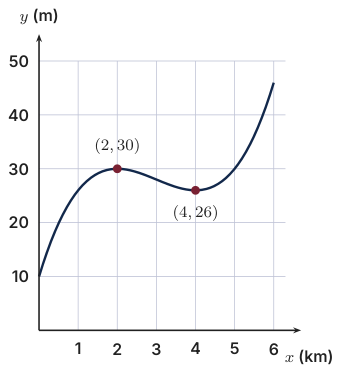
The graph shows the elevation, y = f(x) metres, of a hiking trail x kilometres from the trailhead, for 0 \le x \le 6. The trail has a high point at (2, 30) and a low point at (4, 26).
Original Photon diagram
(a) Write down the values of x for which f'(x) = 0.
[2]
(b) Write down the interval on which f is decreasing.
[1]
(c) Write down the intervals on which f'(x) > 0.
[2]
(d) State whether f'(1), f'(3) and f'(5) are positive or negative.
[3]
Show solutionHide solution
(a) The tangent is horizontal at the high and low points: x = \mathbf{2} A1 [1] and x = \mathbf{4}.
A1[1]
(b) \mathbf{2 < x < 4}
A1[1]
(c) \mathbf{0 \le x < 2} A1 [1] and \mathbf{4 < x \le 6}.
A1[1]
(d) f'(1) > 0 (increasing), A1 [1] f'(3) < 0 (decreasing), A1 [1] f'(5) > 0 (increasing).
A1[1]

Final answer

  • (a) x=2 and x=4
  • (b) 2<x<4
  • (c) 0\le x<2 and 4<x\le6
  • (d) positive, negative, positive

Question 14

[10 marks]
The number of cars in a car park t hours after 07:00 is modelled by
N(t) = -t^3 + 9t^2 - 15t + 100, \qquad 0 \le t \le 8.
(a) Find N'(t) and show that N'(t) = -3(t - 1)(t - 5).
[2]
(b) Find the values of t, in the given domain, for which the number of cars is increasing and for which it is decreasing.
[4]
(c) Find the greatest and the least number of cars in the car park between 07:00 and 15:00, and the time at which each occurs.
[3]
(d) Elspeth says that the least number of cars occurs when N'(t) = 0 at t = 1. Explain why she is wrong.
[1]
Show solutionHide solution
(a) N'(t) = -3t^2 + 18t - 15 M1A1 [2] = -3(t^2 - 6t + 5) = -3(t - 1)(t - 5).
AG
(b) N'(t) = 0 at t = 1 and t = 5.
M1[1]
N'(t) < 0 for 0 \le t < 1 and for 5 < t \le 8: the number of cars is decreasing. A1A1
[2]
N'(t) > 0 for 1 < t < 5: the number of cars is increasing.
A1[1]
(c) N(0) = 100, N(1) = 93, N(5) = 125, N(8) = 44.
M1[1]
Greatest: \mathbf{125} cars at t = 5 (12:00).
A1[1]
Least: \mathbf{44} cars at t = 8 (15:00).
A1[1]
(d) t = 1 is only a local minimum (N = 93); the least value on the domain is at the end-point t = 8, where N = 44 < 93.
R1[1]

Final answer

  • (a) shown
  • (b) increasing 1<t<5; decreasing 0\le t<1 and 5<t\le8
  • (c) greatest 125 at t=5 (12:00); least 44 at t=8 (15:00)
  • (d) t=1 gives only a local minimum of 93; the end value 44 is lower

Question 15

[10 marks]
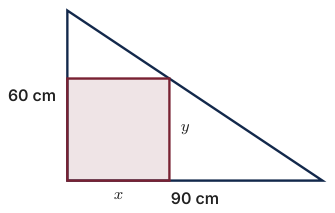
A carpenter cuts a rectangular tabletop from a triangular off-cut of plywood. The off-cut has a right angle, and its two shorter sides are 90 cm and 60 cm long. The rectangle has width x cm and height y cm, with two of its sides along the shorter sides of the triangle and one vertex on the longest side, as shown. The diagram is not to scale.
Original Photon diagram
(a) Show that y = 60 - \dfrac23 x.
[2]
(b) Hence show that the area of the rectangle is A = 60x - \dfrac23 x^2.
[1]
(c) Find \dfrac{dA}{dx}.
[2]
(d) Find the values of x and y for which the area is a maximum, and justify that it is a maximum.
[4]
(e) Find the maximum area, including units.
[1]
Show solutionHide solution
(a) The small triangle above the rectangle is similar to the whole triangle: \dfrac{60 - y}{x} = \dfrac{60}{90}.
M1[1]
60 - y = \dfrac23 x, so y = 60 - \dfrac23 x. A1 [1]
AG
(b) A = xy = x\left(60 - \dfrac23 x\right) = 60x - \dfrac23 x^2. M1 [1]
AG
(c) \dfrac{dA}{dx} = 60 - \dfrac43 x. M1A1
[2]
(d) Set \dfrac{dA}{dx} = 0: x = \mathbf{45} M1A1 [2] and then y = 60 - 30 = \mathbf{30}.
A1[1]
For x < 45 the gradient is positive and for x > 45 it is negative, so this is a maximum.
R1[1]
(e) A = 45 \times 30 = \mathbf{1350 cm^2}.
A1[1]

Final answer

  • (a), (b) shown
  • (c) 60-\frac43x
  • (d) x=45, y=30
  • (e) 1350 cm^2

Question 16

[10 marks]
A farm shop presses and sells x litres of apple juice each day, where 0 \le x \le 150. The daily revenue is R(x) = 14x - 0.02x^2 dollars and the daily cost is C(x) = 0.0004x^3 - 0.03x^2 + 2x + 150 dollars. The daily profit is P(x) = R(x) - C(x) dollars.
(a) Show that P(x) = -0.0004x^3 + 0.01x^2 + 12x - 150.
[2]
(b) Use your GDC to find the number of litres that gives the maximum daily profit, and the maximum profit.
[3]
(c) Find the values of x for which the shop makes a profit.
[2]
(d) The owner wants a daily profit of at least $700. Find the range of values of x for which this is achieved.
[3]
Show solutionHide solution
(a) P(x) = 14x - 0.02x^2 - \left(0.0004x^3 - 0.03x^2 + 2x + 150\right)
M1[1]
= -0.0004x^3 + (0.03 - 0.02)x^2 + (14 - 2)x - 150
A1[1]
= -0.0004x^3 + 0.01x^2 + 12x - 150.
AG
(b) Graph y = P(x) for 0 \le x \le 150 and use Analyze Graph, Maximum.
M1[1]
x = \mathbf{109} litres (108.68…) A1 [1] and maximum profit = \mathbf{\$759} (758.8…).
A1[1]
(c) Find where the graph crosses the x-axis: x = 12.4352\ldots (the next root, 180, is outside the domain).
M1[1]
The shop makes a profit for \mathbf{12.4 < x \le 150}.
A1[1]
(d) Graph y = P(x) and y = 700 and find the intersections.
M1[1]
x = 85.7 A1 [1] and x = 130 (130.04…), so \mathbf{85.7 \le x \le 130}.
A1[1]

Final answer

  • (a) shown
  • (b) 109 litres, $759
  • (c) 12.4<x\le150
  • (d) 85.7\le x\le130

Question 17

[11 marks]
A rainwater butt is an open-topped cylinder of radius r m and height h m, with a volume of 0.8 \text{m}^3. The butt is made from sheet metal for its circular base and curved side.
(a) Write down an expression for h in terms of r.
[1]
(b) Show that the area of metal needed is S = \pi r^2 + \dfrac{1.6}{r} square metres.
[2]
(c) Find \dfrac{dS}{dr}.
[2]
(d) Use your GDC to find the value of r that minimises S.
[3]
(e) Find the corresponding value of h, and the minimum area of metal.
[2]
(f) Justify, using the graph of S on your GDC, that your value of r gives a minimum.
[1]
Show solutionHide solution
(a) \pi r^2 h = 0.8, so h = \dfrac{0.8}{\pi r^2}.
A1[1]
(b) S = \pi r^2 + 2\pi r h
M1[1]
= \pi r^2 + 2\pi r\cdot\dfrac{0.8}{\pi r^2} = \pi r^2 + \dfrac{1.6}{r}. A1 [1]
AG
(c) S = \pi r^2 + 1.6r^{-1}, so \dfrac{dS}{dr} = 2\pi r - 1.6r^{-2}. M1A1
[2]
(d) Set 2\pi r - \dfrac{1.6}{r^2} = 0, or graph y = S(r) and find the minimum.
M1[1]
r^3 = \dfrac{0.8}{\pi} A1 [1] so r = \mathbf{0.634} m.
A1[1]
(e) h = \dfrac{0.8}{\pi(0.6338)^2} = \mathbf{0.634} m (the height equals the radius).
A1[1]
S = \pi(0.6338)^2 + \dfrac{1.6}{0.6338} = \mathbf{3.79 m^2}.
A1[1]
(f) The graph of S falls to a single lowest point at r = 0.634 and then rises, so it is a minimum.
R1[1]

Final answer

  • (a) h=\frac{0.8}{\pi r^2}
  • (b) shown
  • (c) 2\pi r-\frac{1.6}{r^2}
  • (d) r=0.634 m
  • (e) h=0.634 m; 3.79 m^2
  • (f) the graph of S has its lowest point there

Question 18

[9 marks]
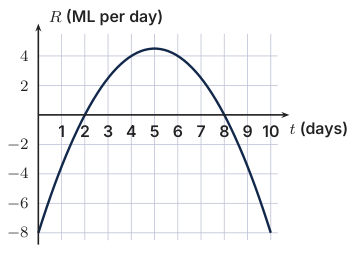
The rate at which the volume of a reservoir is changing is R megalitres (ML) per day, t days after the start of a dry spell, for 0 \le t \le 10. The graph shows y = R(t). The volume of the reservoir at t = 0 is 120 ML.
Original Photon diagram
(a) Write down the values of t between which the volume of the reservoir is increasing.
[2]
(b) Write down the value of t at which the volume is a local minimum, and the value at which it is a local maximum.
[2]
(c) Write down the greatest rate of increase of the volume, and the time at which it occurs.
[2]
(d) Use the rate at t = 0 to estimate the volume of the reservoir at t = 1, assuming the rate stays constant over that day.
[2]
(e) Explain why the volume at t = 10 is less than the volume at t = 8.
[1]
Show solutionHide solution
(a) The volume increases when R(t) > 0: between t = \mathbf{2} A1 [1] and t = \mathbf{8}.
A1[1]
(b) R changes from negative to positive at t = 2: local minimum at t = \mathbf{2}.
A1[1]
R changes from positive to negative at t = 8: local maximum at t = \mathbf{8}.
A1[1]
(c) The greatest value of R is at the peak of the graph: \mathbf{4.5} ML per day A1 [1] at t = \mathbf{5}.
A1[1]
(d) R(0) = -8 ML per day.
M1[1]
V(1) \approx 120 + (-8)(1) = \mathbf{112} ML.
A1[1]
(e) For 8 < t \le 10, R(t) < 0, so the volume is decreasing over that time.
R1[1]

Final answer

  • (a) 2<t<8
  • (b) minimum at t=2, maximum at t=8
  • (c) 4.5 ML per day at t=5
  • (d) 112 ML
  • (e) R<0 for 8<t\le10, so the volume is falling

Mastery

Full exam questions that mix question types, at Paper 1 and Paper 2 standard.

Question 19

[10 marks]
A company designs a closed cylindrical tin of fixed volume 500\text{ cm}^{3}. The tin has radius r cm and height h cm. The manufacturer wishes to minimise the amount of metal used, i.e. the total surface area.
(a) Using the volume, show that h=\dfrac{500}{\pi r^{2}}.
[2]
(b) Hence show that the surface area is S(r)=2\pi r^{2}+\dfrac{1000}{r}.
[3]
(c) Find the value of r that minimises S, giving your answer to 3 significant figures, and find the corresponding minimum surface area.
[5]
Show solutionHide solution
(a) Volume V=\pi r^{2}h=500, so h=\dfrac{500}{\pi r^{2}}.
[2]
(b) Surface area of a closed cylinder: S=2\pi r^{2}+2\pi r h.
Substituting h: S=2\pi r^{2}+2\pi r\cdot\dfrac{500}{\pi r^{2}}=2\pi r^{2}+\dfrac{1000}{r}.
[3]
(c) S'(r)=4\pi r-\dfrac{1000}{r^{2}}=0\Rightarrow 4\pi r^{3}=1000\Rightarrow r^{3}=\dfrac{250}{\pi}.
So r=\sqrt[3]{\dfrac{250}{\pi}}\approx 4.30 cm.
Then S\approx 2\pi(4.301)^{2}+\dfrac{1000}{4.301}\approx 349 cm^{2}.
Minimum surface area is approximately 349 cm^{2}.
[5]

Final answer

  • (a), (b) shown
  • (c) r=4.30 cm, S=349 cm^2

Question 20

[11 marks]
A small firm sells x phone cases per month. Market research shows the selling price per case, in dollars, is p=180-2x. The monthly production cost, in dollars, is C(x)=20x+300.
(a) Show that the monthly revenue is R(x)=180x-2x^{2}.
[2]
(b) Hence show that the monthly profit is \Pi(x)=-2x^{2}+160x-300.
[2]
(c) Find \Pi'(x) and hence the number of cases that maximises the profit.
[4]
(d) Find the maximum monthly profit and the selling price at this level of sales.
[3]
Show solutionHide solution
(a) Revenue = price \times quantity: R(x)=x\,p=x(180-2x)=180x-2x^{2}.
[2]
(b) \Pi(x)=R(x)-C(x)=180x-2x^{2}-(20x+300)=-2x^{2}+160x-300.
[2]
(c) \Pi'(x)=-4x+160=0\Rightarrow x=40.
Since the coefficient of x^{2} is negative this is a maximum, so the profit is greatest when 40 cases are sold.
[4]
(d) \Pi(40)=-2(1600)+160(40)-300=-3200+6400-300=2900, so the maximum profit is $2900.00.
Selling price: p=180-2(40)=\$100.00.
[3]

Final answer

  • (a), (b) shown
  • (c) \Pi'(x)=-4x+160; 40 cases
  • (d) $2900 at a price of $100

Question 21

[15 marks]
A coastal cycle route is 10 km long. The elevation of the route above sea level, h metres, at a distance of x kilometres from the start is modelled by
h(x) = 0.2x^3 - 3x^2 + 9.6x + 50, \qquad 0 \le x \le 10.
(a) Find the elevation at the start and at the end of the route.
[2]
(b) Find h'(x).
[2]
(c) Find the coordinates of the local maximum and the local minimum of the route.
[4]
(d) Find the lowest elevation on the route, and the distance from the start at which it occurs.
[2]
(e) Use your GDC to find the steepest downhill gradient on the route. Give your answer as metres per kilometre.
[2]
(f) A water station is at x = 5. Find the equation of the tangent to the route at the water station.
[3]
Show solutionHide solution
(a) h(0) = \mathbf{50} m A1 [1] and h(10) = 200 - 300 + 96 + 50 = \mathbf{46} m.
A1[1]
(b) h'(x) = 0.6x^2 - 6x + 9.6. M1A1
[2]
(c) h'(x) = 0.6(x - 2)(x - 8) = 0, so x = 2 or x = 8. M1A1
[2]
h(2) = 1.6 - 12 + 19.2 + 50 = 58.8 and h(8) = 102.4 - 192 + 76.8 + 50 = 37.2.
A1[1]
The sign of h' is +,-,+, so the local maximum is \mathbf{(2, 58.8)} and the local minimum is \mathbf{(8, 37.2)}.
A1[1]
(d) Compare the end-points with the local minimum: 50, 46 and 37.2.
M1[1]
The lowest elevation is \mathbf{37.2} m at x = \mathbf{8} km.
A1[1]
(e) Graph y = h'(x) on the GDC and find its minimum:
M1[1]
the least value is −5.4 at x = 5, so the steepest downhill gradient is \mathbf{5.4} m per km (that is, h' = -5.4).
A1[1]
(f) h(5) = 25 - 75 + 48 + 50 = 48 and h'(5) = -5.4.
A1[1]
y - 48 = -5.4(x - 5) M1 [1] so y = \mathbf{-5.4x + 75}.
A1[1]

Final answer

  • (a) 50 m and 46 m
  • (b) 0.6x^2-6x+9.6
  • (c) maximum (2,58.8), minimum (8,37.2)
  • (d) 37.2 m at 8 km
  • (e) −5.4 m per km
  • (f) y=-5.4x+75

Question 22

[8 marks]
On a map a river bank follows the curve y=x^3-6x^2+8x+5, where x and y are in kilometres. P(1,8) is a landing stage on the bank.
(a) Find \dfrac{dy}{dx}.
[2]
(b) Show that the tangent to the bank at P is y=9-x.
[2]
(c) The tangent and the two axes enclose a triangle. Find its area.
[2]
(d) A straight path follows the normal to the bank at P. Find the x-coordinates of the two other points where the path meets the bank.
[2]
Show solutionHide solution
(a) \frac{dy}{dx}=3x^2-12x+8 M1A1 (b) At x=1: 3-12+8=-1 A1 y-8=-(x-1), so y=9-x A1AG (c) The tangent meets the axes at (9,0) and (0,9) A1 Area =\frac12\times9\times9=40.5 km^2 A1 (d) The normal has gradient 1: y-8=x-1, so y=x+7; solve x^3-6x^2+8x+5=x+7 M1 x=4.56 and x=0.438 (besides x=1)
A1

Final answer

  • (a) 3x^2-12x+8
  • (b) shown
  • (c) 40.5 km^2
  • (d) x=4.56 and x=0.438

Question 23

[16 marks]
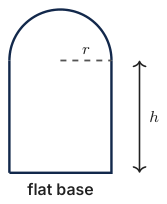
A water tank is made of a cylinder of radius r metres and height h metres with a hemispherical roof and a flat circular base. The tank must hold 9 m^3 of water.
Original Photon diagram
(a) Show that h=\dfrac{9}{\pi r^2}-\dfrac{2r}{3}.
[3]
The base costs 30 AUD per m^2, the curved wall costs 20 AUD per m^2 and the roof costs 40 AUD per m^2.
(b) Show that the total cost of the tank is C=\dfrac{250}{3}\pi r^2+\dfrac{360}{r}.
[4]
(c) Find \dfrac{dC}{dr}.
[2]
(d) Find the value of r that gives the least cost, and justify that it is a minimum.
[4]
(e) Find the height of the cylinder and the least cost.
[2]
(f) The pump needs a cylinder at least 3 m tall. Determine whether the cheapest tank meets this need.
[1]
Show solutionHide solution
(a) The volume is \pi r^2h+\frac23\pi r^3=9 (the roof is half a sphere, \frac12\cdot\frac43\pi r^3) M1A1 h=\frac{9}{\pi r^2}-\frac{2r}{3} A1AG (b) C=30\pi r^2+20(2\pi rh)+40(2\pi r^2) M1A1 2\pi rh=\frac{18}{r}-\frac43\pi r^2 M1 C=30\pi r^2+\frac{360}{r}-\frac{80}{3}\pi r^2+80\pi r^2=\frac{250}{3}\pi r^2+\frac{360}{r} A1AG (c) \frac{dC}{dr}=\frac{500\pi r}{3}-360r^{-2} M1A1 (d) \frac{500\pi r}{3}=\frac{360}{r^2}, so r^3=\frac{1080}{500\pi} M1 r=0.883 m A1 C'(0.8)<0 and C'(1)>0 M1 the sign changes from - to +: a minimum R1 (e) h=3.09 m A1 C=611.82 AUD A1 (f) 3.09\ge3, so the cheapest tank meets the need, only just
R1

Final answer

  • (a), (b) shown
  • (c) \frac{500\pi r}{3}-\frac{360}{r^2}
  • (d) r=0.883 m
  • (e) h=3.09 m, cost 611.82 AUD
  • (f) yes, 3.09 m is at least 3 m

Going further

Beyond the syllabus: the worked examples and investigations of the chapter's Going further pages.

G1 Why the cheapest closed can is as tall as it is wide

G1 Worked example

[7 marks]
Dalia fills closed cylindrical drums with 20 litres of paint, which is 20 000 cm^3. Each drum has radius r cm and height h cm. She wants to use the least metal.
(a) Show that the surface area of a drum is A=2\pi r^2+\dfrac{40\,000}{r}.
[2]
(b) Find the radius that makes A least, and justify that it is a minimum.
[3]
(c) Show that the height of this drum is twice its radius, and find the height.
[2]
Show solutionHide solution
(a) h=\frac{20\,000}{\pi r^2} and A=2\pi r^2+2\pi rh M1 A=2\pi r^2+\frac{40\,000}{r} A1AG (b) \frac{dA}{dr}=4\pi r-\frac{40\,000}{r^2}=0, so r^3=\frac{10\,000}{\pi} M1 r=14.7 cm (14.7101) A1 A'(14)=-28.2<0 and A'(15)=10.7>0: a minimum R1 (c) \pi r^3=10\,000, so h=\frac{20\,000}{\pi r^2}=\frac{2\pi r^3}{\pi r^2}=2r M1 h=29.4 cm
A1

Final answer

(a) shown (b) r=14.7 cm (c) h=2r=29.4 cm

G2 Thicker ends

G2 Investigation

[15 marks]
A drinks can is a closed cylinder that holds 330 cm^3. It has radius r cm and height h cm.
(a) Show that its surface area is A=2\pi r^2+\dfrac{660}{r}, and find the radius and the height that make A least.
[5]
(b) Show that for this can h=2r.
[2]
(c) A real can has radius 3.1 cm. Find its height, and the percentage of extra metal it uses compared with the least possible.
[3]
(d) The top and base are made of metal that costs twice as much per square centimetre as the wall. Show that the cost is proportional to 4\pi r^2+\dfrac{660}{r}, and find the radius and height of the cheapest can and the value of \dfrac{h}{r}.
[3]
(e) Suggest two reasons why real cans are taller than the can in part (a).
[2]
Show solutionHide solution
(a) \pi r^2h=330, so A=2\pi r^2+2\pi r\cdot\frac{330}{\pi r^2}=2\pi r^2+\frac{660}{r} M1 A1AG \frac{dA}{dr}=4\pi r-\frac{660}{r^2}=0, so r^3=\frac{165}{\pi} M1 r=3.74 cm A1 h=\frac{330}{\pi r^2}=7.49 cm A1 (b) \pi r^3=165, so h=\frac{330}{\pi r^2}=\frac{2\pi r^3}{\pi r^2} M1 =2r A1AG (c) h=\frac{330}{\pi(3.1)^2}=10.9 cm A1 A=2\pi(3.1)^2+\frac{660}{3.1}=273.3 cm^2, against the least 264.4 cm^2 M1 \frac{273.3-264.4}{264.4}\times100=3.38\% more metal A1 (d) cost \propto 2(2\pi r^2)+2\pi rh=4\pi r^2+\frac{660}{r} M1 8\pi r-\frac{660}{r^2}=0, so r^3=\frac{660}{8\pi} M1 r=2.97 cm, h=\frac{330}{\pi r^2}=11.9 cm and \frac hr=4 A1 (e) e.g. thicker ends cost more, so a taller can with smaller ends is cheaper (part d) R1 a narrower can is easier to hold and to stack, and the label area matters
R1

Final answer

(a) shown; r=3.74 cm, h=7.49 cm (b) shown (c) h=10.9 cm; about 3.38% more metal (d) shown; r=2.97 cm, h=11.9 cm, h/r=4 (e) e.g. thicker ends cost more; a narrow can is easier to hold and stack

From the book

Photon Guidebook: Mathematics Applications and Interpretation SL for the IB Diploma

Chapter 13 teaches differentiation from the basics to full exam questions: how the IB asks it, every question type with a marked example, and these practice questions in three steps.

About the book