Free worked solutions · 2026 Edition

IB Maths AI SL Chapter 11: Probability distributions worked solutions

Worked solutions to the practice questions in Chapter 11 of Photon Guidebook: Mathematics Applications and Interpretation SL for the IB Diploma (2026 Edition). Each solution shows every step with the mark it earns, the way an IB mark scheme does.

  • Chapter 11 of 15
  • 24 practice questions
  • 3 Going further
  • Free, no sign-up

Basics

One idea at a time, in the order the chapter teaches them.

Question 1

[4 marks]
X takes values 0, 2, 6 with probabilities k,2k,1-3k. The expected value is 3.34.
Find k and check that each probability is valid.
[4]
Show solutionHide solution
2(2k)+6(1-3k)=3.34.
M1
6-14k=3.34, so k=0.19.
A1
Probabilities 0.19,0.38,0.43.
A1
All lie in [0,1] and sum to 1.
R1

Final answer

k=0.19; probabilities 0.19, 0.38, 0.43, all valid

Question 2

[3 marks]
A reward takes values 1, 4 and v with probabilities 0.24, 0.51 and 0.25. Its expected value is 4.78.
Find v.
[3]
Show solutionHide solution
1(0.24)+4(0.51)+0.25v=4.78.
M1
0.25v=2.50.
M1
v=10.
A1

Final answer

v=10

Question 3

[3 marks]
A fair game has expected net gain zero. It awards gross prizes 0, 6 and 17 dollars with probabilities 0.62, 0.25 and 0.13.
Find the fair entry fee, to two decimal places.
[3]
Show solutionHide solution
Expected gross prize =0(0.62)+6(0.25)+17(0.13).
M1
3.71 dollars.
A1
Fee 3.71 dollars makes expected net gain zero.
R1

Final answer

$3.71

Question 4

[4 marks]
A game costs 3.70 dollars to enter. Gross prizes are 0, 4 and 15 dollars with probabilities 0.59, 0.28 and 0.13.
Find the expected gross prize and expected net gain. Decide whether the game is fair to the player.
[4]
Show solutionHide solution
Gross expectation 0(0.59)+4(0.28)+15(0.13).
M1
3.07 dollars.
A1
Net 3.07-3.70=-0.63 dollars.
A1
Not fair: expected net gain is not zero (player loses on average).
R1

Final answer

expected prize $3.07; expected net gain -\$0.63; not fair

Question 5

[3 marks]
A batch of clips is checked for scratches. Independently on each of 21 trials, success probability is 0.18. Let X count successes.
Find the probability of at most 3 successes to 3 significant figures.
[3]
Show solutionHide solution
Required P(X\le3).
A1
Use \operatorname{binomCDF}(21,0.18,3) (CDF sums probabilities from 0 to its count argument).
M1
0.462.
A1

Final answer

0.462

Question 6

[4 marks]
X\sim\mathrm{B}(25,p) has expected value 8.75.
Find p and the probability of no successes.
[4]
Show solutionHide solution
25p=8.75, so p=0.35. M1A1
P(X=0)=(0.65)^{25}.
M1
2.10\times10^{-5}.
A1

Final answer

p=0.35; 2.10\times10^{-5}

Question 7

[4 marks]
A crate has 35 independently packaged tools, each damaged with probability 0.12. A stock of s replacements suffices if no more than s tools are damaged.
Find the smallest integer s giving probability of sufficiency at least 0.95. Show cumulative probabilities at your answer and one below it.
[4]
Show solutionHide solution
X\sim\mathrm{B}(35,0.12); require P(X\le s)\ge0.95.
M1
P(X\le7)=0.948191.
A1
P(X\le8)=0.980269.
A1
Smallest s=8; the first fails and the second meets the target.
R1

Final answer

s=8 (0.948 at 7, 0.980 at 8)

Question 8

[4 marks]
Substrate thickness X\sim\mathrm{N}(2.46,0.18^2) mm. A central interval contains 90% of measurements with equal tails.
Find both interval endpoints to 3 decimal places.
[4]
Show solutionHide solution
Tail areas are 0.05 each, so lower-tail areas are 0.05 and 0.95.
M1
Use inverse normal with the supplied mean and SD.
M1
Lower endpoint 2.164 mm.
A1
Upper endpoint 2.756 mm.
A1

Final answer

2.164 mm and 2.756 mm

Question 9

[4 marks]
Marker lengths satisfy X\sim\mathrm{N}(47,5.6^2) mm. A box contains 650 markers drawn from this model.
Find the probability of a length between 41 and 51 mm, and the expected number in that interval.
[4]
Show solutionHide solution
Use normal CDF bounds 41,51 with mean 47, SD 5.6.
M1
0.62049.
A1
Expected number 650P(41<X<51).
M1
403 markers approximately.
A1

Final answer

0.620; 403 markers

Tutorial

Exam-style questions on each question type, with the marks the IB would give.

Question 10

[7 marks]
A board-game spinner has four equal sectors numbered 1, 2, 2 and 3. A turn consists of two spins, and X is the sum of the two scores.
(a) Write down the probability distribution of X in a table.
[2]
(b) Calculate E(X).
[1]
(c) Find \mathrm P(X\ge5).
[1]
(d) Maria takes 40 turns. Find the probability that X\ge5 on at least 15 of her turns.
[3]
Show solutionHide solution
(a) Sixteen equally likely sector pairs. X=2: (1,1) gives \dfrac1{16}; X=3: 1 with a 2 (either order, two 2-sectors) gives \dfrac{4}{16}; X=4: (2,2) or (1,3)/(3,1) gives \dfrac{4+2}{16}=\dfrac6{16}; X=5: \dfrac4{16}; X=6: \dfrac1{16}.
\begin{array}{c|ccccc} x & \text{2} & \text{3} & \text{4} & \text{5} & \text{6} \\ \hline P(X=x) & \frac1{16} & \frac4{16} & \frac6{16} & \frac4{16} & \frac1{16} \end{array}
A2[2]
(b) E(X)=\dfrac{2(1)+3(4)+4(6)+5(4)+6(1)}{16}=\dfrac{64}{16}=4.
A1[1]
(c) \mathrm P(X\ge5)=\dfrac{4+1}{16}=\dfrac5{16}=0.3125.
A1[1]
(d) Let Y be the number of turns with X\ge5: Y\sim\mathrm B\left(40,\dfrac5{16}\right).
A1[1]
\mathrm P(Y\ge15)=\mathtt{binomCdf}(40,0.3125,15,40).
M1[1]
=0.24411=0.244.
A1[1]

Final answer

  • (a) \frac1{16},\frac4{16},\frac6{16},\frac4{16},\frac1{16}
  • (b) 4
  • (c) \frac5{16}
  • (d) 0.244

Question 11

[6 marks]
At a fairground stall, Wen pays $3 to throw rings at a post. With probability 0.2 she wins a prize worth m dollars, with probability 0.3 she wins a prize worth $4, and otherwise she wins nothing.
(a) Show that Wen's expected net gain per game is 0.2m-1.8 dollars.
[2]
(b) The stall is designed to be a fair game. Find m.
[2]
(c) In fact the stall owner sets m=6. Wen plays 250 games. Find her expected total net gain, and state what this means for Wen.
[2]
Show solutionHide solution
(a) Expected prize =0.2m+0.3(4)=0.2m+1.2.
M1[1]
Expected net gain =0.2m+1.2-3=0.2m-1.8. A1AG
[1]
(b) Fair means 0.2m-1.8=0.
M1[1]
m=9.
A1[1]
(c) For m=6: net gain per game =0.2(6)-1.8=-0.6, so over 250 games 250\times(-0.6)=-\$150.
A1[1]
Wen is expected to lose about $150 (the game favours the stall).
R1[1]

Final answer

  • (b) m=9
  • (c) -\$150; Wen loses about $150

Question 12

[5 marks]
A parents' group runs a lucky-dip. It sells 200 sealed tubs at $2 each. One tub contains a voucher worth x dollars, ten tubs contain a voucher worth $9, and the rest are empty. Let W dollars be the voucher value in a randomly chosen tub.
(a) Show that E(W)=\dfrac{x+90}{200}.
[2]
(b) The lucky-dip is designed to be fair. Find x.
[2]
(c) In fact the top voucher is worth $150. If all tubs are sold, find the group's expected profit.
[1]
Show solutionHide solution
(a) \mathrm P(W=x)=\dfrac1{200}, \mathrm P(W=9)=\dfrac{10}{200}, otherwise 0.
M1[1]
E(W)=x\left(\dfrac1{200}\right)+9\left(\dfrac{10}{200}\right)=\dfrac{x+90}{200}. A1AG
[1]
(b) Fair: E(W)=2, so x+90=400.
M1[1]
x=310.
A1[1]
(c) Takings =200\times2=\$400; vouchers =150+10(9)=\$240; profit =\$160.
A1[1]

Final answer

  • (b) x=310
  • (c) $160

Question 13

[7 marks]
At a call centre, each call is resolved at the first attempt with probability 0.72, independently of other calls. Zainab takes 14 calls in an afternoon. Let X be the number resolved at the first attempt.
(a) Find the probability that at most 9 calls are resolved at the first attempt.
[2]
(b) Find the probability that at least 12 calls are resolved at the first attempt.
[2]
(c) Find \mathrm P(8\le X\le11).
[2]
(d) Find the expected number of calls resolved at the first attempt.
[1]
Show solutionHide solution
(a) X\sim\mathrm B(14,0.72). \mathrm P(X\le9)=\mathtt{binomCdf}(14,0.72,0,9).
M1[1]
=0.35095=0.351.
A1[1]
(b) \mathrm P(X\ge12)=\mathtt{binomCdf}(14,0.72,12,14) (or 1-\mathrm P(X\le11)).
M1[1]
=0.20331=0.203.
A1[1]
(c) \mathrm P(8\le X\le11)=\mathtt{binomCdf}(14,0.72,8,11).
M1[1]
=0.72942=0.729.
A1[1]
(d) E(X)=14(0.72)=10.08.
A1[1]

Final answer

  • (a) 0.351
  • (b) 0.203
  • (c) 0.729
  • (d) 10.08

Question 14

[8 marks]
A stationery shop sells packs of 10 ink cartridges for $18. Each cartridge independently prints at least 500 pages with probability 0.92. The shop refunds the full price of a pack if fewer than 9 of its cartridges reach 500 pages.
(a) Find the probability that a pack is refunded.
[2]
(b) Find the expected amount the shop keeps per pack, after refunds.
[2]
(c) In one month the shop sells 600 packs. Find the expected number of refunds.
[1]
(d) The shop considers refunding only when fewer than 8 cartridges reach 500 pages. Find the expected amount kept per pack under this new policy, and state which policy gives the shop more money on average.
[3]
Show solutionHide solution
(a) X\sim\mathrm B(10,0.92). Refund when X\le8: \mathrm P(X\le8)=\mathtt{binomCdf}(10,0.92,0,8).
M1[1]
=0.18788=0.188.
A1[1]
(b) The shop keeps $18 when X\ge9, which has probability 1-0.18788=0.81212.
M1[1]
Expected amount kept =18\times0.81212=\$14.62.
A1[1]
(c) 600\times0.18788=112.7\approx113 refunds.
A1[1]
(d) New refund probability \mathrm P(X\le7)=\mathtt{binomCdf}(10,0.92,0,7)=0.04008.
M1[1]
Expected amount kept =18\times(1-0.04008)=\$17.28.
A1[1]
The new policy keeps more ($17.28 against $14.62), so it gives the shop more money on average.
R1[1]

Final answer

  • (a) 0.188
  • (b) $14.62
  • (c) 113
  • (d) $17.28; the new policy keeps more

Question 15

[5 marks]
Each email that arrives in Priya's inbox is spam with probability 0.18, independently of other emails. Priya wants to know how many emails she must receive so that the probability that at least one of them is spam exceeds 0.95.
(a) Show that the number of emails n must satisfy 1-0.82^n>0.95.
[1]
(b) Use the table feature of your GDC to find the smallest value of n that satisfies this inequality.
[2]
(c) Hence write down the probability that at least one email is spam when Priya receives this number of emails, and the probability when she receives one fewer.
[2]
Show solutionHide solution
(a) With X\sim\mathrm B(n,0.18), \mathrm P(X\ge1)=1-\mathrm P(X=0)=1-0.82^n, and this must exceed 0.95. A1AG
[1]
(b) Enter Y_1=1-0.82^x in the table and scroll: n=15 gives 0.94904<0.95 and n=16 gives 0.95821>0.95.
M1[1]
The smallest value is n=16.
A1[1]
(c) For n=16: \mathrm P=0.958.
A1[1]
For n=15: \mathrm P=0.949, which is below 0.95.
A1[1]

Final answer

n=16 (0.949 at 15, 0.958 at 16)

Question 16

[6 marks]
In a school exam the marks X are normally distributed with X\sim\mathrm N(58,\,12^2).
(a) The top 15% of students receive a grade A. Find the lowest mark that earns a grade A.
[2]
(b) The pass mark is 40. Find the percentage of students who pass.
[2]
(c) Find the lower and upper quartiles of the marks.
[2]
Show solutionHide solution
(a) Left area =1-0.15=0.85: x=\mathtt{invNorm}(0.85,58,12).
M1[1]
=70.437=70.4, so the lowest mark for an A is about 70.4.
A1[1]
(b) \mathrm P(X\ge40)=\mathtt{normalCdf}(40,10^{99},58,12).
M1[1]
=0.93319, so about 93.3% pass.
A1[1]
(c) Lower quartile: \mathtt{invNorm}(0.25,58,12)=49.9.
A1[1]
Upper quartile: \mathtt{invNorm}(0.75,58,12)=66.1.
A1[1]

Final answer

  • (a) 70.4
  • (b) 93.3%
  • (c) 49.9 and 66.1

Question 17

[6 marks]
A machine fills jars of peanut butter. The mass X of peanut butter in a jar is normally distributed with X\sim\mathrm N(412,\,3.5^2) grams.
(a) Find the interval, symmetric about the mean, that contains the middle 90% of jar masses.
[3]
(b) Find the interval, symmetric about the mean, that contains the middle 98% of jar masses.
[2]
(c) Explain why the interval in part (b) is wider than the interval in part (a).
[1]
Show solutionHide solution
(a) The middle 90% leaves 5% in each tail, so the left areas are 0.05 and 0.95.
M1[1]
Lower end: \mathtt{invNorm}(0.05,412,3.5)=406.24=406.
A1[1]
Upper end: \mathtt{invNorm}(0.95,412,3.5)=417.76=418. The interval is (406,\,418) g.
A1[1]
(b) Left areas 0.01 and 0.99: \mathtt{invNorm}(0.01,412,3.5)=404.
A1[1]
\mathtt{invNorm}(0.99,412,3.5)=420, so the interval is (404,\,420) g.
A1[1]
(c) To contain a larger proportion of the masses the interval must reach further into the tails.
R1[1]

Final answer

  • (a) (406, 418) g
  • (b) (404, 420) g
  • (c) a larger proportion needs a wider interval

Question 18

[7 marks]
A courier's parcels have mass X kg, where X\sim\mathrm N(2.4,\,0.7^2). The lightest 20% of parcels are charged the Tier A price, and the heaviest 3% of parcels are charged a surcharge.
(a) Find the greatest mass of a Tier A parcel.
[2]
(b) Find the smallest mass of a parcel that is charged the surcharge.
[2]
(c) In one day the courier handles 800 parcels. Find the expected number of parcels that are neither Tier A nor surcharged.
[2]
(d) Find \mathrm P(X<0) and comment on the suitability of the normal model.
[1]
Show solutionHide solution
(a) Left area 0.20: x=\mathtt{invNorm}(0.20,2.4,0.7).
M1[1]
=1.8109=1.81 kg.
A1[1]
(b) Left area 1-0.03=0.97: x=\mathtt{invNorm}(0.97,2.4,0.7).
M1[1]
=3.7166=3.72 kg.
A1[1]
(c) The proportion in neither group is 1-0.20-0.03=0.77.
M1[1]
Expected number =800\times0.77=616 parcels.
A1[1]
(d) \mathrm P(X<0)=\mathtt{normalCdf}(-10^{99},0,2.4,0.7)=0.000303, which is tiny (about 0.03%), so a negative mass is almost never predicted and the model is reasonable.
R1[1]

Final answer

  • (a) 1.81 kg
  • (b) 3.72 kg
  • (c) 616
  • (d) 0.000303

Question 19

[8 marks]
A bakery's loaves have mass M grams, where M\sim\mathrm N(800,\,25^2). A loaf is rejected if its mass is less than 760 g.
(a) Find the probability that a loaf is rejected.
[2]
(b) A box contains 12 randomly chosen loaves. Find the probability that exactly 2 loaves in the box are rejected.
[2]
(c) Find the probability that at most 1 loaf in the box is rejected.
[2]
(d) A box is sent to a shop only if it contains no rejected loaves. Out of 50 boxes, find the expected number that are sent to a shop.
[2]
Show solutionHide solution
(a) \mathrm P(M<760)=\mathtt{normalCdf}(-10^{99},760\,800,25).
M1[1]
=0.054799=0.0548.
A1[1]
(b) Let X be the number rejected in the box: X\sim\mathrm B(12,0.054799).
M1[1]
\mathrm P(X=2)=\mathtt{binomPdf}(12,0.054799,2)=0.11281=0.113.
A1[1]
(c) \mathrm P(X\le1)=\mathtt{binomCdf}(12,0.054799,0,1).
M1[1]
=0.86227=0.862.
A1[1]
(d) \mathrm P(X=0)=(1-0.054799)^{12}=0.5085.
M1[1]
Expected number of boxes =50\times0.5085=25.4\approx25.
A1[1]

Final answer

  • (a) 0.0548
  • (b) 0.113
  • (c) 0.862
  • (d) 25.4

Mastery

Full exam questions that mix question types, at Paper 1 and Paper 2 standard.

Question 20

[9 marks]
A mobile game awards a rare "gold chest" to a player with probability 0.12 each time a level is completed, independently of other levels. A player completes 25 levels in a week. Let X be the number of gold chests received.
(a) State the distribution of X with its parameters.
[1]
(b) Find:
(i) the expected number of gold chests;
(ii) the standard deviation of X.
[3]
(c) Find the probability that the player receives exactly 3 gold chests.
[2]
(d) Find the probability that the player receives at least 4 gold chests.
[3]
Show solutionHide solution
(a) X\sim B(25,\,0.12).
[1]
(b) (i) E(X)=np=25\times 0.12=3.
(ii) \text{Var}(X)=np(1-p)=25(0.12)(0.88)=2.64, so \sigma=\sqrt{2.64}\approx 1.62.
[3]
(c) Using GDC:
P(X=3)=\binom{25}{3}(0.12)^3(0.88)^{22}\approx 0.239
[2]
(d)
P(X\ge 4)=1-P(X\le 3)
Using GDC, P(X\le 3)\approx 0.648, so
P(X\ge 4)\approx 1-0.648=0.352
[3]

Final answer

  • (a) \mathrm{B}(25,0.12)
  • (b) 3; 1.62
  • (c) 0.239
  • (d) 0.352

Question 21

[13 marks]
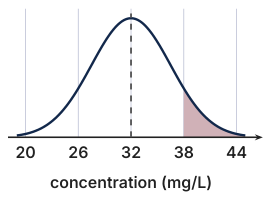
A laboratory measures the daily concentration of a mineral in a water supply. The concentrations (in mg/L) are normally distributed with mean \mu=32 mg/L and standard deviation \sigma=4.5 mg/L.
Original Photon diagram
(a) Find the probability that on a randomly chosen day the concentration exceeds 38 mg/L (shaded region).
[2]
(b) A day is classed as "safe" if the concentration is between 25 mg/L and 40 mg/L. Find the probability that a randomly chosen day is safe.
[2]
(c) The regulator sets an upper limit so that only the top 2.5% of days exceed it. Find this upper limit.
[3]
(d) Over a 30-day month, let D be the number of days on which the concentration exceeds 38 mg/L. Assuming days are independent:
(i) state the distribution of D;
(ii) find the probability that exactly 3 days exceed 38 mg/L;
(iii) find the expected number of such days.
[6]
Show solutionHide solution
Let C\sim N(32,\,4.5^2).
(a) Using GDC:
P(C>38)\approx 0.0912
[2]
(b) Using GDC:
P(25<C<40)\approx 0.902
[2]
(c) Top 2.5% means area 0.975 below the limit. Inverse normal (z=1.9600):
\text{limit}=32+1.9600(4.5)\approx 40.8\text{ mg/L}
[3]
(d) (i) Let p=P(C>38)\approx 0.0912, so D\sim B(30,\,0.0912).
(ii) Using GDC:
P(D=3)=\binom{30}{3}(0.0912)^3(0.9088)^{27}\approx 0.233
(iii) E(D)=30\times 0.0912\approx 2.74 days.
[6]

Final answer

  • (a) 0.0912
  • (b) 0.902
  • (c) 40.8 mg/L
  • (d) \mathrm{B}(30,0.0912); 0.233; 2.74

Question 22

[16 marks]
At a school carnival, Hao pays $4 to play a bean-bag game. He throws 4 bean-bags at a target; each throw independently hits with probability 0.35. Let X be the number of hits.
(a) State the distribution of X.
[1]
(b) Show that \mathrm P(X=2)=0.311 to 3 significant figures.
[2]
Hao's prize W depends on the number of hits: $0 for 0 hits, $2 for 1 hit, $5 for 2 hits and $12 for 3 or 4 hits.
(c) Find the probability distribution of W, giving each probability correct to 4 decimal places.
[3]
(d) Calculate E(W).
[2]
(e) Find Hao's expected net gain per game, and state who the game favours.
[2]
(f) 300 children play the game once each. Find the organisers' expected profit.
[1]
(g) The organisers change the prize for 3 or 4 hits to m dollars so that their expected profit is $0.50 per game. Find m, correct to 2 decimal places.
[3]
(h) State one assumption of the binomial model in this game and explain why it may fail in practice.
[2]
Show solutionHide solution
(a) X\sim\mathrm B(4,0.35).
A1[1]
(b) \mathrm P(X=2)=\mathtt{binomPdf}(4,0.35,2) (or \binom42(0.35)^2(0.65)^2).
M1[1]
=0.31054=0.311 to 3 s.f. A1AG
[1]
(c) \mathtt{binomPdf}(4,0.35,x) for x=0,1,2,3,4 gives 0.17851, 0.38448, 0.31054, 0.11147, 0.01501.
M1[1]
\begin{array}{c|cccc} w & \text{0} & \text{2} & \text{5} & \text{12} \\ \hline P(W=w) & 0.1785 & 0.3845 & 0.3105 & 0.1265 \end{array}
A1A1
[2]
(For \$12: \mathrm P(X=3)+\mathrm P(X=4)=0.11147+0.01501=0.12648.)
(d) E(W)=2(0.3845)+5(0.3105)+12(0.1265).
M1[1]
=\$3.84 (unrounded 3.83941).
A1[1]
(e) Net gain =3.8394-4=-\$0.16.
M1[1]
The expected net gain is negative, so the game slightly favours the organisers.
A1[1]
(f) 300\times0.1606=\$48.18.
A1[1]
(g) Organisers' profit \$0.50 means E(W)=3.50: 2(0.3845)+5(0.3105)+0.1265\,m=3.50.
M1[1]
0.1265\,m=3.50-2.3216 (solve on the GDC or by rearranging).
M1[1]
m=\$9.32.
A1[1]
(h) Assumption: every throw has the same probability 0.35 of hitting (independent throws).
R1[1]
In practice a child's aim improves (or tires) over the four throws, so the probability is not constant (and throws are not independent).
R1[1]

Final answer

  • (b) 0.311
  • (c) 0.1785, 0.3845, 0.3105, 0.1265
  • (d) $3.84
  • (e) -\$0.16
  • (f) $48.18
  • (g) m=9.32
  • (h) throws may not be independent

Question 23

[9 marks]
Maya's school bus is late on any school day with probability 0.15, independently of other days. Consider a period of 10 school days.
(a) Find the probability that the bus is late on exactly 2 of the 10 days.
[2]
(b) Find the probability that the bus is late on at least 1 day.
[2]
(c) Find the probability that the bus is late on exactly 2 days and that these two days are next to each other.
[3]
(d) Given that the bus is late on exactly 2 of the 10 days, find the probability that the two days are next to each other.
[2]
Show solutionHide solution
(a) L\sim\mathrm{B}(10,0.15) M1 P(L=2)=0.276 A1 (b) 1-0.85^{10} M1 =0.803 A1 (c) There are 9 pairs of neighbouring days M1 9\times0.15^2\times0.85^8 M1 =0.0552 (0.0551793) A1 (d) \frac{0.0551793}{0.275897} M1 =0.2, which is \frac{9}{45}: every pair of days is equally likely
A1

Final answer

  • (a) 0.276
  • (b) 0.803
  • (c) 0.0552
  • (d) 0.2

Question 24

[16 marks]
Ama grows avocados. The mass, M grams, of an avocado is normally distributed with mean 210 g and standard deviation 25 g. Avocados heavier than 240 g are sold as premium for $1.80 each, avocados lighter than 170 g are sold for juice at $0.40 each, and all the others are sold for $1.10 each.
(a) Find the probability that an avocado is premium.
[2]
(b) Find the probability that an avocado is sold for juice.
[2]
(c) Find the expected income from one avocado.
[3]
(d) Find the expected income from a crate of 400 avocados.
[1]
A bag contains 12 avocados chosen at random.
(e) Find the probability that exactly 3 avocados in the bag are premium.
[2]
(f) Find the probability that at least 2 avocados in the bag are premium.
[2]
(g) Given that at least 2 avocados in the bag are premium, find the probability that exactly 3 are premium.
[2]
(h) 30% of avocados have a mass greater than m grams. Find m.
[2]
Show solutionHide solution
(a) P(M>240) M1 =0.115 (0.115070) A1 (b) P(M<170) M1 =0.0548 (0.054799) A1 (c) Middle band 1-0.115070-0.054799=0.830131 M1 1.80(0.115070)+0.40(0.054799)+1.10(0.830131) M1 =\$1.14 (1.142189) A1 (d) 400\times1.142189=\$456.88 A1 (e) B\sim\mathrm{B}(12,0.115070) M1 P(B=3)=0.112 A1 (f) 1-P(B\le1) M1 =0.410 A1 (g) \frac{P(B=3)}{P(B\ge2)}=\frac{0.111554}{0.409507} M1 =0.272 A1 (h) P(M<m)=0.7 M1 m=223 g (223.11)
A1

Final answer

  • (a) 0.115
  • (b) 0.0548
  • (c) $1.14
  • (d) $456.88
  • (e) 0.112
  • (f) 0.410
  • (g) 0.272
  • (h) 223 g

Going further

Beyond the syllabus: the worked examples and investigations of the chapter's Going further pages.

G1 Pooled testing

G1 Worked example

[6 marks]
A laboratory in Cape Town mixes the samples of 4 workers and tests the mixture once. If the mixture is positive, the 4 workers are then tested separately. Each worker carries the infection with probability 0.03, independently. Let T be the number of tests used for a group of 4.
(a) Find the probability that the mixture is negative.
[2]
(b) Find E(T).
[2]
(c) Find the expected number of tests per worker, and compare it with testing every sample separately.
[2]
Show solutionHide solution
(a) 0.97^4 M1 =0.885 (0.885293) A1 (b) T=1 with probability 0.885293 and T=5 with probability 0.114707 M1 E(T)=1(0.885293)+5(0.114707)=1.46 (1.45883) A1 (c) \frac{1.45883}{4}=0.365 tests per worker M1 Testing every sample separately uses 1 test per worker, so pooling saves about 0.635 of a test per worker
A1

Final answer

(a) 0.885 (b) 1.46 (c) 0.365 tests per worker, a saving of about 0.635 of a test each

G2 Runs of consecutive days

G2 Worked example

[5 marks]
A ferry is cancelled on any day with probability 0.1, independently of other days. Consider a week of 7 days.
(a) Find the probability that the ferry is cancelled on exactly two days and those two days are next to each other.
[3]
(b) Given that the ferry is cancelled on exactly two days, find the probability that those two days are next to each other.
[2]
Show solutionHide solution
(a) There are 6 pairs of neighbouring days (Monday–Tuesday up to Saturday–Sunday) M1 6\times0.1^2\times0.9^5 M1 =0.0354 A1 (b) There are \binom72=21 pairs of days, all equally likely given two cancellations M1 \frac{6}{21}=\frac27=0.286
A1

Final answer

(a) 0.0354 (b) \frac27=0.286

G3 Investigation

[15 marks]
A clinic tests blood samples for an infection that 2% of people carry. Instead of testing every sample, it mixes the samples of k people and tests the mixture. If the mixture is negative, all k people are clear after one test. If it is positive, each of the k people is then tested separately, making k+1 tests in all. People carry the infection independently of each other.
(a) For k=5, find the probability that a mixture is negative. Write down the probability distribution of T, the number of tests for a group of 5, and find E(T).
[5]
(b) Hence find the expected number of tests per person, and compare it with testing every sample separately.
[2]
(c) Show that, for groups of k, the expected number of tests per person is \frac1k+1-0.98^k.
[3]
(d) Use a table on your GDC to find the group size that makes the expected number of tests per person as small as possible.
[3]
(e) When 5% of people carry the infection, the best group size is 5. Explain why a higher infection rate leads to smaller groups.
[2]
Show solutionHide solution
(a) All 5 people are clear: 0.98^5 M1 =0.904 (0.903921) A1 T=1 with probability 0.903921 A1 T=6 with probability 1-0.903921=0.096079 A1 E(T)=1(0.903921)+6(0.096079)=1.48 (1.48040) A1 (b) \frac{1.48040}{5}=0.296 tests per person A1 Testing every sample separately uses 1 test per person, so pooling uses about 70% fewer tests R1 (c) E(T)=1(0.98^k)+(k+1)(1-0.98^k) M1 =1+k(1-0.98^k) A1 Divide by k: \frac1k+1-0.98^k A1AG (d) Table of f(x)=\frac1x+1-0.98^x from x=2 M1 k=7: 0.2747; k=8: 0.2742; k=9: 0.2774 A1 The smallest value is at groups of 8 A1 (e) A higher rate makes a mixture positive more often, so whole groups have to be retested R1 Smaller groups are positive less often (with 5%: k=4: 0.435, k=5: 0.426, k=6: 0.432)
R1

Final answer

(a) 0.904; T=1 with probability 0.903921, T=6 with probability 0.096079; E(T)=1.48 (b) 0.296 tests per person against 1, about 70% fewer (c) shown (d) groups of 8 (e) a mixture is positive more often, so whole groups are retested

From the book

Photon Guidebook: Mathematics Applications and Interpretation SL for the IB Diploma

Chapter 11 teaches probability distributions from the basics to full exam questions: how the IB asks it, every question type with a marked example, and these practice questions in three steps.

About the book