Free worked solutions · 2026 Edition

IB Maths AI SL Chapter 10: Probability worked solutions

Worked solutions to the practice questions in Chapter 10 of Photon Guidebook: Mathematics Applications and Interpretation SL for the IB Diploma (2026 Edition). Each solution shows every step with the mark it earns, the way an IB mark scheme does.

  • Chapter 10 of 15
  • 21 practice questions
  • 2 Going further
  • Free, no sign-up

Basics

One idea at a time, in the order the chapter teaches them.

Question 1

[2 marks]
Events U and V are mutually exclusive, meaning they cannot occur together. Their probabilities are 0.19 and 0.47.
State P(U\cap V) and find P(U\cup V).
[2]
Show solutionHide solution
P(U\cap V)=0.
A1
P(U\cup V)=0.19+0.47=0.66.
A1

Final answer

P(U\cap V)=0; P(U\cup V)=0.66

Question 2

[4 marks]
Among 83 households, 41 have a compost bin, 36 have a rain barrel and 17 have both.
Find how many have only a compost bin, only a rain barrel, and neither.
[4]
Show solutionHide solution
Compost only 41-17=24.
A1
Barrel only 36-17=19.
A1
At least one 24+17+19=60.
M1
Neither 83-60=23.
A1

Final answer

compost only 24, barrel only 19, neither 23

Question 3

[3 marks]
P(C\cup D)=0.81, P(C)=0.54 and P(D)=0.39.
Find P(C\cap D) and P(C\cap D^c).
[3]
Show solutionHide solution
P(C\cap D)=0.54+0.39-0.81.
M1
0.12.
A1
P(C\cap D^c)=0.54-0.12=0.42.
A1

Final answer

0.12; 0.42

Question 4

[3 marks]
An event log has 43 online bookings (17 paid, 26 unpaid) and 36 desk bookings (25 paid, 11 unpaid).
Find the probability of payment given an online booking, and of an online booking given payment.
[3]
Show solutionHide solution
First 17/43.
A1
Paid bookings total 17+25=42.
M1
Second 17/42.
A1

Final answer

\frac{17}{43}=0.395; \frac{17}{42}=0.405

Question 5

[4 marks]
Two fair four-sided dice are rolled, one blue and one red, each numbered 1 to 4. All 16 ordered pairs are equally likely.
Find the probability that their sum is 5 and the probability that the blue number exceeds the red number.
[4]
Show solutionHide solution
Sum 5 pairs: (1,4),(2,3),(3,2),(4,1).
M1
4/16=1/4.
A1
Blue greater: 1+2+3=6 pairs.
M1
6/16=3/8.
A1

Final answer

\frac14; \frac38

Question 6

[3 marks]
A route is scenic with probability 0.46. A scenic trip is delayed with probability 0.18; a non-scenic trip is delayed with probability 0.31.
Find the overall probability of a delay.
[3]
Show solutionHide solution
Scenic delayed 0.46(0.18).
M1
Non-scenic delayed 0.54(0.31); add the two disjoint paths.
M1
0.2502.
A1

Final answer

0.2502

Question 7

[4 marks]
A machine chooses fine mode with probability 0.64, otherwise coarse mode. A print passes inspection with probability 0.91 in fine mode and 0.76 in coarse mode.
Find the probability a print was fine-mode given that it passed.
[4]
Show solutionHide solution
Fine and pass 0.64(0.91)=0.5824.
M1
Overall pass 0.5824+0.36(0.76)=0.856.
M1
Divide joint probability by overall pass probability.
M1
0.5824/0.856=0.6804 approximately.
A1

Final answer

0.680

Question 8

[3 marks]
Events are independent if P(A\cap B)=P(A)P(B). Here P(A)=0.42, P(B)=0.35 and P(A\cap B)=0.147.
Determine whether A and B are independent, showing the test.
[3]
Show solutionHide solution
P(A)P(B)=0.42(0.35).
M1
0.147 equals the supplied intersection.
A1
Therefore independent.
R1

Final answer

0.42\times0.35=0.147, so the events are independent

Tutorial

Exam-style questions on each question type, with the marks the IB would give.

Question 9

[6 marks]
At a carnival stall Priya spins two fair spinners. Spinner P has four equal sectors numbered 1, 2, 3, 5. Spinner Q has three equal sectors numbered 1, 4, 6. Her score is the sum of the two numbers.
\begin{array}{|c||c|c|c|} \hline P\,/\,Q & \text{\textbf{1}} & \text{\textbf{4}} & \text{\textbf{6}} \\ \hline \hline \text{\textbf{1}} & {} & {} & {} \\ \hline \text{\textbf{2}} & {} & {} & {} \\ \hline \text{\textbf{3}} & {} & {} & {} \\ \hline \text{\textbf{5}} & {} & {} & {} \\ \hline \end{array}
(a) Complete the table of all possible scores.
[2]
(b) Find the probability that Priya scores at least 8.
[2]
(c) Find the probability that Priya's score is a prime number.
[2]
Show solutionHide solution
\begin{array}{|c||c|c|c|} \hline P\,/\,Q & \text{\textbf{1}} & \text{\textbf{4}} & \text{\textbf{6}} \\ \hline \hline \text{\textbf{1}} & \text{2} & \text{5} & \text{7} \\ \hline \text{\textbf{2}} & \text{3} & \text{6} & \text{8} \\ \hline \text{\textbf{3}} & \text{4} & \text{7} & \text{9} \\ \hline \text{\textbf{5}} & \text{6} & \text{9} & \text{11} \\ \hline \end{array}
(a) Table completed as shown (each row is one sector of P, each column one sector of Q).
A2[2]
(b) There are 12 equally likely cells. Scores of at least 8: 8, 9, 9, 11 — 4 cells.
M1[1]
\operatorname{P}{\text{at least }8} = \dfrac{4}{12} = \dfrac13 (= 0.333).
A1[1]
(c) Prime scores: 2, 5, 7 (first row), 3 (second row), 7 (third row) and 11 (fourth row) — 6 cells.
M1[1]
\operatorname{P}{\text{prime}} = \dfrac{6}{12} = \dfrac12.
A1[1]

Final answer

  • (a) rows 2,5,7; 3,6,8; 4,7,9; 6,9,11
  • (b) \frac13
  • (c) \frac12

Question 10

[6 marks]
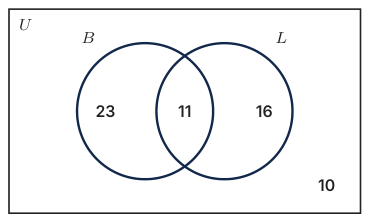
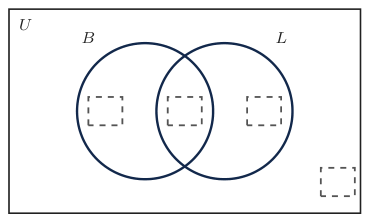
A deli runs a rewards scheme with 60 members. Of these, 34 have bought a baked item (B), 27 have bought a latte (L) and 11 have bought both.
(a) Copy and complete the Venn diagram, showing the number of members in each of the four regions.
[3]
Original Photon diagram
A member is chosen at random.
(b) Find the probability that the member has bought neither item.
[1]
(c) Find the probability that the member has bought exactly one of the two items.
[2]
Show solutionHide solution
(a) Both = 11; baked item only = 34 - 11 = 23; latte only = 27 - 11 = 16; neither = 60 - (23 + 11 + 16) = 10. M1A2
[3]
Original Photon diagram
(b) \dfrac{10}{60} = \dfrac16 (= 0.167).
A1[1]
(c) Exactly one = 23 + 16 = 39
M1[1]
\operatorname{P}{\text{exactly one}} = \dfrac{39}{60} = \dfrac{13}{20} = 0.65.
A1[1]

Final answer

  • (a) 23, 11, 16, 10
  • (b) \frac16=0.167
  • (c) 0.65

Question 11

[7 marks]
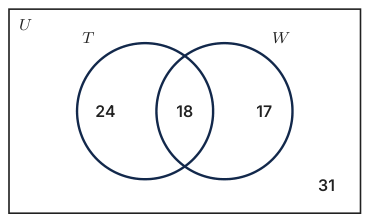
A gym has 90 members. Of these, 42 use the treadmills (T) and 35 use the weights area (W). A total of x members use both, and 2x - 5 members use neither.
(a) Write down an equation for x and solve it.
[3]
A member is chosen at random.
(b) Find the probability that the member uses exactly one of the two areas.
[2]
(c) Find \operatorname{P}{T \cup W}.
[2]
Show solutionHide solution
(a) Treadmill only = 42 - x; weights only = 35 - x. The four regions total 90:
(42 - x) + x + (35 - x) + (2x - 5) = 90
M1[1]
72 + x = 90
A1[1]
x = 18.
A1[1]
Original Photon diagram
(b) Treadmill only = 24, weights only = 17, so exactly one = 41 members.
M1[1]
\operatorname{P}{\text{exactly one}} = \dfrac{41}{90} = 0.456 (3 s.f.).
A1[1]
(c) Neither = 2(18) - 5 = 31, so n(T \cup W) = 90 - 31 = 59.
M1[1]
\operatorname{P}{T \cup W} = \dfrac{59}{90} = 0.656 (3 s.f.).
A1[1]

Final answer

  • (a) x=18
  • (b) 0.456
  • (c) 0.656

Question 12

[5 marks]
At a fitness club, let A be the event that a member attends a morning class and B the event that the member renews their membership. For a randomly chosen member, \operatorname{P}{A} = 0.5, \operatorname{P}{B} = 0.4 and \operatorname{P}{A \cap B} = 0.24.
(a) Find \operatorname{P}{A \mid B}.
[2]
(b) Find \operatorname{P}{B \mid A}.
[2]
(c) Use your answer to part (a) to decide whether A and B are independent.
[1]
Show solutionHide solution
(a) \operatorname{P}{A \mid B} = \dfrac{0.24}{0.4}
M1[1]
= 0.6.
A1[1]
(b) \operatorname{P}{B \mid A} = \dfrac{0.24}{0.5}
M1[1]
= 0.48.
A1[1]
(c) \operatorname{P}{A \mid B} = 0.6 \neq \operatorname{P}{A} = 0.5, so knowing that a member renewed changes the probability of attending: A and B are not independent.
R1[1]

Final answer

  • (a) 0.6
  • (b) 0.48
  • (c) 0.6\neq0.5, not independent

Question 13

[7 marks]
Three smoke detectors in a storage hall work independently. Each detects a fire with probability p.
(a) Given that p = 0.7, find the probability that
(i) all three detectors detect a fire;
[1]
(ii) at least one detector detects a fire.
[2]
The insurer requires that the probability that at least one detector detects a fire is at least 0.992.
(b) Find the smallest value of p that satisfies the insurer's requirement.
[3]
(c) Give one reason why the assumption of independence may not be realistic for detectors in the same hall.
[1]
Show solutionHide solution
(a) (i) 0.7^3 = 0.343.
A1[1]
(ii) \operatorname{P}{\text{at least one}} = 1 - \operatorname{P}{\text{none}} = 1 - 0.3^3
M1[1]
= 1 - 0.027 = 0.973.
A1[1]
(b) Need 1 - (1 - p)^3 \geq 0.992, i.e. (1 - p)^3 \leq 0.008.
M1[1]
1 - p \leq \sqrt[3]{0.008} = 0.2
M1[1]
(or GDC solve of 1 - (1 - x)^3 = 0.992), so the smallest value is p = 0.8.
A1[1]
(c) For example, a power cut or the fire itself could disable several detectors at once, so one detector failing makes another more likely to fail.
R1[1]

Final answer

  • (a) 0.343; 0.973
  • (b) p=0.8
  • (c) one cause, such as a power cut, can disable several detectors

Question 14

[5 marks]
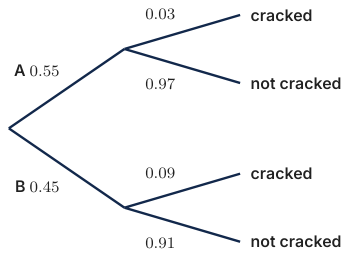
Ayla's café buys its eggs from two farms. Farm A supplies 55% of the eggs and farm B supplies the rest. An egg arrives cracked with probability 0.03 from farm A and 0.09 from farm B, as shown in the tree diagram.
Original Photon diagram
(a) Find the probability that an egg chosen at random is cracked.
[2]
(b) Given that an egg is cracked, find the probability that it came from farm A.
[2]
(c) Hence write down the probability that a cracked egg came from farm B.
[1]
Show solutionHide solution
(a) Add the two paths that end in a cracked egg: \operatorname{P}{\text{cracked}} = 0.55 \times 0.03 + 0.45 \times 0.09
M1[1]
= 0.0165 + 0.0405 = 0.057.
A1[1]
(b) \operatorname{P}{\text{A} \mid \text{cracked}} = \dfrac{\operatorname{P}{\text{A and cracked}}}{\operatorname{P}{\text{cracked}}} = \dfrac{0.0165}{0.057}
M1[1]
= 0.289 (3 s.f.).
A1[1]
(c) 1 - 0.289 = 0.711 (or \dfrac{0.0405}{0.057}).
A1[1]

Final answer

  • (a) 0.057
  • (b) 0.289
  • (c) 0.711

Question 15

[8 marks]
200 students were asked which lunch they chose today.
\begin{array}{|@{\hspace{1pt}}l@{\hspace{1pt}}|@{\hspace{1pt}}c@{\hspace{1pt}}|@{\hspace{1pt}}c@{\hspace{1pt}}|@{\hspace{1pt}}c@{\hspace{1pt}}|@{\hspace{1pt}}c@{\hspace{1pt}}|} \hline {} & \text{Hot meal} & \text{Sandwich} & \text{Salad} & \text{Total} \\ \hline \text{Year 10} & 34 & 21 & 5 & 60 \\ \hline \text{Year 11} & 28 & 25 & 12 & 65 \\ \hline \text{Year 12} & 18 & 30 & 27 & 75 \\ \hline \text{Total} & 80 & 76 & 44 & 200 \\ \hline \end{array}
A student is chosen at random.
(a) Find the probability that the student is in Year 11.
[1]
(b) Find the probability that the student is in Year 12 and chose a salad.
[1]
(c) Given that the student is in Year 12, find the probability that the student chose a salad.
[2]
(d) Given that the student chose the hot meal, find the probability that the student is in Year 10.
[2]
(e) Determine whether choosing a salad is independent of being in Year 12.
[2]
Show solutionHide solution
(a) \dfrac{65}{200} = 0.325.
A1[1]
(b) \dfrac{27}{200} = 0.135.
A1[1]
(c) The world is the 75 Year 12 students: \dfrac{27}{75}
M1[1]
= 0.36.
A1[1]
(d) The world is the 80 hot-meal students: \dfrac{34}{80}
M1[1]
= 0.425.
A1[1]
(e) \operatorname{P}{\text{salad}} = \dfrac{44}{200} = 0.22, but \operatorname{P}{\text{salad} \mid \text{Year 12}} = 0.36 \neq 0.22.
M1[1]
So the events are not independent: Year 12 students are more likely to choose salad.
R1[1]

Final answer

  • (a) 0.325
  • (b) 0.135
  • (c) 0.36
  • (d) 0.425
  • (e) 0.36\neq0.22, not independent

Question 16

[8 marks]
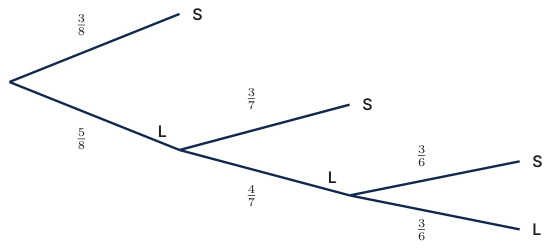
Elise draws sweets one at a time, without replacement, from a jar containing 3 strawberry (S) sweets and 5 lemon (L) sweets. She stops as soon as she draws a strawberry sweet, or after she has drawn three sweets, whichever happens first.
(a) Draw a tree diagram showing every possible sequence of draws, with the probability on every branch.
[3]
(b) Find the probability that Elise stops after exactly two draws.
[2]
(c) Elise wins a prize if she draws a strawberry sweet. Find the probability that she wins a prize.
[1]
(d) Given that Elise draws exactly three sweets, find the probability that the third sweet is strawberry.
[2]
Show solutionHide solution
(a) The tree stops at the first S, or after three draws:
A3[3]
Original Photon diagram
(b) Stops after exactly two draws: L then S, \dfrac58 \times \dfrac37
M1[1]
= \dfrac{15}{56} = 0.268 (3 s.f.).
A1[1]
(c) No prize only on the path L, L, L: \dfrac58 \times \dfrac47 \times \dfrac36 = \dfrac{5}{28}, so \operatorname{P}{\text{prize}} = 1 - \dfrac{5}{28} = \dfrac{23}{28} = 0.821 (3 s.f.).
A1[1]
(d) Drawing exactly three sweets means the first two are L, L: \operatorname{P}{\text{LL}} = \dfrac58 \times \dfrac47 = \dfrac{5}{14}.
M1[1]
\operatorname{P}{\text{third is S} \mid \text{three draws}} = \dfrac{\operatorname{P}{\text{LLS}}}{\operatorname{P}{\text{LL}}} = \dfrac{5/28}{5/14} = \dfrac12.
A1[1]

Final answer

  • (b) \frac{15}{56}=0.268
  • (c) \frac{23}{28}=0.821
  • (d) \frac12

Mastery

Full exam questions that mix question types, at Paper 1 and Paper 2 standard.

Question 17

[10 marks]
A market research team surveys 120 people about which of two streaming services they subscribe to: StreamOne (S) and FilmBox (F). The results are: 68 subscribe to StreamOne, 54 subscribe to FilmBox, and 22 subscribe to both.
(a) Represent the information on a Venn diagram.
[3]
(b) Find the number of people who subscribe to neither service.
[2]
(c) One person is chosen at random. Find:
(i) P(S\cup F);
(ii) P(S\mid F).
[3]
(d) Determine whether events S and F are independent.
[2]
Show solutionHide solution
(a) Only S=68-22=46; only F=54-22=32; both =22.
[3]
(b) At least one =46+22+32=100; neither =120-100=20.
[2]
(c) (i)
P(S\cup F)=\frac{100}{120}=\frac{5}{6}\approx0.833
(ii)
P(S\mid F)=\frac{P(S\cap F)}{P(F)}=\frac{22/120}{54/120}=\frac{22}{54}=\frac{11}{27}\approx0.407
[3]
(d) P(S)=\frac{68}{120}\approx0.567. Since P(S\mid F)\approx0.407\neq P(S), the events are not independent.
[2]

Final answer

  • (a) 46, 22, 32
  • (b) 20
  • (c) \frac56=0.833; \frac{11}{27}=0.407
  • (d) 0.407\neq0.567, not independent

Question 18

[13 marks]
A town library surveys 150 members about the kinds of material they borrowed last year: fiction (F), non-fiction (N) and audiobooks (A). The results are:
\bullet 90 borrowed fiction, 70 borrowed non-fiction and 50 borrowed audiobooks;
\bullet 40 borrowed both fiction and non-fiction, 25 borrowed both fiction and audiobooks, and 20 borrowed both non-fiction and audiobooks (each of these totals includes members who borrowed all three kinds);
\bullet 10 borrowed all three kinds.
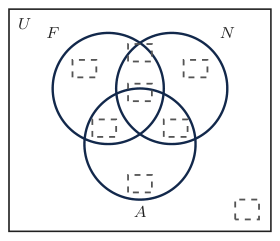
(a) Copy and complete the Venn diagram, showing the number of members in each of the eight regions.
[4]
Original Photon diagram
A member is chosen at random.
(b) Find the probability that the member borrowed exactly two kinds of material.
[2]
(c) Given that the member borrowed non-fiction or audiobooks (or both), find the probability that the member also borrowed fiction.
[3]
Two different members are chosen at random.
(d) Find the probability that both borrowed audiobooks.
[2]
(e) Determine whether borrowing fiction and borrowing audiobooks are independent events.
[2]
Show solutionHide solution
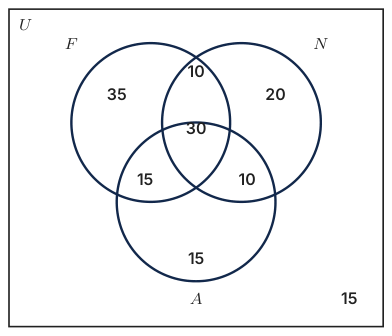
(a) Centre = 10; F \cap N only = 40 - 10 = 30; F \cap A only = 25 - 10 = 15; N \cap A only = 20 - 10 = 10. M1A1
[2]
F only = 90 - 10 - 30 - 15 = 35; N only = 70 - 10 - 30 - 10 = 20; A only = 50 - 10 - 15 - 10 = 15.
A1[1]
Inside the circles: 35 + 20 + 15 + 30 + 15 + 10 + 10 = 135, so none = 150 - 135 = 15.
A1[1]
Original Photon diagram
(b) Exactly two kinds: 30 + 15 + 10 = 55
M1[1]
\operatorname{P}{\text{exactly two}} = \dfrac{55}{150} = \dfrac{11}{30} = 0.367 (3 s.f.).
A1[1]
(c) n(N \cup A) = 20 + 15 + 30 + 15 + 10 + 10 = 100.
M1[1]
Of these, those who also borrowed fiction: 30 + 15 + 10 = 55.
M1[1]
\operatorname{P}{F \mid N \cup A} = \dfrac{55}{100} = 0.55.
A1[1]
(d) Without replacement: \operatorname{P}{\text{both audiobooks}} = \dfrac{50}{150} \times \dfrac{49}{149}
M1[1]
= \dfrac{49}{447} = 0.110 (3 s.f.).
A1[1]
(e) \operatorname{P}{F \cap A} = \dfrac{25}{150} = 0.1667, but \operatorname{P}{F}\operatorname{P}{A} = 0.6 \times \dfrac13 = 0.2.
M1[1]
These are not equal, so borrowing fiction and borrowing audiobooks are not independent.
R1[1]

Final answer

  • (a) centre 10; pairs 30,15,10; singles 35,20,15; none 15
  • (b) 0.367
  • (c) 0.55
  • (d) 0.110
  • (e) \frac16\neq0.2, not independent

Question 19

[9 marks]
A ferry crosses a harbour every morning. The weather is calm on 70% of mornings and rough on the rest. In calm weather the ferry leaves on time with probability 0.95. In rough weather it leaves on time with probability b. Over a long period the ferry leaves on time on 86% of mornings.
(a) Show that 0.665+0.3b=0.86 and find b.
[3]
(b) Given that the ferry left late, find the probability that the weather was rough.
[3]
Assume that mornings are independent.
(c) Find the probability that the ferry leaves on time on all 5 mornings of a week.
[2]
(d) Give one reason why the assumption in part (c) may not be realistic.
[1]
Show solutionHide solution
(a) 0.7\times0.95+0.3b=0.86 M1 0.665+0.3b=0.86 A1AG b=0.65 A1 (b) P(\text{late})=1-0.86=0.14 M1 P(\text{rough and late})=0.3\times0.35=0.105 A1 \frac{0.105}{0.14}=0.75 A1 (c) 0.86^5 M1 =0.470 A1 (d) Rough weather often lasts several days, so one late morning makes the next more likely
R1

Final answer

  • (a) b=0.65
  • (b) 0.75
  • (c) 0.470
  • (d) rough weather lasts several days

Question 20

[12 marks]
A hospital screens patients for a condition using a rapid test. In the screened population, 6% of patients actually have the condition. The test correctly returns positive for 92% of patients who have the condition. For patients who do not have the condition, the test incorrectly returns positive 8% of the time. Let C be the event “has the condition” and T be the event “tests positive”.
(a) Draw a tree diagram to represent this information.
[3]
(b) Find P(T), the probability that a randomly screened patient tests positive.
[3]
(c) Find P(C\mid T), the probability that a patient who tests positive actually has the condition. Give your answer to 3 significant figures.
[3]
(d) Comment on relying on a single positive result from this test.
[3]
Show solutionHide solution
(a) Condition branches: C\,(0.06), C'\,(0.94). From C: T\,(0.92), T'\,(0.08). From C': T\,(0.08), T'\,(0.92).
[3]
(b)
P(T)=0.06\times0.92+0.94\times0.08=0.0552+0.0752=0.1304
[3]
(c)
P(C\mid T)=\frac{0.06\times0.92}{0.1304}=\frac{0.0552}{0.1304}\approx0.423
[3]
(d) Only about 42.3% of those testing positive actually have the condition, so more than half of positive results are false alarms. Because the condition is rare, a single positive result is not reliable on its own; a confirmatory follow-up test is needed.
[3]

Final answer

  • (b) 0.1304
  • (c) 0.423
  • (d) most positive results are false alarms, so retest

Question 21

[15 marks]
A cycle café asks 250 customers whether they cycled there and whether they bought a hot drink. 120 cycled, 130 bought a hot drink and 72 did both.
(a) Draw a two-way table of the customers, with totals.
[2]
(b) A customer is chosen at random. Given that the customer bought a hot drink, find the probability that the customer cycled.
[2]
(c) Two different customers are chosen at random. Find the probability that both cycled.
[2]
(d) Determine whether cycling to the café and buying a hot drink are independent.
[2]
(e) The café has a loyalty card. A customer who cycled signs up with probability 0.35 and one who did not with probability 0.2. Use the table for P(\text{cycled}) and find the probability that a customer signs up.
[2]
(f) Given that a customer signs up, find the probability that the customer cycled.
[2]
(g) For 180 customers in a day, find the expected number who cycled and did not sign up, and suggest one bias in the survey.
[3]
Show solutionHide solution
(a) Cycled: 72, 48, 120; did not cycle: 58, 72, 130; totals 130, 120, 250 A1A1 (b) \frac{72}{130} M1 =0.554 A1 (c) \frac{120}{250}\times\frac{119}{249} M1 =0.229 A1 (d) P(C)P(H)=0.48\times0.52=0.2496 M1 P(C\cap H)=\frac{72}{250}=0.288\neq0.2496, so the events are not independent R1 (e) 0.48\times0.35+0.52\times0.2 M1 =0.168+0.104=0.272 A1 (f) \frac{0.168}{0.272} M1 =0.618 A1 (g) 180\times0.48\times0.65 M1 =56.16\approx56.2 A1 For example, the survey was taken on one day or in one season, or customers chose whether to answer
R1

Final answer

  • (a) 72,48\,120; 58,72\,130; 130 120 250
  • (b) 0.554
  • (c) 0.229
  • (d) 0.288\neq0.2496, not independent
  • (e) 0.272
  • (f) 0.618
  • (g) 56.2; one day or one season only

Going further

Beyond the syllabus: the worked examples and investigations of the chapter's Going further pages.

G1 “At least one” by the complement

G1 Worked example

[3 marks]
Four friends compare birth months. Assume that every month is equally likely.
(a) Find the probability that all four were born in different months.
[2]
(b) Find the probability that at least two of them share a birth month.
[1]
Show solutionHide solution
(a) Each new friend must avoid the months already taken: \frac{12}{12}\times\frac{11}{12}\times\frac{10}{12}\times\frac{9}{12} M1 =\frac{11880}{20736}=0.573 A1 (b) 1-0.573=0.427 (exactly \frac{8856}{20736})
A1

Final answer

(a) 0.573 (b) 0.427

G2 A table that turns over

G2 Investigation

[15 marks]
Assume that every birth month is equally likely.
(a) Write down the probability that two people were born in different months. Show that the probability that three people were all born in different months is \frac{12\times11\times10}{12^3}, and hence find the probability that at least two of the three share a birth month.
[4]
(b) Find the least number of people for which the probability that at least two share a birth month is greater than 0.5.
[3]
(c) Find the least number of people for which this probability is greater than 0.9. Comment on the assumption that every month is equally likely.
[3]
(d) Now assume that each of 365 days is equally likely. Write the probability that n people all have different birthdays as a product, and use your GDC to find the least n for which a shared birthday is more likely than not.
[3]
(e) A club gives each of its 30 members a random four-digit code from 0000 to 9999. Find the probability that at least two members get the same code.
[2]
Show solutionHide solution
(a) \frac{11}{12}=0.917 A1 The second person avoids 1 month and the third avoids 2, so \frac{12}{12}\times\frac{11}{12}\times\frac{10}{12}=\frac{12\times11\times10}{12^3} M1 =\frac{1320}{1728} A1AG At least two share: 1-\frac{1320}{1728}=0.236 A1 (b) For 4 people the probability is 1-\frac{12\times11\times10\times9}{12^4}=0.427 M1 for 5 people it is 0.618 A1 so the least number is 5 A1 (c) For 7 people the probability is 0.889 and for 8 people it is 0.954, so the least number is 8 M1A1 Months have 28 to 31 days and births are not spread evenly, so a match is a little more likely than the calculation says R1 (d) P(\text{all different})=\frac{365\times364\times\dots\times(366-n)}{365^n} A1 n=22 gives 0.476 and n=23 gives 0.507 M1 so the least n is 23 A1 (e) 1-\frac{10000\times9999\times\dots\times9971}{10000^{30}} M1 =0.0426
A1

Final answer

(a) \frac{11}{12}=0.917; \frac{1320}{1728}; 0.236 (b) 5 people (c) 8 people; real months differ in length and births are not spread evenly (d) \frac{365\times364\times\dots\times(366-n)}{365^n}; n=23 (e) 0.0426

From the book

Photon Guidebook: Mathematics Applications and Interpretation SL for the IB Diploma

Chapter 10 teaches probability from the basics to full exam questions: how the IB asks it, every question type with a marked example, and these practice questions in three steps.

About the book