Free worked solutions · 2026 Edition

IB Maths AI HL Chapter 19: Integration worked solutions

Worked solutions to the practice questions in Chapter 19 of Photon Guidebook: Mathematics Applications and Interpretation HL for the IB Diploma (2026 Edition). Each solution shows every step with the mark it earns, the way an IB mark scheme does.

  • Chapter 19 of 24
  • Volume 2
  • 26 practice questions
  • 3 Going further
  • Free, no sign-up

Basics

One idea at a time, in the order the chapter teaches them.

Question 1

[3 marks]
F'(x)=6x+5 and F(2)=19.
Find F(x).
[3]
Show solutionHide solution
F(x)=3x^2+5x+C.
M1
19=12+10+C, so C=-3.
A1
F(x)=3x^2+5x-3.
A1

Final answer

F(x)=3x^2+5x-3.

Question 2

[3 marks]
\int_0^b 6x^2\,dx=128, where b>0.
Find b.
[3]
Show solutionHide solution
[2x^3]_0^b=128.
M1
b^3=64.
M1
b=4.
A1

Final answer

b=4.

Question 3

[5 marks]
The curves y=3x and y=x^2 enclose a region.
Find the intersection coordinates and hence the bounded area.
[5]
Show solutionHide solution
x^2=3x gives x=0,3.
M1
Intersections (0,0) and (3,9).
A1
A=\int_0^3(3x-x^2)\,dx.
M1
[3x^2/2-x^3/3]_0^3.
M1
A=9/2 square units.
A1

Final answer

(0,0) and (3,9); area \frac92.

Question 4

[4 marks]
A tank initially holds 58 litres. Water enters at r(t)=12-t litres per minute for 0\le t\le4; none leaves.
Find the volume after 4 minutes.
[4]
Show solutionHide solution
\Delta V=\int_0^4(12-t)\,dt.
M1
[12t-t^2/2]_0^4=40.
A1
V=58+40.
M1
98 litres.
A1

Final answer

98 litres.

Question 5

[3 marks]
A pond cross-section has measured depths in metres at equally spaced horizontal distances.
\begin{array}{c|ccccc}x&0&2&4&6&8\\\hline d&0&1.7&2.4&1.1&0\end{array}
Estimate the cross-sectional area.
[3]
Show solutionHide solution
h=2 m.
A1
A=\tfrac22(0+0+2(1.7+2.4+1.1)).
M1
A\approx10.4\text{ m}^2.
A1

Final answer

10.4\ \text{m}^2.

Question 6

[2 marks]
Let x>-3/2.
Find \int\dfrac{10}{2x+3}\,dx.
[2]
Show solutionHide solution
u=2x+3, du=2\,dx.
M1
5\ln(2x+3)+C.
A1

Final answer

5\ln(2x+3)+c.

Question 7

[3 marks]
Let u=3x+1.
Use substitution, including transformed limits, to evaluate \int_1^3\dfrac6{3x+1}\,dx exactly.
[3]
Show solutionHide solution
du=3\,dx; limits u=4,10.
M1
2\int_4^{10}du/u=2[\ln u]_4^{10}.
M1
2\ln(5/2).
A1

Final answer

2\ln\frac52\ (\approx1.83).

Question 8

[3 marks]
The region under y=x^2+1, 0\le x\le1, rotates about the x-axis.
Expand the squared radius and calculate the exact volume.
[3]
Show solutionHide solution
(x^2+1)^2=x^4+2x^2+1.
A1
V=\pi[x^5/5+2x^3/3+x]_0^1=28\pi/15. M1A1

Final answer

\frac{28\pi}{15}\ (\approx5.86).

Question 9

[3 marks]
The region between the y-axis and y=x^3, for 1\le y\le8, rotates about the y-axis.
(a) Express the radius as a function of y.
[1]
(b) Calculate the volume exactly.
[2]
Show solutionHide solution
(a) x=y^{1/3}.
A1
(b) V=\pi\int_1^8y^{2/3}\,dy=\frac{3\pi}{5}[y^{5/3}]_1^8.
M1
V=93\pi/5.
A1

Final answer

x=y^{1/3}; \frac{93\pi}{5}\ (\approx58.4).

Question 10

[3 marks]
A washer at position x has outer radius x+4 and inner radius x+1, for 0\le x\le2. A student squares the thickness 3 and integrates it.
Explain why this is wrong and calculate the correct volume.
[3]
Show solutionHide solution
Area is the difference of disk areas, not the area of a disk of radius equal to the thickness.
R1
V=\pi\int_0^2[(x+4)^2-(x+1)^2]\,dx.
M1
V=\pi\int_0^2(6x+15)\,dx=42\pi.
A1

Final answer

The student squared the thickness; the volume is a difference of discs, \pi\int(R^2-r^2)\,dx=42\pi\ (\approx132).

Tutorial

Exam-style questions on each question type, with the marks the IB would give.

Question 11

[6 marks]
Farah is monitoring a lichen colony on a rock. The rate at which the area A\,\text{cm}^2 of the colony changes is modelled by \dfrac{dA}{dt} = 0.9t^{2} - \dfrac{2}{t^{2}}, where t > 0 is the time in months since she began.
(a) Find an expression for A in terms of t and a constant c.
[3]
(b) Explain why the rate \dfrac{dA}{dt} alone is not enough to find the area of the colony at a given time.
[1]
(c) Find the rate at which the area is changing when t = 3. Give your answer to 3 significant figures and state its units.
[2]
Show solutionHide solution
(a) Write \dfrac{2}{t^2} = 2t^{-2}.
[1]
A = \displaystyle\int (0.9t^2 - 2t^{-2})\,dt = 0.3t^3 + 2t^{-1} + c.
[2]
That is A = 0.3t^3 + \dfrac{2}{t} + c.
(b) The rate fixes the shape of the model only; the constant c depends on the area of the colony at some known time, which the rate does not give.
[1]
(c) 0.9(3)^2 - \dfrac{2}{3^2} = 8.1 - 0.2222\ldots = 7.8777\ldots
[1]
The area is growing at 7.88\ \text{cm}^2 per month.
[1]

Final answer

(a) A=0.3t^3+\frac2t+c. (b) c needs the area at one known time. (c) 7.88\ \text{cm}^2 per month.

Question 12

[9 marks]
Dinesh also plans a flower bed. On a plan with axes in metres, the bed is the region R enclosed between the curve y = x^{2} - 4x and the line y = 6 - x. Part of R lies below the x-axis.
(a) Use your GDC to find the x-coordinates of the points where the curve and the line meet.
[2]
(b) Find the area of R.
[3]
(c) Find the area of the part of R that lies below the x-axis.
[3]
(d) Find the percentage of the area of R that lies below the x-axis.
[1]
Show solutionHide solution
(a) Solve x^2 - 4x = 6 - x (intersect).
[1]
x = -1.372 and x = 4.372.
[1]
(b) Test x = 0: line = 6, curve = 0, so the line is on top.
[1]
Area = \displaystyle\int_{-1.372}^{4.372} \bigl((6 - x) - (x^2 - 4x)\bigr)\,dx
[1]
= 31.6\ \text{m}^2 (GDC: 31.595\ldots).
[1]
(c) The curve is below the axis for 0 < x < 4, and in this interval R lies between the curve and the axis.
[1]
Area = \displaystyle\int_0^4 \bigl(0 - (x^2 - 4x)\bigr)\,dx
[1]
= 10.7\ \text{m}^2 (exactly \tfrac{32}{3}).
[1]
(d) \dfrac{10.667}{31.595} \times 100 = 33.8\%.
[1]

Final answer

(a) −1.37 and 4.37. (b) 31.6\ \text{m}^2. (c) 10.7\ \text{m}^2. (d) 33.8%.

Question 13

[7 marks]
The cross-section of a drainage channel is modelled by a curve. The depth of the water is y metres at a distance x metres from the left bank, where y = 0.05x(12 - x) for 0 \le x \le 12.
(a) Write down and evaluate a definite integral for the area of the cross-section of the water.
[2]
(b) The channel is 80 m long and its cross-section is the same all the way along. Find the volume of water held in the channel, in cubic metres, to 3 significant figures.
[2]
(c) Fish need a depth of at least 1.5 m. Find the total width of the channel for which the depth is at least 1.5 m.
[3]
Show solutionHide solution
(a) Area = \displaystyle\int_0^{12} 0.05x(12 - x)\,dx.
[1]
GDC: 14.4\ \text{m}^2.
[1]
(b) Volume = cross-sectional area \times length = 14.4 \times 80 = 1152.
[1]
1150\ \text{m}^3 (3 s.f.).
[1]
(c) Solve 0.05x(12 - x) = 1.5 on the GDC (intersect): x = 3.5505\ldots and x = 8.4494\ldots
[2]
Width = 8.4494 - 3.5505 = 4.899 = 4.90 m.
[1]

Final answer

(a) 14.4\ \text{m}^2. (b) 1150\ \text{m}^3. (c) 4.90 m.

Question 14

[5 marks]
A decorative metal panel has a curved top edge with equation y = \dfrac{12}{3x + 1}, where x and y are in decimetres. The panel is the region bounded by this curve, the x-axis and the lines x = 1 and x = 5.
(a) Find \displaystyle\int \dfrac{12}{3x + 1}\,dx.
[2]
(b) Show that the area of the panel can be written as 8\ln 2 square decimetres.
[2]
(c) Use your GDC to check this value of the area.
[1]
Show solutionHide solution
(a) 12 \times \dfrac13\ln|3x + 1| + c
[1]
= 4\ln|3x + 1| + c.
[1]
(b) Area = \bigl[4\ln(3x + 1)\bigr]_1^5 = 4\ln 16 - 4\ln 4
[1]
= 4\ln\dfrac{16}{4} = 4\ln 4
[1]
= 8\ln 2.
AG
(c) \displaystyle\int_1^5 \dfrac{12}{3x + 1}\,dx = 5.545\ldots and 8\ln 2 = 5.545\ldots
[1]

Final answer

(a) 4\ln|3x+1|+c. (b) Shown, 8\ln2. (c) 5.55.
Question 15

[7 marks]
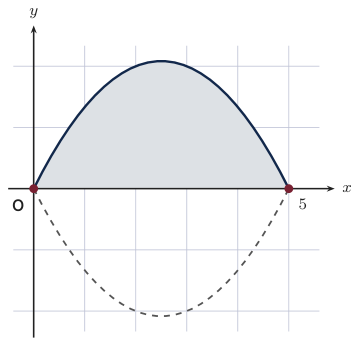
A ceramic pot is made by rotating the region R bounded by the curve y = x(5 - x) and the x-axis through 360^\circ about the x-axis. The units are centimetres.
Original Photon diagram
The region and, dashed, its reflection in the x-axis. Lengths in cm.
(a) Find the exact volume of the pot.
[4]
(b) Find the greatest radius of the pot.
[2]
(c) Find the capacity of the pot in litres, to 3 significant figures.
[1]
Show solutionHide solution
(a) V = \pi\displaystyle\int_0^5 x^2(5 - x)^2\,dx = \pi\int_0^5 (25x^2 - 10x^3 + x^4)\,dx
[2]
= \pi\left[\dfrac{25x^3}{3} - \dfrac{10x^4}{4} + \dfrac{x^5}{5}\right]_0^5 = \pi\left(\dfrac{3125}{3} - \dfrac{6250}{4} + 625\right)
[1]
= \dfrac{625\pi}{6}\ \text{cm}^3.
[1]
(b) By symmetry the maximum of y = x(5 - x) is at x = 2.5.
[1]
y = 2.5 \times 2.5 = 6.25 cm.
[1]
(c) \dfrac{625\pi}{6} = 327.2\ \text{cm}^3 = 0.327 litres (since 1000\ \text{cm}^3 = 1 litre).
[1]

Final answer

(a) \frac{625\pi}{6}\ \text{cm}^3. (b) 6.25 cm. (c) 0.327 litres.

Question 16

[7 marks]
Use the given substitution to find each integral.
(a) \displaystyle\int 3x^{2}\,(x^{3} - 2)^{4}\,dx, using u = x^{3} - 2.
[3]
(b) \displaystyle\int_{0}^{1} x\,e^{x^{2}}\,dx, using u = x^{2}.
[4]
Show solutionHide solution
(a) du = 3x^2\,dx
[1]
\displaystyle\int u^4\,du = \dfrac{u^5}{5}
[1]
= \dfrac{(x^3 - 2)^5}{5} + c.
[1]
(b) du = 2x\,dx, so x\,dx = \tfrac12\,du.
[1]
Limits: x = 0 \to u = 0, x = 1 \to u = 1.
[1]
\dfrac12\displaystyle\int_0^1 e^u\,du = \dfrac12(e - 1)
[1]
= 0.859.
[1]

Final answer

(a) \frac{(x^3-2)^5}{5}+c. (b) \frac{e-1}{2}\approx0.859.

Question 17

[7 marks]
The depth d of a swimming pool is measured at 5 m intervals along its 25 m length, from the shallow end (x = 0) to the diving end (x = 25).
\begin{array}{r|cccccc} x\ (\text{m}) & 0 & 5 & 10 & 15 & 20 & 25 \\ \hline d\ (\text{m}) & 1.0 & 1.2 & 1.5 & 2.1 & 2.8 & 3.0 \end{array}
(a) Use the trapezoidal rule to estimate the area of the longitudinal cross-section of the pool (the area under the depth graph).
[3]
(b) The pool is 10 m wide and its floor is assumed to vary smoothly between the measured points. Estimate the volume of water, in litres, when the pool is full, and the time it takes to fill at 2400 litres per minute. Give the time in hours and minutes.
[3]
(c) Suggest one way to improve the accuracy of the estimate.
[1]
Show solutionHide solution
(a) \dfrac{5}{2}\bigl(1.0 + 3.0 + 2(1.2 + 1.5 + 2.1 + 2.8)\bigr)
[2]
= 2.5(4.0 + 15.2) = 48\ \text{m}^2.
[1]
(b) Volume \approx 48 \times 10 = 480\ \text{m}^3 = 480\,000 litres.
[1]
Time = 480\,000 \div 2400 = 200 minutes.
[1]
= 3 hours 20 minutes.
[1]
(c) Measure the depth at more points, at smaller intervals (more strips).
[1]

Final answer

(a) 48\ \text{m}^2. (b) 480 000 litres; 3 hours 20 minutes. (c) Take more readings.

Question 18

[6 marks]
A lamp maker cuts a metal plate in the shape of the region bounded by the curve y=\dfrac{x^3}{8}, the y-axis and the lines y=1 and y=8, with units in centimetres.
(a) Write x in terms of y.
[1]
(b) Write down an integral, with respect to y, that gives the area of the plate.
[2]
(c) Find the area of the plate.
[2]
(d) Use your GDC to check your answer by integrating with respect to y.
[1]
Show solutionHide solution
(a) x=2y^{1/3}.
A1
(b) \displaystyle\int_1^8 2y^{1/3}\,dy.
M1A1
(c) \dfrac32\Bigl[y^{4/3}\Bigr]_1^8=\dfrac32(16-1).
M1
=22.5\ \text{cm}^2.
A1
(d) GDC: \displaystyle\int_1^8 2y^{1/3}\,dy=22.5.
A1
Check in x: a rectangle 2\times7 plus \displaystyle\int_2^4\Bigl(8-\dfrac{x^3}{8}\Bigr)dx=8.5 gives the same area.

Final answer

(a) x=2y^{1/3}. (b) \int_1^8 2y^{1/3}\,dy. (c) 22.5\ \text{cm}^2. (d) 22.5\ \text{cm}^2.

Question 19

[7 marks]
A 3D printer deposits filament at a rate of f(t) = 12 - 0.3t^{2} grams per minute, for 0 \le t \le 5, where t is the time in minutes since the print began.
(a) Find the mass of filament deposited in the first 5 minutes.
[3]
(b) Find the mass deposited between t = 2 and t = 4.
[2]
(c) A small part needs exactly 40 g of filament. Use your GDC to find the time T at which the printer has deposited 40 g.
[2]
Show solutionHide solution
(a) \displaystyle\int_0^5 (12 - 0.3t^2)\,dt = \bigl[12t - 0.1t^3\bigr]_0^5.
[2]
= 60 - 12.5 = 47.5 g.
[1]
(b) \bigl[12t - 0.1t^3\bigr]_2^4 = (48 - 6.4) - (24 - 0.8).
[1]
= 41.6 - 23.2 = 18.4 g.
[1]
(c) Solve 12T - 0.1T^3 = 40 (graph y = 12T - 0.1T^3 and y = 40, intersect):
[1]
T = 3.785\ldots = 3.79 minutes.
[1]

Final answer

(a) 47.5 g. (b) 18.4 g. (c) 3.79 minutes.

Question 20

[4 marks]
A mould for a ceramic cup is made by rotating the region under the curve y = \dfrac{3}{\sqrt{x + 1}}, for 0 \le x \le 3, through 360^\circ about the x-axis. The units are centimetres.
(a) Show that the volume of the mould is 18\pi\ln 2\ \text{cm}^3.
[3]
(b) Use your GDC to check this value, giving it to 3 significant figures.
[1]
Show solutionHide solution
(a) V = \pi\displaystyle\int_0^3 \dfrac{9}{x + 1}\,dx
[1]
= 9\pi\bigl[\ln(x + 1)\bigr]_0^3
[1]
= 9\pi(\ln 4 - \ln 1) = 9\pi \ln 4
[1]
= 18\pi\ln 2.
AG
(b) \pi\displaystyle\int_0^3 \dfrac{9}{x+1}\,dx = 39.2\ \text{cm}^3.
[1]

Final answer

(a) Shown, 18\pi\ln2. (b) 39.2\ \text{cm}^3.

Mastery

Full exam questions that mix question types, at Paper 1 and Paper 2 standard.

Question 21

[10 marks]
The power output P (in watts) of a rooftop solar panel is recorded every 2 hours during daylight, as shown in the table. Time t is measured in hours after midnight.
\begin{array}{r|ccccccc} t\ (\text{h}) & 6 & 8 & 10 & 12 & 14 & 16 & 18 \\ \hline P\ (\text{W}) & 0 & 220 & 480 & 610 & 500 & 240 & 0 \end{array}
The total energy generated (in watt-hours) equals the area under the power–time graph.
(a) Use the trapezoidal rule with all seven readings to estimate the total energy generated between t=6 and t=18, in watt-hours.
[4]
(b) Convert your answer to kilowatt-hours (kWh).
[2]
(c) Electricity from the grid costs $0.28 per kWh. Estimate the daily saving from using the solar panel.
[2]
(d) Explain briefly why using more frequent readings would improve the estimate.
[2]
Show solutionHide solution
(a) With h=2:
E\approx\frac{2}{2}\big(0+0+2(220+480+610+500+240)\big)=1\times(2\times 2050)=4100\ \text{Wh}.
[4]
(b) 4100\ \text{Wh}=4100\div 1000=4.1\ \text{kWh}.
[2]
(c) Saving =4.1\times 0.28=1.148\approx\$1.15 per day.
[2]
(d) More frequent readings mean narrower strips, so the straight trapezoid tops follow the curved graph more closely, reducing the error in the estimate.
[2]

Final answer

(a) 4100 Wh. (b) 4.1 kWh. (c) USD 1.15. (d) Narrower strips follow the curve more closely.

Question 22

[17 marks]
A home battery stores solar energy. Its stored energy Q kWh changes at a rate r(t) = 0.25t^{2} - 3t + 8 kWh per hour, where t is the number of hours since 6 am, for 0 \le t \le 12. At t = 0 the battery holds 20 kWh.
(a) Find the values of t at which the battery is neither charging nor discharging.
[2]
(b) Find an expression for Q(t).
[3]
(c) Find the least and the greatest amount of energy stored in the battery during the 12 hours.
[3]
(d) Find the total energy added to the battery during the times when it is charging.
[3]
(e) The rate is recorded at t = 0, 3, 6, 9, 12: 8,\ 1.25,\ -1,\ 1.25,\ 8. Use the trapezoidal rule to estimate the net change in stored energy over the 12 hours.
[3]
(f) Find the true net change over the 12 hours, and explain, by describing the graph of r, why the trapezoidal rule gives an over-estimate.
[3]
Show solutionHide solution
(a) 0.25t^2 - 3t + 8 = 0 \Rightarrow t^2 - 12t + 32 = 0
[1]
t = 4 and t = 8.
[1]
(b) Q = \displaystyle\int (0.25t^2 - 3t + 8)\,dt = \dfrac{t^3}{12} - 1.5t^2 + 8t + c
[2]
Q(0) = 20 \Rightarrow Q = \dfrac{t^3}{12} - 1.5t^2 + 8t + 20.
[1]
(c) Turning points at t = 4 and t = 8: Q(4) = 33.3, Q(8) = 30.7; the end values are Q(0) = 20 and Q(12) = 44.
[1]
Least stored energy: 20 kWh (at t = 0)
[1]
Greatest: 44 kWh (at t = 12).
[1]
(d) Charging when r > 0: 0 \le t < 4 and 8 < t \le 12.
[1]
\displaystyle\int_0^4 r\,dt + \int_8^{12} r\,dt = 13.33 + 13.33
[1]
= 26.7 kWh.
[1]
(e) \dfrac{3}{2}\bigl(8 + 8 + 2(1.25 - 1 + 1.25)\bigr)
[2]
= 28.5 kWh.
[1]
(f) True net change = Q(12) - Q(0) = 44 - 20 = 24 kWh.
[1]
The graph of r is a parabola opening upwards (concave up), so the chords lie above the curve.
[1]
So 28.5 > 24: an over-estimate of 18.8%.
[1]

Final answer

(a) t=4 and t=8. (b) Q=\frac{t^3}{12}-1.5t^2+8t+20. (c) Least 20 kWh, greatest 44 kWh. (d) 26.7 kWh. (e) 28.5 kWh. (f) 24 kWh; an over-estimate by 18.8%.

Question 23

[6 marks]
A workshop's marginal cost of producing the xth chair is modelled by
C'(x)=50-0.02x\quad(\text{dollars per chair}).
The fixed set-up cost (when no chairs are produced) is $300.
(a) Find an expression for the total cost C(x) of producing x chairs.
[4]
(b) Find the total cost of producing the first 100 chairs.
[2]
Show solutionHide solution
(a) C(x)=\displaystyle\int (50-0.02x)\,dx = 50x-0.01x^{2}+C.
Fixed cost gives C(0)=300, so C=300:
C(x)=50x-0.01x^{2}+300.
[4]
(b) C(100)=50(100)-0.01(100)^{2}+300=5000-100+300=5200.
The total cost is $5200.00.
[2]

Final answer

(a) C(x)=50x-0.01x^2+300. (b) USD 5200.00.
Question 24

[8 marks]
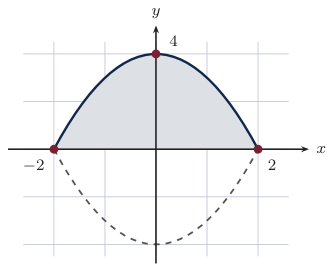
A wooden ornament is made by rotating the region enclosed between the curve y=4-x^{2} and the x-axis through 360^{\circ} about the x-axis. All lengths are in centimetres.
Original Photon diagram
The region and, dashed, its reflection in the x-axis. Lengths in cm.
(a) Find the x-coordinates where the curve meets the x-axis.
[2]
(b) Write down an integral for the volume of the solid formed.
[2]
(c) Find the exact volume of the ornament.
[4]
Show solutionHide solution
(a) 4-x^{2}=0\Rightarrow x^{2}=4\Rightarrow x=\pm 2.
[2]
(b) V=\displaystyle\pi\int_{-2}^{2}\big(4-x^{2}\big)^{2}\,dx.
[2]
(c) Expand: (4-x^{2})^{2}=16-8x^{2}+x^{4}.
V=\pi\Big[16x-\tfrac{8x^{3}}{3}+\tfrac{x^{5}}{5}\Big]_{-2}^{2}.
By symmetry this is 2\pi\Big[16(2)-\tfrac{8(8)}{3}+\tfrac{32}{5}\Big]=2\pi\Big[32-\tfrac{64}{3}+\tfrac{32}{5}\Big]=2\pi\cdot\tfrac{256}{15}=\frac{512\pi}{15}.
V=\dfrac{512\pi}{15}\ \text{cm}^3\approx 107\ \text{cm}^3.
[4]

Final answer

(a) x=\pm2. (b) \pi\int_{-2}^{2}(4-x^2)^2\,dx. (c) \frac{512\pi}{15}\approx107\ \text{cm}^3.

Question 25

[15 marks]
A glass paperweight is made by rotating the region R bounded by the curve y = 0.5(4 - x)\sqrt{x}, for 0 \le x \le 4, and the x-axis through 360^\circ about the x-axis. The units are centimetres.
(a) Use your GDC to find the greatest radius of the paperweight and the value of x at which it occurs.
[2]
(b) Show that the volume of the paperweight is \dfrac{16\pi}{3}\ \text{cm}^3.
[4]
(c) The glass has density 2.5\ \text{g cm}^{-3}. Find the mass of the paperweight.
[1]
(d) Use your GDC to find the area of the region R.
[2]
(e) A plane cut perpendicular to the x-axis at x = k divides the paperweight into two parts of equal volume. Find the value of k.
[3]
(f) Explain why k is less than 2.
[1]
(g) Find the values of x for which the radius of the paperweight is at least 1.5 cm.
[2]
Show solutionHide solution
(a) Graph y = 0.5(4 - x)\sqrt{x} and use the maximum tool.
[1]
x = 1.33, radius 1.54 cm.
[1]
(b) y^2 = \dfrac{x(4 - x)^2}{4} = \dfrac{16x - 8x^2 + x^3}{4}
[2]
V = \dfrac{\pi}{4}\displaystyle\int_0^4 (16x - 8x^2 + x^3)\,dx = \dfrac{\pi}{4}\left[8x^2 - \dfrac{8x^3}{3} + \dfrac{x^4}{4}\right]_0^4
[1]
= \dfrac{\pi}{4}\left(128 - \dfrac{512}{3} + 64\right)
[1]
= \dfrac{\pi}{4}\cdot\dfrac{64}{3} = \dfrac{16\pi}{3}.
AG
(c) \dfrac{16\pi}{3} \times 2.5 = 41.9 g.
[1]
(d) \displaystyle\int_0^4 0.5(4 - x)\sqrt{x}\,dx
[1]
= 4.27\ \text{cm}^2.
[1]
(e) V(k) = \dfrac{\pi}{4}\left(8k^2 - \dfrac{8k^3}{3} + \dfrac{k^4}{4}\right)
[1]
Solve V(k) = \dfrac{8\pi}{3}
[1]
k = 1.54 cm (GDC).
[1]
(f) The solid is wider for small x (the radius is greatest at x = 1.33 and tapers to 0 at x = 4), so more than half the volume lies in 0 \le x \le 2.
[1]
(g) Solve 0.5(4 - x)\sqrt{x} = 1.5 on the GDC:
[1]
x = 1 and x = 1.70, so 1 \le x \le 1.70.
[1]

Final answer

(a) x=1.33, radius 1.54 cm. (b) Shown. (c) 41.9 g. (d) 4.27\ \text{cm}^2. (e) k=1.54. (f) More of the volume lies near the wide end. (g) 1\le x\le1.70.

Question 26

[16 marks]
Hana makes a planter by rotating a curve and a line about the y-axis, with units in decimetres. The inside of the planter is formed by the curve y=0.25x^2 for 0\le y\le4, and above that by a vertical wall at x=4 for 4\le y\le6.
(a) Show that, when water fills the planter to a depth of h dm, where h\le4, its volume is 2\pi h^2 litres.
[3]
(b) Find the capacity of the planter by adding an integral and the volume of a cylinder.
[3]
(c) The planter is filled from empty at a constant 3 litres per minute. Find the time taken to fill it.
[2]
(d) Find the depth of the water when the planter is 40% full.
[3]
(e) By integrating with respect to y, find the area of the region between the curve, the y-axis and the line y=4.
[2]
(f) Find the depth of the water 10 minutes after filling starts.
[2]
(g) Suggest one reason why the model may not give the true capacity of a real planter.
[1]
Show solutionHide solution
(a) x^2=4y.
M1
V=\pi\displaystyle\int_0^h 4y\,dy.
A1
=2\pi h^2 cubic decimetres, and 1\ \text{dm}^3=1 litre.
A1
(b) The curved part holds 2\pi(4)^2=32\pi.
M1
The straight part is a cylinder of radius 4 and height 2: \pi(4)^2(2)=32\pi.
M1
Capacity =64\pi=201 litres.
A1
(c) 201.06\div3.
M1
67.0 minutes.
A1
(d) 0.4\times64\pi=25.6\pi.
M1
2\pi h^2=25.6\pi, so h^2=12.8.
M1
h=3.58 dm, which is below the join at 4.
A1
(e) x=2\sqrt y, so the area is \displaystyle\int_0^4 2\sqrt y\,dy.
M1
=\dfrac{32}{3}=10.7\ \text{dm}^2.
A1
(f) After 10 minutes there are 30 litres.
M1
2\pi h^2=30, so h=2.19 dm.
A1
(g) For example, the walls of a real planter have thickness, or the real profile is not exactly a parabola.
R1

Final answer

(a) Shown. (b) 64\pi\approx201 litres. (c) 67.0 minutes. (d) 3.58 dm. (e) \frac{32}{3}\approx10.7\ \text{dm}^2. (f) 2.19 dm. (g) For example, wall thickness.

Going further

Beyond the syllabus: the worked examples and investigations of the chapter's Going further pages.

G1 Stretch the curve, scale the volume

G1 Worked

[6 marks]
Mina’s glass stopper has volume \frac{68\pi}{3}\ \text{cm}^3, found by rotating y=\sqrt x+1 for 0\le x\le4 about the x-axis. A designer doubles every length of the curve, so the new curve is y=2\bigl(\sqrt{x/2}+1\bigr) for 0\le x\le8.
(a) Use the substitution x=2u to show that the new volume is 8 times the old volume.
[3]
(b) Find the new volume.
[1]
(c) A third stopper stretches every x-value by 2 and every y-value by 0.5. Find its volume.
[2]
Show solutionHide solution
(a) V'=\pi\displaystyle\int_0^8 4\bigl(\sqrt{x/2}+1\bigr)^2\,dx (M1). With x=2u, dx=2\,du and the limits become 0 to 4, so V'=8\pi\displaystyle\int_0^4(\sqrt u+1)^2\,du (A1). This is 8\times\frac{68\pi}{3} (A1). (b) V'=\frac{544\pi}{3}=570\ \text{cm}^3 (A1). (c) The factor is ab^2=2\times0.5^2=0.5 (M1), so the volume is \frac{34\pi}{3}=35.6\ \text{cm}^3 (A1).

Final answer

Shown; 570\ \text{cm}^3; 35.6\ \text{cm}^3.

G2 Where do the marks go on a measuring cup?

G2 Worked

[6 marks]
Rosa’s vase is formed by rotating the curve y=0.5x^4 about the y-axis, with units in centimetres. The rim is at y=8.
(a) Show that the volume of water of depth h is \dfrac{2\sqrt2\,\pi}{3}h^{3/2}.
[3]
(b) Find the capacity of the vase.
[1]
(c) Find the depth at which the vase is half full.
[2]
Show solutionHide solution
(a) x^2=\sqrt{y/0.5}=\sqrt{2y} (M1). V=\pi\displaystyle\int_0^h\sqrt2\,y^{1/2}\,dy (A1) =\pi\sqrt2\cdot\frac23h^{3/2}=\frac{2\sqrt2\,\pi}{3}h^{3/2} (A1). (b) At h=8: \frac{2\sqrt2\,\pi}{3}\times16\sqrt2=\frac{64\pi}{3}=67.0\ \text{cm}^3 (A1). (c) (h/8)^{3/2}=\frac12 (M1), so h=8\times2^{-2/3}=5.04 cm (A1).

Final answer

Shown; \frac{64\pi}{3}=67.0\ \text{cm}^3; 5.04 cm.

G3 Investigation

[21 marks]
Eko, a potter, designs a measuring cup whose inside is formed by rotating the curve y=0.2x^2 about the y-axis, with units in centimetres. The rim is at y=12.
(a) Show that the volume of liquid of depth h is 2.5\pi h^2, and find the capacity of the cup in millilitres.
[3]
(b) Find the depths at which the marks 250, 500, 750 and 1000 ml must be printed. Describe how the gaps between neighbouring marks change, and explain why.
[5]
(c) A cylinder has the same height and capacity as the cup. Find its radius and the gap between its 250 ml marks.
[3]
(d) For a cup formed by rotating y=cx^n, show that the volume is proportional to h raised to the power 1+\frac2n. Show that the cup is half full at a depth of \bigl(\frac12\bigr)^{n/(n+2)} of its height, and evaluate this for n=2,3,4.
[5]
(e) Explain what happens to the marks as n becomes very large, and link this to part (c). Suggest one practical reason why Eko might still choose n=2.
[5]
Show solutionHide solution
(a) x^2=5y (M1), so V=\pi\int_0^h5y\,dy=2.5\pi h^2 (A1). At h=12 the capacity is 360\pi=1131 ml (A1). (b) Solve 2.5\pi h^2=250 (M1) to get h=5.64 cm (A1); the others are 7.98, 9.77 and 11.3 cm (A1). The gaps are 5.64, 2.34, 1.79 and 1.51 cm, so they shrink (A1). The cup widens upwards, so each extra 250 ml needs less depth (R1). (c) \pi r^2\times12=360\pi gives r=\sqrt{30}=5.48 cm (M1 A1). The marks are \frac{250}{30\pi}=2.65 cm apart (A1). (d) x^2=(y/c)^{2/n} (M1), so V=\pi c^{-2/n}\dfrac{h^{1+2/n}}{1+2/n} (A1), which is proportional to h^{1+2/n} (A1). Half full means (h/H)^{1+2/n}=\frac12, so h/H=\bigl(\frac12\bigr)^{n/(n+2)} (M1). The values are 0.707, 0.660 and 0.630 (A1). (e) As n grows the exponent tends to 1 (M1), so V is proportional to h (A1) and the marks are equally spaced, which is the cylinder of part (c) (R1). For example, a wide mouth pours and cleans easily (R1), and the curved base is strong (R1).

Final answer

360\pi\approx1131 ml; 5.64, 7.98, 9.77, 11.3 cm; r=5.48 cm, 2.65 cm; 0.707, 0.660, 0.630; equal gaps, a cylinder.

From the book

Photon Guidebook: Mathematics Applications and Interpretation HL for the IB Diploma

Chapter 19 teaches integration from the basics to full exam questions: how the IB asks it, every question type with a marked example, and these practice questions in three steps.

About the book