Free worked solutions · 2026 Edition

IB Maths AI HL Chapter 18: Differentiation worked solutions

Worked solutions to the practice questions in Chapter 18 of Photon Guidebook: Mathematics Applications and Interpretation HL for the IB Diploma (2026 Edition). Each solution shows every step with the mark it earns, the way an IB mark scheme does.

  • Chapter 18 of 24
  • Volume 2
  • 25 practice questions
  • 3 Going further
  • Free, no sign-up

Basics

One idea at a time, in the order the chapter teaches them.

Question 1

[4 marks]
A record gives cooling temperature in degrees Celsius against elapsed minutes. The input changes from 1 to 5 and the output from 86 to 62.
(a) Calculate the average rate of change, including units.
[3]
(b) Does this determine the derivative at every input in the interval? Explain.
[1]
Show solutionHide solution
(a) Average rate =(62-86)/(5-1).
M1
Rate =-6.
A1
Units: degrees Celsius per minute.
A1
(b) No; an interval average need not equal the instantaneous rate at each input.
R1

Final answer

(a) -6\ {}^\circ\text{C} per minute. (b) No: it is an average over the interval, not the derivative at each input.
Question 2

[3 marks]
Let v(x)=\dfrac{9}{x^3}-2x^2, for x\ne0.
Find v\prime(x), giving your answer with positive exponents in denominators.
[3]
Show solutionHide solution
v(x)=9x^{-3}-2x^2.
M1
Term derivatives are -27x^{-4} and -4x.
M1
v\prime(x)=-27/x^4-4x.
A1

Final answer

v'(x)=-\dfrac{27}{x^4}-4x.

Question 3

[4 marks]
A cubic graph is y=x^3-2x^2+6.
Find the normal at x=-1, writing its equation with integer coefficients in the form ax+by+c=0.
[4]
Show solutionHide solution
The point is (-1,3).
A1
dy/dx=3x^2-4x gives m_T=7, so m_N=-1/7.
M1
y-3=-\tfrac17(x+1).
M1
x+7y-20=0.
A1

Final answer

x+7y-20=0.

Question 4

[7 marks]
A curve y=2x^3+bx+c passes through (1,14). Its normal at this point has gradient -1/9.
(a) Find b and c.
[5]
(b) Find the normal equation.
[2]
Show solutionHide solution
(a) The tangent gradient is 9.
M1
dy/dx=6x^2+b, so 6+b=9.
M1
b=3.
A1
2+3+c=14.
M1
c=9.
A1
(b) y-14=-\tfrac19(x-1).
M1
y=-\tfrac19x+\tfrac{127}{9}.
A1

Final answer

(a) b=3, c=9. (b) y=-\frac19x+\frac{127}{9}.

Question 5

[5 marks]
f(x)=2x^3-3x^2-12x+4.
Find and classify every stationary point. Use the sign of the derivative to justify.
[5]
Show solutionHide solution
f'(x)=6x^2-6x-12. Solve f'(x)=0.
M1
x=-1,2.
A1
Derivative signs in order: +,-,+.
A1
(-1,11)\text{ maximum},\ (2,-16)\text{ minimum}.
A1
A change from positive to negative gives a maximum; negative to positive gives a minimum.
R1

Final answer

(-1,\,11) local maximum; (2,\,-16) local minimum.

Question 6

[4 marks]
The cost model C(x)=7x+252/x applies for x>0.
Find the minimum cost and justify the minimizing input.
[4]
Show solutionHide solution
C\prime=7-252x^{-2}=0.
M1
x=6.
A1
C(6)=84.
A1
Cost decreases for x<6 and increases for x>6.
R1

Final answer

x=6; least cost 84.

Question 7

[2 marks]
Let f(x)=\sqrt{3 x - 2} on its natural real domain; trigonometric arguments are in radians. The chain rule is dy/dx=(dy/du)(du/dx).
Find f'(x) and its value at x=2.
[2]
Show solutionHide solution
The inner derivative is included: f'(x)=\frac{3}{2 \sqrt{3 x - 2}}.
M1
f'(2)=0.750.
A1

Final answer

f'(x)=\dfrac{3}{2\sqrt{3x-2}}; f'(2)=0.750.

Question 8

[2 marks]
A model for a scaled exposure index is f(x)=x e^{- \frac{x}{4}} for x>0. Angles are in radians. Use (uv)'=u' v+uv'.
Find f'(x) and the gradient at x=2.
[2]
Show solutionHide solution
f'(x)=- \frac{x e^{- \frac{x}{4}}}{4} + e^{- \frac{x}{4}}.
M1
At the stated input the gradient is 0.303.
A1

Final answer

f'(x)=e^{-x/4}\left(1-\frac{x}{4}\right); 0.303.

Question 9

[3 marks]
A spherical capsule has V=\frac43\pi r^3, with radius in centimetres. Its volume decreases at 2.4 cubic centimetres per second.
Find dr/dt when r=3.2 cm and interpret the sign.
[3]
Show solutionHide solution
dV/dt=4\pi r^2(dr/dt).
M1
dr/dt=-2.4/[4\pi(3.2)^2]=-0.0187 cm per second.
A1
The negative sign means the radius is decreasing.
R1

Final answer

−0.0187 cm per second: the radius is shrinking.

Question 10

[3 marks]
A point of inflexion is a point where the graph changes concavity. Let f(x)=x^3-9x^2+7x+4.
Locate the change from concave down to concave up. Give the coordinates and justify the change using f^{\prime\prime}.
[3]
Show solutionHide solution
f''(x)=6x-18=0 at x=3.
M1
f(3)=-29, so the point is (3,-29).
A1
The second derivative changes from negative to positive at 3, confirming inflexion.
R1

Final answer

Point of inflexion (3,\,-29).

Tutorial

Exam-style questions on each question type, with the marks the IB would give.

Question 11

[8 marks]
The temperature in a desert camp, in ^\circC, is modelled by T(t) = 25 + 9\sin\bigl(0.26(t-9)\bigr), where t is the time in hours after midnight. Set your GDC to radian mode.
(a) Find T'(t).
[2]
(b) Find the rate of change of the temperature at 02{:}00, and interpret your answer.
[2]
(c) Find the first time after midnight at which the temperature is momentarily neither rising nor falling.
[2]
(d) State the greatest rate at which the temperature rises, and explain how you know.
[2]
Show solutionHide solution
(a) T'(t) = 9\times 0.26\cos\bigl(0.26(t-9)\bigr) = 2.34\cos\bigl(0.26(t-9)\bigr).
[2]
(b) T'(2) = 2.34\cos(-1.82) = -0.577\ldots \approx \mathbf{-0.577}.
[1]
At 02:00 the temperature is falling at about 0.577^\circC per hour.
[1]
(c) T'(t) = 0 \Rightarrow \cos\bigl(0.26(t-9)\bigr) = 0.
[1]
0.26(t-9) = -\dfrac{\pi}{2} \Rightarrow t = 2.96\ldots, i.e. about 02:57 (the overnight minimum, 16^\circC).
[1]
(d) The greatest value of the cosine is 1, so the greatest rate is \mathbf{2.34}^\circC per hour (it occurs at 09:00, t=9, and every 24.2 hours later).
[1]
Since -1 \le \cos(\cdot) \le 1, T'(t) \le 2.34.
[1]

Final answer

(a) 2.34\cos(0.26(t-9)). (b) -0.577\ {}^\circ\text{C} per hour: falling. (c) t=2.96 (02:57). (d) 2.34\ {}^\circ\text{C} per hour.

Question 12

[8 marks]
During a storm, the intensity of rainfall at a weather station is modelled by R(t) = 24t\,e^{-0.4t} millimetres per hour, where t \ge 0 is the time in hours since the storm began.
(a) Show that R'(t) = 24(1 - 0.4t)e^{-0.4t}.
[3]
(b) Find the time at which the rainfall is heaviest, and the maximum intensity.
[3]
(c) Find R'(5) and interpret your answer.
[2]
Show solutionHide solution
(a) Product rule: u = 24t, v = e^{-0.4t}, u' = 24, v' = -0.4e^{-0.4t}.
[2]
R'(t) = 24e^{-0.4t} + 24t(-0.4)e^{-0.4t}
[1]
= 24e^{-0.4t}(1 - 0.4t).
AG
(b) R'(t) = 0 \Rightarrow 1 - 0.4t = 0 (since e^{-0.4t} > 0) \Rightarrow t = 2.5.
[1]
R(2.5) = 60e^{-1} = 22.1 mm per hour.
[1]
R' is positive for t<2.5 and negative for t>2.5, so this is a maximum.
[1]
(c) R'(5) = 24(1-2)e^{-2} = -3.25.
[1]
Five hours into the storm the rainfall intensity is dropping by about 3.25 mm per hour each hour.
[1]

Final answer

(a) Shown. (b) t=2.5 hours; 22.1 mm per hour. (c) −3.25 mm per hour per hour: the rain is easing.

Question 13

[10 marks]
One edge of a canal is modelled by the curve y = x^3 - 6x^2 + 11x - 2 for 0 \le x \le 4, where x and y are measured in hundreds of metres. Two straight service roads are to touch the canal edge, each parallel to the line y = 2x + 5.
(a) Find the values of x at which the canal edge has gradient 2.
[3]
(b) Find the equations of the two roads.
[4]
(c) The normal to the canal edge at x = 3 meets the y-axis at the point Q. Find the coordinates of Q.
[3]
Show solutionHide solution
(a) \dfrac{dy}{dx} = 3x^2 - 12x + 11
[1]
3x^2 - 12x + 11 = 2 \Rightarrow x^2 - 4x + 3 = 0
[1]
x = 1 or x = 3.
[1]
(b) At x = 1: y = 1 - 6 + 11 - 2 = 4, so y - 4 = 2(x - 1), i.e. y = 2x + 2.
[2]
At x = 3: y = 27 - 54 + 33 - 2 = 4, so y - 4 = 2(x - 3), i.e. y = 2x - 2.
[2]
(c) Normal gradient = -\dfrac12
[1]
y - 4 = -\dfrac12(x - 3) \Rightarrow y = -\dfrac12 x + \dfrac{11}{2}
[1]
Q = (0, 5.5).
[1]

Final answer

(a) x=1 and x=3. (b) y=2x+2 and y=2x-2. (c) Q(0,\,5.5).

Question 14

[9 marks]
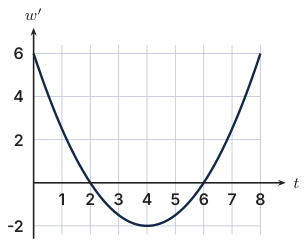
The graph below shows the rate of change w'(t), in centimetres per hour, of the water level w cm in an irrigation canal, for 0 \le t \le 8 hours.
Original Photon diagram
The graph of w'(t) for 0\le t\le8.
(a) Write down the values of t for which the water level is increasing.
[2]
(b) Find the values of t at which w has a local maximum and a local minimum, giving a reason.
[2]
(c) Use the graph to find the value of t at which w''(t) = 0, and show that the graph of w has a point of inflexion there.
[3]
(d) Without calculating, state whether w''(1) and w''(7) are positive or negative, and interpret w''(1).
[2]
Show solutionHide solution
(a) The level increases where w'(t) > 0, i.e. where the graph is above the axis: 0 \le t < 2 and 6 < t \le 8.
[2]
(b) At t=2, w' changes from + to -: local maximum.
[1]
At t=6, w' changes from - to +: local minimum.
[1]
(c) w' has its minimum (lowest point of the graph) at t = 4, so w''(4) = 0.
[1]
w' is decreasing before t=4 and increasing after, so w'' changes from - to +: a point of inflexion.
[2]
(d) w' is decreasing at t=1, so w''(1) < 0; w' is increasing at t=7, so w''(7) > 0.
[1]
At t=1 the level is still rising but the rate of rise is slowing down.
[1]

Final answer

(a) 0\le t<2 and 6<t\le8. (b) Maximum at t=2, minimum at t=6. (c) t=4. (d) w''(1)<0 and w''(7)>0.

Question 15

[9 marks]
A delivery drone uses energy of E(v) = 0.02v^2 + \dfrac{3200}{v} watt-hours per kilometre when it flies at a steady speed of v km per hour, for 10 \le v \le 80.
(a) Find E'(v).
[2]
(b) Find the speed at which the energy used per kilometre is least.
[2]
(c) Justify that this speed gives a minimum, and find the least energy per kilometre.
[3]
(d) The company currently flies the drone at 60 km per hour. By what percentage is the energy used per kilometre greater than the least possible?
[2]
Show solutionHide solution
(a) E(v) = 0.02v^2 + 3200v^{-1}
[1]
E'(v) = 0.04v - 3200v^{-2} = 0.04v - \dfrac{3200}{v^2}.
[1]
(b) 0.04v = \dfrac{3200}{v^2} \Rightarrow v^3 = 80\,000
[1]
v = 43.1 km per hour (GDC or cube root).
[1]
(c) E'(40) = 1.6 - 2 < 0 and E'(50) = 2 - 1.28 > 0: the sign changes from - to +, so it is a minimum.
[1]
E(43.09) = 111.4 \approx \mathbf{111} watt-hours per km.
[2]
(d) E(60) = 72 + 53.33 = 125.33
[1]
\dfrac{125.33 - 111.40}{111.40}\times 100 = 12.5\% more.
[1]

Final answer

(a) E'(v)=0.04v-\dfrac{3200}{v^2}. (b) 43.1 km per hour. (c) 111 Wh per km. (d) 12.5% more.

Question 16

[9 marks]
A gardener builds a compost bin: an open-topped cuboid with a square base of side x metres and height h metres. The bin must hold 0.5 m^3. The base costs $30 per square metre and the four sides cost $20 per square metre.
(a) Find an expression for h in terms of x.
[1]
(b) Show that the total cost is C(x) = 30x^2 + \dfrac{40}{x} dollars.
[2]
(c) Find C'(x) and the value of x that minimises the cost.
[3]
(d) Justify that this is a minimum, and find the dimensions of the bin and its minimum cost.
[3]
Show solutionHide solution
(a) x^2h = 0.5 \Rightarrow h = \dfrac{0.5}{x^2}.
[1]
(b) Base cost = 30x^2; sides cost = 20\times 4xh = 80x\cdot\dfrac{0.5}{x^2}
[2]
= \dfrac{40}{x}, so C(x) = 30x^2 + \dfrac{40}{x}.
AG
(c) C'(x) = 60x - 40x^{-2}
[1]
60x = \dfrac{40}{x^2} \Rightarrow x^3 = \dfrac23
[1]
x = 0.874 m.
[1]
(d) C'(0.8) = 48 - 62.5 < 0 and C'(1) = 60 - 40 > 0: minimum.
[1]
h = \dfrac{0.5}{0.8736^2} = 0.655 m.
[1]
C = 30(0.8736)^2 + \dfrac{40}{0.8736} = \$\mathbf{68.68}.
[1]

Final answer

(a) h=\dfrac{0.5}{x^2}. (b) Shown. (c) x=0.874 m. (d) h=0.655 m; minimum cost $68.68.

Question 17

[8 marks]
A drone flies in a straight horizontal line at a constant height of 60 m above level ground, with a constant speed of 8 m s^{-1}. At time t = 0 it passes directly over a surveyor at the point O on the ground. After t seconds the drone is a horizontal distance x m from the point directly above O, and a distance D m from the surveyor.
(a) Write down \dfrac{dx}{dt}, and express D in terms of x.
[1]
(b) Find \dfrac{dD}{dx}.
[2]
(c) Hence find the rate at which D is increasing at the moment when x = 80.
[3]
(d) Find the value of x at which D is increasing at 4.8 m s^{-1}.
[2]
Show solutionHide solution
(a) \dfrac{dx}{dt} = 8 and D = \sqrt{x^2 + 3600} (Pythagoras).
[1]
(b) D = (x^2 + 3600)^{1/2}, so \dfrac{dD}{dx} = \tfrac12(x^2+3600)^{-1/2}\times 2x
[1]
= \dfrac{x}{\sqrt{x^2 + 3600}}.
[1]
(c) \dfrac{dD}{dt} = \dfrac{dD}{dx}\times\dfrac{dx}{dt}
[1]
When x = 80: D = \sqrt{6400 + 3600} = 100, so \dfrac{dD}{dx} = 0.8.
[1]
\dfrac{dD}{dt} = 0.8\times 8 = \mathbf{6.4} m s^{-1}.
[1]
(d) \dfrac{8x}{\sqrt{x^2 + 3600}} = 4.8 \Rightarrow \dfrac{x}{\sqrt{x^2+3600}} = 0.6
[1]
0.64x^2 = 0.36\times 3600 = 1296 \Rightarrow x^2 = 2025, so x = \mathbf{45} m.
[1]

Final answer

(a) \frac{dx}{dt}=8, D=\sqrt{x^2+3600}. (b) \dfrac{x}{\sqrt{x^2+3600}}. (c) 6.4 m/s. (d) x=45 m.

Question 18

[10 marks]
A factory's weekly production is x units, where x = 40 + 3t and t is the number of weeks since a new line opened. The weekly cost of production, in dollars, is C(x) = 0.02x^2 + 5x + 300.
(a) Write down \dfrac{dC}{dx} and \dfrac{dx}{dt}, and state the formula for \dfrac{dC}{dt}.
[3]
(b) Find the rate at which the weekly cost is rising when t = 10, and interpret your answer.
[4]
(c) Find the value of t for which the weekly cost is rising at $30 per week.
[3]
Show solutionHide solution
(a) \dfrac{dC}{dx} = 0.04x + 5, \dfrac{dx}{dt} = 3.
[2]
\dfrac{dC}{dt} = \dfrac{dC}{dx}\times\dfrac{dx}{dt} (chain rule).
[1]
(b) x = 70, so \dfrac{dC}{dx} = 0.04(70) + 5 = 7.8.
[1]
\dfrac{dC}{dt} = 7.8\times 3 = \mathbf{23.4}.
[2]
In week 10 the weekly cost is rising by about $23.40 per week.
[1]
(c) (0.04x + 5)\times 3 = 30 \Rightarrow 0.04x + 5 = 10
[1]
x = 125
[1]
40 + 3t = 125 \Rightarrow t = 28.3 weeks.
[1]

Final answer

(a) 0.04x+5, 3, \frac{dC}{dt}=\frac{dC}{dx}\cdot\frac{dx}{dt}. (b) $23.40 per week. (c) t=28.3 weeks.

Question 19

[9 marks]
A laser pointer on a rotating stand at ground level shines at a vertical wall 15 m away. When the beam makes an angle of \theta radians with the horizontal, the spot on the wall is at height h = 15\tan\theta metres, for 0 \le \theta < \dfrac{\pi}{2}.
(a) Find \dfrac{dh}{d\theta}.
[2]
(b) Find the exact value of \dfrac{dh}{d\theta} when \theta = \dfrac{\pi}{6}, and interpret it.
[3]
(c) Find the value of \theta for which \dfrac{dh}{d\theta} = 60.
[3]
(d) Describe what happens to the rate at which the spot climbs as \theta approaches \dfrac{\pi}{2}.
[1]
Show solutionHide solution
(a) \dfrac{dh}{d\theta} = \dfrac{15}{\cos^2\theta} (or 15\sec^2\theta).
[2]
(b) \cos^2\dfrac{\pi}{6} = \dfrac34
[1]
\dfrac{dh}{d\theta} = \dfrac{15}{3/4} = \mathbf{20}.
[1]
At that angle the spot rises 20 metres for each radian the beam turns.
[1]
(c) \dfrac{15}{\cos^2\theta} = 60 \Rightarrow \cos^2\theta = \dfrac14
[1]
\cos\theta = \tfrac12 (since \cos\theta > 0)
[1]
\theta = \dfrac{\pi}{3}\ (\approx 1.05).
[1]
(d) \cos\theta \to 0, so \dfrac{15}{\cos^2\theta} becomes arbitrarily large: the spot climbs faster and faster.
[1]

Final answer

(a) \dfrac{15}{\cos^2\theta}. (b) 20 m per radian. (c) \theta=\dfrac{\pi}{3}. (d) It grows without bound.

Mastery

Full exam questions that mix question types, at Paper 1 and Paper 2 standard.

Question 20

[10 marks]
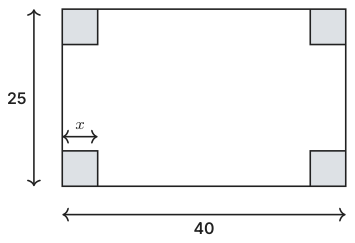
A packaging designer makes an open-topped tray by cutting a square of side x cm from each corner of a rectangular sheet measuring 40 cm by 25 cm, then folding up the sides.
Original Photon diagram
The sheet with a square of side x cm cut from each corner.
(a) Show that the volume of the tray is V(x)=4x^{3}-130x^{2}+1000x.
[3]
(b) Find V'(x).
[2]
(c) Find the value of x that maximises the volume, and state this maximum volume.
[5]
Show solutionHide solution
(a) The base is (40-2x) by (25-2x) and the height is x:
V(x)=x(40-2x)(25-2x).
Expanding (40-2x)(25-2x)=1000-130x+4x^{2}, so
V(x)=x(4x^{2}-130x+1000)=4x^{3}-130x^{2}+1000x.
[3]
(b)
V'(x)=12x^{2}-260x+1000.
[2]
(c) Set V'(x)=0: 4(3x^{2}-65x+250)=0, giving x=5 or x=\dfrac{50}{3}\approx 16.7.
Since x<12.5 (the shorter side halved), only x=5 is valid.
V(5)=5(30)(15)=2250 cm^{3}.
Maximum volume is 2250 cm^{3} at x=5 cm.
[5]

Final answer

(a) Shown. (b) V'(x)=12x^2-260x+1000. (c) x=5 cm; V=2250\ \text{cm}^3.

Question 21

[14 marks]
An ecologist models the population of a rabbit colony on an island by
P(t)=t^{3}-18t^{2}+96t+50,
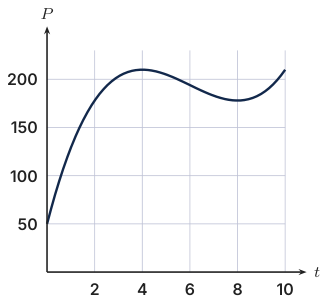
where P is the number of rabbits and t is the time in years (0\le t\le 10). The graph of P is shown below.
Original Photon diagram
The graph of P(t) for 0\le t\le10.
(a) Find the initial population of the colony.
[1]
(b) Find P'(t).
[2]
(c) (i) Find the two values of t at which the population is momentarily neither increasing nor decreasing.
(ii) Using the second derivative, classify each of these as a local maximum or local minimum.
[6]
(d) Find the time at which the population is decreasing most rapidly on the interval 2\le t\le 8 (the point of inflexion).
[3]
(e) State the maximum population reached during the first 10 years.
[2]
Show solutionHide solution
(a) P(0)=50 rabbits.
[1]
(b)
P'(t)=3t^{2}-36t+96.
[2]
(c) (i) 3t^{2}-36t+96=3(t^{2}-12t+32)=3(t-4)(t-8)=0, so t=4 or t=8.
(ii) P''(t)=6t-36. At t=4: P''=-12<0, a local maximum. At t=8: P''=12>0, a local minimum.
[6]
(d) The point of inflexion is where P''(t)=0: 6t-36=0\Rightarrow t=6 years.
[3]
(e) Candidates are the local maximum and the endpoints. P(4)=64-288+384+50=210; P(0)=50; P(10)=1000-1800+960+50=210.
The maximum population is 210 rabbits.
[2]

Final answer

(a) 50. (b) 3t^2-36t+96. (c) t=4 (maximum, 210) and t=8 (minimum, 178). (d) t=6. (e) 210.

Question 22

[14 marks]
A theatre lighting designer models the illumination, in lux, at a point on a stage by E(\varphi) = 200\sin\varphi\cos^2\varphi, where \varphi radians is the angle between a spotlight beam and the vertical, for 0 < \varphi < \dfrac{\pi}{2}.
(a) Show that E'(\varphi) = 200\cos\varphi\,(1 - 3\sin^2\varphi).
[3]
(b) Find the value of \varphi for which E'(\varphi) = 0.
[3]
(c) Justify that this gives the greatest illumination and find its value.
[3]
(d) Use your GDC to find the values of \varphi for which the illumination is 60 lux.
[3]
(e) Find E\left(\dfrac\pi6\right) and E'\left(\dfrac\pi6\right) and interpret the second value.
[2]
Show solutionHide solution
(a) Product rule: E' = 200\bigl[\cos\varphi\cos^2\varphi + \sin\varphi(-2\cos\varphi\sin\varphi)\bigr]
[2]
= 200\cos\varphi\bigl(\cos^2\varphi - 2\sin^2\varphi\bigr) = 200\cos\varphi(1 - 3\sin^2\varphi).
[1]
(b) \cos\varphi > 0 on the interval, so 1 - 3\sin^2\varphi = 0
[1]
\sin\varphi = \dfrac{1}{\sqrt3}
[1]
\varphi = 0.615 radians.
[1]
(c) E'(0.5) = 54.5 > 0 and E'(0.7) = -37.5 < 0: a maximum.
[1]
E = 200\times\dfrac{1}{\sqrt3}\times\dfrac23 = \dfrac{400}{3\sqrt3} = 77.0 lux.
[2]
(d) Solve 200\sin\varphi\cos^2\varphi = 60 (graph intersections).
[1]
\varphi = 0.346 and \varphi = 0.905.
[2]
(e) E\left(\tfrac\pi6\right) = 75 lux and E'\left(\tfrac\pi6\right) = 43.3.
[1]
At \varphi = \pi/6 the illumination is increasing by about 43.3 lux for each radian the beam is tilted away from the vertical.
[1]

Final answer

(a) Shown. (b) \varphi=0.615. (c) 77.0 lux. (d) \varphi=0.346 and 0.905. (e) 75; 43.3 lux per radian.

Question 23

[15 marks]
A fish farmer stocks a pond with n thousand fish. Because of crowding, the average mass of a fish at harvest is (2.4 - 0.02n) kg, and the farmer sells the harvest at $6 per kilogram. The cost of running the pond is C(n) = 0.04n^2 + 2n + 10 thousand dollars. Let R(n) thousand dollars be the revenue and P(n) thousand dollars the profit, for 0 < n \le 100.
(a) Show that P(n) = -0.16n^2 + 12.4n - 10.
[3]
(b) Find R'(20) and C'(20) and use them to explain whether the farmer should stock more than 20 thousand fish.
[3]
(c) Find the number of fish that gives the greatest profit, and that profit.
[5]
(d) Find the average mass of a fish at harvest when the profit is greatest.
[1]
(e) Use your GDC to find the range of values of n for which the farm makes a profit.
[3]
Show solutionHide solution
(a) Mass harvested = n(2.4 - 0.02n) thousand kg, so R(n) = 6n(2.4 - 0.02n) = 14.4n - 0.12n^2.
[2]
P = R - C = 14.4n - 0.12n^2 - 0.04n^2 - 2n - 10
[1]
= -0.16n^2 + 12.4n - 10.
AG
(b) R'(n) = 14.4 - 0.24n, so R'(20) = 9.6; C'(n) = 0.08n + 2, so C'(20) = 3.6 (thousand dollars per thousand fish).
[2]
Revenue rises faster than cost, so profit rises: the farmer should stock more.
[1]
(c) P'(n) = -0.32n + 12.4
[2]
P'(n) = 0 \Rightarrow n = 38.75, i.e. 38 750 fish
[1]
P' changes from + to - (downward parabola): maximum.
[1]
P(38.75) = 230.25, i.e. a profit of about $230 000.
[1]
(d) 2.4 - 0.02(38.75) = \mathbf{1.625} kg.
[1]
(e) Solve P(n) = 0: n = 0.815 and n = 76.7.
[2]
A profit for 0.815 < n < 76.7 (about 815 to 76 700 fish).
[1]

Final answer

(a) Shown. (b) R'(20)=9.6 and C'(20)=3.6 (thousand dollars per thousand fish): stock more. (c) 38 750 fish; \$230\,250. (d) 1.625 kg. (e) 0.815<n<76.7.

Question 24

[10 marks]
The landing slope of a ski jump is modelled by y=40e^{-0.05x}, where x is the horizontal distance and y the height, both in metres.
(a) Find the angle between the slope and the horizontal at x=20.
[3]
(b) Find the value of x at which the slope makes an angle of 30^\circ with the horizontal.
[3]
A skier moves down the slope so that x increases at 15 m per second.
(c) Find the rate at which the skier’s height is changing when x=20.
[2]
(d) Find the value of x at which the height is decreasing at 8 m per second.
[2]
Show solutionHide solution
(a) y'=-2e^{-0.05x}.
M1
At x=20: -2e^{-1}=-0.736.
A1
\arctan0.736=36.3^\circ.
A1
(b) 2e^{-0.05x}=\tan30^\circ.
M1
e^{-0.05x}=0.2887.
A1
x=24.8 m.
A1
(c) \dfrac{dy}{dt}=\dfrac{dy}{dx}\cdot\dfrac{dx}{dt}=-0.736\times15.
M1
=-11.0 m/s.
A1
(d) 30e^{-0.05x}=8.
M1
x=26.4 m.
A1

Final answer

(a) 36.3^\circ. (b) x=24.8 m. (c) −11.0 m/s. (d) x=26.4 m.

Question 25

[16 marks]
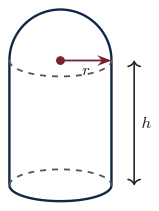
A water tank is made of a cylinder of radius r metres and height h metres with a hemispherical roof and a flat circular base. The tank must hold 9 m^3 of water.
Original Photon diagram
The tank: a cylinder with a hemispherical roof and a flat base.
(a) Show that h=\dfrac{9}{\pi r^2}-\dfrac{2r}{3}.
[3]
The base costs 30 AUD per m^2, the curved wall costs 20 AUD per m^2 and the roof costs 40 AUD per m^2.
(b) Show that the total cost of the tank is C=\dfrac{250}{3}\pi r^2+\dfrac{360}{r}.
[4]
(c) Find \dfrac{dC}{dr}.
[2]
(d) Find the value of r that gives the least cost, and justify that it is a minimum.
[4]
(e) Find the height of the cylinder and the least cost.
[2]
(f) The pump needs a cylinder at least 3 m tall. Determine whether the cheapest tank meets this need.
[1]
Show solutionHide solution
(a) The hemisphere has volume \frac23\pi r^3, so \pi r^2h+\frac23\pi r^3=9.
M1A1
h=\dfrac{9}{\pi r^2}-\dfrac{2r}{3}.
A1
(b) C=30\pi r^2+20(2\pi rh)+40(2\pi r^2).
M1A1
2\pi rh=\dfrac{18}{r}-\dfrac{4\pi r^2}{3}.
M1
C=30\pi r^2+\dfrac{360}{r}-\dfrac{80\pi r^2}{3}+80\pi r^2=\dfrac{250}{3}\pi r^2+\dfrac{360}{r}.
A1
(c) \dfrac{dC}{dr}=\dfrac{500}{3}\pi r-\dfrac{360}{r^2}.
M1A1
(d) \dfrac{500}{3}\pi r=\dfrac{360}{r^2}, so r^3=\dfrac{1080}{500\pi}.
M1
r=0.883 m.
A1
C'(0.8)<0 and C'(1)>0.
M1
The sign changes from - to +: a minimum.
R1
(e) h=3.09 m.
A1
C=611.82 AUD.
A1
(f) 3.09\ge3: yes, but only just.
R1

Final answer

(a) Shown. (b) Shown. (c) \dfrac{500\pi r}{3}-\dfrac{360}{r^2}. (d) r=0.883 m. (e) h=3.09 m; 611.82 AUD. (f) Yes, just.

Going further

Beyond the syllabus: the worked examples and investigations of the chapter's Going further pages.

G1 Marginal cost meets average cost

G1 Worked

[6 marks]
Amara’s workshop makes wooden stools. Her daily cost of making x stools is C(x)=0.02x^2+6x+800 dollars.
(a) Show that the average cost per stool is A(x)=0.02x+6+\dfrac{800}{x}.
[1]
(b) Find the number of stools that gives the least average cost, and that least cost.
[3]
(c) Find C'(200) and compare it with your answer to (b).
[2]
Show solutionHide solution
(a) A(x)=\frac{C(x)}{x}=0.02x+6+\frac{800}{x} (A1). (b) A'(x)=0.02-800x^{-2}=0 gives x^2=40\,000 (M1), so x=200 stools (A1), and A(200)=4+6+4=14 dollars per stool (A1). (c) C'(x)=0.04x+6, so C'(200)=14 (A1). The cost of one more stool equals the least average cost (R1).

Final answer

Shown; 200 stools, 14 dollars; C'(200)=14, equal to the least average cost.

G2 The tangent from the origin

G2 Worked

[6 marks]
Soraya replants her olive grove every T years. The total harvest of a grove t years after planting is modelled by H(t)=0.6t^2-0.01t^3 tonnes, for 0\le t\le40.
(a) Write down the mean harvest per year, Y(t)=\dfrac{H(t)}{t}.
[1]
(b) Find the value of T that maximises the mean harvest per year, and that greatest mean.
[3]
(c) Show that H'(30)=Y(30) and explain what this means on a graph of H.
[2]
Show solutionHide solution
(a) Y(t)=0.6t-0.01t^2 (A1). (b) Y'(t)=0.6-0.02t=0 gives t=30 (M1 A1), and Y(30)=18-9=9 tonnes per year (A1). (c) H'(t)=1.2t-0.03t^2, so H'(30)=36-27=9=Y(30) (A1). The line from the origin to (30,270) has gradient 9, the same as the curve there, so it is a tangent (R1).

Final answer

0.6t-0.01t^2; T=30 years, 9 tonnes per year; shown, the line from the origin is a tangent.

G3 Investigation

[20 marks]
Eun-ji manages a pine plantation. The volume of timber in a plantation t years after planting is modelled by V(t)=\dfrac{600}{1+59e^{-0.12t}} cubic metres per hectare.
(a) Find V(0) and show that V'(t)=\dfrac{4248e^{-0.12t}}{\left(1+59e^{-0.12t}\right)^2}.
[4]
(b) Find the age at which the timber grows fastest, and that rate of growth.
[3]
The forester will fell the trees at age T years and replant at once, so the timber produced per year is Y(T)=\dfrac{V(T)}{T}.
(c) Show that Y'(T)=0 when V'(T)=\dfrac{V(T)}{T}, and interpret this condition on a graph of V against t.
[5]
(d) Find the value of T that maximises Y, and the greatest yield per year.
[3]
(e) Felling and replanting cost the equivalent of 50 cubic metres per hectare each time. Find the new best felling age. Give one limitation of the model.
[5]
Show solutionHide solution
(a) V(0)=\frac{600}{60}=10 (A1). Write V=600(1+59e^{-0.12t})^{-1} (M1); the chain rule gives V'=600\times59\times0.12\,e^{-0.12t}(1+59e^{-0.12t})^{-2} (A1), and 600\times59\times0.12=4248 (A1). (b) The growth is greatest where V''=0, which is where 59e^{-0.12t}=1 (M1), so t=\frac{\ln59}{0.12}=34.0 years (A1). Then V'=\frac{4248/59}{4}=18.0 cubic metres per hectare per year (A1). (c) The quotient rule gives Y'(T)=\frac{TV'(T)-V(T)}{T^2} (M1 A1). This is zero when TV'(T)=V(T), that is V'(T)=\frac{V(T)}{T} (A1). The line from the origin to (T,V(T)) has gradient \frac{V(T)}{T}, so the condition says that this line has the same gradient as the curve: it is a tangent (R1 R1). (d) Graph Y(T) on the GDC and find its maximum (M1): T=46.7 years (A1), Y=10.6 cubic metres per hectare per year (A1). (e) The yield per year is now \frac{V(T)-50}{T} (M1). Its maximum on the GDC is at T=48.0 years (A1 A1), with a yield of 9.50. One limitation: the price of timber depends on tree size, or growth depends on weather and pests, or the model ignores the value of money over 48 years (R1 R1).

Final answer

V(0)=10, shown; 34.0 years, 18.0 m^3 per hectare per year; shown, a tangent from the origin; T=46.7 years, 10.6 m^3 per hectare per year; T=48.0 years, with a stated limitation.

From the book

Photon Guidebook: Mathematics Applications and Interpretation HL for the IB Diploma

Chapter 18 teaches differentiation from the basics to full exam questions: how the IB asks it, every question type with a marked example, and these practice questions in three steps.

About the book