Free worked solutions · 2026 Edition

IB Maths AI HL Chapter 16: Probability distributions worked solutions

Worked solutions to the practice questions in Chapter 16 of Photon Guidebook: Mathematics Applications and Interpretation HL for the IB Diploma (2026 Edition). Each solution shows every step with the mark it earns, the way an IB mark scheme does.

  • Chapter 16 of 24
  • Volume 2
  • 26 practice questions
  • 3 Going further
  • Free, no sign-up

Basics

One idea at a time, in the order the chapter teaches them.

Question 1

[4 marks]
X takes values 0, 2, 6 with probabilities k,2k,1-3k. The expected value is 3.34.
Find k and check that each probability is valid.
[4]
Show solutionHide solution
2(2k)+6(1-3k)=3.34.
M1
6-14k=3.34, so k=0.19.
A1
Probabilities 0.19,0.38,0.43.
A1
All lie in [0,1] and sum to 1.
R1

Final answer

k=0.19; probabilities 0.19, 0.38, 0.43

Question 2

[3 marks]
A fair game has expected net gain zero. It awards gross prizes 0, 6 and 17 dollars with probabilities 0.62, 0.25 and 0.13.
Find the fair entry fee, to two decimal places.
[3]
Show solutionHide solution
Expected gross prize =0(0.62)+6(0.25)+17(0.13).
M1
3.71 dollars.
A1
Fee 3.71 dollars makes expected net gain zero.
R1

Final answer

$3.71

Question 3

[5 marks]
A random variable takes values 2,5,9 with probabilities 0.31,0.46,0.23. Let Y=4-2X.
Find E(X), \operatorname{Var}(X) and \operatorname{Var}(Y).
[5]
Show solutionHide solution
E(X)=2(0.31)+5(0.46)+9(0.23)=4.99. M1 A1 E(X^2)=4(0.31)+25(0.46)+81(0.23)=31.37. M1 \operatorname{Var}(X)=31.37-4.99^2=6.4699. A1 \operatorname{Var}(Y)=4(6.4699)=25.8796.
A1

Final answer

E(X)=4.99; \mathrm{Var}(X)=6.4699; \mathrm{Var}(Y)=25.9

Question 4

[3 marks]
A display invites users to scan a code. Independently on each of 23 trials, success probability is 0.29. Let X count successes.
Find the probability of at least 8 successes to 3 significant figures.
[3]
Show solutionHide solution
Required P(X\ge8).
A1
Use 1-\mathrm{P}(X\le7) (a cumulative probability adds from 0 up to 7).
M1
0.342.
A1

Final answer

0.342

Question 5

[3 marks]
A model describes package mass in kg. Let X\sim\mathrm{N}(18.3,2.1^2).
Find the cutoff exceeded by 7% of packages. Give the value to 2 decimal places.
[3]
Show solutionHide solution
Required lower-tail area 0.93.
A1
Use inverse normal with area 0.93, mean 18.3, standard deviation 2.1.
M1
21.40.
A1

Final answer

21.40 kg

Question 6

[5 marks]
Eight independent vial volumes each follow N(12.4,0.09) millilitres, in mean, variance notation. Let T be their sum.
Find the distribution of the stated total or difference, using N(\mu,\sigma^2) notation, and calculate P(T<98).
[5]
Show solutionHide solution
Independence and normality make the linear combination normal. R1 Its mean is 99.2 and variance is 0.72, so T\sim N(99.2,0.72). M1 A1 P(T<98)=0.0786496\approx0.0786 using standard deviation \sqrt{0.72}.
M1A1

Final answer

T\sim\mathrm N(99.2,0.72); 0.0786

Question 7

[5 marks]
Independent sensor errors are X\sim N(1.7,0.81) and Y\sim N(-0.4,0.49), with mean, variance notation. Let T=X-Y.
Find the distribution of the stated total or difference, using N(\mu,\sigma^2) notation, and calculate P(T<0).
[5]
Show solutionHide solution
Independence and normality make the linear combination normal. R1 Its mean is 2.1 and variance is 1.3, so T\sim N(2.1,1.3). M1 A1 P(T<0)=0.0327506\approx0.0328 using standard deviation \sqrt{1.3}.
M1A1

Final answer

T\sim\mathrm N(2.1,1.3); 0.0328

Question 8

[2 marks]
A photographic plate has flecks at a uniform average rate of 1.3 per square centimetre, with independent counts in disjoint regions.
Find the probability of more than five flecks in a rectangular region measuring 2 cm by 1.5 cm.
[2]
Show solutionHide solution
The area is 3 square centimetres and the mean is 3.9.
M1
P(X>5)=1-P(X\le5)=0.199.
A1

Final answer

0.199

Question 9

[3 marks]
Independent samples from a clean-room surface each have Poisson fleck count with mean 1.1. Eight samples are taken.
Find the probability that exactly three samples contain no flecks.
[3]
Show solutionHide solution
A sample is empty with probability p=e^{-1.1}=0.332871.
M1
The number of empty samples is Y\sim B(8,p).
A1
P(Y=3)=\binom83p^3(1-p)^5=0.273.
A1

Final answer

0.273

Question 10

[2 marks]
A Poisson count X has P(X=0)=0.21.
Find its mean to three significant figures and calculate P(X=1).
[2]
Show solutionHide solution
e^{-\lambda}=0.21, so \lambda=-\ln(0.21)=1.56.
M1
P(X=1)=\lambda e^{-\lambda}=(-\ln0.21)(0.21)=0.328.
A1

Final answer

m=1.56; 0.328

Tutorial

Exam-style questions on each question type, with the marks the IB would give.

Question 11

[10 marks]
Isabel plays a game with a bag containing four tokens, marked $1, $1, $2 and $5. She draws two tokens at random without replacement and wins T dollars, the total of the two values.
(a) Show that \mathrm{P}(T=6)=\dfrac13.
[2]
(b) Write down the probability distribution of T.
[2]
(c) Find E(T).
[2]
(d) State the entry fee that would make the game fair.
[1]
(e) The entry fee is actually $4. Find Isabel's expected net gain after playing 30 games.
[3]
Show solutionHide solution
(a) There are \binom42=6 equally likely pairs of tokens. A total of 6 arises from \{1,5\} using either of the two $1 tokens.
[1]
So \mathrm{P}(T=6)=\dfrac26=\dfrac13.
[1]
(b) The totals are \{1,1\}\to2, \{1,2\}\to3 (twice), \{1,5\}\to6 (twice), \{2,5\}\to7.
[1]
\begin{array}{c|cccc} t & \text{2} & \text{3} & \text{6} & \text{7} \\ \hline \mathrm{P}(T=t) & \frac16 & \frac13 & \frac13 & \frac16 \\ \end{array}
[1]
(c) E(T)=2\left(\tfrac16\right)+3\left(\tfrac13\right)+6\left(\tfrac13\right)+7\left(\tfrac16\right).
[1]
=\dfrac{27}{6}=4.5 (that is, $4.50).
[1]
(d) Fair fee =E(T)=\$4.50.
[1]
(e) Net gain per game =4.50-4=\$0.50.
[2]
After 30 games: 30\times0.50=\$15.00.
[1]

Final answer

(b) \frac16,\frac13,\frac13,\frac16 for t=2,3,6,7 (c) $4.50 (d) $4.50 (e) $15.00

Question 12

[6 marks]
Wei Ling designs a game for a charity stall. A player pays $5 and spins a wheel. With probability 0.1 the player wins $20; with probability 0.2 the player wins k dollars; otherwise the player wins nothing.
(a) Given that the game is fair, find the value of k.
[3]
(b) Wei Ling instead sets k=10. Find the expected net gain per player, and the stall's expected profit when 80 people play.
[3]
Show solutionHide solution
(a) A fair game has expected winnings equal to the cost: 20(0.1)+k(0.2)=5.
[2]
2+0.2k=5\Rightarrow k=15.
[1]
(b) Expected winnings =20(0.1)+10(0.2)=\$4.00.
[1]
Expected net gain per player =4.00-5=-\$1.00.
[1]
Stall's expected profit =80\times1.00=\$80.00.
[1]

Final answer

(a) k=15 (b) -\$1.00; $80.00

Question 13

[6 marks]
Yusuf is an operations analyst at a rail company. For a fixed number n of independent departures, the number X of delayed trains satisfies X\sim\mathrm B(n,p) with E(X)=9 and \mathrm{Var}(X)=6.3.
(a) Find the values of n and p.
[3]
(b) Find \mathrm{P}(X=9).
[1]
(c) Find the probability that at least 12 trains are delayed.
[2]
Show solutionHide solution
(a) np=9 and np(1-p)=6.3.
[1]
Dividing: 1-p=\dfrac{6.3}{9}=0.7, so p=0.3.
[1]
Then n=\dfrac{9}{0.3}=30.
[1]
(b) X\sim\mathrm B(30,0.3): \mathrm{P}(X=9)=0.15729=0.157.
[1]
(c) \mathrm{P}(X\ge12)=1-\mathrm{P}(X\le11)=0.15932=0.159.
[2]

Final answer

(a) n=30, p=0.3 (b) 0.157 (c) 0.159

Question 14

[9 marks]
At a street market in Penang, Dewi runs a ring-toss stall. A player pays $6 and throws 8 rings. Each ring lands on a peg independently with probability 0.2. Let X be the number of rings that land on a peg.
The prize W (in dollars) is $20 if X\ge3, $5 if X=2, and nothing otherwise.
(a) Find \mathrm{P}(X=2) and \mathrm{P}(X\ge3).
[3]
(b) Find E(W).
[2]
(c) Find the expected net gain per game for a player, and state whether the game is fair.
[2]
(d) On a busy Saturday 100 players each play once. Find Dewi's expected profit.
[2]
Show solutionHide solution
(a) X\sim\mathrm B(8,0.2). \mathrm{P}(X=2)=0.2936.
[2]
\mathrm{P}(X\ge3)=0.20308.
[1]
(b) E(W)=20(0.20308)+5(0.2936)+0.
[1]
=\$5.53.
[1]
(c) Expected net gain =5.53-6=-\$0.47.
[1]
This is not 0, so the game is not fair (it favours the stall).
[1]
(d) Expected profit per game =\$0.47035, so 100\times0.47035.
[1]
=\$47.03 (using the unrounded value).
[1]

Final answer

(a) 0.294; 0.203 (b) $5.53 (c) -\$0.47, not fair (d) $47.03

Question 15

[8 marks]
Jia Hui is a sprinter. Her times, T seconds, for a 100 m race are modelled by T\sim\mathrm N(13.8,\,0.45^2).
(a) Find the probability that she runs faster than 13.0 seconds in a race.
[2]
(b) To qualify for a regional final she must run in under 13.2 seconds. Find the probability that she qualifies in a single race.
[2]
(c) She runs 10 independent races. Find the probability that she qualifies in at least 3 of them.
[3]
(d) State one reason why the assumption that races are independent may not hold.
[1]
Show solutionHide solution
(a) T\sim\mathrm N(13.8,0.45^2), so \mathrm{P}(T<13.0) is the left-tail area.
[1]
=0.03772=0.0377.
[1]
(b) \mathrm{P}(T<13.2)=0.091211=0.0912.
[2]
(c) X\sim\mathrm B(10,0.091211).
[1]
\mathrm{P}(X\ge3)=1-\mathrm{P}(X\le2).
[1]
=0.055881=0.0559.
[1]
(d) For example, fatigue, injury or improved fitness would change her times from one race to the next, so the races are not independent.
[1]

Final answer

(a) 0.0377 (b) 0.0912 (c) 0.0559 (d) fatigue, injury or improved fitness link one race to the next

Question 16

[8 marks]
Tomás can travel to work by bus or by bicycle. The bus trip takes X\sim\mathrm N(34,\,5^2) minutes and the bicycle trip takes Y\sim\mathrm N(31,\,4^2) minutes, independently.
(a) Let D=Y-X. State the distribution of D.
[3]
(b) Find the probability that, on a given day, the bicycle trip takes longer than the bus trip.
[2]
(c) Tomás cycles on 5 days in a week. Find the probability that the bicycle trip is quicker than the bus trip on exactly 4 of these days.
[3]
Show solutionHide solution
(a) E(D)=E(Y)-E(X)=31-34=-3.
[1]
\mathrm{Var}(D)=\mathrm{Var}(Y)+\mathrm{Var}(X)=16+25=41.
[1]
A linear combination of independent normals is normal: D\sim\mathrm N(-3,\,41).
[1]
(b) \mathrm{P}(Y>X)=\mathrm{P}(D>0).
[1]
=0.31971\approx0.320.
[1]
(c) \mathrm{P}(\text{cycling quicker})=1-0.31971=0.68029; the number of such days \sim\mathrm B(5,0.68029).
[1]
\mathrm{P}(\text{exactly }4) from the binomial distribution.
[1]
=0.34238\approx0.342.
[1]

Final answer

(a) D\sim\mathrm N(-3,41) (b) 0.320 (c) 0.342

Question 17

[7 marks]
The mass of honey in a jar from a producer is normally distributed with X\sim\mathrm N(455,\,6^2) grams. A box contains 6 jars chosen independently, and \bar X=\dfrac{X_1+X_2+\cdots+X_6}{6} is the mean mass of honey per jar in a box.
(a) Show that E(\bar X)=455 and \mathrm{Var}(\bar X)=6.
[3]
(b) Find \mathrm{P}(\bar X<452).
[2]
(c) Find the probability that a single jar contains less than 452 g, and use it to comment on your answer to (b).
[2]
Show solutionHide solution
(a) E(\bar X)=\dfrac{6\times455}{6}=455.
[1]
\mathrm{Var}(\bar X)=\dfrac{1}{6^2}\bigl(\mathrm{Var}(X_1)+\cdots+\mathrm{Var}(X_6)\bigr) (the factor \tfrac16 is squared).
[1]
=\dfrac{6\times36}{36}=6.
[1]
(b) \bar X\sim\mathrm N(455,\,6), with standard deviation \sqrt6=2.449.
[1]
\mathrm{P}(\bar X<452)=0.11034\approx0.110.
[1]
(c) \mathrm{P}(X<452)=0.30854\approx0.309.
[1]
The mean of 6 jars is much less likely than a single jar to fall that far below 455 g, because averaging reduces the spread (standard deviation \sqrt6<6).
[1]

Final answer

(a) shown (b) 0.110 (c) 0.309; a mean of six jars is less spread than one jar

Question 18

[10 marks]
A juice stand sells X cups on a randomly chosen day, where E(X)=64 and \mathrm{Var}(X)=81. Each cup earns the stand a profit of $1.35 and the stand has fixed daily costs of $40, so the daily profit is P=1.35X-40 dollars.
(a) Find E(P).
[2]
(b) Find the standard deviation of P.
[3]
Over a 6-day week, the numbers of cups sold on different days are independent. Let S=X_1+X_2+\cdots+X_6 be the total number of cups sold in the week, where each X_i has the same distribution as X.
(c) Find E(S) and the standard deviation of S.
[3]
(d) Find \mathrm{Var}(6X), and explain why it is different from \mathrm{Var}(S).
[2]
Show solutionHide solution
(a) E(P)=1.35E(X)-40=1.35(64)-40.
[1]
=\$46.40.
[1]
(b) \mathrm{Var}(P)=1.35^2\,\mathrm{Var}(X)=1.8225\times81 (the constant −40 does not change the spread).
[2]
=147.623, so \sigma_P=\$12.15.
[1]
(c) E(S)=6\times64=384.
[1]
Independent days: \mathrm{Var}(S)=6\times81=486, so \sigma_S=\sqrt{486}=22.045\approx22.0.
[2]
(d) \mathrm{Var}(6X)=6^2\times81=2916.
[1]
6X is one day's sales scaled up six times (the variation is multiplied by 36), whereas S adds six independent days whose ups and downs partly cancel (variance multiplied only by 6): \mathrm{Var}(6X)\ne \mathrm{Var}(S).
[1]

Final answer

(a) $46.40 (b) $12.15 (c) 384; 22.0 (d) 2916; one scaled day varies more than six independent days

Question 19

[7 marks]
A tailor's workshop in Hanoi receives custom orders at a mean rate of 7.5 per day, modelled by a Poisson distribution. A day is called full if more than 10 orders arrive.
(a) Show that the probability that a day is full is 0.138 (to 3 significant figures).
[2]
(b) Over a period of 30 days, find the probability that there are at least 5 full days. Assume that days are independent.
[3]
(c) Find the expected number of full days in the 30 days.
[1]
(d) Explain why the assumption of independence between days may be questionable.
[1]
Show solutionHide solution
(a) X\sim\mathrm{Po}(7.5): \mathrm{P}(X>10)=1-\mathrm{P}(X\le10).
[1]
=0.13776=0.138.
[1]
(b) Each day is a trial with “success” meaning a full day, so the number of full days is Y\sim\mathrm B(30,0.13776) (a binomial, not a Poisson).
[1]
\mathrm{P}(Y\ge5)=1-\mathrm{P}(Y\le4).
[1]
=0.39875=0.399.
[1]
(c) E(Y)=30\times0.13776=4.13.
[1]
(d) For example, a promotion or a seasonal rush would raise the order rate over several consecutive days, so full days would tend to come in clusters.
[1]

Final answer

(a) shown (b) 0.399 (c) 4.13 (d) a promotion or seasonal rush gives runs of busy days

Question 20

[8 marks]
The number of burnt loaves, X, in a batch from a large oven is modelled by a Poisson distribution with mean \lambda. The proportion of batches that contain no burnt loaves is 15%.
(a) Show that \lambda=\ln\dfrac{1}{0.15}, and find its value to 3 significant figures.
[2]
(b) Find the probability that a batch contains at least two burnt loaves.
[2]
(c) Write down the standard deviation of X.
[1]
(d) Given that a batch contains at least one burnt loaf, find the probability that it contains exactly one.
[3]
Show solutionHide solution
(a) \mathrm{P}(X=0)=e^{-\lambda}=0.15.
[1]
\lambda=-\ln0.15=\ln\dfrac1{0.15}=1.8971\approx1.90.
[1]
(b) \mathrm{P}(X\ge2)=1-\mathrm{P}(X\le1), using the unrounded \lambda.
[1]
=0.56543=0.565.
[1]
(c) \mathrm{Var}(X)=\lambda, so \sigma=\sqrt{\lambda}=1.377=1.38.
[1]
(d) \mathrm{P}(X=1\mid X\ge1)=\dfrac{\mathrm{P}(X=1)}{\mathrm{P}(X\ge1)}.
[1]
\mathrm{P}(X=1)=\lambda e^{-\lambda}=0.28457 and \mathrm{P}(X\ge1)=1-0.15=0.85.
[1]
\mathrm{P}=\dfrac{0.28457}{0.85}=0.335.
[1]

Final answer

(a) 1.90 (b) 0.565 (c) 1.38 (d) 0.335

Mastery

Full exam questions that mix question types, at Paper 1 and Paper 2 standard.

Question 21

[13 marks]
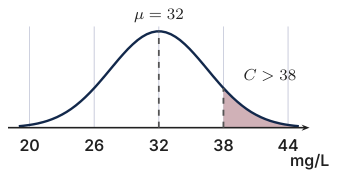
A laboratory measures the daily concentration of a mineral in a water supply. The concentrations (in mg/L) are normally distributed with mean \mu=32 mg/L and standard deviation \sigma=4.5 mg/L.
Original Photon diagram
(a) Find the probability that on a randomly chosen day the concentration exceeds 38 mg/L (shaded region).
[2]
(b) A day is classed as "safe" if the concentration is between 25 mg/L and 40 mg/L. Find the probability that a randomly chosen day is safe.
[2]
(c) The regulator sets an upper limit so that only the top 2.5% of days exceed it. Find this upper limit.
[3]
(d) Over a 30-day month, let D be the number of days on which the concentration exceeds 38 mg/L. Assuming days are independent:
(i) state the distribution of D;
(ii) find the probability that exactly 3 days exceed 38 mg/L;
(iii) find the expected number of such days.
[6]
Show solutionHide solution
Let C\sim N(32,\,4.5^2).
(a) Using GDC:
P(C>38)\approx 0.0912
[2]
(b) Using GDC:
P(25<C<40)\approx 0.902
[2]
(c) Top 2.5% means area 0.975 below the limit. Inverse normal (z=1.9600):
\text{limit}=32+1.9600(4.5)\approx 40.8\text{ mg/L}
[3]
(d) (i) Let p=P(C>38)\approx 0.0912, so D\sim B(30,\,0.0912).
(ii) Using GDC:
P(D=3)=\binom{30}{3}(0.0912)^3(0.9088)^{27}\approx 0.233
(iii) E(D)=30\times 0.0912\approx 2.74 days.
[6]

Final answer

(a) 0.0912 (b) 0.902 (c) 40.8 mg/L (d) \mathrm B(30,0.0912); 0.233; 2.74 days

Question 22

[16 marks]
A mountain cable-car cabin has mass C\sim\mathrm N(310,\,6^2) kg when empty (the mass varies with the equipment on board). Passengers are independent of each other and of the cabin, and each passenger has mass P\sim\mathrm N(68,\,12^2) kg. The cabin is overloaded if the total mass exceeds 800 kg.
(a) A cabin carries 6 passengers. Find the distribution of the total mass T of the cabin and its passengers, giving its mean and variance.
[3]
(b) Find the probability that the cabin with 6 passengers is overloaded.
[2]
(c) Find the probability that the mean mass of the 6 passengers is greater than 75 kg.
[3]
Cabins arrive at the upper station at random, at a mean rate of 3 per 10 minutes, modelled by a Poisson distribution.
(d) Find the probability that more than 5 cabins arrive in a 10-minute period.
[2]
(e) Find the probability that between 7 and 12 cabins inclusive arrive in a 30-minute period.
[2]
The operator wants the probability of overload to be less than 0.001.
(f) Find the greatest number of passengers a cabin may carry.
[4]
Show solutionHide solution
(a) T=C+P_1+\cdots+P_6 is a sum of independent normals, so it is normal.
[1]
E(T)=310+6(68)=718 and \mathrm{Var}(T)=6^2+6(12^2)=900, so T\sim\mathrm N(718,\,900).
[2]
(b) \mathrm{P}(T>800).
[1]
=0.003135\approx0.00313.
[1]
(c) \bar P=\dfrac{P_1+\cdots+P_6}{6} has mean 68 and variance \dfrac{6(144)}{36}=24, so \bar P\sim\mathrm N(68,\,24).
[2]
\mathrm{P}(\bar P>75)=0.076521\approx0.0765.
[1]
(d) X\sim\mathrm{Po}(3): \mathrm{P}(X>5)=1-\mathrm{P}(X\le5).
[1]
=0.083918\approx0.0839.
[1]
(e) In 30 minutes \lambda=9: \mathrm{P}(7\le X\le12).
[1]
=0.66899\approx0.669.
[1]
(f) With n passengers T_n\sim\mathrm N(310+68n,\ 36+144n) and the overload probability is \mathrm{P}(T_n>800).
[1]
Tabulate f(n)=\mathrm{P}(T_n>800):
[1]
\begin{array}{cccc} n & \text{mean} & \text{variance} & f(n) \\ \hline \text{3} & \text{514} & \text{468} & <10^{-4} \\ \text{4} & \text{582} & \text{612} & <10^{-4} \\ \text{5} & \text{650} & \text{756} & <10^{-4} \\ \text{6} & \text{718} & \text{900} & \text{0.00313} \\ \text{7} & \text{786} & \text{1044} & \text{0.33240} \\ \end{array}
[1]
f(5)<0.001<f(6), so the greatest number of passengers is 5.
[1]

Final answer

(a) \mathrm N(718\,900) (b) 0.00313 (c) 0.0765 (d) 0.0839 (e) 0.669 (f) 5 passengers

Question 23

[10 marks]
A courier company finds that the mass X kg of its parcels has mean 2.4 and standard deviation 1.1. The distribution of X is strongly skewed, not normal. A van is loaded with 50 parcels chosen at random.
(a) State the approximate distribution of the mean mass \bar X of the 50 parcels, and explain why a normal distribution may be used.
[3]
(b) Find the probability that the mean mass is greater than 2.6 kg.
[2]
(c) Find the probability that the total mass of the 50 parcels exceeds 125 kg.
[3]
(d) The company wants the probability that the mean mass of a van-load exceeds 2.6 kg to be less than 0.05. Find the least number of parcels that should be loaded.
[2]
Show solutionHide solution
(a) E(\bar X)=2.4 and \mathrm{Var}(\bar X)=\dfrac{1.1^2}{50}=0.0242.
[2]
By the central limit theorem, for a large sample the mean is approximately normal whatever the shape of X, so \bar X\approx\mathrm N(2.4,\,0.0242).
[1]
(b) \mathrm{P}(\bar X>2.6).
[1]
=0.099283\approx0.0993.
[1]
(c) Total S=X_1+\cdots+X_{50} has mean 50(2.4)=120 and variance 50(1.21)=60.5, and is approximately normal.
[2]
\mathrm{P}(S>125)=0.26017\approx0.260.
[1]
(d) For n parcels \bar X\approx\mathrm N(2.4,\,1.21/n) and we need \mathrm{P}(\bar X>2.6)<0.05.
[1]
GDC table in n: n=81 gives 0.05088 and n=82 gives 0.04984<0.05, so n=82.
[1]

Final answer

(a) \mathrm N(2.4,0.0242); large sample (b) 0.0993 (c) 0.260 (d) 82 parcels

Question 24

[10 marks]
At an airport passport kiosk, the number of travellers N already waiting when Sami arrives has the distribution below.
n0123
\mathrm{P}(N=n)0.250.350.250.15
Each traveller's processing time is normally distributed with mean 95 seconds and standard deviation 20 seconds, independently of the others. Sami's waiting time is the total processing time of the travellers ahead of him.
(a) Given that 3 travellers are ahead of Sami, state the distribution of his waiting time and find the probability that he waits more than 5 minutes.
[3]
(b) Find the probability that Sami waits more than 4 minutes.
[4]
(c) The airport states that at most 10% of travellers wait more than 4 minutes. Comment on this statement.
[1]
(d) Given that Sami waited more than 4 minutes, find the probability that 3 travellers were ahead of him.
[2]
Show solutionHide solution
(a) W_3\sim\mathrm N(285,1200) (M1 A1); \mathrm{P}(W_3>300)=0.333 (A1). (b) With 1 traveller ahead, \mathrm{P}(W_1>240)\approx2\times10^{-13}, which is negligible; with 2 ahead, W_2\sim\mathrm N(190\,800) and \mathrm{P}(W_2>240)=0.0385; with 3 ahead, \mathrm{P}(W_3>240)=0.903 (M1 A1). Then 0.25(0.0385499)+0.15(0.903035) (M1) =0.145 (A1). (c) 14.5% is more than 10%, so the model does not support the statement (R1). (d) \frac{0.15(0.903035)}{0.145093} (M1) =0.934 (A1).

Final answer

(a) W_3\sim\mathrm N(285,1200); 0.333 (b) 0.145 (c) 14.5% is above 10%: the statement is not supported (d) 0.934

Question 25

[16 marks]
Ama grows avocados. The mass, M grams, of an avocado is normally distributed with mean 210 g and standard deviation 25 g. Avocados heavier than 240 g are sold as premium for AUD 1.80 each, avocados lighter than 170 g are sold for juice at AUD 0.40 each, and all the others are sold for AUD 1.10 each.
(a) Find the probability that an avocado is premium.
[2]
(b) Find the probability that an avocado is sold for juice.
[2]
(c) Find the expected income from one avocado.
[3]
(d) Find the expected income from a crate of 400 avocados.
[1]
A bag contains 12 avocados chosen at random.
(e) Find the probability that exactly 3 avocados in the bag are premium.
[2]
(f) Find the probability that at least 2 avocados in the bag are premium.
[2]
(g) Given that at least 2 avocados in the bag are premium, find the probability that exactly 3 are premium.
[2]
(h) 30% of avocados have a mass greater than m grams. Find m.
[2]
Show solutionHide solution
(a) \mathrm{P}(M>240)=0.115 (M1 A1; stored value 0.115070). (b) \mathrm{P}(M<170)=0.0548 (M1 A1). (c) The middle band has probability 1-0.115070-0.054799=0.830131 (M1); 1.80(0.115070)+0.40(0.054799)+1.10(0.830131) (M1) =\text{AUD }1.14 (A1; 1.142189). (d) 400\times1.142189=\text{AUD }456.88 (A1). (e) B\sim\mathrm B(12,0.115070) (M1); \mathrm{P}(B=3)=0.112 (A1). (f) 1-\mathrm{P}(B\le1)=0.410 (M1 A1). (g) \frac{0.111554}{0.409507} (M1) =0.272 (A1). (h) \mathrm{P}(M<m)=0.7 (M1); m=223 g (A1; 223.11).

Final answer

(a) 0.115 (b) 0.0548 (c) AUD 1.14 (d) AUD 456.88 (e) 0.112 (f) 0.410 (g) 0.272 (h) 223 g

Question 26

[19 marks]
Kofi runs a bicycle-hire kiosk that opens for 10 hours a day. He records the number of bicycles hired in 80 randomly chosen 15-minute intervals.
Bicycles hired0123456
Frequency10192216931
(a) Find the mean number of bicycles hired in 15 minutes and an unbiased estimate of the variance.
[3]
(b) Explain why your answers to (a) support a Poisson model.
[1]
(c) State one assumption needed for a Poisson model, in context.
[1]
Kofi models the number of hires in a 15-minute interval by X\sim\mathrm{Po}(2.1).
(d) Find the probability of more than 4 hires in a 15-minute interval.
[2]
(e) Find the probability of at least 10 hires in one hour.
[2]
(f) An interval with no hires is called quiet. Find the probability that at least 3 of the 40 intervals in a day are quiet.
[3]
Each hire earns NZD 6. Kofi also sells drinks: the number sold in a 15-minute interval is D\sim\mathrm{Po}(3.5), independent of X, and each drink earns NZD 2. Let I=6X+2D be his income in a 15-minute interval.
(g) Find E(I) and \mathrm{Var}(I).
[3]
(h) Give one reason why I cannot be modelled by a Poisson distribution.
[1]
(i) With the central limit theorem, estimate the probability that his mean income over the 40 intervals of a day exceeds NZD 21.
[3]
Show solutionHide solution
(a) \bar x=\frac{168}{80}=2.1 (A1); s_n^2=\frac{506}{80}-2.1^2=1.915 (M1); s_{n-1}^2=\frac{80}{79}(1.915)=1.94 (A1). (b) The mean 2.1 and the variance estimate 1.94 are close, as they are for a Poisson model (R1). (c) For example, hires happen one at a time and independently, at a constant average rate through the day, with no group bookings and no lunchtime rush (R1). (d) 1-\mathrm{P}(X\le4)=0.0621 (M1 A1). (e) m=8.4; 1-\mathrm{P}(Y\le9)=0.334 (M1 A1). (f) p=e^{-2.1}=0.122456 (A1); Q\sim\mathrm B(40,0.122456) (M1); 1-\mathrm{P}(Q\le2)=0.883 (A1). (g) E(I)=6(2.1)+2(3.5)=\text{NZD }19.60 (A1); \mathrm{Var}(I)=36(2.1)+4(3.5)=89.6 (M1 A1). (h) E(I)\ne\mathrm{Var}(I), or I takes only even values (R1). (i) \bar I\approx\mathrm N\left(19.6,\frac{89.6}{40}\right)=\mathrm N(19.6,2.24) (M1 A1); \mathrm{P}(\bar I>21)=0.175 (A1).

Final answer

(a) 2.1; 1.94 (b) mean and variance close (c) hires are single, independent and at a constant rate (d) 0.0621 (e) 0.334 (f) 0.883 (g) NZD 19.60; 89.6 (h) E(I)\ne\mathrm{Var}(I) (i) 0.175

Going further

Beyond the syllabus: the worked examples and investigations of the chapter's Going further pages.

G1 Overbooking: optimising over a whole number

G1 Worked example

[7 marks]
A pottery studio runs a class with 6 places. It sells n non-refundable tickets at GBP 30 each. Each ticket holder turns up with probability 0.8, independently of the others. The studio refunds GBP 45 to every ticket holder who turns up and finds no place. Let X be the number who turn up.
(a) For n=7, show that the expected number of people refunded is 0.8^7, and evaluate it.
[2]
(b) Find the expected profit for n=7 and for n=8.
[3]
(c) The expected profits for n=9 and n=10 are GBP 211.11 and GBP 208.20. State the number of tickets that gives the greatest expected profit.
[2]
Show solutionHide solution
(a) With 7 tickets, only X=7 leaves anyone without a place, and then exactly one person (M1). So the expected number refunded is 1\times\mathrm{P}(X=7)=0.8^7=0.2097 (A1). (b) For n=7 the profit is 30(7)-45(0.2097152)=\text{GBP }200.56 (M1 A1). For n=8, X=7 gives one refund and X=8 gives two: \mathrm{P}(X=7)=0.335544 and \mathrm{P}(X=8)=0.167772, so the expected number refunded is 0.671089 and the expected profit is 240-45(0.671089)=\text{GBP }209.80 (A1). (c) The expected profits are GBP 180.00 for n=6, GBP 200.56, GBP 209.80, GBP 211.11 and GBP 208.20 for n=7 to 10, so the greatest is at n=9 (M1 A1).

Final answer

(a) 0.8^7=0.2097 (b) GBP 200.56; GBP 209.80 (c) 9 tickets

G2 When the variance is bigger than the mean

G2 Worked example

[6 marks]
A café has weekday orders X\sim\mathrm{Po}(4) per hour at the counter and weekend orders X\sim\mathrm{Po}(10) per hour. A day of the week is chosen at random, so 5 of the 7 days have the weekday rate.
(a) Find the mean number of orders in an hour on a randomly chosen day.
[2]
(b) Find the variance of the number of orders in an hour on a randomly chosen day.
[3]
(c) Explain why the number of orders on a randomly chosen day is not Poisson.
[1]
Show solutionHide solution
(a) \frac{5(4)+2(10)}{7}=\frac{40}{7}=5.71 (M1 A1). (b) For a Poisson variable E(X^2)=m+m^2, so E(X^2)=\frac{5(4+16)+2(10+100)}{7}=\frac{320}{7} (M1 A1), and the variance is \frac{320}{7}-\left(\frac{40}{7}\right)^2=\frac{640}{49}=13.1 (A1). (c) The variance 13.1 is far larger than the mean 5.71, but a Poisson distribution has equal mean and variance (R1).

Final answer

(a) \frac{40}{7}=5.71 (b) \frac{640}{49}=13.1 (c) variance exceeds mean

G3 Investigation

[20 marks]
A boutique hotel has 20 rooms. It sells non-refundable bookings at EUR 150 each. Each guest with a booking turns up with probability 0.9, independently of the others. If more guests turn up than there are rooms, the hotel pays each guest without a room EUR 200 in compensation. Let X be the number of guests who turn up when n bookings are sold.
(a) Find the hotel's profit from bookings when exactly 20 bookings are sold. For n=21, show that the expected number of guests without a room is 0.9^{21} and find the expected profit.
[4]
(b) For n=22, find the expected number of guests without a room and the expected profit.
[4]
(c) Use your GDC to find the expected profit for n=23,24,25 and hence the number of bookings that maximises it.
[4]
(d) Repeat (c) for a turn-up probability of 0.85, and comment on the effect of the turn-up probability.
[4]
(e) Explain why one-off group bookings, such as a family of four, make the independence assumption unrealistic and how this would affect the hotel's decision. Suggest a second quantity, besides expected profit, that the hotel should calculate before choosing n.
[4]
Show solutionHide solution
(a) With 20 bookings the profit is 20\times150=\text{EUR }3000 (A1). With 21 bookings only X=21 leaves a guest out, so the expected number is 1\times0.9^{21}=0.109419 (M1 A1), and the expected profit is 3150-200(0.109419)=\text{EUR }3128.12 (A1). (b) X=21 leaves one guest out and X=22 leaves two: \mathrm{P}(X=21)=0.240722 and \mathrm{P}(X=22)=0.098477, so the expected number without a room is 0.240722+2(0.098477)=0.437676 (M1 A1). The expected profit is 3300-200(0.437676)=\text{EUR }3212.46 (M1 A1). (c) Each expected profit is 150n-200\sum_{x>20}(x-20)\mathrm{P}(X=x) (M1). n=23: EUR 3250.86; n=24: EUR 3255.55; n=25: EUR 3240.86 (A1 A1). The maximum is at 24 bookings (A1). (d) With p=0.85: n=25: EUR 3446.55; n=26: EUR 3454.01; n=27: EUR 3448.18 (M1 A1), so the maximum is at 26 bookings (A1). The lower the turn-up probability, the more bookings it pays to sell (R1). (e) A family arrives or stays away together, so turn-ups are positively related (R1). Large groups make "everyone turns up" more likely than the binomial model says, so the hotel should sell fewer extra bookings (R1). A second quantity is, for example, the probability that at least one guest is turned away; for n=24 and p=0.9 it is \mathrm{P}(X\ge21)=0.786 (R1 A1).

Final answer

(a) EUR 3000; 0.109; EUR 3128.12 (b) 0.438; EUR 3212.46 (c) EUR 3250.86, EUR 3255.55, EUR 3240.86: 24 bookings (d) EUR 3446.55, EUR 3454.01, EUR 3448.18: 26 bookings (e) group arrivals are linked, so sell fewer; for example \mathrm{P}(X\ge21)=0.786 at n=24

From the book

Photon Guidebook: Mathematics Applications and Interpretation HL for the IB Diploma

Chapter 16 teaches probability distributions from the basics to full exam questions: how the IB asks it, every question type with a marked example, and these practice questions in three steps.

About the book