Free worked solutions · 2026 Edition

IB Maths AI HL Chapter 15: Probability worked solutions

Worked solutions to the practice questions in Chapter 15 of Photon Guidebook: Mathematics Applications and Interpretation HL for the IB Diploma (2026 Edition). Each solution shows every step with the mark it earns, the way an IB mark scheme does.

  • Chapter 15 of 24
  • Volume 2
  • 21 practice questions
  • 3 Going further
  • Free, no sign-up

Basics

One idea at a time, in the order the chapter teaches them.

Question 1

[4 marks]
Among 83 households, 41 have a compost bin, 36 have a rain barrel and 17 have both.
Find how many have only a compost bin, only a rain barrel, and neither.
[4]
Show solutionHide solution
Compost only 41-17=24.
A1
Barrel only 36-17=19.
A1
At least one 24+17+19=60.
M1
Neither 83-60=23.
A1

Final answer

24 compost only, 19 barrel only, 23 neither

Question 2

[3 marks]
An archive item is tagged A with probability 0.58, tagged B with probability 0.43, and has both tags with probability 0.26. Use P(A\cup B)=P(A)+P(B)-P(A\cap B).
Find the probability of at least one tag and the probability of neither tag.
[3]
Show solutionHide solution
0.58+0.43-0.26=0.75. M1A1
Neither =1-0.75=0.25.
A1

Final answer

0.75; 0.25

Question 3

[3 marks]
An event log has 43 online bookings (17 paid, 26 unpaid) and 36 desk bookings (25 paid, 11 unpaid).
Find the probability of payment given an online booking, and of an online booking given payment.
[3]
Show solutionHide solution
First 17/43.
A1
Paid bookings total 17+25=42.
M1
Second 17/42.
A1

Final answer

\frac{17}{43}=0.395; \frac{17}{42}=0.405

Question 4

[3 marks]
A route is scenic with probability 0.46. A scenic trip is delayed with probability 0.18; a non-scenic trip is delayed with probability 0.31.
Find the overall probability of a delay.
[3]
Show solutionHide solution
Scenic delayed 0.46(0.18).
M1
Non-scenic delayed 0.54(0.31); add the two disjoint paths.
M1
0.2502.
A1

Final answer

0.250

Question 5

[4 marks]
A machine chooses fine mode with probability 0.64, otherwise coarse mode. A print passes inspection with probability 0.91 in fine mode and 0.76 in coarse mode.
Find the probability a print was fine-mode given that it passed.
[4]
Show solutionHide solution
Fine and pass 0.64(0.91)=0.5824.
M1
Overall pass 0.5824+0.36(0.76)=0.856.
M1
Divide joint probability by overall pass probability.
M1
0.5824/0.856=0.6804 approximately.
A1

Final answer

0.680

Question 6

[4 marks]
A crate contains 8 round and 13 square tiles. Two are drawn uniformly without replacement.
Find the probability of one tile of each shape.
[4]
Show solutionHide solution
Round-square path \frac8{21}\frac{13}{20}.
M1
Square-round path \frac{13}{21}\frac8{20}.
M1
Add the two distinct orders.
M1
52/105 approximately 0.4952.
A1

Final answer

\frac{52}{105}=0.495

Question 7

[3 marks]
Events are independent if P(A\cap B)=P(A)P(B). Here P(A)=0.42, P(B)=0.35 and P(A\cap B)=0.147.
Determine whether A and B are independent, showing the test.
[3]
Show solutionHide solution
P(A)P(B)=0.42(0.35).
M1
0.147 equals the supplied intersection.
A1
Therefore independent.
R1

Final answer

0.42\times0.35=0.147, so independent

Question 8

[4 marks]
Two fair four-sided dice are rolled, one blue and one red, each numbered 1 to 4. All 16 ordered pairs are equally likely.
Find the probability that their sum is 5 and the probability that the blue number exceeds the red number.
[4]
Show solutionHide solution
Sum 5 pairs: (1,4),(2,3),(3,2),(4,1).
M1
4/16=1/4.
A1
Blue greater: 1+2+3=6 pairs.
M1
6/16=3/8.
A1

Final answer

\frac14; \frac38

Tutorial

Exam-style questions on each question type, with the marks the IB would give.

Question 9

[6 marks]
Kai rolls two fair six-sided dice and adds the scores. He says: “There are 11 possible totals, from 2 to 12, so the probability of a total of 7 is \dfrac1{11}.”
(a) Explain why Kai's reasoning is wrong.
[1]
(b) Describe the sample space Kai should use, and hence find the probability of a total of 7.
[2]
In a board game a player moves an extra turn if the total is 7 or 11.
(c) Find the probability that a player gets an extra turn.
[3]
Show solutionHide solution
(a) The eleven totals are not equally likely (a total of 7 can happen in several ways, a total of 2 in only one), so the probability cannot be found by counting totals.
[1]
(b) Use the 36 equally likely ordered pairs (first die, second die).
[1]
Total 7: (1,6),(2,5),(3,4),(4,3),(5,2),(6,1), so \dfrac{6}{36} = \dfrac16.
[1]
(c) Total 11: (5,6),(6,5) – 2 pairs. The totals 7 and 11 cannot occur together, so there are 6 + 2 = 8 favourable pairs.
[2]
\mathrm{P}(\text{extra turn}) = \dfrac{8}{36} = \dfrac29 = 0.222 (3 s.f.).
[1]

Final answer

  • (a) the 11 totals are not equally likely
  • (b) 36 ordered pairs; \frac16
  • (c) \frac29=0.222

Question 10

[6 marks]
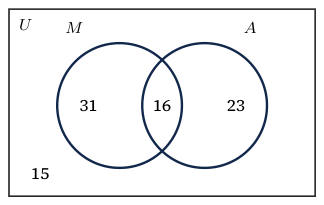
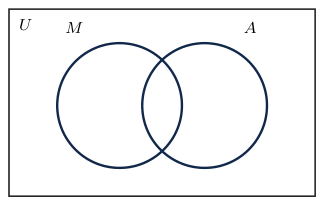
A tour operator surveys 85 tourists. Of these, 47 visited the museum (M), 39 visited the aquarium (A) and 16 visited both.
(a) Copy and complete the Venn diagram below, showing the number of tourists in each of the four regions.
[3]
Original Photon diagram
A tourist is chosen at random.
(b) Find the probability that the tourist visited at least one of the two attractions.
[1]
(c) Find the probability that the tourist did not visit both attractions, and state which region(s) of the diagram this describes.
[2]
Show solutionHide solution
(a) Intersection first: 16. Museum only = 47 - 16 = 31; aquarium only = 39 - 16 = 23.
[2]
Neither = 85 - (31 + 16 + 23) = 85 - 70 = 15.
[1]
Original Photon diagram
(b) \dfrac{31 + 16 + 23}{85} = \dfrac{70}{85} = 0.824 (3 s.f.).
[1]
(c) This is (M \cap A)': every region except the overlap, 85 - 16 = 69 tourists.
[1]
\dfrac{69}{85} = 0.812 (3 s.f.).
[1]

Final answer

  • (a) 31, 16, 23, 15
  • (b) 0.824
  • (c) 0.812

Question 11

[6 marks]
A leisure centre has 200 members. Of these, 55% are under 30, 42% use the swimming pool, and 64 of the members aged 30 or over use the pool.
Under 3030 or overTotal
Swims64
Does not swim
Total200
(a) Copy and complete the table.
[3]
(b) A member who does not swim is chosen at random. Find the probability that the member is under 30.
[2]
(c) Find the probability that a member under 30 uses the pool.
[1]
Show solutionHide solution
(a) Under 30: 0.55 \times 200 = 110, so 30 or over: 90. Swimmers: 0.42 \times 200 = 84, so non-swimmers: 116.
[2]
Under-30 swimmers = 84 - 64 = 20; then 110 - 20 = 90 under-30 non-swimmers and 90 - 64 = 26 non-swimmers aged 30 or over.
[1]
\begin{array}{|l|c|c|c|} \hline & \text{\textbf{Under 30}} & \text{\textbf{30 or over}} & \text{\textbf{Total}} \\ \hline \text{\textbf{Swims}} & 20 & 64 & 84 \\ \hline \text{\textbf{Does not swim}} & 90 & 26 & 116 \\ \hline \text{\textbf{Total}} & 110 & 90 & 200 \\ \hline \end{array}
(b) \mathrm{P}(\text{under } 30 \mid \text{does not swim}) = \dfrac{90}{116}
[1]
= 0.776 (3 s.f.).
[1]
(c) \dfrac{20}{110} = \dfrac{2}{11} = 0.182 (3 s.f.).
[1]

Final answer

  • (a) 20, 64, 84 / 90, 26, 116 / 110, 90, 200
  • (b) 0.776
  • (c) 0.182

Question 12

[7 marks]
A school surveys 200 students. The table shows how many are in the choir and how many play a musical instrument.
PlaysDoes not play
In the choir4832
Not in the choir7248
(a) A student is chosen at random. Find the probability that the student is in the choir, and the probability that the student plays an instrument.
[2]
(b) Show that “being in the choir” and “playing an instrument” are independent events.
[2]
A second school has 350 students and the same overall percentages, and the same independence holds there.
(c) Find the expected number of students at the second school who are in the choir and play an instrument.
[2]
(d) Interpret the independence found in part (b) in the context of the school.
[1]
Show solutionHide solution
(a) Choir: 48 + 32 = 80, so \mathrm{P}(C) = \dfrac{80}{200} = 0.4.
[1]
Instrument: 48 + 72 = 120, so \mathrm{P}(I) = \dfrac{120}{200} = 0.6.
[1]
(b) \mathrm{P}(C \cap I) = \dfrac{48}{200} = 0.24.
[1]
\mathrm{P}(C)\mathrm{P}(I) = 0.4 \times 0.6 = 0.24 = \mathrm{P}(C \cap I), so the events are independent.
[1]
(c) By independence \mathrm{P}(C \cap I) = 0.4 \times 0.6 = 0.24 at the second school.
[1]
Expected number = 350 \times 0.24 = 84.
[1]
(d) Being in the choir tells you nothing about whether a student plays an instrument: \dfrac{48}{80} = 60\% of choir members play one, and so do \dfrac{72}{120} = 60\% of non-members.
[1]

Final answer

  • (a) 0.4, 0.6
  • (b) 0.24 both ways
  • (c) 84
  • (d) 60% of choir members and 60% of the others play

Question 13

[6 marks]
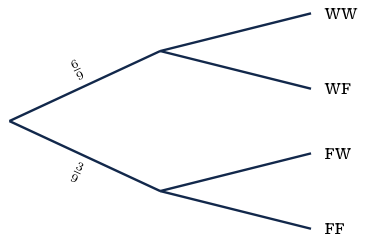
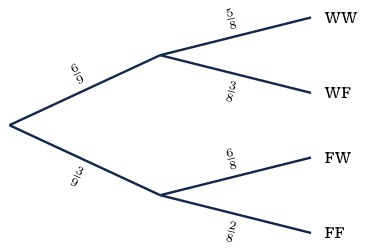
A box holds 9 fuses: 6 are working and 3 are faulty. An electrician takes two fuses from the box one after the other, without replacement.
Original Photon diagram
(a) Copy the tree diagram and fill in the four missing probabilities.
[2]
(b) Find the probability that both fuses are faulty.
[2]
(c) Find the probability that exactly one of the two fuses is faulty.
[2]
Show solutionHide solution
(a) After a working fuse is removed, 5 working and 3 faulty remain out of 8; after a faulty one is removed, 6 working and 2 faulty remain out of 8.
[2]
Original Photon diagram
(b) \mathrm{P}(\text{both faulty}) = \dfrac39 \times \dfrac28
[1]
= \dfrac{6}{72} = \dfrac1{12} = 0.0833.
[1]
(c) \mathrm{P}(\text{WF}) + \mathrm{P}(\text{FW}) = \dfrac69 \times \dfrac38 + \dfrac39 \times \dfrac68
[1]
= \dfrac{18}{72} + \dfrac{18}{72} = \dfrac12.
[1]

Final answer

  • (a) \frac58, \frac38, \frac68, \frac28
  • (b) \frac1{12}=0.0833
  • (c) \frac12

Question 14

[7 marks]
A school's students travel by bus (45%), by train (35%) or on foot (20%). The probability that a student arrives late is 0.14 for bus users, 0.05 for train users and 0.02 for those on foot.
(a) Find the probability that a randomly chosen student arrives late.
[3]
(b) A student arrives late. Find the probability that the student travelled by train.
[2]
(c) A student arrives on time. Find the probability that the student came on foot.
[2]
Show solutionHide solution
(a) Tree with three first-stage branches (0.45, 0.35, 0.20), each splitting into late and on time.
[1]
\mathrm{P}(\text{late}) = 0.45(0.14) + 0.35(0.05) + 0.20(0.02)
[1]
= 0.063 + 0.0175 + 0.004 = 0.0845.
[1]
(b) \mathrm{P}(\text{train} \mid \text{late}) = \dfrac{0.0175}{0.0845}
[1]
= 0.207 (3 s.f.).
[1]
(c) \mathrm{P}(\text{on time}) = 1 - 0.0845 = 0.9155, and \mathrm{P}(\text{foot} \cap \text{on time}) = 0.20 \times 0.98 = 0.196.
[1]
\mathrm{P}(\text{foot} \mid \text{on time}) = \dfrac{0.196}{0.9155} = 0.214 (3 s.f.).
[1]

Final answer

  • (a) 0.0845
  • (b) 0.207
  • (c) 0.214

Question 15

[7 marks]
A tour company records that 52% of clients book an excursion (A), 40% buy travel insurance (B) and 25% do neither.
(a) Find \mathrm{P}(A \cap B).
[2]
(b) Find \mathrm{P}(A \mid B).
[2]
(c) Determine whether A and B are independent.
[2]
(d) Compare your answer to part (b) with \mathrm{P}(A) = 0.52 and say what this means for the company's sales team.
[1]
Show solutionHide solution
(a) \mathrm{P}(A \cup B) = 1 - 0.25 = 0.75, so 0.75 = 0.52 + 0.40 - \mathrm{P}(A \cap B).
[1]
\mathrm{P}(A \cap B) = 0.17.
[1]
(b) \mathrm{P}(A \mid B) = \dfrac{0.17}{0.40}
[1]
= 0.425.
[1]
(c) \mathrm{P}(A)\mathrm{P}(B) = 0.52 \times 0.40 = 0.208 ≠ 0.17.
[1]
So A and B are not independent.
[1]
(d) Clients who buy insurance are less likely to book an excursion (42.5%) than clients overall (52%), so insurance buyers are not good prospects for excursion offers.
[1]

Final answer

  • (a) 0.17
  • (b) 0.425
  • (c) 0.208\neq0.17, not independent
  • (d) insurance buyers are less likely to book

Question 16

[6 marks]
A box of 9 batteries contains 3 that are dead. A technician tests the batteries one at a time, chosen at random without replacement, and stops as soon as a dead battery is found (or after three tests).
(a) Write down the probability that the first battery tested is dead.
[1]
(b) Find the probability that the first dead battery is found on the second test.
[2]
(c) Find the probability that the first dead battery is found on the third test.
[2]
(d) Find the probability that a dead battery is found within the three tests.
[1]
Show solutionHide solution
(a) \dfrac{3}{9} = \dfrac13.
[1]
(b) Good battery first, then dead: \dfrac69 \times \dfrac38
[1]
= \dfrac{18}{72} = \dfrac14.
[1]
(c) Good, good, then dead: \dfrac69 \times \dfrac58 \times \dfrac37
[1]
= \dfrac{90}{504} = \dfrac{5}{28} = 0.179 (3 s.f.).
[1]
(d) Complement: the first three tested are all good, \dfrac69 \times \dfrac58 \times \dfrac47 = \dfrac{120}{504} = \dfrac5{21}, so the required probability is 1 - \dfrac{5}{21} = \dfrac{16}{21} = 0.762 (3 s.f.). (Check: \dfrac13 + \dfrac14 + \dfrac5{28} = \dfrac{16}{21}.)
[1]

Final answer

  • (a) \frac13
  • (b) \frac14
  • (c) \frac5{28}=0.179
  • (d) \frac{16}{21}=0.762

Mastery

Full exam questions that mix question types, at Paper 1 and Paper 2 standard.

Question 17

[10 marks]
A market research team surveys 120 people about which of two streaming services they subscribe to: StreamOne (S) and FilmBox (F). The results are: 68 subscribe to StreamOne, 54 subscribe to FilmBox, and 22 subscribe to both.
(a) Represent the information on a Venn diagram.
[3]
(b) Find the number of people who subscribe to neither service.
[2]
(c) One person is chosen at random. Find:
(i) P(S\cup F);
(ii) P(S\mid F).
[3]
(d) Determine whether events S and F are independent.
[2]
Show solutionHide solution
(a) Only S=68-22=46; only F=54-22=32; both =22.
[3]
(b) At least one =46+22+32=100; neither =120-100=20.
[2]
(c) (i)
P(S\cup F)=\frac{100}{120}=\frac{5}{6}\approx0.833
(ii)
P(S\mid F)=\frac{P(S\cap F)}{P(F)}=\frac{22/120}{54/120}=\frac{22}{54}=\frac{11}{27}\approx0.407
[3]
(d) P(S)=\frac{68}{120}\approx0.567. Since P(S\mid F)\approx0.407\neq P(S), the events are not independent.
[2]

Final answer

  • (a) 46, 22, 32
  • (b) 20
  • (c) \frac56=0.833; \frac{11}{27}=0.407
  • (d) 0.407\neq0.567, not independent

Question 18

[8 marks]
A club has 100 members. Each member plays chess (C), debates (D), both, or neither. Exactly 5 members play chess only and exactly 60 debate only. Let x be the number who do both. The events “plays chess” and “debates” are independent.
(a) Show that x^2 - 35x + 300 = 0.
[3]
(b) Solve the equation in part (a).
[2]
Fewer than 18 members do neither activity.
(c) Find the value of x, and the number of members who do neither.
[2]
(d) For this value of x, find \mathrm{P}(C \mid D) and confirm that it equals \mathrm{P}(C).
[1]
Show solutionHide solution
(a) n(C) = x + 5, n(D) = x + 60, so \mathrm{P}(C) = \dfrac{x+5}{100}, \mathrm{P}(D) = \dfrac{x+60}{100}, \mathrm{P}(C \cap D) = \dfrac{x}{100}.
[1]
Independence: \dfrac{x}{100} = \dfrac{(x+5)(x+60)}{10\,000}, so 100x = x^2 + 65x + 300.
[2]
x^2 - 35x + 300 = 0.
AG
(b) GDC polynomial solver (or (x-15)(x-20) = 0): x = 15 or x = 20.
[2]
(c) Number doing neither = 100 - (5 + 60 + x) = 35 - x: 20 if x = 15, 15 if x = 20.
[1]
Fewer than 18 do neither only when x = 20; then 15 members do neither.
[1]
(d) \mathrm{P}(C \mid D) = \dfrac{20}{80} = 0.25 and \mathrm{P}(C) = \dfrac{25}{100} = 0.25: equal, as independence requires.
[1]

Final answer

  • (a) shown
  • (b) 15 or 20
  • (c) x=20; 15 neither
  • (d) 0.25=0.25

Question 19

[8 marks]
A batch of 20 items contains d defective items. Quality-control plan A tests two items taken at random without replacement and accepts the batch only if both are good.
(a) Show that the probability that the batch is accepted is \dfrac{(20 - d)(19 - d)}{380}.
[2]
(b) Find this probability when d = 3.
[1]
(c) Use your GDC to find the smallest value of d for which plan A accepts the batch with probability less than 0.5.
[2]
Plan B tests three items without replacement and accepts only if all three are good.
(d) For a batch with d = 4, find the acceptance probability under each plan and state which plan is stricter.
[2]
The producer wants plan A to accept at least 80% of batches that have d defective items.
(e) Find the largest value of d for which this is true.
[1]
Show solutionHide solution
(a) There are 20 - d good items. \mathrm{P}(\text{first good}) = \dfrac{20 - d}{20} and \mathrm{P}(\text{second good} \mid \text{first good}) = \dfrac{19 - d}{19}.
[1]
\mathrm{P}(\text{accept}) = \dfrac{(20 - d)(19 - d)}{20 \times 19} = \dfrac{(20-d)(19-d)}{380}.
[1]
(b) d = 3: \dfrac{17 \times 16}{380} = \dfrac{272}{380} = 0.716 (3 s.f.).
[1]
(c) GDC table of f(d) = \dfrac{(20-d)(19-d)}{380}: d = 5 gives 0.553, d = 6 gives 0.479.
[1]
Smallest d = 6.
[1]
(d) Plan A: \dfrac{16 \times 15}{380} = 0.632. Plan B: \dfrac{16}{20} \times \dfrac{15}{19} \times \dfrac{14}{18} = \dfrac{3360}{6840} = 0.491.
[1]
Plan B accepts less often, so it is stricter.
[1]
(e) d = 2: \dfrac{18 \times 17}{380} = 0.805 \geq 0.8; d = 3: 0.716 < 0.8. Largest d = 2.
[1]

Final answer

  • (a) shown
  • (b) 0.716
  • (c) d=6
  • (d) A 0.632, B 0.491; B is stricter
  • (e) d=2

Question 20

[14 marks]
A factory makes components on three machines. Machine M_1 makes 50% of the components, M_2 makes 30% and M_3 makes 20%. The proportions of defective components are 2% for M_1, 3.5% for M_2 and 8% for M_3.
(a) Find the probability that a randomly chosen component is defective.
[3]
(b) A component is found to be defective. Find the probability that it was made on M_3.
[2]
Each component is then checked by an automatic scanner. The scanner flags 95% of defective components and, wrongly, flags 4% of components that are not defective.
(c) Find the probability that a randomly chosen component is flagged by the scanner.
[3]
(d) A component is flagged. Find the probability that it is actually defective.
[2]
Every flagged component is scrapped at a cost of 4.20 dollars.
(e) The factory makes 25 000 components in a month. Find the expected scrapping cost, to the nearest ten dollars.
[2]
(f) The manager says: “The scanner is 95% accurate, so nearly everything it flags is bad.” Use your answer to part (d) to comment on this statement.
[2]
Show solutionHide solution
(a) \mathrm{P}(D) = 0.5(0.02) + 0.3(0.035) + 0.2(0.08)
[2]
= 0.01 + 0.0105 + 0.016 = 0.0365.
[1]
(b) \mathrm{P}(M_3 \mid D) = \dfrac{0.016}{0.0365}
[1]
= 0.438 (3 s.f.).
[1]
(c) \mathrm{P}(\text{flagged}) = 0.0365(0.95) + 0.9635(0.04)
[2]
= 0.034675 + 0.03854 = 0.073215 = 0.0732 (3 s.f.).
[1]
(d) \mathrm{P}(D \mid \text{flagged}) = \dfrac{0.034675}{0.073215}
[1]
= 0.474 (3 s.f.).
[1]
(e) Expected flagged = 25\,000 \times 0.073215 = 1830.4 components.
[1]
Cost = 1830.4 \times 4.20 = 7687.6 \approx 7690 dollars.
[1]
(f) Only about 47.4% of flagged components are defective, so more than half of the scrapped components are actually good.
[1]
The defect rate (3.65%) is low, so the 4% false-flag rate applied to the many good components produces nearly as many flags as the true detections; “95% accurate” describes detection of defective items, not the reliability of a flag.
[1]

Final answer

  • (a) 0.0365
  • (b) 0.438
  • (c) 0.0732
  • (d) 0.474
  • (e) 7690 dollars
  • (f) most flags are false alarms

Question 21

[15 marks]
A cycle café asks 250 customers whether they cycled to the café and whether they bought a hot drink. 120 customers cycled, 130 bought a hot drink and 72 cycled and bought a hot drink.
Hot drinkNo hot drinkTotal
Cycled
Did not cycle
Total
(a) Copy and complete the table.
[2]
(b) A customer is chosen at random. Given that the customer bought a hot drink, find the probability that the customer cycled.
[2]
(c) Two different customers are chosen at random. Find the probability that both cycled.
[2]
(d) Determine whether cycling to the café and buying a hot drink are independent.
[2]
The café offers a loyalty card. A customer who cycled signs up with probability 0.35 and a customer who did not cycle signs up with probability 0.2. Use the table to estimate the probability that a customer cycled.
(e) Find the probability that a customer signs up.
[2]
(f) Given that a customer signs up, find the probability that the customer cycled.
[2]
(g) On a day with 180 customers, find the expected number who cycled and did not sign up.
[2]
(h) Give one reason why the survey may not represent all of the café's customers.
[1]
Show solutionHide solution
(a) Cycled: 72, 48, 120. Did not cycle: 58, 72, 130. Totals: 130, 120, 250. A2 (b) \frac{72}{130} M1 =0.554 A1 (c) \frac{120}{250}\times\frac{119}{249} M1 =0.229 A1 (d) P(C)P(H)=0.48\times0.52=0.2496 M1 P(C\cap H)=\frac{72}{250}=0.288\neq0.2496, so they are not independent R1 (e) 0.48\times0.35+0.52\times0.2 M1 =0.168+0.104=0.272 A1 (f) \frac{0.168}{0.272} M1 =0.618 A1 (g) 180\times0.48\times0.65 M1 =56.16\approx56.2 A1 (h) For example, the survey was taken on one day or season only, or customers chose whether to answer
R1

Final answer

  • (a) 72, 48, 120 / 58, 72, 130 / 130, 120, 250
  • (b) 0.554
  • (c) 0.229
  • (d) 0.288\neq0.2496, not independent
  • (e) 0.272
  • (f) 0.618
  • (g) 56.2
  • (h) one day only, or self-selected replies

Going further

Beyond the syllabus: the worked examples and investigations of the chapter's Going further pages.

G1 The same test in two different places

G1 Worked example

[7 marks]
Wei Ling manages security at a concert hall in Singapore. The bag scanner beeps for 95% of bags that contain a banned item and for 5% of bags that do not. At the concert hall, 8% of bags contain a banned item.
(a) Find the probability that a bag beeps.
[2]
(b) Given that a bag beeps, find the probability that it contains a banned item.
[2]
At a school fair, the same scanner is used, and 1% of bags contain a banned item.
(c) Find the answer to part (b) for the school fair.
[2]
(d) Explain why a beep means something different at the two places.
[1]
Show solutionHide solution
(a) 0.08\times0.95+0.92\times0.05 M1 =0.076+0.046=0.122 A1 (b) \frac{0.076}{0.122} M1 =0.623 A1 (c) \frac{0.01\times0.95}{0.01\times0.95+0.99\times0.05}=\frac{0.0095}{0.059} M1 =0.161 A1 (d) At the school fair almost every bag is harmless, so false beeps from harmless bags outnumber true beeps from banned ones
R1

Final answer

(a) 0.122 (b) 0.623 (c) 0.161 (d) harmless bags dominate at the school fair

G2 A second independent scan

G2 Worked example

[4 marks]
At the school fair, 1% of bags contain a banned item. The scanner beeps for 95% of bags that contain a banned item and for 5% of bags that do not. A bag that beeps is scanned again. Given the true state of a bag, the two scans are independent.
(a) Find the probability that a bag beeps twice.
[2]
(b) Given that a bag beeps twice, find the probability that it contains a banned item.
[2]
Show solutionHide solution
(a) 0.01\times0.95^2+0.99\times0.05^2 M1 =0.009025+0.002475=0.0115 A1 (b) \frac{0.009025}{0.0115} M1 =0.785
A1

Final answer

(a) 0.0115 (b) 0.785

G3 Investigation

[21 marks]
Wind-turbine blades are scanned for a hidden crack. 2% of blades have a crack. The scanner flags 96% of cracked blades and 5% of sound blades.
(a) Find the probability that a blade is flagged. Hence find the probability that a flagged blade is cracked.
[4]
Every flagged blade is scanned again. Given the true state of a blade, scans are independent.
(b) Show that the probability that a blade flagged twice is cracked is \dfrac{0.02(0.96)^2}{0.02(0.96)^2+0.98(0.05)^2}, and evaluate it.
[3]
(c) Show that after k flags in a row this probability is \dfrac{1}{1+49\left(\frac{5}{96}\right)^k}. Hence find the least k for which the probability is greater than 0.99.
[6]
(d) For a fleet where the proportion of cracked blades is p, find the least p for which one flag gives a probability of at least 0.5 that the blade is cracked.
[3]
(e) Comment on the assumption that repeated scans of the same blade are independent. A cheaper scanner flags 99% of cracked blades and 10% of sound blades. Compare one flag from each scanner when 2% of blades are cracked.
[5]
Show solutionHide solution
(a) P(\text{flagged})=0.02\times0.96+0.98\times0.05=0.0192+0.049=0.0682 M1A1 P(\text{cracked}\mid\text{flagged})=\frac{0.0192}{0.0682}=0.282 M1A1 (b) Two flags on a cracked blade: 0.02(0.96)^2; on a sound blade: 0.98(0.05)^2 M1A1 \frac{0.018432}{0.018432+0.00245}=0.883 A1 (c) After k flags the paths are 0.02(0.96)^k and 0.98(0.05)^k M1 Divide the top and bottom by 0.02(0.96)^k: \frac{1}{1+\frac{0.98}{0.02}\left(\frac{0.05}{0.96}\right)^k} M1 \frac{0.98}{0.02}=49 and \frac{0.05}{0.96}=\frac{5}{96}, so the formula follows AG k=2 gives 0.883 and k=3 gives 0.993 M1A1 The least k is 3 A1 (d) \frac{0.96p}{0.96p+0.05(1-p)}\ge0.5 M1 0.96p\ge0.05(1-p) M1 p\ge\frac{0.05}{1.01}=0.0495 A1 (e) Repeat flags on one blade may share a cause, such as a surface mark that fools the scanner every time, so independence overstates the certainty in (b) and (c) R1R1 Cheaper scanner: \frac{0.02\times0.99}{0.02\times0.99+0.98\times0.10}=\frac{0.0198}{0.1178} M1 =0.168, below 0.282 A1 It flags twice as many sound blades, so one of its flags is less informative
R1

Final answer

(a) 0.0682; 0.282 (b) 0.883 (c) k=3 (d) p\ge\frac{0.05}{1.01}=0.0495 (e) repeat flags may share one cause, so independence overstates certainty; one cheaper-scanner flag gives 0.168, below 0.282

From the book

Photon Guidebook: Mathematics Applications and Interpretation HL for the IB Diploma

Chapter 15 teaches probability from the basics to full exam questions: how the IB asks it, every question type with a marked example, and these practice questions in three steps.

About the book