
Trigonometry is the largest single topic in IB Mathematics Analysis & Approaches HL by syllabus reference count, spanning SL 3.1–3.8 and AHL 3.9–3.11. It threads through almost every other topic — calculus, complex numbers, vectors and 3D geometry all assume fluency with the unit circle, the identities, and the compound-angle formulas. The trickiness is rarely conceptual; it is procedural. Students lose marks for forgetting that arc-length and sector formulas need radians, mixing up the range of $\arccos$, missing the second triangle in an ambiguous SSA case, or skipping the reasoning sentence "no solution since $|\sin\theta| \leq 1$".
This cheatsheet condenses every formula, identity, trick and trap from SL 3.1–3.8 and AHL 3.9–3.11 into one page you can revise from. If you want the printable PDF version, the full set of notes, the worked tutorials, and the marked-up solutions, scroll to the bottom for the download links and the gated full library.
§1 — Right-Angle Trig & Exact Values SL 3.1–3.4
SOH CAH TOA & reciprocal trig
$\sin\theta = \dfrac{\text{Opp}}{\text{Hyp}}$ $\cos\theta = \dfrac{\text{Adj}}{\text{Hyp}}$ $\tan\theta = \dfrac{\text{Opp}}{\text{Adj}}$
$\csc\theta = \dfrac{1}{\sin\theta}$ $\sec\theta = \dfrac{1}{\cos\theta}$ $\cot\theta = \dfrac{\cos\theta}{\sin\theta}$
Exact values — must memorise for P1
| $\theta$ | $0$ | $\dfrac{\pi}{6}$ | $\dfrac{\pi}{4}$ | $\dfrac{\pi}{3}$ | $\dfrac{\pi}{2}$ |
|---|---|---|---|---|---|
| $\sin\theta$ | $0$ | $\dfrac{1}{2}$ | $\dfrac{\sqrt{2}}{2}$ | $\dfrac{\sqrt{3}}{2}$ | $1$ |
| $\cos\theta$ | $1$ | $\dfrac{\sqrt{3}}{2}$ | $\dfrac{\sqrt{2}}{2}$ | $\dfrac{1}{2}$ | $0$ |
| $\tan\theta$ | $0$ | $\dfrac{1}{\sqrt{3}}$ | $1$ | $\sqrt{3}$ | undef |
Radians & circle mensuration (SL 3.1)
$180° = \pi$ rad. Arc: $\ell = r\theta$. Sector: $A = \tfrac{1}{2}r^2\theta$. Segment: $\tfrac{1}{2}r^2(\theta - \sin\theta)$.
§2 — Unit Circle, ASTC & Reference Angles SL 3.3–3.5
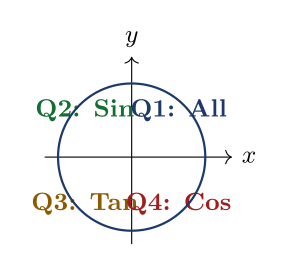
ASTC rule — All Students Take Calculus
- Q1 ($0°$–$90°$): All positive
- Q2 ($90°$–$180°$): Sin positive
- Q3 ($180°$–$270°$): Tan positive
- Q4 ($270°$–$360°$): Cos positive
Reference angles: Q2 → $180° - \theta$; Q3 → $\theta - 180°$; Q4 → $360° - \theta$.
Symmetry identities (AHL 3.11)
§3 — Trigonometric Identities SL 3.6, AHL 3.9–3.10
Pythagorean identities (SL 3.6 / AHL 3.9)
$\sin^2\theta + \cos^2\theta = 1$ | $1 + \tan^2\theta = \sec^2\theta$ | $1 + \cot^2\theta = \csc^2\theta$.
Power-reduction: $\cos^2\theta = \dfrac{1 + \cos 2\theta}{2}$ and $\sin^2\theta = \dfrac{1 - \cos 2\theta}{2}$.
Double angle formulas (SL 3.6)
$\sin 2\theta = 2\sin\theta\cos\theta$ $\tan 2\theta = \dfrac{2\tan\theta}{1 - \tan^2\theta}$.
$\cos 2\theta = \cos^2\theta - \sin^2\theta = 2\cos^2\theta - 1 = 1 - 2\sin^2\theta$.
Compound angle formulas (AHL 3.10)
Solving $a\sin x + b\cos x = k$ (from AHL 3.10)
Derive using the compound angle formula (not a separate syllabus formula):
$$a\sin x + b\cos x = R\sin(x + \phi), \quad R\cos\phi = a,\;\; R\sin\phi = b$$
$$R = \sqrt{a^2 + b^2}, \quad \tan\phi = \frac{b}{a} \quad (\text{check quadrant of } \phi)$$
Then set $u = x + \phi$, solve $\sin u = k/R$, back-substitute tracking the range of $u$.
§4 — Solving Trigonometric Equations SL 3.8
General solutions
- $\sin\theta = k$: $\theta = \arcsin k + 2n\pi$ or $\pi - \arcsin k + 2n\pi$
- $\cos\theta = k$: $\theta = \pm\arccos k + 2n\pi$
- $\tan\theta = k$: $\theta = \arctan k + n\pi$
Step-by-step strategy
- Isolate the trig function (factorise if quadratic).
- Mixed $\sin$/$\cos$: substitute $\cos^2 = 1 - \sin^2$ or expand the double angle.
- Find reference angle $\alpha$; apply ASTC to find quadrants.
- Write both solutions; check the domain; reject $|\sin\theta| > 1$ with reason (R1).
§5 — Graphs of Trigonometric Functions SL 3.5
Key graph properties
| Fn | Period | Range | $x$-intercepts | Even / Odd |
|---|---|---|---|---|
| $\sin x$ | $2\pi$ | $[-1, 1]$ | $n\pi$ | Odd |
| $\cos x$ | $2\pi$ | $[-1, 1]$ | $\tfrac{\pi}{2} + n\pi$ | Even |
| $\tan x$ | $\pi$ | $\mathbb{R}$ | $n\pi$ | Odd |
| $\csc x$ | $2\pi$ | $|y| \geq 1$ | none | Odd |
| $\sec x$ | $2\pi$ | $|y| \geq 1$ | none | Even |
| $\cot x$ | $\pi$ | $\mathbb{R}$ | $\tfrac{\pi}{2} + n\pi$ | Odd |
General sinusoidal form
$f(x) = a\sin\!\big(b(x - h)\big) + k$:
- $|a|$ amplitude
- $T = \dfrac{2\pi}{|b|}$ period
- $h$ phase shift
- $k$ midline
$a = \dfrac{\max - \min}{2}$, $k = \dfrac{\max + \min}{2}$, Range: $[k - |a|, k + |a|]$.
§6 — Sine Rule, Cosine Rule & Area SL 3.7
Sine rule & ambiguous case
$\dfrac{\sin A}{a} = \dfrac{\sin B}{b} = \dfrac{\sin C}{c}$. Use: AAS or SSA.
Ambiguous case (SSA): $a < b\sin A$ → none; $a = b\sin A$ → one right-angled; $b\sin A < a < b$ → two!; $a \geq b$ → one.
Cosine rule & area
$a^2 = b^2 + c^2 - 2bc\cos A$ $\cos A = \dfrac{b^2 + c^2 - a^2}{2bc}$ Use: SAS or SSS.
Area $= \tfrac{1}{2}ab\sin C$.
§7 — 3D Trigonometry SL 3.2–3.3
- Draw and label the 3D diagram.
- Identify the 2D triangle containing the unknown.
- Apply SOH/CAH/TOA or sine/cosine rule.
- Work step by step.
Space diagonal: $d = \sqrt{l^2 + w^2 + h^2}$.
§8 — Inverse Trigonometric Functions AHL 3.9
Domains and ranges
| Function | Domain | Range |
|---|---|---|
| $\arcsin x$ | $[-1, 1]$ | $\left[-\tfrac{\pi}{2}, \tfrac{\pi}{2}\right]$ |
| $\arccos x$ | $[-1, 1]$ | $[0, \pi]$ |
| $\arctan x$ | $\mathbb{R}$ | $\left(-\tfrac{\pi}{2}, \tfrac{\pi}{2}\right)$ |
Right-triangle method & derivatives
Let $\theta = \arccos x$: adj $= x$, hyp $= 1$, opp $= \sqrt{1 - x^2}$ ⇒ $\sin(\arccos x) = \sqrt{1 - x^2}$.
$\sin\!\left(\arctan\dfrac{a}{b}\right) = \dfrac{a}{\sqrt{a^2 + b^2}}$ $\cos(\arctan x) = \dfrac{1}{\sqrt{1 + x^2}}$.
$(\arcsin x)' = \dfrac{1}{\sqrt{1 - x^2}}$ $(\arccos x)' = \dfrac{-1}{\sqrt{1 - x^2}}$ $(\arctan x)' = \dfrac{1}{1 + x^2}$.
§9 — GDC Skills (Paper 2) SL 3.5–3.8
TI-Nspire: mode, syntax, solving
Mode check: type sin(90) → 1 = degrees; 0.894 = radians (IB default).
| Wrong | Right |
|---|---|
xsinx | x*sin(x) |
2sinx | 2*sin(x) |
sin2x | sin(2*x) |
Use Zoom-Trig for trig graphs. Menu → Analyse → Intersection to solve graphically. solve(eq,x) | 0<=x<=6.2832 — always restrict the domain.
solve command returns one solution. Always graph first to count intersections, then find each one separately.§10 — Identity Proofs AHL 3.10
- Start one side only (the more complex side).
- Convert to $\sin$ / $\cos$.
- Use $1 - \cos 2x = 2\sin^2 x$ or $1 + \cos 2x = 2\cos^2 x$.
- Factorise / expand to reach the other side.
- Write $\equiv$ throughout — never move terms across it.
§11 — Exam Attack Plan All sections
| If you see… | First move |
|---|---|
| $a\cos^2 x \pm b\sin x + c = 0$ | Substitute $\cos^2 x = 1 - \sin^2 x$ |
| $\sin 2x$ in the equation | Expand $2\sin x \cos x$ |
| $a\sin x + b\cos x = k$ | Compound angle: find $R$, $\phi$ |
| "Show that" identity | Start LHS; convert to $\sin/\cos$ |
| Arc / sector / segment | Check $\theta$ in radians first |
| SSA triangle | Check ambiguous case |
| 3D elevation problem | Identify the 2D right triangle |
| $\arcsin / \arccos +$ trig | Draw a right triangle |
| Sinusoidal model (P2) | Read $a, k$ from max/min; $b$ from period; $h$ last |
| Trig equation (P2) | Graph both sides; count intersections |
Top mark-losing errors
- Not stating why $\sin\theta = k$ is impossible when $|k| > 1$ (R1 mark).
- Missing the second triangle in the ambiguous SSA case.
- Wrong range for $\arccos$: must be $[0, \pi]$, not $[-\pi/2, \pi/2]$.
- Rounding intermediate values — keep them exact until the final answer.
- No domain restriction in the GDC
solvecommand. - Moving terms across $\equiv$ in a proof.
- Not tracking the range of $u$ when solving $\sin(x + \phi) = k$.
- Wrong angle mode on the GDC (always check with $\sin(90)$ first).
Worked Example — IB-Style Compound Angle Equation
Question (HL Paper 1 style — 7 marks)
Solve the equation $\sqrt{3}\sin x + \cos x = 1$ for $x \in [0, 2\pi]$, giving exact answers.
Solution
- Identify the compound-angle form: $a\sin x + b\cos x$ with $a = \sqrt{3}$, $b = 1$. Rewrite as $R\sin(x + \phi)$ where $R\cos\phi = a$, $R\sin\phi = b$. (M1)
- Find $R$ and $\phi$: $R = \sqrt{(\sqrt{3})^2 + 1^2} = \sqrt{4} = 2$. From $R\cos\phi = \sqrt{3}$ and $R\sin\phi = 1$ both positive, $\phi$ is in Q1: $\tan\phi = \dfrac{1}{\sqrt{3}} \Rightarrow \phi = \dfrac{\pi}{6}$. (A1)(A1)
- Rewrite the equation: $2\sin\!\left(x + \dfrac{\pi}{6}\right) = 1 \Rightarrow \sin\!\left(x + \dfrac{\pi}{6}\right) = \dfrac{1}{2}$. (M1)
- Solve for $u = x + \dfrac{\pi}{6}$ over the shifted interval: since $x \in [0, 2\pi]$, $u \in \left[\dfrac{\pi}{6}, \dfrac{13\pi}{6}\right]$. Solutions of $\sin u = \dfrac{1}{2}$ in this range: $u = \dfrac{\pi}{6}, \dfrac{5\pi}{6}, \dfrac{13\pi}{6}$. (R1)
- Back-substitute $x = u - \dfrac{\pi}{6}$: $x = 0,\; \dfrac{2\pi}{3},\; 2\pi$. (A1)(A1)
Examiner's note: the R1 in step 4 is awarded for explicitly stating the shifted range of $u$; missing it costs the mark even if the final answers are correct. Students who use the R-formula without showing the derivation via the compound-angle formula also lose marks — the IB syllabus does not list the R-form as a given identity (AHL 3.10).
Common Student Questions
Why is the range of $\arccos$ different from $\arcsin$ and $\arctan$?
How do I solve $a\sin x + b\cos x = k$ in IB Math AA HL?
When is the SSA case ambiguous?
Why must the $\sin\theta = k$ case state "no solution since $|\sin\theta| \leq 1$"?
How do I choose which form of $\cos 2x$ to use?
Get the printable PDF cheatsheet — free
The same cheatsheet on one A4 page — formulas, methods and traps. No sign-in needed.