
Functions is the conceptual spine of IB Mathematics Analysis & Approaches HL. Every chapter that follows — calculus, complex numbers, statistics, sequences — assumes you can confidently sketch graphs, find inverses, classify transformations, and reason about domain and range. The HL extension over SL is large: oblique asymptotes via long division, odd/even classification, restricted-domain inverses, modulus transformations, rational inequalities via sign tables, and the $1/f(x)$ and $f(|x|)$ advanced graph transforms.
The single biggest source of dropped marks is sloppy notation around transformations — students mix up $f(x - a)$ vs $f(x + a)$, or invent the "rule" that $|f(x)| = f(|x|)$. This cheatsheet condenses every formula and trap from SL 2.1–2.11 and AHL 2.13–2.16 into one page you can revise from. For the printable PDF, full notes, the tutorial booklet, and the marked-up solutions, scroll to the bottom.
§1 — Lines & Function Basics SL 2.1–2.2, 2.5
Straight lines
Parallel: $m_1 = m_2$. Perpendicular: $m_1 m_2 = -1$, so $m_\perp = -\dfrac{1}{m}$ (negate AND reciprocate).
Function concepts
Domain: allowed inputs. Range: outputs.
Vertical Line Test (VLT): a graph defines a function iff every vertical line hits it at most once.
Inverse $f^{-1}$: exists iff $f$ is one-to-one. Domain $f^{-1}$ $=$ Range $f$. Graph: reflect in $y = x$. Compositions: $(f \circ f^{-1})(x) = x$. Method: write $y = f(x)$; swap $x \leftrightarrow y$; rearrange.
Composites & domain
$(f \circ g)(x) = f(g(x))$ — apply $g$ first, then $f$. In general $f \circ g \neq g \circ f$.
Domain of $f \circ g$: $x \in \text{dom}(g)$ with $g(x) \in \text{dom}(f)$.
Key graph checklist
Always find & label: $x$-intercepts ($f(x) = 0$); $y$-intercept ($f(0)$); VA (denominator $= 0$); HA ($x \to \pm \infty$); turning points; domain; range. Sketch = shape + key points labelled. Draw = accurate scale.
§2 — Quadratics & Rational Functions SL 2.6–2.8
Quadratic forms
- Standard: $ax^2 + bx + c$, $y$-intercept $(0, c)$.
- Factored: $a(x - p)(x - q)$, roots $p, q$.
- Vertex: $a(x - h)^2 + k$, vertex $(h, k)$ with $h = -\dfrac{b}{2a}$, $k = c - \dfrac{b^2}{4a}$.
Discriminant & quadratic formula
- $\Delta > 0$: two distinct real roots (crosses $x$-axis twice).
- $\Delta = 0$: one repeated root (touches $x$-axis).
- $\Delta < 0$: no real roots (no $x$-intercept).
Parameter conditions: set $\Delta > 0$, $\Delta = 0$, or $\Delta < 0$ and solve.
Rational $\dfrac{ax + b}{cx + d}$
Vertical asymptote: $x = -d/c$. Horizontal asymptote: $y = a/c$.
6-step sketch: 1) VA (denominator $= 0$); 2) HA (leading coefficient ratio); 3) $y$-int $f(0) = b/d$; 4) $x$-int (numerator $= 0$); 5) sign table for branches; 6) draw and label.
Self-inverse: $d = -a$. To prove: show $f(f(x)) = x$.
§3 — Exp/Log & Transformations SL 2.9, 2.11
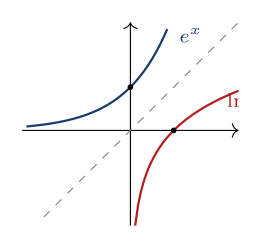
$e^x$ vs $\ln x$
- $e^x$: domain $\mathbb{R}$, range $> 0$, HA $y = 0$, $y$-int $(0, 1)$.
- $\ln x$: domain $x > 0$, range $\mathbb{R}$, VA $x = 0$, $x$-int $(1, 0)$.
- Inverses of each other; reflect in $y = x$.
Log laws
- $\ln(xy) = \ln x + \ln y$
- $\ln(x/y) = \ln x - \ln y$
- $\ln(x^n) = n \ln x$
- $\log_a x = \dfrac{\ln x}{\ln a}$ (change of base)
- $e^{\ln x} = x$, $\ln(e^x) = x$, $a^x = e^{x \ln a}$
Hidden quadratic: for $e^{2x} - 5e^x + 4 = 0$, substitute $u = e^x$: $(u - 1)(u - 4) = 0$, so $x = 0$ or $\ln 4$.
SL transformations
| Transformation | Effect | Map |
|---|---|---|
| $y = f(x) + b$ | Translate up by $b$ | $(x, y) \to (x, y + b)$ |
| $y = f(x - a)$ | Translate right by $a$ | $(x, y) \to (x + a, y)$ |
| $y = p\,f(x)$ | Vertical stretch $\times p$ | $(x, y) \to (x, py)$ |
| $y = f(qx)$ | Horizontal stretch $\times \tfrac{1}{q}$ | $(x, y) \to (\tfrac{x}{q}, y)$ |
| $y = -f(x)$ | Reflect in $x$-axis | |
| $y = f(-x)$ | Reflect in $y$-axis |
Order for $p\,f(q(x - a)) + b$: 1) horizontal stretch $\tfrac{1}{q}$; 2) horizontal translate $+a$; 3) vertical stretch $p$; 4) vertical translate $+b$.
§4 — Oblique Asymptotes & Odd/Even AHL 2.13–2.14
Oblique asymptote
When $\deg(\text{numerator}) = \deg(\text{denominator}) + 1$ there is an oblique (slant) asymptote.
Method — long division:
$$\frac{P(x)}{dx + e} = \text{quotient} + \frac{R}{dx + e}.$$
The oblique asymptote is the quotient (the remainder $\to 0$ as $x \to \infty$).
Example: $\dfrac{x^2 - 14x + 24}{2(x + 3)} = \dfrac{x - 17}{2} + \dfrac{75/2}{x + 3}$. OA: $y = \tfrac{x}{2} - \tfrac{17}{2}$; VA: $x = -3$.
Odd & even functions
Even: $f(-x) = f(x)$; symmetric about the $y$-axis. e.g.\ $x^2$, $\cos x$, $|x|$, $\dfrac{1}{x^2 + 1}$.
Odd: $f(-x) = -f(x)$; $180^\circ$ symmetric about the origin, so $f(0) = 0$ always. e.g.\ $x^3$, $\sin x$, $\tan x$, $\dfrac{1}{x}$.
Proof: compute $f(-x)$, compare with $\pm f(x)$, state the conclusion.
Products: Even $\times$ Even $=$ Even; Odd $\times$ Odd $=$ Even; Even $\times$ Odd $=$ Odd.
Inverse on a restricted domain
- Pass the Horizontal Line Test on the restricted domain.
- State the restricted domain.
- Swap $x \leftrightarrow y$ and rearrange.
- Domain of $f^{-1}$ $=$ Range of the restricted $f$.
Self-inverse: $f(f(x)) = x$; graph symmetric in $y = x$. For $\dfrac{ax + b}{cx + d}$, self-inverse iff $d = -a$.
§5 — Inequalities & Modulus AHL 2.15–2.16
Inequalities — sign-table method
- Rearrange to $h(x) \geq 0$.
- Fully factorise $h(x)$.
- Critical values $=$ roots of numerator $+$ undefined points (zeros of denominator).
- Determine the sign of $h$ in each interval.
- State the solution set with the correct $\leq$ vs $<$.
Rational inequalities: $\dfrac{h}{k} \geq 0$ — exclude points where $k = 0$ from the solution.
GDC (Paper 2): graph both sides; find intersections.
Sign table template
| $x$ | $< r_1$ | $r_1$ | $(r_1, r_2)$ | $r_2$ | $> r_2$ |
|---|---|---|---|---|---|
| $(x - r_1)$ | $-$ | $0$ | $+$ | $+$ | $+$ |
| $(x - r_2)$ | $-$ | $-$ | $-$ | $0$ | $+$ |
| product | $+$ | $0$ | $-$ | $0$ | $+$ |
Product $\leq 0$: $r_1 \leq x \leq r_2$.
Modulus
$|x| = x$ if $x \geq 0$; $|x| = -x$ if $x < 0$.
Equations: $|f(x)| = k$ $\Rightarrow$ $f(x) = k$ or $f(x) = -k$ (require $k \geq 0$, else no solution).
Inequalities:
- $|f| < k \;\Leftrightarrow\; -k < f < k$
- $|f| > k \;\Leftrightarrow\; f > k$ or $f < -k$
Graph $y = |f(x)|$: reflect any negative parts upwards (result $\geq 0$).
Graph $y = f(|x|)$: keep the right half, then reflect right $\to$ left (result is even).
§6 — Advanced Transforms & Attack Plan AHL 2.16
$y = 1/f(x)$ rules
| Zero of $f$ | $\to$ VA of $1/f$ |
| VA of $f$ | $\to$ zero of $1/f$ |
| $f = \pm 1$ | Invariant point |
| $f$ local max $(a, b)$ | $1/f$ local min $(a, 1/b)$ |
| $f > 0$ | $1/f > 0$ (same sign) |
| $f \to \infty$ | $1/f \to 0$ |
$[f(x)]^2$ & $f(ax + b)$
$[f(x)]^2$: always $\geq 0$; zeros stay; negative parts reflect then stretch.
$f(ax + b)$ (AHL only): rewrite as $f\!\left(a\!\left(x + \tfrac{b}{a}\right)\right)$. Horizontal stretch $\times \tfrac{1}{a}$, then horizontal translate $-\tfrac{b}{a}$. Map: $(x, y) \to \left(\dfrac{x - b}{a}, y\right)$.
Attack plan
| See… | Do… |
|---|---|
| Find $f^{-1}$ | Swap; rearrange |
| Sketch rational | VA, HA, intercepts, branches |
| Describe transformation | Identify $p, q, a, b$ |
| Discriminant condition | Set $\Delta >/</= 0$; solve |
| Odd/even proof | Compute $f(-x)$ |
| Oblique asymptote | Long division; OA $=$ quotient |
| $|f(x)| = k$ | Two cases $\pm k$ |
| Rational inequality | Sign table |
| Self-inverse | Show $f(f(x)) = x$ |
| Restricted inverse | HLT; state new domain |
| $e^{2x} + \ldots$ | Substitute $u = e^x$ |
| $\log$ equation | Log laws; check domain |
| $1/f$ sketch | Zeros $\leftrightarrow$ VAs; invert TPs |
| $f(|x|)$ sketch | Right half + reflect to left |
Top exam traps
- $f^{-1}(x) \neq \dfrac{1}{f(x)}$ — inverse $\neq$ reciprocal.
- $f(x - a)$ shifts right, not left.
- $f(qx)$: stretch $= \tfrac{1}{q}$, not $q$.
- Inequality: NEVER multiply by an unknown-sign variable.
- Odd function: must have $f(0) = 0$.
- $|f(x)|$ is reflect-negative-parts-up, not "lift the whole graph".
- $f(|x|) \neq |f(x)|$ — completely different.
- Oblique asymptote $=$ quotient, not remainder.
- Rational inequality: exclude zeros of the denominator.
- Domain of $f^{-1}$ $=$ range of the restricted $f$.
- $\ln(a + b) \neq \ln a + \ln b$.
- Check $k \geq 0$ before splitting $|f| = k$.
Worked Example — Restricted Inverse & Composition
Question (HL Paper 1 style — 7 marks)
The function $f$ is defined by $f(x) = x^2 - 4x + 7$ for $x \geq 2$.
(a) Show that $f$ has an inverse on this domain. (b) Find $f^{-1}(x)$ and state its domain. (c) Find $(f^{-1} \circ f)(5)$.
Solution
- Complete the square: $f(x) = (x - 2)^2 + 3$. The vertex is at $(2, 3)$. (M1)
- For $x \geq 2$, $f$ is monotonically increasing (the right arm of the parabola). It passes the Horizontal Line Test, so $f$ has an inverse on $[2, \infty)$. (R1)
- Set $y = (x - 2)^2 + 3$ and swap: $x = (y - 2)^2 + 3$, so $(y - 2)^2 = x - 3$. (M1)
- Since $y \geq 2$, take the positive root: $y = 2 + \sqrt{x - 3}$. So $f^{-1}(x) = 2 + \sqrt{x - 3}$. (A1)
- Domain of $f^{-1}$ $=$ Range of $f$ $= [3, \infty)$, i.e.\ $x \geq 3$. (A1)
- For (c): $(f^{-1} \circ f)(5) = 5$ directly, since $f^{-1}$ undoes $f$ on the restricted domain (and $5 \geq 2$). (R1)(A1)
Examiner's note: Two common errors: (a) taking the negative square root and writing $y = 2 - \sqrt{x - 3}$ — that gives the inverse for the LEFT arm $x \leq 2$, not the right arm; (b) stating the domain of $f^{-1}$ as $\mathbb{R}$ instead of $[3, \infty)$. Always quote: "domain of $f^{-1}$ $=$ range of restricted $f$".
Common Student Questions
Does $f(x - a)$ shift the graph left or right by $a$?
Is $f^{-1}(x)$ the same as $\dfrac{1}{f(x)}$?
When can I take an inverse, and what's the trick for restricting the domain?
Why am I always getting rational inequalities wrong?
What's the difference between $|f(x)|$ and $f(|x|)$?
Get the printable PDF cheatsheet — free
The same cheatsheet on one A4 page — formulas, methods and traps. No sign-in needed.